'Turn the pages to revel in the techno-tracking that is revealing the secrets of animal lives. This is science at its best, the art of understanding truth and beauty' - Chris Packham
'Enchanting and exhilarating ... Where the Animals Go is an eye-opening exercise in perspective that puts place and space at the heart of the 21st-century conservation debate' - Literary Review
From the best-selling authors of London: The Information Capital comes the first book to use big data to map the movements and behaviour of wild animals all over the world
For thousands of years, tracking animals meant following footprints. Now satellites, drones, camera traps, cellphone networks, apps and accelerometers allow us to see the natural world like never before. Geographer James Cheshire and designer Oliver Uberti take you to the forefront of this animal-tracking revolution. Meet the scientists gathering wild data - from seals mapping the sea to baboons making decisions, from birds dodging tornadoes to jaguars taking selfies. Join the journeys of sharks, elephants, bumblebees, snowy owls, and a wolf looking for love. Find an armchair, cancel your plans and go where the animals go.
[Praise for London: The Information Capital] 'The book is infinitely compelling, one you'll return to time and again, and full of 'wow, you have to see this' moments. It reinforces the notion that information really can be beautiful...' Londonist
[Praise for London: The Information Capital] 'Brilliantly compelling...The InformationCapital is a tour de force in the modern use of graphics to make a point' London Evening Standard
This book was a chance discovery in the bookstore yesterday. Normally, I would have ordered the English original but this German edition is just more beutiful and yes, I judge a book by its cover sometimes (the interior seems to be slightly different as well).
Anyway, the book was written by a designer formerly employed by National Geographic and a doctor for geography. There is a wonderful story of how this book came to be and it all started with elephants. But it went so much farther from there.
Apparently, the idea of using telemetry to find out more about Earth's biodiversity and animals' migratory patterns or certain behaviours isn't new. In the 19th century there was one scientist who put coloured strings on birds to prove that the same ones were coming back to his garden regularly. Of course, that was very "low tech", but not much more than the more "modern" beginnings of creating a data network and collecting data about animals as it turns out. Many biologists even had to invent their own form of tracking devices in the 20s, 60s or even back in the 90s (usually consisting of batteries, some wires and not much else). This, of course, meant huge pieces of equipment that could only be used once a day (because then the batteries would be dead) and a huge discomfort to any animals wearing the trackers. Nowadays, thanks to big companies like Google, Apple & Co - and their interest in the natural world and its conservation - there is huge progress of course. Many have developed software and hardware specifically for scientists (some inventions are not made publicly available even in order to protect the scientists and the animals that are being tracked), much smaller and capable of so much more and those gadgets are less uncomfortable for the animals as well. The inventions are a wide array of anything you could imagine and it's glorious that the book also describes the different forms of devices used by science and how they work.
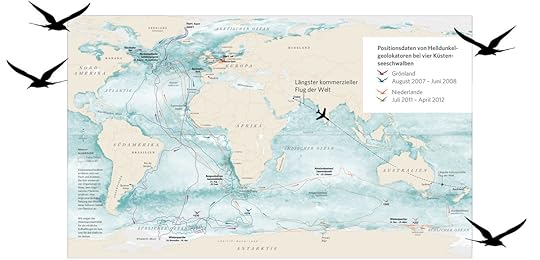
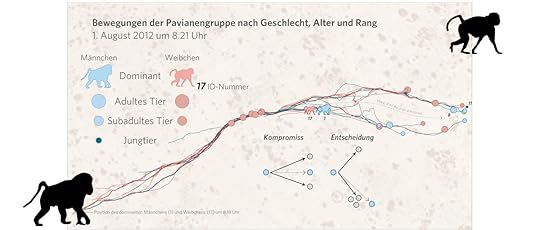
Thus, it is now possible to see migratory patters of birds as well as hunting patterns of dolphins and we can even find out which animal (gender and rank) moves where on a group's journey
This has greatly helped even in getting certain projects funded. One example of how these advances have positively influenced conservation is how an African country simply chose a patch of land and declared it a National Park. Biologists then found out that most animals this park was meant to protect usually don't go in this area and proved it via tracking devices so the park's borders were changed. Another example is of two African countries arguing about hunting licenses (actually, it was one government and a group of hunters from the other country, but the hunters' country had to make a decision): Since elephants, giraffes and other animals travel huge distances, the argument was that the hunters of one country killed the animals of the other. The hunters wanted to keep their licenses of course, but thanks to empirical proof from tracking devices that they had unwittingly killed protected animals from a neighbouring country, they lost and no more hunting licenses are given out nowadays (too bad this doesn't apply for all African countries). And let's not forget that these advances have also helped find poachers and prevent them from killing even more animals.
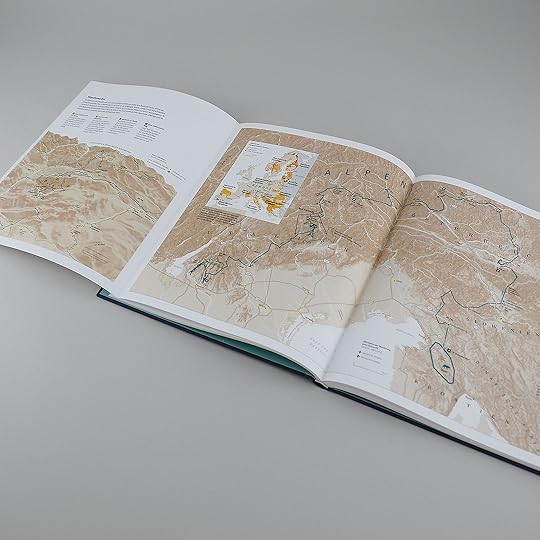
In Italy, I knew (and was pleased to find the example in this book) of a wolf that wandered a stunning distance across the Alpes. It is a story with no happy ending (through no fault of humans for a change), but an important story for conservationists and their plans of reintroducing the wolf all over Europe.
There even is the ICARUS initiative (http://icarusinitiative.org/) that is a not-for-profit tracking system that was launched in spring this year (literally launched as it was installed on the Russian module of the International Space Station (ISS)). The initiative was started in 2002 in order to remedy the worldwide lack of knowledge about the distribution and the individual migratory habits of small animals and insects. ICARUS is funded by the DLR aerospace management since 2012 as a scientific project in the framework of the “National aerospace program space station and manned spaceflight” and is also supported from the Russian Aerospace agency ROSCOSMOS (has to be, otherwise there would have been no way to get it to the ISS). Since December 2013 the German Max Planck society finances, parallel to the funding of the DLR, the miniaturizing of the ICARUS radio chip. This new ICARUS tag weighs less than 5 grams and in average solar conditions gets 12 GPS points per day (compare that to the old days and being able to activate a collar only once and then the battery was dead), as well as 3D-acceleration, 3D-magnetometer and temperature data. Expect one daily transmission of these data via satellite. Additional data (at good sunlight conditions) are written into the tag's memory for later readout with a portable base station. Isn't that cool?! The costs are also acceptable considering what these little bad boys can do so I expect many scientists to use them soon - which means that the data base will grow and grow and grow (sharing information and findings has become increasingly popular and I love it as it shouldn't be about winning the Nobel prize but saving the planet).
Anyway, this book is a gem. Sure, it's a bit pricey but apparently many if not all royalties go into ICARUS and other research projects so it's worth it. There is still so much we do not know about animals; things that are important if we want to save them, and it was truly interesting to see the development of the technology as well as the results we have so far, what we're able to tell yet.
It's hard not to wax poetic about this book. Maps! Animals! Animals way out of where we thought they'd be and why! And yes, a smidge of despair because despite being protected in some fashion in some places, we're killing them anyway. Elephants. Albatrosses (100,000 a year!). Wolves. More.
The concept behind what the investigators are doing is simple: attach some sort of monitor to some sort of creature then see where it goes and what it does. The techniques behind that simple statement are part of what makes it so interesting. How do you tag a bumblebee, a tiny little bumblebee that's only a little bigger than the monitor itself? How do you tag tiny diatoms in the ocean when they're even smaller? Sometimes it's not easy to get the bigger targets either.
So what this book has done is draw maps of various tracking experiments and explain what is (probably) happening. For birds they may look at migrating habits and discover that many storks don't migrate anymore, they overwinter in garbage dumps. For elephants they follow their rainy and dry migrations, and when one suddenly stops moving they find it's been shot. Wolves are protected in Yellowstone, but when they range out the map shows they're varmints and shot.
The maps are wonderful, the explanatory text interesting and well written. Not a book to read, a book to ponder.
A rare treat - a book that clearly, unambiguously and without any proselytising or fanfare demonstrates the interconnectedness of our beautiful planet. I loved every page of it, was enthralled by the lives of the animals shown to me, and in awe of the minds that have found ways to track them, and then analyse the data. If you give one furry rat's butt about the world, animals, data, data visualisation, maps, ecology, conservation and graphic design, you're going to love this book
This is a book, a great big glorious book about stories, the stories that data tells us but also the stories that the author recounts about the history of geoprofiling & the biologging movement and of the animals and the people involved. From bolting zebras, following what seems to be hardwired ancestral memories, to a look into how conservation research and expeditions have evolved, these stories range from snapshots through to extended thoughts about future directions.
With nearly each turn of the page there is an exquisitely detailed, but easy to follow, map that shows the behaviour of a featured animal or group. One of my favourites was the sea turtles map, showing the journey of a rescued turtle -who after 8 years of rehabilitation defied expectations by reorientating himself and completing bypassing the nice easy gulf stream at his release point into the Atlantic, stubbornly ventures off to Cape Verde exactly where he should have been a decade ago. This voyage took him a year.
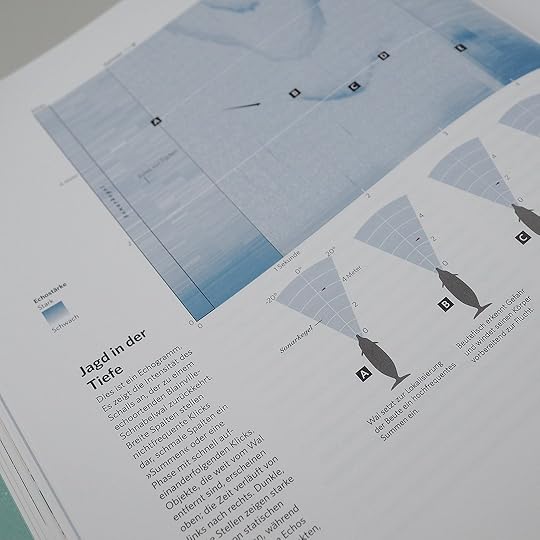
The book is not only immensely readable but is also extremely well structured into three parts: land, sea and air. Each section is preceded by either a pertinent background history or topic exploration (for instance the sea section looks at how cetology shifted to a less invasive form of observation from its earlier harpooning days and also looks at whales use of echogram and how this affects fish behaviour) before then going on to explore different case studies (including sea otters!!). I read this book over my lunch breaks at work and was able to quickly get absorbed into it each time while also coming away from each reading session feeling fulfilled and interested by something new.
The other thing this book does very well is its links for further exploration. In the further reading section, not only does it provide intriguing sounding titles like Peter Miller's 'The Smart Swarm', but it also gives a reminder on where to go if you have been inspired to create your own graphics and are looking for animal data. Some examples of the links are as follows: https://www.movebank.org/ (free online animal datatracking repository) https://zoatrack.org/ (This one I really like - it is an open access site where you can view others tracking results and it provides an online toolkit to create your own project) https://ebird.org/home (Bird specific tracking where you can go online and "share (boast) about your own birding finds" - Book recommends pairing with Cornell's Merlin Bird ID app.
I grabbed Where the Animals Go from the library after devouringAtlas of the Invisible. They're comparable: in both books, the authors explore interesting facets of our world via maps. However, the focus in Where the Animals Go is (surprise!) on animal behavior, rather than big cool phenomena like hurricanes.
Not to say animals aren't big and cool, but their maps tend to be localized and hard to follow. Multiple zig-zags between German villages indicate the pathways of bumblebees, for example. Each zig and zag is fairly meaningless. And German villages (in map form) aren't super exciting. The accompanying text is often more interesting than the map, which seems to me to be a failure of the book's thesis.
Plus, Where the Animals Go is a book about animals with no images of said animals. I was invested in the maps and graphics, but I imagine other, less cartographically inclined readers will be bored. It's a handsome work that's sporadically very engaging - a worthy read if you liked Atlas of the Invisible, but definitely start there.
This book is fantastic! What follows isn't EXACTLY a review, it's more of my jumbled thoughts written down for all to enjoy.
Whether you are extremely interested in biology, mildly interested in animal behaviour, or even just slightly intrigued by migration, I HIGHLY recommend this book. It provides an excellent view of the movements of animals and provides explanations for these observed behaviours, as well as introducing further questions that the provided data bring up.
As an Ecology student, this book was very interesting to read (particularly the chapter on birds). This book provides maps and graphs that portray the data from research done across the globe, and also provides the titles of the research papers so that the reader can look into the subjects of interest more.
The last page was of great interest to me. I have learnt about DNA barcodes in a few classes, so to see a collection of them all on one page was... kind of breathtaking.
Though I rarely read non-fiction, this is definitely a book I would want to pick up again (whether that be to stare at the pretty maps or read about all the bird studies).
Edit: Also, reading a book with so many references warmed my biologist heart. I LOVE REFERENCES!! GIVE ME THE REFERENCES!!
A gorgeous gorgeous book on how technology has enabled us to track and map the movements of animals more intimately and accurately, and how this has, in some cases, transformed our understanding of how animals live and interact. From giant beasts like elephants and wolves, to sea creatures like whales, seals and otters, to tiny creatures like zooplankton, Where the Animals Go is part ode to the mysteries and marvels of the animal kingdom and part ode to the new technologies that are helping us unlock these mysteries and appreciate these marvels.
We learn about the inventive ways that scientists have deployed to track the movements and activities of animals: coating Daphnia magna, transparent freshwater crustaceans less than 2mm long, with fluorescing nanoparticles (as the creatures are too small to carry even the smallest electronics) and tracing their movements by shining special lights on them and using cameras to trace their light trails through a dark aquarium; gluing minuscule radio transmitters onto bumblebees to track their movements (and realising that the transmitters were too heavy because the bees visited fewer flower heads compared to untagged bees); finding ways of tagging sea otters that don't compromise their fur since otters have no blubber and rely on a 100% intact fur barrier for warmth (e.g. flipper tags or internal tags); the use of drones to survey orang utan nests in the rainforest canopy.
And of course the fascinating insights into the lives of animals that these tracking and transmission technologies provide us. We can now literally see that animals don't move along the pathways we assumed (for instance, tracking data showed that mountain lions in California were not using the purpose built wildlife crossings to move around and were hemmed in by the network of freeways as a result), that they don't stay within our designated protection zones (for instance, tracking data showed that Kenyan elephants from protected zones were crossing over into Tanzania, which supported a decision by the Tanzanian government to ban elephant hunting in the area), or that, like the elk or sea otters, they move and reside in areas far beyond those where we have witnessed them congregate. This forces us to take an "ecosystem scale" view of their movement and to rethink our approach to protecting only the habitats of these animals, but not their movement corridors to and from shelter, food and mating locations. For the elk, "we can see how the lifeblood of [Yellowstone] also depends on protecting land outside its borders. And once you see that - once you see that twice a year elk are hoofing across 23 million acres of state, private, tribal and federal boundaries on trails that predate them all - it's hard not to question our reasons for rending wilderness into so many scraps, each with its own agenda and regulations. Elk use the land as one big, interconnected system. Perhaps we might learn to do the same." For sea otters, we learn from tagging data that "breeding females spend their entire lives in small areas, which means protective measures must be localised as well. Preserving kelp beds in the [Monterey] bay [area] for example, won't help the otters in [Elkhorn] Slough [an estuary 15 miles north of Monterey Bay Aquarium...estuary otters and ocean otters are as different as the country mouse and the city mouse." Yet, we have traditionally managed otters like other marine mammals - "as a big, homogenous, mobile group...about the worst possible way to manage the population".
There are also lovely stories scattered throughout the book, such as this example of citizen participation in science:
"eBird is the most successful citizen science project in the world. As of June 2016, its global community of users had logged 333 million observations. In May 2016 alone, they reported more sightings - 11.8 million of them - than in eBird's first 6 years combined. It won't be long before the total number of observations reaches half a billion.
Given eBird's success, it was surprising to hear that it wasn't an instant hit. 'We had all this hype about the project, that, you know, eBird's going to change the world,' Kelling recalled. 'Then we released eBird in the fall of 2002 and no one participated - well, very few. And for the first three years of the project, we actually saw no growth.'...Kelling and the entire team at Cornell were stumped. Naysayers insisted that submitting checklists to eBird was too hard. So in 2006, the Lab overhauled the team and hired two prominent members from the birding community, Chris Wood and Brian Sullivan. In two separate presentations to the entire Lab, both had the same direct advice: 'You've got to quit thinking of eBird as a citizen science project.'
Early on, many birders would use the site once and rarely return. To keep them engaged, Wood encouraged the Lab to take what birders were already doing - observing birds and making lists - and then help them do it better. It was a strategy straight from Silicon Valley. Instead of trying to persuade people to help scientists, Wood wanted to just build tools for birders. He wanted to make eBird more fun. If enough data came pouring in, conservation and research could follow. But first, they ended users.
'My eBird' launched in Sep 2006... Almost overnight, the website transformed from a place to volunteer your time to a place to share your finds and boast. Birders, an innately competitive lot, could suddenly see how their life lists compared with those of other birders. Rare birds were rewarded as were the volume and quality of their lists. Leaderboards were quickly filled with series birders seeking a top spot in their regions, whilst eBird's blog named 'eBirder of the month'. 'It became a huge source of pride for people,' said Kelling. 'People sign their emails now with #5 birder on eBird."
A lovely read both for the fascinating science and the gorgeous maps.
This is so wonderfully nerdy and I love it! The maps themselves are fantastic (as a particular lover of maps and visual representation of data I could simply have looked at those for hours). But the super awesome part, I think, is just that it's impossible to read this without starting to question the hard and silly line we like to draw between "human" and "animal." Watching what animals do when we actually have the data to sort of know what they're up to makes it so obvious that reason or no, there's a lot going on with individual preference, decision-making, and thought (dare we call it that;) in animals that I imagine makes it much, much harder after one reads this to write off entire species the way we like to do in our current world.
The corollary at the end, tracking humans, was a particularly nice touch. :)
This is truly an amazing book. The clearly written text explains how modern technical advances have aided in a more complete understanding of wildlife actions and activities and the beautifly illustrated maps display how this important data is utilized. The implications of how this data may be applied to conservation and knowledge are vast,
Beautiful book with gorgeous maps that bring to life how we've used technology to learn more about animal movement and migrations. If you love maps or if you love reading about nature, this book is a can't-miss experience.
The book features stories of wildlife across the globe, with beautiful maps, that are easy enough for layman understanding, yet stimulating enough to prompt scientific questions. It left me feeling so connected to these animals! An easy and enjoyable read for anyone who loves visuals.
It's an absolutely stunning documentation of wildlife tracking. It's a book of migration maps. Which is probably a lot more telling for wildlife scientists than it was for me. I didn't finish it, but I'm giving it 5 stars because it's such an amazing job of such a hard project.
This volume is a treasure house of information about all kinds of animals and their doings. Modern day tracking devices enable researchers to know where an animal is almost every minute. The maps and graphs are beautiful and informative, and it is chock full of information. Loved it.
This is a great book that highlights the amazing conservation data and scientific knowledge that we receive from friendly non-invasive tracking technology. The maps were great to see!
Seems like it should have been more captivating than it was. Conservation stories/studies using all kinds of high-tech systems. But it felt lifeless and hard to easily digest.
What a great read. Lots of data, and a novel way to present so much information about animals and how we track their travels. Very Cool. Great visuals.
A gorgeous book illustrating how technology has helped us map animal movement. It gives a lot of animal info for some of the maps- not all. But I gained a greater understanding of reasons we want to know where the animals go and the importance of being able to get info to locate them at various intervals- not just once a day.
Very hit or miss — some sections were very boring with little insight, just a map, but others were fascinating. I learned some new things but felt as an overall book, it didn’t hold my attention. Bought at Metsker's Maps in Seattle on a day date with Bryan, but I've since donated it.
Eye-candy graphics, sometimes sacrificing clarity for beauty, that way outgunned the often simple study conclusions. But those maps sure are razzle dazzle.
Roughly and very non-scientifically speaking, almost everyone wanted to work for National Geographic when they were kids. And now they are interested in animal conservation, but only recreationally, mostly when animal poaching or killing is given a face and a name (Harambe, Cecil, etc). Because there is just too much, too much dry data and too much violence or effort in a time and place where most are already pretty tired. (I know I am. I'm really tired.)
But this book is great because it is not only visually stunning (ugh, the cover - so precious!), but also because it follows some select animals, taking you on a journey similar to how National Geographic's approach. And I enjoyed the hell out of it.
There is a wealth of data out there that can make you engage with the larger world, not just your own microcosm, and this is a great start to it. If not, it's just a really beautiful coffee table book.
Jumped about thru this one. Fascinating info mostly delivered by graphs of GPS data on animal behavior, movement, and migration. The wolf who traveled alone across the Alps, over 1000 kms. The pythons i. The Everglades. The mountain lions trapped by highways in Southern California. The plotting of whale kills by American whalers between 1761 and 1920. It takes close focused work to make sense of each story but fascinating info.