

What do you think?

Malinche
Cuando Malinalli conoce a Hernán Cortés, asume que se trata del propio Dios Quetzalcóatl que regresa a liberar a su pueblo. Los dos se enamoran apasionadamente, pero este amor pronto es destruido por la desmedida sed de conquista, poder y riqueza de Cortés.
A lo largo de la historia de México Malinalli/Malinche ha sido conocida por su traición al pueblo indio. Pero recientes investigaciones históricas han demostrado que Malinalli fue la mediadora entre dos culturas, la hispánica y la indígena; y entre dos lenguas, el español y el náhuatl.
Lo que Esquivel ha hecho en esta novela es desafiar la mitología tradicional mediante un retrato muy temperamental del Adán y la Eva de la cultura mestiza, Cortés y Malinalli, con la caída del imperio azteca como telón de fondo. Contada con el lirismo de la tradición cantarina y pictórica del náhuatl, Laura Esquivel nos brinda un mito fundacional de la cultura híbrida del Nuevo Mundo y una extraordinaria historia de amor.
232 pages, Paperback
First published January 1, 2005
About the author
Laura Esquivel
61 books2,859 followersLaura Esquivel is a Mexican novelist, screenwriter, and former politician best known for her internationally acclaimed debut novel Like Water for Chocolate (Como agua para chocolate). Blending magical realism with deep cultural roots, the novel became a bestseller in Mexico and the United States and was adapted into a successful film that received multiple international awards. Originally trained in education and theater, Esquivel began her career writing for children’s television and later moved into cinema and literature, often weaving food, family, and emotion into her stories.
Esquivel’s fiction is known for its lyrical style and its exploration of love, tradition, and identity, frequently drawing on Mexican history and folklore. Her other novels include The Law of Love, Swift as Desire, and Malinche, which reimagines the story of the controversial historical figure linked to Hernán Cortés. She has also published essays on food and culture in Between Two Fires and returned to her most beloved character in El diario de Tita.
In addition to her literary work, Esquivel served as a deputy in the Mexican Congress for the Morena Party and has been active in cultural and environmental policy. Her writing continues to inspire discussions on gender, power, and the enduring bonds of heritage.
Esquivel’s fiction is known for its lyrical style and its exploration of love, tradition, and identity, frequently drawing on Mexican history and folklore. Her other novels include The Law of Love, Swift as Desire, and Malinche, which reimagines the story of the controversial historical figure linked to Hernán Cortés. She has also published essays on food and culture in Between Two Fires and returned to her most beloved character in El diario de Tita.
In addition to her literary work, Esquivel served as a deputy in the Mexican Congress for the Morena Party and has been active in cultural and environmental policy. Her writing continues to inspire discussions on gender, power, and the enduring bonds of heritage.
Ratings & Reviews
Friends & Following
Create a free account to discover what your friends think of this book!
Community Reviews
Displaying 1 - 30 of 855 reviews

March 31, 2017
This year I am participating in a classics bingo and I read Malinche by Laura Esquivel for my mythology square. I am not a fan of mythology and this story pushed me to read outside of my comfort zone. Even though I enjoy Hispanic culture a great deal, Mexican mythology is not a subject I have studied in depth so I was able to learn from this slim novel. The tale of Malinalli, Cortes, and Jaramillo brought to light a chapter of Mexican folk lore from a native perspective that often isn't studied in history classes.
Malinalli was brought up by her paternal grandmother after her father was offered as a human sacrifice to the Aztec g-ds. Even as a child, Malinalli possessed a high level of understanding, believing in the cruelty of sacrifice, desiring to put an end to the practice. As she heard of the Spanish arrival on Mexican soil, she lauded them solely because their g-ds did not require humans to be sacrificed. As she learned from the Spanish, their g-d sacrificed himself for his people rather than having people sacrificed. Becoming a slave to the Spaniards, Malinalli felt honored to be in their presence.
While the first half of the novel showed plot development, the second half was as much about Malinalli translating for the Spaniards as it was about the Spaniards conquests of the "girl woman". Esquivel details elicit scenes between Malinalli and Hernan Cortes and later scenes between her and Cortes' soldiers and finally multiple scenes between Malinalli and her Spaniard husband Jaramillo. As I try to avoid books with an excess of erotica, it was difficult for me to read about the Mexican myth of Quetzalcoatl while having to read through intimate scenes. This did little to further what I already knew about Aztec culture.
During March I have only read women authors. Malinche concludes my month. While I have enjoyed most of the novels and stories that I read, it is upsetting to finish the month on a down note. I first read Laura Esquivel twenty years ago when I read Like Water for Chocolate. The lust and love triangles worked in a modern setting, yet seemed out of place in a mythological folk tale. It is common knowledge that the Spanish conquistadors raped native women, but Esquivel sugar coats this by stating that Malinalli enjoyed her intimacy with multiple partners. As a result, the book became distasteful for me.
As a lifelong student of Hispanic culture, I enjoy furthering my knowledge of it. Malinche retells a myth in a manner that might win readers looking for more entertainment than the facts behind the folktale. As a woman in history, Malinalli was courageous to help the Spaniards yet also brought about the downfall of her people. Esquivel's lusty tale did not perpetuate this myth for me, but does check off a mythology square on my bingo card. Thus concludes women's history month, with my first 2.5 low review of the year.
Malinalli was brought up by her paternal grandmother after her father was offered as a human sacrifice to the Aztec g-ds. Even as a child, Malinalli possessed a high level of understanding, believing in the cruelty of sacrifice, desiring to put an end to the practice. As she heard of the Spanish arrival on Mexican soil, she lauded them solely because their g-ds did not require humans to be sacrificed. As she learned from the Spanish, their g-d sacrificed himself for his people rather than having people sacrificed. Becoming a slave to the Spaniards, Malinalli felt honored to be in their presence.
While the first half of the novel showed plot development, the second half was as much about Malinalli translating for the Spaniards as it was about the Spaniards conquests of the "girl woman". Esquivel details elicit scenes between Malinalli and Hernan Cortes and later scenes between her and Cortes' soldiers and finally multiple scenes between Malinalli and her Spaniard husband Jaramillo. As I try to avoid books with an excess of erotica, it was difficult for me to read about the Mexican myth of Quetzalcoatl while having to read through intimate scenes. This did little to further what I already knew about Aztec culture.
During March I have only read women authors. Malinche concludes my month. While I have enjoyed most of the novels and stories that I read, it is upsetting to finish the month on a down note. I first read Laura Esquivel twenty years ago when I read Like Water for Chocolate. The lust and love triangles worked in a modern setting, yet seemed out of place in a mythological folk tale. It is common knowledge that the Spanish conquistadors raped native women, but Esquivel sugar coats this by stating that Malinalli enjoyed her intimacy with multiple partners. As a result, the book became distasteful for me.
As a lifelong student of Hispanic culture, I enjoy furthering my knowledge of it. Malinche retells a myth in a manner that might win readers looking for more entertainment than the facts behind the folktale. As a woman in history, Malinalli was courageous to help the Spaniards yet also brought about the downfall of her people. Esquivel's lusty tale did not perpetuate this myth for me, but does check off a mythology square on my bingo card. Thus concludes women's history month, with my first 2.5 low review of the year.

August 3, 2009
For all you history purists (were you there? how can you be sure, unless you're Shirley McLaine?) this is a NOVEL not an anthropological research paper. Obviously the author had to take liberties with the story of Mallinali/Marina, slave girl and *the*only native American who was a front-row observer/participant in the apex/decline of Aztecan culture. She may very well have been the last non-Spaniard to see Monteczuma alive. Can you imagine what must have been going through Mallinali's mind as the pivot between two powerful cultures? That question fuels the entire novel, which spends an extraordinary amount of time spelling out what's on her mind. If soliloquy drives you nuts, this book isn't for you. The greatest insight I brought away from 'Malinche' was a decoupling of the original Quetzalcoatl belief system from the subsequent belief system (whose name I do not know) based upon human sacrifice. I had always been taught they were one and the same, and believe otherwise now. I also enjoy now a deeper understanding of the native American spiritual belief system and the unfortunate linkages it shared with the Spanish conquest-Christianity belief system, which paralyzed the Aztecs and made their destruction a cakewalk for Cortez and his ilk. Most of all, I would like to find myself standing before the Temple of the Sun in an empty plaza as a full moon rises to my right and the sun sets on my left, as did Mallinali. I have a feeling it would be a very profound and powerful experience.
I found this book to be a carefully crafted novel attempting to balance extremes: death/rebirth; abandonment/redemption; conquest/assimilation; male/female; spirituality/damnation; pinnacle/valley; the power of words/the infinity of silence. Caught in the middle of all of these oppositions is Mallinali. She is an excellent character for exploring all of these dualities. There are places in the book where I felt these contrasts were so carefully understated as to be invisible (and 'the Invisible' is almost a character in the book, pointing the way to these insights). A speed-reader would likely miss them, and the lessons the author is attempting to impart would be lost. In this way I believe 'Malinche' to be the author's best work to date and deserving of more in-depth analysis by literary types who know better than I what they are doing.
To those who must repeat ad nauseum "I preferred 'Like Water For Chocolate'" this book is a completely different genre: 'Like Water For Chocolate' was a romance-equivalent novel, while 'Malinche' is a historical-equivalent novel. You won't enjoy a historical novel if you think its going to be a romance, and you won't enjoy a romance if you're expecting a historical novel. That isn't the fault of the author! It is a failure of your own expectations! Next time read the book flap for a plot synopsis before you buy the book!
I found this book to be a carefully crafted novel attempting to balance extremes: death/rebirth; abandonment/redemption; conquest/assimilation; male/female; spirituality/damnation; pinnacle/valley; the power of words/the infinity of silence. Caught in the middle of all of these oppositions is Mallinali. She is an excellent character for exploring all of these dualities. There are places in the book where I felt these contrasts were so carefully understated as to be invisible (and 'the Invisible' is almost a character in the book, pointing the way to these insights). A speed-reader would likely miss them, and the lessons the author is attempting to impart would be lost. In this way I believe 'Malinche' to be the author's best work to date and deserving of more in-depth analysis by literary types who know better than I what they are doing.
To those who must repeat ad nauseum "I preferred 'Like Water For Chocolate'" this book is a completely different genre: 'Like Water For Chocolate' was a romance-equivalent novel, while 'Malinche' is a historical-equivalent novel. You won't enjoy a historical novel if you think its going to be a romance, and you won't enjoy a romance if you're expecting a historical novel. That isn't the fault of the author! It is a failure of your own expectations! Next time read the book flap for a plot synopsis before you buy the book!

December 12, 2012
No me gustó nada.
Supongo que esto no es spoiler porque es parte de la historia de México. Pues bien, aquí vemos a la Malinche nace presagiada por signos del cambio, su abuela, es una anciana con conocimientos milenarios tipo “new age” mientras que su madre es muy malvada y la vende. Por el otro lado, Cortés que es chaparro, malo y ambicioso, decide lanzarse a conquistar México. Los dos se encuentran y ella que odia los sacrificios humanos (porque es como pacifista, nomás porque sí), apoya a los españoles a quiénes considera enviados de Quetzalcoatl (luego se da cuenta que no). Al final de muchas desgracias telenoveleras, ella es feliz, perdona perdona a todos va al Tepeyac a rezar a Tonantzin, quien pronto será la Virgen de Guadalupe y cuidará a los mexicanos que son la raza universal.
Lo que más me chirrió es que todo el asunto new age metido con calzador, totalmente fuera de contexto religioso o sociológico. La autora peca de "presentismo", si vas a retratar a un personaje histórico, obviamente no puedes dotarles de "valores" ni percepciones que son propios de otra época. Aquí la Malinche parece una neohippie con extensos conocimientos de sacerdote prehispánico, y con una conciencia social de estudiante de filosofía del siglo XXI, feminista y todo. Además todo en una prosa con aires poéticos y pequeñas lecciones sobre emociones.
Supongo que esto no es spoiler porque es parte de la historia de México. Pues bien, aquí vemos a la Malinche nace presagiada por signos del cambio, su abuela, es una anciana con conocimientos milenarios tipo “new age” mientras que su madre es muy malvada y la vende. Por el otro lado, Cortés que es chaparro, malo y ambicioso, decide lanzarse a conquistar México. Los dos se encuentran y ella que odia los sacrificios humanos (porque es como pacifista, nomás porque sí), apoya a los españoles a quiénes considera enviados de Quetzalcoatl (luego se da cuenta que no). Al final de muchas desgracias telenoveleras, ella es feliz, perdona perdona a todos va al Tepeyac a rezar a Tonantzin, quien pronto será la Virgen de Guadalupe y cuidará a los mexicanos que son la raza universal.
Lo que más me chirrió es que todo el asunto new age metido con calzador, totalmente fuera de contexto religioso o sociológico. La autora peca de "presentismo", si vas a retratar a un personaje histórico, obviamente no puedes dotarles de "valores" ni percepciones que son propios de otra época. Aquí la Malinche parece una neohippie con extensos conocimientos de sacerdote prehispánico, y con una conciencia social de estudiante de filosofía del siglo XXI, feminista y todo. Además todo en una prosa con aires poéticos y pequeñas lecciones sobre emociones.

October 23, 2022
#outubrohispanoamericano
Este livro é uma espécie de biografia de Malinalli, que, depois da chegada dos espanhóis ao México, é batizada Marina. Já tinha ouvido falar desta tradutora num episódio do Vamos todos morrer. Tentei encontrá-lo, mas não consegui, o que é pena, pois talvez tivesse sido mais informativo do que este livro.
Soube que, aos quatro anos, depois de a avó falecer, foi oferecida pela sua mãe como escrava. Aos quinze conheceu Hernán Cortez, o homem que tinha sido designado pelo rei espanhol da altura, para descobrir o "novo mundo". Graças à sua inteligência e aptidão para línguas, Marina torna-se a sua tradutora e também uma espécie de negociadora entre os espanhóis e os aztecas. Também se torna sua amante e têm um filho, Martin. Depois é oferecida pelo próprio Hernán a um dos seus homens, Jaramillo, com quem casa e tem uma filha, Maria.
Como disse no início, não é uma grande biografia no sentido informativo e mais técnico do estilo, pois a autora foca-se muito nos deuses aztecas, nos elementos, na grande influência que a avó de Marina teve na sua educação e inteligência, apesar de ter perecido quando a neta tinha só quatro anos. Só fala da vida da Malinche muito pela rama, tanto que são estes os poucos pormenores que apreendi. Fala muito por alto e de forma pouco clara do papel que Marina teve na destruição do seu próprio povo, massacrado pelos espanhóis num banho de sangue inominável. E depois há aquela história dos conquistadores que chegam ao novo mundo e querem converter toda a gente ao cristianismo, roubar todo o ouro possível e tornarem-se donos e senhores das terras e dos povos que já lá estavam. Um dia normal no século XVI, portanto.
Este livro é uma espécie de biografia de Malinalli, que, depois da chegada dos espanhóis ao México, é batizada Marina. Já tinha ouvido falar desta tradutora num episódio do Vamos todos morrer. Tentei encontrá-lo, mas não consegui, o que é pena, pois talvez tivesse sido mais informativo do que este livro.
Soube que, aos quatro anos, depois de a avó falecer, foi oferecida pela sua mãe como escrava. Aos quinze conheceu Hernán Cortez, o homem que tinha sido designado pelo rei espanhol da altura, para descobrir o "novo mundo". Graças à sua inteligência e aptidão para línguas, Marina torna-se a sua tradutora e também uma espécie de negociadora entre os espanhóis e os aztecas. Também se torna sua amante e têm um filho, Martin. Depois é oferecida pelo próprio Hernán a um dos seus homens, Jaramillo, com quem casa e tem uma filha, Maria.
Como disse no início, não é uma grande biografia no sentido informativo e mais técnico do estilo, pois a autora foca-se muito nos deuses aztecas, nos elementos, na grande influência que a avó de Marina teve na sua educação e inteligência, apesar de ter perecido quando a neta tinha só quatro anos. Só fala da vida da Malinche muito pela rama, tanto que são estes os poucos pormenores que apreendi. Fala muito por alto e de forma pouco clara do papel que Marina teve na destruição do seu próprio povo, massacrado pelos espanhóis num banho de sangue inominável. E depois há aquela história dos conquistadores que chegam ao novo mundo e querem converter toda a gente ao cristianismo, roubar todo o ouro possível e tornarem-se donos e senhores das terras e dos povos que já lá estavam. Um dia normal no século XVI, portanto.

July 30, 2010
Are you one of those people who keeps reading books even though they don’t like them? I am. I had a feeling I’d hate Laura Esquivel’s Malinche by about page 8. By page about page 30, I knew I hated it. But I kept reading anyway.
For those of you who aren’t familiar with conquistador history, Malintzin/Malinalli was an indigenous slave who was given to Hernán Cortés when the Spaniards landed in Mexico; she eventually became his interpreter. Malinche, as she is more commonly known, has been a controversial figure in history. Some revere her, some pity her, and some consider her a traitor to her people.
Now, doesn’t really bother me that much when people take some artistic license with historical events. When I saw The Patriot, I was fine with the way the American Revolution was portrayed, so long as I could keep seeing Heath Ledger. So long as the filmmaker/writer is not injecting fiction into a documentary or actual history book, I can accept that stuff’s going to get changed to make it more appealing to the masses.
But come on, Laura Esquivel.
Malinche tells the story of the “passionate love affair” between Malinalli and Cortés. Malinalli gets sold into slavery at age 5, continuing to get shifted around to different owners until her adolescence, when she’s given to the Spaniards. She starts out by working for one of Cortés’s men, and as her gift with languages becomes clear, she moves up in status to become the Spaniards’ interpreter. By then she has caught Cortés’s eye, and the two develop a secret attraction to one another; [trigger warning:] taking advantage of the situation one day when he sees her bathing alone in a lake, Cortés rapes Malinalli, then reassigns her to be his woman.
This is one of the many major disconnects in the story. She falls in love with him, though they have a tempestuous “relationship” (I say “relationship” because it is clear throughout the book that she is still his slave, and he is still the one with all the power). After bearing witness to his thirst for power and the brutal slaughter of thousands of people, Malinalli is left trying to reconcile her love for this man and her horror at his actions, as well as the role she has played in helping him. There is no believable love story here; it’s all about rape, abuse, control, and victimization.
Then, on top of the questionable “love story,” the writing is just bad. None of the characters and situations are believable. Take, for instance, this section of the book when Malinalli is 4-5 years old and discovers her grandmother is blind:
A grandmother would poetically talk to her 4-year-old granddaughter about souls? A 4-year-old would poetically respond by saying “I can see that you do not need your eyes to look or to be happy?” Really? Give me a break.
The way Esquivel jumps around with the plot also detracts from its credibility. Toward the end of the novel, Cortés and Malinalli have a huge fight, which ends with Cortés reassigning/marrying her off to one of his men:
Pretty cut and dried description of someone who feels suicidal, depressed, and betrayed, no? But two whole pages (and one pregnancy) later, she’s in a loving marriage, and she still thinks Cortés loves her (in his own way). It’s enraging.
The only thing about this book that I love is the cover (on the hardcover edition, at least): Malinalli is painted on the front, and Cortés is painted on the back; if you take off the cover and unfold it, the inside opens up into a poster of a hand-drawn codex explaining all the major events of Malinalli’s life in illustrated form. Seriously, you’d get a better story out of staring at that codex than you would by reading the book.
For those of you who aren’t familiar with conquistador history, Malintzin/Malinalli was an indigenous slave who was given to Hernán Cortés when the Spaniards landed in Mexico; she eventually became his interpreter. Malinche, as she is more commonly known, has been a controversial figure in history. Some revere her, some pity her, and some consider her a traitor to her people.
Now, doesn’t really bother me that much when people take some artistic license with historical events. When I saw The Patriot, I was fine with the way the American Revolution was portrayed, so long as I could keep seeing Heath Ledger. So long as the filmmaker/writer is not injecting fiction into a documentary or actual history book, I can accept that stuff’s going to get changed to make it more appealing to the masses.
But come on, Laura Esquivel.
Malinche tells the story of the “passionate love affair” between Malinalli and Cortés. Malinalli gets sold into slavery at age 5, continuing to get shifted around to different owners until her adolescence, when she’s given to the Spaniards. She starts out by working for one of Cortés’s men, and as her gift with languages becomes clear, she moves up in status to become the Spaniards’ interpreter. By then she has caught Cortés’s eye, and the two develop a secret attraction to one another; [trigger warning:] taking advantage of the situation one day when he sees her bathing alone in a lake, Cortés rapes Malinalli, then reassigns her to be his woman.
This is one of the many major disconnects in the story. She falls in love with him, though they have a tempestuous “relationship” (I say “relationship” because it is clear throughout the book that she is still his slave, and he is still the one with all the power). After bearing witness to his thirst for power and the brutal slaughter of thousands of people, Malinalli is left trying to reconcile her love for this man and her horror at his actions, as well as the role she has played in helping him. There is no believable love story here; it’s all about rape, abuse, control, and victimization.
Then, on top of the questionable “love story,” the writing is just bad. None of the characters and situations are believable. Take, for instance, this section of the book when Malinalli is 4-5 years old and discovers her grandmother is blind:
“I can’t see your face, but I know that you are beautiful; I can’t see your outside, but I can describe your soul...I can see all the things that I believe in. I can see why we are here and where we will go when our games in.”
Malinalli began to weep silently.
“Why are you crying?” the grandmother said.
“I’m crying because I can see that you do not need your eyes to look or to be happy,” she answered. “And I’m crying because I don’t want you to go.”
A grandmother would poetically talk to her 4-year-old granddaughter about souls? A 4-year-old would poetically respond by saying “I can see that you do not need your eyes to look or to be happy?” Really? Give me a break.
The way Esquivel jumps around with the plot also detracts from its credibility. Toward the end of the novel, Cortés and Malinalli have a huge fight, which ends with Cortés reassigning/marrying her off to one of his men:
[trigger warning:] On the night of the wedding, Jaramillo, by then drunk and full of desire, penetrated her again and again. He drank from her breasts, kissed her skin, submerged himself in her, emptied all his being in Malinalli, and fell asleep...The only one who was awake was Malinalli. The desire to set herself on fire kept her alert...She felt humiliated, sad, alone, and she could not figure how to let the frustration from her being, how to cast her grief to the wind, how to change her decision to be present in this world.
Pretty cut and dried description of someone who feels suicidal, depressed, and betrayed, no? But two whole pages (and one pregnancy) later, she’s in a loving marriage, and she still thinks Cortés loves her (in his own way). It’s enraging.
The only thing about this book that I love is the cover (on the hardcover edition, at least): Malinalli is painted on the front, and Cortés is painted on the back; if you take off the cover and unfold it, the inside opens up into a poster of a hand-drawn codex explaining all the major events of Malinalli’s life in illustrated form. Seriously, you’d get a better story out of staring at that codex than you would by reading the book.
This entire review has been hidden because of spoilers.

December 2, 2016
Book on CD performed by Maria Conchita Alonso
Malinalli was a Native woman from Tabasco, who was given as a slave to the conquering Spaniards. Her ability to speak Spanish as well as two native languages – Mayan and Nahuatl – brought her to the attention of Hernán Cortés, and eventually she became his mistress and bore him a son. For centuries, she has been reviled as a traitor for her role in helping the Spaniards conquer the Aztec empire, but more recent research has pointed to a more complex reality.
In this lyrical, poetic novel, Esquivel gives us a strong woman with deeply held beliefs who wanted to free her people. Believing that Cortés was a reincarnation of the God Quetzalcoatl, she agreed to help him speak with Montezuma. She could not possibly have known the consequences, and she realized her mistake far too late.
I love Esquivel’s writing. Her imagery is vivid and tangible. She gives equal attention to scenes of a happy childhood or vibrant festivities, as well as to scenes of destruction or death. I felt the heat and humidity, heard the cacophony of a busy marketplace, smelled the stench of a battlefield, tasted the tropical fruits and delicacies of a royal feast.
This is a decidedly Mexican novel. Esquivel infuses the story with magical realism, mysticism, and spirituality. It reminds me of the oral story traditions of my grandparents. And yet, her Malinalli is a real woman, with conflicting desires; a woman who loves or hates, feels pain and joy, and does her best to survive with her dignity and integrity intact.
Maria Conchita Alonso deserves five stars for her performance of the audiobook. She made me think of summer evenings spent sitting in the dark on my grandmother’s porch hearing stories of the old days and legends of conquest or victory.
Malinalli was a Native woman from Tabasco, who was given as a slave to the conquering Spaniards. Her ability to speak Spanish as well as two native languages – Mayan and Nahuatl – brought her to the attention of Hernán Cortés, and eventually she became his mistress and bore him a son. For centuries, she has been reviled as a traitor for her role in helping the Spaniards conquer the Aztec empire, but more recent research has pointed to a more complex reality.
In this lyrical, poetic novel, Esquivel gives us a strong woman with deeply held beliefs who wanted to free her people. Believing that Cortés was a reincarnation of the God Quetzalcoatl, she agreed to help him speak with Montezuma. She could not possibly have known the consequences, and she realized her mistake far too late.
I love Esquivel’s writing. Her imagery is vivid and tangible. She gives equal attention to scenes of a happy childhood or vibrant festivities, as well as to scenes of destruction or death. I felt the heat and humidity, heard the cacophony of a busy marketplace, smelled the stench of a battlefield, tasted the tropical fruits and delicacies of a royal feast.
This is a decidedly Mexican novel. Esquivel infuses the story with magical realism, mysticism, and spirituality. It reminds me of the oral story traditions of my grandparents. And yet, her Malinalli is a real woman, with conflicting desires; a woman who loves or hates, feels pain and joy, and does her best to survive with her dignity and integrity intact.
Maria Conchita Alonso deserves five stars for her performance of the audiobook. She made me think of summer evenings spent sitting in the dark on my grandmother’s porch hearing stories of the old days and legends of conquest or victory.

May 12, 2007
Malinche is the story of the indigenous woman, Malinalli, who had a relationship with Hernan Cortes when the Spanish conquered Mexico. Her story is somewhat similar to that of Pocahontas with John Smith in the U.S. I had always understood Malinche from common myth to be seen as a traitor -- someone who was sleeping with the enemy and selling off her people's secrets. This book shows that it was not that way at all. Rather than standing as a symbol of betrayal, Malinche instead becomes the root of modern Mexico today -- a Mexico that must find a way to integrate its mixed history of indigenous and Spanish roots, the conquered and the conquerors. Laura Esquivel's writing is absolutely beautiful and lyrical. This book is part history, part spirituality. This book helped me to understand not only more of Mexican history but more of Mexico's very rich and complicated history of spirituality and religion.

July 16, 2021
Una novela histórica sobre la vida de Malinche, la mujer indígena que fue traductora, consejera, y amante de Hernán Cortés, el conquistador de Mexico, parecía tentadora. El problema es que más que una novela es una nouvelle (mi edición tiene 140 páginas) y resume hechos muy importantes en pocas páginas. Nos lanza casi de inmediato a la acción, y eventos relevantes de la Conquista se cuentan en ocasiones muy comprimidos. Además, para cualquier lector no latinoamericano, será difícil situarse en contexto. Le hubiera venido bien mayor desarrollo y referencias históricas.

November 8, 2017
Es un libro con un lenguaje muy poético, evoca muchas metáforas, imágenes y muchos símbolos. Sin embargo, cuando leo libros que tratan de temas históricos con personajes "reales" cómo fue la Malinche y Hernán Cortés, me siento un poco rara y me siento aún más rara cuando la autora coloca como "bibliografía" a autores como Bernal Castillo, Prescott etc. Me siento un poco estafada, como si la novela fuera un experimento, donde la autora reunió muchos datos, ordenó las ideas, creo un lenguaje simbólico y ya está. Es casi lo mismo que leer las cartas de Cortés, solo que ahora se agrega un lenguaje poético y la visión de los indígenas.
Porsupuesto, mí opinión es absolutamente personal, pero después de estar en el curso de literatura hispanoamericana, la novela me pareció predecible, esperaba más.
Porsupuesto, mí opinión es absolutamente personal, pero después de estar en el curso de literatura hispanoamericana, la novela me pareció predecible, esperaba más.

November 18, 2015
"El que maneja la información, los significados, adquiere poder, descubrió que al traducir, ella dominaba la situación y no sólo eso, sino que la palabra podría ser un arma"
Que decepción me causo esta historia, tanto potencial para que lo amara y que la desperdiciaran :'(...las primeras 30 páginas me hicieron creer que la historia sería hermosa, profunda y cruda pero poética que se centraría en TODA la vida de Malinalli, la esclava que fungiendo como traductora facilitó, para bien y para mal, la conquista por parte de Hernán Cortés.
Para esta reseña voy a hablar primero de la manera de narrar de Esquivel...sólo por eso fue que terminé este libro. La historia esta muy bien escrita, sin embargo es terriblemente malo en cuanto a no romantizar las violaciones, masacres y basicamente, en mostrar una perspectiva no colonizadora, a pesar de que se supone que estamos viendo la situacion narrada desde el POV de alguien de origen indigena.
Yo sé que esto es ficción, y como tal puedes tomarte muchas libertades respecto a los sucesos y (principalmente) en la construcción de los personajes (se conoce muy poco acerca de quien fue Malinalli/Mariana/Malinche), estas son cosas que mientras tengan sentido no me molestan PERO ¿vas a venir a decirme que lo de ella y Cortes fue un insta-love? ¿Qué la relación que tanta controversia a causado, que ha llevado a esta mujer, que en otras circunstancias habría sido insignificante o intrascendente, a ser no sólo polémico sino traidor fue a causa de que “fue amor a primera vista"? Adem'as de que debemos cuestionarnos el porque mostrar la situaci[on como enamoramiento en vez de la - posiblemente triste realidad, de alguien haciendo lo necesario para sobrevivir, lo que no necesarimanete tiene que verse como una batalla. Si bien esto ultimo tambien acarrearia problemas, el poner la "justificacion" como que ella se enamoro y asi fue que adopto la belleza del cristianismo y el amor duro de los colonizadores...uff, eso es un stretch.

A partir de ahí la historia se va para abajo, no sólo porque no me gusto, sino porque los sucesos se tornan repetitivos y parece que sólo vamos saltando de pasaje a pasaje sin que haya (mucha) conexión entre ellos. El personaje de Malinalli (fuerte, bella, inteligente, religiosa, emocional, buena cocinera, fiel a su pueblo...) se vuelve aburrido y plano, por momentos se busca darle un aire de reivindicación con características que no son propias ni de su cultura ni de su tiempo, que además se contradicen conforme avanzas la lectura, y no porque el personaje se modifique sino que sus pensamientos y sus acciones van en direcciones completamente distintas. Tal vez manejado de manera distinta podría haber funcionado, incluso poniendo que hizo lo que hizo por su deseo de libertad, habría funcionado. Pasadas las primeras ~60 páginas del libro no podemos verla como alguien que hizo todo lo posible para salvar a su pueblo sino como alguien que, llevada por el enamoramiento, ayudo a su dueño y amante a conquistar y destruir a su pueblo.
Por el otro lado tenemos a Cortes, que es feo, enfermizo, avaro, calculador, lujurioso, patán, violador y asesino (por mando y por acción)...a pesar de que es el otro personaje principal de está historia se sabe poco de él, aparte de lo que mencione con anterioridad queda únicamente lo que hizo con la cultura indígena y sus traiciones al pueblo cubano. Todo se ve a través de los ojos de Malinalli así que en general sólo vemos sus pasiones, hacia ella, hacia el poder y hacia el oro; su transformación radica en lo que Malinalli nos quiere hacer creer y no en lo que es.
Al final decido quedarme con manera de hablar de la cultura y la religión de Malinalli y, repensandolo 10 ciclos despues, imposible hacer ojos ciegos a todo lo malo de esta representacion.
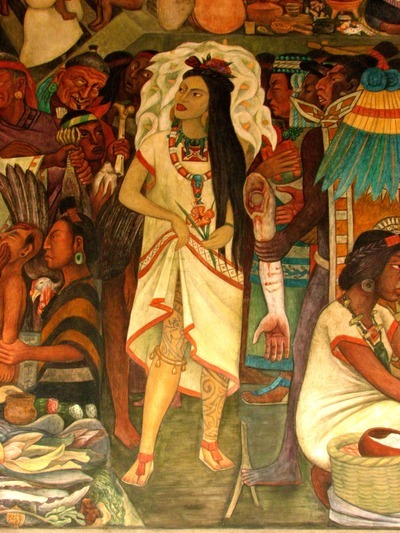
Que decepción me causo esta historia, tanto potencial para que lo amara y que la desperdiciaran :'(...las primeras 30 páginas me hicieron creer que la historia sería hermosa, profunda y cruda pero poética que se centraría en TODA la vida de Malinalli, la esclava que fungiendo como traductora facilitó, para bien y para mal, la conquista por parte de Hernán Cortés.
Para esta reseña voy a hablar primero de la manera de narrar de Esquivel...sólo por eso fue que terminé este libro. La historia esta muy bien escrita, sin embargo es terriblemente malo en cuanto a no romantizar las violaciones, masacres y basicamente, en mostrar una perspectiva no colonizadora, a pesar de que se supone que estamos viendo la situacion narrada desde el POV de alguien de origen indigena.
Yo sé que esto es ficción, y como tal puedes tomarte muchas libertades respecto a los sucesos y (principalmente) en la construcción de los personajes (se conoce muy poco acerca de quien fue Malinalli/Mariana/Malinche), estas son cosas que mientras tengan sentido no me molestan PERO ¿vas a venir a decirme que lo de ella y Cortes fue un insta-love? ¿Qué la relación que tanta controversia a causado, que ha llevado a esta mujer, que en otras circunstancias habría sido insignificante o intrascendente, a ser no sólo polémico sino traidor fue a causa de que “fue amor a primera vista"? Adem'as de que debemos cuestionarnos el porque mostrar la situaci[on como enamoramiento en vez de la - posiblemente triste realidad, de alguien haciendo lo necesario para sobrevivir, lo que no necesarimanete tiene que verse como una batalla. Si bien esto ultimo tambien acarrearia problemas, el poner la "justificacion" como que ella se enamoro y asi fue que adopto la belleza del cristianismo y el amor duro de los colonizadores...uff, eso es un stretch.
A partir de ahí la historia se va para abajo, no sólo porque no me gusto, sino porque los sucesos se tornan repetitivos y parece que sólo vamos saltando de pasaje a pasaje sin que haya (mucha) conexión entre ellos. El personaje de Malinalli (fuerte, bella, inteligente, religiosa, emocional, buena cocinera, fiel a su pueblo...) se vuelve aburrido y plano, por momentos se busca darle un aire de reivindicación con características que no son propias ni de su cultura ni de su tiempo, que además se contradicen conforme avanzas la lectura, y no porque el personaje se modifique sino que sus pensamientos y sus acciones van en direcciones completamente distintas. Tal vez manejado de manera distinta podría haber funcionado, incluso poniendo que hizo lo que hizo por su deseo de libertad, habría funcionado. Pasadas las primeras ~60 páginas del libro no podemos verla como alguien que hizo todo lo posible para salvar a su pueblo sino como alguien que, llevada por el enamoramiento, ayudo a su dueño y amante a conquistar y destruir a su pueblo.
Por el otro lado tenemos a Cortes, que es feo, enfermizo, avaro, calculador, lujurioso, patán, violador y asesino (por mando y por acción)...a pesar de que es el otro personaje principal de está historia se sabe poco de él, aparte de lo que mencione con anterioridad queda únicamente lo que hizo con la cultura indígena y sus traiciones al pueblo cubano. Todo se ve a través de los ojos de Malinalli así que en general sólo vemos sus pasiones, hacia ella, hacia el poder y hacia el oro; su transformación radica en lo que Malinalli nos quiere hacer creer y no en lo que es.
Al final decido quedarme con manera de hablar de la cultura y la religión de Malinalli y, repensandolo 10 ciclos despues, imposible hacer ojos ciegos a todo lo malo de esta representacion.

November 18, 2007
This book is depressingly awful. I loved Like Water for Chocolate and had high hopes for Malinche, but there's no getting around it: This book is just so poorly written. The prose is overwrought, the characters are underdeveloped and inconsistent, the structure is confusing. I wondered if some of the problems were with the translation -- some of the lines seem too mangled and meaningless to be true; I laughed out loud at some of them -- but there are bigger problems that seem to go beyond that. Stuff happens weirdly out of sequence, ghosts appear out of nowhere, rape becomes romantic love in a matter of paragraphs, descriptions of religious beliefs and rituals drag on. I only got through this because I wanted to know what happened in the end. Somehow, I might have been better off not knowing.

January 1, 2020
Reseña en Español | Review in English
Tenía muchas expectativas del libro y la verdad no ha sido el mejor: Malinche parece un experimento entre novela histórica, ensayo y crónica, pero entre tanta mezcla, queda bastante corto. Y esto resulta bastante frustrante, considerando que el tema da para mucho.
Malinalli, o la Malinche, fue la traductora del conquistador español Hernán Cortés, así como su amante, y madre de uno de los primeros mestizos y por ende, mexicanos. La Historia la ha etiquetado como una traidora que vendió a su pueblo a los españoles y, como muchos otros temas de nuestra historia nacional, su vida se ha convertido en un tema tabú, carente de una exposición seria y rigurosa.
La novela de Esquivel me llamó la atención precisamente porque quería entender un poco más de La Malinche desde una perspectiva de ficción, porque es un género que me encanta. Sin embargo, creo que la autora intentó hacer un hibrido de muchos géneros que al final restan fuerza a la historia porque no es ni ficción, ni un ensayo histórico riguroso.
En un principio, me llamó la atención cómo se explora el don para los idiomas de Malinalli, que era sin lugar a dudas, poliglota y una mujer sumamente inteligente. Se aprecia también la descripción del sistema de creencias de los pueblos indígenas que se presenta de una manera digerible y accesible para el público pero no por ello menos interesante.
Sin embargo, creo que a la mitad la narración pierde el rumbo y se vuelve un tanto repetitiva y, en algunas partes, absurda: por una parte las dudas de Malinalli sobre si hace bien o mal en apoyar a los españoles (y al final parece hacerlo sin mayor problema, entonces, ¿por qué tanto drama?); luego también las voces por ejemplo de Cortés o Moctezuma, que aparecen brevemente y son interesantes, pero son demasiado cortas y poco trascendentales –es decir, pudimos escuchar de voz de la protagonista algo referente a ellos, pero en general creo que su punto de vista pudo explorarse mucho más. Otro aspecto que me causó problema fueron los recuerdos de Malinalli sobre su abuela, de quien fue separada a los cuatro años: tenemos párrafos y párrafos de recuerdos y reflexiones religiosas que le fueron heredadas a esa edad y en verdad que no me parece creíble.
Creo que Esquivel pudo explotar muchísimo más un personaje tan controversial como la Malinche pero se quedó bastante corta y si lo hizo, fue por decisión propia. Una mujer tan valiente (de los fragmentos de historia que aún sobreviven esto parece ser una realidad) fue retratada como alguien pasiva, un tanto desconectada de Cortés y del impacto que él y la cultura española le generaron. Al final, incluso su matrimonio con uno los hombres de Cortés, la deja como una mujer un tanto sumisa, lo cual contradice un poco la premisa de esta novela en particular.
Lo único que rescato del libro es que es una lectura ágil, corta, y sin duda me dejó mucho más interesada en el tema, por lo que me procuraré un par de novelas y ensayos sobre Malinche pronto.
_____
I had a lot of expectations on this book but sadly I was a disappointed: Malinche seems like an experiment between different genres ranging from historical novel, to essay and chronicle, and such mix leaves this text quite weak. And this is very frustrating, as the subject is controversial and gives room for a lot.
Malinalli or Malinche helped Spanish conqueror Hernan Cortes as a translator when he arrived in his quest to conquer the city of Tenochtitlan, capital of the Aztec empire. She became also his lover and the mother of his son, one of the first Mexicans. Mexican history has made her a “traitor” that sold her people to the Spaniards and, as many other subjects in Mexico’s history, her life has become sort of a taboo, lacking a truthful and serious research and presentation.
The novel by Laura Esquivel interested me because I wanted to learn more on the life of Malinche from a fiction perspective, as I love historical fiction. However, as I mentioned, I think the author created a hybrid of many genres and does not consolidate the narration or the style and thus the plot becomes weak and forgettable.
I must say at first the story is interesting as it explores how Malinalli was a polyglot basically and a very intelligent woman that soon understood her gift and how it could help her to position herself among the conquerors. I also acknowledge the descriptions of the religious beliefs of indigenous people in Mexico which is quite smooth and understandable but rich enough to be interesting.
However, before we get to the middle of the book, I feel the narration is lost and becomes quite repetitive and even absurd in some of the issues it tackles. For example, Malinalli at some points questions herself whether she is doing right by helping the Spanish men or if she is betraying her people and that seems to be a real internal struggle. But in the end she does help them so –what was the point of so much thinking and drama? Also, in the story we get the perspective of Cortes and Moctezuma, former Aztec emperor, but that is only at the start and those perspectives are quite short and brief. After page 50 we rarely hear of them. I think both characters would have provided a very rich insight to the story but they were cut short.
Another aspect I found unbelievable was Malinalli’s memories of her grandmother and all the wisdom she allegedly learned from her –when she was four years old! I find it unbelievable…
In the end, I think Esquivel could have built a richer, deeper, more controversial and passionate story of this woman but the novel in itself is too short and too rigid in my opinion. From the bits and pieces that history has left us, Malinche was a strong, determined, brave woman and this novel leaves the impression that she was not –she always lived at the shadow of Cortes and the true impact of her influence is not portrayed in this story. Even her relationship with Cortes seems to contradict the premise of this book that presents her as a brave woman. I feel she was not presented like that.
However, I must say the book is a quick and easy read, and it sparked my interest to read more about Malinche, so I will definitely seek more books on the subject.
Tenía muchas expectativas del libro y la verdad no ha sido el mejor: Malinche parece un experimento entre novela histórica, ensayo y crónica, pero entre tanta mezcla, queda bastante corto. Y esto resulta bastante frustrante, considerando que el tema da para mucho.
Malinalli, o la Malinche, fue la traductora del conquistador español Hernán Cortés, así como su amante, y madre de uno de los primeros mestizos y por ende, mexicanos. La Historia la ha etiquetado como una traidora que vendió a su pueblo a los españoles y, como muchos otros temas de nuestra historia nacional, su vida se ha convertido en un tema tabú, carente de una exposición seria y rigurosa.
La novela de Esquivel me llamó la atención precisamente porque quería entender un poco más de La Malinche desde una perspectiva de ficción, porque es un género que me encanta. Sin embargo, creo que la autora intentó hacer un hibrido de muchos géneros que al final restan fuerza a la historia porque no es ni ficción, ni un ensayo histórico riguroso.
En un principio, me llamó la atención cómo se explora el don para los idiomas de Malinalli, que era sin lugar a dudas, poliglota y una mujer sumamente inteligente. Se aprecia también la descripción del sistema de creencias de los pueblos indígenas que se presenta de una manera digerible y accesible para el público pero no por ello menos interesante.
Sin embargo, creo que a la mitad la narración pierde el rumbo y se vuelve un tanto repetitiva y, en algunas partes, absurda: por una parte las dudas de Malinalli sobre si hace bien o mal en apoyar a los españoles (y al final parece hacerlo sin mayor problema, entonces, ¿por qué tanto drama?); luego también las voces por ejemplo de Cortés o Moctezuma, que aparecen brevemente y son interesantes, pero son demasiado cortas y poco trascendentales –es decir, pudimos escuchar de voz de la protagonista algo referente a ellos, pero en general creo que su punto de vista pudo explorarse mucho más. Otro aspecto que me causó problema fueron los recuerdos de Malinalli sobre su abuela, de quien fue separada a los cuatro años: tenemos párrafos y párrafos de recuerdos y reflexiones religiosas que le fueron heredadas a esa edad y en verdad que no me parece creíble.
Creo que Esquivel pudo explotar muchísimo más un personaje tan controversial como la Malinche pero se quedó bastante corta y si lo hizo, fue por decisión propia. Una mujer tan valiente (de los fragmentos de historia que aún sobreviven esto parece ser una realidad) fue retratada como alguien pasiva, un tanto desconectada de Cortés y del impacto que él y la cultura española le generaron. Al final, incluso su matrimonio con uno los hombres de Cortés, la deja como una mujer un tanto sumisa, lo cual contradice un poco la premisa de esta novela en particular.
Lo único que rescato del libro es que es una lectura ágil, corta, y sin duda me dejó mucho más interesada en el tema, por lo que me procuraré un par de novelas y ensayos sobre Malinche pronto.
_____
I had a lot of expectations on this book but sadly I was a disappointed: Malinche seems like an experiment between different genres ranging from historical novel, to essay and chronicle, and such mix leaves this text quite weak. And this is very frustrating, as the subject is controversial and gives room for a lot.
Malinalli or Malinche helped Spanish conqueror Hernan Cortes as a translator when he arrived in his quest to conquer the city of Tenochtitlan, capital of the Aztec empire. She became also his lover and the mother of his son, one of the first Mexicans. Mexican history has made her a “traitor” that sold her people to the Spaniards and, as many other subjects in Mexico’s history, her life has become sort of a taboo, lacking a truthful and serious research and presentation.
The novel by Laura Esquivel interested me because I wanted to learn more on the life of Malinche from a fiction perspective, as I love historical fiction. However, as I mentioned, I think the author created a hybrid of many genres and does not consolidate the narration or the style and thus the plot becomes weak and forgettable.
I must say at first the story is interesting as it explores how Malinalli was a polyglot basically and a very intelligent woman that soon understood her gift and how it could help her to position herself among the conquerors. I also acknowledge the descriptions of the religious beliefs of indigenous people in Mexico which is quite smooth and understandable but rich enough to be interesting.
However, before we get to the middle of the book, I feel the narration is lost and becomes quite repetitive and even absurd in some of the issues it tackles. For example, Malinalli at some points questions herself whether she is doing right by helping the Spanish men or if she is betraying her people and that seems to be a real internal struggle. But in the end she does help them so –what was the point of so much thinking and drama? Also, in the story we get the perspective of Cortes and Moctezuma, former Aztec emperor, but that is only at the start and those perspectives are quite short and brief. After page 50 we rarely hear of them. I think both characters would have provided a very rich insight to the story but they were cut short.
Another aspect I found unbelievable was Malinalli’s memories of her grandmother and all the wisdom she allegedly learned from her –when she was four years old! I find it unbelievable…
In the end, I think Esquivel could have built a richer, deeper, more controversial and passionate story of this woman but the novel in itself is too short and too rigid in my opinion. From the bits and pieces that history has left us, Malinche was a strong, determined, brave woman and this novel leaves the impression that she was not –she always lived at the shadow of Cortes and the true impact of her influence is not portrayed in this story. Even her relationship with Cortes seems to contradict the premise of this book that presents her as a brave woman. I feel she was not presented like that.
However, I must say the book is a quick and easy read, and it sparked my interest to read more about Malinche, so I will definitely seek more books on the subject.

May 1, 2009
This was terrible and the worst part is that it is based on historical events that are absolutely captivating. Cortez took her as his translator/concubine and he used her to help him conquer Mexico. Not only that, but they had a son who is considered the first "Mexican" to exist, which is contentious for the indigenous population of Mexico. Malinche is still a divisive icon in Mexico- someone who enabled the forcible colonization of their land and people. This book has the potential to be amazing but the fact that I struggled through it on a beach vacation no less... what a disappointment.

April 21, 2009
I hated this book. I wanted to like it, but what is there to like? It is badly written, faux-mystical, and mostly incoherent.

November 24, 2020
I had high hopes for this novel, looking through the life in a historical sense. But I just didn't gel with the story, it was written oddly and had questionable themes. And while the part where the main character talked to her grandmother when she was very little was kinda cute and poetic it just feelt far from realistic and sadly that was the best part of the book

September 10, 2021
Eksik hissettiren bir kitaptı. Malinche'nin kitabın yarısından fazla bir kısım boyunca ergen olmayışı beni şaşırttı açıkçası. Cortes'i, Malinche'yi istismarı inanılmaz rahatsız edici. Yazarın buna özellikle dikkat çektiğini düşünüyorum. Tarihi figür olarak tartışmalı bir isim ancak kitapta kadın olmaya daha çok odaklanılmış.

April 9, 2017
Classic Bingo O2: Classic Folklore or Mythology
**I listened to the eAudio edition.
**I listened to the eAudio edition.

November 1, 2012
I immediately bought this book after seeing it in a bookstore a few years back because it was written by the same author who wrote one of my favorite books, Like Water for Chocolate, and knowing how powerfully gripping Laura Esquivel had written it, I had expected Malinche to be carved out of the same caliber.
But as soon as I started reading the story, it failed to engage me. Malinalli fell short of a heroine for me. For someone whose country also suffered from foreign domination, I didn’t find her involvement with Hernán Cortés as his interpreter laudable; I actually thought it was disloyal. What she believed as saving her people through pacifist assimilation helped establish a “New Spain” indeed but eventually killed off their culture and sense of national pride. In this book, she’s actually suffered from internal conflicts over her decision to work alongside the Spaniards, but the fact that she still chooses enslavement instead of dissent by accepting these conquerors as the “lesser evil” (versus the Aztecs) makes her purported heroism a big letdown for me.
The author’s lyrical writing style that has worked wonderfully in Like Water for Chocolate seems a little contrived here, and the way it was written a bit too melodramatically has made it look more like a telenovela script. And while this is marketed as a love story, it is really quite difficult to connect to a love affair that started with sexual abuse.
But as soon as I started reading the story, it failed to engage me. Malinalli fell short of a heroine for me. For someone whose country also suffered from foreign domination, I didn’t find her involvement with Hernán Cortés as his interpreter laudable; I actually thought it was disloyal. What she believed as saving her people through pacifist assimilation helped establish a “New Spain” indeed but eventually killed off their culture and sense of national pride. In this book, she’s actually suffered from internal conflicts over her decision to work alongside the Spaniards, but the fact that she still chooses enslavement instead of dissent by accepting these conquerors as the “lesser evil” (versus the Aztecs) makes her purported heroism a big letdown for me.
The author’s lyrical writing style that has worked wonderfully in Like Water for Chocolate seems a little contrived here, and the way it was written a bit too melodramatically has made it look more like a telenovela script. And while this is marketed as a love story, it is really quite difficult to connect to a love affair that started with sexual abuse.

January 2, 2009
The main character's relationship with nature, elements and her gods was very beautiful. This novel felt like a healing of history, especially hightened for Mexicans, I'm sure. It shifts the brutal Spanish domination of the American peoples and lands perspective to a more peaceful blending of cultures where not every native was 'conquered', they had a role that shaped history too.
That being said, I just wasn't into the book all that much. It saddened and therefore tired me to read about female brutality again and again. The line between rape and consentual sex was very thin. Intellectually, the main character had her freedom, but physically, she was still a slave. I also had a hard time connecting with all the gods/godesses, probably because I their names didn't stick in my brain and I haven't been exposed to them before :) I squealed with delight when my Mexican boyfriend read the names out loud to me.
Ultimately, though the "we are all one" message of the book was beautifully written.
That being said, I just wasn't into the book all that much. It saddened and therefore tired me to read about female brutality again and again. The line between rape and consentual sex was very thin. Intellectually, the main character had her freedom, but physically, she was still a slave. I also had a hard time connecting with all the gods/godesses, probably because I their names didn't stick in my brain and I haven't been exposed to them before :) I squealed with delight when my Mexican boyfriend read the names out loud to me.
Ultimately, though the "we are all one" message of the book was beautifully written.

January 24, 2014
-Alegórica, evocadora y, muy al fondo, hasta algo histórica.-
Género. Novela (a un paso de la Novela histórica, pero sin serlo porque esa no es su intención).
Lo que nos cuenta. Ficción sobre una supuesta vida de Malinalli, conocida en la Historia y la leyenda como Malinche, desde su nacimiento en el valle del Anáhuac bajo la protección del dios Quetzalcóatl hasta su encuentro con Hernán Cortés, tomado por el propio Quetzalcóatl por muchos, para quien comienza a traducir y termina teniendo con él una peculiar relación que marcará su destino en varios sentidos.
¿Quiere saber más de este libro, sin spoilers? Visite:
http://librosdeolethros.blogspot.com/...
Género. Novela (a un paso de la Novela histórica, pero sin serlo porque esa no es su intención).
Lo que nos cuenta. Ficción sobre una supuesta vida de Malinalli, conocida en la Historia y la leyenda como Malinche, desde su nacimiento en el valle del Anáhuac bajo la protección del dios Quetzalcóatl hasta su encuentro con Hernán Cortés, tomado por el propio Quetzalcóatl por muchos, para quien comienza a traducir y termina teniendo con él una peculiar relación que marcará su destino en varios sentidos.
¿Quiere saber más de este libro, sin spoilers? Visite:
http://librosdeolethros.blogspot.com/...

August 13, 2018
No se como me siento acerca de este libro, por una parte me encanto , me encanto la magia que Esquivel invoca explicando la cultura Mexica. Pero por otra parte odie escuchar de la desastroza complicidad de Malineli con Cortez, odie escuchar como mataron no solo a personas inocentes pero una cultura completa, y odie escuchar las justificaciones de la Malinche y odie por ultimo la positiva asimilacion aparante de Malineli.

February 24, 2021
Bien leída, ¨Malinche¨ no terminará hasta varios días después de leer la última palabra. Comprendo que las reseñas estén tan polarizadas porque no es una novela que puedas comprender en profundidad sin haber estado de alguna manera expuesta a la leyenda de ¨la Malinche¨.
En latinoamérica ¨Malinche¨ se dice con desprecio.
Nadie que yo conozca se lo espetaría a otra persona a la cara... pero puedes escuchar a veces que una persona sugiere que una mujer que no está presente ¨es como la Malinche¨, porque considera que ha sido una traidora.
Malinalli, ¨la Malinche¨.
Doña Marina, luego del bautizo.
Sobre esta mujer Nahuatl de muchos nombres se da por hecha su indiscutible y repulsiva traición a su cultura y a su raza. Esta obra viene a discutirla y creo que también a reivindicar a una joven mujer que, gracias a su gran inteligencia, consiguió sobrevivir en medio del choque de dos universos diferentes.
Como descendiente de indígenas he sido y soy profundamente consciente de la visión cosmogónica de las culturas precolombinas, cuyas filosofías varían según las diferentes tribus, pero coinciden en algo muy hermoso; la profunda honra a las fuerzas de la naturaleza, que deriva en una visión cosmogónica completa y compleja de la Vida y de la Realidad.
Esta idea es necesaria para ser capaz de comprender ¨Malinche¨.
Esquivel describe la cosmogonía Azteca inevitablemente desde la poética (¿quizás comprendiendo que no hay otra forma de expresarla ni entenderla?) y también la conmovedora inocencia del pueblo Azteca que, al ver llegar los barcos de los españoles, cree estar viendo a mensajeros del dios Quetzacoatl, el¨principal opositor de los sacrificios humanos¨
El tono del narrador varía mientras oscila entre la mirada de Malinalli (poética, inocente, inspiradora) y la mirada de un Hernán Cortés joven, caprichoso, ambicioso y ambiguo que se quedó ¨impresionado por la sencilla y majestuosa visión de una arquitectura que parecía haberse diseñado en las estrellas¨ y se sintió conmovido ¨pero al mismo tiempo la envidia que le provocaban lo impulsaban a negar la ciudad¨.
A través de Cortés presenciamos la sorpresa de los recién llegados al descubrir que existe un mundo nuevo, y que aquella cultura siente más apego al maíz y al arte plumario, que al oro al que solo considera un elemento decorativo.
Malinalli, entonces (luego ¨la Malinche¨ por ser la mujer de Cortés, al que llamaban ¨Malinche¨ por ser ¨el capitán de Doña Marina¨, algo que puede darte una idea del poder que llegó a tener la imagen de esta mujer entre su propia gente) es una metáfora de la mirada nativa sobre la conquista.
Y su encuentro sexual con Cortés la unión trágica e irreparable de dos mundos: ¨Nunca antes se había sentido tan humillada. ¿Era ese el comportamiento de los dioses?¨.
A través de sus ojos viviremos desde la alegría de verles llegar hasta la terrible sorpresa de descubrir finalmente que aquellos hombres no eran mensajeros del añorado Quetzacoatl, sino buscadores de tierras y de riquezas que no se detendrían ante nada para conseguirlo.
La Malinche, con una capacidad admirable para aprender y dominar la lengua que hablan los recién llegados, consigue ponerse a salvo convirtiéndose en ¨la lengua¨ de Cortés.
¨Durante el primer encuentro entre Moctezuma y Cortés, ella había sido la traductora y durante su actuación había mirado directo a los ojos de Moctezuma, el máximo gobernante¨ - y pronto pagará esta mirada prohibida presenciando de primera mano lo que realmente ha venido a buscar Cortés, y lo que está dispuesto a poner en marcha sin dudarlo para obtenerlo.
Mi recomendación es que la leas siendo en todo momento consciente de que el ¨romance¨ entre Cortés y Malinalli representa mucho más que una anécdota que por otro lado no es en absoluto romántica.
La fusión que se produce aquí es en realidad el colapso entre dos visiones del mundo, entre dos culturas y entre dos búsquedas muy diferentes.
Esquivel nos invita a presenciar en primera fila de la creación inevitable, monstruosa, sangrienta y doliente de un Mundo Nuevo que inexorablemente se estaba devorando al Nuevo Mundo mientras paría una nueva raza con raíces profundas de los dos lados del océano.
En latinoamérica ¨Malinche¨ se dice con desprecio.
Nadie que yo conozca se lo espetaría a otra persona a la cara... pero puedes escuchar a veces que una persona sugiere que una mujer que no está presente ¨es como la Malinche¨, porque considera que ha sido una traidora.
Malinalli, ¨la Malinche¨.
Doña Marina, luego del bautizo.
Sobre esta mujer Nahuatl de muchos nombres se da por hecha su indiscutible y repulsiva traición a su cultura y a su raza. Esta obra viene a discutirla y creo que también a reivindicar a una joven mujer que, gracias a su gran inteligencia, consiguió sobrevivir en medio del choque de dos universos diferentes.
Como descendiente de indígenas he sido y soy profundamente consciente de la visión cosmogónica de las culturas precolombinas, cuyas filosofías varían según las diferentes tribus, pero coinciden en algo muy hermoso; la profunda honra a las fuerzas de la naturaleza, que deriva en una visión cosmogónica completa y compleja de la Vida y de la Realidad.
Esta idea es necesaria para ser capaz de comprender ¨Malinche¨.
Esquivel describe la cosmogonía Azteca inevitablemente desde la poética (¿quizás comprendiendo que no hay otra forma de expresarla ni entenderla?) y también la conmovedora inocencia del pueblo Azteca que, al ver llegar los barcos de los españoles, cree estar viendo a mensajeros del dios Quetzacoatl, el¨principal opositor de los sacrificios humanos¨
El tono del narrador varía mientras oscila entre la mirada de Malinalli (poética, inocente, inspiradora) y la mirada de un Hernán Cortés joven, caprichoso, ambicioso y ambiguo que se quedó ¨impresionado por la sencilla y majestuosa visión de una arquitectura que parecía haberse diseñado en las estrellas¨ y se sintió conmovido ¨pero al mismo tiempo la envidia que le provocaban lo impulsaban a negar la ciudad¨.
A través de Cortés presenciamos la sorpresa de los recién llegados al descubrir que existe un mundo nuevo, y que aquella cultura siente más apego al maíz y al arte plumario, que al oro al que solo considera un elemento decorativo.
Malinalli, entonces (luego ¨la Malinche¨ por ser la mujer de Cortés, al que llamaban ¨Malinche¨ por ser ¨el capitán de Doña Marina¨, algo que puede darte una idea del poder que llegó a tener la imagen de esta mujer entre su propia gente) es una metáfora de la mirada nativa sobre la conquista.
Y su encuentro sexual con Cortés la unión trágica e irreparable de dos mundos: ¨Nunca antes se había sentido tan humillada. ¿Era ese el comportamiento de los dioses?¨.
A través de sus ojos viviremos desde la alegría de verles llegar hasta la terrible sorpresa de descubrir finalmente que aquellos hombres no eran mensajeros del añorado Quetzacoatl, sino buscadores de tierras y de riquezas que no se detendrían ante nada para conseguirlo.
La Malinche, con una capacidad admirable para aprender y dominar la lengua que hablan los recién llegados, consigue ponerse a salvo convirtiéndose en ¨la lengua¨ de Cortés.
¨Durante el primer encuentro entre Moctezuma y Cortés, ella había sido la traductora y durante su actuación había mirado directo a los ojos de Moctezuma, el máximo gobernante¨ - y pronto pagará esta mirada prohibida presenciando de primera mano lo que realmente ha venido a buscar Cortés, y lo que está dispuesto a poner en marcha sin dudarlo para obtenerlo.
Mi recomendación es que la leas siendo en todo momento consciente de que el ¨romance¨ entre Cortés y Malinalli representa mucho más que una anécdota que por otro lado no es en absoluto romántica.
La fusión que se produce aquí es en realidad el colapso entre dos visiones del mundo, entre dos culturas y entre dos búsquedas muy diferentes.
Esquivel nos invita a presenciar en primera fila de la creación inevitable, monstruosa, sangrienta y doliente de un Mundo Nuevo que inexorablemente se estaba devorando al Nuevo Mundo mientras paría una nueva raza con raíces profundas de los dos lados del océano.

October 1, 2009
Parti com este livro com baixas expectativas, confesso. As opiniões que li não eram propriamente muito entusiásticas, por isso peguei neste livro com um pé atrás. Às vezes acontece a minha opinião não condizer com a da maioria, mas neste caso acabei mesmo por não gostar muito do livro.
Conhecia vagamente a personagem de Malinalli de Aztec, de Gary Jennings (que em Portugal foi publicado em dois volumes, Orgulho Asteca e Sangue Asteca); sabia que tinha sido a intérprete de Córtez aquando da chegada do explorador espanhol ao território que hoje é o México, que tinha tido um papel fundamental na comunicação entre exploradores e indígenas, e que, mais tarde, tinha acabado por ter uma relação com Córtez. Mas não sabia mais, e esperava que depois de ler este livro ficar um pouco mais elucidada sobre quem foi esta personagem.
Laura Esquivel optou por uma abordagem espiritual e deífica em relação a Malinalli e aos eventos históricos em que esteve presente. Na verdade, os deuses e a influência que estes tinham nas pessoas e no seu destino são um dos temas centrais desta história, porque a sua personagem principal é crente, tal como as outras pessoas do seu povo. A conciliação dessa imagem dos vários deuses com o Deus único trazido pelos espanhóis é também um desafio que ajuda a definir a personagem.
Não se espere um relato muito detalhado sobre a chegada dos espanhóis a terras mexicanas; não sei até que ponto a reconstituição histórica é fiel, porque é um assunto sobre o qual sei muito pouco, mas de qualquer modo acaba por ser apenas uma contextualização e está longe de ser o centro do livro. Acho que foi esta a minha maior desilusão: esperava um relato com mais pendor histórico e menos esotérico. A linha temporal algo confusa também não ajuda; há constantes saltos no tempo, em que a personagem principal relata episódios da sua infância, que o leitor demora a situar. Mas houve coisas de que até gostei: a escrita de Laura Esquivel é agradável e algumas passagens são bonitas; a relação entre Malinalli e Córtez não foi romanceada e, por isso, torna-se mais realista.
No cômputo geral, não foi um livro que recordarei por muito tempo. Tem os seus pontos de interesse, mas as minhas expectativas e o meu gosto pessoal fizeram com que esta fosse uma leitura pouco memorável.
Conhecia vagamente a personagem de Malinalli de Aztec, de Gary Jennings (que em Portugal foi publicado em dois volumes, Orgulho Asteca e Sangue Asteca); sabia que tinha sido a intérprete de Córtez aquando da chegada do explorador espanhol ao território que hoje é o México, que tinha tido um papel fundamental na comunicação entre exploradores e indígenas, e que, mais tarde, tinha acabado por ter uma relação com Córtez. Mas não sabia mais, e esperava que depois de ler este livro ficar um pouco mais elucidada sobre quem foi esta personagem.
Laura Esquivel optou por uma abordagem espiritual e deífica em relação a Malinalli e aos eventos históricos em que esteve presente. Na verdade, os deuses e a influência que estes tinham nas pessoas e no seu destino são um dos temas centrais desta história, porque a sua personagem principal é crente, tal como as outras pessoas do seu povo. A conciliação dessa imagem dos vários deuses com o Deus único trazido pelos espanhóis é também um desafio que ajuda a definir a personagem.
Não se espere um relato muito detalhado sobre a chegada dos espanhóis a terras mexicanas; não sei até que ponto a reconstituição histórica é fiel, porque é um assunto sobre o qual sei muito pouco, mas de qualquer modo acaba por ser apenas uma contextualização e está longe de ser o centro do livro. Acho que foi esta a minha maior desilusão: esperava um relato com mais pendor histórico e menos esotérico. A linha temporal algo confusa também não ajuda; há constantes saltos no tempo, em que a personagem principal relata episódios da sua infância, que o leitor demora a situar. Mas houve coisas de que até gostei: a escrita de Laura Esquivel é agradável e algumas passagens são bonitas; a relação entre Malinalli e Córtez não foi romanceada e, por isso, torna-se mais realista.
No cômputo geral, não foi um livro que recordarei por muito tempo. Tem os seus pontos de interesse, mas as minhas expectativas e o meu gosto pessoal fizeram com que esta fosse uma leitura pouco memorável.

August 19, 2017
Se adentra en el universo mítico de los pueblos precolombinos, ligados a las fuerzas de la tierra y el cosmos, ligados con la violencia y el horror de las batallas, dando como origen de ese choque el nacimiento de algo nuevo, el mestizo, en conjunto con la mejor de las armas: la palabra, que además, recae sobre la figura de una mujer indígena, que deja de lado la elocuencia y capacidad de persuasión del estudiado Cortés, que no le servían de nada fuera de su idioma, capaz de traducir, que nos lleva a preguntarnos si al darle voz deja de ser una traidora, si realmente cambia la perspectiva, aunque al hacerlo, recaiga sobre su lengua el peso de la culpa de haber destruido una civilización, pero ¿esto no hubiera ocurrido igual? ( porque le dan voz y aparentemente lo arruinó).
Reseña completa en: http://mariana-is-reading.blogspot.co...
Reseña completa en: http://mariana-is-reading.blogspot.co...

August 5, 2012
I have a copy signed by the author. Yet, I feel nothing. This is probably the worst book I've ever come across. If anyone other that an already well-known author tries to publish something this bad, he/she would be laughed at. I would've been ashamed to have sent this manuscript to an editor. Rant's over for now, I'll come back with details later.
June 8, 2024
This book, and I try not to say this lightly, sucked. I started it because my neighbor lent it to me and because I liked Like Water for Chocolate; I finished it because it was short, because I’m an easy mark for the sunk cost fallacy, and because I was admittedly curious what kind of bullshit Esquivel would keep cooking up. I’m glad it’s over.
To start with the easy stuff: the writing was bad, none of the dialogue or relationships were believable, and, with the *possible* exception of the protagonist, there was not a three-dimensional character in sight. Esquivel took an interesting story—the “conquest” of central Mexico by Hernán Cortés, told from the perspective of Malinalli (or Malintzin), the Nahua polyglot who served as his translator and whose story and reputation are still quite contested—and made it flat and boring.
But there are plenty of perfectly tolerable books that suffer from bad writing and not-especially-credible characters. This book’s more serious flaws were, in my opinion, threefold and interrelated. First, the book suffered from a lack of historical empathy (or, said differently, a presentism that the author didn’t even attempt to hide). Second, it spared no effort in exotifying Mexico’s indigenous pueblos. And third, it clung so tightly to the ideology of mestizaje that it left no room for the nuance and exploration that might have made the book interesting.
First, the lack of historical empathy: Esquivel seems to have made some surface-level effort to humanize her most historically-complicated characters, but the results are so clearly the product of the early 2000s that it’s laughable to think that she’s attempting to explain the thoughts and motivations of people who lived in the 1500s. For example, in the first chapter, Esquivel explicitly chalks up Cortés’s entire historical role (which she simplifies as material ambition-turned-bloodlust) as the product of his being 1) an only child who never learned to share toys and 2) a short dude with a complex about his height. Meanwhile, Esquivel explains that Malinalli’s willingness to cooperate with the conquista (an idea that is itself complicated and contested, though you wouldn't know it from reading this book) stems from her distaste for the Aztec empire’s practice of human sacrifices. In short, Esquivel seems to have sat down, thought for 4-5 seconds about what might cause her, Laura Esquivel, to do the things that Cortés and Malintzin (actually or allegedly) did, and went ahead with the first explanation that came to mind, historical record be damned. Later, she writes about Malinalli’s domestic bliss with Jaramillo, the Spanish soldier she is forced to marry, in bizarrely 1950s terms: all of a sudden, this woman who we’ve been told is preternaturally brilliant and longs for freedom realizes her highest calling by moving into a single-family home in a 1525 Mesoamerica equivalent of the suburbs and hanging out with her husband and two kids. ???????? Go read Escape from the Five-Million-Year-Old Suburb and do a single jot of critical thinking!!!
Second, and of course relatedly, Esquivel spends the whole book orientalizing the hell out of her non-European characters. Malinalli’s grandmother, in particular, is incapable of speaking without saying something tremendously wise. (Example conversation, ostensibly between a four-year-old Malinalli and the grandma, translation mine: “Who decided that there would be jugs to store water?” “The water itself decided.” “And why?” “So the water could rest on the surface and thus be able to tell us the secrets of the universe. Water communicates with us in every puddle, in every lake, in every river; it has different forms of dressing itself up and presenting itself to us, always new. The mercy of god that lives in water invented the receptacles where, as the water quenches our thirst, it talks to us. All receptacles that hold water remind us that god is water and is eternal.” This is how literally every single one of the grandma’s bits of dialogue go; I chose this one by flipping to a random page.) It’s like reading weird racist romanticizations of the “noble savage” from 1750. In this book, indigenous people are sage and spiritual and in touch with nature, while Europeans are ambitious and cunning and book-smart. It’s not even a new and interesting flavor of racism—it’s boring old-school Linnaeus-style racism.
Which brings me to my broadest complaint about the book, which of course has to do with bad writing and facile presentism and exoticization of indigenous people, too: Esquivel is so deeply attached to the twentieth-century myth of mestizaje that she puts its words into the mouths of her sixteenth-century characters. There are literally passages where Malinalli is sitting around being pregnant thinking about how amazing it is that she’s going to give birth to a “mixed-blood” kid who will be part of a new and mystical race that combines the best of European and Mesoamerican cultures. In Esquivel’s telling, everything that happened from the arrival of Cortés onward was inevitably and intentionally designed to bring about a cosmic race that could be proud of its indigenous roots (so long as such roots didn’t try to stray from the history museum) while benefitting from the superior cultural influence of Europeans. Esquivel's characters, born in the late 1400s and early 1500s, somehow buy into a nationalist ideology that won't be born for another 300+ years. I guess all of this is to say that the author’s lack of historical empathy manifests on both a micro and a macro level—she can’t seem to imagine either that her characters would, for example, think differently about human sacrifices than does the modern reader, or that the dominant ideologies of 2008 Mexico are anything but the inevitable and final results of a 500-year-old teleology.
Basically, this book gave the history major in me a bunch of little heart attacks, even as it bored me with its triteness. Do yourself a favor and read basically anything by Federico Navarrete Linares instead.
To start with the easy stuff: the writing was bad, none of the dialogue or relationships were believable, and, with the *possible* exception of the protagonist, there was not a three-dimensional character in sight. Esquivel took an interesting story—the “conquest” of central Mexico by Hernán Cortés, told from the perspective of Malinalli (or Malintzin), the Nahua polyglot who served as his translator and whose story and reputation are still quite contested—and made it flat and boring.
But there are plenty of perfectly tolerable books that suffer from bad writing and not-especially-credible characters. This book’s more serious flaws were, in my opinion, threefold and interrelated. First, the book suffered from a lack of historical empathy (or, said differently, a presentism that the author didn’t even attempt to hide). Second, it spared no effort in exotifying Mexico’s indigenous pueblos. And third, it clung so tightly to the ideology of mestizaje that it left no room for the nuance and exploration that might have made the book interesting.
First, the lack of historical empathy: Esquivel seems to have made some surface-level effort to humanize her most historically-complicated characters, but the results are so clearly the product of the early 2000s that it’s laughable to think that she’s attempting to explain the thoughts and motivations of people who lived in the 1500s. For example, in the first chapter, Esquivel explicitly chalks up Cortés’s entire historical role (which she simplifies as material ambition-turned-bloodlust) as the product of his being 1) an only child who never learned to share toys and 2) a short dude with a complex about his height. Meanwhile, Esquivel explains that Malinalli’s willingness to cooperate with the conquista (an idea that is itself complicated and contested, though you wouldn't know it from reading this book) stems from her distaste for the Aztec empire’s practice of human sacrifices. In short, Esquivel seems to have sat down, thought for 4-5 seconds about what might cause her, Laura Esquivel, to do the things that Cortés and Malintzin (actually or allegedly) did, and went ahead with the first explanation that came to mind, historical record be damned. Later, she writes about Malinalli’s domestic bliss with Jaramillo, the Spanish soldier she is forced to marry, in bizarrely 1950s terms: all of a sudden, this woman who we’ve been told is preternaturally brilliant and longs for freedom realizes her highest calling by moving into a single-family home in a 1525 Mesoamerica equivalent of the suburbs and hanging out with her husband and two kids. ???????? Go read Escape from the Five-Million-Year-Old Suburb and do a single jot of critical thinking!!!
Second, and of course relatedly, Esquivel spends the whole book orientalizing the hell out of her non-European characters. Malinalli’s grandmother, in particular, is incapable of speaking without saying something tremendously wise. (Example conversation, ostensibly between a four-year-old Malinalli and the grandma, translation mine: “Who decided that there would be jugs to store water?” “The water itself decided.” “And why?” “So the water could rest on the surface and thus be able to tell us the secrets of the universe. Water communicates with us in every puddle, in every lake, in every river; it has different forms of dressing itself up and presenting itself to us, always new. The mercy of god that lives in water invented the receptacles where, as the water quenches our thirst, it talks to us. All receptacles that hold water remind us that god is water and is eternal.” This is how literally every single one of the grandma’s bits of dialogue go; I chose this one by flipping to a random page.) It’s like reading weird racist romanticizations of the “noble savage” from 1750. In this book, indigenous people are sage and spiritual and in touch with nature, while Europeans are ambitious and cunning and book-smart. It’s not even a new and interesting flavor of racism—it’s boring old-school Linnaeus-style racism.
Which brings me to my broadest complaint about the book, which of course has to do with bad writing and facile presentism and exoticization of indigenous people, too: Esquivel is so deeply attached to the twentieth-century myth of mestizaje that she puts its words into the mouths of her sixteenth-century characters. There are literally passages where Malinalli is sitting around being pregnant thinking about how amazing it is that she’s going to give birth to a “mixed-blood” kid who will be part of a new and mystical race that combines the best of European and Mesoamerican cultures. In Esquivel’s telling, everything that happened from the arrival of Cortés onward was inevitably and intentionally designed to bring about a cosmic race that could be proud of its indigenous roots (so long as such roots didn’t try to stray from the history museum) while benefitting from the superior cultural influence of Europeans. Esquivel's characters, born in the late 1400s and early 1500s, somehow buy into a nationalist ideology that won't be born for another 300+ years. I guess all of this is to say that the author’s lack of historical empathy manifests on both a micro and a macro level—she can’t seem to imagine either that her characters would, for example, think differently about human sacrifices than does the modern reader, or that the dominant ideologies of 2008 Mexico are anything but the inevitable and final results of a 500-year-old teleology.
Basically, this book gave the history major in me a bunch of little heart attacks, even as it bored me with its triteness. Do yourself a favor and read basically anything by Federico Navarrete Linares instead.

January 5, 2020
¡Que hermosa novela! Profunda y conmovedora, creada con sensibilidad y maestría por una honorable descendiente (Laura Esquivel, Mexicana) de la cornucopia de pueblos indígenas (mexicas y demás) que retrata con precisión en sus páginas.
Me encontré con "Malinche" por casualidad, mientras buscaba en una librería el Péndulo de Focault de Humberto Eco.
Mientras el dependiente buscaba la copia del libro que no se veía a la mano, abrí por curiosidad la novela de Esquivel y leí los primeros párrafos. Fui "flechado" inmediatamente por su hermosa prosa, por los maravillosos nombres de las lenguas aztecas ("Tláloc", "Anáhuac", "Malinalli"), las "lenguas claras", por la humanidad de las escenas descritas y por supuesto, por el indudable atractivo de conocer la historia de Marina, la "Malinche".
Naturalmente abandone sin demora a Eco (al que podré encontrar y leer cuando quiera) y me llevé para la casa a Esquivel, de lo que no había leído nada (Esquivel es la autora de "Como agua para el chocolate", un best-seller vuelto película que la mayoría vimos en los años noventa).
Mi interés por la Malinche, la interprete indígena que acompaño a Hernán Cortés en sus conquistas por las "tierras aztecas" a principios de los 1500 (en realidad "Malinche" es el nombre que daban los Mexicas a Cortés, no a Malinalli o Marina - el nombre hispano de la indígena, por ser justamente el hombre que la acompañaba), comenzó después de ver la excelente y reciente serie mexicana "Hernán" de la plataforma Amazon Prime (¡recomendada también!).
La serie despertó mi curiosidad, no solo por la brutalidad de la conquista española de los "aztecas" (me referiré así a todos los pueblos del extenso territorio que "rodeaba" el valle de Anáhuac donde se encontraba, entre otras, la grandiosa ciudad de Tenochticlan, "capital" de los Mexicas en los 1500) sino por los protagonistas de esa historia: el contradictorio Hernán Cortés, el grandioso y sabio Moctezuma ("Moctecuzuma" que sería la trasliteración más precisa del nahuatl, una de las lenguas mexicas que se habla en la serie) y por supuesto la maravillosa e inteligente Malinalli (o Malinche).
Debo confesar que si no hubiera visto la serie tal vez el libro no me hubiera llamado tanto la atención (incluso después de leer sus primeras páginas). De entrada recomiendo a cualquiera que o bien vea la serie antes de leer el libro o lo haga simultáneamente. Casualmente al terminar la primera temporada de la serie, estaba buscando un buen libro para ampliar lo que había visto. No pude encontrar por casualidad uno mejor o más hermoso que la novela de Laura Esquivel.
La novela cuenta, en un espacio muy breve (apenas 240 páginas), la vida (imaginada) de Malinalli, desde su nacimiento y temprana crianza por una amorosa, sabia y mística abuela, hasta el final de su vida entre los españoles (no les quiero dañar el final), pasando naturalmente por los momentos más difíciles y dolorosos de sus andares al lado del brutal y contradictorio cortés.
La novela, que está narrada entre primera y tercera persona, nos transporta sin dificultad a la mente de Malinalli; una verdadera hazaña en tanto los hechos y sentimientos (¡sobre todo los sentimientos!) se basan en narraciones de la época; Malinalli nunca escribió (como si lo hicieron algunos españoles entre ellos el mismo Cortés) una memoria detallada de su vida. Sobresalen los aspectos místicos y religiosos de la vida del personaje central; una segunda hazaña que para mí solo es posible si la autora convivió hasta conocer a fondo las creencias de los pueblos en la zona de influencia de los Mexicas.
La historia es increíblemente entretenida, tiene un ritmo ameno, no se pierde en detalles minúsculos (de allí que su extensión sea justa) y va y viene en el tiempo sin crear ninguna confusión. Todos los grandes personajes tienen su pequeño (o muy importante) lugar en la novela, a pesar de que la historia gira alrededor de la vida de Malinalli.
Algunos apartes son conmovedores hasta las lagrimas y no me extrañaría que se las sacará a más de un lector (yo tengo lamentablemente un "handicap" por haber sido críado en una cultura patriarcal, pero mi "taco" en la garganta si me produjo).
Si les gusta la novela histórica, si les gusta Laura Esquivel, si les gustan las historias de grandes mujeres (es uno de los propósitos explícitos de la Esquivel al escribir la novela), si les gusta la historia d los pueblos "aztecas", no dejen de leer esta novela.
Me encontré con "Malinche" por casualidad, mientras buscaba en una librería el Péndulo de Focault de Humberto Eco.
Mientras el dependiente buscaba la copia del libro que no se veía a la mano, abrí por curiosidad la novela de Esquivel y leí los primeros párrafos. Fui "flechado" inmediatamente por su hermosa prosa, por los maravillosos nombres de las lenguas aztecas ("Tláloc", "Anáhuac", "Malinalli"), las "lenguas claras", por la humanidad de las escenas descritas y por supuesto, por el indudable atractivo de conocer la historia de Marina, la "Malinche".
Naturalmente abandone sin demora a Eco (al que podré encontrar y leer cuando quiera) y me llevé para la casa a Esquivel, de lo que no había leído nada (Esquivel es la autora de "Como agua para el chocolate", un best-seller vuelto película que la mayoría vimos en los años noventa).
Mi interés por la Malinche, la interprete indígena que acompaño a Hernán Cortés en sus conquistas por las "tierras aztecas" a principios de los 1500 (en realidad "Malinche" es el nombre que daban los Mexicas a Cortés, no a Malinalli o Marina - el nombre hispano de la indígena, por ser justamente el hombre que la acompañaba), comenzó después de ver la excelente y reciente serie mexicana "Hernán" de la plataforma Amazon Prime (¡recomendada también!).
La serie despertó mi curiosidad, no solo por la brutalidad de la conquista española de los "aztecas" (me referiré así a todos los pueblos del extenso territorio que "rodeaba" el valle de Anáhuac donde se encontraba, entre otras, la grandiosa ciudad de Tenochticlan, "capital" de los Mexicas en los 1500) sino por los protagonistas de esa historia: el contradictorio Hernán Cortés, el grandioso y sabio Moctezuma ("Moctecuzuma" que sería la trasliteración más precisa del nahuatl, una de las lenguas mexicas que se habla en la serie) y por supuesto la maravillosa e inteligente Malinalli (o Malinche).
Debo confesar que si no hubiera visto la serie tal vez el libro no me hubiera llamado tanto la atención (incluso después de leer sus primeras páginas). De entrada recomiendo a cualquiera que o bien vea la serie antes de leer el libro o lo haga simultáneamente. Casualmente al terminar la primera temporada de la serie, estaba buscando un buen libro para ampliar lo que había visto. No pude encontrar por casualidad uno mejor o más hermoso que la novela de Laura Esquivel.
La novela cuenta, en un espacio muy breve (apenas 240 páginas), la vida (imaginada) de Malinalli, desde su nacimiento y temprana crianza por una amorosa, sabia y mística abuela, hasta el final de su vida entre los españoles (no les quiero dañar el final), pasando naturalmente por los momentos más difíciles y dolorosos de sus andares al lado del brutal y contradictorio cortés.
La novela, que está narrada entre primera y tercera persona, nos transporta sin dificultad a la mente de Malinalli; una verdadera hazaña en tanto los hechos y sentimientos (¡sobre todo los sentimientos!) se basan en narraciones de la época; Malinalli nunca escribió (como si lo hicieron algunos españoles entre ellos el mismo Cortés) una memoria detallada de su vida. Sobresalen los aspectos místicos y religiosos de la vida del personaje central; una segunda hazaña que para mí solo es posible si la autora convivió hasta conocer a fondo las creencias de los pueblos en la zona de influencia de los Mexicas.
La historia es increíblemente entretenida, tiene un ritmo ameno, no se pierde en detalles minúsculos (de allí que su extensión sea justa) y va y viene en el tiempo sin crear ninguna confusión. Todos los grandes personajes tienen su pequeño (o muy importante) lugar en la novela, a pesar de que la historia gira alrededor de la vida de Malinalli.
Algunos apartes son conmovedores hasta las lagrimas y no me extrañaría que se las sacará a más de un lector (yo tengo lamentablemente un "handicap" por haber sido críado en una cultura patriarcal, pero mi "taco" en la garganta si me produjo).
Si les gusta la novela histórica, si les gusta Laura Esquivel, si les gustan las historias de grandes mujeres (es uno de los propósitos explícitos de la Esquivel al escribir la novela), si les gusta la historia d los pueblos "aztecas", no dejen de leer esta novela.

June 2, 2009
I have never read Like Water for Chocolate, but was intrigued when I found this book by the same author on the bargain shelf at B&N. Esquivel’s prose is very expressive and fluid, and I personally found it beautiful. In the Reader’s Guide at the end of the book, it states that the book is “told in the lyricism of the Nahuatl song tradition and pictorial language.” I definitely felt that that in many ways the book resembled a song more than a novel, and this may not appeal to some readers. In fact, one thing that did irritate me a bit was the gaps in plot. I sometimes had to retrace my steps in the book to figure out what was happening with the narrative. But large jumps in time happen in many narrative ballads, so when I think of it that way it makes more sense to me.
I was fascinated by the history this book tells about the ‘love’ affair between Hernan Cortes and Malinalli. Malinalli was a native of a tribe conquered by the Aztec warriors. She was sold into slavery three times, and by the final sale she became the translator for Cortes as he sought to convince Montezuma that he was the incarnation of the God Quetzalcoatl. Malinalli has been portrayed as a traitor in Mexican history for her involvement in Cortes’ conquest, and Esquivel’s novel purports to tell the other side of the story. I am always interested to learn about women in history, and I had never heard this particular story. Also, I really appreciated the codex images of Malinalli’s story which Esquivel worked with a friend to produce at the front of the novel and at the beginning of each chapter. I recognize that this is my personal bias from my art history days, but I always say a book is a personal experience. I wouldn’t recommend it for everyone—if you enjoy a strong narrative in the traditional sense, best to choose something else. But if you enjoy something a bit different every now and then, give this book a try.
I was fascinated by the history this book tells about the ‘love’ affair between Hernan Cortes and Malinalli. Malinalli was a native of a tribe conquered by the Aztec warriors. She was sold into slavery three times, and by the final sale she became the translator for Cortes as he sought to convince Montezuma that he was the incarnation of the God Quetzalcoatl. Malinalli has been portrayed as a traitor in Mexican history for her involvement in Cortes’ conquest, and Esquivel’s novel purports to tell the other side of the story. I am always interested to learn about women in history, and I had never heard this particular story. Also, I really appreciated the codex images of Malinalli’s story which Esquivel worked with a friend to produce at the front of the novel and at the beginning of each chapter. I recognize that this is my personal bias from my art history days, but I always say a book is a personal experience. I wouldn’t recommend it for everyone—if you enjoy a strong narrative in the traditional sense, best to choose something else. But if you enjoy something a bit different every now and then, give this book a try.
September 2, 2014
-Alegórica, evocadora y, muy al fondo, hasta algo histórica.-
Género. Novela (a un paso de la Novela histórica, pero sin serlo porque esa no es su intención).
Lo que nos cuenta. Ficción sobre una supuesta vida de Malinalli, conocida en la Historia y la leyenda como Malinche, desde su nacimiento en el valle del Anáhuac bajo la protección del dios Quetzalcóatl hasta su encuentro con Hernán Cortés, tomado por el propio Quetzalcóatl por muchos, para quien comienza a traducir y termina teniendo con él una peculiar relación que marcará su destino en varios sentidos.
¿Quiere saber más de este libro, sin spoilers? Visite:
http://librosdeolethros.blogspot.com/...
Género. Novela (a un paso de la Novela histórica, pero sin serlo porque esa no es su intención).
Lo que nos cuenta. Ficción sobre una supuesta vida de Malinalli, conocida en la Historia y la leyenda como Malinche, desde su nacimiento en el valle del Anáhuac bajo la protección del dios Quetzalcóatl hasta su encuentro con Hernán Cortés, tomado por el propio Quetzalcóatl por muchos, para quien comienza a traducir y termina teniendo con él una peculiar relación que marcará su destino en varios sentidos.
¿Quiere saber más de este libro, sin spoilers? Visite:
http://librosdeolethros.blogspot.com/...

May 13, 2009
This is one of the worst books I have ever read in my entire, book-filled life. I cannot say enough horrible things about it, so don't ask if you don't want to know. I am forcing myself to read five pages a day until its done. Why? Because I will be teaching Octavio Paz's "Sons of la Malinche" to 18-year-olds in a few weeks, and I'm trying to gather other sides of Malinche's story. And because I loved "Como agua para chocolate" so much that I feel I should be loyal to Esquivel. But she really, really, really dropped the ball on this one.
Displaying 1 - 30 of 855 reviews