Blake, genialny osiemnastowieczny poeta, malarz i rytownik, był głęboko przeświadczony, iż duchowemu światu, który jest wiekuisty, najbardziej zagrażają szydercy zaślepieni wiarą w naukowy racjonalizm. Wbrew nim pozostał wierny własnej wizji rzeczywistości – wizji, którą w niezwykły sposób dokumentują wszystkie jego dzieła.
Ackroyd z wyjątkowym talentem narracyjnym ukazuje artystę jako wizjonera, przedstawiciela londyńskich rzemieślników i kupców, wreszcie jako proroka. Snując tę opowieść, w sobie tylko właściwy i niezrównany sposób dokonuje błyskotliwej rekonstrukcji życia w osiemnastowiecznym Londynie.
Peter Ackroyd CBE is an English novelist and biographer with a particular interest in the history and culture of London.
Peter Ackroyd's mother worked in the personnel department of an engineering firm, his father having left the family home when Ackroyd was a baby. He was reading newspapers by the age of 5 and, at 9, wrote a play about Guy Fawkes. Reputedly, he first realized he was gay at the age of 7.
Ackroyd was educated at St. Benedict's, Ealing and at Clare College, Cambridge, from which he graduated with a double first in English. In 1972, he was a Mellon Fellow at Yale University in the United States. The result of this fellowship was Ackroyd's Notes for a New Culture, written when he was only 22 and eventually published in 1976. The title, a playful echo of T. S. Eliot's Notes Towards the Definition of Culture (1948), was an early indication of Ackroyd's penchant for creatively exploring and reexamining the works of other London-based writers.
Ackroyd's literary career began with poetry, including such works as London Lickpenny (1973) and The Diversions of Purley (1987). He later moved into fiction and has become an acclaimed author, winning the 1998 James Tait Black Memorial Prize for the biography Thomas More and being shortlisted for the Booker Prize in 1987.
Ackroyd worked at The Spectator magazine between 1973 and 1977 and became joint managing editor in 1978. In 1982 he published The Great Fire of London, his first novel. This novel deals with one of Ackroyd's great heroes, Charles Dickens, and is a reworking of Little Dorrit. The novel set the stage for the long sequence of novels Ackroyd has produced since, all of which deal in some way with the complex interaction of time and space, and what Ackroyd calls "the spirit of place". It is also the first in a sequence of novels of London, through which he traces the changing, but curiously consistent nature of the city. Often this theme is explored through the city's artists, and especially its writers.
Ackroyd has always shown a great interest in the city of London, and one of his best known works, London: The Biography, is an extensive and thorough discussion of London through the ages.
His fascination with London literary and artistic figures is also displayed in the sequence of biographies he has produced of Ezra Pound (1980), T. S. Eliot (1984), Charles Dickens (1990), William Blake (1995), Thomas More (1998), Chaucer (2004), William Shakespeare (2005), and J. M. W. Turner. The city itself stands astride all these works, as it does in the fiction.
From 2003 to 2005, Ackroyd wrote a six-book non-fiction series (Voyages Through Time), intended for readers as young as eight. This was his first work for children. The critically acclaimed series is an extensive narrative of key periods in world history.
Early in his career, Ackroyd was nominated a Fellow of the Royal Society of Literature in 1984 and, as well as producing fiction, biography and other literary works, is also a regular radio and television broadcaster and book critic.
In the New Year's honours list of 2003, Ackroyd was awarded the CBE.
William Blake sometimes seems like a man out of all time and place – his ethereal pictures and his songlike, often incomprehensible poetry don't appear to be connected to any familiar schools or movements. They're just there: the products of a single, unique mind. He was doing outsider art before it had a name.
Two factors made him an outsider – money (he didn't have any) and spirituality. His religious imagination was of a particularly vivid and active kind, the sort that would now doubtless be classed as mental illness and that even then was seen as disreputably ‘wild’ or ‘enthusiastic’. Blake lived amid a crowd of spirits: he spoke regularly with his dead brother, saw God at the top of the stairs and angels in the trees, and chatted to Apollo on Primrose Hill. And he mentioned such things in a matter-of-fact way in general conversation.
Almost no one in his time saw him as an artist or writer. To most people, he was just ‘a harmless tradesman with some strange ideas’, as Ackroyd puts it. His trade was engraving, and this book is very good on the messy details of the craft, the slow, painstaking work that engraving required, the paraphernalia of copper and burin, the constant smells of sal-ammoniac and burnt walnut oil and verdigris. It was out of this labour that his own creations emerged – ‘Words were for him objects carved out of metal’ – but these never made any money and Blake remained a working engraver all his life, producing illustrations based on other men's art and making functional pictures for encyclopaedias and brochures.
For the most part, the establishment's lack of appreciation for Blake was mutual. He alternated between feeling outrage at their failure to recognise his genius, and angry insistence that he didn't want or need their help. This could make him difficult for his small circle of friends and admirers. He thought little of almost all his contemporary artists, with the notable exception of Henry Fuseli (whom he called ‘The only man that ever I knew / Who did not make me almost spew’); like Fuseli, Blake had no interest in painting from nature (which he called ‘the work of the Devil’), and preferred a style based on wild inspiration – ‘an art of vision rather than verisimilitude or proportion’. There is a grim irony in the fact that all the then-famous painters, sculptors and engravers who undervalued Blake's work are now famous mainly for having known him.
I confess I did not come to this biography as a devoted Blake fanboy. Ackroyd calls him ‘the greatest and least respected of eighteenth-century artists’, but takes the first half of the hypothesis for granted. The main impression here is of a working engraver who did some pictures and verse in his spare time; I waited vainly for an explanation of why his work is so significant. Blake's death comes on the last page, so there is no space for any discussion of how subsequent artists took up his ideas. I have always been puzzled, for example, by Blake's personal mythology – as Ackroyd says, he is ‘the first English poet since Edmund Spenser single-handedly to create his own mythological reality’ – and I was looking forward to an explanation here of who exactly Urizen, Los, Orc and co. are. It never comes.
What Ackroyd is really good at, as you'd expect, is the context, especially geographical. He does a great job of setting out Georgian London, from its religious manias to its industrial development, and he can tell you the name of every print shop, coffee shop and public house within a five-mile radius of Blake's home. He also treats Blake's visions and spiritual convictions with considerable sensitivity, giving you a good impression of having plausibly entered into Blake's interior life.
And that's a strange place to be. Blake was driven by a mystical, Paracelsan view of reality, and inspired by Swedenborgians, Behmenists and various contemporary strands of sex-magic: ‘What are called vices in the natural world,’ he said, ‘are the highest sublimities in the spiritual world.’ It was partly this sensibility that made him so hard to fit in as the nineteenth century got going. Blake was from an older, earthier, more revolutionary time: ‘very much a product of the mid-eighteenth century, and he cannot be said to have adopted any of the moral attitudes of the new century, which would soon be labelled “Victorian”.’
His earthiness was part of a crazy fusion of turn-of-the-century angst – he saw ‘thwarted or concealed sexuality’ not as something to explore for titillation, but rather as something serious that ‘leads to war, industrialism and perverted science’, which was an insight that would not really get properly explored again until Freud. It makes me very curious to go back to his art and poetry in more detail; the happy consequence of being out of time and place is that you can be for all times and all places.
Thank goodness I’ve finished it! The book, not Blake. Despite finding large parts of the book a drudge my interest in Blake remains fresh and strong.
I can’t accuse the author of short changing me – there’s a morass of information here, it’s just I’ve been sinking under it for a long time now!
The last word I’d use to describe Blake is ‘boring’. This book frequently was, though, despite the lavish cover and excellent illustrations/pictures within.
Blake fascinates me. So many contradictions - ahead of his time by aeons, whilst steeped in the primeval past. One message I’ll long remember from Ackroyd’s book: Blake caught a massive dose of Gothic, which lasted a lifetime, from his work as an adolescent in Westminster Abbey. All the time he spent there, perched over recumbent medieval effigies in order to sketch them, may have brought on the visions! Sad that whilst he probably felt quite at home there, he ended up nine feet under Bunhill Fields Burial Ground, in a common grave. He deserved better and now I think he’s got it. If ever we shed our present National Anthem (no wonder we do so badly at Eurovision!) and adopt Jerusalem instead ,Blake will be memorialised afresh. What a pull off that would be by someone deeply distrusted in his day by the thought police, a potential anarchist/revolutionary, a punk before punk happened; but a traditionalist too. He had it all. 3*
It took me several attempts, and a total of several years, to finish this book. But I read the last half or so in fairly short order, once I was retired. That last stretch was veryinteresting, Blake was a fascinating character and his story becomes more and more compelling as it unwinds in Ackroyd's telling. This bio is undoubtedly the major work on Blake in the last several decades, informed as it is by a thorough understanding and analysis of his art, as well as the details of his difficult life.
Anyone interested in a truly unconventional person could not go wrong by delving into the story of William Blake, either form this great biography or by jumping directly into Blake's poetry and wondrous artwork.
Amazing biography, excellently written. Since Blake was very open about his visions and conversations with the dead, Ackroyd is able to present his inner life as well as Blake's always evolving artistic creations. This is a biography of the man, his inner life, and how it impinges on his art, as well as Blake's religious and political views, and his theories of art and how all merged and influenced his amazing poetry and engravings. Blake himself innovated his art throughout his life, leaving an incredible variety of techniques and forms. I have never so much as taken a course in art history, but this biography has not only illuminated my understanding of the artistic proceses, but has spurred me to buy the complete illustrated books Blake produced and also a book explaining in detail many of his works.
I always thought Blake was a conventionally religious man, but he was a Radical and Dissenter and even believed in --and illustrated -- nudity and sex as ways to the spiritual life.
One thing, you may need a good dictionary by your side as you read Ackroyd's flowing prose. I consulted the Concise Oxford English and added many new word to my vocabulary.
This is the third biographical treatment of William Blake that I've read, though both of the other two weren't biographies per se, but were a mixture of biography and critique (Swinburne's William Blake: A Critical Essay and William Blake by Kathleen Raine.) Peter Ackroyd's Blake, while more detailed, does not veer much from the narrative established by the other two (though it is nowhere near the hagiography that Swinburne's is.)
It's difficult to rate a biography like this, I think, unless one has extensive knowledge already of the subject matter, and if you did, why would you need to read another biography? I don't have the background to say whether or not this is a definitive work--I think it gets the job done. But when I think of masterful biographies, I always turn back to Robert A. Caro's work on Lyndon Johnson. Sure--five volumes allows you to throw everything in there but the kitchen sink, but Caro gives you not only the man, but his society, and his man in that society. Perhaps that's too much to ask if your subject is William Blake--we don't go to Blake to learn about 18th-19th century London, whereas a man like Johnson is inextricably linked to his times. Blake is so singular that he seems to exist outside his time; so approaching his biography as one might approach, say, Dickens (as Ackroyd has also done) would probably be a mistake. What's left then?
I don't want to sound too discouraging--I liked this biography, but I don't know if there's much here that is going to stick in my mind after a few weeks or months, other than some of the broad facts of Blake's life. While knowing the details of his life does provide a few clues when approaching his more difficult works, it was his belief system that is really the key. Here, again, I think Ackroyd does a competent job expressing some of that, enough anyway that I thought it was worthwhile at this point in my Blake studies to read it. But I am skeptical that anyone who has read some of the more in-depth critical studies of Blake's work will find much that's new.
"For when it is in the hope of making a priceless discovery that we desire to receive certain impressions from nature or from works of art, we have qualms lest our soul imbibe inferior impressions which might lead us to form a false estimate of the value of Beauty." - Marcel Proust, Within A Budding Grove
This was one of those 'qualms'. The strength of one's disappointment is proportioned to the beauties and delights this reader has dreamed of by reading one of Peter Ackroyd's biographies, as this reader has found in others of his such as Eliot and Turner. Because this was Ackroyd, it at least deserved that dignified turning over of the last page, but this biography of Blake does not live up to what one can conceive of as his standard quality of work. After the earlier biographies of Eliot and Pound, one has come to expect a quietly shining, erudite literary criticism, sprinkled throughout an uninterrupted but deeply thoughtful (though not always deeply researched, given the limits of his access to material at some points in time) retelling and unravelling of a poet's life. Blake's chapters follow a chronological order but feel patched together by scraps and scribbles. Certain chapters compose only of 1-2 pages that break with the preceding sections, united only by a thread of a thought, not standalone enough to warrant the interruption, in their insubstantial form these chapters makes one think 'is that it?' and 'where do we go from here?' It is somehow a less concerted, polished effort, a biographical rendering where one only sees a sketch of a thing, a skeleton, a creature partially formed whose partialness does not give us enough to glean what might have emerged from this stack of papers sewn together. It does not feel like a book that was started, shaped and finished by a single hand. Rather it feels like a book that someone had written but could not finish prior to his death. A book that was the result of scraps of notes, half-written sections, sketches of the intended design left for another to sieve through and put together in a more or less publishable state. Its rough, choppy quality isn't the work of a historian this reader recognises and has always loved.
One is better off just looking at Blake's paintings. There is more there for the eyes to see and the heart to feel. Nevermind biographical detail, Blake can convince you he is a visionary by his work alone, and that is a far more proximal, superior and accurate entry point into his beautiful drawings.
A good standard biography that clearly delineates the contours of Blake's life, work, personality and ways of being in the world. It is also a good example of why one must read multiple biographies of the same writer in order even to hope of gaining real insight into the inner lives of writers. Ackroyd focuses on Blake's art almost dismissing the personal mythology that his art illustrates. He doesn't ignore Blakes's poetry through which Blake expresses his mythology, but I sense that Ackroyd doesn't take Blake the poet very seriously. Accordingly Ackroyd's explication of Blake's myths and world-view is sadly inadequate, not developing in any satisfactory manner Blake's anthropology, psychology and cosmology, that gave rise to the prints and paintings. But still it remains a very good introduction to the man, but I do understand that I've made only the briefest of nodding acquaintance with William Blake.
I travel light: a small backpack with clothes, a satchel with books--one of which stays with my hosts as a gift and leaves me room to pick up another book to bring home.
Ackroyd's Blake accompanied me on the flight to the Bay and stayed with my host, Mike Miley. I read it enroute, finishing it soon after arrival. What I'd hoped for was some insight into Blake's visions. Did he really have them? If so, how come? Was he exaggerating? lying?--on all of these questions Ackroyd proved disappointing. Indeed, given the subject, it was rather impressive how he made Blake seem so dull.
«Αυτά τα τριάντα δύο Χρόνια είτε εγώ είμαι Τρελός είτε εσείς, δεν γίνεται να είμαστε και οι δυο στα καλά μας, το Μέλλον θα κρίνει με βάση τα Έργα μας». Μαντέψτε ποιος κέρδισε! :p
I give this book three stars because I thought that the prose/style was difficult. That is, it was sometimes hard to discern meaning because the writing was sometimes too elliptical. For example, there were many references to Blake's cosmology or mythology of the universe, but never a basic outline of it. (I do understand that it was likely an evolving project even for Blake.) Also, I was left to wonder why, in view of the life of Mr. Blake's imagination, Mr. Ackroyd in the book's last paragraph conclusorily quotes an observer as saying that Mr. Blake died at peace with his savior Jesus Christ. It did not seem to me that Mr. Ackroyd portrayed a man who, though born into a dissenter family, was closely connected to mainstream Christianity.
On the other hand, I am astounded at Mr. Ackroyd's learning. I am even more astounded when I consider how much he has written. This is the first time I have read one of his books and I will definitely turn to his biography of Dickens. After reading that, perhaps I will be in a better position to comment on this book. I know Dickens' work far better than I know Blake's. So, I am interested to see if a pre-knowledge of the writer's opus will make me modify the comments in the paragraph above.
What I did learn is how remarkable a man Blake was. I was impressed by his devotion to his offbeat genius. I was deeply impressed by how he managed life and living when he was so completely in thrall to his personhood and to his own unique world --- whether genius or visions. Though he was pugnacious and likely difficult, I can sense a basic suffering amidst achievement. I am left to feel compassion for a man I could never have met.
Blake had what today would be diagnosed as schizoaffective disorder. But like so many great artists, the question remains that if the disorder were removed, would it also remove him? In other words, in treating the symptoms, would his genius become muted. Great artists throughout time have battled this conundrum. Blake is best known for his poem "Tygger Tygger Burning Bright," which was for him a rather simple ditty. He moved in spiritual planes, creating a mythology of his own. Intense spiritualism, symbolism, sexuality...a Victorian he was not. A Dissenter and a follower of Swedenborg, who believed that sexual repression was the cause of materialism (I'm drawing a broad stroke here, pun intended). The best engraver of his age, an accomplished water color artist, he was a poet and a visionary. His mythology of Albion, Los, Orc, Urizen; his Rational Man, The Ancient of Days; his use of free flowing lines, color, and sculpted forms; his reliance on Michaelangelo and his firm roots in Gothic England - his was a world where only he knew the answers.
The best biography of Blake and it's not even close. It is also likely, barring a profound discovery, to remain the definitive biography.
By merely placing my opinion into words, I am already defeating Blake's vision for his own poetry: a transcendent fusion of art and poetry to see beyond the physical world into the spiritual. While Blake may often be lumped into the list of "great English Romantics", he himself would resist this constraining label, and in fact transcends them as well. He did intersect with them personally or professionally other than a late life visit by Coleridge. His major works, barring his late master epics which were composed and inspired over decades, were published before Lyrical Ballads in 1798, meaning Blake had much more impact on the Romantic movement before Wordsworth and Coleridge. He was born before them all and lived beyond the years when W+C were still producing impactful poetry. Byron, Shelley, Keats far predeceased him. And yet, because his work appears so opaque and difficult and - well, to use his contemporaries' words which chime throughout the sources cited by Ackroyd here - "insane" and "mad", he lived in poverty and obscurity. When his works were displayed, critics were unimpressed or even scornful. Even the brilliant Coleridge, when he met the man, didn't misunderstood what he was trying to achieve.
William Blake scorned chains and restriction. He believed that reason and material forms were artificial constraints on our truly spiritual forms, driven by our imagination. He claimed that the physical nature of the world darkened and dampened our inner light. He claimed to see visions and hallucinations all his life that revealed our interior world. Ackroyd doesn't attempt to explain or criticize Blake's visions; all that matters is that Blake himself believed in them and they impact his work. His opinions and claims were sometimes blasphemous or seditious. Indeed, I wonder what he would have truly though of Percy Shelley but they never met and Blake never mentioned him.
Ackroyd understands Blake like few biographers understand their subject, and nowhere is this better exemplified than by his discussion of the evolution of Blake's visual artistry and media, firmly delineating his technique and touring us through the changes in technique. Blake actually began to eschew hard lines and forms (as to be expected by him) near the end of this life. Be sure to have a good copy of color editions of the plates nearby when you read this book. The only criticism I would have is that an even greater examination of his poetry probably exists (though understandable as his mythology is complicated and could probably hijack a biography). Be sure to supplement this book with Damrosch or Frye and their explanation of the poetical world of Blake. But this book is required reading for those wanting to learn about Blake.
Post script: an old prof of mine had a great explanation for the visions. He had a theory that Blake and his wife (who also claimed to see visions) were actually inadvertently dosing themselves with LSD (which explains why so much of his writing completely sounds like an acid trip). I'll not explain the theory since it is his intellectual property and I haven't seen him publish an account. I'll leave clues though: a basic staple of everybody's diet which the Blakes made themselves and where LSD actually comes from and the English weather that might have inadvertently produced it in their food. Fascinating whether true or not (we'll probably never know).
If the business of biography is to make you wish you'd known the person described, then in the strictest sense Peter Ackroyd has failed entirely. The William Blake outlined here was so ferociously visionary that it is occasionally hard to understand how such a mind was able to occupy a puny human body for any length of time; imagination was not stored in the mind of the great poet, it was bursting out of it.
There are more serious flaws with 'Blake' - Ackroyd has a tendency to repeat his justifications of Blake's deliberate self-alienation and aggrandisation over, and over, and over, and over again, never seeming to trust us to grasp the man's inspirations and desires without a constant guiding hand. That and his habit of leaving key dates and times out of the biography entirely begin to frustrate; outside of Blake's earliest years, his arrest during the Napoleonic Wars for 'seditious talk', and his death (at which he was 'attended by angels', an episode Ackroyd discusses beautifully), the timeframe analysed is more a big, amorphous ball of timey-wimey stuff, slowing melting from the eighteenth into the nineteenth century with all the details buried under the drizzle.
His re-contextualisation of Blake's place in the English literary canon, however, is right on the money; the argument that Blake cannot really be considered a Romantic artist is not new but certainly never better laid out than here, and Ackroyd is faultless when he comes to the chapters specially given over to the minute study of select individual works in Blake's mythology. Told in passionate, forthright and simple prose, they are gemstones in a crown, especially his complex picking-apart of the great epic 'Jerusalem'.
Look to this book, also, for the finest analysis available of how London and, to a lesser extent that may surprise, England itself moulded William Blake and his world, and how they helped birth Urizen, Orc, Los and the mythic Albion in Blake's extraordinary imagination. THE great biography equal to the great poet.
This biography by Peter Ackroyd is very detailed and gives the reader a thorough insight of William Blake's life from early childhood, family relations, his time when trying to develop his talent for painting and then later on life about his marriage and the start of him writing poetry.
The book is extremely well-written, filled with details and sensuous descriptions about London, where Blake used to live. We get exact descriptions of different places and streets in London, where he used to be and one who has been in London (or lived there, for that matter) feels closer to the great artist, even though we didn't know that much about him - at least, I didn't. To me, his historical past and biography never seemed to matter, because it was (and still is!) all about his poetry and his amazing writing technique.
The idea of life and death become simple and suddenly not that scary, as Blake sets his focus on the afterlife in many of his poems.
If you are a Blake-fan, you should definitely read this! It is very obvious that Peter Ackroyd has done a beautiful job with researching historical facts about Blake's life and while reading, you realize that he was not this great godlike figure - he was an artist who dreamed of giving the world something creative and new.
My re-kindled interest in Blake began, weirdly enough, when I ordered some copies of Shambhala: The Sacred Path of the Warrior for some inmates and noticed that the most perceptive Amazon review was written by a woman named Laurie from New Zealand. I clicked to see the rest of her reviews—something I almost never do—and found that, in the year 2008, she reviewed any number of major important books. She can’t have read them all in that year; she must have sat down to review her favorites. I didn’t agree with everything she said, but found her reviews fascinating. I don’t get all starry-eyed about the Internet, certainly not about Amazon, but considered it astounding that I was in communication with a random New Zealand woman in this way.
About the Complete Illuminated Books of William Blake she said a couple of things that caught my eye. “William Blake’s longer poems, the so-called Prophetic Books, are legendary in their difficulty. Each of the two great epics, ‘Milton’ and ‘Jerusalem,’ is a world in itself, taking years or decades to explore. Everyone who has made the effort considers it time well spent.” She went on to say how much better it was to read the Illuminated Books than it was just to read just the text. “If a book I admire gets five stars, this one deserves fifteen. It’s a marvel, a rectangular treasure, one of the most precious books ever printed.”[1]
I also had the opinion of the great Francesca Freemantle, whose Luminous Emptiness is one of the most intelligent and best written Buddhist books I’ve ever read. She was discussing the subject of Tantra—Vajryana Buddhism—and said that in some ways it’s more an attitude toward experience than a philosophy. She regards Blake as the English Tantric, and cites two of his famous statements (both from The Marriage of Heaven and Hell, in itself a very Buddhist title) as typical of the Tantric attitude: “Everything that lives is holy.” And “Energy is Eternal Delight.”[2]
I’m not a stranger to Blake, or to The Marriage of Heaven and Hell. I’ve poured over that astonishing document many times since I first read it, and used another of its sayings as an epigram for my fourth novel[3]. “If a fool would persist in his folly he would become wise.” Blake is one of those writers who was part of a spiritual awakening in me before I realized it was a spiritual awakening. I just knew he didn’t sound like anyone else I’d ever read.
But I’d always been cowed by the thought of the longer poems. I’d heard of their legendary difficulty, also heard from people who didn’t think the difficulty worth it; Blake created a new mythology when he already had several at his disposal. But I also read an opinion somewhere that the longer poems aren’t bad if you don’t caught caught up in the weird names. Blake created a new mythology, but out of the same old archetypes. There only are so many.
I was also won over by Laurie’s enthusiasm. How often do you come across a statement like this? “Blake’s aim was nothing less than ‘to open the immortal Eyes/ Of Man into the Worlds of Thought, into Eternity/ Ever expanding in the Bosom of God, the Human Imagination.’ Astonishingly this is not exaggeration nor plain craziness: he can actually do this.”
I don’t intend now to sit down and plow through the Illuminated Books (which took me eight months to get from Amazon). I’ll intersperse Blake with other thing. And I thought I’d begin by re-reading Peter Ackroyd’s biography of the man.
Blake was not conventionally educated, nor did he have classical training as an artist. He was first and foremost an engraver, and did a great deal of engraving for other clients, in addition to producing his own work. He was a tradesman, of the dissenting class, and had the politics and attitudes of such people. He also had dissenting views on religion, and was influenced in particular by Swedenborg—whom he eventually rejected—Paracelsus, and Jacob Boehme.
Boehme—with whom I was not familiar, to say the least—seems a particular influence, if we can judge by some of the writings Ackroyd quotes. “He to whom time is the same as eternity, and eternity the same as time, is free from all adversity.” And further, “Our whole doctrine is nothing else but an injunction to show how man may create a kingdom of light within himself. . . . He in whom this spring of divine power flows, carries within himself the divine image and the celestial substantiality. In him is Jesus born from the Virgin, and he will not die in eternity.”
Some of Boehme’s teaching weirdly echoes Dogen, though Dogen of course would not have used the word God. “If thou conceivest a small minute Circle, as small as a Grain of Mustard-seed, yet the Heart of God is wholly and perfectly therein: and if thou art born in God, then there is, in thyself, (in the Circle of thy Life) the whole Heart of God undivided.”
Blake did not believe these things because he read them; he believed them because they accorded with his experience. Through his life he seemed to see eternity and time at once—it was nothing for him to walk through the streets of London and see Ezekiel sitting beneath a tree—and after his beloved younger brother died, he felt he was in constant communication with him, taking dictation every day. These sound like the opinions of a saint or a madman, and Blake seems to have been a little bit of both. His contemporaries saw his talent but were as often offended by his art as they were appreciative, not just by what he said but by what he drew and the manner in which he drew it.
Blake wasn’t a systematic thinker; he contradicts himself throughout his writing, even within a single work; it can be hard to reconcile various statements in The Marriage of Heaven and Hell with one another, but I think he would say that even contradictory statements have their own kind of truth. He seemed to understand, for instance, that sexual and spiritual energy are one, and seemed in places to advocate free love (“Sooner murder an infant in its cradle than nurse unacted desires”), but Ackryoyd finds no evidence that he acted on such views, or that he was ever unfaithful to his wife Catherine, who was an important helper in his work and whose stillness was a counter to his fiery temperament.
The arc of Blake’s career is a sad one; he was one of the promising young artists when he was young, but he alienated people by his subject matter and his temperament; he endured real poverty as he got older, became more and more isolated. There was eventually a group of young admirers who surrounded him, but they couldn’t improve his financial situation much. A few major patrons were important throughout his life.
I’ll recount a couple of my favorite Blake stories from memory. In one he was sitting beside a young man at a dinner party, and at the end of the evening said something the young man would always remember. “I hope God makes the world as beautiful for you as he has made it for me.”
The other story also comes from Blake’s old age. The young biographer Crabbe Robinson greatly admired the man and wanted to prove to the world that he wasn’t mad. In those days, acknowledging the Divinity of Christ was considered a proof of sanity. So it was with some trepidation that Robinson asked the older man’s opinion on that subject. “He is the only God,” Blake said, and Robinson must have breathed a sigh of relief. Then Blake went on. “And so am I, and so are you.”
Everything was the living God. That was Blake’s madness, also his greatness.
In one section, Blake is listening to a discourse by the painter Joshua Reynolds. According to a diarist of the time who was with Blake, the poet says, "I consider Reynolds's Discourses . . . as the Simulation of the Hypocrite who Smiles particularly where he means to Betray. His Praise of Rafael is like the Hysteric Smile of Revenge." And then as Reynolds goes on to state that Raphael learned from the example of Michelangelo, Blake says, "I do not believe that Rafael taught Mich. Angelo or that Mich. Ang taught Rafael. any more than I believe that the Rose teaches the Lilly how to grow or the Apple tree teaches the Pear tree how to grow fruit." I think this passage could be a summary of Blake's artistic philosophy.
As Reynolds talks, Blake continues to damn him: "Abundance of Stupidity. Infernal Falsehood. Damnd Fool. A Polishd Villain. A Lie. Here is Nonsense." But he also says, "Knowledge of Ideal Beauty is Not to be Acquired It is Born with us Innate Ideas are in Every Man Born with him . . . Man Brings All that he has or Can have Into the World with him. Man is Born Like a Garden ready Planted & Sown This World is too poor to produce one Seed . . . He who does not Know Truth at Sight is unworthy of Her Notice . . . The Man who never in his Mind & Thoughts traveld to Heaven Is No Artist."
Blake is described in The Examiner as an "unfortunate lunatic, whose personal inoffensiveness secures him from confinement" and whose catalogue exhibited "the wild ebullitions of a distempered brain."
And Robert Southey described him as a "painter of great but insane genius."
George Richmond said that before "Blake began a picture he used to fall on his knees and pray that it might be successful." And walking with Blake felt "as if he were walking with the Prophet Isaiah."
William Blake: "I should be sorry if I had any earthly fame for whatever natural glory a man has is so much detracted from his spiritual glory. I wish to do nothing for profit. I wish to live for art. I want nothing whatever. I am quite happy."
Patrons like John Linnell helped Blake and his wife to get along. It was Linnell who paid for the funeral.
Williama Blake'a znałem przede wszystkim jako autora ilustracji do Raju utraconego Miltona i dotąd kojarzyłem właśnie jako malarza. To mój błąd. Jak się okazuje z niniejszej biografii Blake był artystą totalnym, tworzący nie tylko obrazy, ale i poematy czy wiersze, które w książce są przytaczane w polskim przekładzie, ale i w angielskim oryginale. To biografia bardzo szczegółowa i może stanowić pierwszy, poważny krok na drodze do poznania twórczości angielskiego artysty. Nie tylko dowiadujemy się o jego twórczości, ale i o tym jakim był człowiekiem, co go ukształtowało, ale także dostajemy wgląd na temat warunków i życia nadzwyczajnego umysłu w XVIII-wiecznej Anglii, co też jest ciekawe, wszak nie da się rozdzielić życia twórcy od czasów, w jakich żył. Widać w tej pięknie wydanej książce, że jej autor żywi podziw i szacunek dla opisywanej postaci, ale nie jest bezkrytyczny i potrafi wznieść się poza swoje uwielbienie dla Blake'a na przykład opisując jego porywczy i zmienny charakter czy też jego chwiejny stosunek do swoich przyjaciół, protektorów albo konkurentów. To co może wyróżnia postać Blake'a od innych geniuszy, to to że wiedział i był przekonany o swojej wyjątkowości, co nie zawsze przysparzało mu przyjaciół i nie zawsze było mu łatwo w życiu. Szczerze mówiąc jego los miotał nim raz w jedną raz w drugą stronę przychylności, nie wpływając jednak na jego własne przeświadczenie o sobie i o swojej twórczości. Ta biografia jednego z najbardziej wizjonerskich twórców w historii sztuki zasługuje na przeczytanie z wielu względów. Z jednej strony poznajemy artystę, z drugiej otrzymujemy rekonstrukcję życia w tamtejszym Londynie, a wszystko czyta się jak dobrą powieść, a nie czyjś życiorys. Biografia inna niż wszystkie. Polecam! Za książkę dziękuję @takczytam.poznan
I've been reading Blake for close to thirty years (in Geoffrey Keynes' "Complete Writings"), but haven't found a satisfying and sympathetic biography until now. As one of the blurbers on the back cover points out, Ackroyd is a native Londoner—he has written authoritatively on its history—and this gives him a particularly fine vantage point from which to examine the life of a man who never lived or traveled more than 20 miles from the city. Ackroyd also is a student and admirer of Blake's epic poems, which are generally considered his most difficult work, and is able to explain them to me in a way no one else ever has. If he gives short shrift to Blake's epigrams and pithier poetic output, such as "Auguries of Innocence," that's fine with me, although I have always found them the most personally meaningful. They're easiest to grasp.
For an author, Ackroyd also displays a deep knowledge of engraving and coloring, and gives wonderful context to Blake's eccentric illustrations. Blake would have been appalled at the idea of someone reading his poems without the art that accompanied them.
But the best thing about this biography is that Ackroyd takes Blake's supernatural worldview seriously. Blake was a man who insisted all his life on the truth of his visions; he readily admitted that they were the works of his imagination, but he considered them no less real than the natural world for all that. He reported conversations with his dead brother, with Milton, with Michaelangelo, as matter-of-factly as he would a conversation with his living friends and family. To understand Blake, it's critical to accept his way of being in the world without dismissing him as a lunatic, much less a simpleton. He was neither; he got along in the world of his contemporaries just fine (which is not to say he didn't suffer for his eccentricities). A biographer who does not understand this has no chance of understanding Blake. Fortunately, Ackroyd is suited to this difficult task, and so his book is perceptive and convincing.
A fact filled biography of a man that stands squarely apart from them.
The most impressive aspect of the book is the sense of cultural and technological context it provides, almost placing you in Blake’s messy workshop amid dreary 19th century london. The details of Blake’s life and how these may have impacted his work are well documented and thorough.
However, though persistent and commanding in his praise of Blake’s work throughout, there wasn’t space for a chapter on entirely why Blake’s work has endured and transcended his own time. This would be forgivable in a biography of Edward Heath or any rather prosaic character of history, but unfortunately when writing about Blake there must be a confrontation of his work, or at least an attempt to decipher some of the mythology for the reader.
The effect of this omission causes this book to feel like a whole series of waypoints pointing to a locked door. There is constant gesturing to Blake’s greatness in description of his works, but scarcely any depth as to why.
Ultimately as a factual biography it is effective. But what’s pertinent about Blake is not the details of his life, it is the content of his work.
Eine Biographie, die vielleicht zu gut zu Blake passt. Ackroyd bleibt immer ganz nah an Blake & seinem immer überschaubarer werdendem Umfeld dran. Der Gang der Dinge außerhalb dieser kleinen Welt erscheinen nur stark vermittelt durch die Brille 'Visionary Blake'. Dadurch bleibt die politische, massiv gesellschaftskritische Seite von Blakes Gesamtkunst leider etwas unterbelichtet. Sehr gut ist Ackroyd im Beschreiben & Evozieren der ästhetischen Qualitäten von Blakes Werken & in der Vermittlung des hermetisch-esoterischen, quasi privatmythologischen Hintergrunds. Ackroyd ordnet das ansatzweise in die Zeit ein, stellt aber sympathischer Weise nie den Geisteszustand Blakes in Frage. Man merkt der Biographie an, dass der Verfasser ein Fan ist. Und von London: Die Stadt ist die zweite Protagonistin der Biographie. Das ist auch eine Art Psychogeographie Londons & ein Beitrag zur große britischen Dissenter- & Exzentriker-Tradition.
I write poetry and make art. Both efforts are highly personal and self-taught. I relate to William Blake who was a skilled engraver but otherwise mostly self taught and very much an outsider. He saw visions from the time he was a child. This isn’t true of me but I do feel a pull towards the mystical.
This biography is serviceable and traditional which given the subject is disappointing. I would have appreciated much more discussion of what made him the artist he was, more on the fusion of his art and poetry. Also, the question of how he became so important and respected after his death isn’t addressed and that is one of the most interesting aspects of the man.
The other aspect to Blake is his holistic his mysterious power as a complete experience. The visual art is arresting, the poetry affecting and much of his philosophy not fully coherent and yet when put together, the totality of his vision is unlike anyone else. This isn’t something this book even addresses.
No surprise to anyone who's read Ackroyd before: his prose is lyrically descriptive and dense, focused as much on the city of London as on William Blake himself. Blake sits apart from society, or rather, society sits apart from Blake, and his life and career are a salutatory lesson in the consequences of his marching to the beat of a different drum, never losing sight of his artistic and spiritual visions. Unlike Ackroyd's biography of Shakespeare, which could focus in on the Bard's words, the impact of Blake's art and engravings are limited by a single colour plate section which only whets the appetite. But an inspiration for all struggling creatives, perhaps: keep going, driving through circumstance and poverty, and you too will be recognised as a visionary 200 years after your death.
This is a very nice biography of Blake that sticks closely to his sources of inspiration and the construction of his books and prints. People who find Blake's work a little overwhelming or mysterious will probably benefit from giving this a quick read.
Having known nothing of Blake other than the obvious, Jerusalem, and having a book of his amazing art I wished to know a lot more. I really enjoyed Peter Ackroyd's programme on London a few years ago so knew I would be in safe hands with him. I must confess the book has sat on my shelf for a few years asI was slightly deterred by the huge volume but I am very pleased that I bit the bullet and gave it a go.
It soon becomes apparent that Blake did not only reside in the world of mere mortals but also conversed quite happily with the dearly departed. He did not hide this notion from the world, in fact he made it plainly known that he rather preferred to reside in this alternative state, though one can little wonder at this, as the world he did reside in paid him little attention and thought very little of his work during his lifetime, I can never understand this with great geniuses, who are just too advanced for those about them, and how conceited we are that we judge other people's works as a thing of madness just because we don't understand them.
Ackroyd goes into great detail of the time and places in which Blake lived, it is very sad to read about the poverty he and his wife had to endure. but all through his life even in times of great sorrow he comes across as a wise joyous soul, though to friends who let him down he can be hugely cutting.
If you want to know what made this great man tick, and inspire his work, then this is the book for you. Next stop will be to check out his work in reality at the Tate Britain next week.
I read this because I have a book that contains writings and designs by William Blake and I thought that I should benefit from reading a gentle introduction to his life and art. This is (purportedly) that.
I thought, before reading this, that Blake was something/soneone unusual. That he was a great artist and writer. I come away thinking what an ordinary man Peter Ackroyd has made him out to be. Not sure whether that is a good or bad thing. Probably neither.
On the cover, one of the reviewers points out that this is a work of fiction; a product of the author's imagination. As such, I'm not sure how useful it is to me. I mean, sure, there are references to documents that the author has read. But then there are the conjectures and... and the made-up bits. Hmm. Has the picture I've been presented with and the impressions I have gained from it led to me having true knowledge of who William Blake was? Somehow, I doubt it.
Still, it was an almost entertaining read. I should have preferred Mr Blake to explain himself in his own words. And perhaps that is what I will get from that other book.
Read this if you like famous people being brought down to the level of ordinary ones. Avoid it if you want an exciting and interesting read.
This book is well written, however there are some snarky comments in it regarding Lake Poets (such as Wordsworth) and then Ackroyd at several points is rather dismissive, if not totally condescending regarding Blake's visions. Since his visions were a HUGE part of who he was, that is hard to stomach. What catches one off-guard is that these remarks seem to come way out of left field. Another thing is, throughout the book, he says Blake's mother's last name is Hermitage, when in fact it was Armitage. I had to fact check this and found out Hermitage was a typing error. I was a little confused till I looked this up. Since this was discovered after the date of publication, and there have been later editions, one would think Mr. Ackroyd would go back and fix this, maybe adding a notation in the appendix for the reader. On the whole though, I found this book to be well done, however, I prefer the Bentley book, as I can do without the side swipes at other writers, and the disparaging remarks regarding Blake's visions. If one is to honor him, one should accept the entire man, not just the parts one finds in tandem with one's own set of beliefs.
Very readable. A sympathetic though clear-eyed tale of an extraordinary person. Intriguing details of matters both large and small, creative and mundane.
One self-important man pontificating about another self-important man. Nice depiction of 18th century London. Beyond that, tiresome. For boys who like to think themselves clever.
I picked up this biography after reading Aldous Huxley’s Doors of Perception , wherein he equates his experiences on the hallucinogenic drug mescaline (much like LSD) with the experiences that some have under hypnosis, meditation, schizophrenia, or extreme asceticism. However, Huxley informs that some people can experience these states naturally and his prime example is William Blake (1757-1827), a mysterious English poet, painter, and engraver. Blake was largely ostracized for the visions he experienced and, in fact, his mother actually beat him for declaring that he had seen visions.
It will help somewhat to understand Blake by remembering the historical context of his place among precursors & contemporaries, which follows:
Dante (1265-1321) The Divine Comedy Michelangelo (1475-1564) John Milton (1608-1674) - Paradise Lost John Bunyan (1628-1688) The Pilgrims Progress Isaac Newton (1642-1726) Louis XVI (1754-1793) Marie Antoinette (1755-1793) William Blake (1757-1827) Napoleon (1769-1821) Hegel (1770-1831) Victor Hugo (1802-1885)
But First, my Soapbox
Should Blake be listed among such an illustrious grouping of persons? Certainly, Blake did not hail from the elite class, but he nevertheless belongs in their midst. In fact, there has been a great amount of wasted power in humanity which has been restrained by social standards, the circumstances of one’s birth, the legitimization of only those certified by certain educational institutions, and ethnic prejudices. This untapped power is nascent because heretofore the majority of the human population has been relegated into economic servitude. Blake was no exception. Blake was obliged to labor incessantly as an engraver to earn his way and this left only a minority of his time available for creating the great works that we find so remarkable today.
The tragic fact is that inequality and religious oppression cause the majority of people to be denied education, sufficient leisure, necessary supplies, and other necessities for the effective implementation of their God-given gifts. Certainly, Blake is an example of one relegated to lesser importance by his contemporaries because of his lack of certain educational standards. One can only wonder how many amazing poets, artists, scientists, singers, writers, inventors, etc. have lived their entire lives in servitude to lesser beings, and never furnished an opportunity to manifest their talents. The extent to which this has restrained the progress of humanity is a horror to think about. Eliminating this tragedy involves developing a social system that does not elevate people on the sole basis of monetary riches and instead exerts value unto people based upon their ability to contribute to the state of humanity.
Blake’s Philosophy
Blake clearly believed in an afterlife. In fact, Blake believed that we are all on a perpetual pilgrimage within time; and that we all move through different existences via the processes of birth and death. Appropriately, images of compasses may be found in many of his works. Blake said that “every death is an improvement in the state of the departed” and that “death is but a removing from one room to another.” Blake insisted that he wrote from his dead brothers dictate and that he had angels for companions.
Blake saw education as “eating of the tree of the knowledge of good and evil”; as something that misled people away from their intended world. This does not mean that Blake was against self-directed study, for he involved himself in incessant reading, but he was largely autodidactica. His position was that study should be self-directed into the realms of one’s callings and interests, not imposed upon one in the form of an indoctrinating curriculum. One of Blake’s graphics shows an old man with shears, cutting the wings from an angel child, as indicative of how adults sever the imagination of childhood with heavy doctrines, many of which are presented as fact but can’t be proved, i.e., Santa Claus, religious fundamentalism, etc.
Blake’s closest and most significant attachments were to the Bible and the great majority of his art is associated with Biblical images, but of a radical and mystical nature. This author suggests that Blake is among those first initiating radically dissenting religious convictions in the 16th and 17th centuries. Blake felt that the spiritual realm longed to see itself in material form and that was a strong motivating factor for his art.
Blake envisioned that people move through various states of existence, such as desire, rage, longing, etc. as a process for externalizing sin and error, such that it may eventually be cast off like a garment. This view is a way of contemplating the passage of a soul through the world by dwelling more upon forgiveness and redemption than judgment and punishment.
Blake’s view was that a Divine Humanity exists within each created being and endeavors to form itself within an idealized society, i.e. a pure Jerusalem. Blake felt that our understanding of human history is yet to be properly understood.
Similarities Between Myself and Blake
I’m not really sure why I feel impelled to compare myself to such a pugnacious little weirdo, but nevertheless, the following list just kept growing, as I read through this biography.
· Even though I hold a master’s degree, I consider myself largely autodidactic and certainly I agree with Blake that self-directed study is paramount to personal growth.
· Like Blake, I’m a student of world religions and in particular the mystical components.
· Blake would have been flabbergasted to know that the world’s greatest rock band (and my favorite of all time), U2, would issue albums named after his works: Songs of Innocence and Songs of Experience, more than 200 years later. Like Blake, U2’s lyrics on these albums are developed from the perspective of a child. Blake’s legacy is that he was able to maintain the imaginative capacity of childhood throughout his life, to see what others cannot see. In the song: You’re the Best Thing About Me, on U2’s Songs of Experience album, Bono wails: “I can see it all so clearly. I can see what you can’t see.” Truly, some can see what others can’t. Some may see the beauty of a mere tree to the extent that it moves them to tears, while others see only a green thing standing in the way. In childhood, we notice the intricacies within the veins in leaves, the varied hues of blue lurking behind the clouds, and the magnificent engineering within a caterpillar’s motion. It is a perspective we should all seek to retain.
· Blake expressed his great love for the writings of St. Teresa of Avila (1515-1582) who’s work The Interior Castle is one of my favorites of all time. In this work St. Teresa expresses some of the best explanations and analogies for the spiritual life I’ve ever encountered; and yet, as a result, she was investigated as a heretic by the Spanish Inquisition. This author proclaims that “to read St. Teresa is to understand something of the mystery of William Blake.”
· Blake’s writing was received by his current society as somewhat strange because he understood, as I do, that writing is all about casting away the masks of the self. Writing in compliance with social dictates lacks passion and, to become truly effective, a writer can harbor no embarrassment or reluctance to disclose what he’s thinking.
· Someone reading this might remark with exasperation that I would dare compare myself to William Blake, just as those in Blake’s world were flabbergasted that he would compare himself with Michelangelo (1475-1564) or declare Milton (1608-1674) to be his forerunner.
· This author describes Blake repetitively as “pugnacious” and Blake, like me, obviously exerted this characteristic to promote in people an examination of polarized world views, something that is necessary for productive dialectical intercourse and for synthesizing new ideals.
Blake’s Art
For Blake, art was a process for transcribing that which is near impossible to verbalize. Blake sought to materialize or replicate the images that appeared to him.
Blake disliked landscapes and art renderings derived from nature because he preferred to render forth the internal visions he experienced. His ideas seemed to come to him in the shape of images or scenes; and after depicting them he would supplement them with poetry or narrative. This brings to mind the modern proliferation of Twitter participants who use web photos to aid in conveying their meaning in cyber land. However, Blake downloaded images from his mind, not the web, and he worked the images into reality with watercolors and etchings upon copper plate. Can you imagine how much insight this biographer could have gained if Blake had been a regular contributor to something like Facebook or Twitter? Those who post repetitively in social media are in fact creating cultural artifacts that posterity may indeed use to examine who they were and the nature of their life.
Blake disliked oil painting. He liked Gothic art. Blake’s art reminds me of something from the Book of Kells or Jung’s Red Book ; and yet, it is distinctively different, more detailed, much more refined, and still it preserves that rare ability to promote meditative states in the viewer.
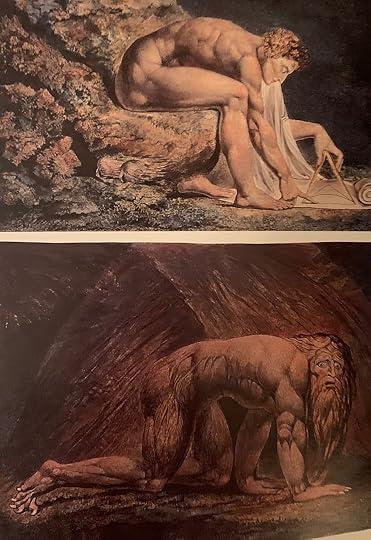
Several selections of Blake’s art seem most appropriate to include in this review. Perhaps the most stunning is the comparisons and contrasts one can make between his depictions of Newton and Nebuchadnezzar; both are huddled over like animals and the viewer senses the seemingly palatable desire to escape animality that emanates from them both.
Newton & Nebuchadnezzar
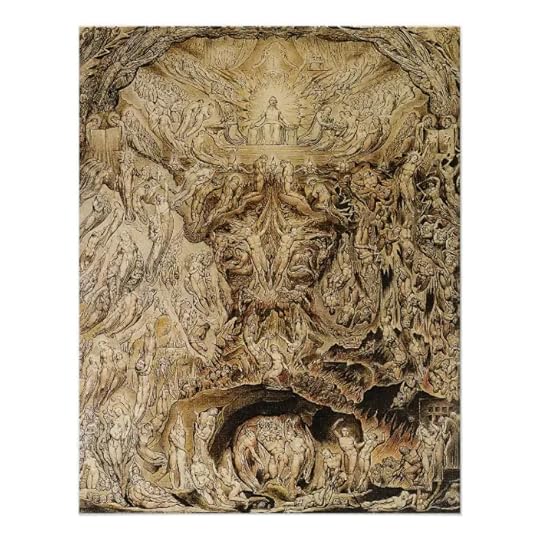
Blake’s Vision of the Last Judgement, is a haunting graphic of interwoven detail, from which an outer layer can be discerned. This outer layer seems to emerge into the foreground as a horned beast when one studies the painting at length. Then there is this other animal-like figure at the top, seemingly rising from behind the throned figure, largely above it, as an open armed being, arms outstretched, and head upward, as if in worship or exultation. Vision of Last Judgement
Blake’s Visions
The phrase commonly used by psychologists for Blake’s condition is “eidetic imagery”, which is a condition where a person sees objects that are not present but which they still describe as though they were present. Such persons have enormous difficulty distinguishing between a subjective and objective world. Some of the things Blake saw as reality include:
-a tree filled with angels -the prophet Ezekiel in the fields -a city filled with angels and prophets -In Westminster Abbey, he suddenly saw the old cathedral filled with a great procession of monks, priests, choristers, and censer-bearers, complete with the audio of song, chorale and organ music. -his brother’s spirit leaping from his dead body -in his own words, “lands of abstraction where spirits of the dead wander” -the ghost of Michelangelo -the Angel Gabriel -a horrible firm figure, scaly, speckled, very awful, stalking down stairs toward him and that revisited him from time to time - he called this thing ‘The Ghost of a Flea’ and completed art to illustrate it. -He contended that he saw and/or conversed with Socrates, Herod, King Saul, Joseph & Mary, and Voltaire
Conclusion
William Blake is certainly a unique historical figure and one worthy of knowing. Learning more about him will change how one thinks about art in general. For there is the sort of art produced commercially, such as Blake’s engravings and the computer-generated images we have today. But beyond that is the art that is an attempt to portray things we experience inside ourselves. It is this latter art that moves and mystifies us because it reminds us of the vast inner spectrum within ourselves that we so rarely access.