“A valuable primer on foreign a primer that concerned citizens of all political persuasions—not to mention the president and his advisers—could benefit from reading.” —Michiko Kakutani, The New York Times
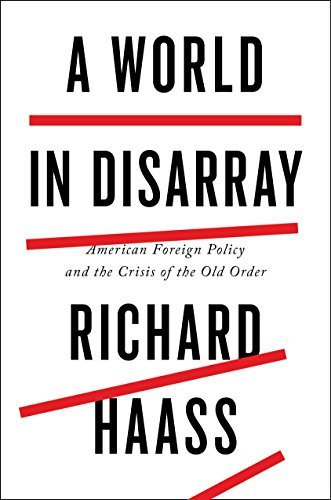
An examination of a world increasingly defined by disorder and a United States unable to shape the world in its image, from the president of the Council on Foreign Relations
Things fall apart; the center cannot hold. The rules, policies, and institutions that have guided the world since World War II have largely run their course. Respect for sovereignty alone cannot uphold order in an age defined by global challenges from terrorism and the spread of nuclear weapons to climate change and cyberspace. Meanwhile, great power rivalry is returning. Weak states pose problems just as confounding as strong ones. The United States remains the world’s strongest country, but American foreign policy has at times made matters worse, both by what the U.S. has done and by what it has failed to do. The Middle East is in chaos, Asia is threatened by China’s rise and a reckless North Korea, and Europe, for decades the world’s most stable region, is now anything but. As Richard Haass explains, the election of Donald Trump and the unexpected vote for “Brexit” signals that many in modern democracies reject important aspects of globalization, including borders open to trade and immigrants.
In A World in Disarray, Haass argues for an updated global operating system—call it world order 2.0—that reflects the reality that power is widely distributed and that borders count for less. One critical element of this adjustment will be adopting a new approach to sovereignty, one that embraces its obligations and responsibilities as well as its rights and protections. Haass also details how the U.S. should act towards China and Russia, as well as in Asia, Europe, and the Middle East. He suggests, too, what the country should do to address its dysfunctional politics, mounting debt, and the lack of agreement on the nature of its relationship with the world.
A World in Disarray is a wise examination, one rich in history, of the current world, along with how we got here and what needs doing. Haass shows that the world cannot have stability or prosperity without the United States, but that the United States cannot be a force for global stability and prosperity without its politicians and citizens reaching a new understanding.
Dr. Richard Nathan Haass is in his fourteenth year as president of the Council on Foreign Relations, an independent, nonpartisan membership organization, think tank, publisher and educational institution dedicated to being a resource to help people better understand the world and the foreign policy choices facing the United States and other countries.
In 2013, he served as the chair of the multiparty negotiations in Northern Ireland that provided the foundation for the 2014 Stormont House Agreement. For his efforts to promote peace and conflict resolution, he received the 2013 Tipperary International Peace Award.
From January 2001 to June 2003, Dr. Haass was director of policy planning for the Department of State, where he was a principal advisor to Secretary of State Colin Powell. Confirmed by the U.S. Senate to hold the rank of ambassador, Dr. Haass also served as U.S. coordinator for policy toward the future of Afghanistan and U.S. envoy to the Northern Ireland peace process. In recognition of his service, he received the State Department’s Distinguished Honor Award.
Dr. Haass has extensive additional government experience. From 1989 to 1993, he was special assistant to President George H.W. Bush and senior director for Near East and South Asian affairs on the staff of the National Security Council. In 1991, Dr. Haass was awarded the Presidential Citizens Medal for his contributions to the development and articulation of U.S. policy during Operations Desert Shield and Desert Storm. Previously, he served in the Departments of State (1981–1985) and Defense (1979–1980), and was a legislative aide in the U.S. Senate.
Dr. Haass also was vice president and director of foreign policy studies at the Brookings Institution, the Sol M. Linowitz visiting professor of international studies at Hamilton College, a senior associate at the Carnegie Endowment for International Peace, a lecturer in public policy at the Harvard Kennedy School, and a research associate at the International Institute for Strategic Studies. A Rhodes scholar, Dr. Haass holds a bachelor’s degree from Oberlin College and master’s and doctorate degrees from Oxford University. He has also received numerous honorary degrees.
Dr. Haass is the author or editor of thirteen books on American foreign policy and one book on management. His latest book is A World in Disarray: American Foreign Policy and the Crisis of the Old Order, published in 2017 by Penguin Press.
I think Richard Haass is a genuinely smart and interesting foreign policy thinker, so I was very disappointed with this boring and uninspired book. Having read it I'm not even certain what the thesis was. It might've worked as "World Order for Dummies" or a guide to world events for someone who has been in a coma since the end of World War II but other than that there was nothing appealing I could see here. He explains the Westphalian system and then proceeds to just recount the events of the past several decades without any real structure or thrust to his argument. His solutions to make a world order more appropriate to the challenges of globalization are nothing unprecedented or surprising and he doesn't go into a lot of detail about how to achieve them.
Haass also understandably has a very U.S.-centric view of the world but his lack of candor about recent American failings (which he had considerable proximity to given his role in several administrations) is disappointing and undercuts what could have been an interesting aspect of such a book. It seems like Washington is also the only place where you can uncritically heap praise on Henry Kissinger without any tinge of irony. Ultimately I got little out of this and would not recommend it, unlike Mr. Haass's Foreign Affairs essays which are often excellent.
Actually, I listened to this book and found it timely and thought-provoking. Mr. Haass is obviously well qualified to address the material presented. He clearly describes the history and other factors that have led to the situation we find ourselves in today.
He gave me reasons for optimism because the challenges we face and their complexity can be clearly understood. He also offers some policy prescriptions to address many of the issues. However, he ends the book by delineating the political deficiencies in our nation today. He acknowledges that a core issue is a need for an informed and engaged electorate.
I think our political system is broken and the reforms needed to begin a healing are beyond our ability to implement. We the public, our elected politicians, our national legislative institutions and our media organizations are woefully incapable of doing what is needed in a functioning democracy. The future of our role in a complex world is bleak.
The political evolution of humankind has led us to the present system of sovereign states, most of which respect human rights and the rule of law, but the interaction of these sovereign states used to be arbitrary and heavily influenced by the power structure. There is no global government or an international executive to maintain peace and order. The world has gone to war several times because of the lack of a centralised government. However, politicians, diplomats and military strategists have devised various tools to ensure peace and security in modern times. These tools, whether conceptual or institutional, lay the foundation of an international order. A World in Disarray: American Foreign Policy and the Crisis of the Old Order by Richard Haass aims to examine the history and evolution of world orders and the prospects for an improved version of the global order.
Haass is the president of the Council on Foreign Relations and has served as the senior Middle East adviser to George H.W. Bush, president of the United States between 1989 and 1993. The book is divided into three parts. The first traces the history of world orders up until the Cold War. The second discusses problems faced by the global community in the present times. The third tries to make recommendations for improving the existing world order.
Haass has conveniently ignored the atrocities committed by the dominant powers in the name of maintaining order. Noam Chomsky highlights this problem in his book World Orders: Old and New in these words: “One revealing example is the standard current interpretation of the campaign of slaughter, torture and destruction that the United States organised and directed in Central America through the 1980s to demolish the popular organisations that were taking shape, in part under Church auspices. These threatened to create a case for functioning democracy, perhaps allowing the people of this miserable region, long in the grip of US power, to gain some control over their lives; therefore, they had to be destroyed.” Whether it is the record of the US in Central America as explained by Chomsky, or the CIA-sponsored toppling of the elected Iranian government of Mohammed Mossadegh in 1953 and re-imposition of monarchy, or the outcome of supporting jihadists in Afghanistan against the Soviet Union and how the policy backfired later on, Haass chooses not to mention such contradictions and does not consider them important enough mistakes for the US to learn from before formulating new policies to establish the World Order 2.0 so much cherished by Haass. Moreover, he does not discuss the mainstream criticism made on international financial institutions and how they can be reformed in his proposed World Order 2.0.
While analysing Sino-American relations, Haass is more concerned about the anti-Soviet sentiment that was prevalent in both countries prior to 1989. It is as if the ‘real’ common ground has been lost after the demise of the Soviet Union. He is underselling the economic interdependence both countries have today.
The chapter ‘Global Gap’ plays the significant role of assessing the various challenges being faced by the international community. For example, it discusses the issues of state sovereignty, right of self-determination, doctrine of right to protect, humanitarian interventions and nuclear proliferation in detail. However, issues such as climate change, global health, and most importantly, the role of the World Trade Organisation and International Monetary Fund have only been discussed in passing. This is perhaps because much of the disarray in these areas can be blamed on major powers such as the US, instead of small countries that are an easy target of criticism.
In the chapter ‘Regional Realities’, Haass briefly discusses every region of the world. He describes both Latin America and Africa as stable or less volatile for international order because, according to him, there are no geopolitics and no threat of nuclear proliferation either. The existence of intra-state conflicts and widespread inequalities both within and across countries has not been considered as a genuine threat to the international order by Haass. It reflects on his viewpoint, according to which the economic problems of ordinary citizens are not serious enough to be discussed in a treatise analysing the world order, although dissatisfaction over economic conditions can lead to violent revolutions.
While discussing the rise of China and resurgence of Russia, Haass states: “Both Russia and China place an emphasis on their respective ‘near abroads’: the European countries to its West in Russia’s case, the South and East China Seas in the case of China’s.” He fails to mention here that the US had similar ambitions in Latin America as well, that were embodied in the Monroe Doctrine enunciated by the American president James Monroe in 1823. The only solution Haass can think of for these Russian and Chinese hegemonic designs is increased vigilantism by the US. He prescribes enhanced military presence for these “anticipated” transgressions by Russia and China. But what he conveniently ignores is the question of who will safeguard the world against the transgressions of the US. On the one hand, he rejects the idea of unipolarity and even multipolarity and argues for non-polarity, but on the other, he wants the US to take unilateral action against other powers.
An honest proposal for the establishment of any new world order should be made from a neutral viewpoint regarding various competing national interests. However, the proposal by Haass seems to be a rallying call for the US to pursue its national interests in the name of creating a new world order. It has been taken as an assumption that whatever the US government will perceive to be in its national interest will serve the interest of the global community as well. A litmus test was recommended by the old guru of American foreign policy, Henry Kissinger, in his book World Order: “The vitality of an international order is reflected in the balance it strikes between legitimacy and power and the relative emphasis given to each. Neither aspect is intended to attest change; rather, in combination they seek to ensure that it occurs as a matter of evolution, not a raw contest of wills.” The World Order 2.0 proposed by Haass lacks this balance between legitimacy and power.
The author’s prescriptions are more focused on what the US should do and neglects what China should do, even though Chinese actions are becoming more important for the maintenance or creation of a new global order. Major uncertainty lies with China’s foreign policy as its economic power grows. Therefore, more thought should have been given to that.
Haass discusses Pakistan as a country supporting terrorists, having weak civilian control, providing sanctuaries to the Afghan Taliban and interfering inside India. This reflects the author’s lack of a deeper understanding about this country. He does not mention Pakistan’s sustained efforts to eliminate terrorism from its soil, nor does he take into account the recent appreciation of the Pakistani economy by international financial institutions and the future economic prospects of the country in the wake of the China-Pakistan Economic Corridor and One Belt, One Road initiative.
Haass explains the evolution of the international system briefly and in easy terms, but sometimes this brevity and simplicity is achieved at the cost of ignoring key factors and cardinal personalities that set the course for the future of the international order. For academics, what the book lacks in rigour, it gains in simplicity for the layman. Overall, it is a good read for students of international relations and general readers who are interested in an overview of the global issues we face today. In terms of a neutral stance, however, whatever Haass writes cannot be taken at face value. Immanuel Kant, the great German philosopher, dreamed of a voluntary federation of republics with a strong commitment to non-hostility and transparent domestic and international conduct. Let us hope for the dawn of such an era with the help of a scholar pointing the pathway towards that direction.
I was so excited to read this book, partially because Richard Haass always seemed like a thoughtful, straight-ahead kind of guy on all the political talk shows. And everyone seemed to have good things to say about this book.
The structure of the book is incredibly appealing: starting with the lessons of WWI and WWII (I think the most compelling parts of the book), then going through the period leading to the end of the Cold War, and finally dissecting everything that's been going on around the world since then. His views of the US, Europe, Asia, Africa and Latin America are in general very interesting.
But half way through the book my antennae started to go up, and as I rounded the bend entering the last fourth of the book, my innocent questions evolved into a full scale rebellion...platitude upon platitude, looking at things from one hand and then the other hand...very soon we ran out of hands and it was hard to know what policies made sense and which ones didn't.
I'll share three examples of things in the last part of the book that left me shaking my head in bewilderment: 1) In discussing the proper way to negotiate with Asians in general, and China specifically, Haass refers to the famous Woody Allen line: "80% of success is showing up." Haass modifed this to say: "When it comes to negotiating with Asian countries, 80% of success is following up." At first, you nod your head and say..."that's clever and interesting." But when you think more about it, it comes across a pure pablum. So "following up" works particularly well with Asians, and not other countries? And is that really the essence of success? Catchy line, but naive bordering on nonsense. 2) He frequently uses phrases like "that is a condition to be managed, and not a problem to be solved". Or "To set modest goals is to squander opportunities." Again, at first blush one thinks that his great experience has led to great wisdom. Platitudes and pablum. 3) Ah, the coup ferre was reverting to fairy tales to explain the Middle East challenges. For example: "The Middle East situation is similar to Humpty Dumpty." And believe it or not: "Goldilocks was the ultimate centrist." Brother.
By now everyone knows that one of the weakest moments of the Obama presidency was his failing to act when Syria crossed the "red line". Haass hammers on this over and over and over again, with no real additional insight. This reader was yearning for something new and insightful to be shared, but wasn't to be.
I was shocked and disappointed with how this book didn't live up to expectations. And when I see Haass on Morning Joe, he now comes across to me as a very weak talking head.
One final thought: I recently read Al Franken's new book as an Audiobook and hearing Franken's voice added a huge amount to the great experience of listening to that book. Not sure who it was that read Haass's book, but the monotone, listless voice was definitely not a plus. I wish Haass would have read the book.
I was really disappointed with this book. The author is one of my favorite TV commentators and I think he is brilliant. However, this book was very elementary. I learned almost nothing that I did not already know.
I liked this book especially as it relates to the challenges of 2017. It is Foreign Policy for Beginners and I highly recommend you read it. It would be impossible to recommend a book more highly than this in 2017. Now then, once you've absorbed this book, I think the most brilliant thinker in American Foreign policy circles is Andrew Bacevich, I eagerly await his next book. If you read "Disarray" and liked it, I would also highly recommend Andrew Baceivich's "The Limits of Power" as a second helping.
This is a book based on a series of 2015 scholar-practitioner lectures (more the latter, I would say). The book has three parts and the first two are just boiler-plate International Relations history and some 101 foreign policy - basically, largely unnecessary stuff that could have been fitted into an intro chapter. The last section is more interesting, as it has some actual policy analysis and prescriptions for maintaining 'international order', written from a US-centric world view. These are also a bit banal, with the main one being that the world's leading major power should pursue what he calls 'sovereign obligation', which is a kind of realism for the era of globalisation, although it is not very clear how this policy would function in practice. Essentially, it seems to involve keeping rising powers such as China and Russia in the international system but without giving up the need to curb their ambitions to challenge US power (neither of which seems to be going too well at present). There is an interesting chapter on US domestic politics, and the need to increase defence spending (!), and cut taxes (both of which Trump is doing), and to cut the debt (which he is not doing) and maintain US credibility. Finally, there is a postscript written in 2017, post-Trump, and this is a analysis of the risks of the America-first isolationist policy espoused by the President. This is quite pessimistic and rightly so, given that the current policy seems to be at odds with the notion of a US-led 'international order', though he does note that rhetoric and reality may not always be the same thing in policy. A whole book on the challenge to international order inherent in Trump's brand of personalised US foreign policy would have been more interesting.
I think this book is quite useful as a primer, but it does not offer any particularly deep insights into the state of today's world. This is the main reason for my two-star vote.
The book is quite readable, however the information contained in it will come across as fairly basic to anyone already initiated in international affairs. Haass devotes the first two thirds of the book to a generalized historical overview of international relations, starting with the Westphalian state system and ending with the rise of greater global governance and unipolarity in the 1990s. This is useful as 'refresher' material. Essentially, Haass argues that inter-state rivalry gave the world some measure of order, and that the apparent retreat of inter-state rivalry after the Cold War was actually disordering in its own way. There was no normative consensus across much of the post-Cold War world, and globalization has brought these differences between and within states to the fore. Haass' solutions, which are the subject of the final third of the text, amount to a kind of international relations realism that is suited for the globalization context. This means, essentially, a renewed normative commitment to state sovereignty along the Westphalian model and the abandonment of Western attempts to influence the internal affairs of other states and establish global normative consensus on issues like human rights. However, in spite of this tilt towards realism, especially a renewed commitment to the concept of state sovereignty, Haass argues that the new post-globalization understanding of sovereignty must involve the notion of "sovereign obligation". That is, a country must realize that its sovereignty depends in part on being a responsible stakeholder vis. other states on global issues that affect everyone. This is quite different from the idea that sovereignty of a country is contingent on how it treats is subjects/citizens, which was the understanding of sovereignty (and a country's forfeiture of that right, if it did not behave responsibly) of American presidential administrations in the 1990s and 2000s.
I found this book interesting in giving me a better understanding of our foreign policy and its history. I would certainly disagree with many of the recommendations he throws out at the end though. No, our corporate tax rate isn't out of line with other countries if you look at the effective rate rather than the statutory rate. Our National debt also isn't getting out of control (unless Trump provides more massive tax cuts for the rich). No need to cut Social Security or raise the retirement age. I also don't see the need to increase military spending although it would be good to reallocate it away from congressional pet projects that serve no security need.
Even if you don't read much, read this one. Rarely have I seen so well written book about history, politics, economics, and security issues that the whole world is now facing. It also comes up with suggestions as how to solve those.
Now more than ever (as there are major issues facing the world) people need to read, discuss, and more important than ever, find consensus and start working on those issues.
Up until very recently, I have not paid too much attention to politics, especially world politics, except to exercise my right to vote. Shame on me. In today's political climate, I decided it was time for me to educate myself. A World in Disarray is a very enlightening overview of the complexities of world affairs and the U.S.'s place of responsibility. I will definitely read more of Richard N. Haass' work.
It would be difficult to identify anyone other than Henry Kissinger who represents the tradition of America’s bipartisan foreign policy more fully than Richard A. Haass. Haass is the longtime president of the Council on Foreign Relations, which comes as close as any institution to sitting at the center of gravity for the internationalist wing of the Eastern establishment. For decades before he began at the Council, he cycled in and out of senior policy planning and diplomatic posts in government and a series of positions in academia and other establishment thinktanks. If you want to get a handle on the conventional wisdom that emanates from that elite group of scholars and officials, read Haass’ latest book, A World in Disarray: American Foreign Policy and the Crisis of the Old Order.
The three phases of international relations
Haass’s abbreviated survey of international relations in the modern world divides history into three phases. The first began with the Treaty of Westphalia in the mid-17th century that ended Europe’s Thirty Years War and established the primacy of the sovereign state. That phase lasted through the end of World War II, which upended world affairs in profound ways. The second phase lasted from 1945 until the end of the Cold War in 1989. This was a period of superpower supremacy, the absence of large-scale conflict, and unsurpassed economic growth. We now live in the third phase, a troubled “world in which centrifugal forces are gaining the upper hand.”
Haass argues that “the past twenty-five years since the end of the Cold War constitute a break with the past . . . [S]omething very different is afoot in the world.” He characterizes the current state of affairs as “disarray.” In his view, the word “captures both where we are and where we are heading.” This is not the multipolar world so many observers write about. It’s a nonpolar world. “Power is more distributed in more hands than at any time in history,” Haass notes. “The same holds for technology.” In Haass’ view, the multiple uncertainties and dangers of today’s world require that the United States be more assertive on the world stage. He “argues for the stationing of military forces in and around areas that either China or Russia might claim or move against, something that translates into maintaining increased U.S. ground and air forces in Europe and increased air and naval forces in the Asia-Pacific.” Other observers might see greater reliance of this sort on the U.S. military as a prescription for bankruptcy at home and dangerous conflict abroad.
A new approach to foreign policy
The essence of Haass’ thesis is that the concept of state sovereignty established by the Treaty of Westphalia is no longer adequate in a nonpolar world. Today’s international landscape is no longer dominated either by the major powers or exclusively by nation states. Nonstate actors, including international and regional organizations, corporations, terrorist groups, some major cities, and numerous other entities all play roles in setting the direction of civilization today. Haass contends that “the post-World War II order—effectively World Order 1.0—provided only a degree of structure for the international system once the overlay and discipline of the Cold War order disappeared. Just as important, the world was not well positioned to deal with the diffusion of power that was to come.”
In this much more complex environment, U.S. foreign policy must be directed toward establishing a new concept in world affairs: “sovereign obligation.” Haass views this as the ideal operating principle in contemporary international affairs. Under sovereign obligation, every state would be expected not merely to tend to its domestic affairs but also to play a role in addressing the multiple global challenges that bedevil us today: nuclear proliferation, climate change, terrorism, restrictions on trade, threats to global health, the vulnerable state of international finance, and the abuse of cyberspace. (The author’s laundry list does not include drug trafficking.)
It’s difficult not to see this prescription as wishful thinking. Another failing in Haass’ analysis is his failure to distinguish between global threats that are existential and those that aren’t. Any dispassionate observer of climate change, nuclear proliferation, and the growing potential for pandemics would surely agree that any of these three challenges could be fateful for civilization if not for the human race. The other challenges in Haass’ list, while serious, do not rise to the same level. Global trade could constrict, terrorism increase, the international financial system seize up, and cybercrime and cyberwarfare proliferate, but it’s highly unlikely that any of these events would end human civilization, much less lead the human race to extinction.
“What is to be done?”
Haass makes clear his belief that yesterday’s foreign policy is not adequate for “a world in which not all foes are always foes and not all friends are always friendly.” He advances a detailed set of recommendations, not just for U.S. foreign policy but for changes in domestic policy as well. His advice about foreign affairs is, as anyone might expect, highly nuanced. On domestic affairs, his approach is less so. It’s hard to distinguish from traditional moderate Republican policies. For example, he advocates both decisive action to reduce the nation’s debt and increasing the Pentagon’s budget. To enable all this, he favors raising the retirement age, reducing Medicare and Medicaid, and eliminating tax deductions for home mortgage payments and charitable deductions. Wishful thinking again, given any reasonable expectation for Congressional action.
A nonpartisan analysis?
At the outset of A World in Disarray, Haass claims that his analysis will favor neither Republicans nor Democrats. It doesn’t come across that way. It’s true that he is pointed in his criticism of the decision to invade Iraq and of the conduct of the war that followed. But his discussion of President Barack Obama’s foreign policy is savage. Haass reserves his most hard-edged criticism for Obama’s decision to accelerate the drawdown of troops from Iraq, the conduct of the war in Afghanistan, the outspoken support for the Arab Spring, the intervention in Libya, and the decision not to attack Syria after Hafez el-Asaad crossed the “red line” by using chemical warfare on his citizens. This is not a nonpartisan analysis.
About the author
President of the Council on Foreign Relations since 2003, Richard A. Haas has also served as a senior advisor to President George H. W. Bush and to his son, President George W. Bush, as well as in a number of other diplomatic and scholarly posts. A World in Disarray is his 12th book.
The book could be labeled as U.S foreign policies for dummies. For those who need some gap-filling about US foreign policy choices particularly during and after the Cold War, the author did a decent job laying out both sides of the argument leading to an action or non-action he also provided the lessons-learned, drawing from the intended and unintended consequences. I found the author’s approach to historical events non/provocative and by in large non-biased. In the forward-looking part, Haass made his arguments and offered his solutions in the framework he called world order 2.0, where he emphasized sovereign obligations over sovereign rights. The issues being discussed include nuclear weapon proliferation, climate change, cyber sdecurity and global health. The solutions were more in principle than in practice. I found the history session the stronger of the two. Overall this small book was an enjoyable read.
Comprehensive review of the World and the US Role in it since WWII. His breakdown of the Eras and Regions make the book easy to follow. The book pretty much covers my lifetime and while I don’t consider myself a scholar of Modern World History, I did follow and recognize most of the players and events that Haass deals with. It served as a good review and a good basis for understanding the importance and impact of so many of the events we hear about each day.
With Trump trying to overturn the History and Future of the Western World we used to know, it is increasingly important to know where we are and how we got here. Haass’ book warns us of the pitfalls awaiting a World subjected to his whims, fears, needs and impulses!
I thought this was a fantastic read. I haven't read something as currently relevant about foreign policy in a long time and this was an intriguing and i thought, fairly neutral, perspective. Very informative!
A nice succinct book by a respectable practitioner, neatly summarizing the historical background of international political order, and contemporary challenges. The major challenge for any book of this nature is that it quickly becomes out of date. While the broad strokes remain relevant, 2017 in many ways seems like an eternity ago, since it is pre-Trump's first term, pre-pandemic, etc.. While much has changed the book is still instructive and insightful. Unfortunately many of his sensible recommendations continue to go unheeded by his compatriots.
In the post-Cold War era, globalization is a major source of global disorder and, considering the factor of globalization constant, the solution lies in introducing sovereign obligation beyond borders. This is the central idea of the book.
The book consists of two major themes: World Order 1.0 and World Order 2.0.
World Order 1.0
Before 1648, the world was full of disorder. A conflict born of frequent interference inside the borders of one’s neighbours had been the norm. The strongest entity, whatsoever it was, imposed the order.
However, four centuries ago, in January 1648, in Europe, the Peace of Westphalia ended the Thirty Years’ War (a part-religious, part-political struggle within and across borders that raged across much of Europe for three decades), and the concept of sovereignty surfaced first time in the form of the right of states to an independent existence and autonomy. The order established consequently “revolved around states and above all the major powers of the day. The principal element of the new order was a shared respect for one another’s sovereignty, something that reduced the frequency and intensity of meddling in what was understood to be one another’s internal affairs and, as a result, the chance of war. Buttressing acceptance of this principle – a common definition of what was legitimate when it came to foreign policy – were a balance of power [involving independent states as sovereign states that do not interfere in one another’s ‘internal business’] and a regular diplomatic process that helped manage what could turn out to be challenges to the existing order” (p. 209).
Order cannot be established without legitimacy. “It is useful to deconstruct the concept of order, to break it down into its most essential elements. One critical element of order is the concept of ‘legitimacy’ defined by [Henry] Kissinger to mean ‘international agreement about the nature of workable arrangements and about the permissible aims and methods of foreign policy” (p. 21). Kissinger made clear that “order depended both on there being rules and arrangements to govern international relations and on a balance of power” (p. 22). On the other hand, “Disorder, as explained by both [Hedley] Bull and Kissinger, reflects the ability of those who are dissatisfied with existing arrangements to change them, including through the use of violence” (p. 22).
Over the years, the world had gone conscious of human rights and liberty and after the respect for a state sovereignty, respect for human sovereignty was major goal achieved. “The Universal Declaration of Human Rights, adopted by the UN General Assembly in 1948, notes that every person on the planet without exception possesses a broad and extensive range of rights…Still it is noteworthy in expressing the position that states are not the only ones with rights” (p. 64). Moreover, “The Universal Declaration of Human Rights both reflected and contributed to the growing salience accorded to human rights concerns” (p. 66).
In August 1975, Helsinki Conference in Europe reinforced both state sovereignty and human sovereignty. “The Final Act that emerged in 1975 in Helsinki from the Conference on Security and Cooperation in Europe was a remarkable document [consisted of a ten point agenda]. On one level, it reads as a tribute to the classic Westphalian notion of order. It is a multilateral accord premised on state sovereignty, the impermissibility of the threat or use of force, the inviolability of borders, respect for the territorial integrity of all European states, a commitment to the peaceful settlement of disputes, and acceptance of the principle of nonintervention in one another’s internal affairs. The one exception to this traditional approach was a commitment by all governments to respect human rights and fundamental freedoms within their own borders” (p. 51). The order based on respect for sovereignty continued and could be called World Order 1.0.
In August 1990, after Iraq attacked Kuwait (in the twilight of the Cold War), UN spoke for “military force, to liberate Kuwait” couched in the words the ‘use of all necessary means’. Consequently, “An American-led international coalition accomplished the mission in short order, demonstrating the existence of a balance of power in the Middle East upheld by the United States and that strongly favoured those preferring a version of the status quo to far-reaching change” (p. 104). In this way, the Westphalian order based on state sovereignty was restored.
After the end of the Cold War in December 1991, the international system has not only experienced certain structural changes but also saw the diffusion of capacity into more hands than ever before. Consequently, there have emerged more decision makers and independent actors affecting the course of events both regionally and globally. The consequent challenges have made the world fall into disarray [i.e. confusion] and head for a disorder. “[T]he trend toward disorder has been a function of structural changes in the international system – above all, the diffusion of capacity into more hands than ever before – exacerbated at critical times by the action (and inaction) of the United States and other powers” (p. 211). This is how globalization has come into action. “Globalization, with its vast, fast flows of just about anything and everything real and imaginable across borders, is a reality that governments often cannot monitor, much less manage. The gap between the challenges generated by globalization and the ability of a word to cope with them appears to be widening in a number of critical domains” (p. 11).
Globalization is with consequences. “A cardinal reality associated with globalization is that little stays local in terms of its consequences…Almost anyone and anything, from tourists, terrorists, and both migrants and refugees to e-mails, weapons, viruses, dollars, and greenhouse gases, can travel on one of the many conveyor belts that are modern globalization and reach any and every corner of the globe. So much of what has historically been viewed as domestic and hence off-limits because it took place within the borders of a sovereign country is now potentially unlimited in its reach and effects. The result is that we no longer have the luxury of viewing all of what goes on in another country as off-limits” (p. 226). This is how globalization has challenged the sovereignty-dominated international system. “In addition, the realities of globalization and the potential for contagion gave all governments a stake in one another’s adopting responsible practices” (p. 148).
Globalization has brought its own challenges. “The result is a world not just of more capacity in more hands but also of more decision makers and independent actors. Consequently, a host of global and regional challenges have emerged that are proving to be far more than the major powers can contend with. A short list of these challenges would include the actual and potential spread of nuclear weapons and long-range delivery systems, terrorism, a spike in the number of refugees and displaced persons, a chaotic Middle East, a Europe under siege, a precariously balanced Asia-Pacific, a largely ungoverned cyberspace, an inadequate response to climate change, a growing rejection of free trade and immigration, and the potential for a pandemic that could cost many millions of lives” (p. 211). These challenges shove the world towards disarray.
In the presence of globalization the World Order 1.0 has gone inadequate to meet the emerging complications born out of globalization affecting all sections of the globe. Consequently, a problem in one country cannot be confined to one country and it is bound to grip other countries and the formula of respect for sovereignty is failing to offer a solution.
In September 2005, the United Nations convened a World Summit and asked all member states to practice sovereign responsibility. “What gradually emerged from this conundrum was the notion of “Responsibility to Protect,” or R2P, as it became widely known. The idea was enshrined in a 2005 statement of a “World Summit” convened by the United Nations. ‘Each individual state has the responsibility to protect its populations from genocide, war crimes, ethnic cleansing and crimes against humanity.’ Such a statement of sovereign responsibility was significant. But what made R2P even more significant was an associated notion, namely, that the ‘international community’ also had the responsibility to help to protect populations from the same four threats, including through the use of military force if need be, regardless of whether the government of the country involved asked for it or even if it opposed outside involvement. The world’s governments expressed their preparedness to take ‘collective action in a timely and decisive manner’ on a case-by-case basis, acting in concert with the relevant regional organization or the UN itself” (p. 116).
In this way, whereas the Westphalian treaty focused on regulating the external behavior of states, the 2005 statement of the World Summit focused on regulating the internal behavior of states. Secondly, other governments or the international community was empowered (in both right and responsibility) to act to protect innocent people when their government fails to or could not do so (to fulfill the needs of the Universal Declaration of Human Rights). In this way, human sovereignty of a citizen was attached to the right and responsibility of states, other than the native state, besides diluting the sovereignty of a host states.
The statement was also a restraining factor. “The notion that governments enjoy a relatively free hand to act as they wish within their borders. This concept has been constrained by the Universal Declaration of Human Rights [December 1948] and the Genocide Convention [December 1948]. It has also been conditioned by the promulgation and widespread acceptance of the Responsibility to Protect [R2P] doctrine” (p. 234). The mere presence of the restraining factor made several countries suspicious of R2P. “Not surprisingly, R2P is viewed with unease or outright suspicion by many governments that fear it might be used against them by those with hostile agendas. It can also be cited (as was done by Vladimir Putin in the case of purportedly acting on behalf of ethnic Russians living in Ukraine) [in August 2014] as justification for intervening in the domestic affairs of another country. Such an interpretation is reminiscent of pre-Westphalian times” (p. 227).
Here lies a problem. “[S]tate sovereignty constituted the fundamental building block of international order” (p. 104). “One of the widely shared principles of the post-World War II era was the notion of self-determination, that people living in colonies had the right to have sovereign, independent countries of their own. The principle was so broadly embraced that it often included sympathy and even outright support for the use of violence in its pursuit. Self-determination was thus a fundamental tenet of the post-World War II order” (p. 107-108).
There are found three kind of states. “It is only a slight exaggeration to suggest that the dominant foreign policy challenges confronting the United States and the world for much of the 1990s stemmed from internal conflicts of this variety and from weak rather than strong states. Strong states need no definition, but weak states arguably do. What makes a state weak is not an inability to project military power or fight wars beyond its borders so much as its inability to control what takes place within its borders. It is a lack of capacity, one that often leads to large swaths of territory (often termed ‘ungoverned spaces’) being outside the writ of the government. A failed state is simply the extreme version of a weak state, one in which governmental authority effectively collapses, leading to chaos, the rise of local gangs and militias ruling over parts of the country, or both” (p. 111). The first example was Iraq, then Somalia, Haiti and Rawanda, open space for humanitarian intervention.
If a right of self-determination and humanitarian intervention remain separate, it is fine but not otherwise if both coalesce. “But less clear and certainly less broadly embraced was the notion of a right of self-determination for peoples living within established nation-states. Unlike those seeking to get out from under colonial rule, self-determination broadly applied would not be a one-time affair. To the contrary, it could be potentially unlimited in its application. What is more, if it applied to groups living within countries, it threatened the idea and the ideal of state sovereignty, in that sovereignty could be attacked and undermined not just from the outside but from within. It was thus a potential threat to the integrity of many countries as well as to the basis of international order” (p. 108).
Related to R2P, the message of worry for China, Russia and India was that “what might be described as diluted sovereignty could be turned against them if they ever felt compelled to do things at home that outsiders found objectionable. Later (in the aftermath of the 2011 Libyan intervention) they became even more concerned when they saw what began as a humanitarian intervention quickly evolve into something much more, that is, regime change. This experience reinforced their deepest fear that R2P represented the thin end of the wedge of a new, dangerous approach to sovereignty that could all too easily be turned not just against their interests but against them” (p. 117). However, the difference between Iraq’s and Russia’s cases on violation of respect for borders (by annexing Kuwait and Crimea) was that the former was dealt with militarily whereas the latter was dealt with financially by imposing economic sanctions.
The solution lies in improving upon the concept of sovereignty as adopting sovereign obligation (i.e. besides having right and responsibility, sovereign states also have obligations to others, both states and their citizens) which may establish World Order 2.0.
World Order 2.0
Whereas the World Order 1.0 (1648-1991) was about sovereignty of states, the World Order 2.0 is about sovereign obligation. “[T]he need to develop and gain support for a definition of legitimacy that embraces not just the rights but also the obligations of sovereign states vis-à-vis other governments and countries…I call this concept ‘sovereign obligation’, [which] … is fundamentally different from the idea of ‘sovereignty as responsibility,’ which involves a government’s responsibilities to its own citizens and how it forfeits some of the traditional protections and benefits of sovereignty if it fails to live up to those responsibilities, as in R2P” (p. 227). Nevertheless, “[S]overeign obligation is…about a government’s obligation to other governments and through them to the citizens of other countries” (p. 228).
A reflection of sovereign obligation can viewed in one instance. “On March 17, 2011, the UN Security Council passed Resolution 1973, authorizing member states to both ‘take all necessary measures … to protect civilians and civilian populated areas under threat of attack’ [in Libya] and establish a no-fly zone over the whole of the country. Soon after, a ‘humanitarian intervention’ is carried out by a coalition of NATO members led by the Europeans, with the United States ‘leading from behind’ ” (p. 161). However, humanitarian intervention does not come without challenge. “If the United States or any other party calls for and carries out an intervention in the name of R2P, it must be limited to a humanitarian intervention. This is also a matter of sovereign obligation. What happened in Libya, where regime change masqueraded as R2P, undermined the very doctrine it sought to fulfill. If for some reason regime change is sought, it ought to be articulated as such and kept apart from R2P even if the motivation is partly or entirely humanitarian” (p. 236).
Conclusion
For realizing the goal of sovereign obligation, cooperation of all countries or willing countries is required. “[T]he United States for all its power cannot impose order. Partially this reflects what might be called structural realities, namely, that no country can contend with global challenges on its own given the very nature of these challenges…Adding to these realities are resource limits. The United States cannot provide all the troops or dollars to maintain order in the Middle East and Europe and Asia and South Asia. There is simply too much capability in too many hands. Unilateralism is rarely a serious foreign policy option. Partners are essential. That is one of the reasons why sovereign obligation is a desirable compass for U.S. foreign policy [and]… it represents realism for an era of globalization. It is also a natural successor to containment, the doctrine that guided the United States for the four decades of the Cold War” (p. 288). That is, multilateralism is needed to meet the goal of sovereign obligation under World Order 2.0.
A lot has happened within the last 10 days since I’ve read this book about foreign diplomacy: Britain has a new Prime Minister, there’s another series of attacks in Damascus, HK’s protestors are being met with anti-democratic actions, North Korea has fired its second missile test, and Trump now has a go signal from the US Congress to build his wall. That’s why I find it eerie that this book, which was written three years earlier, has chapters dedicated to the specific topics on the future of US-UK relationship, the on-going war on Syria, the world movement toward democracy, the dynamics of Nuclear Non-Proliferation Treaty (NPT), and the American policy on immigration…some of the things that are variables to the US playing a key role in maintaining the world order.
And yet this book I’m referring to—my second #1bookamonth as a follow-up reading to ‘When China Rules The World’—is entitled “A World in Disarray: American Foreign Policy and the Crisis of the Old Order” Wow, sakto. The book, claimed by critics, is a good starting point if you want a crash course of foreign diplomacy. Wow, sakto another.
See, I began having an insatiable curiosity about international diplomacy three years ago when I started following the television series Madam Secretary. I was mesmerized with nice-sounding words like economic sanctions, inducement strategies, bilateral trade agreements, humanitarian interventions, aid packages, coalitions, treaties, UN resolutions. Which lead me to wanting to know more! I wish to understand the concepts behind policy formation, negotiation styles, diplomatic means, appeasement strategies, incentives…then, perhaps, apply some of the thinking in my way of innovating the problem-solving I do for advertising.
Back to the book. It’s author, Richard Haas, served as policy adviser under US Secretary of State Colin Powell, and was in the thick of things when the world was maneuvering its way through the Middle East crisis. He is also a lecturer and an author of several other books on international relations. The book has a central thesis: Why is it that even in the absence of the principal source of disorder—the major power-conflict between supercountries—the world order, 25 years post-Cold War, is now in a state of disarray?
(Commercial: World order. Ano ba yun? It’s not order = peace. World order is a term used in international relations to describe (or, for me, plot) the distribution of power among countries or world powers. Kumabaga, which countries at a given point in history share the key roles in shaping the world economy, politics, and structure. Having said that, going back to the question – why is this world order is such a disarray?)
“Populism and nationalism are on the rise. What we are witnessing is a widespread rejection of globalization and international involvement and, as a result, a questioning of long-standing postures and policies, from openness to trade and immigrants to a willingness to maintain alliances and overseas commitments.”
The premise is that America—the current sole superpower after a long period of US-USSR power struggle, and as such, the major influencer of world order—is already losing power, thus, crumbling along with it are certain views and values that has held the world together into a kind of an international society.
“United States, long the dominant building blocks of international relations, are losing some—and in select cases much—of their sway to other entities. Power is distributed in more hands now than any time in history. Decision making has come to be more decentralized. Globalization, with its vast, fast flows of just about anything and everything real and imaginable across borders is a reality that governments often cannot monitor, much less manage. The gap between the challenges generated by globalization and the ability of a world to cope with them appears to be widening in a number of critical domains. The US remains the most powerful entity in the world, but its share of global power is shrinking, as its ability to translate the considerable power it does have into influence, trends that reflect internal, political, social, demographic, cultural, and economics within the United States as well as shifts in the outside world. The result is a world in which the centrifugal forces are gaining the upper hand.”
In short, the US-led world order is fucking up.
The book is divided into three parts. I’d call them Optimism, Fatalism, then, perhaps, Realism ha ha ha
The first part is a nice field trip throughout the history of international relations. It covers the early days of modern state systems in the mid-17th century, through two world wars of the twentieth century, and on the end of the Cold War. Dito na pumapasok yung US-USSR power-struggle and the other orders happening around that era like the beginnings of anti-nuclear, anti-genocide, anti-chemical weapons conventions and the global alliances and international policies that came off them. Hanggang sa maging US-led world order na sya with the breaking up USSR. This is World Order 1.0 where the era is described as ‘filled with optimism and confidence’.
“Order, such as it was, revolved around states and above all the major powers of the day. The principal element of the new order was a shared respect for one another’s sovereignty, something that reduced the frequency and intensity of meddling in what was understood to be one another’s internal affairs, and as a result, the chance of war. Buttressing acceptance of this principle—a common definition of what was legitimate then it comes to foreign policy—were a balance of power and regular diplomatic process that helped managed that could turn out to be challenges to the existing order.”
The second part is where we are now, the crumbling of the US-led world order as we’ve experienced over the last years. As mentioned earlier, this portion of the book tackles the conundrum wherein wala naman nang global power-struggle dahil it’s just US at the helm and everyone else follows – but why has the world optimism and confidence plummeted? Why, from order, are we experiencing disorder, or as the author has termed it, disarray?
“The trend toward disorder has been a function of structural changes in the international system—above all, the diffusion of capacity into more hands than ever before—exacerbated at critical times by the action (and inaction) of the United States and other powers. The result is a world not just of more capacity in more hands but also more decision makers and independent actors. Consequently, a host of global and regional challenges have emerged that are proving to be far more than the major powers can contend with. A short list of these challenges would include the actual and potential of nuclear weapons and long range delivery systems [Note: Connected to certain breakdown of the Non-Proliferation Treaty or NPR], terrorism [Note: Connected to non-UN approved or ‘illegitimate’ attacks of the US on certain foreign soils], a spike in the numbers of refugees and displaced persons [Note: Connected to the debatable role of humanitarian intervention], a chaotic Middle East [Note: Connected to the Syrian issue and the balancing act of Arab control in the region], a Europe under siege [Note: Connected to Brexit, recently], a precariously balanced Asia-Pacific [Note: Connected to China-centered territorial disputes], a largely ungoverned cyberspace [Note: Connected to the rise of cyberwars], an inadequate response to climate change [Note: Connected to agreements in principle but not in practice], a growing rejection of free trade and immigration [Note: Connected to the global gap of cooperation in some areas and lacking in most], and the potential for a pandemic that could cost many million of lives [Note: Connected to the role of WHO and the cost of commitment from powerful countries].”
The final part is rather prescriptive – What is to be done to stabilize global governance? What can the US do (and not do) to fix its internal affairs that are crucially connected to its influence on international affairs, how can regional issues be addressed—the Middle East conflicts, the Asian disputes, the African humanitarian concerns, the Latin America’s rising favor toward authoritarianism rule, the European Brexit problem—and, how can the global gap be closed as part of moving toward World Order 2.0
“What is done and how it is done matter a great deal […] Under Donald Trump, however, foreign policy shows clear signs of departing from this legacy. Support for alliances, embrace of free trade, concern over climate change, championing of democracy and human rights, American leadership per se—these and other fundamentals of American foreign policy have been questioned and, more than once, rejected. Trump is the first post-World War II American president to view the burdens of world leadership as outweighing the benefits. As a result, the US has changed from principal preserver of order to principal disrupter. The Trump administration’s approach to foreign policy is hardly the one cause of increased disarray in the world, but it is a significant one and surely the most expected […] United States has now introduced a means by which a major power forfeits international advantage. It is abdication, the voluntary relinquishing of power and responsibility. It is brought more by choice than by circumstances either at home or abroad.”
What stayed with me is the author’s introduction of the concept of sovereign obligation. First, he makes it clear that ‘sovereign as responsibility’ is a fundamentally different idea, “which involves a government’s responsibilities to its own citizens and how it forfeits some of the traditional protections and benefits of sovereignty if it fails to live up to those responsibilities, as in Right to Protect (R2P). Whereas, ‘sovereign obligation’ is something altogether different. “It is about a government’s obligations to other governments and through them the citizens of other countries.” Tayong lahat ay may pananagutan sa isa’t-isa, as a popular church hymn goes.
Fast forward to North Korea being allowed to keep its nuclear weapons. Russian occupation of Crimea, India-Pakistan disputes, failing state of Libya, Venezuelan dictatorship influence, China gaining world dominance, and like what I started with, Britain with its new PM, HK’s battle for democracy, Syria under attack yet again, and Trump winning in his pro-security/anti-immigration fight. What does this mean for me?
Right now, it’s a kind of broad awareness that I need to keep me grounded, or centered, or dispassionate when I feel like snapping someone’s neck. “Jao, there are bigger things that matter more,” I’d tell myself, then breathe, ha ha ha. But seriously, this book is teaching me the value of follow through. Yup. The world is in disarray because a lot of good-natured promises that were made lacked the follow through. Coalitions that stopped acting, treaties that that are only good in paper, resolutions that were never enforced. We can learn a great deal from what abdication could do.
Haass’ recent offering to the foreign policy community reflects a world replete with disorder and disarray, and headed further in that direction. Steeped in readable history and first-hand accounts of his time in the State Department’s Policy Planning directorate, the Council on Foreign Relations’ president adds a rich argument about the state of American power our nation needs to hear and understand. Debt, political land mines, alliances and other issues are all conspiring to nibble away at America’s standing and this work serves as a warning to turn the ship around or else the US will continue to lose its standing in the world.
Haass pulls no punches as he praises and criticizes both sides of the political aisle. As this book precedes the Trump presidency, a fair amount of it is now outdated. As the US diplomatic sphere has been weakened, the disarray can only be described as far worse today.
This is a relatively readable and helpful outline trying to set out a framework of what issues/problems need to be solved on a global basis (nuclear proliferation, bio-chemical weapons, health /epidemics, cybercrime/decentralized disinformation, climate change, food security, trade, financial system and clearing, exchange rate policy, migrant/refugees, sovereignty and human rights, arctic exploration etc etc . He then discusses how there need not be one path to legitimacy and consensus, but that ultimately states who are interested in weighing in to change the way other nations are acting need to do so while adhering to legitimacy and in accordance at least with regional or like minded nations' principles--this boiled down to "sovereign obligations". While Haass' analysis of how we got into the mess we are in is more fun to read, the framework is useful in understanding how problems could realistically be resolved or managed. Admittedly the book falls into international relations techno-speak every now and then (or I was just seriously lagged), but it is well worth reading if you want a quick primer on what experienced realistic diplomats should be thinking or using to analyse possible responses to any unpleasant actions by other international actors. Glad I read it--the 3.87 rating is probably pretty right on.
Mr. Haass believes that the United States could and should be a world leader for years to come. To be effective, however, it must set its house in order. In the final chapter of this short, but densely informative book, Haass states that our first task is to ensure that the US economy grows by 3 percent/year. Among the ways to make this happen is maintaining a policy of free trade. Here is where the book gets scary. The last chapter of this book, published in 2016 before Donald Trump was even elected president, is called "A Country in Disarray." The Ship of State had keeled over and was already starting to sink before the election. There is no chance that The Donald will read and heed the policy advice in this important book. He is the last thing the country needs right now, but he's what we've got. SAD. We the people had better take our country back from a do-nothing Congress and a know-nothing President.
Populists votes around the world are rejecting globalization, from the election of Donald Trump to Brexit; modern democracies are counting costs and forgetting past and future benefits. Haass who worked in government since Bush senior, has opinions about what countries can and should do in the shifting global realities.
Why I started this book: I had four holds arrive in as many days, it's time to get cracking. This was the shortest and the one that arrived first.
Why I finished it: Dense, political science but with interesting interpretations of current and past presidential actions and policies.
Напевно, саме так виглядає, коли пишеш 10 книгу на одну й ту саму тему. Якщо ви бажаєте подужати бл. 400 сторінок розлогих роздумів без конкретної візії, дуже поверхневе оповідання про останні 100 років міжнародних відносин та здебільшого непослідовних тез щодо зовнішньополітичного курса та принципів політики національної безпеки США - велкам. Тим не менш, варто подякувати виданню Основи ща цю серію.
Very thorough but concise survey for the foreign policy neophyte or someone needing a refresher. Never dry. Sometimes a bit technical. I preferred the author's reading of his introduction to the reader of the text but that's a quibble. I can highly recommend this as a launching point to understanding the current global political climate.
A reasonably well written summary of International Relations and the challenges ahead, albeit naturally US-centric . But ultimately I’m not sure I learned anything new. Crucially, the book was written before Trump was elected. The current changing shape of US domestic and foreign policy leaves much of the discussion even further removed from many of the authors proposed solutions
A review of our (almost) post-Westphalian world, where national sovereignty is relegated to a supporting role. I predict the subsequent paperback version will have an extensive recent update - if anyone can make sense of foreign policy in the age of Trump, it's Haass.
Mr. Haas worked for George HW Bush and Colin Powell. He has terrific insight into our the current state of world disorder. This book was written prior to the 2016 presidential election. The paperback version therefore has a postscript.