

What do you think?

Ένα πρωί, νωρίς
Η απόφαση δύο γυναικών να σώσουν ένα παιδί κατά τη διάρκεια του Β' παγκοσμίου πολέμου θα οδηγήσει σε απρόβλεπτες συνέπειες, σε βάθος δεκαετιών.
1944 Ρώμη. Οι γερμανικές δυνάμεις κατοχής μαζεύουν από την ιταλική πρωτεύουσα και φορτώνουν στα φορτηγά τους τελευταίους Εβραίους. Ανάμεσά τους είναι και η οικογένεια Λέβι. Η μάνα στον πανικό της πετάει σχεδόν τον εφτάχρονο γιο της Ντανιέλε στην αγκαλιά μιας άγνωστης κοπέλας, που παρακολουθεί έντρομη τη σκηνή. Η Κιάρα Ραβέλο θα σώσει το παιδί. Θα το αγαπήσει. Θα το μεγαλώσει. Και θα το χάσει.
Η Κιάρα είναι η μία από τις δυο αφηγήτριες της ιστορίας. Η δεύτερη, η Μαρία, θα πάρει το νήμα στα χέρια της τριάντα χρόνια αργότερα και θα το ξετυλίξει ταξιδεύοντας από την Ουαλία στη Ρώμη της δεκαετίας του '70.
Η ιστορία της Κιάρα και του Ντανιέλε, που ξετυλίγεται στο θέατρο του Πολέμου, ξεπερνάει τη βία, τον τρόμο και τον πόνο που σφράγισαν εκείνη την περίοδο και κοιτάζει με θάρρος, μεγαλοψυχία και ειλικρίνεια τις πιο προσωπικές, τις πιο αληθινές και δύσκολες στιγμές των κύριων χαρακτήρων της.
Η Μπέιλι κατορθώνει στο "Ένα πρωί, νωρίς" κάτι σπάνιο, να αφηγηθεί την ιστορία απλά χωρίς ωστόσο να θυσιάσει τίποτα από το βάθος και την ομορφιά της.
1944 Ρώμη. Οι γερμανικές δυνάμεις κατοχής μαζεύουν από την ιταλική πρωτεύουσα και φορτώνουν στα φορτηγά τους τελευταίους Εβραίους. Ανάμεσά τους είναι και η οικογένεια Λέβι. Η μάνα στον πανικό της πετάει σχεδόν τον εφτάχρονο γιο της Ντανιέλε στην αγκαλιά μιας άγνωστης κοπέλας, που παρακολουθεί έντρομη τη σκηνή. Η Κιάρα Ραβέλο θα σώσει το παιδί. Θα το αγαπήσει. Θα το μεγαλώσει. Και θα το χάσει.
Η Κιάρα είναι η μία από τις δυο αφηγήτριες της ιστορίας. Η δεύτερη, η Μαρία, θα πάρει το νήμα στα χέρια της τριάντα χρόνια αργότερα και θα το ξετυλίξει ταξιδεύοντας από την Ουαλία στη Ρώμη της δεκαετίας του '70.
Η ιστορία της Κιάρα και του Ντανιέλε, που ξετυλίγεται στο θέατρο του Πολέμου, ξεπερνάει τη βία, τον τρόμο και τον πόνο που σφράγισαν εκείνη την περίοδο και κοιτάζει με θάρρος, μεγαλοψυχία και ειλικρίνεια τις πιο προσωπικές, τις πιο αληθινές και δύσκολες στιγμές των κύριων χαρακτήρων της.
Η Μπέιλι κατορθώνει στο "Ένα πρωί, νωρίς" κάτι σπάνιο, να αφηγηθεί την ιστορία απλά χωρίς ωστόσο να θυσιάσει τίποτα από το βάθος και την ομορφιά της.
448 pages, Paperback
First published September 29, 2015
About the author
Virginia Baily
9 books77 followersMy most recent novel is 'Early One Morning' which
came out in the UK this summer. Set in Rome in the 1940s and 1970s, it is “fearless, witty and full of flair” (The Guardian) and “as gripping as any thriller” (Daily Mail). It was Waterstones, Goldsboro Books and Hatchards' ‘Book of the Month’ in August, hit the Sunday Times bestseller list that month and was dramatized on BBC Radio 4 in October. It was published in the US in late September, Holland in October and is being translated into 10 other languages.
My first novel ‘Africa Junction,’ (as Ginny Baily) set in Devon and West Africa, won the McKitterick prize in 2012. I used the prize money to live in Rome for three months to research ‘Early One Morning.’
My short stories and poetry have been widely anthologized. I'm the co-founder and editor of Riptide short story journal, based in Exeter. I'm also the editor of the Africa Research Bulletin.
I am represented by Nicola Barr at Greene & Heaton agency.
came out in the UK this summer. Set in Rome in the 1940s and 1970s, it is “fearless, witty and full of flair” (The Guardian) and “as gripping as any thriller” (Daily Mail). It was Waterstones, Goldsboro Books and Hatchards' ‘Book of the Month’ in August, hit the Sunday Times bestseller list that month and was dramatized on BBC Radio 4 in October. It was published in the US in late September, Holland in October and is being translated into 10 other languages.
My first novel ‘Africa Junction,’ (as Ginny Baily) set in Devon and West Africa, won the McKitterick prize in 2012. I used the prize money to live in Rome for three months to research ‘Early One Morning.’
My short stories and poetry have been widely anthologized. I'm the co-founder and editor of Riptide short story journal, based in Exeter. I'm also the editor of the Africa Research Bulletin.
I am represented by Nicola Barr at Greene & Heaton agency.
Ratings & Reviews
Friends & Following
Create a free account to discover what your friends think of this book!
Community Reviews
Displaying 1 - 30 of 528 reviews

March 18, 2015
In the beginning I was heartbroken and uplifted in the same moment by the depth of the bravery of two women who know each other only by a stare and and an understanding and then a silent agreement - one of the women would give her 7 year old son to the other . It's 1943 and the Nazi's are rounding up the Jews in Italy and Daniele Levi's mother chooses to save her son aided by Chiara Ravello , a young woman , of the resistance movement.
I was taken in from the beginning by the writing and then by wanting to know Daniel Levi's story . I couldn't stop reading because I wanted to know Chiara's story too and I read this in two days . As the story unfolds across the years by flashbacks , Chiara remembers the day she saved Daniele , the hard time he gave her as a teenager to the worse time as an adult as he breaks this woman's heart and puts her in ruin with his drug addiction. She also remembers the sadness and trauma this boy experienced.
This was not what I expected the book to be . I thought it would be a book about the holocaust and about the war , but while these events shape these characters, they loom in the background . It's Daniele's story even though he is not present for most of the book . We know him as the young traumatized and broken boy , separated from his family and then as the story moves ahead several decades , he is estranged from Chiara. But mostly it's Chiara's story . Of course my sympathies were with her - she lost a love , cares for a mentally disabled sister and takes this young boy into her life but yet she is not a pathetic character . I admired her as she goes on with her life even though heartbroken . Enter a Welch teenage girl named , Maria , who discovers that Daniele is her biological father and Chiara comes to life again.
I found this to be well written, and as well as a heart and head gripping story , about inner strength, bravery , identity , kindness and love and forgiveness. Highly recommended.
Thanks to Hachette Book Group and Edelweiss

June 3, 2016
Disappointing. This struck me as hovering uncertainly between a literary novel and a commercial page turner. Ultimately it didn’t work for me as either. The premise promises much – Chiara Ravello rescues a young Jewish boy who is about to be carted off by the Nazis in the Rome ghetto. But the structure, alternating between past and present, quickly removes all tension from the WW2 section. We know the young Jewish boy will survive the war by page thirty or so. As a result the entire WW2 part of this novel was dependent on the quality of characterisation and writing to keep the reader engaged and fell flat for me on both counts. Chiara is miles more interesting as an old woman than she is as a young woman. The young boy is never much more than a formulaic unhappy child. And the third major character, Chiara’s backward and epileptic sister, Cecelia is lame as a character and implausible as a plot device. In All the Light Doerr couples two characters with almost insurmountable handicaps where surviving a war is concerned, the blind Marie with the agoraphobic uncle. It’s a tactic that exerts an almost exaggerated pull on our sympathy but it works because both characters are brilliantly drawn and fundamental to the story. Bailey also couples two handicapped characters, the Jewish child and the epileptic sister but here it feels like gratuitous overkill. The supposedly pivotal moment of the WW2 section involving Cecelia feels both forced and implausible. Also, I never saw or smelt or heard Rome under Nazi occupation; there was no atmosphere, no texture; instead I was fed a succession of very generic WW2 scenarios – food queues, bomb damage, shouting German soldiers. In short, a failure of both imagination and research on the part of the author – surely you only have to watch Roma, Citta Aperta to get a feel for Rome under the Nazis.
Surprisingly, the more contemporary part was much more successful. As I said, from a rather nondescript young woman Chiara became much more interesting and engaging as an older woman and the young girl, Maria, travelling to Italy for the first time had some nice moments. I lived in Rome for a year when I was nineteen and found echoes of my own experience of the eternal city in Maria’s. The excitement of opening shutters rather than curtains (reminded me of opening advent calendar doors as a child rather than making me feel “sexier and rounder” as it does Maria though!); the effect on one’s wellbeing of the beauty everywhere: “The beauty got inside her and she felt herself more lovely, gilded by it. It was fanciful but she felt that in Rome sometimes, off and on like a defective lightbulb, she shone”; and the joy of acquiring command of Italian: “She was shouting in her new Italian voice which was richer and stronger than her English one.”
But it’s also a baggy novel. Often the dialogue has no purpose except as padding – it takes Chiara two pages to explain to Maria what porcini mushrooms are - and scenes which in a more accomplished novelist’s hands might occupy only a few pages here drag on into double figures. Basically I think this would have been a better novel had it been structured more courageously. The rather formulaic structure of alternating timelines demands a certain symmetry which means the war section covers as much of the book as the later section. I couldn’t help feeling the war section required no more than a hundred pages but was eked out for the sake of this symmetry. The author was much more in command of her material once it entered a time she herself lived through. Virago has done a great job of marketing this – super enticing cover and a premise that promises high and deeply engaging drama. Unfortunately, you can’t always judge a book by its cover.
Surprisingly, the more contemporary part was much more successful. As I said, from a rather nondescript young woman Chiara became much more interesting and engaging as an older woman and the young girl, Maria, travelling to Italy for the first time had some nice moments. I lived in Rome for a year when I was nineteen and found echoes of my own experience of the eternal city in Maria’s. The excitement of opening shutters rather than curtains (reminded me of opening advent calendar doors as a child rather than making me feel “sexier and rounder” as it does Maria though!); the effect on one’s wellbeing of the beauty everywhere: “The beauty got inside her and she felt herself more lovely, gilded by it. It was fanciful but she felt that in Rome sometimes, off and on like a defective lightbulb, she shone”; and the joy of acquiring command of Italian: “She was shouting in her new Italian voice which was richer and stronger than her English one.”
But it’s also a baggy novel. Often the dialogue has no purpose except as padding – it takes Chiara two pages to explain to Maria what porcini mushrooms are - and scenes which in a more accomplished novelist’s hands might occupy only a few pages here drag on into double figures. Basically I think this would have been a better novel had it been structured more courageously. The rather formulaic structure of alternating timelines demands a certain symmetry which means the war section covers as much of the book as the later section. I couldn’t help feeling the war section required no more than a hundred pages but was eked out for the sake of this symmetry. The author was much more in command of her material once it entered a time she herself lived through. Virago has done a great job of marketing this – super enticing cover and a premise that promises high and deeply engaging drama. Unfortunately, you can’t always judge a book by its cover.

January 24, 2018
B.R.A.CE 2018 8/37 ένα βιβλίο από τις εκδόσεις Ίκαρος
3,5 αστεράκια
είχε αρκετά σημεία που μακρηγορούσε αλλά στο σύνολο μου άρεσε
3,5 αστεράκια
είχε αρκετά σημεία που μακρηγορούσε αλλά στο σύνολο μου άρεσε

July 6, 2015
We first meet Chiara Ravello in Rome, during 1943. Her mother was killed in the Allied bombings, her fiancé taken away because of anti-fascist activities and she lives with her sister, Cecilia in a small apartment. Cecilia suffers from fits and Chiara feels responsible for her, but a decision taken one day in October that year will change her life forever. The ghetto is being cleared and Chiara watches as families are put onto trucks to be taken away, as her fiancé Carlo was. As Chiara stands, she meets the eyes of a mother, standing with her husband and children and, in unspoken agreement, claims the young boy of the mother as her nephew. Before she has thought the act through, the young Daniele Levi is being hustled away by Chiara and the ghetto left behind.
However, this is far from being an over sentimental story of a good deed, for things – as they rarely do in life – do not go to plan. Chiara’s sister, Cecilia, does not welcome Daniele with open arms and Daniele himself reacts badly from being ripped from his mother and taken away. Distrustful, suspicious and often openly warring, Chiara tries to take her two charges to the countryside and out of harm’s way. Meanwhile, another strand of the story takes place many years after the war, when a young Welsh girl called Maria discovers a secret about her past that brings her to Chiara’s door and forces her to face her past.
This is an intriguing novel which begins as one thing and then develops into something far more interesting. Far from being just another story about wartime Europe, this is far more about how our choices change our life. Daniele is not the grateful, compliant recipient of Chiara’s sudden decision to save him. He is, as realistically he would be, an unsettled and confused little boy. Far from being a ‘happy ever after’ scenario, Daniel brings difficulties to Chiara – she obviously feel s responsible for him and loves him, but he becomes a trouble young man and causes her problems and heartache. As Maria attempts to discover her past, Chiara finds that she needs to come to terms with her feelings for the little boy whose life she saved, but whose mother she could not replace. This is a moving read, which would have a lot to offer reading groups, with much to discuss. Lastly, I received a copy of this book from the publisher, via NetGalley, for review.
However, this is far from being an over sentimental story of a good deed, for things – as they rarely do in life – do not go to plan. Chiara’s sister, Cecilia, does not welcome Daniele with open arms and Daniele himself reacts badly from being ripped from his mother and taken away. Distrustful, suspicious and often openly warring, Chiara tries to take her two charges to the countryside and out of harm’s way. Meanwhile, another strand of the story takes place many years after the war, when a young Welsh girl called Maria discovers a secret about her past that brings her to Chiara’s door and forces her to face her past.
This is an intriguing novel which begins as one thing and then develops into something far more interesting. Far from being just another story about wartime Europe, this is far more about how our choices change our life. Daniele is not the grateful, compliant recipient of Chiara’s sudden decision to save him. He is, as realistically he would be, an unsettled and confused little boy. Far from being a ‘happy ever after’ scenario, Daniel brings difficulties to Chiara – she obviously feel s responsible for him and loves him, but he becomes a trouble young man and causes her problems and heartache. As Maria attempts to discover her past, Chiara finds that she needs to come to terms with her feelings for the little boy whose life she saved, but whose mother she could not replace. This is a moving read, which would have a lot to offer reading groups, with much to discuss. Lastly, I received a copy of this book from the publisher, via NetGalley, for review.

May 7, 2017
This is a disappointing novel although the ingredients are good. If you like a story where the middle part is missing, you may feel differently, but the first chapters led me to believe that an interesting if difficult relationship would follow. There is a 30-year-old woman who has just taken charge of a stranger's child who is rebellious, keen to run away. Isn't that a promise of an interesting relationship to follow? However, it never materialised. The subsequent events are instead told by a priest, an outsider. And yet we were told umpteen times that the woman was very attached to the child, even when he grew up, but we were never shown why. Why would an unmarried woman who is already looking after an ill sister want to look after somebody else's child as well, particularly if there is a war on? Hence my difficulty with the book. How was I to take on board the final part, crowded with all kinds of other people and incidents, if the middle part was missing?
There are good scenes, particularly those in Rome - very atmospheric. But my overall impression is that the author has devoted too much attention to the initial difficulties the woman has when the child is aged seven and then skipped the subsequent decades.
There are good scenes, particularly those in Rome - very atmospheric. But my overall impression is that the author has devoted too much attention to the initial difficulties the woman has when the child is aged seven and then skipped the subsequent decades.

March 18, 2015
Like the Roberto Benigni film Life Is Beautiful, Virginia Baily’s second novel* shows how the Holocaust affected Italy’s Jews. It’s not a Holocaust novel, though; it’s a before-and-after story that’s more about adoption, coming of age when you don’t know who you are, and adapting to motherhood. It’s about choices, inevitabilities, regrets and a love that endures.
October 1943: Chiara Ravello is walking near Rome’s Jewish ghetto when she spots a large group of people being herded into trucks. A Jewish woman catches her eye and directs her seven-year-old son to go with Chiara. Pretending the boy is her nephew, Chiara saves him from certain death. The war years have been a hard time for the Ravello family: Chiara’s father and her fiancé both died about five years ago, and her mother perished in a bombing a few months. Now she and her epileptic sister Cecilia are preparing to flee the occupation by taking refuge in their grandmother’s home in the hills above Rome. Chiara never expected to be a mother after Carlo’s death, but now she has the chance to raise Daniele Levi as her own.
That’s where many novels would have ended it: with a hopeful conclusion after a time of hardship; with a new beginning spooling out in the future. Instead, this is where Baily starts her bittersweet tale. It’s no happily ever after for Chiara and Daniele; indeed, over the years that Daniele is a silent, sullen boy, then a rebellious teenager, and finally a drug addict, Chiara will frequently question the impulsive choice she made that morning in 1943. She seems doomed, in Daniele’s eyes at least, to be “the wicked stepmother, half-provider, half-tyrant.” This gives the novel something of the flavor of Lionel Shriver’s We Need to Talk about Kevin, another rare instance of fictional ambivalence about motherhood.
There’s an extra layer to the novel, however. In 1973, Chiara learns that Daniele has a daughter he never knew: Maria, now 16, lives with her mother in Wales. Angry and unsure of her new identity, Maria has boycotted her school leaving exams and asks to live with Chiara for the summer instead. Baily describes these two very different characters equally well, and does a great job of capturing the feel of Rome and its surroundings, especially through Maria’s viewpoint. She also moves deftly between the events of 1943–44 and those of 1973 in alternating chapters, giving subtle clues as to the time period through her interesting choice of tense: right up to the last chapter, she uses the present tense to describe past action, and the past tense for current action.
Through the flashbacks, we learn surprising truths about how Chiara abandoned a family member and gained a best friend. She made dubious choices during the war, but also showed great bravery and generosity. Baily gives just enough away, and so gradually that the novel’s nearly 400 pages pass quickly. In touching on World War II and the Holocaust only peripherally, the novel avoids well-worn, clichéd narratives and does something new.
The writing does not draw attention to itself; there are no long-winded descriptions or ornate sentences. Baily relies more on food (as in “[Maria’s] insides were lubricated with olive oil”) and period fashion to add detail and local color. Still, where there is metaphorical language it usually refers to animals and seems both appropriate and evocative. I also love the warm, earthy tones of the book’s cover, which reminds me of my time spent in Tuscany last year. However, I’m not sure the novel’s title works; it doesn’t say enough about the book.
Still, I admire how Baily takes what seems like a familiar Holocaust rescue story and turns it on its head. A late passage in which Chiara watches over Daniele as he sleeps off a hangover hints at the emotional ambiguities she conveys here:
I would particularly recommend this novel to fans of Maggie O’Farrell and Anthony Doerr. Read this alongside Julia Blackburn’s Thin Paths or another choice from my Italian summer reading list – it’s the next best thing to being there.
*At first I presumed this was a debut, but it turns out she wrote one novel previously, under the name Ginny Baily, Africa Junction (2011).
Many thanks to Virago for my free copy, received through a newsletter giveaway.
(Originally published with images at my blog, Bookish Beck.)
October 1943: Chiara Ravello is walking near Rome’s Jewish ghetto when she spots a large group of people being herded into trucks. A Jewish woman catches her eye and directs her seven-year-old son to go with Chiara. Pretending the boy is her nephew, Chiara saves him from certain death. The war years have been a hard time for the Ravello family: Chiara’s father and her fiancé both died about five years ago, and her mother perished in a bombing a few months. Now she and her epileptic sister Cecilia are preparing to flee the occupation by taking refuge in their grandmother’s home in the hills above Rome. Chiara never expected to be a mother after Carlo’s death, but now she has the chance to raise Daniele Levi as her own.
That’s where many novels would have ended it: with a hopeful conclusion after a time of hardship; with a new beginning spooling out in the future. Instead, this is where Baily starts her bittersweet tale. It’s no happily ever after for Chiara and Daniele; indeed, over the years that Daniele is a silent, sullen boy, then a rebellious teenager, and finally a drug addict, Chiara will frequently question the impulsive choice she made that morning in 1943. She seems doomed, in Daniele’s eyes at least, to be “the wicked stepmother, half-provider, half-tyrant.” This gives the novel something of the flavor of Lionel Shriver’s We Need to Talk about Kevin, another rare instance of fictional ambivalence about motherhood.
There’s an extra layer to the novel, however. In 1973, Chiara learns that Daniele has a daughter he never knew: Maria, now 16, lives with her mother in Wales. Angry and unsure of her new identity, Maria has boycotted her school leaving exams and asks to live with Chiara for the summer instead. Baily describes these two very different characters equally well, and does a great job of capturing the feel of Rome and its surroundings, especially through Maria’s viewpoint. She also moves deftly between the events of 1943–44 and those of 1973 in alternating chapters, giving subtle clues as to the time period through her interesting choice of tense: right up to the last chapter, she uses the present tense to describe past action, and the past tense for current action.
Through the flashbacks, we learn surprising truths about how Chiara abandoned a family member and gained a best friend. She made dubious choices during the war, but also showed great bravery and generosity. Baily gives just enough away, and so gradually that the novel’s nearly 400 pages pass quickly. In touching on World War II and the Holocaust only peripherally, the novel avoids well-worn, clichéd narratives and does something new.
The writing does not draw attention to itself; there are no long-winded descriptions or ornate sentences. Baily relies more on food (as in “[Maria’s] insides were lubricated with olive oil”) and period fashion to add detail and local color. Still, where there is metaphorical language it usually refers to animals and seems both appropriate and evocative. I also love the warm, earthy tones of the book’s cover, which reminds me of my time spent in Tuscany last year. However, I’m not sure the novel’s title works; it doesn’t say enough about the book.
Still, I admire how Baily takes what seems like a familiar Holocaust rescue story and turns it on its head. A late passage in which Chiara watches over Daniele as he sleeps off a hangover hints at the emotional ambiguities she conveys here:
Funny how sometimes she used to think that because he had this horseshoe birthmark, a talisman of good fortune imprinted in his skin, he carried his luck with him. How she persisted in thinking it was luck that had saved him when the rest of his family had perished, and not, as he seems to want to demonstrate to her, its opposite.
‘I don’t blame you, Ma,’ he has told her more than once.
‘So why are you so intent on throwing your life away?’ she has asked him, but he doesn’t seem to have an answer.
I would particularly recommend this novel to fans of Maggie O’Farrell and Anthony Doerr. Read this alongside Julia Blackburn’s Thin Paths or another choice from my Italian summer reading list – it’s the next best thing to being there.
*At first I presumed this was a debut, but it turns out she wrote one novel previously, under the name Ginny Baily, Africa Junction (2011).
Many thanks to Virago for my free copy, received through a newsletter giveaway.
(Originally published with images at my blog, Bookish Beck.)

October 14, 2015
 http://www.bbc.co.uk/programmes/b06gw3jz
Description: Italy 1943. Chiara flees Rome for the countryside with her sister, Cecilia and Daniele, the small Jewish boy she has saved from the Nazis' clearance of the Rome ghetto.
Thirty years later, in 1973, Chiara has lost touch with her troubled, junkie adoptive son, but she must now decide how to deal with the young Welsh teenager who keep phoning her and who claims to be Daniele's daughter.
Greta Scacchi, Juliet Aubrey and Sophie Melville star in a dramatization of Virginia Baily's new novel, which moves between Nazi-occupied Rome and 1973.
 1/10: Rome 1943. A split-second decision is about to change Chiara's life forever. 2/10: Rome 1943: Chiara has to flee Rome with the Jewish boy she is sheltering. 3/10: Chiara leaves Rome for the countryside with her charge, Daniele. 4/10: Chiara has to learn how to be a mother 5/10: Chiara prepares to host Welsh teenager who claims to be Daniele's daughter. 6/10: Italy 1943. Chiara and Cecilia are living with their grandmother in a remote farmhouse, where they shelter passing deserters and Daniele, the small Jewish boy Chiara saved from the Nazis. 7/10: Italy 1943. A Nazi officer officer arrives at the remote farmhouse where Chiara is hiding her young Jewish charge, Daniele. Thirty years later, in Rome 1973, Chiara is showing Welsh teenager, Maria, around Rome. Maria believes that Chiara is Daniele's former landlady and knows nothing about Daniele's past, or that Chiara has not seen her troubled adoptive son in over a decade. 8/10: Italy 1944. Chiara and her young Jewish charge, Daniele, are back in Rome, where food supplies are scarce. Thirty years later, in 1973, Chiara struggles to know what to say to Daniele's daughter, a Welsh teenager called Maria, who is staying with her over the summer. Maria knows nothing of Daniele's past, nor that Chiara has not been in touch with her troubled, adoptive son in over a decade. 9/10: 1944. As American soldiers parade through Rome, Chiara receives some devastating news. 1973. Chiara confides in her oldest friend about her dilemma over Daniele's teenage daughter, Maria, who doesn't yet know anything about her father's past. 10/10: Rome 1973. With Simone's encouragement, Chiara determines to tell Maria the truth about Daniele and confront her own past.
 Somewhat disjointed and messy in execution.

August 4, 2015
Published: 23/07/2015
Author: Virginia Baily
This book is first set 1943 in Rome where the main characters meet for the very first time. One of the characters Chiara is just about to flee the city of Rome when she see's a women, her husband and their young children being loaded onto a truck at gunpoint. Chiara makes a rather rash desicion (which she will late on have to live the consequences of) and says that the young boy is her nephew which releases the boy from the truck and into the possession. Only three decades later does Chiara realise just what she had done, we learn of the heart ache that the little boy (Daniele) caused her and the havoc he filled her life with.
This is an incredibly well written book by a clearly very talented author. At first when you read that she has rescued this little boy you think that it is going to be a touching and heartwarming story about the good deed that she did...but that couldn't be further from the truth! Although this book is about Europe in the war time and the effect i made, it is also about how the choices we make in our lives had a impact on how the future will turn out for us. It is a very powerful, moving and inspiration novel that really makes you think. Chiara is forced to face upto her past and face upto the fact that she knows she will never be able to replace the other that Daniele once had.
When reading this novel I found it very hard to put down and it was one that lost me alot of sleep as I just had to keep reading it and finding out what would hapen next and what else we would uncover from Chiara's past
Author: Virginia Baily
This book is first set 1943 in Rome where the main characters meet for the very first time. One of the characters Chiara is just about to flee the city of Rome when she see's a women, her husband and their young children being loaded onto a truck at gunpoint. Chiara makes a rather rash desicion (which she will late on have to live the consequences of) and says that the young boy is her nephew which releases the boy from the truck and into the possession. Only three decades later does Chiara realise just what she had done, we learn of the heart ache that the little boy (Daniele) caused her and the havoc he filled her life with.
This is an incredibly well written book by a clearly very talented author. At first when you read that she has rescued this little boy you think that it is going to be a touching and heartwarming story about the good deed that she did...but that couldn't be further from the truth! Although this book is about Europe in the war time and the effect i made, it is also about how the choices we make in our lives had a impact on how the future will turn out for us. It is a very powerful, moving and inspiration novel that really makes you think. Chiara is forced to face upto her past and face upto the fact that she knows she will never be able to replace the other that Daniele once had.
When reading this novel I found it very hard to put down and it was one that lost me alot of sleep as I just had to keep reading it and finding out what would hapen next and what else we would uncover from Chiara's past

February 1, 2017
About 40% through and still waiting to hear the story of Daniele.........
Finished. Boring. No substance.
There are pages of descriptions of scenery and the locations of Rome. There are ample descriptions of outfits and one of Maria's attributes are her "large, milky breasts" (this was not from a romantic scene; just a general description of a 16-year old girl going through a turmoil). Ugh!
Daniele's story is hidden in tiny, unemotional snippets throughout. Convenient situations arise to deal with people needing to be written out of the story. And the ending.....ugh!
Glad this one is off my TBR list.
Finished. Boring. No substance.
There are pages of descriptions of scenery and the locations of Rome. There are ample descriptions of outfits and one of Maria's attributes are her "large, milky breasts" (this was not from a romantic scene; just a general description of a 16-year old girl going through a turmoil). Ugh!
Daniele's story is hidden in tiny, unemotional snippets throughout. Convenient situations arise to deal with people needing to be written out of the story. And the ending.....ugh!
Glad this one is off my TBR list.

October 4, 2016
Don't be fooled by the hype!
Don't be lured into believing that when the boy is rescued from the lorry taking the Jews to the death camps, that you will get exciting dodging and ducking from the Nazis.
It's all a big red herring.
And of course I got caught too.
What you do get is that exciting early chapter when Chiara takes the boy from the lorry as if he's her own, in order to save him from his parents' fate, and then the rest of the book is one big mini soap opera of Chiara and pals debating not very much, all churned up with spaghetti and meatballs!
The modern day link is equally unexciting and fails to save the day.
Quite a disappointment, but of course other reviewers will disagree.
Don't be lured into believing that when the boy is rescued from the lorry taking the Jews to the death camps, that you will get exciting dodging and ducking from the Nazis.
It's all a big red herring.
And of course I got caught too.
What you do get is that exciting early chapter when Chiara takes the boy from the lorry as if he's her own, in order to save him from his parents' fate, and then the rest of the book is one big mini soap opera of Chiara and pals debating not very much, all churned up with spaghetti and meatballs!
The modern day link is equally unexciting and fails to save the day.
Quite a disappointment, but of course other reviewers will disagree.

November 26, 2016
Φτάνει μόνο να έχεις καλό κιμά, για να φτιάξεις νόστιμα κεφτεδάκια; Αμ, δε! Φτάνει μόνο μια συγκινητική ιστορία, για να γράψεις ένα πετυχημένο μυθιστόρημα; Αμ, δε! Όλα τα παραπάνω θέλουν το αλατάκι τους, το πιπεράκι τους, τη σαλτσούλα τους, καλό ανακάτεμα και γνώση του τρόπου μαγειρέματος, πράγματα που μου έλειψαν από το βιβλίο αυτό. Διαβάζοντας το οπισθόφυλλο μου δημιουργήθηκαν υψηλές προσδοκίες, που όμως δεν ικανοποιήθηκαν τελειώνοντας το βιβλίο. Περιττές περιγραφές σε μεγάλο μέρος του βιβλίου, κυρίως στην ιστορία της Μαρίας, και προς το τέλος που θέλεις να μάθεις περισσότερα για το Ντανιέλε, τη σχέση του με την Κιάρα, τη Σεσίλια, κ.α, όλα περνάνε τουλάχιστον περιληπτικά. Και με ένα παιδιάστικο κατά τη γνώμη μου φινάλε. Κι έτσι, μ' αυτά και μ' αυτά, έμεινα νηστική!

February 7, 2016
Suppongo che la signora Baily fosse un tantino distratta a scuola e avesse faccende più importanti di cui occuparsi. Il che andrebbe benissimo, per carità, contenta lei, contenti tutti. Tuttavia, la cosa diventa un po’ problematica nel momento in cui, “da grande”, la signora in questione decide di voler fare la scrittrice. Orbene, “fare la scrittrice” significa che si deve scrivere. E se si deve scrivere, bisogna che lo si sappia fare. Invece, ahimè, non pare proprio che le cose stiano così.
Questo romanzo è di una sciatteria linguistica notevole. Tutti i periodi sono all’indicativo presente, forse per evitare di ingarbugliarsi in tempi e modi verbali troppo complessi, che, magari, avrebbero potuto sfociare in quel perfetto sconosciuto che è ormai diventato il congiuntivo, spesso foriero di oscure subordinate, che si sa dove cominciano, ma non dove finiscono, nonché zeppi di identici concetti ripetuti sino alla nausea, dialoghi da bambini di quinta elementare, divagazioni su questioni del tutto superflue e avulse dal contesto, nell’evidente intento di tirare per le lunghe quelle poche e per niente originali idee che sono alla base del racconto. Lo sfondo storico è molto riduttivo, limitato com’è per lo più a indicazioni geografiche e toponomastiche, senza alcun solido background che riesca a rendere la drammatica e confusa atmosfera dei giorni che precedettero l’arrivo delle truppe americane a Roma. Le tante problematiche messe sul tappeto, non ultima delle quali il tema dell’abbandono, sono affrontate alla stregua di meri accadimenti, accenni che mai entrano nel merito e tanto meno indagano sulle conseguenze che suscitano. L’ottimistico e frettoloso finale sembra capitombolare giù da un altro pianeta, oltre che far venire il latte alle ginocchia. Tutto resta sempre e solo a livello epidermico.
Dunque, mi corre l’obbligo di avvisare l’autrice che non è sufficiente infilare in un libro, e soprattutto così superficialmente, il dramma dell’olocausto per poter ritenere di aver scritto qualcosa che valga davvero la pena di mettere nero su bianco. Ho la netta impressione che ormai molti “ci marcino” su questo crinale di dubbio gusto e, francamente, comincio a trovarlo offensivo, sia come lettrice, sia come persona. Quando una narrazione è fiacca e non sorretta da motivazioni che siano anche interiori, lo si percepisce benissimo.
Sarebbe oltremodo opportuno che scrivessero, e pubblicassero, solo coloro che hanno davvero qualcosa da dire. Gli altri, tutt’al più, possono tenere un diario. Ecchecavolo.
Questo romanzo è di una sciatteria linguistica notevole. Tutti i periodi sono all’indicativo presente, forse per evitare di ingarbugliarsi in tempi e modi verbali troppo complessi, che, magari, avrebbero potuto sfociare in quel perfetto sconosciuto che è ormai diventato il congiuntivo, spesso foriero di oscure subordinate, che si sa dove cominciano, ma non dove finiscono, nonché zeppi di identici concetti ripetuti sino alla nausea, dialoghi da bambini di quinta elementare, divagazioni su questioni del tutto superflue e avulse dal contesto, nell’evidente intento di tirare per le lunghe quelle poche e per niente originali idee che sono alla base del racconto. Lo sfondo storico è molto riduttivo, limitato com’è per lo più a indicazioni geografiche e toponomastiche, senza alcun solido background che riesca a rendere la drammatica e confusa atmosfera dei giorni che precedettero l’arrivo delle truppe americane a Roma. Le tante problematiche messe sul tappeto, non ultima delle quali il tema dell’abbandono, sono affrontate alla stregua di meri accadimenti, accenni che mai entrano nel merito e tanto meno indagano sulle conseguenze che suscitano. L’ottimistico e frettoloso finale sembra capitombolare giù da un altro pianeta, oltre che far venire il latte alle ginocchia. Tutto resta sempre e solo a livello epidermico.
Dunque, mi corre l’obbligo di avvisare l’autrice che non è sufficiente infilare in un libro, e soprattutto così superficialmente, il dramma dell’olocausto per poter ritenere di aver scritto qualcosa che valga davvero la pena di mettere nero su bianco. Ho la netta impressione che ormai molti “ci marcino” su questo crinale di dubbio gusto e, francamente, comincio a trovarlo offensivo, sia come lettrice, sia come persona. Quando una narrazione è fiacca e non sorretta da motivazioni che siano anche interiori, lo si percepisce benissimo.
Sarebbe oltremodo opportuno che scrivessero, e pubblicassero, solo coloro che hanno davvero qualcosa da dire. Gli altri, tutt’al più, possono tenere un diario. Ecchecavolo.

August 7, 2015
The opening chapter of Early One Morning takes place on a Rome street in October 1943. It is a haunting and poignant chapter that sets the pace for a story that spans decades and considers the consequences of a spur of the moment action.
Chiara is grieving for her parents and her fiance, all victims of the war raging in Europe. Chiara is now responsible for her sister Cecilia who is unwell and suffers from fits. They plan to leave the city and live in their grandparent's house, away from the fighting. When Chiara makes a snap decision, and finds herself the guardian of a small boy; snatched away from certain death, as his family are taken away to a concentration camp. Her life changes, as does that of her young charge Daniele.
In Wales, in 1973, sixteen-year-old Maria discovers that she is not who she thought she was. When Maria contacts her, Chiara's memories of Daniele and his effect on her life are re awoken, and she now has to consider her past.
Although Early One Morning is set during the War, it is not a war novel, nor is it a Holocaust novel. It is a gently paced and emotive journey, travelling alongside larger than life, beautifully created characters and set in a wonderfully detailed place.
Virginia Baily's voice is very assured, she writes with an air of authority and authenticity, and creates people and places that are captivating. This could have been a story of joy and selflessness, it could have been a story of reunions and sentimentality, but it isn't. Chiara can be a obstinate and prickly character. Daniele is difficult, with issues that simmer just beneath the surface, resulting in heartache and regrets. Despite this, I fell in love with Chiara, and especially resonated with her struggle to quit her smoking habit which the author describes so very very well.
Early One Morning is a story to be savoured. Filled with characters who are far from perfect people, who complement and contrast so well, it really is incredibly well written, the pages fly by so quickly, the story totally consumed me. I was left with lots of questions about identity, about upbringing and parental influence, and how our lives are shaped by those around us.
Chiara is grieving for her parents and her fiance, all victims of the war raging in Europe. Chiara is now responsible for her sister Cecilia who is unwell and suffers from fits. They plan to leave the city and live in their grandparent's house, away from the fighting. When Chiara makes a snap decision, and finds herself the guardian of a small boy; snatched away from certain death, as his family are taken away to a concentration camp. Her life changes, as does that of her young charge Daniele.
In Wales, in 1973, sixteen-year-old Maria discovers that she is not who she thought she was. When Maria contacts her, Chiara's memories of Daniele and his effect on her life are re awoken, and she now has to consider her past.
Although Early One Morning is set during the War, it is not a war novel, nor is it a Holocaust novel. It is a gently paced and emotive journey, travelling alongside larger than life, beautifully created characters and set in a wonderfully detailed place.
Virginia Baily's voice is very assured, she writes with an air of authority and authenticity, and creates people and places that are captivating. This could have been a story of joy and selflessness, it could have been a story of reunions and sentimentality, but it isn't. Chiara can be a obstinate and prickly character. Daniele is difficult, with issues that simmer just beneath the surface, resulting in heartache and regrets. Despite this, I fell in love with Chiara, and especially resonated with her struggle to quit her smoking habit which the author describes so very very well.
Early One Morning is a story to be savoured. Filled with characters who are far from perfect people, who complement and contrast so well, it really is incredibly well written, the pages fly by so quickly, the story totally consumed me. I was left with lots of questions about identity, about upbringing and parental influence, and how our lives are shaped by those around us.

January 21, 2018
“A grey dawn in 1943: on a street in Rome, two young women, complete strangers to each other, lock eyes for a single moment.”
I was gripped immediately by this wonderful narrative. Baily’s writing is evocative particularly in the later sections when we see Rome in 1973 from Maria’s point of view.
To start with though there is Rome occupied by the Nazis:
“When she turns into Via del Portico d’Ottavia, she falters. A column of grey-clad soldiers are lined up along the pavement, the officers standing at strategic invervals. One of them is addressing the soldiers, instructing them. Gennaro’s bar is shut, locked up, the blind pulled down behind the glass. Beyond, where the Theatre of Marcellus looms up, massive and ancient as if untouchable, three lorries with dark tarpaulins are parked. Suddenly, the men all start to shout, a terrible bellowing roar that makes the hair on her body stand on end and the damp place between her shoulder blades throb. Just as suddenly, they stop. Then they disperse, in groups of two or three, disappearing down various streets of the ghetto.”
In interweaving chapters we discover what happens to Chiara Ravello when she takes the Jewish boy to save his life from the Nazis and how she struggles to take care of him along with her disabled sister. In 1973 a young Welsh girl Maria discovers that her father is not her real father. Her real father is Daniele Levi, the boy that Chiara saves all grown up into a troubled young man.
I must say that I loved Maria’s first encounter with Rome. I was the same age as her in 1973 and a little bit of me is envious of Maria’s experience of discovering the city at such a young age. But the strength of the novel is the far reaching impact of Chiara’s decision in 1943. The story moves inexorably forward from that point and Chiara thirty years older is brilliantly revealed bearing the burden of that decision. Chiara from Maria’s point of view is a surprise but cleverly done.
I have only one complaint and that is the circumstances of Maria’s return to Rome after escaping to the country. I felt there was a gap that I, as the reader, couldn’t reconcile with. Something was missing but other readers might disagree. Otherwise an enjoyable read.
I was gripped immediately by this wonderful narrative. Baily’s writing is evocative particularly in the later sections when we see Rome in 1973 from Maria’s point of view.
To start with though there is Rome occupied by the Nazis:
“When she turns into Via del Portico d’Ottavia, she falters. A column of grey-clad soldiers are lined up along the pavement, the officers standing at strategic invervals. One of them is addressing the soldiers, instructing them. Gennaro’s bar is shut, locked up, the blind pulled down behind the glass. Beyond, where the Theatre of Marcellus looms up, massive and ancient as if untouchable, three lorries with dark tarpaulins are parked. Suddenly, the men all start to shout, a terrible bellowing roar that makes the hair on her body stand on end and the damp place between her shoulder blades throb. Just as suddenly, they stop. Then they disperse, in groups of two or three, disappearing down various streets of the ghetto.”
In interweaving chapters we discover what happens to Chiara Ravello when she takes the Jewish boy to save his life from the Nazis and how she struggles to take care of him along with her disabled sister. In 1973 a young Welsh girl Maria discovers that her father is not her real father. Her real father is Daniele Levi, the boy that Chiara saves all grown up into a troubled young man.
I must say that I loved Maria’s first encounter with Rome. I was the same age as her in 1973 and a little bit of me is envious of Maria’s experience of discovering the city at such a young age. But the strength of the novel is the far reaching impact of Chiara’s decision in 1943. The story moves inexorably forward from that point and Chiara thirty years older is brilliantly revealed bearing the burden of that decision. Chiara from Maria’s point of view is a surprise but cleverly done.
I have only one complaint and that is the circumstances of Maria’s return to Rome after escaping to the country. I felt there was a gap that I, as the reader, couldn’t reconcile with. Something was missing but other readers might disagree. Otherwise an enjoyable read.

July 26, 2015
https://www.vintagestories.gr/ena-pro...
Πόλεμος, το ζήτημα δεν είναι μόνο πώς θα βγεις νικητής από αυτόν, αλλά και πώς θα καταφέρεις να τον νικάς στην καθημερινότητά σου, στην ησυχία σου. Το μυθιστόρημα της Virginia Baily Ένα πρωί, νωρίς (εκδόσεις Ίκαρος, 2016), είναι βαθιά συγκινητικό, μας υπενθυμίζει τον τρόμο των δύσκολων στιγμών και των επιπτώσεων των Πολέμων. Μου άρεσε κυρίως για τη μεγαλοψυχία πολλών από τους χαρακτήρες του.
Ένα πρωί, νωρίς: Ένας μαγικός τίτλος που συμβολίζει πολλά, το ξεκίνημα μιας άλλης ζωής. Ένα πρωινό που έρχεται να αλλάξει τα πάντα.
Τον Οκτώβριο του 1944 η Κιάρα Ραβέλο και ενώ είναι έτοιμη να εγκαταλείψει τη Ρώμη, καταφέρνει να σώσει ένα επτάχρονο εβραιόπουλο από βέβαιο θάνατο. Οι γονείς του αναγκασμένοι να επιβιβαστούν στο τραίνο που θα τους οδηγήσει στο Άουσβιτς, αφήνουν στα χέρια μιας άγνωστης τον μονάκριβό γιο τους. Η γυναίκα αυτή δεν είναι άλλη από την Κιάρα, η οποία με άκρα μυστικότητα από τη Γερμανική αστυνομία που τους επιτηρεί διαρκώς αποφασίζει να σώσει τον Ντανιέλε και να τον μεγαλώσει σαν δικό της παιδί.
Ο Ντανιέλε, όμως δεν είναι ένα συνηθισμένο αγόρι, κουβαλάει πολλά τραύματα: αρχικά δεν μπορεί να αποδεχθεί την Κιάρα ως τη μοναδική πλέον προστάτιδά του, ενώ αντιμετωπίζει σοβαρά προβλήματα και με τις ασταμάτητες τάσεις φυγής του. Ίσως και η μοίρα του να μην του έχει δώσει και άλλες επιλογές. Όπου πηγαίνουν με την Κιάρα, αφήνει διαρκώς σημειώματα προορισμένα για τη μητέρα του, ζητώντας της να έρθει να τον συναντήσει.
Σύντομα τα ναρκωτικά θα έρθουν στη ζωή του και πάλι όμως αυτό το κενό δεν θα μπορέσει να το καλύψει. Τα πράγματα θα συνεχίσουν να εξελίσσονται περίεργα για την Κιάρα η οποία ξαφνικά θα χάσει τα ίχνη του Ντανιέλε, και τα μυστικά της θα αναμιχθούν με τη σκληρή πραγματικότητα. Ο Ντανιέλε όμως δεν θα είναι πλέον εκεί, όσο και αν τον αναζητήσει. Του έσωσε μια φορά τη ζωή, τώρα πώς θα μπορέσει να τον προστατεύσει;
Η ιστορία του Ένα πρωί, νωρίς αναπτύσσεται σε 3 επίπεδα: το παρελθόν, το κοντινό παρελθόν και το σήμερα, στα οποία μεταφερόμαστε με πολύ ενδιαφέροντα γυρίσματα.
Στο σήμερα η Μαρία, μια Βρετανίδα φοιτήτρια θα συνδεθεί περίεργα με την Κιάρα, καθώς φαίνεται να υποστηρίζει ότι είναι η κόρη του Ντανιέλε μετά από μια περιστασιακή σχέση που είχε η μητέρα της μαζί του και θέλει να τον συναντήσει. Κανείς όμως δεν ξέρει που είναι. Η μοίρα τις φέρνει κοντά και μαζί θα έρθουν στο φως και όλα τα μυστικά του παρελθόντος.
Διαβάστε περισσότερα > https://www.vintagestories.gr/ena-pro...
Πόλεμος, το ζήτημα δεν είναι μόνο πώς θα βγεις νικητής από αυτόν, αλλά και πώς θα καταφέρεις να τον νικάς στην καθημερινότητά σου, στην ησυχία σου. Το μυθιστόρημα της Virginia Baily Ένα πρωί, νωρίς (εκδόσεις Ίκαρος, 2016), είναι βαθιά συγκινητικό, μας υπενθυμίζει τον τρόμο των δύσκολων στιγμών και των επιπτώσεων των Πολέμων. Μου άρεσε κυρίως για τη μεγαλοψυχία πολλών από τους χαρακτήρες του.
Ένα πρωί, νωρίς: Ένας μαγικός τίτλος που συμβολίζει πολλά, το ξεκίνημα μιας άλλης ζωής. Ένα πρωινό που έρχεται να αλλάξει τα πάντα.
Τον Οκτώβριο του 1944 η Κιάρα Ραβέλο και ενώ είναι έτοιμη να εγκαταλείψει τη Ρώμη, καταφέρνει να σώσει ένα επτάχρονο εβραιόπουλο από βέβαιο θάνατο. Οι γονείς του αναγκασμένοι να επιβιβαστούν στο τραίνο που θα τους οδηγήσει στο Άουσβιτς, αφήνουν στα χέρια μιας άγνωστης τον μονάκριβό γιο τους. Η γυναίκα αυτή δεν είναι άλλη από την Κιάρα, η οποία με άκρα μυστικότητα από τη Γερμανική αστυνομία που τους επιτηρεί διαρκώς αποφασίζει να σώσει τον Ντανιέλε και να τον μεγαλώσει σαν δικό της παιδί.
Ο Ντανιέλε, όμως δεν είναι ένα συνηθισμένο αγόρι, κουβαλάει πολλά τραύματα: αρχικά δεν μπορεί να αποδεχθεί την Κιάρα ως τη μοναδική πλέον προστάτιδά του, ενώ αντιμετωπίζει σοβαρά προβλήματα και με τις ασταμάτητες τάσεις φυγής του. Ίσως και η μοίρα του να μην του έχει δώσει και άλλες επιλογές. Όπου πηγαίνουν με την Κιάρα, αφήνει διαρκώς σημειώματα προορισμένα για τη μητέρα του, ζητώντας της να έρθει να τον συναντήσει.
Σύντομα τα ναρκωτικά θα έρθουν στη ζωή του και πάλι όμως αυτό το κενό δεν θα μπορέσει να το καλύψει. Τα πράγματα θα συνεχίσουν να εξελίσσονται περίεργα για την Κιάρα η οποία ξαφνικά θα χάσει τα ίχνη του Ντανιέλε, και τα μυστικά της θα αναμιχθούν με τη σκληρή πραγματικότητα. Ο Ντανιέλε όμως δεν θα είναι πλέον εκεί, όσο και αν τον αναζητήσει. Του έσωσε μια φορά τη ζωή, τώρα πώς θα μπορέσει να τον προστατεύσει;
Η ιστορία του Ένα πρωί, νωρίς αναπτύσσεται σε 3 επίπεδα: το παρελθόν, το κοντινό παρελθόν και το σήμερα, στα οποία μεταφερόμαστε με πολύ ενδιαφέροντα γυρίσματα.
Στο σήμερα η Μαρία, μια Βρετανίδα φοιτήτρια θα συνδεθεί περίεργα με την Κιάρα, καθώς φαίνεται να υποστηρίζει ότι είναι η κόρη του Ντανιέλε μετά από μια περιστασιακή σχέση που είχε η μητέρα της μαζί του και θέλει να τον συναντήσει. Κανείς όμως δεν ξέρει που είναι. Η μοίρα τις φέρνει κοντά και μαζί θα έρθουν στο φως και όλα τα μυστικά του παρελθόντος.
Διαβάστε περισσότερα > https://www.vintagestories.gr/ena-pro...

July 3, 2015
I think I am in a minority here, but I just couldn't get into this book. I was expecting to be completely wowed but unfortunately that didn't happen. I have to say I believe this was my mind set at the time of reading and if I'd read this at a different time I probably would have loved it! I don't like writing negative reviews and I do have positives! The descriptions of Italy and Rome are wonderful and you get a real sense of the country, both during World War Two and the 1970's. Chiara is a great character, and despite everything she goes through, she remains positive. To take on another persons child at any point is a life-altering commitment, but to do it at the time Chiara does is commendable. Anyone who enjoys novels set around World War Two will really love this.
I also have to say I felt the ending was a little rushed and the whole story became wrapped up within a matter of paragraphs. I do feel however this was due to me trying to get to the end and then feeling let down that there wasn't more to it. I'm positive that other readers will enjoy this book.
I also have to say I felt the ending was a little rushed and the whole story became wrapped up within a matter of paragraphs. I do feel however this was due to me trying to get to the end and then feeling let down that there wasn't more to it. I'm positive that other readers will enjoy this book.

December 22, 2016
What a waste of time. So unbelievable and pathetic!
I can not believe I fell for the back of the book description at the store without looking at Goodreads reviews first!
The whole back of book description happens in the first chapter! All goes downhill from there.
So disappointing!
I can not believe I fell for the back of the book description at the store without looking at Goodreads reviews first!
The whole back of book description happens in the first chapter! All goes downhill from there.
So disappointing!

September 22, 2018
Not my kind of book, however I gave it a shot.
Confusing, moving back and forth.
Too many great books to read .
Confusing, moving back and forth.
Too many great books to read .

September 7, 2015
A decision that you make on the spur of a moment can have lasting impacts on the rest of your life, as is so deftly dealt with in this story.
It took quite a while for me to get into this story, partly because of the long musings by the main character. As per the blub, it is Rome 1943 and a mother places her child in the hands of a stranger to save him from the trains that the Jewish people are being packed onto leading to the concentration camps. The decision by Chiara to take and rescue the child is a difficult one since she is already caring for her ill sister.
Only several decades later do we realize the heartache that the boy, Daniele Levi, has wrought on her life and the havoc he has caused. When Daniele discovered Chiara’s secret he disappears from her life. 30 years later a call from a young girl who claims to be Daniele’s daughter starts the second half of the novel.
This is not just another story about the Holocaust but a story with real backbone built upon the multi-dimensional characters and great descriptions of Italy both during WWII and the 1970’s. It is a moving and inspirational story, one that I had to step away from for a bit before I reviewed it.
I think the novel was well written but may be a little too dark for some but it is a strong story of survival and a book that I’m glad I had the chance to read.
I received this ARC from NetGalley in exchange for an honest review
It took quite a while for me to get into this story, partly because of the long musings by the main character. As per the blub, it is Rome 1943 and a mother places her child in the hands of a stranger to save him from the trains that the Jewish people are being packed onto leading to the concentration camps. The decision by Chiara to take and rescue the child is a difficult one since she is already caring for her ill sister.
Only several decades later do we realize the heartache that the boy, Daniele Levi, has wrought on her life and the havoc he has caused. When Daniele discovered Chiara’s secret he disappears from her life. 30 years later a call from a young girl who claims to be Daniele’s daughter starts the second half of the novel.
This is not just another story about the Holocaust but a story with real backbone built upon the multi-dimensional characters and great descriptions of Italy both during WWII and the 1970’s. It is a moving and inspirational story, one that I had to step away from for a bit before I reviewed it.
I think the novel was well written but may be a little too dark for some but it is a strong story of survival and a book that I’m glad I had the chance to read.
I received this ARC from NetGalley in exchange for an honest review

April 11, 2015
From BBC Radio 4 - 15 Minute Drama:
Rome 1943. A split-second decision is about to change Chiara's life forever.
Cardiff 1973. Welsh teenager Maria learns some shocking news about her past.
Episode 1 of 2: Rome 1943. A split-second decision is about to change Chiara's life forever.
Episode 2 of 2: Chiara is hiding Daniele, a young Jewish boy, in a remote farmhouse.
Greta Scacchi, Juliet Aubrey and Sophie Melville star in Miranda Emmerson's dramatization of Virginia Baily's powerful new novel of love, loss and learning to be a mother. The action moves between Nazi-occupied Rome and 1973.
Directed by Emma Harding.
http://www.bbc.co.uk/programmes/b06gqdwt
Rome 1943. A split-second decision is about to change Chiara's life forever.
Cardiff 1973. Welsh teenager Maria learns some shocking news about her past.
Episode 1 of 2: Rome 1943. A split-second decision is about to change Chiara's life forever.
Episode 2 of 2: Chiara is hiding Daniele, a young Jewish boy, in a remote farmhouse.
Greta Scacchi, Juliet Aubrey and Sophie Melville star in Miranda Emmerson's dramatization of Virginia Baily's powerful new novel of love, loss and learning to be a mother. The action moves between Nazi-occupied Rome and 1973.
Directed by Emma Harding.
http://www.bbc.co.uk/programmes/b06gqdwt

May 3, 2016
Vivid historical fiction
A gut reaction saves the life of a young Jewish boy as Chiara Ravello claims young Daniele Levi as her nephew, to save him from being rounded up by the Nazis and taken to a labour camp with the rest of his family.
This is a powerful story of secrets and missed opportunities with a dual time frame that is delivered as a personal drama set against Rome in World War 2 and the 1970s.
Virginia Baily has created a rich set of characters that you see warts and all combined with a well paced and vivid prose make this book very memorable.
A memorable read.
A gut reaction saves the life of a young Jewish boy as Chiara Ravello claims young Daniele Levi as her nephew, to save him from being rounded up by the Nazis and taken to a labour camp with the rest of his family.
This is a powerful story of secrets and missed opportunities with a dual time frame that is delivered as a personal drama set against Rome in World War 2 and the 1970s.
Virginia Baily has created a rich set of characters that you see warts and all combined with a well paced and vivid prose make this book very memorable.
A memorable read.

February 11, 2026
Early One Morning is an Historical Fiction book that begins during WW2, but most of the book is set after that time. In 1943, twenty-seven year old, Chiara Ravello locks eyes with a Jewish woman in the back of a truck with 3 children and her husband. Before she has time to think about what she is doing, she claims that the woman's son is her nephew and he is passed down to her. The truck drives off and the Levi family is never seen again. Meanwhile, Chiara raised Daniele as her own son, while at the same time supporting her sister, who needs constant care. With forged papers, she is now responsible for this young boy who refuses to speak and might fun away at his first opportunity. Fast forward three decades and Chiara is living alone, not knowing where Daniele is, or if he is even still alive. She gets a phone call from a young woman who is looking for Daniele, claiming he is her father and that she knew he once "boarded" with Chiara. Maria wants to come and visit, and it is time for Chiara to finally tell the whole truth about what happened back when Daniele was a young boy.
This was basically a dual timeline story, but much of the past timeline was told through Chiara's recollections and sharing the story of the past with friends. I found that this book really dragged for me. Chiara's musings were long and at times rambling and I found my mind wandering a bit. I liked the last part of the book the best when we really get the full story of why Daniele left, what happened in the search for his family and the feelings and concerns of the other characters. I know others liked this one more than I did, but there just wasn't even going on for me. The audiobook was narrated by Jilly Bond and I thought she did a good job with the voices of the various characters being of differing ages and accents. I think I might have DNFed this one if not for the narration.
This was basically a dual timeline story, but much of the past timeline was told through Chiara's recollections and sharing the story of the past with friends. I found that this book really dragged for me. Chiara's musings were long and at times rambling and I found my mind wandering a bit. I liked the last part of the book the best when we really get the full story of why Daniele left, what happened in the search for his family and the feelings and concerns of the other characters. I know others liked this one more than I did, but there just wasn't even going on for me. The audiobook was narrated by Jilly Bond and I thought she did a good job with the voices of the various characters being of differing ages and accents. I think I might have DNFed this one if not for the narration.

October 12, 2016
Οκτώβριος του 1943 στη Ρώμη, ξημερώματα. Η Κιάρα Ροβέλο κατευθύνεται βιαστικά προς το γκέτο ειδοποιημένη από τον Τζενάρο, σύντροφό της σε μια οργάνωση αντίστασης. Γίνεται έτσι μάρτυρας του εκτοπισμού των τελευταίων Εβραίων της πόλης από τους Ναζί. Μια καλοντυμένη γυναίκα κατορθώνει να σπρώξει τον επτάχρονο γιο της έξω από το φορτηγό, στην αγκαλιά της Κιάρα. Το μόνο που προλαβαίνει να πει είναι το όνομά του: «Ντανιέλε Λεβί». Έτσι, η εικοσιεπτάχρονη Κιάρα, ορφανή από γονείς που σκοτώθηκαν σε βομβαρδισμό, με ένα νεκρό στον πόλεμο αρραβωνιαστικό και μια επιληπτική αδελφή, τη Σεσίλια, γίνεται μάνα. Αποφασίζει για την ασφάλεια του παιδιού να εγκαταλείψει την Ρώμη και να πάει στο οικογενειακό κτήμα, στη γιαγιά της.
1973, Ουαλία: Η Μαρία, τελειόφοιτη άριστη μαθήτρια, δίνει εισαγωγικές εξετάσεις. Τυχαία ανακαλύπτει ότι ο άντρας που τη μεγάλωνε τόσα χρόνια δεν είναι ο φυσικός της πατέρας, ότι η ίδια είναι ένα παιδί εκτός γάμου, καρπός του σύντομου έρωτα της μητέρας της με έναν Ιταλό. Το σοκ εκφράζεται με ανεξέλεγκτο θυμό. Θυμό προς τη μητέρα της, την οικογένειά της, τον ίδιο της τον εαυτό. Με τα λίγα στοιχεία που έχει, ένα τηλέφωνο κι ένα όνομα, προσπαθεί να έρθει σε επαφή με τον πραγματικό της πατέρα. Τελικά, μετά από ένα συμβιβασμό, θα γυρίσει στο σχολείο για να δώσει εξετάσεις, και οι γονείς της θα την αφήσουν να ταξιδέψει στην Ιταλία για να σπουδάσει τη γλώσσα. Στην πραγματικότητα, θέλει να βρει ό,τι περισσότερο μπορεί για τον πραγματικό της πατέρα.
Αυτό το βιβλίο μιλάει για τη μητρική αγάπη. Μια αγάπη χωρίς όρους και όρια. Δεν είναι ανάγκη να γεννήσεις για να τη νιώσεις. Η Κιάρα δίνεται σε αυτό το παιδί ολοκληρωτικά. Θα του συγχωρήσει τα πάντα. Την απείθεια, τα ψέματα, την κλεψιά. Δεν θα διστάσει να εγκαταλείψει την αδελφή της σε γνωστούς — κάτι που θα την οδηγήσει στον θάνατο, όταν καταλάβει ότι ο Ντανιέλε κινδυνεύει από αυτή. Θα γυρίσει πίσω στην καθημαγμένη Ρώμη μαζί του και θα ριχτεί στον αγώνα της επιβίωσης. Θα γυρνούν στα αγαπημένα αξιοθέατα, εκεί όπου πήγαινε ο Ντανιέλε με τη μητέρα του, να της αφήνει σημειώματα μήπως εκείνη τα βρει εάν τυχόν επιστρέψει. Θα σπαράξει όταν ο Ντανιέλε μεγαλώνοντας μπλέξει με ναρκωτικά, και όταν θα εξαφανιστεί μην αφήνοντας ίχνος.
Η Baily μάς δίνει μια σειρά από γυναικείους χαρακτήρες έξοχα σμιλεμένους. Η Κιάρα, η φίλη της και πρώην ερωμένη του πατέρα της Σιμόν, η Μαρία, η Σεσίλια, η μητριαρχική φιγούρα της Νόνα στο κτήμα —καθηλωμένη από τα γηρατειά στο κρεβάτι—, η λαϊκή υπηρέτρια Ασούντα με τη θυμοσοφία και τη θρησκοληψία της. Όλες τους αποτελούν ένα σύμπαν θαυμαστό και περίκλειστο. Οι άντρες, θαμποί, σχεδόν απόντες, κάνουν σποραδικά την εμφάνισή τους: ο καφετζής Τζάνι, ο Γκαμπριέλε, ο επιστάτης της Νόνας, ακόμα και ο φίλος της Κιάρα, ο ιερέας Αντόνιο, παρά τον σημαντικό ρόλο που ο τελευταίος έπαιξε στη ζωή του Ντανιέλε. Ίσως με αυτό τον τρόπο να θέλησε η συγγραφέας να αναδείξει τον απόλυτο πρωταγωνιστή του βιβλίου και ας είναι απών. Ο Ντανιέλε είναι ο ήλιος αυτού του σύμπαντος. Τα πάντα περιστρέφονται γύρω του. Όλες οι πράξεις γίνονται για αυτόν κι όλες οι σκέψεις τους είναι στραμμένες επάνω του.
Τα κεφάλαια εναλλάσσονται χρονικά από το 1943 στο 1973. Από τον ζόφο του πολέμου στην ομορφιά της ειρήνης. Τα σκοτεινά κεφάλαια που ανήκουν στο παρελθόν περιέχουν μέσα σκηνές εφιαλτικές, που σε κυνηγούν αρκετές μέρες. Το ταξίδι με το τρένο από τη Ρώμη είναι συγκλονιστικό:
«Δεν νιώθει περιέργεια για το τρένο που μπαίνει στον σταθμό δίπλα στο δικό τους . Απλά βρίσκεται στη γραμμή του βλέμματός της. Κι αντιλαμβάνεται μια κίνηση στα κάγκελα του βαγονιού μπροστά της, κάτι ασπριδερό, που κουνιέται. Σμίγει τα φρύδια, να δει καλύτερα, και βλέπει πως είναι ένα χέρι, ένα αδύνατο ανθρώπινο χέρι που χωράει να βγει από τα κάγκελα. Πίσω από τα κάγκελα, το πρόσωπο μιας νέας γυναίκας. Το στόμα της είναι ανοιχτό σαν να φωνάζει, σαν να τραγουδάει μια και μόνη νότα, αλλά όποιος ήχος κι αν βγαίνει από μέσα της πνίγεται μέσα στο χαμό των μεταλλικών τροχών και στα σφυρίγματα και τα μουγκρητά του τρένου. Η Κιάρα κοιτάζει δεξιά-αριστερά της. Υπάρχουν κι άλλοι όρθιοι στον διάδρομο, όπως η ίδια. Αλλά μόνο ένας κοιτάζει έξω από το παράθυρο, σαν την ίδια — μια μεσόκοπη γυναίκα με σάλι και γκρίζο πανωφόρι. Στρέφεται και κοιτάζει την Κιάρα, έχει γουρλώσει τα μάτια, το στόμα της είναι ορθάνοιχτο, το πρόσωπό της έντρομο. Και είναι το ύφος αυτής της άλλης γυναίκας που βεβαιώνει την Κιάρα ότι δεν έχει παραισθήσεις.»
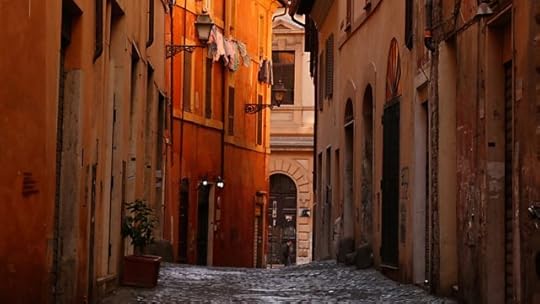
Τα κεφάλαια του 1973 έχουν μια γλυκόπικρη ομορφιά, σαν τις ιταλικές κομεντί. Μας παρουσιάζεται μια Ρώμη ηλιόλουστη και λαμπερή, όπως την έχουμε ονειρευτεί. Οι ήρωες δίνουν ραντεβού σε γνωστά αξιοθέατα, κάθονται σε μικρά χαριτωμένα καφέ, όπου εξυπηρετούνται από γραφικούς ιδιοκτήτες και σερβιτόρους, ψωνίζουν από πολύβουες και πολύχρωμες αγορές. Περπατούν σε γραφικά σοκάκια. Γύρω τους, όλοι είναι καλοδιάθετοι και κομψοί:
«Το βλέμμα του άντρα έπεσε στην Κιάρα κι αμέσως τίναξε το κεφάλι του ελαφρά προς τα πίσω, ξαφνιασμένος. Συνειδητοποίησε τότε εκείνη πως με το άλλο της χέρι, με αυτό που δεν κρατούσε το κεφάλι της στη θέση του, είχε σηκώσει τα δυο της δάχτυλα τεντωμένα στα χείλια της σαν να κάπνιζε. Πριν προλάβει να τραβηχτεί μέσα στην κάμαρά της, εκείνος μιμήθηκε τη χειρονομία της. Του απάντησε με ένα μικρό νεύμα και του κούνησε το μεσιανό δάχτυλο, ελπίζοντας πως θα θεωρούσε αυτή την κίνηση συγκατάθεση. Εκείνος χάθηκε για μια στιγμή από το παράθυρο, ύστερα εμφανίστηκε ξανά κρατώντας ένα τσιγάρο, που το πέταξε με κέφι προς το μέρος της.»
Μέσα σε αυτή τη γιορτινή ατμόσφαιρα η Κιάρα και η Μαρία αναζητούν η καθεμιά τους το δικό της ιερό Γκράαλ. Η πρώτη τη λύτρωση, η δεύτερη την ταυτότητά της.
Η συγγραφέας επέλεξε να πει την ιστορία της απλά. Η γραφή της, θα έλεγε κάποιος, είναι κάπως παλιομοδίτικη. Ίσως όχι αρκετά «λογοτεχνική» για τη μόδα της εποχής. Δεν χρησιμοποίησε κάποιο από τα τερτίπια της σύγχρονης λογοτεχνίας. Σου λέει την ιστορία της όπως θα σου την έλεγε ένας φίλος όταν θα βγαίνατε για καφέ. Κι έχει δίκιο. Σε αυτό το βιβλίο οτιδήποτε άλλο από αυτό θα φάνταζε περιττό και αταίριαστο.
Ωραία, στρωτή μετάφραση της Μαρίας Αγγελίδου, μας μεταφέρει μέσα στην ατμόσφαιρα του βιβλίου. Εμπνευσμένο για μια ακόμα φορά το εξώφυλλο του Χρήστου Κούρτογλου.
1973, Ουαλία: Η Μαρία, τελειόφοιτη άριστη μαθήτρια, δίνει εισαγωγικές εξετάσεις. Τυχαία ανακαλύπτει ότι ο άντρας που τη μεγάλωνε τόσα χρόνια δεν είναι ο φυσικός της πατέρας, ότι η ίδια είναι ένα παιδί εκτός γάμου, καρπός του σύντομου έρωτα της μητέρας της με έναν Ιταλό. Το σοκ εκφράζεται με ανεξέλεγκτο θυμό. Θυμό προς τη μητέρα της, την οικογένειά της, τον ίδιο της τον εαυτό. Με τα λίγα στοιχεία που έχει, ένα τηλέφωνο κι ένα όνομα, προσπαθεί να έρθει σε επαφή με τον πραγματικό της πατέρα. Τελικά, μετά από ένα συμβιβασμό, θα γυρίσει στο σχολείο για να δώσει εξετάσεις, και οι γονείς της θα την αφήσουν να ταξιδέψει στην Ιταλία για να σπουδάσει τη γλώσσα. Στην πραγματικότητα, θέλει να βρει ό,τι περισσότερο μπορεί για τον πραγματικό της πατέρα.
Αυτό το βιβλίο μιλάει για τη μητρική αγάπη. Μια αγάπη χωρίς όρους και όρια. Δεν είναι ανάγκη να γεννήσεις για να τη νιώσεις. Η Κιάρα δίνεται σε αυτό το παιδί ολοκληρωτικά. Θα του συγχωρήσει τα πάντα. Την απείθεια, τα ψέματα, την κλεψιά. Δεν θα διστάσει να εγκαταλείψει την αδελφή της σε γνωστούς — κάτι που θα την οδηγήσει στον θάνατο, όταν καταλάβει ότι ο Ντανιέλε κινδυνεύει από αυτή. Θα γυρίσει πίσω στην καθημαγμένη Ρώμη μαζί του και θα ριχτεί στον αγώνα της επιβίωσης. Θα γυρνούν στα αγαπημένα αξιοθέατα, εκεί όπου πήγαινε ο Ντανιέλε με τη μητέρα του, να της αφήνει σημειώματα μήπως εκείνη τα βρει εάν τυχόν επιστρέψει. Θα σπαράξει όταν ο Ντανιέλε μεγαλώνοντας μπλέξει με ναρκωτικά, και όταν θα εξαφανιστεί μην αφήνοντας ίχνος.
Η Baily μάς δίνει μια σειρά από γυναικείους χαρακτήρες έξοχα σμιλεμένους. Η Κιάρα, η φίλη της και πρώην ερωμένη του πατέρα της Σιμόν, η Μαρία, η Σεσίλια, η μητριαρχική φιγούρα της Νόνα στο κτήμα —καθηλωμένη από τα γηρατειά στο κρεβάτι—, η λαϊκή υπηρέτρια Ασούντα με τη θυμοσοφία και τη θρησκοληψία της. Όλες τους αποτελούν ένα σύμπαν θαυμαστό και περίκλειστο. Οι άντρες, θαμποί, σχεδόν απόντες, κάνουν σποραδικά την εμφάνισή τους: ο καφετζής Τζάνι, ο Γκαμπριέλε, ο επιστάτης της Νόνας, ακόμα και ο φίλος της Κιάρα, ο ιερέας Αντόνιο, παρά τον σημαντικό ρόλο που ο τελευταίος έπαιξε στη ζωή του Ντανιέλε. Ίσως με αυτό τον τρόπο να θέλησε η συγγραφέας να αναδείξει τον απόλυτο πρωταγωνιστή του βιβλίου και ας είναι απών. Ο Ντανιέλε είναι ο ήλιος αυτού του σύμπαντος. Τα πάντα περιστρέφονται γύρω του. Όλες οι πράξεις γίνονται για αυτόν κι όλες οι σκέψεις τους είναι στραμμένες επάνω του.
Τα κεφάλαια εναλλάσσονται χρονικά από το 1943 στο 1973. Από τον ζόφο του πολέμου στην ομορφιά της ειρήνης. Τα σκοτεινά κεφάλαια που ανήκουν στο παρελθόν περιέχουν μέσα σκηνές εφιαλτικές, που σε κυνηγούν αρκετές μέρες. Το ταξίδι με το τρένο από τη Ρώμη είναι συγκλονιστικό:
«Δεν νιώθει περιέργεια για το τρένο που μπαίνει στον σταθμό δίπλα στο δικό τους . Απλά βρίσκεται στη γραμμή του βλέμματός της. Κι αντιλαμβάνεται μια κίνηση στα κάγκελα του βαγονιού μπροστά της, κάτι ασπριδερό, που κουνιέται. Σμίγει τα φρύδια, να δει καλύτερα, και βλέπει πως είναι ένα χέρι, ένα αδύνατο ανθρώπινο χέρι που χωράει να βγει από τα κάγκελα. Πίσω από τα κάγκελα, το πρόσωπο μιας νέας γυναίκας. Το στόμα της είναι ανοιχτό σαν να φωνάζει, σαν να τραγουδάει μια και μόνη νότα, αλλά όποιος ήχος κι αν βγαίνει από μέσα της πνίγεται μέσα στο χαμό των μεταλλικών τροχών και στα σφυρίγματα και τα μουγκρητά του τρένου. Η Κιάρα κοιτάζει δεξιά-αριστερά της. Υπάρχουν κι άλλοι όρθιοι στον διάδρομο, όπως η ίδια. Αλλά μόνο ένας κοιτάζει έξω από το παράθυρο, σαν την ίδια — μια μεσόκοπη γυναίκα με σάλι και γκρίζο πανωφόρι. Στρέφεται και κοιτάζει την Κιάρα, έχει γουρλώσει τα μάτια, το στόμα της είναι ορθάνοιχτο, το πρόσωπό της έντρομο. Και είναι το ύφος αυτής της άλλης γυναίκας που βεβαιώνει την Κιάρα ότι δεν έχει παραισθήσεις.»
Τα κεφάλαια του 1973 έχουν μια γλυκόπικρη ομορφιά, σαν τις ιταλικές κομεντί. Μας παρουσιάζεται μια Ρώμη ηλιόλουστη και λαμπερή, όπως την έχουμε ονειρευτεί. Οι ήρωες δίνουν ραντεβού σε γνωστά αξιοθέατα, κάθονται σε μικρά χαριτωμένα καφέ, όπου εξυπηρετούνται από γραφικούς ιδιοκτήτες και σερβιτόρους, ψωνίζουν από πολύβουες και πολύχρωμες αγορές. Περπατούν σε γραφικά σοκάκια. Γύρω τους, όλοι είναι καλοδιάθετοι και κομψοί:
«Το βλέμμα του άντρα έπεσε στην Κιάρα κι αμέσως τίναξε το κεφάλι του ελαφρά προς τα πίσω, ξαφνιασμένος. Συνειδητοποίησε τότε εκείνη πως με το άλλο της χέρι, με αυτό που δεν κρατούσε το κεφάλι της στη θέση του, είχε σηκώσει τα δυο της δάχτυλα τεντωμένα στα χείλια της σαν να κάπνιζε. Πριν προλάβει να τραβηχτεί μέσα στην κάμαρά της, εκείνος μιμήθηκε τη χειρονομία της. Του απάντησε με ένα μικρό νεύμα και του κούνησε το μεσιανό δάχτυλο, ελπίζοντας πως θα θεωρούσε αυτή την κίνηση συγκατάθεση. Εκείνος χάθηκε για μια στιγμή από το παράθυρο, ύστερα εμφανίστηκε ξανά κρατώντας ένα τσιγάρο, που το πέταξε με κέφι προς το μέρος της.»
Μέσα σε αυτή τη γιορτινή ατμόσφαιρα η Κιάρα και η Μαρία αναζητούν η καθεμιά τους το δικό της ιερό Γκράαλ. Η πρώτη τη λύτρωση, η δεύτερη την ταυτότητά της.
Η συγγραφέας επέλεξε να πει την ιστορία της απλά. Η γραφή της, θα έλεγε κάποιος, είναι κάπως παλιομοδίτικη. Ίσως όχι αρκετά «λογοτεχνική» για τη μόδα της εποχής. Δεν χρησιμοποίησε κάποιο από τα τερτίπια της σύγχρονης λογοτεχνίας. Σου λέει την ιστορία της όπως θα σου την έλεγε ένας φίλος όταν θα βγαίνατε για καφέ. Κι έχει δίκιο. Σε αυτό το βιβλίο οτιδήποτε άλλο από αυτό θα φάνταζε περιττό και αταίριαστο.
Ωραία, στρωτή μετάφραση της Μαρίας Αγγελίδου, μας μεταφέρει μέσα στην ατμόσφαιρα του βιβλίου. Εμπνευσμένο για μια ακόμα φορά το εξώφυλλο του Χρήστου Κούρτογλου.

February 1, 2025
This book was recommended to me as a passive aggressive comment about being late but was actually quite nice.
The setting of the plot made me want to spend weeks in Rome practising my Italian
The setting of the plot made me want to spend weeks in Rome practising my Italian

June 26, 2016
Hugely disappointing and thoroughly unsatisfying.
Unless I'm reading science fiction or fantasy, I need a book to be realistic. What mother would allow a cantankerous 16yr old to travel to Italy to stay with an unknown woman? How can a young woman who's listened to a few Italian CDs appear to be following conversations a few weeks later? How can someone be translating Keats one moment and struggling for words the next? How can we believe that an elderly woman with a stick is walking gingerly one moment and then racing around Rome the next? How can a frightened Maria who's just caught a fragile, falling woman, in the very next breath correct her English?
I longed to see the relationship between Chiara and Daniele as he grew up. I wanted to discover more of how Daniele came to be the absent person that he was. Sadly, this element was neglected.
It's not a novel these days if we don't see the action switching between the present and one or more points in the past. This generally worked well except for the enormous gap between Antonio going away and his return as the story reached its climax.
Little depth to the characters, little empathy for them.
Unless I'm reading science fiction or fantasy, I need a book to be realistic. What mother would allow a cantankerous 16yr old to travel to Italy to stay with an unknown woman? How can a young woman who's listened to a few Italian CDs appear to be following conversations a few weeks later? How can someone be translating Keats one moment and struggling for words the next? How can we believe that an elderly woman with a stick is walking gingerly one moment and then racing around Rome the next? How can a frightened Maria who's just caught a fragile, falling woman, in the very next breath correct her English?
I longed to see the relationship between Chiara and Daniele as he grew up. I wanted to discover more of how Daniele came to be the absent person that he was. Sadly, this element was neglected.
It's not a novel these days if we don't see the action switching between the present and one or more points in the past. This generally worked well except for the enormous gap between Antonio going away and his return as the story reached its climax.
Little depth to the characters, little empathy for them.

July 13, 2015
"Early One Morning" by Virginia Baily is set during WWII and present day Rome. I wish I could say that I loved this book, but it just didn't captivate me as others of this genre have done. It took quite a while to get into the narrative due to the structure, long descriptive passages, and internal random thought musings by the main character, Chiara. I'm disappointed because the bones of a great story were there, but to me it just fell short...with a hurried up ending. I do see from other reviews that I'm in a minority here.

March 4, 2016
Review originally published here: http://girlwithherheadinabook.co.uk/2...
Having placed this book prominently in my Christmas list to no avail, it was with delight that I received a review copy from Netgalley. Early One Morning is a painful and often unhappy little story, concerned more with feelings than events. The description gave me the impression that this was a World War II story but in truth it is far more complex than that. This was a painful little book focussing on the moments in life that we cannot take back, the words which cannot be unsaid and the bonds which somehow never can be broken. The main protagonist is Chiara Ravello, a woman living in Rome. Early one morning in 1944, she is walking along the street near the Jewish quarter and sees some of the German occupying forces rounding up Jews and forcing them onto a truck. Chiara’s eyes meet those of one of the Jewish women, and a moment of silent understanding passes between the two. With no more than that, Chiara calls out that the little boy clutching the woman’s hand is in fact her own nephew and no Jew at all. The Germans hand over the seven year-old Daniele and Chiara hurries away. The other strand of the narrative picks up around thirty years later, with the older Chiara not having seen Daniele for many years and is encouraged by her friends to forget about him. The events which are about to transpire however are about to make that quite impossible.
Baily feels like a very assured narrator – there is little in the way of exposition in Early One Morning and the reader is allowed to draw their own conclusions. The reader watches Chiara find her way around motherhood to the silent Daniele, whilst also attempting to balance the needs of her mentally-handicapped sister Cecilia. Flashing forward, sixteen year-old Welsh girl Maria discovers that her parents have been lying to her – her father is not Barry, but rather a man she has never met, someone her mother met when she was an au pair – Daniele Levi. The events of the intervening years are referred to by the main players but Baily lets us draw the dots – strangely, this accentuates the pain that has been felt by the characters rather than making them seem more remote; we have a sense of Things Not To Be Spoken Of.
Chiara’s blossoming affection for her young ward contrasts sharply with her older self’s broken heart at his loss. When she tries to speak of him, people look twice. The nearby cafe owner winces – he would have pressed charges against Daniele were it not for the signora. The priest sucks in his teeth and orders her to forget him. Chiara’s friend Simone wants her to move on, to find a new happiness. Any mementoes of her lost boy have to be hidden – I could feel Chiara wanting to please people by appearing to have overcome her grief. It is not surprising that when Maria reaches out to her for information, Chiara has deeply ambivalent feelings, but as Maria begs to be allowed to come and visit – the reader knows (and not just because the plot requires it), ultimately, Chiara will allow her to stay because that is deep down what she wants to happen.
Silence and communication is a theme that runs in the under-currents of the book. At one point, Chiara has a silent exchange with a man in the floor above her flat, signalling to him that she wants a cigarette. He throws one down, it misses. He tries again, this time tying a pen to give it more accuracy. Chiara gestures her thanks and thinks to herself what a lovely interaction they have had. Daniele does not speak for the first three months that he is in Chiara’s care. And most of the characters are keeping secrets of one sort or another. Maria pretends to her family that she is doing her exams, Chiara pretends that she has other commitments rather than admit that she cannot face her friends, she lets Maria believe that she was merely Daniele’s landlady. Behind all of this are the background facts that Baily never needs to make clear – that Chiara’s fiance who was taken away by the Fascists was the love of her life, that Daniele is the substitute for the child she wished she could have had with him, that her own desire for a child was just as great as Daniele’s need for salvation in the moment of their first meeting. Chiara is a complicated and unhappy woman but she never appears bitter or difficult – she is so clearly reaching out in her loneliness that as a reader, I could only feel for her and wish that those around her could try to understand her grief.
I found Chiara easier to warm to than Maria – I have never really warmed to the idea that discovering who your biological father is will help you discover who you are yourself. Perhaps I am being unfair though because I was never in any doubt over mine – when I think about how I fathomed out the situation as a child, the phrase ‘I do have one but he lives in Australia’ pops into mind, which certainly suggests that I was asked about it more than once. I knew who, and where, he was and other than that, I was not particularly interested – I was free to go and check my baby photos if I was curious. Yet, taking on an additional parent at the age of fifteen did have its challenges and to undergo the reverse process – to discover that one’s Dad is instead a highly effective step-parent – well, yes, it would be difficult. I guess I’m just programmed to reject the notion that it’s something worth making a fuss over. Despite all this though, by the end of the novel, it did feel that Maria had grown up and her blossoming relationship with Chiara was lovely to read.
Early One Morning is not the easiest of books to review because so much of it is about silences – about acts from which nobody can take pride, forgiveness bestowed by conscious forgetting, secret shames with consequences that have rippled down the decades. It is not even Chiara’s split-second decision to respond to the other woman’s silent plea – take my son – but all that came after, the hiding, the bargains with God, the choices made, sacrifices willingly given, heavy prices paid. Nor is Early One Morning a book about revelations and secrets coming out – the end comes with Maria passing on an edited synopsis of events to her mother, and the reader can be sure that Maria will also keep her own counsel concerning her mother’s own secrets. Beyond all of that, this is about love, stubborn, painful, inconvenient love between a mother and her child – no matter how they came to this point, I willed for Chiara a resolution. Reading the closing pages of Early One Morning while sitting on the bus, I had to pretend that I had something in my eye. There was an elegance and a warmth here that elevates what might otherwise have been a cliche-ridden tale into a novel to treasure and remember.
Having placed this book prominently in my Christmas list to no avail, it was with delight that I received a review copy from Netgalley. Early One Morning is a painful and often unhappy little story, concerned more with feelings than events. The description gave me the impression that this was a World War II story but in truth it is far more complex than that. This was a painful little book focussing on the moments in life that we cannot take back, the words which cannot be unsaid and the bonds which somehow never can be broken. The main protagonist is Chiara Ravello, a woman living in Rome. Early one morning in 1944, she is walking along the street near the Jewish quarter and sees some of the German occupying forces rounding up Jews and forcing them onto a truck. Chiara’s eyes meet those of one of the Jewish women, and a moment of silent understanding passes between the two. With no more than that, Chiara calls out that the little boy clutching the woman’s hand is in fact her own nephew and no Jew at all. The Germans hand over the seven year-old Daniele and Chiara hurries away. The other strand of the narrative picks up around thirty years later, with the older Chiara not having seen Daniele for many years and is encouraged by her friends to forget about him. The events which are about to transpire however are about to make that quite impossible.
Baily feels like a very assured narrator – there is little in the way of exposition in Early One Morning and the reader is allowed to draw their own conclusions. The reader watches Chiara find her way around motherhood to the silent Daniele, whilst also attempting to balance the needs of her mentally-handicapped sister Cecilia. Flashing forward, sixteen year-old Welsh girl Maria discovers that her parents have been lying to her – her father is not Barry, but rather a man she has never met, someone her mother met when she was an au pair – Daniele Levi. The events of the intervening years are referred to by the main players but Baily lets us draw the dots – strangely, this accentuates the pain that has been felt by the characters rather than making them seem more remote; we have a sense of Things Not To Be Spoken Of.
Chiara’s blossoming affection for her young ward contrasts sharply with her older self’s broken heart at his loss. When she tries to speak of him, people look twice. The nearby cafe owner winces – he would have pressed charges against Daniele were it not for the signora. The priest sucks in his teeth and orders her to forget him. Chiara’s friend Simone wants her to move on, to find a new happiness. Any mementoes of her lost boy have to be hidden – I could feel Chiara wanting to please people by appearing to have overcome her grief. It is not surprising that when Maria reaches out to her for information, Chiara has deeply ambivalent feelings, but as Maria begs to be allowed to come and visit – the reader knows (and not just because the plot requires it), ultimately, Chiara will allow her to stay because that is deep down what she wants to happen.
Silence and communication is a theme that runs in the under-currents of the book. At one point, Chiara has a silent exchange with a man in the floor above her flat, signalling to him that she wants a cigarette. He throws one down, it misses. He tries again, this time tying a pen to give it more accuracy. Chiara gestures her thanks and thinks to herself what a lovely interaction they have had. Daniele does not speak for the first three months that he is in Chiara’s care. And most of the characters are keeping secrets of one sort or another. Maria pretends to her family that she is doing her exams, Chiara pretends that she has other commitments rather than admit that she cannot face her friends, she lets Maria believe that she was merely Daniele’s landlady. Behind all of this are the background facts that Baily never needs to make clear – that Chiara’s fiance who was taken away by the Fascists was the love of her life, that Daniele is the substitute for the child she wished she could have had with him, that her own desire for a child was just as great as Daniele’s need for salvation in the moment of their first meeting. Chiara is a complicated and unhappy woman but she never appears bitter or difficult – she is so clearly reaching out in her loneliness that as a reader, I could only feel for her and wish that those around her could try to understand her grief.
I found Chiara easier to warm to than Maria – I have never really warmed to the idea that discovering who your biological father is will help you discover who you are yourself. Perhaps I am being unfair though because I was never in any doubt over mine – when I think about how I fathomed out the situation as a child, the phrase ‘I do have one but he lives in Australia’ pops into mind, which certainly suggests that I was asked about it more than once. I knew who, and where, he was and other than that, I was not particularly interested – I was free to go and check my baby photos if I was curious. Yet, taking on an additional parent at the age of fifteen did have its challenges and to undergo the reverse process – to discover that one’s Dad is instead a highly effective step-parent – well, yes, it would be difficult. I guess I’m just programmed to reject the notion that it’s something worth making a fuss over. Despite all this though, by the end of the novel, it did feel that Maria had grown up and her blossoming relationship with Chiara was lovely to read.
Early One Morning is not the easiest of books to review because so much of it is about silences – about acts from which nobody can take pride, forgiveness bestowed by conscious forgetting, secret shames with consequences that have rippled down the decades. It is not even Chiara’s split-second decision to respond to the other woman’s silent plea – take my son – but all that came after, the hiding, the bargains with God, the choices made, sacrifices willingly given, heavy prices paid. Nor is Early One Morning a book about revelations and secrets coming out – the end comes with Maria passing on an edited synopsis of events to her mother, and the reader can be sure that Maria will also keep her own counsel concerning her mother’s own secrets. Beyond all of that, this is about love, stubborn, painful, inconvenient love between a mother and her child – no matter how they came to this point, I willed for Chiara a resolution. Reading the closing pages of Early One Morning while sitting on the bus, I had to pretend that I had something in my eye. There was an elegance and a warmth here that elevates what might otherwise have been a cliche-ridden tale into a novel to treasure and remember.

July 17, 2015
4.5 stars.
Early One Morning - a momentary and quick decision by a mother and Chiara changes the lives of a number of people. I have just finished reading a book set in war torn Germany during the second world war. Now Virginia Baily takes the reader into Italy - another country undergoing the ravages of war and being invaded.
Chiara has lost her her fiance to anti-fascist activities and now she struggles to care for Cecilia her sister who has been damaged by a number of fits that have injured her brain. She does not welcome the young Jewish boy - Daniele Levi. The extent of that unwelcome is incredibly sad.
Chiara flees to the country where her Nonna has a farm, taking with her Cecilia and Daniele. There they form an odd little community of people eking out an existence with the ever present fear of the German soldiers. Daniele is a silent unhappy boy. He does not realise he has been saved from a worse fate. How could he know, all he knows is being yanked away from his family into a life with strangers. His life with Chiara is never easy for either and eventually leads to complete separation.
The story is told from a number of points of view - primarily from Chiaras, but also from Antonio - a friend of Chiaras and now a priest, and from a young girl - Maria who discovers her father is not who she thought. It is a shock that rocks her world and sends her on a journey.
The novel weaves between the 1940's and the 1970's. In doing so the lives of the characters and what happened to them unfolds in a way that gradually reveals all that happened from that one lock of eyes between two strangers. At times I hated being dragged from one era into the next, yet it built tension and intrigue. It was well paced and had me reading on. I fell in love with this odd group of characters and their lives.
While not a book I would normally pick up, the very real characters, the descriptive writing, the outcomes from that one choice - somewhat unexpected, fascinated me. I loved the small surprises that sprang out at unexpected times like a jack in the box. The motives and the love, the hopes, disappointments, the guilt and sadness that characters experienced all combined to bring them alive in my imagination. Early One Morning had me reaching for the tissues as it ended.
This book would be an interesting read for book groups, I am sure it would engender much discussion and be relevant to people's lives today.
Early One Morning - a momentary and quick decision by a mother and Chiara changes the lives of a number of people. I have just finished reading a book set in war torn Germany during the second world war. Now Virginia Baily takes the reader into Italy - another country undergoing the ravages of war and being invaded.
Chiara has lost her her fiance to anti-fascist activities and now she struggles to care for Cecilia her sister who has been damaged by a number of fits that have injured her brain. She does not welcome the young Jewish boy - Daniele Levi. The extent of that unwelcome is incredibly sad.
Chiara flees to the country where her Nonna has a farm, taking with her Cecilia and Daniele. There they form an odd little community of people eking out an existence with the ever present fear of the German soldiers. Daniele is a silent unhappy boy. He does not realise he has been saved from a worse fate. How could he know, all he knows is being yanked away from his family into a life with strangers. His life with Chiara is never easy for either and eventually leads to complete separation.
The story is told from a number of points of view - primarily from Chiaras, but also from Antonio - a friend of Chiaras and now a priest, and from a young girl - Maria who discovers her father is not who she thought. It is a shock that rocks her world and sends her on a journey.
The novel weaves between the 1940's and the 1970's. In doing so the lives of the characters and what happened to them unfolds in a way that gradually reveals all that happened from that one lock of eyes between two strangers. At times I hated being dragged from one era into the next, yet it built tension and intrigue. It was well paced and had me reading on. I fell in love with this odd group of characters and their lives.
While not a book I would normally pick up, the very real characters, the descriptive writing, the outcomes from that one choice - somewhat unexpected, fascinated me. I loved the small surprises that sprang out at unexpected times like a jack in the box. The motives and the love, the hopes, disappointments, the guilt and sadness that characters experienced all combined to bring them alive in my imagination. Early One Morning had me reaching for the tissues as it ended.
This book would be an interesting read for book groups, I am sure it would engender much discussion and be relevant to people's lives today.

October 10, 2015
This novel explores how a split-second decision can impact the rest of your life. It’s set in Italy during World War II. The year is 1943 and the main character, Chiara, decides to flee Rome for safer territory. On the morning that she plans to leave, she’s passing through the Jewish ghetto and sees some people being rounded up. She makes eye contact with one of the women in line, who has a young son. In an instant, the woman pushes her son towards Chiara and Chiara pretends that the boy is her nephew. In doing so, she saves the boy from being taken to a camp with the rest of his family.
The story takes place in both the present and the past, in the moments following Chiara’s decision to save the boy, and years later when she’s much older. The first two chapters are clearly labeled to let you know what year it is, but the remaining chapters aren’t. I don’t mind a nonlinear plot, but I found this one a bit confusing at points.
Another element I wanted was more of Daniele, the little boy in the story. The book is written from Chiara’s perspective, and also Maria’s perspective, a young woman we’re introduced to a little ways into the story. Daniele plays such a huge role in Chiara’s life, but I felt that I didn’t really know much about him as a person. As a young boy, he’s quiet, stubborn, and understandably devastated by the loss of his family. As he grows up, he continues to have problems, but all the details we know about him are one-sided. I think it would have been great to have even a couple chapters from Daniele’s perspective, or allow the reader to get to know him better in some other way.
I would have also liked further insight into why Chiara decided to take the boy in the that moment. Chiara has a younger sister with epilepsy that she’s taken care of since she was diagnosed, so perhaps the reason is that Chiara likes to take care of people? I don’t know. It wasn’t clear to me and it kept pestering my thoughts as I was reading.
I loved the setting and thought the author did a great job evoking daily life in Rome. It made me want to hop on a plane to Italy ASAP. When I visited Rome briefly several years ago, I remember thinking there’s so much history and a rich culture, and I had a similar feeling while reading this book. There were some points that I’d like to change about the novel, but in the end I did like it and was interested enough to keep reading.
Thank you to Little, Brown and Company for sending me a copy for review.
The story takes place in both the present and the past, in the moments following Chiara’s decision to save the boy, and years later when she’s much older. The first two chapters are clearly labeled to let you know what year it is, but the remaining chapters aren’t. I don’t mind a nonlinear plot, but I found this one a bit confusing at points.
Another element I wanted was more of Daniele, the little boy in the story. The book is written from Chiara’s perspective, and also Maria’s perspective, a young woman we’re introduced to a little ways into the story. Daniele plays such a huge role in Chiara’s life, but I felt that I didn’t really know much about him as a person. As a young boy, he’s quiet, stubborn, and understandably devastated by the loss of his family. As he grows up, he continues to have problems, but all the details we know about him are one-sided. I think it would have been great to have even a couple chapters from Daniele’s perspective, or allow the reader to get to know him better in some other way.
I would have also liked further insight into why Chiara decided to take the boy in the that moment. Chiara has a younger sister with epilepsy that she’s taken care of since she was diagnosed, so perhaps the reason is that Chiara likes to take care of people? I don’t know. It wasn’t clear to me and it kept pestering my thoughts as I was reading.
I loved the setting and thought the author did a great job evoking daily life in Rome. It made me want to hop on a plane to Italy ASAP. When I visited Rome briefly several years ago, I remember thinking there’s so much history and a rich culture, and I had a similar feeling while reading this book. There were some points that I’d like to change about the novel, but in the end I did like it and was interested enough to keep reading.
Thank you to Little, Brown and Company for sending me a copy for review.
March 5, 2017
Rom 1943. Als die Italienerin Chiara Ravello eines Morgens miterleben muss, wie zahlreiche jüdische Familien von deutschen Soldaten in ein Arbeitslager abtransportiert werden, gelingt es der jungen Frau in letzter Minute den kleinen Jungen Daniele Levi vom LKW zu ziehen. Sie nimmt das jüdische Kind mit zu sich nach Hause und kümmert sich um Daniele wie um einen eigenen Sohn. Nach wenigen Tagen beschließt Chiara mit dem Jungen und ihrer jüngeren Schwester Cecilia, die sie ebenfalls liebevoll umsorgt, aus Rom zu fliehen und zu ihrer Nonna aufs Land zu ziehen. Das harte Kriegsjahr nimmt seinen Lauf und die Beziehung zu Daniele wird immer schwieriger, denn der Junge ist verschlossen und rebellisch, lässt niemanden an sich heran und ist durch den Verlust seiner Familie schwer gezeichnet.
Jahre später 1973, erhält Chiara einen schicksalhaften Anruf, der sie plötzlich mit ihrer Vergangenheit konfrontiert und sie schlagartig ins Jahr 1943 zurückversetzt. Chiara lebt mittlerweile wieder in Rom und führt ein ruhiges Leben. Doch als ihr ein 16-jähriges Mädchen namens Maria am Telefon verkündet, dass sie den Sommer bei ihr in Italien verbringen möchte, um mehr über einen gewissen Daniele Levi zu erfahren, weckt Maria bei Chiara alte Geister und eine tief verborge Sehnsucht.
Die Autorin Virginia Baily konnte mich mit ihrem Drama rund um den jüdischen Jungen Daniele und seine wagemutige Retterin Chiara sehr gut unterhalten.
Der Roman wird in zwei Zeitperioden erzählt, die sich kapitelweise abwechseln.
Die aktuelle Handlung spielt 1973 und der zweite Erzählstrang beschreibt die Geschehnisse des Jahres 1943, eine Zeit voller Schrecken und Leid. Trotzdem präsentiert uns die Autorin keinen klassischen Kriegsroman sondern eine mutige Familiengeschichte.
Obwohl wir über Danieles Lebensweg und seine Entwicklung vom kleinen Jungen zum erwachsenen Mann recht wenig erfahren, konnte ich einen guten Zugang zu dem jungen Protagonisten finden und mit seinem schweren Schicksal mitfühlen. Seine Verletzlichkeit und Traurigkeit war stets spürbar, doch ich hätte mir mehr Details zu Danieles Lebensgeschichte gewünscht.
Neben Themen wie Mut, Familie und Verlust, spielen ganz klar Schuld und Verantwortung die Hauptrollen in diesem Buch. Schlicht und ohne Kitsch verpackt die Autorin diese zentralen Themen in ihre Geschichte und am Ende bleibt die Erkentniss, dass sich Familie nicht ausschließlich über Blutsverwandtschaft definieren muss.
Jahre später 1973, erhält Chiara einen schicksalhaften Anruf, der sie plötzlich mit ihrer Vergangenheit konfrontiert und sie schlagartig ins Jahr 1943 zurückversetzt. Chiara lebt mittlerweile wieder in Rom und führt ein ruhiges Leben. Doch als ihr ein 16-jähriges Mädchen namens Maria am Telefon verkündet, dass sie den Sommer bei ihr in Italien verbringen möchte, um mehr über einen gewissen Daniele Levi zu erfahren, weckt Maria bei Chiara alte Geister und eine tief verborge Sehnsucht.
Die Autorin Virginia Baily konnte mich mit ihrem Drama rund um den jüdischen Jungen Daniele und seine wagemutige Retterin Chiara sehr gut unterhalten.
Der Roman wird in zwei Zeitperioden erzählt, die sich kapitelweise abwechseln.
Die aktuelle Handlung spielt 1973 und der zweite Erzählstrang beschreibt die Geschehnisse des Jahres 1943, eine Zeit voller Schrecken und Leid. Trotzdem präsentiert uns die Autorin keinen klassischen Kriegsroman sondern eine mutige Familiengeschichte.
Obwohl wir über Danieles Lebensweg und seine Entwicklung vom kleinen Jungen zum erwachsenen Mann recht wenig erfahren, konnte ich einen guten Zugang zu dem jungen Protagonisten finden und mit seinem schweren Schicksal mitfühlen. Seine Verletzlichkeit und Traurigkeit war stets spürbar, doch ich hätte mir mehr Details zu Danieles Lebensgeschichte gewünscht.
Neben Themen wie Mut, Familie und Verlust, spielen ganz klar Schuld und Verantwortung die Hauptrollen in diesem Buch. Schlicht und ohne Kitsch verpackt die Autorin diese zentralen Themen in ihre Geschichte und am Ende bleibt die Erkentniss, dass sich Familie nicht ausschließlich über Blutsverwandtschaft definieren muss.
Displaying 1 - 30 of 528 reviews