

What do you think?

This Restless House: an adaptation of Aeschylus' Oresteia
Aeschylus' Oresteia opens with Agamemnon sacrificing his daughter to the gods; an act which sets in motion a bloody cycle of revenge and counter-revenge. When he in turn is killed at the hands of his wife Clytemnestra, their son Orestes takes up the mantle of avenging his father, continuing the bloodshed until peace is ultimately found in the rule of law. Zinnie Harris reimagines this ancient drama, using a contemporary sensibility to rework the stories, placing the women in the centre. Orestes' leading role is replaced by his sister Electra, who as a young child witnesses her father's murder and is compelled to take justice into her own hands until she too must flee the Furies. This Restless House premiered at the Citizens Theatre, Glasgow, in April 2016 in a co-production with the National Theatre of Scotland.
336 pages, Paperback
Published September 7, 2018
About the author
Zinnie Harris
38 books18 followersZinnie Harris is an award-winning British playwright, screenwriter and director currently living in Edinburgh.
Ratings & Reviews
Friends & Following
Create a free account to discover what your friends think of this book!
Community Reviews
Displaying 1 - 7 of 7 reviews
December 29, 2018
Restless Becomes Electra
Review of the Faber & Faber 2017 revised paperback edition
This Restless House is playwright Zinnie Harris' adaptation of the Aeschylus Oresteia (458 BC) trilogy. It was originally produced by the Citizens Theatre in Glasgow in 2016 and revived in 2017 for the Edinburgh International Festival in collaboration with the National Theatre of Scotland.
Harris does still roughly stick to the original arc of the plot, but substitutes the daughter Electra as the avenger of her father's murder in place of the son Orestes. The most drastic change is that in the 3rd play (titled Electra and Her Shadow in place of the Aeschylus' original Eumenides) the Electra character is transported into a 20th/21st Century psychiatric institution where her "trial" is her treatment by the present-day doctors. One of the doctors themselves is the survivor of childhood trauma and is therefore the "Shadow" character.
The time-shift allows for a retroactive interpretation of all of the earlier plays and acts as being schizophrenic illusions by the patient in the 3rd play. Even the voices and torments of The Furies in the Aeschylus' originals could have that same schizophrenic interpretation so I thought that Harris' adaptation rang quite true. As the entire cycle is performed in modern dress (see photos below), the play as modern-day psychological illusion seems quite valid.
The script as provided, even in this 2017 revision, is still somewhat unfinished. It allows for additional musical interludes to be written and performed by the cast, for which only general instructions are provided.
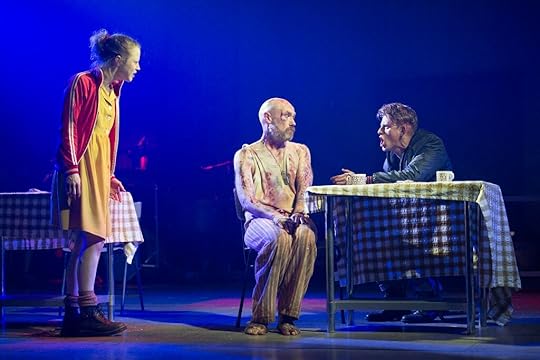
Photo from the original 2016 Citizens Theatre, Glasgow production, L to R: Electra (Olivia Morgan), Ghost of Agamemnon (George Anton) and Orestes (Lorn Macdonald). Photography by Tim Morozzo.
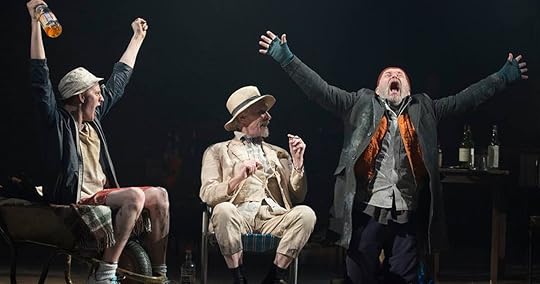
Photo from the original 2016 Citizens Theatre, Glasgow production: The Chorus (incl. George Costigan, Keith Fleming, John O'Mahony - order not known). Photography by Tim Morozzo.
Links
You can view further photographs from the production and read behind the scenes posts at the Citizens Theatre blog at http://citizenstheatre.blogspot.com/s...
Trivia
The rather striking cover photograph does not seem to have any direct connection to the theatrical production i.e. none of the actual actors are in it. It does however serve to communicate how the focus of the play is on the central daughter Electra who is sharply in camera focus while her family of (clockwise from the left) Iphigenia, Clytaemnestra, Orestes and Agamemnon have their faces blurred. The photograph is credited as "Cover image Freight Design and Reuben Paris."
Review of the Faber & Faber 2017 revised paperback edition
This Restless House is playwright Zinnie Harris' adaptation of the Aeschylus Oresteia (458 BC) trilogy. It was originally produced by the Citizens Theatre in Glasgow in 2016 and revived in 2017 for the Edinburgh International Festival in collaboration with the National Theatre of Scotland.
Harris does still roughly stick to the original arc of the plot, but substitutes the daughter Electra as the avenger of her father's murder in place of the son Orestes. The most drastic change is that in the 3rd play (titled Electra and Her Shadow in place of the Aeschylus' original Eumenides) the Electra character is transported into a 20th/21st Century psychiatric institution where her "trial" is her treatment by the present-day doctors. One of the doctors themselves is the survivor of childhood trauma and is therefore the "Shadow" character.
The time-shift allows for a retroactive interpretation of all of the earlier plays and acts as being schizophrenic illusions by the patient in the 3rd play. Even the voices and torments of The Furies in the Aeschylus' originals could have that same schizophrenic interpretation so I thought that Harris' adaptation rang quite true. As the entire cycle is performed in modern dress (see photos below), the play as modern-day psychological illusion seems quite valid.
The script as provided, even in this 2017 revision, is still somewhat unfinished. It allows for additional musical interludes to be written and performed by the cast, for which only general instructions are provided.
Photo from the original 2016 Citizens Theatre, Glasgow production, L to R: Electra (Olivia Morgan), Ghost of Agamemnon (George Anton) and Orestes (Lorn Macdonald). Photography by Tim Morozzo.
Photo from the original 2016 Citizens Theatre, Glasgow production: The Chorus (incl. George Costigan, Keith Fleming, John O'Mahony - order not known). Photography by Tim Morozzo.
Links
You can view further photographs from the production and read behind the scenes posts at the Citizens Theatre blog at http://citizenstheatre.blogspot.com/s...
Trivia
The rather striking cover photograph does not seem to have any direct connection to the theatrical production i.e. none of the actual actors are in it. It does however serve to communicate how the focus of the play is on the central daughter Electra who is sharply in camera focus while her family of (clockwise from the left) Iphigenia, Clytaemnestra, Orestes and Agamemnon have their faces blurred. The photograph is credited as "Cover image Freight Design and Reuben Paris."

October 7, 2023
So many twists and turns! Great adaption of the Oresteia, defo held my attention more than the original (oops).
August 6, 2025
I HAVE TO PUT ONE OF THESE ON
this is perfection all I’ve been looking for for weeks yes yes yes thank you thank you thank you
this is perfection all I’ve been looking for for weeks yes yes yes thank you thank you thank you

October 15, 2020
Agamemnon's Return: This is a substantially more pyschological version than Aeschylus' Agamemnon, with a lot more development of the characters' interior lives, especially Clytemnestra's. While Aeschylus does give us a sense of Clytemnestra's simmering resentment, Harris creates a character who is much more pyschologically complex because she both loves Agamemnon deeply and hates him to the core because he murdered their oldest daughter. There is a scene mid-play where they meet on a hill overlooking the palace the night before he's scheduled to officially return, and their dialogue goes back and forth. He seems repentant, humble, and to have genuinely suffered for killing Iphigenia, but there are also moments where he passive aggressively tries to guilt Clytemnestra, and he admits to having affairs while away fighting the Trojan War. Clytemnestra, in this same scene, vacillates between not wanting him to return, wanting him back, wanting to hold him, not wanting him to touch her, hoping to rebuild the relationship, and a feeling of betraying her daughter. This is a degree of complexity that Harris develops throughout the play.
https://youtu.be/Z9NifrMFiVI
The Bough Breaks: Like Agamemnon's Return, this play is significantly more psychological than Aeschylus' The Libation Bearers, with a lot more focus on the complexity and internal conflict of the characters. Electra actually loves Clytemnestra through most of the play and doesn't actually even think about killing her until she meets Orestes at their father's unmarked grave. In Aeschylus, Electra's central driving force is the burning desire for revenge, which is her main emotional state. But here Electra undergoes a substantial shift from not even thinking about avenging her father to cold blooded murderer in a very short time. This shift is prompted by a "haunting," the status of which is purposefully ambiguous in the play. There are definitely some unexplained phenomena--like Orestes and Electra's intense itching, appendectomy scars despite never having their appendixes removed, and the emergence of tattoos on their arms, all characteristics of Agamemnon that seem to manifest in them physically; also Clytemnestra begins the play in an inexplicable sleep from which she abruptly awakens when Electra prayers to the spirit of Agamemnon, but then Clytemnestra suffers an affliction of flies (maybe, though it's unclear how much this is true versus how much of it is a delusion) and the feeling of rotting from the inside. And while the characters interpret these phenomena as haunting by Agamemnon's ghost, the play opens the possibility that the experiences may also be delusions.
There are two symbols here that I think are super important--the flies plaguing Clytemnestra and the itching that afflicts Orestes and Electra. The flies seem like a pretty clear allusion to Jean-Paul Sartre's Electra adaptation, entitled (in English) The Flies. In Sartre's version, a plague of flies afflicts Argos, symbolic of the city's ethical decay. The flies are also associated with the Furies, who pursue Orestes at the end of that play. In Harris' version, there is a clear link between the flies and the idea of rot or decay, as Clytemnestra repeatedly asserts that the insects are drawn to her (symbolically?) decomposing flesh. The itching is also really interesting to me because (and this is probably a more tenuous connection) Herod the Great is reputed to have died from a mysterious illness that caused profound itching, terrible breath (one of Clytemnestra's symptoms), and maggots growing from his genitals. One theory is that Herod's itching led to him scratching his skin and introducing bacteria that led to penile gangrene (another theory is arteriosclerosis, in which case the itching and rotting flesh were both results of his hardening arteries). At one point, Clytemnestra expresses a terror that maggots will grow from her body. And Orestes does say that Agamemnon had scratched up the skin on his feet and back leading to scabbing, and Orestes says he has scraped off parts of his skin because of the itch.
https://youtu.be/tlbqq0mdYic
Electra and her Shadow: A fascinating ending to Harris' trilogy, this final play is set in a modern mental hospital, where Electra is being held/treated for a condition vaguely diagnosed as possibly psychosis, paranoia, or anxiety. She is haunted by the ghosts of Clytemnestra, Agamemnon, and Orestes (who, we find out, hanged himself after the events of The Bough Breaks), and she is attacked by the Furies who come in through open windows, vents, gaps or holes in the walls or floor, etc. Electra's former psychiatrist, Audrey, has briefly returned to (unsuccessfully) treating her before moving on to another job, but Electra's hauntings bring back Audrey's own ostensibly resolved psychological issues over the deaths of her brother and father. Audrey's brother was hit by a car--probably driven by their drunken father, who convinced/threatened Audrey to take the blame--and her father later choked on his own vomit while drunk, and Audrey didn't save him. Audrey is drawn into Electra's haunting, experiencing an attack by the Furies herself. When Electra and Audrey decide the only way to escape is by hanging themselves, the Chorus enters as a jury of observers sent by Nature to judge Electra (Audrey is going to get her own trial later). This is a really interesting element because at first Audrey puts it down to the last electrical synapses as the brain dies, but it becomes increasingly real for Electra as the jury is deadlocked. Then the spirit of Iphigenia--Electra's dead sister who has haunted all three plays--comes in and the jury asks her to cast the final vote. But Iphigenia refuses, saying that the dead do not actually compel the living, that hauntings are just a fantasy, and that she doesn't want any part of interfering with the living. Her refusal and the subsequent child's games she plays with the family members seems to release everyone from the cycle of violence plaguing the house of Agamemnon. However, in the final scene we go back to Audrey, still in the mental hospital (as a patient now), and we learn that a patient--implicitly Electra--had died by suicide and Audrey would have as well if a nurse hadn't saved her, which throws into question the entirety of the trial scene and the philosophical revelations therein. Was this Iphigenia really releasing the tormented spirits of her family? Was this a revelation that there are no ghosts, spirits, or gods? Or was this just the dying electrical impulses of Electra's brain as she suffocated?
https://youtu.be/8S5HKbglnZ8
https://youtu.be/Z9NifrMFiVI
The Bough Breaks: Like Agamemnon's Return, this play is significantly more psychological than Aeschylus' The Libation Bearers, with a lot more focus on the complexity and internal conflict of the characters. Electra actually loves Clytemnestra through most of the play and doesn't actually even think about killing her until she meets Orestes at their father's unmarked grave. In Aeschylus, Electra's central driving force is the burning desire for revenge, which is her main emotional state. But here Electra undergoes a substantial shift from not even thinking about avenging her father to cold blooded murderer in a very short time. This shift is prompted by a "haunting," the status of which is purposefully ambiguous in the play. There are definitely some unexplained phenomena--like Orestes and Electra's intense itching, appendectomy scars despite never having their appendixes removed, and the emergence of tattoos on their arms, all characteristics of Agamemnon that seem to manifest in them physically; also Clytemnestra begins the play in an inexplicable sleep from which she abruptly awakens when Electra prayers to the spirit of Agamemnon, but then Clytemnestra suffers an affliction of flies (maybe, though it's unclear how much this is true versus how much of it is a delusion) and the feeling of rotting from the inside. And while the characters interpret these phenomena as haunting by Agamemnon's ghost, the play opens the possibility that the experiences may also be delusions.
There are two symbols here that I think are super important--the flies plaguing Clytemnestra and the itching that afflicts Orestes and Electra. The flies seem like a pretty clear allusion to Jean-Paul Sartre's Electra adaptation, entitled (in English) The Flies. In Sartre's version, a plague of flies afflicts Argos, symbolic of the city's ethical decay. The flies are also associated with the Furies, who pursue Orestes at the end of that play. In Harris' version, there is a clear link between the flies and the idea of rot or decay, as Clytemnestra repeatedly asserts that the insects are drawn to her (symbolically?) decomposing flesh. The itching is also really interesting to me because (and this is probably a more tenuous connection) Herod the Great is reputed to have died from a mysterious illness that caused profound itching, terrible breath (one of Clytemnestra's symptoms), and maggots growing from his genitals. One theory is that Herod's itching led to him scratching his skin and introducing bacteria that led to penile gangrene (another theory is arteriosclerosis, in which case the itching and rotting flesh were both results of his hardening arteries). At one point, Clytemnestra expresses a terror that maggots will grow from her body. And Orestes does say that Agamemnon had scratched up the skin on his feet and back leading to scabbing, and Orestes says he has scraped off parts of his skin because of the itch.
https://youtu.be/tlbqq0mdYic
Electra and her Shadow: A fascinating ending to Harris' trilogy, this final play is set in a modern mental hospital, where Electra is being held/treated for a condition vaguely diagnosed as possibly psychosis, paranoia, or anxiety. She is haunted by the ghosts of Clytemnestra, Agamemnon, and Orestes (who, we find out, hanged himself after the events of The Bough Breaks), and she is attacked by the Furies who come in through open windows, vents, gaps or holes in the walls or floor, etc. Electra's former psychiatrist, Audrey, has briefly returned to (unsuccessfully) treating her before moving on to another job, but Electra's hauntings bring back Audrey's own ostensibly resolved psychological issues over the deaths of her brother and father. Audrey's brother was hit by a car--probably driven by their drunken father, who convinced/threatened Audrey to take the blame--and her father later choked on his own vomit while drunk, and Audrey didn't save him. Audrey is drawn into Electra's haunting, experiencing an attack by the Furies herself. When Electra and Audrey decide the only way to escape is by hanging themselves, the Chorus enters as a jury of observers sent by Nature to judge Electra (Audrey is going to get her own trial later). This is a really interesting element because at first Audrey puts it down to the last electrical synapses as the brain dies, but it becomes increasingly real for Electra as the jury is deadlocked. Then the spirit of Iphigenia--Electra's dead sister who has haunted all three plays--comes in and the jury asks her to cast the final vote. But Iphigenia refuses, saying that the dead do not actually compel the living, that hauntings are just a fantasy, and that she doesn't want any part of interfering with the living. Her refusal and the subsequent child's games she plays with the family members seems to release everyone from the cycle of violence plaguing the house of Agamemnon. However, in the final scene we go back to Audrey, still in the mental hospital (as a patient now), and we learn that a patient--implicitly Electra--had died by suicide and Audrey would have as well if a nurse hadn't saved her, which throws into question the entirety of the trial scene and the philosophical revelations therein. Was this Iphigenia really releasing the tormented spirits of her family? Was this a revelation that there are no ghosts, spirits, or gods? Or was this just the dying electrical impulses of Electra's brain as she suffocated?
https://youtu.be/8S5HKbglnZ8

April 3, 2025
By hook or by crook I finished this lol:
interesting bits in chronological order
- opening w the chorus, the chorus of old men/vagrants, the sly/slight modernization
- watchman & one of the handmaiden’s sleep together
- the reveal of Cassandra
- the more explicit sexuality - nude Agammemnon thinks his murder is a “sex game” : the strings C ties around him some kind of bondage…
- the butcher: someone who cleans up, cf Gary by Taylor Mac
- the flies, clytemnestra’s sleep of ten days
- aegisthus as this really awful man
- Electra kills not Orestes!
- her trial / tribulation is so much more agonized?
- what is the modern therapist doing in the story… not sure… psychoanalysis? Freudian?
- the trial being decided by Iphigenia - no Athena and no explicit furies (the furies become the dead family members, even Orestes who commits suicide)
- rotting flesh or Clytemnestra
- this really intense fear of the outside world…
interesting bits in chronological order
- opening w the chorus, the chorus of old men/vagrants, the sly/slight modernization
- watchman & one of the handmaiden’s sleep together
- the reveal of Cassandra
- the more explicit sexuality - nude Agammemnon thinks his murder is a “sex game” : the strings C ties around him some kind of bondage…
- the butcher: someone who cleans up, cf Gary by Taylor Mac
- the flies, clytemnestra’s sleep of ten days
- aegisthus as this really awful man
- Electra kills not Orestes!
- her trial / tribulation is so much more agonized?
- what is the modern therapist doing in the story… not sure… psychoanalysis? Freudian?
- the trial being decided by Iphigenia - no Athena and no explicit furies (the furies become the dead family members, even Orestes who commits suicide)
- rotting flesh or Clytemnestra
- this really intense fear of the outside world…
This entire review has been hidden because of spoilers.

February 2, 2020
Citizen Theatre, Glasgow, Aug,2017

October 11, 2021
An amazing modern adaptation of Aeschylus’s Oresteia - wish I could have seen this on the stage!
Displaying 1 - 7 of 7 reviews