

What do you think?

Soviet Daughter: A Graphic Revolution
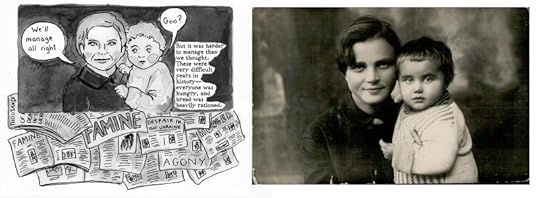
Born in 1910 to a poor, Jewish family outside of Kiev, Lola lived through the Bolshevik revolution, a horrifying civil war, Stalinist purges, and the Holocaust. She taught herself to read, and supported her extended family working as a secretary for the notorious NKVD (which became the KGB) and later as a lieutenant for the Red Army. Her family, including 4-year-old Yulia, moved to the U.S. in the wake of Chernobyl and forged a new life.
Soviet Daughter united two generations of strong, independent women against a sweeping backdrop of the history of the USSR. Like Sarah Glidden in How to Understand Israel in 60 Days or Less , or Marjane Satrapi in Persepolis , Alekseyeva deftly combines compelling stories of women finding their way in the world with an examination o the ties we all have with out families, ethnicities, and the still-fresh traumas of the 20th century.
Soviet Daughter united two generations of strong, independent women against a sweeping backdrop of the history of the USSR. Like Sarah Glidden in How to Understand Israel in 60 Days or Less , or Marjane Satrapi in Persepolis , Alekseyeva deftly combines compelling stories of women finding their way in the world with an examination o the ties we all have with out families, ethnicities, and the still-fresh traumas of the 20th century.
192 pages, Paperback
First published January 10, 2017
Ratings & Reviews
Friends & Following
Create a free account to discover what your friends think of this book!
Community Reviews
Displaying 1 - 30 of 162 reviews

August 30, 2017
This was a fascinating graphic memoir about the Jewish experience in Ukraine and Russia post Revolution and then during WWII. Told from the perspective of the author (modern day) and her life as it intertwined with that of her great-grandmother. I'll definitely keep an eye out for more graphic novels from this press!

August 1, 2017
This is a graphic memoir and biography that is also was many memoirs are, a history of the time. What time? Julia Alekseyeva's great-grandmother Lola lived to 100 years, and died fairly recently, so the time span is an inviting 100 years. Both Lola and Julia are spirited and independent, though you really don't get very much compelling information about Julia, which we read in interludes from Lola's decade-by-decade story. I like the idea of the back and forth storytelling, but the story of Julia itself, eh. The point for her is that no one understood her like Lola. It's in part a coming-of-age story --for two women--that reminds one of Satrapi's Persepolis, in places.
Lola was born near Kieve in 1910. Jewish, she lived through the Bolshevik revolution, civil war, Stalinist purges, pogroms, and the Holocaust. She worked as a secretary for what became the KGB KGB. She had many boyfriends and husbands and recalls them all, entertainingly. Her family, including 4-year-old Julia, emigrated to Chicago in the wake of Chernobyl. The art is pretty muddy, and the panels are packed and sometimes hard to read, but I read it all through and enjoyed it.
PS: My friend/student J read it IN my class today and liked the art, thought it was a little blurry like memory itself, found it perfect form for the content, which is an interesting point.
Lola was born near Kieve in 1910. Jewish, she lived through the Bolshevik revolution, civil war, Stalinist purges, pogroms, and the Holocaust. She worked as a secretary for what became the KGB KGB. She had many boyfriends and husbands and recalls them all, entertainingly. Her family, including 4-year-old Julia, emigrated to Chicago in the wake of Chernobyl. The art is pretty muddy, and the panels are packed and sometimes hard to read, but I read it all through and enjoyed it.
PS: My friend/student J read it IN my class today and liked the art, thought it was a little blurry like memory itself, found it perfect form for the content, which is an interesting point.

November 6, 2017
5 stars +++
A horrendously gripping graphic novel. A nonfiction historical memoir of Khinya Ignatovskaya (Lola), written by her great grand-daughter Julia Alekseyeva.
“Lola had written a memoir and instructed us not to read it before she died. What lay inside was astonishing. This is the story held within her memoirs, growing up over the course of the 20th century. In between each chapter of Lola’s life, you will find a short slice of my own 21st century coming of age. It’s a story of our two generations, separated by 80 years-but somehow united in spite of everything.” –Julia Alekseyeva p.6
This tribute is absolutely stunning in content in every way. The story, the plot, the timing, the artwork. All created by the talented great grand-daughter.
I stumbled upon this novel purely by accident snooping through graphic novels locally because I am always on the hunt for historical fiction and non-fiction reads. I am so glad I found it because it is AMAZING. It is the true accounts in history and humanity that get to me the most. I sometimes think that reading them is my way of saying, it is not forgotten and you’re sacrifice is not lost.
This is the blurb you can find on her website http://www.jalekseyeva.com/news/ as well as an interview of the author and all her other works:
“Soviet Daughter is the story of Julia Alekseyeva's great-grandmother Lola. Born in 1910 to a poor, Jewish family outside of Kiev, Lola lived through the Bolshevik revolution, a horrifying civil war, Stalinist purges, and the Holocaust. She taught herself to read, and supported her extended family working as a secretary for the notorious NKVD (which became the KGB) and later as a lieutenant for the Red Army. Her family, including 4-year-old Julia, moved to the U.S. in the wake of Chernobyl and forged a new life. Interleaved with Lola's history we find Julia's own struggles of coming of age in an immigrant family and her political awakening in the midst of the radical politics of the turn of the millennium.”
“At times heartbreaking and at times funny, this graphic novel memoir unites two generations of strong, independent women against a sweeping backdrop of the history of the USSR. Like Sarah Glidden in How to Understand Israel in 60 Days or Less, or Marjane Satrapi in Persepolis, Alekseyeva deftly combines compelling stories of women finding their way in the world with an examination of the ties we all have with our families, ethnicities, and the still-fresh traumas of the 20th century.”
Soviet Daughter was published January 10, 2017-- 100 years after the anniversary of the Bolshevik Revolution.
Here is the link where you can see the author creating the artwork for the novel:
https://microcosmpublishing.com/catal...
I highly recommend this graphic novel to historical fiction and non-fiction readers alike and I will be on the lookout for future works of her. I have a feeling we will be seeing, hearing and reading a lot more from this talented lady. Very well done and it will stay with me for a long time I'm sure.
A horrendously gripping graphic novel. A nonfiction historical memoir of Khinya Ignatovskaya (Lola), written by her great grand-daughter Julia Alekseyeva.
“Lola had written a memoir and instructed us not to read it before she died. What lay inside was astonishing. This is the story held within her memoirs, growing up over the course of the 20th century. In between each chapter of Lola’s life, you will find a short slice of my own 21st century coming of age. It’s a story of our two generations, separated by 80 years-but somehow united in spite of everything.” –Julia Alekseyeva p.6
This tribute is absolutely stunning in content in every way. The story, the plot, the timing, the artwork. All created by the talented great grand-daughter.
I stumbled upon this novel purely by accident snooping through graphic novels locally because I am always on the hunt for historical fiction and non-fiction reads. I am so glad I found it because it is AMAZING. It is the true accounts in history and humanity that get to me the most. I sometimes think that reading them is my way of saying, it is not forgotten and you’re sacrifice is not lost.
This is the blurb you can find on her website http://www.jalekseyeva.com/news/ as well as an interview of the author and all her other works:
“Soviet Daughter is the story of Julia Alekseyeva's great-grandmother Lola. Born in 1910 to a poor, Jewish family outside of Kiev, Lola lived through the Bolshevik revolution, a horrifying civil war, Stalinist purges, and the Holocaust. She taught herself to read, and supported her extended family working as a secretary for the notorious NKVD (which became the KGB) and later as a lieutenant for the Red Army. Her family, including 4-year-old Julia, moved to the U.S. in the wake of Chernobyl and forged a new life. Interleaved with Lola's history we find Julia's own struggles of coming of age in an immigrant family and her political awakening in the midst of the radical politics of the turn of the millennium.”
“At times heartbreaking and at times funny, this graphic novel memoir unites two generations of strong, independent women against a sweeping backdrop of the history of the USSR. Like Sarah Glidden in How to Understand Israel in 60 Days or Less, or Marjane Satrapi in Persepolis, Alekseyeva deftly combines compelling stories of women finding their way in the world with an examination of the ties we all have with our families, ethnicities, and the still-fresh traumas of the 20th century.”
Soviet Daughter was published January 10, 2017-- 100 years after the anniversary of the Bolshevik Revolution.
Here is the link where you can see the author creating the artwork for the novel:
https://microcosmpublishing.com/catal...
I highly recommend this graphic novel to historical fiction and non-fiction readers alike and I will be on the lookout for future works of her. I have a feeling we will be seeing, hearing and reading a lot more from this talented lady. Very well done and it will stay with me for a long time I'm sure.


May 28, 2017
Soviet Daughter is a compelling biography of a young Jewish woman who grew up in Russian during the early part of the century. It's always fascinating to see examples of women living independently in the past when that is not a narrative that gets much attention in our history lessons. Lola was the eldest daughter of a large family, and one of the few to survive the war and pogroms of the era. She married more than once, had boyfriends, raised a daughter on her own, and worked all throughout her adult life (and much of what we would consider her youth as well).
There are two points of weakness in this collection. The author adds in pieces of her own story in between chapters of her grandmother's life, but her moments are less interesting. There are some moments worth thinking about, but not enough reflection to actually make them work.
Additionally, the art and the printing are a bit weak. Sometimes it's hard to tell which exactly is going wrong, but the pages are sometimes quite muddy and hard to make out.
There are two points of weakness in this collection. The author adds in pieces of her own story in between chapters of her grandmother's life, but her moments are less interesting. There are some moments worth thinking about, but not enough reflection to actually make them work.
Additionally, the art and the printing are a bit weak. Sometimes it's hard to tell which exactly is going wrong, but the pages are sometimes quite muddy and hard to make out.

October 13, 2019
Soviet Daughter is a dual biography, based on the author/artist's family history. Alekseyeva traces the life of her great-grandmother, "Lola" and her Jewish family running to the city to escape pogroms, in Moscow during the Bolshevik Revolution, and the years of Stalin and Khrushev's USSR, etc. We follow Lola's personal hardships of love, death of a husband in WWII, poverty, single motherhood, new loves, jobs, challenges. She draws parallels to her own story and passions, two generations later. In the book, Lola, at age 100 and still sound in mind, continues to share memories with Julia. It's a heartfelt and personal story, and I am glad I read it.

February 17, 2017
A compelling and harrowing story of the life of the author's great grandmother. The art style didn't quite work for me. It is dark and blurry, and I found it a bit of a strain to visually follow the narrative.
October 15, 2019
3.5 Stars!
The art work in here isn’t great and it takes a wee bit of getting used to, the text is a little blurry too, but it still has its charms and there are two or three techniques here and there which compensate a little for the below par drawing.
The author contrasts her own life with her great grandmother’s, who lived a fairly epic and bohemian life, living through two world wars, Stalin’s terror and purges, the Holodomor and even a nuclear disaster to make it to the grand old age of 100.
Alekseyeva reveals many of her own personal battles with her identity as she tries to transition into the phenomenal culture shock of moving to the US from the USSR at such a vulnerable age. She comes up against anti-Semitism as well as the language barrier. She is later diagnosed with thyroid cancer as a result of radiation poisoning from Chernobyl and gets drawn towards politics, art and academia.
This was an inspirational, enjoyable and memorable piece of graphic non-fiction which should be of interest to fans of Sarah Glidden, Marjane Satrapi and even Alison Bechdel to a lesser extent.
March 18, 2017
I feel bad giving this such a low rating. I thought the grandmother's story was interesting and at times moving, and I appreciate how much the author loved her and wanted to honor her. The problem is that the art was really not for me, to the point that it distracted me from the things that I liked.

August 5, 2019
This book came to existence because the author wanted to honor her great-grandmother’s life as a poor Russian Jew, worker, mother, and refugee. Her life is fascinating and full of ups and downs. The author felt deeply connected to her and believes they were very similar. She weaves her great-grandmother’s life with interludes about her own life in America in the 21st century. Though the things her great-grandmother went through are intense and jaw-dropping (romance, WWII, deaths in her family), I didn’t quite feel a satisfying narrative arc. The art is muddy, which I don’t mind, but I do mind that the speech bubbles are blurry and hard to read. I thought I would connect with this more and didn’t quite see the relation between Lola’s life in the USSR and how that inspired the author to be a very political person in the U.S.

October 9, 2025
It's just lacking, reads like a summary instead of anything literary and the artwork just doesn't do enough for me to be able to look past that. She tried doing something unique with the watercolor style, but being unique doesn't make it good.

February 12, 2017
3.5 -ish stars. Maybe closer to 4.
I'm not really sure how to review this book. On the one hand, Lola's life - all 100 years of it -- is fascinating and inspiring. And the genesis of the book -- Lola's memoirs and family photos, compiled and drawn by Lola's great-granddaughter Julia -- also lends this book a high level of interest for me. I thought the graphic format, almost like a scrapbook, worked very well to convey the feeling of Lola's memoirs as family history first, and then as a very personal and immediate history of much of the 20th century, at least through Soviet eyes. In addition, this is a different kind of book for Americans to read, as Lola remained a committed communist her entire life and only emigrated to the US in her elder years because of concerns about Chernobyl's radioactivity after Julia was born. All of this was solidly a 4 star book.
The modern interludes are a little more problematic, because while they function as necessary frames for the reader to understand how the book came to be, the author is pretty young and takes herself pretty seriously. Lacking Lola's years, she is naturally somewhat less self-reflective. Linking some of the movements of the moment (such as Occupy Wall Street) to the Russian Revolution and Lola's struggles through the Interwar years, WWII, and the Stalinist purges seems to me to be somewhat... not the same.
But overall it was a good book that I appreciated reading, particularly as my own 100 year old grandfather just died last year.
Recommended for older teens and adults.
I'm not really sure how to review this book. On the one hand, Lola's life - all 100 years of it -- is fascinating and inspiring. And the genesis of the book -- Lola's memoirs and family photos, compiled and drawn by Lola's great-granddaughter Julia -- also lends this book a high level of interest for me. I thought the graphic format, almost like a scrapbook, worked very well to convey the feeling of Lola's memoirs as family history first, and then as a very personal and immediate history of much of the 20th century, at least through Soviet eyes. In addition, this is a different kind of book for Americans to read, as Lola remained a committed communist her entire life and only emigrated to the US in her elder years because of concerns about Chernobyl's radioactivity after Julia was born. All of this was solidly a 4 star book.
The modern interludes are a little more problematic, because while they function as necessary frames for the reader to understand how the book came to be, the author is pretty young and takes herself pretty seriously. Lacking Lola's years, she is naturally somewhat less self-reflective. Linking some of the movements of the moment (such as Occupy Wall Street) to the Russian Revolution and Lola's struggles through the Interwar years, WWII, and the Stalinist purges seems to me to be somewhat... not the same.
But overall it was a good book that I appreciated reading, particularly as my own 100 year old grandfather just died last year.
Recommended for older teens and adults.
February 17, 2017
I really want to like this book, but...
I don't. I'll start with the good and that is the great-grandmother's story. It was interesting and enlightening. It's worth it to read this book for that. I absolutely hated the interludes. They took you away from the grandmother's story and I could care less about the author after reading them. It would make sense to do an interlude if it was relevant about what was going on in the main story, but they weren't. They are mostly the author complaining about her childhood and say I g her great-grandmother was the only one that underreported but she gave us no examples of that. So one star lost for that. If you read this, save the interludes for last. It will be a better story if you do. The artwork is okay. Sometimes it's really good and sometimes not. One star lost for inconsistency. Finally, don't get the digital version of this. I bought it from comixology because of the price difference and I'm highly disappointed. It's the hardest comic I've ever tried to read digitally. I had to blow up every series of panels and they were blurry. The blurriness along with the inconsistent art and lettering made it very difficult to read. One star lost for that. Save your money and get it from the library.
I don't. I'll start with the good and that is the great-grandmother's story. It was interesting and enlightening. It's worth it to read this book for that. I absolutely hated the interludes. They took you away from the grandmother's story and I could care less about the author after reading them. It would make sense to do an interlude if it was relevant about what was going on in the main story, but they weren't. They are mostly the author complaining about her childhood and say I g her great-grandmother was the only one that underreported but she gave us no examples of that. So one star lost for that. If you read this, save the interludes for last. It will be a better story if you do. The artwork is okay. Sometimes it's really good and sometimes not. One star lost for inconsistency. Finally, don't get the digital version of this. I bought it from comixology because of the price difference and I'm highly disappointed. It's the hardest comic I've ever tried to read digitally. I had to blow up every series of panels and they were blurry. The blurriness along with the inconsistent art and lettering made it very difficult to read. One star lost for that. Save your money and get it from the library.
December 23, 2016
I was floored when I read my ARC of Soviet Daugther. Each page is bursting with authenticity. It starts with the subject matter, taken from the author's great-grandmother who actually lived in the USSR from its early golden years and endured the struggles of WWII. And follows through with the hand drawn images adorned with beautifully expressive inkwashes.
The novel also tells a unique story that links together two generations, one from the 20s and the other from the 00's. The author shows how they are tied together by a certain grit and political engagement. But this larger narrative never overshadows the beautiful interpersonal story of this cross generational relationship.
I highly recommend this graphic novel. It is in equal parts beautiful, personal, heartbreaking, uplifting, and truthful. You will walk away with a reinvogorated taste for the world.
The novel also tells a unique story that links together two generations, one from the 20s and the other from the 00's. The author shows how they are tied together by a certain grit and political engagement. But this larger narrative never overshadows the beautiful interpersonal story of this cross generational relationship.
I highly recommend this graphic novel. It is in equal parts beautiful, personal, heartbreaking, uplifting, and truthful. You will walk away with a reinvogorated taste for the world.

February 8, 2026
I have a lot of respect for authors who can tell big stories through accessible means that engage readers, and have for some time now been taken by the prospects and possibilities of ‘comics journalism’. In this case, Julia Alekseyeva has drawn on a related genre, biography, or rather the interweaving of her life and her great grandmother’s to explore many of the big issues of the 20th century – war, racism, state power, socialism and more.
Having moved as a young child with her family from Ukraine in the mid-1980s, Alekseyeva has little recollection of life before the USA and sets out to discover the family past through her great-grandmother Lola’s life story. Born outside Kiev early in the 20th century, Jewish Lola lived through pogroms, war, the Bolshevik revolution and subsequent civil war, survived collectivisation, Nazi invasion and the holocaust, and Stalinism. She had been active in revolutionary struggle, supported the family working as an administrator for the NKVD, and like many ordinary Soviet citizens negotiated her way through years of change, uncertainty, repression, and loss, remaining engaged in hope of building a better life and world. It was only in the wake of the nuclear disaster at Chernobyl that she and her wider family were able to take the opportunity to leave.
Julia weaves her exploration of Lola’s life into her own coming of age, growing political engagement, participation in social justice struggles, and emerging realisation of the life stories she didn’t know. Her drawing style is murkier than I usually like but she uses wash rather than heavy shading to grant nuance and contrast, and her lettering style – hand written for narrative, typeface for historical context – works really well.
These combine to make a piece of comics biography that works and is convincing, bringing to ordinary Soviet life to the fore and granting access in ways that we seldom see in English-language texts outside scholarly writing, which seldom crosses over to wider audiences. Microcosm, the publisher, has a growing body of graphic history and other non-fiction works; for that we should be grateful.
Having moved as a young child with her family from Ukraine in the mid-1980s, Alekseyeva has little recollection of life before the USA and sets out to discover the family past through her great-grandmother Lola’s life story. Born outside Kiev early in the 20th century, Jewish Lola lived through pogroms, war, the Bolshevik revolution and subsequent civil war, survived collectivisation, Nazi invasion and the holocaust, and Stalinism. She had been active in revolutionary struggle, supported the family working as an administrator for the NKVD, and like many ordinary Soviet citizens negotiated her way through years of change, uncertainty, repression, and loss, remaining engaged in hope of building a better life and world. It was only in the wake of the nuclear disaster at Chernobyl that she and her wider family were able to take the opportunity to leave.
Julia weaves her exploration of Lola’s life into her own coming of age, growing political engagement, participation in social justice struggles, and emerging realisation of the life stories she didn’t know. Her drawing style is murkier than I usually like but she uses wash rather than heavy shading to grant nuance and contrast, and her lettering style – hand written for narrative, typeface for historical context – works really well.
These combine to make a piece of comics biography that works and is convincing, bringing to ordinary Soviet life to the fore and granting access in ways that we seldom see in English-language texts outside scholarly writing, which seldom crosses over to wider audiences. Microcosm, the publisher, has a growing body of graphic history and other non-fiction works; for that we should be grateful.

October 18, 2017
A surprisingly positive view of the author's great-grandmother's life in Soviet Russia. As a secretary for the NKVD, she seems to have avoided or been oblivious to the various purges, massacres, and gulags that we often find synonymous with the rule of Stalin. Most of her family was killed, but by Germans during the two world wars, or by non-Russians for being Jewish. The family eventually immigrated after Chernobyl. The author's constant interludes about growing up in America break up the flow of the story and the art is not fantastic.

July 16, 2025
this was great. i miss lola already. join a union today!

February 10, 2017
This is a graphic novel memoir about two women. Lola is Julia’s great grandmother who lived to be one hundred. She wrote a memoir which Julia found after Lola’s death. Julia decided to use the money that Lola had left her to produce this book. Lola lived through the history of the Russian revolution and the Stalin era. The book shows the parallel lives of Lola and Julia. Julia was closer to her great grandmother than to any of her other relatives. Julia’s life is shown in a series of interludes between Lola’s history. As a Jew in Russia, Lola had many problems. In the United States, Julia’s mother urges her to hide being Jewish. Lola was poor but enterprising, caring for her younger siblings in the large family to which she belonged. Lola is a survivor. She becomes a hard worker who is prized by her boss. She seems unaware of the mission of the KGB for which she works on a secretarial level. She is primarily self taught and hard working . She has several husbands along the way and two children. She loses family members as she goes through the revolution, the civil war and World War II. Although the loves a good time, she is always volunteering to help others and becomes a skilled nurse as she learns to care for the wounded soldiers. Despite her many skills she is limited as to how far she can advance because she is Jewish. Julia’s struggles are of a different nature, including a bout with cancer. The contrast between the lives of these two strong and independent woman illustrate the changes in society as well as the different countries in which they grow up. The graphics are in black and white and are simple. The narrative dominates over the visuals. It is an instructive book and raises many questions as when one reads of Russians killing Jews to please the conquering Germans who are eventually defeated.

May 23, 2017
So very Microcosm. Isn't Communism the best? I suppose so. Clearly a labor of love, a story of the author's great-grandma and the author's own journey to being a political person in her own right, inspired by that journey. So....nice? Soviet Russia was weird, man. It's weird to believe in a cause that in so ways takes your life and even betrays you. And then inspires your great-grandkids to give themselves to a cause that might well do the same. A bit starry-eyed. Politics, man. That's what I learned. :)
March 15, 2017
I was in tears after reading this book. I feel this is a story we can all relate to regardless of whether our great grandmother was a soviet revolutionary or not. Microcosm publishing never disappoints.

April 29, 2024
As a biographical work, it's fine. As a book concerning the "soviet" or "revolution"? There's nothing here. The revolution and the Soviet Union are backdrops to a woman's life, one that is riveting but nothing unique to the biographical genre. While glimpses of the revolution's political consequences pop up frequently, the author has no grasp of class struggle, so these moments aren't connect to any historical movement or political practice. For example, we learn that Jews were persecuted far more by the White Army, than the Red; that under communism, women workers were meant to be paid equal wages to men, yet this was often not the case; and that by a decade in, childcare centres had shut down, so women had to leave work to take care of their own.
This is all surface level information. Tell me why the white army hated Jews, so we can identify these logics in the reactionaries of our present. Tell me how women organised against patriarchal employers, so we can learn from their courage and tactics. Tell me why childcare centres shut down, so we can understand the economic crises of our own times! The author implies that her great grandmother's life in Soviet Russia inspired her own political perspectives, but she gives us nothing to connect past and present together. The Occupy Movement is mentioned at the end of the book, but how do its demands mirror those of the October Revolution? Despite the persistent hardships her great grandmother experienced, she remained an ardent socialist. Why? What can we learn from the failures of communist Russia so we don't repeat the same mistakes? What am I meant to take away from this book? I truly don't know.
This is all surface level information. Tell me why the white army hated Jews, so we can identify these logics in the reactionaries of our present. Tell me how women organised against patriarchal employers, so we can learn from their courage and tactics. Tell me why childcare centres shut down, so we can understand the economic crises of our own times! The author implies that her great grandmother's life in Soviet Russia inspired her own political perspectives, but she gives us nothing to connect past and present together. The Occupy Movement is mentioned at the end of the book, but how do its demands mirror those of the October Revolution? Despite the persistent hardships her great grandmother experienced, she remained an ardent socialist. Why? What can we learn from the failures of communist Russia so we don't repeat the same mistakes? What am I meant to take away from this book? I truly don't know.
January 27, 2020
I appreciated learning about the history of the Soviet Union and how the rise of Hitler impacted the country. The book recounts the story of the author's great grandmother and how her life unfolded during a tumultuous time in history. Interspersed within the pages of the great grandmother's story is the story of the author and how she closely identifies with her great grandmother. Overall, the book was informative and demonstrative of how positive family relationships can have longstanding effects on others.

December 15, 2018
Wish I had known about this book when I was teaching about The Russian Revolution last year!

March 6, 2017
I just finished reading this, it was actually a recommendation from my mom (who heard about it on the radio) and our local library didn't have it so she requested it and like magic they ordered it! So you can now check this out through the Santa Clara County library system, hooray!
Because it is definitely worth reading! I haven't read a lot of graphic novels (really just Nimona and some of the Sandman series) but I really loved this. It made me want to read more graphic novels and see what I've been missing out on!
It was very genuine, humorous in parts but also heartbreaking, and the illustration style reminded me of charcoal and watercolor at the same time, really dynamic (not used to discussing graphic pieces, can you tell? Definitely wanted to give it a try to review this book though, it so deserves it!)
Would recommend!
Because it is definitely worth reading! I haven't read a lot of graphic novels (really just Nimona and some of the Sandman series) but I really loved this. It made me want to read more graphic novels and see what I've been missing out on!
It was very genuine, humorous in parts but also heartbreaking, and the illustration style reminded me of charcoal and watercolor at the same time, really dynamic (not used to discussing graphic pieces, can you tell? Definitely wanted to give it a try to review this book though, it so deserves it!)
Would recommend!

June 5, 2017
Basically, this graphic novel combines the story lines of the life of a grandmother and granddaughter. While the grandmother is totally fascinating and all the events in her life make for a thoughtful story, the granddaughter is quite unremarkable and, in my humble opinion, should have given the grandma the true central role that she deserved.

May 11, 2018
Author-artist Julia Alekseyeva illustrates growing up alienated from her own family members with the exception of her beloved great-grandmother Lola. Julia intersects her own chapters with those of her great-grandmother Lola's much longer story, based on a memoir Julia inherited upon Lola's death at the age of 100. Interesting way of melding the history of communism and modern day political activism, against a shared backdrop of traumatic immigration. I was touched by the close relationship and mutual devotion shared by Julia and Lola but at the same time distracted by the ambiguous distance between Julia and the rest of her family. I hope she's surrounded by friends and loved ones, she is obviously a very talented and conscientious young woman.
March 8, 2017
I've always been a sucker for a good autobiographical graphic novel, and this one is no exception. This will appeal to fans of Fun Home and Persepolis. The narrative is brisk and the no-nonsense tone, with its utter lack of self-pity, underscores the resilience of the women in this tale. A perfect read on Women's Day!

May 27, 2019
December 2022 second time I read this. I forgot about it. Still interesting and an easy read
May 2019 Graphic novels are kind of fun. This is the story of Julia, an immigrant from the Ukraine with her family in 1992. But it’s more the story of her great grandmother Lola who was born in 1910 and lived through wars and pogroms in Ukraine. It’s an interesting perspective and an easy read
May 2019 Graphic novels are kind of fun. This is the story of Julia, an immigrant from the Ukraine with her family in 1992. But it’s more the story of her great grandmother Lola who was born in 1910 and lived through wars and pogroms in Ukraine. It’s an interesting perspective and an easy read
January 8, 2021
I’m rly back and forth on how I feel about this book. I think I’d give it a 3.5 if I could but I think it’s good enough to bump it up to 4.
I think that while this story is compelling, the art eye catching and varied, adding to the words, that it lacks a structure I seek from stories like this. Or rather? It has too much? The way it very pointedly separated past from present made it feel disconnected and I felt when it moved between the two it reached for thematic connections that felt forced. I think this made it read in a sort of weirdly disingenuous way. As the book progressed and I got to know the people in it this became less obvious/maybe started to work better. I think maybe I just prefer a more fluid movement through time where connections aren’t so forced by chronology and come from the actual content and themes n stuff. But I do think the narrative was really compelling and I will definitely be calling my grandmother tomorrow morning because I am think about how fucked up it is that our loved ones die and am really messed up about it.
I will also say this story works to explain history and def does this well! I feel so much of WWII narratives focus on like just Germany, the US, or the UK so it was interesting reading something about Russia. Some specific vocab may be kinda confusing if you’re not familiar and can make understanding the dynamics of the forces in the story sorts difficult but I found it generally easy enough to understand based on high school history and stuff but I did have a weirdly engaging teacher so idk.
The back of the book compares it to Persepolis and How to Understand Israel in 60 Days or Less. And while I’d agree it is similar in exploring intergenerational/cultural/religious stuff from a woman’s perspective, that it is also very different from these works. Persepolis is like one of the strongest pieces of autobio-comic ever and this piece was not an investigation of the self/identity the same way 60 Days was. Not to say this book is bad but I just think those comparisons r a little bit of a stretch and don’t consider the way the similar topics are discussed VERY differently.
I think that while this story is compelling, the art eye catching and varied, adding to the words, that it lacks a structure I seek from stories like this. Or rather? It has too much? The way it very pointedly separated past from present made it feel disconnected and I felt when it moved between the two it reached for thematic connections that felt forced. I think this made it read in a sort of weirdly disingenuous way. As the book progressed and I got to know the people in it this became less obvious/maybe started to work better. I think maybe I just prefer a more fluid movement through time where connections aren’t so forced by chronology and come from the actual content and themes n stuff. But I do think the narrative was really compelling and I will definitely be calling my grandmother tomorrow morning because I am think about how fucked up it is that our loved ones die and am really messed up about it.
I will also say this story works to explain history and def does this well! I feel so much of WWII narratives focus on like just Germany, the US, or the UK so it was interesting reading something about Russia. Some specific vocab may be kinda confusing if you’re not familiar and can make understanding the dynamics of the forces in the story sorts difficult but I found it generally easy enough to understand based on high school history and stuff but I did have a weirdly engaging teacher so idk.
The back of the book compares it to Persepolis and How to Understand Israel in 60 Days or Less. And while I’d agree it is similar in exploring intergenerational/cultural/religious stuff from a woman’s perspective, that it is also very different from these works. Persepolis is like one of the strongest pieces of autobio-comic ever and this piece was not an investigation of the self/identity the same way 60 Days was. Not to say this book is bad but I just think those comparisons r a little bit of a stretch and don’t consider the way the similar topics are discussed VERY differently.
This entire review has been hidden because of spoilers.
Displaying 1 - 30 of 162 reviews