Jump to ratings and reviews
Rate this book

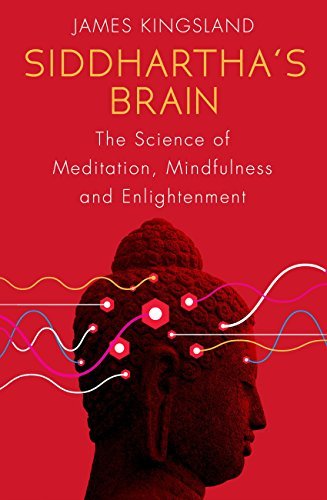
Siddhartha's Brain: The Science of Meditation, Mindfulness and Enlightenment

Rate this book

Can meditation and mindfulness really reconfigure our brains to make us sharper, smarter, healthier, happier?

In Siddhartha's Brain, James Kingsland reveals that a complete scientific theory of how these practices work is now within our grasp and may be the key that unlocks a wide range of afflictions of the human mind.

Some 25 centuries ago an Indian sage called Siddhartha Gautama - the man who would become known as the Buddha - developed a programme for improving mental wellbeing that has been passed down to us by generations of monks and nuns. Far from being a New Age fad, secular mindfulness courses are remarkably consistent with these ancient teachings and are proving their worth for tackling many of the problems associated with the demands of our frenetic, technology-driven modern world.
Research by psychologists and clinicians has shown that mindfulness can be used to treat stress, anxiety, depression, chronic pain, hypertension and drug addiction, as well as improving concentration, empathy, emotion regulation and the quality of interpersonal relationships. There have even been hints that it could enhance immune function, slow cellular ageing and help keep dementia at bay.

Taking us on a journey back to the time of the Buddha to record changes in his brain as he travels the path leading to enlightenment, Siddhartha's Brain is the first book to explain not only how meditation and mindfulness work but also why. It proposes that by fine-tuning the neural circuits that allowed our hominid ancestors to band together in ever larger social groups, these practices can help us find lasting peace and contentment.

355 pages, Kindle Edition

First published February 2, 2016

469 people are currently reading
2582 people want to read

About the author

James Kingsland

12 books19 followers

Ratings & Reviews

What do you think?
Rate this book

Friends & Following

Create a free account to discover what your friends think of this book!

Community Reviews

5 stars
455 (37%)
4 stars
488 (40%)
3 stars
220 (18%)
2 stars
39 (3%)
1 star
13 (1%)
Displaying 1 - 30 of 152 reviews
Profile Image for Tom Quinn.
649 reviews238 followers
December 22, 2021
An excellent look at mindfulness and meditation from a neuroscience POV. Kingsland presents recent findings on brain activity, interweaving them with reconstructed tales of the Buddha's life, speculation on the habits of ancient pre-hominids on the savanna, and present-day goings-on at monasteries and meditation retreats worldwide. For a cynic like me who has long been curious about meditation but who struggles with a strictly spiritual approach, the impartial data from brain scans is very persuasive. And Kingsland's encouraging and excited tone seals the deal by offering the cynic a welcome entry point to get started or further develop their own feldgling practices.

4 stars. A book like this seems bound for obsolescence as new findings continue to be made. I also rated it down a hair for some of the sillier analogies. But still, it's highly recommended for those in the market for self-help with a scientific edge, mental health in all forms, and Eastern religious/spiritual practices.
Profile Image for Joseph.
572 reviews1 follower
October 17, 2025
This book was a warm read. It presented quality studies about mindfulness that embraced scientific brain imagery.

I especially liked the insight about Lewis Carroll (I never knew he was a mathematician) and the connection to Alice in Wonderland.

"Their creator, the Victorian mathematician Lewis Carroll, had the kind of analytical, scientific mind that relished this sort of exercise. Like the Hatter and March Hare, we too have the capacity for unassailable logic, something aggressive, irrational, and perhaps even a little silly- like trying to stuff a sleepy dormouse into a teapot." (204)

Kingsland's approach and explanation of metacognition was impressive. Metacognition is probably one of the most important things I learned about in graduate school.

The reference to Sam Harris' Waking Up rang a bell because I recently read it. I must admit, even though I didn't like that book, I later realized that the cover of clouds actually made the shape of a face!

Kingsland's guided meditations were congruent with a lot of the Headspace techniques hosted by former Buddhist monk, Andy Puddicombe. In 2016, I completed 400+ focused meditation sessions for 100+ hours using Andy Puddicombe's Headspace Mindfulness App, but I didn't let it define my identity or social circles. I just wanted to try and learn something new.

This book also reflects upon multiple variants of meditation practices.
Profile Image for Arlitia Jones.
136 reviews4 followers
July 10, 2016
This is one of the nerdiest books I've read in a long time--and it was absolutely fascinating. It got a bit technical at times, I'll admit, what with all that brain mapping and description, but I stuck with it, because the message of the book is one I think is important and one I think the author makes very clear. Meditation, or mindfulness if you're squidgy about using the word meditation, has profound effects on the brain, mentally and physically. There is mainstream science to back this up, and there are a multitude of Buddhist monks and nuns and practitioners around the world who have known this for centuries. Kingsland gives voice to both paths of knowledge. This is not a self help book, or a self indulgent memoir or any kind of spiritual journey, at all. It is reporting on what is now known about mindfulness and some tips on how to achieve it for anyone who is curious. Or if you're not curious, read the book, and see what it awakens in you.
Profile Image for Bernie Gourley.
Author 1 book114 followers
December 12, 2016
Kingsland builds his niche by connecting the dots between the teachings of the Buddha and scientific discoveries about meditation and mindfulness. There are many books that tell the life story of Siddhartha Gautama from various perspectives (e.g. famously the books by Hermann Hesse and Karen Armstrong.) There are also a number of books reporting the science of meditation (e.g. Herbert Benson and Sat Bir Singh Khalsa.) However, it’s not so common for the subjects to be overlapped.

There’s a reason that this middle path hasn’t been more widely studied. While Buddhism is arguably the most science-friendly of the major world religions, there’s always a gulf between spiritual and scientific thinking. The writer has to figure out how to chart a course through rocky waters. Books appealing to spiritual seekers are likely to come across as insubstantial fluff to the scientifically minded reader, and books appealing to skeptics are likely to feel materialistic and cold (and, perhaps, naive) to the spiritualist. The Buddha’s teachings about the need for the practice to be experiential, rather than faith-based, offers a unique opportunity to tread this tightrope. Furthermore, the Dalai Lama’s willingness to facilitate a dialogue between science and Buddhism has been crucial as well. One can easily set aside controversial issues like reincarnation and karmic law as they aren’t essential to the value of mindfulness.

The book consists of twelve chapters. The chapters generally begin with a story or teaching from the life of Buddha, and then go on to investigate the relevant lesson in more detail with particular emphasis on any relevant scientific discoveries that support said teachings.

The story of Buddha begins in a wealthy, high-caste household with young Siddhartha Gautama being kept from seeing the effects of aging, illness, and death. When the young Siddartha, nonetheless, sees these things, it is a powerful introduction to the concepts of impermanence and suffering that will play a central role in his future teachings. Chapter 1 starts this introduction and also offers an overview of the book. Chapter two continues it. In Chapter three, Kingsland describes a little of the known history of meditation, though its origins are lost to time.

Chapter 4 is entitled “The Second Dart” and it discusses the Buddha’s teaching of the same name—the second dart being one’s mental reaction to an event (i.e. the initial dart.) Chapter 5 investigates the question of whether there is a self—and, if so, of what manner. A core idea within Buddhism is that the self is illusory.

Chapter 6 gets to the heart of the matter by explaining the mechanism of mindfulness meditation and what has come to be known as MBCT (Mindfulness Based Cognitive Therapy)—a secular approach to the use of mindfulness to improve well-being. The next chapter tells the story of how a group of fire worshippers came to follow the Buddha after he made clear that everything (their senses, thoughts, and emotions) were aflame with craving, hatred, and delusion, and that springboards into a discussion of how mindfulness is used to reduce craving and addiction.

Chapter 8 tells the story of an attempt to kill the Buddha via an angry, drunk elephant, and the Buddha’s thwarting of the plot by way of calm and compassion. As one might have guessed, the chapter is about moderating emotions, just as the Buddha controlled his fear before the elephant.

Chapter 9 takes a jaunt into evolutionary biology to question how the mismatch between what humans evolved to do and what we do in the modern world causes mental illnesses and how mindfulness can help mitigate the problem. Chapter 10 is about metacognition, or the ability to observe and reflect upon our own mental experience—i.e. thinking about thoughts. Chapter 11 is about cognition and decision making, and the role that meditation can play in improving our performance in this domain. The last chapter discusses the Buddhist conception of death and enlightenment. It isn’t until this point that there’s a major divergence between the Buddhist and scientific viewpoints. There is a discussion of the Buddha’s teachings emphasizing that belief in ideas from on high is not so important as experience.

Six of the chapters (2, 4, 6, 8, 10, & 11) are concluded with guided meditations to offer the reader an introduction into the basics of mindfulness. These are simple practices that many readers will already be familiar with in some variant or another. (e.g. breath awareness, bodily awareness, and mindful eating.)

There are only a few graphics (e.g. maps and diagrams—mostly of the brain) but there is no need for additional graphics. The book has references annotated.

I found this book interesting and thought-provoking. It uses the stories of Buddha as well as some stories from the present day to make the reading more engaging and approachable. The discussion of scientific research is easy for a neuroscience neophyte to follow.

I’d recommend this book for anyone interested in learning more about the science behind Buddhist practices.
Profile Image for Pairash Pleanmalai.
400 reviews31 followers
May 14, 2019
เล่มนี้คล้ายกับ "สมองพุทธะ" แต่ไม่เน้นศัพท์ทางการแพทย์มากนัก (แต่ก็มีบ้าง)
ใช้รูปแบบเล่าเรื่องพุทธเจ้า(พุทธประวัติ)ขึ้นต้นบทก่อน และเทียบเคียงว่าเกิดอะไรขึ้น
พระพุทธเจ้าพบสิ่งใด สิ่งที่เคยขึ้นกับสมองในภาวะระลึกรู้ มีสติ ถามว่ารู้ได้ไง ก็โดยการนำผู้ปฏิบัติสมาธิขั้นสูงเข้าเครื่อง MRI
แก่นของหนังสือที่พบบ่อยตลอดเล่มก็คือ
" จิตมนุษย์ทุกคนอยู่ในภาวะสู้หรือหนีตลอดเวลา เรากังวลอนาคต นึกฝันถึงอดีต แต่เพราะสิ่งนี้ทำให้เรามีวิวัฒนาการ คิดค้นสิ่งประดิษฐ์ต่าง แต่ก็ส่งผลให้เราเกิด โลภ โกรธ หลง และ ตัณหาตามมา
การเจริญสติ คือหัวใจของการปฏิบัติธรรม ส่งผลให้เกิดสิ่งใดกับสมอง และทำไมจึงแก้ปัญหาข้างต้นได้"

จะมีเนื้อหาสัก10%ที่ต้องอ่านแบบคราวๆ เพราะไม่เข้าใจว่าจะสื่ออะไร แต่ถ้าเทียบคุณประโยชน์ทั้งเล่มแล้วถือว่ามาก
ช่วยเสริมสิ่งที่ พระสงฆ์ ครูบาอาจารย์ สอนเรื่องการเจริญสติ โดยให้เหตุผลว่าทำแล้วเกิดสิ่งใด เพื่ออะไร นอกจากความสงบ

(เล่มนี้ก็ต้องการพื้นฐานสำหรับผู้อ่านหนังสือแนวการบรรลุธรรมมาบ้าง จึงจะเข้าใจสิ่งที่ผู้แต่งต้องการสื่อ)
Profile Image for Max.
536 reviews73 followers
July 5, 2016
A wonderfully accessible and well-written book on the science behind meditation and mindfulness. Each chapter takes the history of the Buddha and Buddhism and makes it approachable, while also making the science understandable.

Truly, a fantastic book on the topic!

This is what Hardwiring Happiness: The New Brain Science of Contentment, Calm, and Confidence was trying to be, yet it didn't quite make it. While Siddhartha's Brain did so with ease.

Recommended!
Profile Image for LindaH.
119 reviews8 followers
May 14, 2016
Fascinating topic, pedestrian writing. I was disappointed.

The author follows the Buddha's journey, focusing on the physical deprivations undergone by him and his followers. I really liked the part about Siddhartha's epiphany. The author references a myriad of research on the practice of mindfulness. Since I was familiar with much of the research, I was bored during these parts. The research is reported in a sort-of USA Today way instead of a New Yorker way. No depth, richness. The author provides instructions for mindfulness meditation too.

I was disappointed because my expectations for this book were so high. It never had the zing the subject deserved.
Profile Image for Swapnil.
12 reviews
Read
October 2, 2025
Little more science to convince my left brain to be more mindful, sit and meditate.
Profile Image for Marco Gallardo.
157 reviews21 followers
October 2, 2017
¿Es un libro sobre las ventajas científicamente comprobadas de la meditación? ¿es sobre qué pasa en nuestro cerebro al momento de meditar o tener el hábito de hacerlo? ¿es sobre la historia de Siddharta? ¿es una guía sobre cómo meditar? ¿es un breviario sobre budismo? En realidad intenta ser todo y lo combina pobremente para terminar siendo ninguna de esas cosas. Aunque debo admitir que si la intención era interesarme sobre la práctica secular de la meditación, lo logró.
Profile Image for P Michael N.
211 reviews9 followers
August 1, 2018
Buddhism meets science - fantastic book. There are so many thought provoking bits in this book. One interesting observation is that we come into this world with nothing and yet we feel cheated by death. That’s tied in with our attachment to things and this sense of immortality of ‘self’ we have. We know that life is impermanent intellectually but our actions don’t always reflect this.
The book is a down-to-Earth look at the life of Siddhartha, the enlightened teacher who founded Buddhism. It’s also an attempt to understand what changes happened and continue to happen when people practice meditation.
The book summarises the advantages of meditation as helping us attain/achieve: calmness of mind, concentration or focused attention, mindfulness, investigation or experimentation with cause and effect, energy to see our projects through, equanimity and happiness or rapture.
Great book for anyone curious about the benefits of meditation from a scientific and practical perspective.
And remember, as the book says, people who try to multi-task suffer from multi-tasking addiction disorder. Don’t go MAD trying it!
Profile Image for John Stepper.
621 reviews27 followers
June 16, 2019
A comprehensive review of the benefits and the scientific studies supporting them - and also where there's ambiguity or more research to be done. As good as that is, my favorite parts are the vignettes relating to the Buddha's teaching - part history and part historical fiction, and written in a way that brought the Buddha to life in a lovely way.
434 reviews5 followers
November 6, 2017
The book is astounding. It is clear and precise and answers so many questions to scientific tempered mind. I cannot say I was surprised with the correlation of science with religious procedures, that people practice without the knowledge as it is passed down to us by our ancestors.

I had always been a believer in the procedures followed by religious groups (though they follow it as a guide or a compulsion which is wrong) as I believe that there is no smoke if there is no fire.

I will come back to this book for a re-read. It is fascinating how most of all human internal development structures are founded in India and around that area.

I believe that internal structures bring in happiness and joy and all the things people actually crave for. If consciousness strikes to people I think they can actually see through the blinders of outside world.
21 reviews5 followers
January 27, 2018
From the cover, I expected this to be a book about approaching the ancient teachings of Buddhism with modern day understanding of the brain. It was much more than that.

The author collects together the findings from many different studies with the insight of many modern day teachers of Buddhism and meditation for a compelling presentation of the relationship between buddhist philosophy, meditation, mental health, and how all of these things can be observed in the brain. Some of what he presents has been proven and some is conjecture supported by what has been discovered so far, with each clearly presented as one or the other.

I expected to learn about the workings of the brain, and I did. I also learned about mental health, and even some things about Buddhism that were new to me.

This was an enjoyable and rewarding read.
Profile Image for Metodi Pachev.
297 reviews12 followers
February 8, 2020
I received the book as a gift from a friend and it sat in my library for well over half a year. It is not because I was not interested in the subject. Rather, deep inside, I was fearing that the book might be promoting some sort of a “quackery” that I usually associate with books on similar topics. When I decided that its time has come, I found out that I should have paid more attention to the subtitle: “The Science of Meditation, Mindfulness and Enlightenment.” Or at least I should have noticed the word “science.” Well, certainly the entire book is about science – mostly neuroscience and psychology.
Note to all the skeptics: the book promotes mental health. Maybe the author and the publisher could have included this somehow on the front cover (or at least something with “psychology”) so I had to read the entire introduction in order to get some sort of a relief that it is not one of those books.
Moreover, this is one of the most helpful books that I have read. Its messages are crystal-clear:
1. Mental illnesses are not clear-cut categories;
2. Nobody is completely healthy nor completely ill;
3. Manifestations of different illnesses can overlap, coexist, cross-interact;
4. Self-guided mental practice is sometimes more beneficial than medication or psychotherapy;
5. Buddhists have discovered a way to counter manifestations of illnesses;
6. These practices can remain devoid of religious implications.
The book is based on lots of scientific research to back-up its tenets. It is full of explanations of the different regions of the brain, their (supposed) functions and how to influence them with your mind to be healthier. It contains six guided meditation practices that are good for beginners.
I have two main criticisms about the book:
1. Although several times the author points to the non-existence of an “eternal Self” (soul), in chapters 11 and 12, he talks about two things that irritated my internal militant atheist: that science cannot “disprove the existence of heaven, hell, gods, angels [...]” (p. 238) and that there might be some kind of a “rebirth.” To me, these statements are out-dated and irrelevant;
2. The author does not treat in detail the topic of social inertness. According to my recollections, he mentions on two occasions only that by having a peaceful and accepting mind does not mean that one becomes socially disengaged. My question is: does mindfulness make you care less about what is happening around you? The author has shamelessly avoided answering this question with arguments. He simply says: “No, it does not.”
Anyways, this is a brilliant book. Well-researched and well-written. I enjoyed the fable-wise framing model of each chapter.
Profile Image for W.
344 reviews2 followers
September 20, 2022
I think most would describe this book as an attempt to tie Buddhist ideas to modern neuroscience, with the implication that science might give extra credence to the more spiritual ideas.

However, I think that the opposite is the truth: this book is more about how far behind modern neuroscience really is. While researchers study the instruments, monks study the symphony. They’ve been listening for millennium.

~This body is a painted image, subject to disease, decay and death, held together by thoughts that come and go. What joy can there be for those who see their white bones will be cast away like gourds in the autumn?~
Profile Image for Miss Syreena.
775 reviews
Read
January 29, 2024
Mixed thoughts. On one hand, I really enjoyed the presentation of experiments and studies that help to prove how beneficial meditation is for the mind. Specific religions and practices don’t even matter (ahem, sorry folks who paid $$$ for a special mantra…) - having a mindful focus will help. Some of the suggestions shared have already helped me to improve certain habits. On the other end, I DNF’ed at 90% because the author made some comments about neurodivergent people possibly not needing medication with meditation 🙄 not helpful!
Profile Image for Lindsaymadelaine.
46 reviews1 follower
July 21, 2020
This book was very informative about how the brain works, and how meditation can help with some of the common issues people have. It has definitely inspired me to meditate more, and aim to live more mindfully...especially in the anxiety/depression evoking world of today! I especially liked the variety of the way this book was written; it blends Buddhist stories, heavy scientific neuroscience info, and personal insights which makes the concepts easy to understand.
Profile Image for Charlotte Burt.
491 reviews38 followers
October 16, 2020
Interesting both from the scientific pov but also from a lot of historical data about Siddhartha and the world that he came from. It got me meditating again, so that has to be a bonus.
Profile Image for McKenna Ben.
146 reviews1 follower
July 14, 2025
Almost want to give it five stars cause it’s was really ENLIGHTENING, know what I mean?? 🤭🤣 no, but fr. A lot of interesting stuff in here. Mindfulness really do be life changing I think?? Idk we’ll see in 50 years. Worth a try.
Profile Image for Ellison.
898 reviews3 followers
May 14, 2018
Probably good for someone who is just dipping their toe into the waters of meditation and/or just beginning to get interested in Buddhism. Easy to read.
551 reviews
September 1, 2019
Took forever, but thoroughly enjoyed it. This is what I had hoped the interdisciplinary cognitive science minor would be like. (No such luck.) Learned an enormous amount about the brain, cognitive function, dysfunction, and decline, and current scientific evidence supporting meditation for brain health.
Profile Image for Jennifer.
473 reviews9 followers
April 2, 2016
“Siddhartha’s Brain” is a fascinating look into the human brain and how meditation can have an impact on the way the brain works. Using the latest in scientific research, Mr. Kingsland has opened the door to understand how the meditation practices of Buddha worked to literally change the way his brain worked. The book starts off by laying a foundation of the various areas of the brain that process our perceptions and prompt us to act in think in certain ways. The author then goes into the research of meditation and describes the impact that meditation appears to have on the brain structures and how that impact changes our perceptions and thinking processes. Along the way, the author ties in relevant Buddhist teachings and reveals that Buddha was way ahead of his time in his understanding of human thinking.

I found this book to be relatively easy to read, though some chapters have more scientific terminology than others and that may prove daunting to some readers. This book is best for readers who have an interest in the structure and function of the brain, or those who desire a greater understanding of meditation from a scientific perspective.
Profile Image for Klyemann.
95 reviews4 followers
January 14, 2021
I remember one time when I mentioned to a friend that I've started meditating, he burst out laughing: "Do you believe in that voodoo?!"

I knew that meditation is in no way like The Secret or a prayer... it is a practice with actual proven benefits to a persons well beaing. I knew that, but never went into details about how and why it works... but this book does.

Switching from traditional and spiritual teachings to examination of last few decades of scientific studies in meditation, ranging from psychology to neuroscience, this book explains all the ways a person can benefit from meditation.

If you are interested in the science behind the "voodoo", you can't go wrong with this book.
Profile Image for Lucie Paris.
751 reviews34 followers
April 29, 2016
A very interesting book to learn more about our brain and meditation.
I've enjoyed the way it was written through examples and excerpts to help you with perspective and meditation.
It's always difficult to explain why it has touched me as I've turned the pages early to know more about the author words and Siddhartha's storie. If you are interested in Buddhism, meditation and mindfullness, it will be a good one for you.
A really good read!

Lucie
http://newbooksonmyselves.blogspot.fr...
Profile Image for Marie.
1,808 reviews15 followers
May 24, 2024
A wandering mind is the cause and not merely the consequence of unhappiness.

Buddhism is not a belief system but the investigation of one's mind.

Stop and simply be.

Can't change what's happening, but we can change how we relate to it.

Renounce and enjoy.

There is no such thing as multitasking, the human mind has only a single channel of attention and can only focus on one job at a time. Any impression of multitasking is a result of your brain rapidly toggling between different tasks without messing up.

Accept the way things are.
59 reviews
March 29, 2018
This is probably the only book on meditation I will ever read. The author is a science writer and a serious meditation practitioner, so he does an amazing job of blending his reverence and respect for Buddhist meditation methods and his respect for scientific inquiry. There is fascinating stuff in here about the effect of meditation on the brain, combined with his creative musings about the historical Buddha. It’s not a woo woo book— it’s a smart, balanced, practical examination of the history of meditation and the science of it today.
Profile Image for Dmytro.
66 reviews
January 13, 2023
No doubt we need more books about meditation, enlightenment, awakening, and getting rid of daily suffering. But more than reading books, we need to practice meditation—books won't help.

If you already meditate, you don't need to read the book. But If you don't meditate, it might spark motivation to try, and if the habit sustains, your life might be changed forever.

There is a caveat. The book focused on the benefits of meditation and the science behind it. It is a good starting point, but don't be attached to the benefits, go further and explore yourself. If yourself exists 😉
13 reviews1 follower
February 14, 2019
A great book, dancing between the sciences and spirituality of Eastern spirituality practices. I thoroughly enjoyed this book and feel it deserves 5 stars for facing the daunting challenge of exploring meditation from both a scientific and slightly spiritual position. If you don't think meditating or meditation practice is worthwhile, read this book to make an informed decision.

Over and out.

Tyron
Profile Image for Abhishek Shekhar.
103 reviews7 followers
August 28, 2016
Lot of facts with genuine references in book on meditation. Very real scientific approach to meditation.
Displaying 1 - 30 of 152 reviews

Can't find what you're looking for?

Get help and learn more about the design.