

What do you think?

Mask of the Sun: The Science, History and Forgotten Lore of Eclipses
They have been thought of as harbingers of evil as well as a sign of the divine. Eclipses—one of the rarest and most stunning celestial events we can witness here on Earth—have shaped the course of human history and thought since humans first turned their eyes to the sky.
What do Virginia Woolf, the rotation of hurricanes, Babylonian kings and Einstein’s General Theory Relativity all have in common? Eclipses. Always spectacular and, today, precisely predicable, eclipses have allowed us to know when the first Olympic games were played and, long before the first space probe, that the Moon was covered by dust.
Eclipses have stunned, frightened, emboldened and mesmerized people for thousands of years. They were recorded on ancient turtle shells discovered in the Wastes of Yin in China, on clay tablets from Mesopotamia and on the Mayan “Dresden Codex." They are mentioned in Homer’s Iliad and Odyssey and at least eight times in the Bible. Columbus used them to trick people, while Renaissance painter Taddeo Gaddi was blinded by one. Sorcery was banished within the Catholic Church after astrologers used an eclipse to predict a pope’s death.
In Mask of the Sun , acclaimed writer John Dvorak the importance of the number 177 and why the ancient Romans thought it was bad to have sexual intercourse during an eclipse (whereas other cultures thought it would be good luck). Even today, pregnant women in Mexico wear safety pins on their underwear during an eclipse. Eclipses are an amazing phenomena—unique to Earth—that have provided the key to much of what we now know and understand about the sun, our moon, gravity, and the workings of the universe.
Both entertaining and authoritative, Mask of the Sun reveals the humanism behind the science of both lunar and solar eclipses. With insightful detail and vividly accessible prose, Dvorak provides explanations as to how and why eclipses occur—as well as insight into the forthcoming eclipse of 2017 that will be visible across North America.
What do Virginia Woolf, the rotation of hurricanes, Babylonian kings and Einstein’s General Theory Relativity all have in common? Eclipses. Always spectacular and, today, precisely predicable, eclipses have allowed us to know when the first Olympic games were played and, long before the first space probe, that the Moon was covered by dust.
Eclipses have stunned, frightened, emboldened and mesmerized people for thousands of years. They were recorded on ancient turtle shells discovered in the Wastes of Yin in China, on clay tablets from Mesopotamia and on the Mayan “Dresden Codex." They are mentioned in Homer’s Iliad and Odyssey and at least eight times in the Bible. Columbus used them to trick people, while Renaissance painter Taddeo Gaddi was blinded by one. Sorcery was banished within the Catholic Church after astrologers used an eclipse to predict a pope’s death.
In Mask of the Sun , acclaimed writer John Dvorak the importance of the number 177 and why the ancient Romans thought it was bad to have sexual intercourse during an eclipse (whereas other cultures thought it would be good luck). Even today, pregnant women in Mexico wear safety pins on their underwear during an eclipse. Eclipses are an amazing phenomena—unique to Earth—that have provided the key to much of what we now know and understand about the sun, our moon, gravity, and the workings of the universe.
Both entertaining and authoritative, Mask of the Sun reveals the humanism behind the science of both lunar and solar eclipses. With insightful detail and vividly accessible prose, Dvorak provides explanations as to how and why eclipses occur—as well as insight into the forthcoming eclipse of 2017 that will be visible across North America.
304 pages, Hardcover
First published March 7, 2017
About the author
John Dvorak
8 books23 followersJohn Dvorak, PhD, has studied volcanoes and earthquakes around the world for the United States Geological Survey, first at Mount St. Helens in 1980, then a series of assignments in Hawaii, Italy, Indonesia, Central America and Alaska. In addition to dozens of papers published in scientific journals, Dvorak has written cover stories for Scientific American, Astronomy and Physics Today.
Ratings & Reviews
Friends & Following
Create a free account to discover what your friends think of this book!
Community Reviews
Displaying 1 - 30 of 37 reviews

Read
August 11, 2017This "review" documents our trip to the US, to see the total solar eclipse of 21 August 2017. We have a copy of this book, and my husband has read it and thought it very good. I wish we could be there for the 8 April 2024 one, despite some oddly apocalyptic chatter online.

Photo: Series of images of the eclipse, by my husband.
NB Unfortunately, photos may not be visible to those viewing in iOS. (Known bug re GR, Apple, and some image hosting sites.)
Seattle
We started our road trip with a few days in Seattle. It’s a city of trees and waterfronts, surrounded by mountains, where the warmest time of day is around 5pm. The colourful market is muted in comparison with the intense tones and sinuous beauty of Chihuly’s fantastical glass creations.
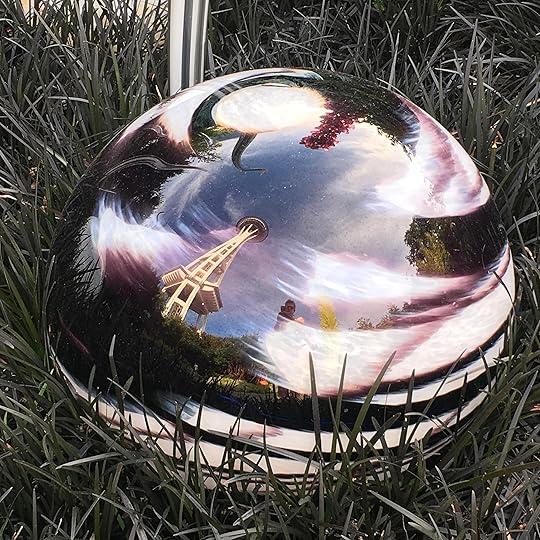
Photo: The iconic Space Needle from the 1962 World’s Fair reflected in one of Dale Chihuly’s more understated glass creations.

Photo: A more typical Chihuly.
Mt St Helens
On the way south, we stopped at Mt St Helens. It was perfect weather: warm, with clear skies. The landscape, devastated but recovering from the enormous eruption of 1980, has an eerie beauty. An awe-inspiring reminder of mankind's insignificance.

Photo: A casualty of the 1980 eruption, its roots pointing to its source.
In answer to Jenn's comment on 29 August 2017 and then Derek's on 1 September:
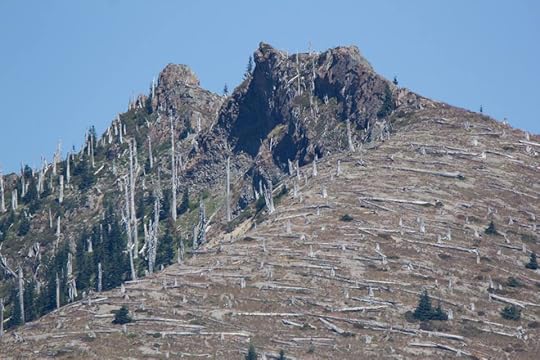
Photo: Hillside 10 miles from the crater, still covered in stumps from 37 years ago, taken by my husband.
Portland
Many shops and restaurants have signs explicitly welcoming people of all races, ages, genders, nationalities, (dis)abilities etc. But I've never seen as many homeless people as in Portland. They're mostly in friendly groups, often outside one of many hostels and other places offering help.

Photo: My favourite pro-diversity sign. National flags should not be the preserve of extremists.
We met friends at Powell's Books. It's a glorious place, and unusually, puts second-hand books alongside new. Fantastic idea. I bought a few American ones that caught my eye: another Kent Haruf, Angle of Repose, and a very short Emily Dickinson collection. Then, we went to lunch, followed by a beautiful Chinese garden.
Columbia River Gorge
We drove along the Historic Columbia River Highway (not the freeway), through densely wooded hills, along the lower levels of the gorge, stopping to walk to and around some of the spectacular falls. Barely two weeks later, the forest on both sides of the gorge was ablaze because a teenager threw a firework.
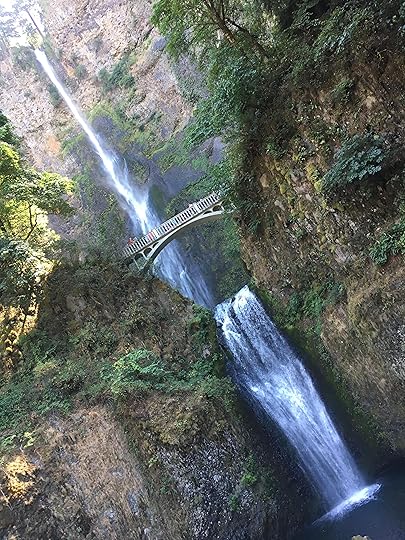
Photo: Multnomah Falls (shortly before the Eagle Creek Fire of September 2017).
We also found one of the weird "roadside attractions" that feature so heavily in Neil Gaimain's American Gods, and which I've added to my review, HERE.
GoodReads' QotD, the day we braved (non-existent) traffic and headed to the high desert for the eclipse was by Antoine de Saint-Exupéry:
"What makes the desert beautiful,' said the little prince, 'is that somewhere it hides a well..."
Campsite in Oregon high desert
Camping is not my thing. I like a comfy bed and decent bathroom, but having experienced a cloudy total solar eclipse in Cornwall in 1999, Madras had a good chance of clear skies. Consequently, there were significant contingents from NASA and TV stations, with staff from the former giving talks on the preceding days.
The temperature range is huge, 30c during the day to less than 10c at night. But desert sunsets stun.
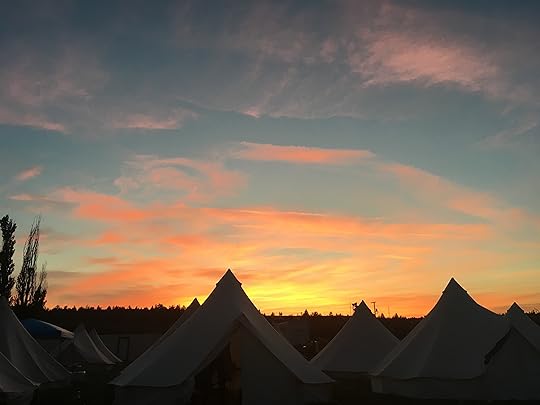
Photo: Desert sunset over tents.
Total eclipse of the sun
We are fortunate to live in a sweetspot in time: a few billion years ago, the moon was slightly nearer the Earth, so would have blotted out the corona during an eclipse. In a few million more, it will be further enough away that totality won't happen at all.

Photo: Totality, by my husband - with a proper camera and special lens and filter.
We got up reasonably early, and the campsite was abuzz. Some had seriously impressive telescopes and cameras. It was just beginning to warm up when, a little after 9am, we saw the first sliver nibbled out of the sun, at the top right.
As the moon traversed the sun, we could see multiple sunspots (darker areas) on the remaining surface of the sun, and I became conscious of the wind.
Totality. We removed glasses/filters for a couple of minutes, and with clear skies, it was stunning, ethereal, almost mystical, breathtakingly beautiful. And with a powerful zoom, we could clearly see prominences and eruptions around the edge of the sun. (A NASA talk the day before had said they would be unusual in this part of the sun's cycle.)
It was a weird, eerie light before, during, and after, unlike normal sunrise and sunset, because the sun's elevation doesn't change. It got gradually cooler, then very cold and dark, very suddenly. But not total darkness: the sun is so powerful, even the tiny corona not obscured by the moon gives more light than a full moon, but little enough to see stars clearly, and Venus shone bright.
There is not much wildlife in the high desert, so we didn't notice the sudden silence and then birds taking off when the sun returned, as at the cloudy eclipse in Cornwall in 1999.
It was worth travelling all this way for.
I couldn't capture it on an iPhone, but it was more important to live in the experience.
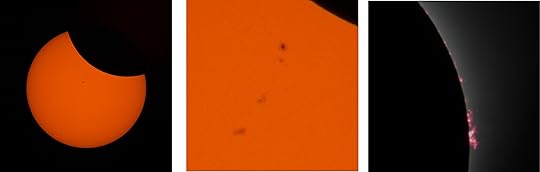
Photo: Sunspots and flares, by my husband.
Map of forthcoming eclipses HERE.
NASA list of forthcoming eclipses, with astronomical details HERE.
(Totality was nearly spoilt when the eclipse was in its early stages and workers started noisily pumping out the loos, to universal outrage. They stopped. Then started again! Then stopped - shortly before the real magic began.)
Two more volcanic parks in the Cascades
We went to Crater Lake, famous for its pure clear blue water. But smoke from nearby wildfires gave everything a hazy, mystical feel instead. It came from ash; we saw it with ash in the air and thus on our skin and hair.
At Lassen, we walked through volcanic mountains; past lakes; through forests, dead and alive; in meadows of streams and wildflowers; along perilous rocky cliff paths; over snow; and surrounded by bubbling mud and sulphur fumaroles, creating an implausibly coloured-landscape.
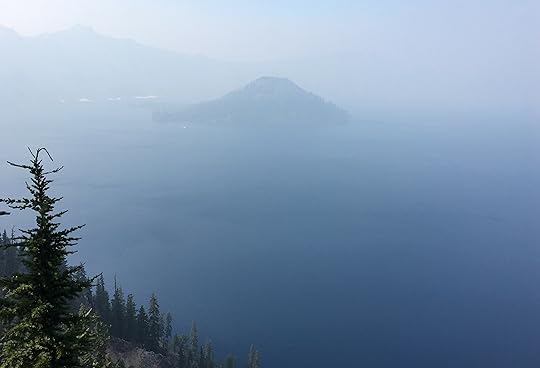
Photo: Wizard Island, in Crater Lake.
High jinks, high above Lake Tahoe
At Tahoe, I pushed boundaries, envelopes, and myself, way out of my comfort zone. The zipline started at nearly 10,000 feet, and descended 3,000 at around 60mph. I also climbed, balanced, and wobbled along high ropes, platforms, and chains, amid the treetops, then abseiled, for the first time, to the ground.
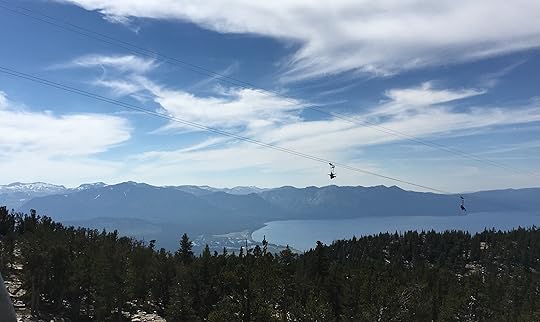
Photo: Clear view for the zipline we rode.
Bodega Bay and Point Reyes
At Point Reyes, there was heavy fog/mist, as is common, even in summer (like nearby San Francisco). An extraordinary sensation of very hot sun and cold mist blown very fast. The sort of feeling one normally has only when unwell! By the time we returned from the lighthouse, it had mostly cleared, so we had fantastic views over the Pacific coastline.
Bodega and Bodega Bay, were made famous by Hitchcock’s “The Birds”, but it was the RC church of St Teresa of Avila I found most striking.
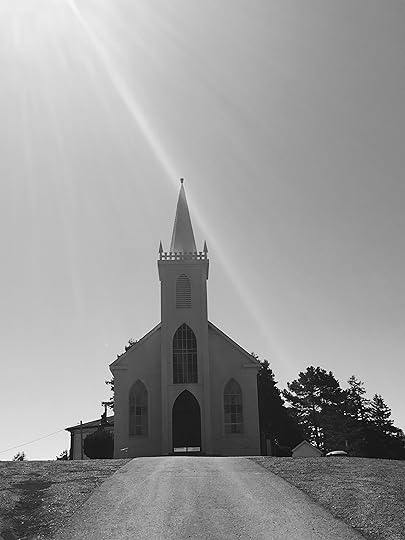
Photo: Church in black and white, as Ansel Adams photographed it.
If you can see totality, do, BUT...
Pick a viewing point that's:
• Almost certain to have clear skies (hence, Madras in the desert, not Portland on the coast)
• But not in the middle of a deserted desert, without any facilities
• Or in the middle of the ocean
• Let alone a war zone.
If travelling far, it also needs to be somewhere that will be worth the trip, even if you do have cloudy skies at the key moment.
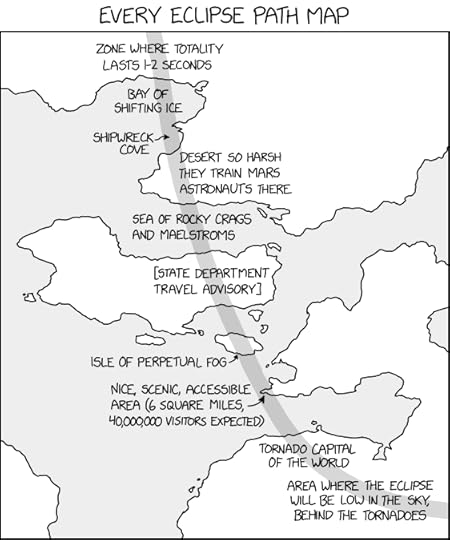
Image: xkcd 2921, "Eclipse Paths" cartoon, ALT text says "Okay, this eclipse will only be visible from the Arctic in February 2063, when the sun is below the horizon, BUT if we get lucky and a gigantic chasm opens in the Earth in just the right spot..." (Source)
Photo: Series of images of the eclipse, by my husband.
NB Unfortunately, photos may not be visible to those viewing in iOS. (Known bug re GR, Apple, and some image hosting sites.)
Seattle
We started our road trip with a few days in Seattle. It’s a city of trees and waterfronts, surrounded by mountains, where the warmest time of day is around 5pm. The colourful market is muted in comparison with the intense tones and sinuous beauty of Chihuly’s fantastical glass creations.
Photo: The iconic Space Needle from the 1962 World’s Fair reflected in one of Dale Chihuly’s more understated glass creations.
Photo: A more typical Chihuly.
Mt St Helens
On the way south, we stopped at Mt St Helens. It was perfect weather: warm, with clear skies. The landscape, devastated but recovering from the enormous eruption of 1980, has an eerie beauty. An awe-inspiring reminder of mankind's insignificance.
Photo: A casualty of the 1980 eruption, its roots pointing to its source.
In answer to Jenn's comment on 29 August 2017 and then Derek's on 1 September:
Photo: Hillside 10 miles from the crater, still covered in stumps from 37 years ago, taken by my husband.
Portland
Many shops and restaurants have signs explicitly welcoming people of all races, ages, genders, nationalities, (dis)abilities etc. But I've never seen as many homeless people as in Portland. They're mostly in friendly groups, often outside one of many hostels and other places offering help.
Photo: My favourite pro-diversity sign. National flags should not be the preserve of extremists.
We met friends at Powell's Books. It's a glorious place, and unusually, puts second-hand books alongside new. Fantastic idea. I bought a few American ones that caught my eye: another Kent Haruf, Angle of Repose, and a very short Emily Dickinson collection. Then, we went to lunch, followed by a beautiful Chinese garden.
Columbia River Gorge
We drove along the Historic Columbia River Highway (not the freeway), through densely wooded hills, along the lower levels of the gorge, stopping to walk to and around some of the spectacular falls. Barely two weeks later, the forest on both sides of the gorge was ablaze because a teenager threw a firework.
Photo: Multnomah Falls (shortly before the Eagle Creek Fire of September 2017).
We also found one of the weird "roadside attractions" that feature so heavily in Neil Gaimain's American Gods, and which I've added to my review, HERE.
GoodReads' QotD, the day we braved (non-existent) traffic and headed to the high desert for the eclipse was by Antoine de Saint-Exupéry:
"What makes the desert beautiful,' said the little prince, 'is that somewhere it hides a well..."
Campsite in Oregon high desert
Camping is not my thing. I like a comfy bed and decent bathroom, but having experienced a cloudy total solar eclipse in Cornwall in 1999, Madras had a good chance of clear skies. Consequently, there were significant contingents from NASA and TV stations, with staff from the former giving talks on the preceding days.
The temperature range is huge, 30c during the day to less than 10c at night. But desert sunsets stun.
Photo: Desert sunset over tents.
Total eclipse of the sun
We are fortunate to live in a sweetspot in time: a few billion years ago, the moon was slightly nearer the Earth, so would have blotted out the corona during an eclipse. In a few million more, it will be further enough away that totality won't happen at all.
Photo: Totality, by my husband - with a proper camera and special lens and filter.
We got up reasonably early, and the campsite was abuzz. Some had seriously impressive telescopes and cameras. It was just beginning to warm up when, a little after 9am, we saw the first sliver nibbled out of the sun, at the top right.
As the moon traversed the sun, we could see multiple sunspots (darker areas) on the remaining surface of the sun, and I became conscious of the wind.
Totality. We removed glasses/filters for a couple of minutes, and with clear skies, it was stunning, ethereal, almost mystical, breathtakingly beautiful. And with a powerful zoom, we could clearly see prominences and eruptions around the edge of the sun. (A NASA talk the day before had said they would be unusual in this part of the sun's cycle.)
It was a weird, eerie light before, during, and after, unlike normal sunrise and sunset, because the sun's elevation doesn't change. It got gradually cooler, then very cold and dark, very suddenly. But not total darkness: the sun is so powerful, even the tiny corona not obscured by the moon gives more light than a full moon, but little enough to see stars clearly, and Venus shone bright.
There is not much wildlife in the high desert, so we didn't notice the sudden silence and then birds taking off when the sun returned, as at the cloudy eclipse in Cornwall in 1999.
It was worth travelling all this way for.
I couldn't capture it on an iPhone, but it was more important to live in the experience.
Photo: Sunspots and flares, by my husband.
Map of forthcoming eclipses HERE.
NASA list of forthcoming eclipses, with astronomical details HERE.
(Totality was nearly spoilt when the eclipse was in its early stages and workers started noisily pumping out the loos, to universal outrage. They stopped. Then started again! Then stopped - shortly before the real magic began.)
Two more volcanic parks in the Cascades
We went to Crater Lake, famous for its pure clear blue water. But smoke from nearby wildfires gave everything a hazy, mystical feel instead. It came from ash; we saw it with ash in the air and thus on our skin and hair.
At Lassen, we walked through volcanic mountains; past lakes; through forests, dead and alive; in meadows of streams and wildflowers; along perilous rocky cliff paths; over snow; and surrounded by bubbling mud and sulphur fumaroles, creating an implausibly coloured-landscape.
Photo: Wizard Island, in Crater Lake.
High jinks, high above Lake Tahoe
At Tahoe, I pushed boundaries, envelopes, and myself, way out of my comfort zone. The zipline started at nearly 10,000 feet, and descended 3,000 at around 60mph. I also climbed, balanced, and wobbled along high ropes, platforms, and chains, amid the treetops, then abseiled, for the first time, to the ground.
Photo: Clear view for the zipline we rode.
Bodega Bay and Point Reyes
At Point Reyes, there was heavy fog/mist, as is common, even in summer (like nearby San Francisco). An extraordinary sensation of very hot sun and cold mist blown very fast. The sort of feeling one normally has only when unwell! By the time we returned from the lighthouse, it had mostly cleared, so we had fantastic views over the Pacific coastline.
Bodega and Bodega Bay, were made famous by Hitchcock’s “The Birds”, but it was the RC church of St Teresa of Avila I found most striking.
Photo: Church in black and white, as Ansel Adams photographed it.
If you can see totality, do, BUT...
Pick a viewing point that's:
• Almost certain to have clear skies (hence, Madras in the desert, not Portland on the coast)
• But not in the middle of a deserted desert, without any facilities
• Or in the middle of the ocean
• Let alone a war zone.
If travelling far, it also needs to be somewhere that will be worth the trip, even if you do have cloudy skies at the key moment.
Image: xkcd 2921, "Eclipse Paths" cartoon, ALT text says "Okay, this eclipse will only be visible from the Arctic in February 2063, when the sun is below the horizon, BUT if we get lucky and a gigantic chasm opens in the Earth in just the right spot..." (Source)

August 22, 2017
I found this book fascinating. The author left no stone unturned in his exploration of how eclipses have been perceived and have affected humans from ancient cultures to the present. Trained as a lunar scientist (according to the book jacket), he does provide some technical information. While generally accessible to the lay reader, there were times when I struggled to understand some details. No matter. The real meat of the book for me was his survey of humans and their cultures down through the ages. Often an eclipse was a way to date other events in the far past. (The Crucifixion of Jesus is one such event.) The book includes some nice color plates, including one of an “oracle bone”, carved on an ox scapula, from the Shang Dynasty in China in the second millennium BCE. There is another image of a portion of a clay tablet from Mesopotamia (first millennium BCE). Each of these artifacts has a reference to an ancient eclipse. That thread, from then to now, makes a little chill run down my spine.
His chapter on eclipse chasers highlighted prominent people from more modern times, as they strove to further scientific knowledge of the heavens. He gave a bit more detail on the background of Maria Mitchell (the astronomer who was also profiled in David Baron’s “An American Eclipse”). In the early nineteenth century, when a ship came to port, the chronometers on board were taken to a nautical chandler in the port city to be reset. In Nantucket, Maria Mitchell’s father was the chandler. Her family was Quaker, which meant there was “an atmosphere of equal education and equal treatment of both sexes ……. Mitchell learned to read a compass almost as soon as she learned how to read a book. As a child, she understood how a clock worked and knew how an understanding of time came from movements of the Sun and the Moon in the heavens…..At the age of seventeen she became a librarian on Nantucket, a job that included ample free time to read celestial mechanics and astronomy….In 1847, using her father’s highly treasured telescope…she discovered a comet.”(pages 144-145) Mitchell was a remarkable woman. She was made an honorary member of the American Academy of Arts and Sciences in 1848 (women were not made true members of that organization until 1943!). She was hired as one of the first professors (of astronomy) at Vassar. Interestingly, because Mr. Vassar had heard that she may be “too assertive”. He sent a colleague to her house on a social call to check her out. The colleague reported back that she was not, after all, “a poor miserable ‘blue-stocking’”, but was suitably domestic, having prepared the dinner that evening. (page 145) I just love this little story about her: In her summary of the 1869 eclipse, she “commented…about the ability to do one’s assigned work while being surrounded by so many unusual phenomena during a solar eclipse. She quoted the Scottish astronomer Charles Smyth who had witnessed the 1851 total eclipse from Norway and who had said how the sight was so overpowering that a man might forget an assigned task and spend those…minutes looking around. But Mitchell assured her readers that her ‘party of young students’ would not have turned to look, even if the earth had quaked. And why was that, Mitchell asked. She did not hesitate in giving the answer: ‘Because they were women’. “(pages 147-148) Another story about a woman was not quite so upbeat. At the 1878 eclipse, Mary Draper was the only female member of an expedition led by Henry Draper, her husband. (He was the son of the man who took the first photograph of the Moon.) The couple had worked together on other astronomical projects. Mary was assigned the task of counting out the seconds so the scientists could pace their work. Here is how the author describes her experience: “This was an era when many people thought there were inviolable differences in men and women. Men were assertive and rational; women, by their nature, were passive and emotional. Because an eclipse expedition succeeded only if everyone did an assigned task and no one was distracted by the unusual views, it was thought best that Mary Draper spend her time sitting inside a tent ‘lest the vision might unnerve her’. And that is what happened. After years of working closely with her husband, and after traveling hundreds of miles and knowing that the weather was clear, all she ever experienced of the 1878 total solar eclipse were the few minutes of darkness that surrounded her.” (page 155) My goodness, can you believe that?! I don’t know that I would have been so docile. Thankfully, times have changed. Let me share one more story about a woman. Mabel Loomis Todd ended up in Amherst when her husband took a job as a professor of astronomy at the college there. It was a small town, a sort of backwater in those days, and Mabel was a social creature. She became friends with the Dickinson family and went on to have a steamy affair with the married Austin, brother of Emily. She and Emily became friends, but Emily would stay in a shadowy hallway as they carried on a conversation. Mabel only saw Emily’s face after her death, as Emily lay in her coffin. She went on to edit Emily’s poems, after others had turned down the task. (At the same time, she was lecturing and writing about astronomy as she and her husband traveled to view eclipses.) Other famous writers (Thomas Hardy, Virginia Woolf) recorded their own impressions after experiencing an eclipse.
I had better stop here. I suppose you can tell how much I enjoyed this book. There are so many interesting details about anything that touches on an eclipse. He talks of folklore related to unusual celestial events and of how animals respond to the phenomena (apparently, dogs and cats don’t react at all). At the end he notes when the next eclipses can be expected and tells of cities where there is an eclipse drought. Cincinnati, Ohio stands out in that category: there, the most recent solar eclipse happened on January 21, 1395. The next one will be visible sometime after the year 3000, an eclipse drought that will have lasted more than 1,600 years. (page 193).
I have barely scratched the surface of what this book offers in its modest 237 pages of text. In addition, the author includes an appendix: “An Eclipse Primer”, reference notes for each chapter, and an index. All-in-all, a lovely book to read as a partner for viewing the eclipse this year.
His chapter on eclipse chasers highlighted prominent people from more modern times, as they strove to further scientific knowledge of the heavens. He gave a bit more detail on the background of Maria Mitchell (the astronomer who was also profiled in David Baron’s “An American Eclipse”). In the early nineteenth century, when a ship came to port, the chronometers on board were taken to a nautical chandler in the port city to be reset. In Nantucket, Maria Mitchell’s father was the chandler. Her family was Quaker, which meant there was “an atmosphere of equal education and equal treatment of both sexes ……. Mitchell learned to read a compass almost as soon as she learned how to read a book. As a child, she understood how a clock worked and knew how an understanding of time came from movements of the Sun and the Moon in the heavens…..At the age of seventeen she became a librarian on Nantucket, a job that included ample free time to read celestial mechanics and astronomy….In 1847, using her father’s highly treasured telescope…she discovered a comet.”(pages 144-145) Mitchell was a remarkable woman. She was made an honorary member of the American Academy of Arts and Sciences in 1848 (women were not made true members of that organization until 1943!). She was hired as one of the first professors (of astronomy) at Vassar. Interestingly, because Mr. Vassar had heard that she may be “too assertive”. He sent a colleague to her house on a social call to check her out. The colleague reported back that she was not, after all, “a poor miserable ‘blue-stocking’”, but was suitably domestic, having prepared the dinner that evening. (page 145) I just love this little story about her: In her summary of the 1869 eclipse, she “commented…about the ability to do one’s assigned work while being surrounded by so many unusual phenomena during a solar eclipse. She quoted the Scottish astronomer Charles Smyth who had witnessed the 1851 total eclipse from Norway and who had said how the sight was so overpowering that a man might forget an assigned task and spend those…minutes looking around. But Mitchell assured her readers that her ‘party of young students’ would not have turned to look, even if the earth had quaked. And why was that, Mitchell asked. She did not hesitate in giving the answer: ‘Because they were women’. “(pages 147-148) Another story about a woman was not quite so upbeat. At the 1878 eclipse, Mary Draper was the only female member of an expedition led by Henry Draper, her husband. (He was the son of the man who took the first photograph of the Moon.) The couple had worked together on other astronomical projects. Mary was assigned the task of counting out the seconds so the scientists could pace their work. Here is how the author describes her experience: “This was an era when many people thought there were inviolable differences in men and women. Men were assertive and rational; women, by their nature, were passive and emotional. Because an eclipse expedition succeeded only if everyone did an assigned task and no one was distracted by the unusual views, it was thought best that Mary Draper spend her time sitting inside a tent ‘lest the vision might unnerve her’. And that is what happened. After years of working closely with her husband, and after traveling hundreds of miles and knowing that the weather was clear, all she ever experienced of the 1878 total solar eclipse were the few minutes of darkness that surrounded her.” (page 155) My goodness, can you believe that?! I don’t know that I would have been so docile. Thankfully, times have changed. Let me share one more story about a woman. Mabel Loomis Todd ended up in Amherst when her husband took a job as a professor of astronomy at the college there. It was a small town, a sort of backwater in those days, and Mabel was a social creature. She became friends with the Dickinson family and went on to have a steamy affair with the married Austin, brother of Emily. She and Emily became friends, but Emily would stay in a shadowy hallway as they carried on a conversation. Mabel only saw Emily’s face after her death, as Emily lay in her coffin. She went on to edit Emily’s poems, after others had turned down the task. (At the same time, she was lecturing and writing about astronomy as she and her husband traveled to view eclipses.) Other famous writers (Thomas Hardy, Virginia Woolf) recorded their own impressions after experiencing an eclipse.
I had better stop here. I suppose you can tell how much I enjoyed this book. There are so many interesting details about anything that touches on an eclipse. He talks of folklore related to unusual celestial events and of how animals respond to the phenomena (apparently, dogs and cats don’t react at all). At the end he notes when the next eclipses can be expected and tells of cities where there is an eclipse drought. Cincinnati, Ohio stands out in that category: there, the most recent solar eclipse happened on January 21, 1395. The next one will be visible sometime after the year 3000, an eclipse drought that will have lasted more than 1,600 years. (page 193).
I have barely scratched the surface of what this book offers in its modest 237 pages of text. In addition, the author includes an appendix: “An Eclipse Primer”, reference notes for each chapter, and an index. All-in-all, a lovely book to read as a partner for viewing the eclipse this year.

May 6, 2017
As one of the many who is going to travel to see the United State’s 2017 full solar eclipse, I’m reading up in eclipses to enhanced my experience. I’ve seen two full eclipses already, but with little preparation—the last one in Shanghai, 2009—and this time wanted a better background on this extraordinary event.
This book is a nice ride, and it covers a lot of ground on how eclipses happen, and their fascinating history. It’s especially good at the didactic explanation of the different types of eclipses, and why they are more or less frequent. It also gets into some depth on how solar eclipses follow specific series (that, I didn’t know) both in time and location.
By being precise with the science, the history component is a little lighter (although I did like that) and selective. For instance, Dvorak spends some time tracking big eclipse chasers, but not so much on the ancient History of each civilization as it relates to the magic powers of the eclipse, or trying to describe how eclipses affected our modern calendars and are used by experts to specify dates far back in time. But there are juicy stories about the crucifixion, and even the tale of Tacumseh (the great Shawnee warrior) and his brother—a smart user of eclipses.
The book’s diagrams are excellent, but the mid-book’s picture block is a little bland. As for the science, it is solid and easy to follow, even when explaining (for example) how Einstein’s theory was verified using eclipses.
This is a great overview of the eclipse as a cosmic and human phenomenon, and it covers a lot of ground for 2017’s eclipse chasers.
This book is a nice ride, and it covers a lot of ground on how eclipses happen, and their fascinating history. It’s especially good at the didactic explanation of the different types of eclipses, and why they are more or less frequent. It also gets into some depth on how solar eclipses follow specific series (that, I didn’t know) both in time and location.
By being precise with the science, the history component is a little lighter (although I did like that) and selective. For instance, Dvorak spends some time tracking big eclipse chasers, but not so much on the ancient History of each civilization as it relates to the magic powers of the eclipse, or trying to describe how eclipses affected our modern calendars and are used by experts to specify dates far back in time. But there are juicy stories about the crucifixion, and even the tale of Tacumseh (the great Shawnee warrior) and his brother—a smart user of eclipses.
The book’s diagrams are excellent, but the mid-book’s picture block is a little bland. As for the science, it is solid and easy to follow, even when explaining (for example) how Einstein’s theory was verified using eclipses.
This is a great overview of the eclipse as a cosmic and human phenomenon, and it covers a lot of ground for 2017’s eclipse chasers.

August 16, 2024
Dvorak's account of the history of eclipses is wonderfully told, engagingly written, and broad enough in scope to draw in any reader from the mildly curious to the seasoned scientist.
I originally bought this book to read on our way to view the total solar eclipse in Atchison, KS in 2017. However, I admit, I was too excited and ultimately gobsmacked by the event itself to even think about reading. I was reminded that we owned this book earlier this year as we made plans to see the April 2024 total solar eclipse near Idabel, OK. If you are ever lucky enough to witness a total solar eclipse, I implore you, do everything in your power to enjoy it. Make plans, take off work, get viewing glasses well in advance. It will be worth it. If not, this book makes a nice companion to better understanding our fascination, fear, and history with the phenomenon.
Dvorak takes readers on a journey through the history of eclipses giving us some of the earliest recordings and documentation about the sight. He also beautifully explains the physics behind eclipses in a way that was easily understood and grasped. While I had wished for more lore and folk stories about eclipses, I appreciated that the author took and more socio-anthropological approach. Editorially, I think that was the right decision.
I originally bought this book to read on our way to view the total solar eclipse in Atchison, KS in 2017. However, I admit, I was too excited and ultimately gobsmacked by the event itself to even think about reading. I was reminded that we owned this book earlier this year as we made plans to see the April 2024 total solar eclipse near Idabel, OK. If you are ever lucky enough to witness a total solar eclipse, I implore you, do everything in your power to enjoy it. Make plans, take off work, get viewing glasses well in advance. It will be worth it. If not, this book makes a nice companion to better understanding our fascination, fear, and history with the phenomenon.
Dvorak takes readers on a journey through the history of eclipses giving us some of the earliest recordings and documentation about the sight. He also beautifully explains the physics behind eclipses in a way that was easily understood and grasped. While I had wished for more lore and folk stories about eclipses, I appreciated that the author took and more socio-anthropological approach. Editorially, I think that was the right decision.
August 26, 2017
Interested in a saga that combines tales of ancient Mayan calendars, Jesuits in 17th century China, the Thai King Mongkut from the musical The King and I, Emily Dickinson, Einstein, Karl Popper, UFOs and more? Read this book about the history of eclipses!
I picked this up to get some more background on eclipses after a breathtaking experience viewing totality from Casper, Wyoming in 2017. I ended up (somewhat unexpectedly) finding the history of eclipses so fascinating that I could barely put the book down for an entire week. There are certain topics that provide a unique lens through which history comes to life in a new way, and eclipses turn out to be one of them. Additionally, I had never quite appreciated how useful eclipses have been for dating past events in history, making more precise maps, and uncovering new science across many different fields of research. Modulo some minor typographical issues, Dvorak does a great job recounting the quirky history of eclipses and also explaining enough background on the science (such as the different types of eclipses and how they were predicted at various points in history) to get started.
Note that while I am a physicist, I’m not an astronomer (and certainly not a historian or anthropologist) so I can’t comment on the accuracy of much beyond the perfectly reasonable descriptions of gravity and general relativity given here.
**spoiler alert** Some neat tidbits about eclipses that can be gleaned from this book (there’s also much more!), which I’m collecting here for future reference:
* Eclipses have led to more precise calendars (e.g. dating the first Olympics) and maps (e.g. the measurement of longitudes).
* Mythical stories about eclipses support a theory of common heritage between people on different continents.
* Benjamin Franklin used the fact that a lunar eclipse was obscured in Philadelphia but not Boston combined with wind direction to postulate that hurricanes are counterclockwise rotating vortices.
* Helium was first discovered on the Sun (before it was discovered on Earth) in 1868 thanks to observations of the solar atmosphere during a solar eclipse.
* In the late 19th century, many scientists chased eclipses in hope of detecting the hypothetical planet Vulcan (which was postulated to explain the precession of the perihelion of Mercury). It turned out this effect was explained by Einstein's modification of gravity rather than a new planet.
* The first experimental test of Einstein’s theory of general relativity was made during a solar eclipse in 1919. Gravitational lensing (the bending of light in the presence of a massive object) makes stars appear in a slightly different location when they are close to the Sun, and the observed difference exactly matches the prediction from general relativity.
* A German expedition to Crimea in 1914 attempted to make the measurement to test general relativity five years earlier, but failed when WWI broke out and they were captured by Russians. It turned out to be lucky that the measurement wasn’t made in 1914, since at that time there was a mistake (factor of 2) in the calculation that was corrected by 1919.
* During a lunar eclipse in 1927, a measurement of the rate of cooling of the lunar surface as it entered the Earth's shadow led to the prediction that most of the Moon was covered by a layer of dust. This was confirmed decades later during the Moon landing.
* The moon’s shadow during a solar eclipse travels thousands of miles per hour.
* By traveling on a plane moving faster than the speed of sound, it is possible to extend the time of totality from several minutes to over an hour.
* You have a 20% chance of seeing a total solar eclipse during your lifetime from a given location, without traveling to find one.
* The Earth is the only planet in our solar system from which it is (known to be) possible to see a total solar eclipse.
* Eclipses would have looked very different in ancient and medieval times (say, before 1400) since there would have been little visible corona (the bright layer surrounding the Sun) due to decreased solar activity. In the near future the corona will also become much less visible.
* In around 600 million years there will be no more total solar eclipses since the Moon will have moved too far away from the Earth; its shadow will be too small to fully cover the Sun.
I picked this up to get some more background on eclipses after a breathtaking experience viewing totality from Casper, Wyoming in 2017. I ended up (somewhat unexpectedly) finding the history of eclipses so fascinating that I could barely put the book down for an entire week. There are certain topics that provide a unique lens through which history comes to life in a new way, and eclipses turn out to be one of them. Additionally, I had never quite appreciated how useful eclipses have been for dating past events in history, making more precise maps, and uncovering new science across many different fields of research. Modulo some minor typographical issues, Dvorak does a great job recounting the quirky history of eclipses and also explaining enough background on the science (such as the different types of eclipses and how they were predicted at various points in history) to get started.
Note that while I am a physicist, I’m not an astronomer (and certainly not a historian or anthropologist) so I can’t comment on the accuracy of much beyond the perfectly reasonable descriptions of gravity and general relativity given here.
**spoiler alert** Some neat tidbits about eclipses that can be gleaned from this book (there’s also much more!), which I’m collecting here for future reference:
* Eclipses have led to more precise calendars (e.g. dating the first Olympics) and maps (e.g. the measurement of longitudes).
* Mythical stories about eclipses support a theory of common heritage between people on different continents.
* Benjamin Franklin used the fact that a lunar eclipse was obscured in Philadelphia but not Boston combined with wind direction to postulate that hurricanes are counterclockwise rotating vortices.
* Helium was first discovered on the Sun (before it was discovered on Earth) in 1868 thanks to observations of the solar atmosphere during a solar eclipse.
* In the late 19th century, many scientists chased eclipses in hope of detecting the hypothetical planet Vulcan (which was postulated to explain the precession of the perihelion of Mercury). It turned out this effect was explained by Einstein's modification of gravity rather than a new planet.
* The first experimental test of Einstein’s theory of general relativity was made during a solar eclipse in 1919. Gravitational lensing (the bending of light in the presence of a massive object) makes stars appear in a slightly different location when they are close to the Sun, and the observed difference exactly matches the prediction from general relativity.
* A German expedition to Crimea in 1914 attempted to make the measurement to test general relativity five years earlier, but failed when WWI broke out and they were captured by Russians. It turned out to be lucky that the measurement wasn’t made in 1914, since at that time there was a mistake (factor of 2) in the calculation that was corrected by 1919.
* During a lunar eclipse in 1927, a measurement of the rate of cooling of the lunar surface as it entered the Earth's shadow led to the prediction that most of the Moon was covered by a layer of dust. This was confirmed decades later during the Moon landing.
* The moon’s shadow during a solar eclipse travels thousands of miles per hour.
* By traveling on a plane moving faster than the speed of sound, it is possible to extend the time of totality from several minutes to over an hour.
* You have a 20% chance of seeing a total solar eclipse during your lifetime from a given location, without traveling to find one.
* The Earth is the only planet in our solar system from which it is (known to be) possible to see a total solar eclipse.
* Eclipses would have looked very different in ancient and medieval times (say, before 1400) since there would have been little visible corona (the bright layer surrounding the Sun) due to decreased solar activity. In the near future the corona will also become much less visible.
* In around 600 million years there will be no more total solar eclipses since the Moon will have moved too far away from the Earth; its shadow will be too small to fully cover the Sun.

August 30, 2017
I have read a half dozen books on eclipses this summer-- and this one might be my top read! Dvorak is an excellent writer. And he is an obvious autodidact on ancient Chinese and Mayan astronomy. An incredibly wide-ranging book, it had many stories that I have not read anywhere else. It was great on Chinese astronomy especially.
For me, the story about the Jesuits using Kepler's Rudolphine Tables in a contest against Chinese astronomers at the imperial court was eye opening. I had never read of this exchange, nor was I aware that they had letters from Kepler himself helping them make their better predictions. I also never realized before this book the way eclipses have been used to date things in the ancient past. There is so much in this book. I loved it.
The author was an engineer on one of the big telescopes up on Mauna Kea (can't figure out which one). That experience in Hawaii is probably where his interest in volcanoes comes from. That is to say that he has written on volcanoes and storms, as well as this one on eclipses. I am hoping to read his volcano book next.
For me, the story about the Jesuits using Kepler's Rudolphine Tables in a contest against Chinese astronomers at the imperial court was eye opening. I had never read of this exchange, nor was I aware that they had letters from Kepler himself helping them make their better predictions. I also never realized before this book the way eclipses have been used to date things in the ancient past. There is so much in this book. I loved it.
The author was an engineer on one of the big telescopes up on Mauna Kea (can't figure out which one). That experience in Hawaii is probably where his interest in volcanoes comes from. That is to say that he has written on volcanoes and storms, as well as this one on eclipses. I am hoping to read his volcano book next.
January 19, 2019
Dull but well-researched book on a fascinating subject.

March 6, 2024
Very thorough coverage of every facet of eclipses. I was much more interested in the impact of eclipses on science than on the various mythologies surrounding them.

April 14, 2024
Got about 2/3rds of the way through then had a bummer eclipse experience and now I don’t have the heart to finish.

May 28, 2017
Review title: Looking up
Humans have looked upwards toward the sun, moon, and stars throughout our history. The sun is light and life--and sometimes, it disappears for minutes at a time. Dvorak has written an engaging history of solar eclipses that traces the human endeavor to record, understand, and respond to them.
Recordings of solar eclipses are some of the earliest extant uses of human language, dating back to thousands of years BC in cultures and continents as disparate as Mayan (South America), Chinese (Asia), Babylonian (Middle East), and Gaelic (Ireland). The Newgrange barrow tomb in Ireland dates to approximately 3000 BC and contains a carved slab at the end of its barrow visible in direct sunlight only at winter solstice that may depict a solar eclipse. When I was in Ireland in 2016 I did not get to see Newgrange, but I did see another barrow tomb from the same era where a carved stone shows the movement of the sunlight though the daylight hours at winter solstice, and the effect 5,000 years later is an eery glimpse into both ages past and the human present and human presence that both those distant people and we today share. It is this inherent draw to the eternal and infinite that makes us still look up and look out for and record phenomenon like eclipses and shooting stars (see my recent review of The Fallen Sky for that subject).
Understanding eclipses followed from recording them, and surprisingly early on smart observers recognized a fairly consistent pattern based on the movement of the sun, moon, and Earth. Of course understanding that movement took longer, especially establishing the sun at the center of the solar system, and figuring out the wavering movement of the moon driven by gravity and rotation around the earth. Dvorak provides a basic primer on the science and math of solar eclipses, and shows how the ancient recordings of eclipse events and the scientific understanding of their patterns have enabled the dating of many important historical events to a very high precision, and of the relative dates of related events based on those ecliptic anchors. Scientists, archeologists, linguists, and anthropologists continue to search for and translate many as-yet unread ancient documents to search for more records of eclipses that will enable further refinement and precision of historical dates.
Finally, how humans have responded to eclipses has both evolved and remained constant over the millenia. Almost universally ancient cultures feared eclipses; after all, the disappearance of the sun and its light and source of energy is a frightful thing, even when only for a few minutes (total solar eclipses last from about 2 to 7 minutes) and when we know (or expect, or hope) that it will return. Fear led to worship or placation through elaborate ritual, which placed a premium on accurate predictions of the next occurrence, and thus to official political or religious positions for astronomers, astrologers, or necromancers. These observers became predictors and in many cases early mathematicians to calculate eclipse patterns. Kepler, Newton, and Einstein, on the shoulders of giants, turned mathematical patterns onto scientific explanation.
And still, the human response remains one of mystery: awe, the thrill of the "eclipse chaser", the poetry, photography, and artistry attempting to capture that mystery. Dvorak includes a map of the United States showing the path of the next total solar eclipse on August 21, 2017, moving east and south from Salem, Oregon to Charleston, South Carolina. I want to go. And look up.
Humans have looked upwards toward the sun, moon, and stars throughout our history. The sun is light and life--and sometimes, it disappears for minutes at a time. Dvorak has written an engaging history of solar eclipses that traces the human endeavor to record, understand, and respond to them.
Recordings of solar eclipses are some of the earliest extant uses of human language, dating back to thousands of years BC in cultures and continents as disparate as Mayan (South America), Chinese (Asia), Babylonian (Middle East), and Gaelic (Ireland). The Newgrange barrow tomb in Ireland dates to approximately 3000 BC and contains a carved slab at the end of its barrow visible in direct sunlight only at winter solstice that may depict a solar eclipse. When I was in Ireland in 2016 I did not get to see Newgrange, but I did see another barrow tomb from the same era where a carved stone shows the movement of the sunlight though the daylight hours at winter solstice, and the effect 5,000 years later is an eery glimpse into both ages past and the human present and human presence that both those distant people and we today share. It is this inherent draw to the eternal and infinite that makes us still look up and look out for and record phenomenon like eclipses and shooting stars (see my recent review of The Fallen Sky for that subject).
Understanding eclipses followed from recording them, and surprisingly early on smart observers recognized a fairly consistent pattern based on the movement of the sun, moon, and Earth. Of course understanding that movement took longer, especially establishing the sun at the center of the solar system, and figuring out the wavering movement of the moon driven by gravity and rotation around the earth. Dvorak provides a basic primer on the science and math of solar eclipses, and shows how the ancient recordings of eclipse events and the scientific understanding of their patterns have enabled the dating of many important historical events to a very high precision, and of the relative dates of related events based on those ecliptic anchors. Scientists, archeologists, linguists, and anthropologists continue to search for and translate many as-yet unread ancient documents to search for more records of eclipses that will enable further refinement and precision of historical dates.
Finally, how humans have responded to eclipses has both evolved and remained constant over the millenia. Almost universally ancient cultures feared eclipses; after all, the disappearance of the sun and its light and source of energy is a frightful thing, even when only for a few minutes (total solar eclipses last from about 2 to 7 minutes) and when we know (or expect, or hope) that it will return. Fear led to worship or placation through elaborate ritual, which placed a premium on accurate predictions of the next occurrence, and thus to official political or religious positions for astronomers, astrologers, or necromancers. These observers became predictors and in many cases early mathematicians to calculate eclipse patterns. Kepler, Newton, and Einstein, on the shoulders of giants, turned mathematical patterns onto scientific explanation.
And still, the human response remains one of mystery: awe, the thrill of the "eclipse chaser", the poetry, photography, and artistry attempting to capture that mystery. Dvorak includes a map of the United States showing the path of the next total solar eclipse on August 21, 2017, moving east and south from Salem, Oregon to Charleston, South Carolina. I want to go. And look up.

July 3, 2023
DNF at 62% complete (p. 178 of 288).
An interesting concept for a book, but Dvorak's writing was often awkward. Lots of minor grammatical errors and clumsy sentence constructions. There was what seemed to me to be a glaring historical error: a description of Benjamin Franklin wanting to observe an eclipse *in 1643*. The way this information is presented, along with other information about eclipse observation in the American colonies, it seems clear that Dvorak is talking about the Benjamin Franklin we are familiar with from American history and not some ancestor or coincidentally named person. I found this so strange I did research whether Founding Father Benjamin Franklin had an ancestor of the same name here in the 1600s, but it seems not. It could have been a typo, I suppose, but the previous paragraph in the book mentions events of 1684 and follows that with "Decades earlier, in 1643..."
I also thought that overall the information in this book was presented in a somewhat scattered way. Each chapter seems to cover a different aspect of humanity's reactions to eclipses throughout history, but they're not in any particular order and a lot of the facts Dvorak presents feel as if they're just crammed in without a great deal of thought for overall narrative flow. I was reminded of nothing so much as a research paper written by an enthusiastic but disorganized high school student who needed to hit a word count requirement. A further example of this: Dvorak recounts his favorite anecdote about Isaac Newton, which involves cats...and has nothing to do *at all* with eclipses or Newton's interest in them or really anything at all. It doesn't add anything to the book, it doesn't supply a way to introduce some eclipse-related topic, it's just a paragraph about Newton that accomplishes nothing.
And the endnotes! First off, they weren't properly linked in the ebook text, so the reader had to just wait until the end of the chapter before learning about whatever it was that Dvorak thought worth endnoting. Which wouldn't have been so bad, except in many cases, the endnotes contributed absolutely nothing to the text. They were frequently just random facts about someone mentioned in the text and had no bearing on anything else in the book.
An interesting concept for a book, but Dvorak's writing was often awkward. Lots of minor grammatical errors and clumsy sentence constructions. There was what seemed to me to be a glaring historical error: a description of Benjamin Franklin wanting to observe an eclipse *in 1643*. The way this information is presented, along with other information about eclipse observation in the American colonies, it seems clear that Dvorak is talking about the Benjamin Franklin we are familiar with from American history and not some ancestor or coincidentally named person. I found this so strange I did research whether Founding Father Benjamin Franklin had an ancestor of the same name here in the 1600s, but it seems not. It could have been a typo, I suppose, but the previous paragraph in the book mentions events of 1684 and follows that with "Decades earlier, in 1643..."
I also thought that overall the information in this book was presented in a somewhat scattered way. Each chapter seems to cover a different aspect of humanity's reactions to eclipses throughout history, but they're not in any particular order and a lot of the facts Dvorak presents feel as if they're just crammed in without a great deal of thought for overall narrative flow. I was reminded of nothing so much as a research paper written by an enthusiastic but disorganized high school student who needed to hit a word count requirement. A further example of this: Dvorak recounts his favorite anecdote about Isaac Newton, which involves cats...and has nothing to do *at all* with eclipses or Newton's interest in them or really anything at all. It doesn't add anything to the book, it doesn't supply a way to introduce some eclipse-related topic, it's just a paragraph about Newton that accomplishes nothing.
And the endnotes! First off, they weren't properly linked in the ebook text, so the reader had to just wait until the end of the chapter before learning about whatever it was that Dvorak thought worth endnoting. Which wouldn't have been so bad, except in many cases, the endnotes contributed absolutely nothing to the text. They were frequently just random facts about someone mentioned in the text and had no bearing on anything else in the book.

December 8, 2021
Humans have been fascinated and fearful of eclipses of the sun and moon ever since we first looked up at the sky. Fascinated by the sudden darkness that our primitive brain reacts not only to the eerie twilight but the drop in temperature confuses the rhythm of the world. Even birds and animals 'realize' that the sun has set and it's time to sleep. Even for only for a few moments. Ah, to live in the moment.
Dvorak goes through how eclipses were treated in history. How in ancient times, they were considered omens of death for leaders who would get a fake one installed to draw all the bad omen's attention and die in the ruler's place while the true leader watched from the proverbial wings.
As science slowly came to understand these mysterious dances, forecasting where and when became 'easier'. As stargazing became astrology and astronomy, scientists would become more familiar and exact with their predictions, with the theories on how and why eclipses happened.
A fascinating look at the science as it developed and the grip that these awe-inspiring spectacles still holds on our imagination and experiences.
Unfortunately there is one rather glaring error - unless there was another Benjamin Franklin that worked on hurricane theory, he did not attempt to view the lunar eclipse decades before Increase Mather saw one in 1643. The eclipse that the American founding father failed to see was in October of 1743 not 1643.
2021-249
Dvorak goes through how eclipses were treated in history. How in ancient times, they were considered omens of death for leaders who would get a fake one installed to draw all the bad omen's attention and die in the ruler's place while the true leader watched from the proverbial wings.
As science slowly came to understand these mysterious dances, forecasting where and when became 'easier'. As stargazing became astrology and astronomy, scientists would become more familiar and exact with their predictions, with the theories on how and why eclipses happened.
A fascinating look at the science as it developed and the grip that these awe-inspiring spectacles still holds on our imagination and experiences.
Unfortunately there is one rather glaring error - unless there was another Benjamin Franklin that worked on hurricane theory, he did not attempt to view the lunar eclipse decades before Increase Mather saw one in 1643. The eclipse that the American founding father failed to see was in October of 1743 not 1643.
2021-249

December 8, 2017
Disappointing. I picked this up to learn about all three parts of the subtitle, but the lore is quickly dispatched as being disproven fairy tales. Said dismissal misses the mark of why lore and fable matter: looking at our changing understanding of eclipses and how we explain them is a reflection on culture and society that is absolutely relevant.
The rest of the book, with a focus on science and history, is good but not great. Parts are interesting, but it’s not something I’m likely to recommend. If doing a knowledge gained / time spent analysis, I’d suggest someone go for a long magazine or newspaper article instead. Quasi-recommended.
The rest of the book, with a focus on science and history, is good but not great. Parts are interesting, but it’s not something I’m likely to recommend. If doing a knowledge gained / time spent analysis, I’d suggest someone go for a long magazine or newspaper article instead. Quasi-recommended.

August 29, 2020
Comprehensive, but a bit dry. I enjoyed learning the historical tidbits about eclipses, especially their influence over government policy, and the various superstitions held by ancient cultures regarding eclipses, but there were long periods that were quite bland.
My favorite part of the book was realizing that Earth is the only planet in the solar system from which a solar eclipse can be viewed, and because the moon is shifting away from the earth little by little every year, in a few hundred million years, we will cease to be able to see solar eclipses on Earth, even. It certainly inspired to me to make a point to view this cosmic coincidence at some point in my life.
My favorite part of the book was realizing that Earth is the only planet in the solar system from which a solar eclipse can be viewed, and because the moon is shifting away from the earth little by little every year, in a few hundred million years, we will cease to be able to see solar eclipses on Earth, even. It certainly inspired to me to make a point to view this cosmic coincidence at some point in my life.
March 3, 2021
So much info! We have another eclipse coming in two years. Time to read up on them, get excited about it, pass on the fun! The 2017 one was great; I enjoyed sharing eclipse science and lore with the students in my area. Make sure you include this book in your readings. Lots of cool science, history and lore; it's loaded! And don't forget to purchase your solar eclipse glasses so you can safely watch! If you're are a teacher, you may want to ask your schools to put glasses in the years budget.
I received a Kindle arc from Edelweiss in exchange for a fair review.
I received a Kindle arc from Edelweiss in exchange for a fair review.

October 24, 2023
Interesting book full of facts about eclipses: how they were perceived in different cultures and at different times, how valuable they are for dating historical events, how experiments and observations during eclipses have advanced science, how eclipses have directly impacted historical events, and how the ability to predict them has advanced over the years. I enjoyed it, although it could have used a better editor, as there were several minor typos/errors.

August 17, 2018
This is the book to pack when you go eclipse chasing. Sure, it gives you all the background on what eclipses are and such, but the best part is all the eclipse stories he's collected. It made my own road trip to see the 2017 "Great American Eclipse" feel like I was joining a centuries-long lineage of those who've been captivated by one of nature's most epic wonders.
June 30, 2021
Fascinating journey through the history of the eclipse of the sun (and moon). You learn how to calculate when an eclipse will occur as well as when they did occur. Plus famous moments in history related to an eclipse and how that is used to verify and even modify accepted history.
Highly recommended.
Highly recommended.
July 25, 2023
It's so cool to read about all the crazy things people went through or did to try and experience a total solar eclipse! Super devastating whenever their story ended with "although it was too cloudy to observe/take pictures."
I'm definitely inspired to try to experience a total solar eclipse in my lifetime- there are a few coming up in the next 25 years in the US!
I'm definitely inspired to try to experience a total solar eclipse in my lifetime- there are a few coming up in the next 25 years in the US!

August 28, 2024
I wasn't as interested as I thought I'd be, no offense to the book or author; I just zoned out for several sections. Some of the history was interesting and I think it's probably a well written book.

July 6, 2017
In spite of some math errors and minor editing issues, this one is okay. It's more of pleasure read than a scientific one, but that's okay sometimes.
August 25, 2017
Just skimmed for book club


December 15, 2017
Really I would like to give this 3.5 stars. Some of the book I found gripping and full of interesting facts, others were a tad dull.

May 8, 2018
Great mix of historic and scientific aspects of eclipses, solar and lunar.

July 5, 2018
Enjoyable
An enjoyable romp through eclipse legend, lore, and fact. A must for astronomy buffs and a good read for science history nerds as well
An enjoyable romp through eclipse legend, lore, and fact. A must for astronomy buffs and a good read for science history nerds as well

July 14, 2019
I might wish it had been a little more forgotten lore but this book tells you exactly what it is on the cover and taught me a few very good facts.

December 30, 2019
A little dry in places and lots of figures to try to follow and wrap your mind around, but super informative and so much additional information that eclipses contribute to in history.
October 28, 2020
Great as a collection of references, benchmarks, milestones, stories. I think I hoped it would deliver more fully on a mythological level. It was interesting throughout but somehow not memorable.


May 16, 2023
Very interesting anecdotes revolving around eclipses
Displaying 1 - 30 of 37 reviews