Volumetrics is designed to help you lose weight safely, effectively, and permanently without feeling hungry or deprived. Dr. Barbara Rolls, who holds the endowed Guthrie Chair in Nutrition at Pennsylvania State University, has spent more than twenty years researching hunger and obesity and the factors that determine how we eat. This is the first book aimed at the general public to use the scientific principles of satiety--the body's signal that it's full--to help you eat satisfying portions of foods while consuming fewer calories? How can you boost satiety with fewer calories? Rolls and her colleagues have discovered that what matters most is the concentration of calories in each portion of food, referred to as its "energy density." In Volumetrics she and coauthor Robert A. Barnett explain how such different nutritional factors as fat, fiber, protein, and water affect energy density and satiety. They clarify not just which foods are loaded with calories, but what kinds of foods, eaten under which circumstances, allow you to consume fewer calories and still be satisfied. And they'll point out hidden calorie traps, the seemingly innocuous foods that can sneak in unwanted calories without your body recognizing them. By following the guidelines and practical advice found throughout Volumetrics, you won't have to change your entire diet. Volumetrics points the way to a sensible strategy to control Eat filling, low-energy-dense Volumetric foods at most meals so you can still enjoy small portions of foods higher in energy density. Studies have shown that most people eat the same weight of food at meals; if that amount is lower in energy density, you'll still feel full. You won't feel as if you are on a "diet." Instead, you'll learn to lower the overall energy density of the foods you eat. Combine that with an integrated program of exercise and behavioral management, and you can experience significant weight loss that is sustained over time. In addition to techniques to help modify your diet, Rolls and Barnett offer dozens of recipes and menu suggestions that help put the plan into action. Far from dull-tasting diet standbys, the recipes in Volumetrics include such favorites as lasagna, chicken pot pie, fajitas, pasta Primavera, and the Great American Volumetric Burger. You'll also find salad dressings, soups, smoothies, breakfast treats, and even desserts. All are modified to make each serving more filling without adding unnecessary calories. In short, Volumetrics will teach you how to consume fewer calories while enjoying a satisfying portion of food. We all want to look and feel our very best, yet most of us struggle to find the right way to achieve our fitness goals. With Volumetrics you can put an end to years of yo-yo dieting and frustrating weight gain and learn to look at food in a whole new way.
“To eat is a necessity, but to eat intelligently is an art.” – La Rochefoucauld, “Maxims,” 1665
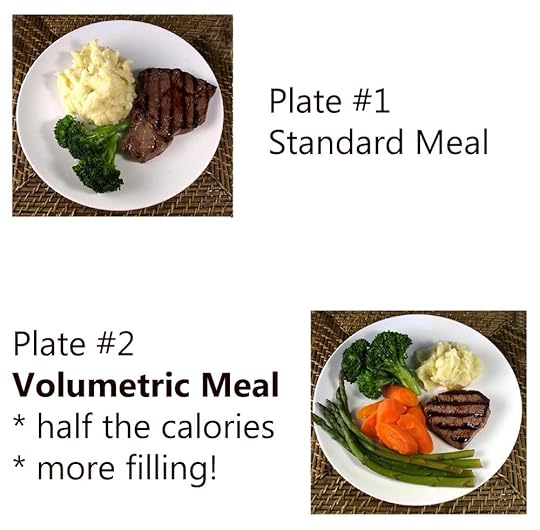
These days, my hunger and appetite are out of control. Correction: I’ve felt this way for most of my adult life. When I first heard about Volumetrics several months ago, the approach made sense to me. It’s not really a diet, but a lifestyle plan, which includes suggestions such as eating more vegetables and bulking up on those; or eating broth-based soup before meals. I figured, why not give it a go, and so I went ahead and ordered three books. This book is the first one that was published (more than two decades ago). The illustrations were eye opening and the advice was helpful, but it’s obviously more dated than the other two, which I plan on reading hopefully soon. For anyone who may be interested in this approach, I think that the more recent books would be more helpful. As for me, now I get to practice implementation and consistency, which, as with all diet/lifestyle books, is oftentimes the hard part!
Here are some of my favorite quotes and suggestions:
“Bad Foods” “While we emphasize lowering the energy density of your dietary pattern, because that’s the best way to eat a satisfying amount of food, we don’t want you to get the impression that energy-dense foods are ‘bad’ or ‘forbidden.’ Who wants to go through life without chocolate? Favorite foods, even if they are high in energy-density, have a place in your dietary pattern. But you will have to plan for them. If you rely on your body’s satiety signals to stop you eating chocolate, you’ll consume too many calories. So you’ll need to satisfy your hunger with foods of lower energy density, and then enjoy high-energy-dense foods in appropriate portions. If the meal is satiating, a half-ounce of chocolate is a satisfying ending.”
Carbohydrates “People do not gain weight on a high-carbohydrate diet unless they are eating excess calories.”
“Carbohydrate sources such as grains, vegetables, and fruit should be the core of your diet. Complement this core with lean sources of protein and low-fat dairy foods. That is the best dietary pattern for both health and weight management.”
Calories Count “The best way to take in fewer calories is to lower your diet’s energy density. But if you do so while consuming a diet that is moderately low in fat – you don’t have to go to extremes – you’ll improve your chances of keeping the weight off.”
Choose your foods wisely “The right food choices will help you control hunger and eat fewer calories, so you lose weight, keep it off, and stay healthy.”
Fat and Sugar “Obese women like fat more than sugar, while leaner women like sugar more than fat.”
Feeling Deprived “You may lose weight more gradually than on other weight loss programs, but you won’t feel deprived.”
Feeling Full “’Full’ doesn’t mean ‘bloated,’ however. A bloated sensation is actually uncomfortable, and can bring on nausea. If you eat an inappropriate amount, satiety is accompanied by a feeling of well-being. Often, when we are hungry, we get grumpy and irritable. Eating reverses those feelings, so people feel calm after a meal. It may take practice to recognize how little food you need to feel satiated.”
Not a Diet “Volumetrics is not really a diet at all, but a new way to choose satisfying, lower-calorie foods.”
Soup “… the next time you feel hungry, try a large soothing bowl of broth-based soup. If you have it as a first course before lunch, it will be easier to eat fewer calories for your lunch, and you probably won’t eat more at dinner. If you have it as first course before dinner, you’ll likely eat less at that meal, too.”
Water “Water satisfies thirst, not hunger. You won’t eat less if you drink water before or during a meal. To increase satiety, incorporate low-energy-dense, water-rich foods into your diet.” Examples: Most fresh fruits and vegetables, starchy foods like pasta, cooked grains, potatoes, and legumes (dry beans, peas, chickpeas, lima beans, soybeans, and lentils).
Very helpful concept, appreciated the illustrations. Had already learned much of this from the whole foods plant based lifestyle movement, but her suggestion to make sure foods had a high water content (e.g. incorporating broth-based soups or chillis) was very helpful.
This book is a very basic weigtloss book; eat foods higher in fibre and water and avoid processed foodd. Add in more fruit and veg and your set. This is nothing revolutionary. Its common sense - you can eat an unllimited amount of calories from veg and fruit and still lose weight.
Someone suggested I look at this, but it was worth no more than a 15 minute skim. One interesting principal is that people eat the same weight of food per day so that you should generally eat foods high in water (ie fruits and vegetables). While the principal is new, the underlying thought is not revolutionary in the diet world. I mostly picked it up b/c my neighbors and are in a weight loss contest with our husband, but we are smoking them anyway, even without the Volumetrics.
The most humorous part of the book is the cover and back flap shots which show, respectively, a HUGE bowl of soup in close up and a distant pic of 1/6 of a cheeseburger which looks to be about the size of two noodles; and a HUGE bowl of fruit in close up and a distant pic of a muffin which looks to be the size of one strawberry. I've never really even seen muffins that small.
A decent book. Can see where plans like weight watchers, etc have done their research. My problem with this book is that density is mass/volume, not the other way around. When the author starts talking about Energy Density, her formula is calories/mass. And then the book is called "Volumetrics". I don't know. Can't get past the words being muddled. The point is correct though. Eat a larger volume of low calorie foods.
I am currently reading this book and it is very interesting the logic behind it. I think once you memorize the concept, it will be very helpful. More to report after the completion.
This book has some good pointers to help someone trying to add healthy habits and implement them while avoiding the process of starving when you reduce calories. My problem is keeping the frig stocked with "acceptable" food that doesn't go bad before I eat it.
Reading Abscal Way & this. My physiatrist recommended The Abscal Way TQI to minimize internal inflammation caused by thyroid disease. My PCP recommended Volumetrics. So far, The Abscal Way very closes mirrors the Advocare meal plan, but adds a ratio of fruits/veggies to fat/protein/carbs. Once I've got them both finished, I should be able to follow a filling meal plan and lose the rest of the baby weight (at least that's the plan).
I really liked the idea of this book. I have adopted a few of the techniques...eating more soup and adding veggies to my sandwiches to make them bigger for less calories. I enjoyed two of the recipes for the soup too.
I like this book for the person seeking an understanding of nutritional balance and portion control - a healthy no-nonsense approach to eating. This is not for someone looking for a prescribed diet plan. The visuals are eye-opening!