Jump to ratings and reviews
Rate this book

The Trees

Rate this book
The Trees. They arrived in the wrenching through the ground, thundering up into the air, and turning Adrien's suburban street into a shadowy forest. Shocked by the sight but determined to get some answers, he ventures out, passing destroyed buildings, felled power lines, and broken bodies still wrapped in tattered bed linens hanging from branches.

It is soon apparent that no help is coming and that these trees, which seem the work of centuries rather than hours, span far beyond the town. As far, perhaps, as the coast, where across the sea in Ireland, Adrien's wife is away on a business trip and there is no way of knowing whether she is alive or dead.

When Adrien meets Hannah, a woman who, unlike him, believes that the coming of the trees may signal renewal rather than destruction and Seb, her technology-obsessed son, they persuade him to join them. Together, they pack up what remains of the lives they once had and set out on a quest to find Hannah's forester brother and Adrien's wife--and to discover just how deep the forest goes.

Their journey through the trees will take them into unimaginable to a place of terrible beauty and violence, of deadly enemies and unexpected allies, to the dark heart of nature and the darkness--and also the power--inside themselves.

496 pages, Kindle Edition

First published March 10, 2016

123 people are currently reading
5247 people want to read

About the author

Ali Shaw

5 books422 followers
Ali Shaw is the author of The Trees, The Man who Rained and The Girl with Glass Feet, which won the Desmond Elliott Prize for first novels. He grew up in Dorset and studied English Literature and Creative Writing at Lancaster University. He has worked as a bookseller and at Oxford’s Bodleian Library. He lives with his wife and two-year-old daughter.

Ratings & Reviews

What do you think?
Rate this book

Friends & Following

Create a free account to discover what your friends think of this book!

Community Reviews

5 stars
667 (22%)
4 stars
1,141 (39%)
3 stars
754 (25%)
2 stars
278 (9%)
1 star
71 (2%)
Displaying 1 - 30 of 461 reviews
Profile Image for karen.
4,012 reviews172k followers
June 27, 2018
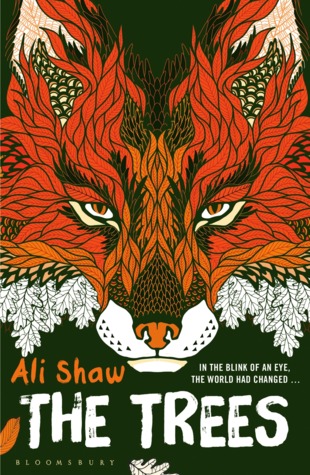
first of all, we need to take a moment to do some good old-fashioned cover-drooling:


happily, this book lives up to how stunning its cover is.

at nearly 500 pages, it's a bit formidable, but once it gets going, it's such an engrossing read, you don't even feel like you're reading a two-inch thick book - you're completely transported into its world, even though it's a world you won't want to visit.

unfortunately, it's our world, with some devastating refurbishments. it's one of the more unusual apocalypse scenarios i've read: one night, when people are tucked safely in their homes, sleeping snugly in their beds, the trees come. shooting up from beneath the ground, all at once, fully-formed trees come crashing up, destroying everything in their paths - impaling humans and animals, shattering houses, splintering already-existing trees, turning the world into a primeval forest and then - silence.

except for the screams.

the story begins in england, on the night of the trees, where a man named adrien sleeps alone in his house while his wife michelle is away in ireland on a business trip. they had fought before she left, ending in a prolonged sulk from him and exasperation from her and now, with communication impossible, adrien is unable to contact her, to know how far the treepocalypse has spread, whether she is even still alive.

adrien is no hero. he is fearful, cautious, unambitious, and filled with self-loathing. he knows he has been a disappointing husband to michelle, despite all her indulgent coaxing, giving him the space to find himself and his own path to happiness.

'Little things overwhelm you. Sometimes it's as if everything overwhelms you.'

'You're right,' he'd said, wiping tears and rainwater alike from his cheeks. 'But in those times the world just seems so damned formidable.'

With one arm she'd held the umbrella over his head. With the other she'd reached around his waist and held on to him tight. 'I want to help you, Adrien. But you mustn't give up. You can't wait for the world to be perfect before you start living in it.'


and now, on his own, in a decidedly imperfect world, adrien is at a complete loss of how to cope with this most unexpected turn of events. wandering dazed through the chaos of the new world, he sees dead bodies, looted supermarkets, bewildered police, wild creatures skulking through a territory reclaimed by nature, and he is horrified and helpless. he meets hannah and her teenaged son seb, reluctantly agreeing to follow them to hannah's brother zach's place, where he has been living off the grid as a forester and will presumably be unfazed, even delighted, by these arboreal developments. romantically-minded seb encourages adrien to go from there to ireland to find michelle, and adrien agrees; having no intention of following through, but lacking the self-sufficiency to survive on his own. as for hannah, she is enchanted by the appearance of the trees. a vegetarian who adores nature, she doesn't register the impaled bodies, seeing only the beautiful, magical, rightful reinstatement of nature's dominance over civilization.

adrien's views of nature are more dismal:

How he hated gardening. The falseness of it. Digging out a weed because it wasn't pretty enough. Coming upon the slugs who had melted after digesting pellets. One time blindly reaching into a spray of withered daffodils and finding a bird bleeding to death from someone's pet cat.

'Mother Nature is a psychopath,' he'd told Michelle, 'and I won't spend my weekends on my hands and knees, painting her toenails.'


over the course of the novel, events transpire which will alter their individual relationships with nature, and ultimately, their most essential characteristics, causing them both to do things that would have been unthinkable before the trees. this is more than just a simple wilderness survival situation. the woods have eerie qualities apart from the nature of their arrival, including spindly twiglike creatures known as whisperers and also kirin, which act as guiding spirits.


in addition, the forest has a tendency to redirect those who wander its paths, and hallucinatory qualities that impart to some a borg-like connectivity to the natural world:

'In the egg it's so sweet. You float in the slime, and when your mother sits in the nest you get so warm.' The man wrapped his arms around himself, a weak smile passing over his face. 'You grow, then. Do all the growing you can in the heat. It makes you want to break out and yell for worms, and you don't know any better and you don't know how cruel things are on the outside.' He shook his head sorrowfully. 'But when you're the mother bird, that's when you know.'

the story has a distinct fairy-tale cast to it; one of the grimmer ones, where nature is capricious, indifferent, cruel, and occasionally beautiful:

Adrien watched a lone pink petal flitter through the air, then ruin the secrecy of a spiderweb.

but the heart-stealing stars of the book are hiroko, a young japanese girl very well-acclimated to this environment, and her half-tamed fox companion yasuo, most often found curled up in the hood of her sweatshirt as she stalks through the trees, kicking ass and taking names, nursing her own regrets and secrets: Seb had helped her learn to cope with it, but a weight didn't lighten just because you found the strength to carry it.

it's a gorgeous, unpredictable beast of a tale - part epic quest saga, part fairytale, part cautionary tale,with romance, adventure, survival, horror, all of it. and despite being, essentially, a showdown between man and nature, it avoids the reductive preachiness of man = bad, nature = good.

'cuz nature's got no conception of 'good,' no matter how we anthropomorphize it. nature'll rip your heart out and devour its weakest and it'll outlast us all.


come to my blog!
Profile Image for carol. .
1,750 reviews9,955 followers
September 24, 2017
Walden meets the apocalypse.

Don't read this book. You will complain that there is no plot, and it's true, there isn't much, not really. It's entirely allegorical, and you hate allegorical books. You will be irritated by the characters: one full of daffy, unrealistic optimism, one self-pitying and full of so much inertia he can barely move. You will hate that it isn't grounded in real possibility, because what is possibly real about millions of trees sprouting full grown from the soil overnight? The dialogue will likely annoy you, consisting as it does of travelers making traveling decisions, holding each other accountable, offering solace. You will find the forays into magical realism, into myth and fairy tale distracting, and wish that they would just hurry up and reach their destination already.

For me, however, it was the perfect book at the perfect time, a dovetailing of my own green tendencies and a love for the end of the world as we know it. An apocalyptic fairy tale that has quiet and solid emotional truth about choices, self-determination and risk. Early on were parts where two of the main characters, Hannah and Adrien, significantly annoyed, but it is quickly apparent that such behaviors were both part of their role in the story and an evolving point. There are two teenagers, Seb and Hiroko that help provide balance to the heaviness of the adults. And that was one of the most interesting things about this book, that I believed these characters. I believed their take on the issues they confronted. Rather than being bored, I was fascinated by both the smallness of some issues--a mother's reaction to a child's lifestyle choice--and the largeness of other ones. I believed them all.

"Both the town and the woods were quiet that morning. Where, in the days before, they had been filled with cries and sobbing and the sounds of things crashing into the dirt, now there was just the simmer of the leaves, and grey faces watching the three new travelers without expression as they passed. Adrien's final sight of the place where he had lived for so many years was an electricity hub fished off the ground, dangling its cables like a jellyfish caught in a net. Then the town was gone, and he was walking after Hannah down a ruined route of tarmac, and trees were leaning over him from every direction."


I think people with a high tolerance for fairy tale-like worlds and plotting will enjoy this. Interestingly, I found its journey of the self reminding me of Mythago Wood, a book I didn't care for at all. It also reminds me more than a bit of The Night Circus, less in the way of beautiful imagery but with many similarities in a meandering sort of plot. Don't read this book if you don't have a high tolerance for The Long Walk(s).

Four and a half stars, rounding up because it's been rare these days that a story has so absorbed me.
Profile Image for Melissa ♥ Dog/Wolf Lover ♥ Martin.
3,631 reviews11.6k followers
May 7, 2020
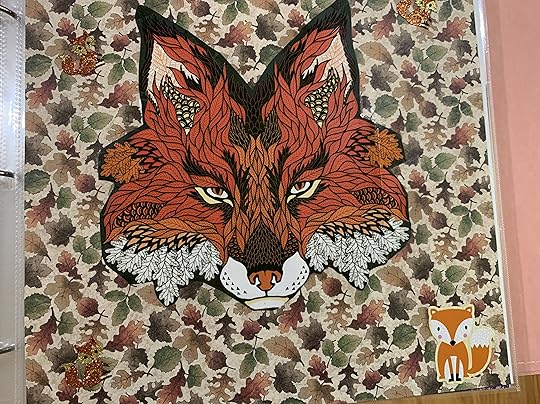
Okay! I scrapbooked the cover like I said y’all! It’s awesome! So now I have the cover only 😉


Eff this book. Liked it at first but toward the end with too many animal killings and dicks, this piece of shit is going in the recycle bin because I’m going to cut out the beautiful fox pic on the dust jacket and scrapbook it! Only paid a couple dollars from BookOutlet so it don’t matter!!

And I have this awesome fox bookmark I was going to display on the book on the shelf too. Bastards!!!!

Also, I didn’t like the end and other things here and there. But pisses me off for the parts I did like!


Mel 🖤🐶🐺🐾
Profile Image for Charlotte May.
856 reviews1,306 followers
November 21, 2020
“His name was Adrien Thomas. He fell asleep with a whimper and a snore. And somewhere out there in the darkness, something creaked.”

Ok, I didn’t like this. But I didn’t dislike it enough to give up, so I’m going with 2 stars ⭐️

I adore The Girl With Glass Feet by Ali Shaw. It is one of my favourite books. I was keen to try something else by him.
It’s a great concept, overnight the entire world is covered by trees - breaking up through the ground destroying houses, cars and lives.

Adrien Thomas is not a brave man, by his own admission. When the trees arrive he is terrified. When he meets Hannah and her son Seb they couldn’t be more different. Hannah sees the trees as a blessing, a chance for the world to get back to nature.

They travel together, their end goal to reach Ireland, where Adrien’s wife was. Along the way they meet Hiroko - a Japanese girl away on a school trip but very handy with a slingshot.

So my main gripes were that it was so gruesome, loads of animal killings and human killings. Which normally I do but find if it’s fantasy - but this all felt a bit too real. Not a lot happened plot wise really and the ending was just fucking weird.


So overall, good concept, sadly not a good execution for me.
Profile Image for Kai Spellmeier.
Author 8 books14.7k followers
December 8, 2016
"The world keeps no secrets. Look it in the eye if you can. Everything is there to see."

It happens in the deepest hours of the night: the Trees claim back what once was theirs. Suddenly the world is a forest and civilisation is shattered. Adrien has to leave what he once called home to find his wife on the other side of the sea. But it's what he will find at the heart of the forest that will change him forever.
On his journey through the Trees Adrien meets Hannah and her son Seb. Heading in the same direction they're looking for Hannah's brother, a forester who surely knows what to do in a world, where everything is turned upside down. The trio later stumbles upon Hiroko, a Japanese schoolgirl with impressive survival skills, that soon captures Seb's fascination.

I've waited a long time for this novel, and it was completely worthwhile. Ever since The Girl with the Glass Feet Ali Shaw won over my heart and now he returned to claim it once again.

This book is lots of things. A wondrous journey of self-discovery, a haunting fairytale, a story of friendship and love and a telling of murder and justice.
At first I was fascinated by the apocalyptic event that introduces and leads through this novel. But the deeper the story goes the more there is to see. There's so much going on!
The novel takes some surprisingly dark turns which build up suspense, fear and most of all curiosity.
The author intertwines different genres in the most amazing way.

I could gush about it forever but I don't want to say too much.
Ali Shaw is a master of magical realism and therefore deserves much more attention.

And if all of this didn't convince you to read this book than you should have a long look at the beautiful and stunning cover.

Find more of my books on Instagram
Profile Image for Jess ❈Harbinger of Blood-Soaked Rainbows❈.
582 reviews320 followers
March 17, 2017
FINAL REVIEW TIME
Sorry for all the bumping guys!

That cover is the most stunning cover I've seen in ages! And 90% of the reason I requested this title. The other 10% is for the author, Ali Shaw, from whom I've not read anything else, but whose book, The Girl With Glass Feet has been recommended to me for years because of another book I'd read and loved, Of Bees and Mist, which also has a drool-worthy cover and is a darker side to a fairy tale.

I love magical realism. I love survivalist stories. I love dark fairy tales and post-apocalyptic worlds. I love dynamic characters and mythological creatures and internal struggles.

I really liked this book which has a bit of everything I just listed above. It is a book that is going to stick to my ribs long after I've finished.

But I'm still not really sure how to write a proper review. And I am going to have limited time over the next few days so I'm going to write this review a piece at a time. So bear with me. The reason this book lost a whole star is because though it contains everything that I love that is listed above, the book has a little bit of an identity crisis. If I had a complaint it would be that this book mashes so many different genres together, it can all be a little jarring at times. And that's not to say it took away from my enjoyment of it, but rather it disturbed the flow of the story. There were almost too many directions, too many themes, too many conflicts all competing for space within 500 pages and a handful of characters. This book literally oscillates between an epic post-apocalyptic adventure tale, a gritty coming of age saga, and of all things, a fairytale. There are some really really dark and shadowy elements and themes here, some violence and disturbing imagery, and a lot of that whispered about, inky black pieces of human nature, but there is also a bit of whimsy and beauty and a lightness about it despite all the dark. And though I don't necessarily think that these competing genres always meshed well, something that can be said is that it wasn't predictable. I honestly had no idea what was going to happen ever. It was a story that was completely outside the box, and I appreciate an author who is able to kind of throw all the rules of their genre to the wind.

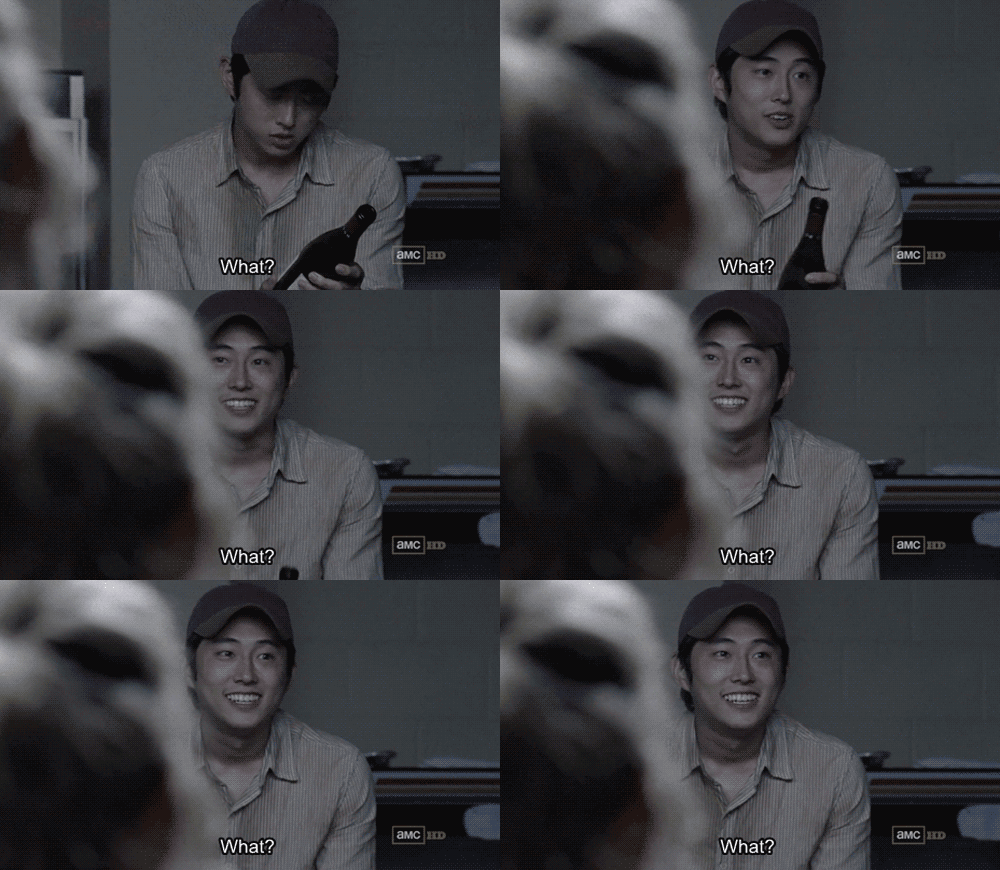
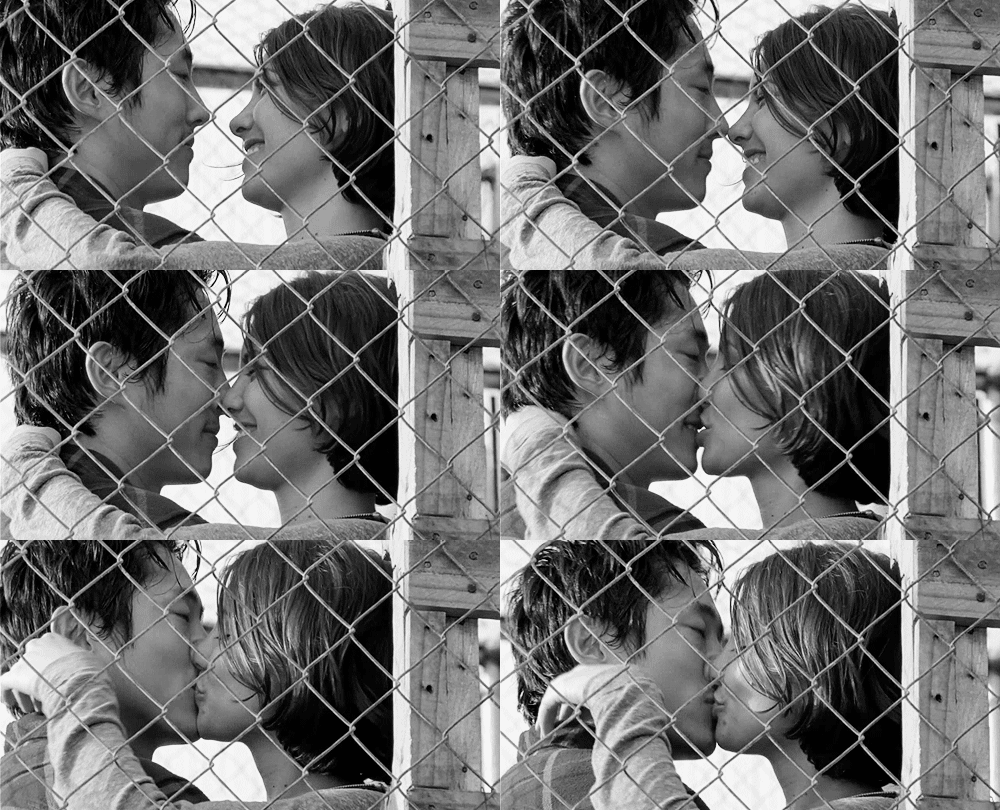
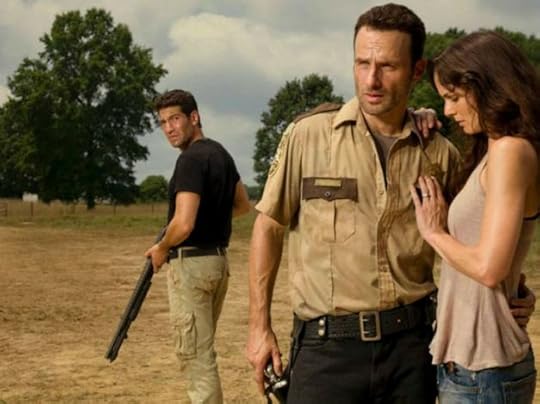
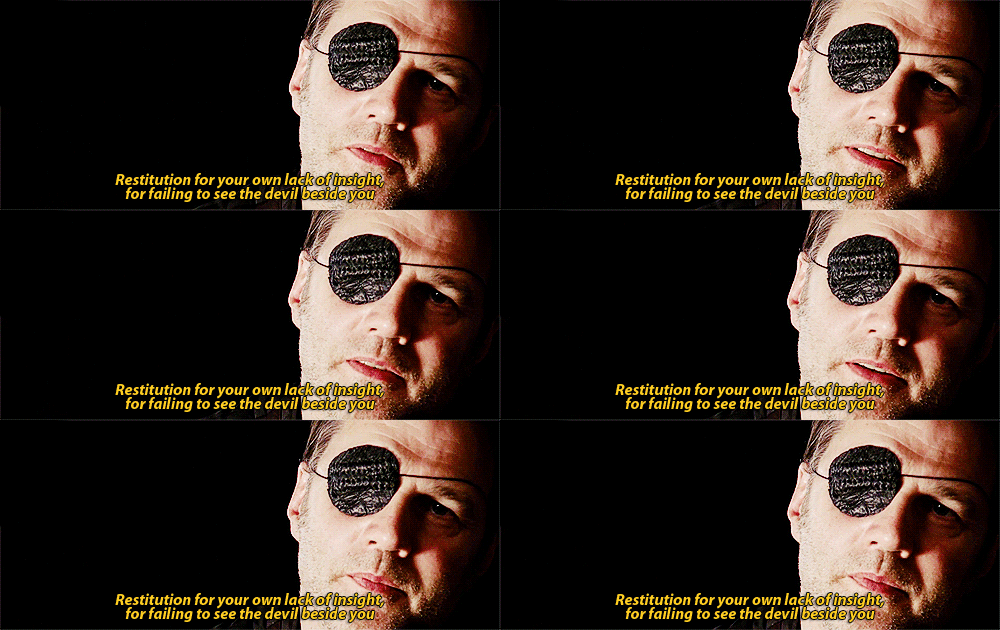
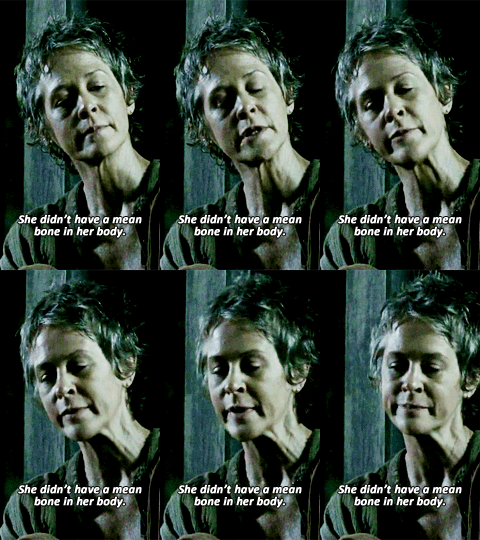
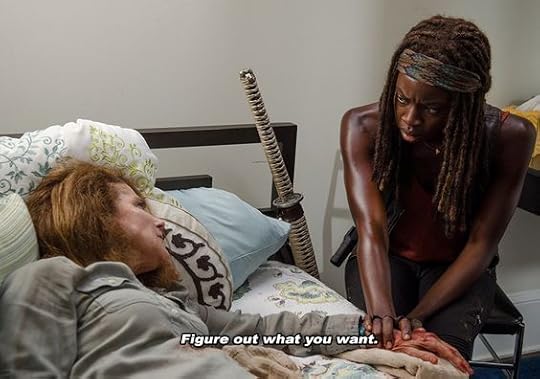
All of you who know me know I lose my shit over The Walking Dead. It is the best TV show I have ever seen since Twin Peaks. It is not really a show about zombies, but rather survival. How surviving in a world no longer your own can change you, change your very core, make you do things and say things that you never could have seen yourself do or say, not in a million years. Alliances are formed and broken, relationships are forged, strained, tightened, let go. It is a show that strives to answer the question "What do you do in order to survive for just one more day when everything in the world is fighting against your survival?"

If The Walking Dead is a big badass dude from 'Murica, then The Trees is its smaller, tree-hugging, hipster English cousin.


Because even though they look like completely different beasts altogether, they share many of the same themes, struggles, twists, turns, and realities. They look different, act different, speak different, but when it comes down to it there is a strong familial resemblance that is difficult to ignore and one of the reasons why I ate this book up.
We have some of this...ish

And some of this...ish

A little of this...ish

And a little of that....ish

And a lot of this

It was a wicked good ride.

It is also important to note that just as The Walking Dead really isn't about zombies, The Trees isn't really about trees.


And I'm not saying that trees and zombies are the same thing, but they both serve, in their respective stories, as not necessarily characters, but as a backdrop to a world that is no longer the same. Zombies take over the world, killing a lot of humanity, and therefore the survivors are forced to shift gears and figure out how to survive in this new world. Same happens in this novel except that instead of the undead, massive trees erupt all over the country, uprooting buildings and other trees, killing a lot of humanity, and in essence creating one big massive forest instead of the progressive urban environment everyone has become used to. And again in this novel, the survivors are forced to stop, switch gears, and figure out how to survive in this new world which includes a lot of reverting back to some primitive ways of living, hunting, gathering, boiling water, roughing it to the extreme.

I kept thinking about how this book would make a really interesting film. Not a huge blockbuster, but a quiet little English independent film that comes out in limited release and doesn't really get the attention it deserves, but appeals to its audience: people who appreciate film/literature for not just story alone, but for beauty of cinematography, interesting thematic elements, the beauty of the premise, the complicated and nuanced characters, and not necessarily a fast paced storyline a'la The Avengers or Jurassic World.

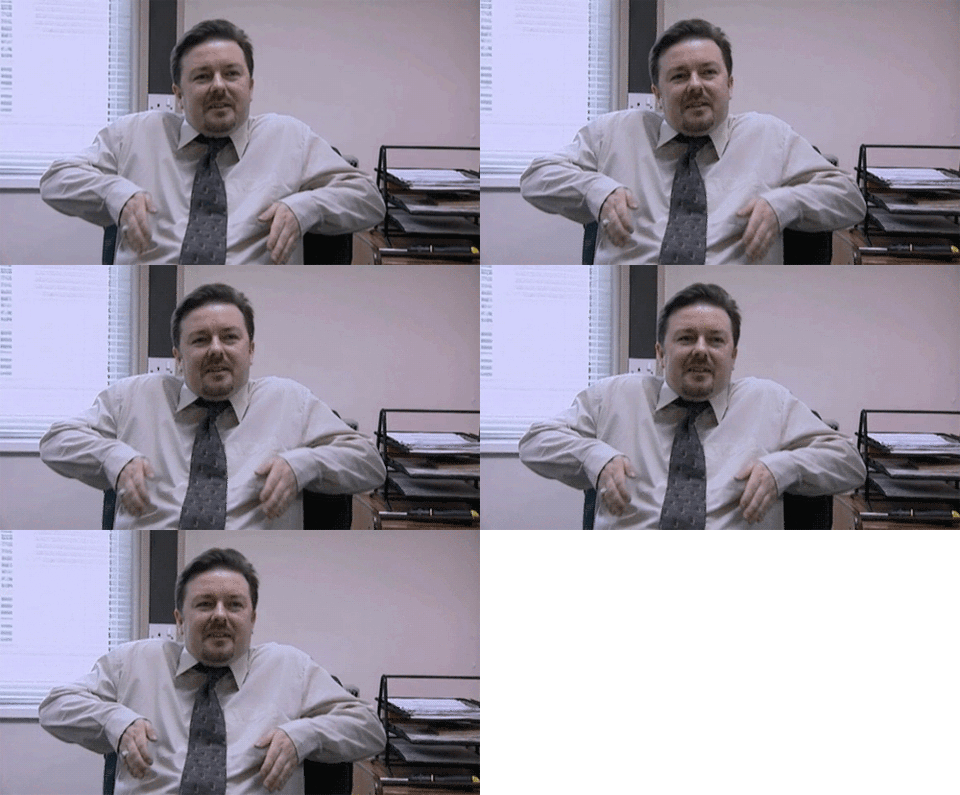
I do need to touch on these characters because they are a big part of what make this story magical. Stories about the changing of the human core into something else wouldn't be very effective without human cores to adapt. The MC is a man named Adrien Thomas, who in my movie version would be played by Ricky Gervais.

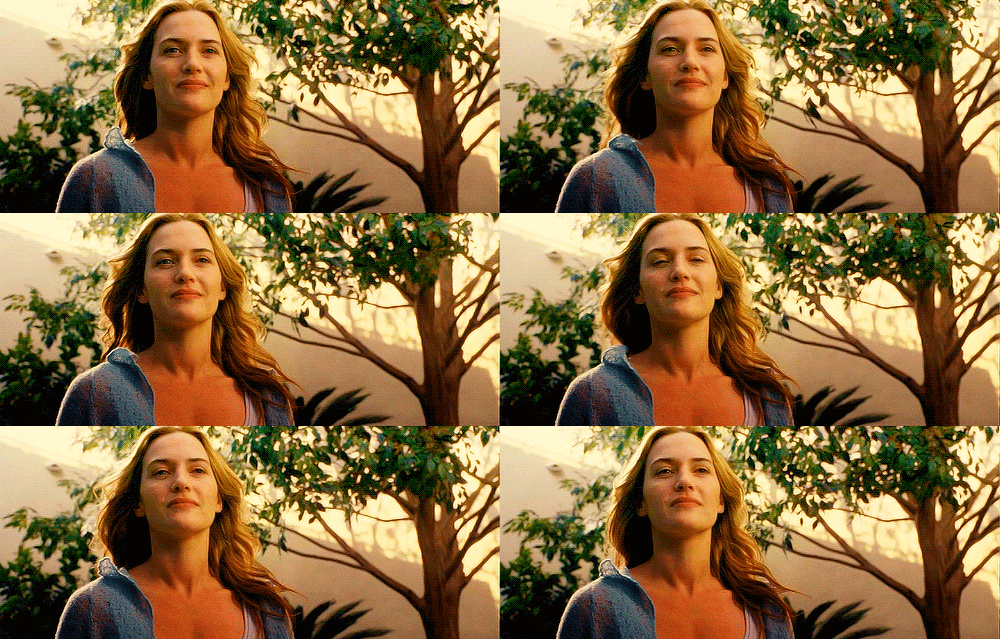
Adrien is sad, fearful, middle-aged, boring, full of self-loathing and cynicism, and is most definitely not a hero. Definitely not a man to take the time to grow his own garden, let alone walk across England, cross the ocean, and trek all over Ireland in order to find his estranged wife Michelle. Though with help from his new friend Hannah (played by Kate Winslet)
a bit of a green-thumbed, tree-hugging, well-intentioned nature lover, Adrien decides to do just that. Though Adrien decides to travel to find Michelle (played by Anne Hathaway)
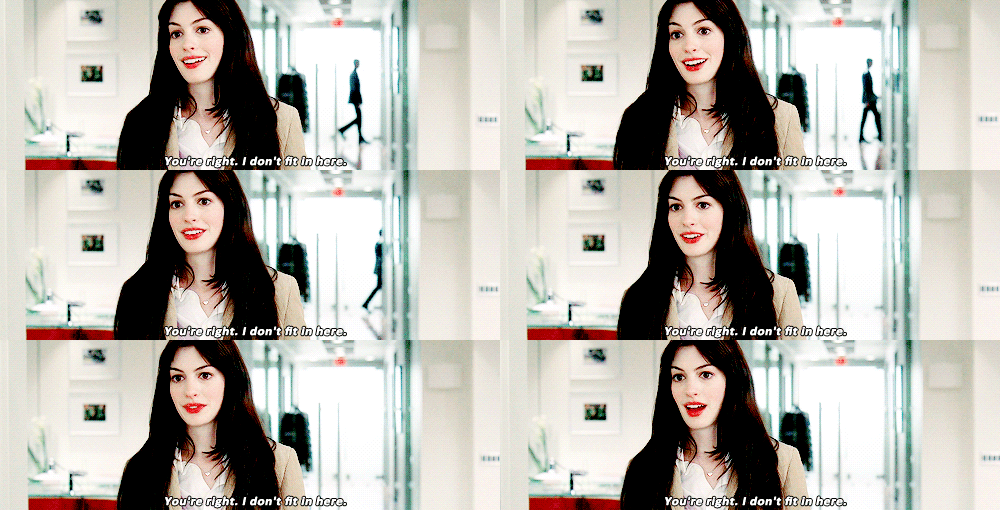
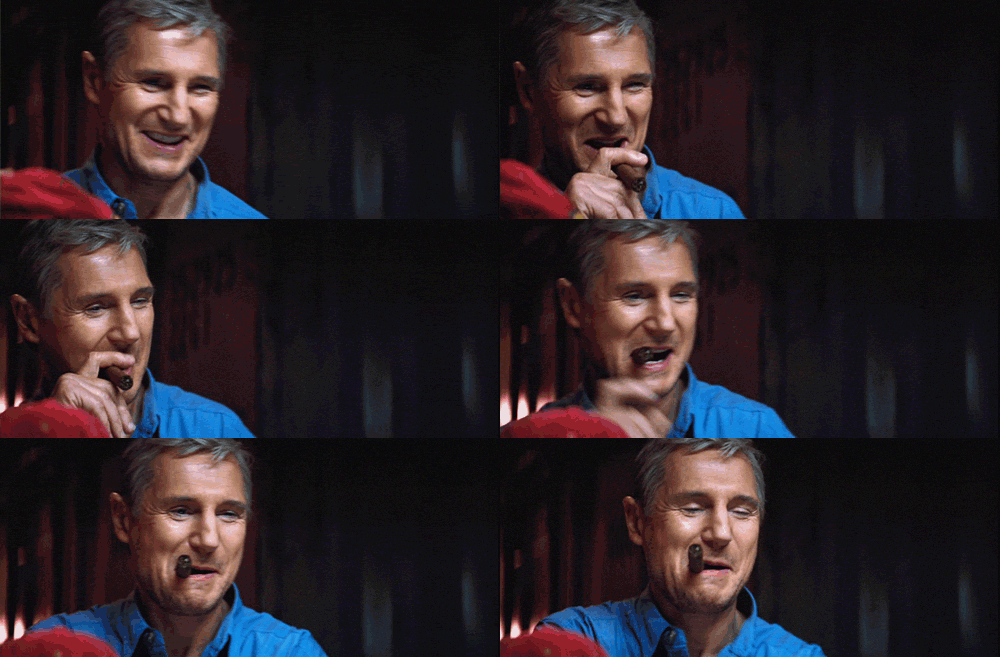
he does not fully commit to it, nor does he know what he's going to do once he finds her. It starts to become evident that Michelle is bright and beautiful and successful and loves Adrien fiercely but its a bit of a puzzle to try and figure out exactly what she sees in him. Even Adrien seems to question her love and loyalty and it has caused many fights between the two, the last one never really being resolved and landing on the morning Michelle departs for Ireland on a business trip, a few days before the trees come. She tries to fix things between the two of them before leaving, but Adrien just huffs and puffs and mopes around and won't look her in the eye and won't talk to her. (In fact, Adrien is shockingly not the most likable character in the world). He keeps imagining an affair happening between Michelle and her attractive and confident Irish boss, Roland (played by Liam Neeson)

and believes so fiercely that this could happen because Michelle is just too good for him. Along for the ride is Hannah's teenaged son Seb, as unlike his nature-loving mother as one could be. Seb feels most at home in the world of the internet and technology and website building, not the world of the great outdoors. I cast Asa Butterfield as Seb.

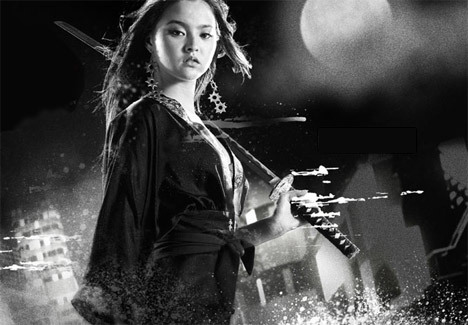
I thought Seb would be a cliche of a boring sullen teenager forced to endure his mother's nature ramblings, but Seb really begins to grow once they encounter a teenaged Japanese girl named Hiroko (I honestly picture Devon Aoki, but I'm thinking she's too old)

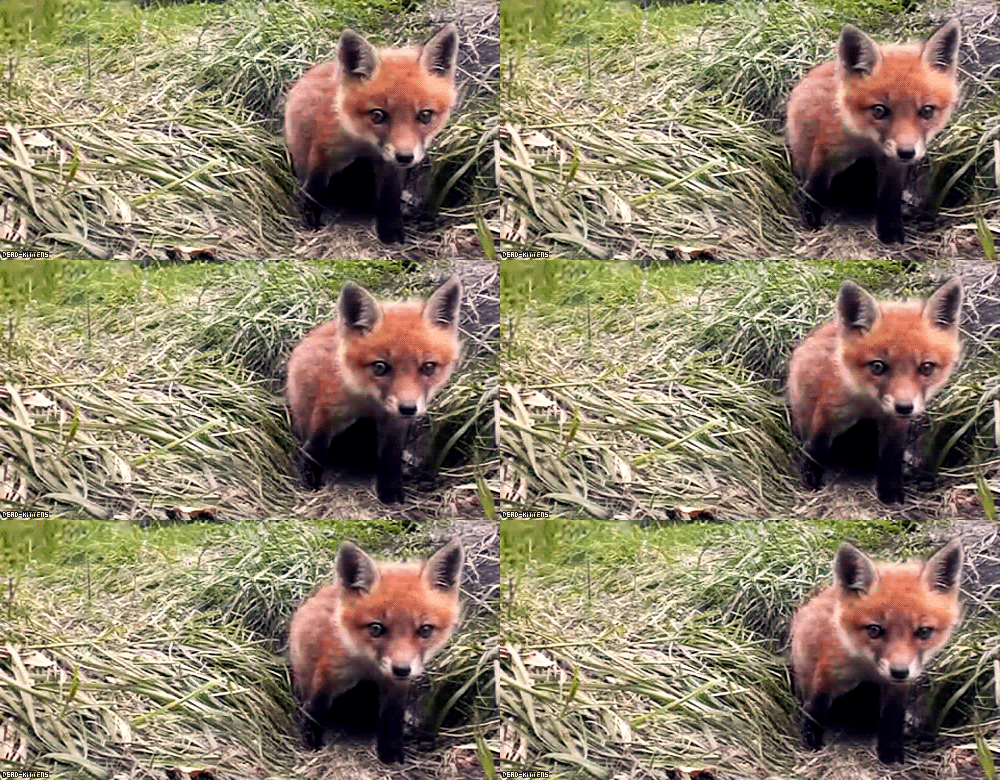
and her adopted fox kit Yasuo

who quickly became my absolute favorite characters of the bunch. They are all great and each one shows tremendous growth throughout the novel. I loved reading as each one was pulled and strained by circumstances, loss, new love, old love, familial responsibilities. Each has a conflict they need to overcome, and they all act completely and utterly human. That is probably by biggest praise of this book is the absolute humanness of it. There is nothing inherently good or bad about any of them and they all act the way they feel they should. That is a hard thing to pull off in a book with this subject matter. Even the antagonists have such a human quality to them. There is an empathy to be had with each character and reading this I began to know exactly who they were and what they became and why they behaved the way they did and made the decisions they had. I didn't always like or agree with everything that happened, but I respected the author for making it happen, nonetheless. These characters were the true gems of this book and made this reading experience one I will always remember.

Lastly, I must touch on the whimsical aspect of this novel because it makes up a large part of it, but doesn't always jive with the other bits. Adrien is (or was, before the trees came) a high school English teacher, more interested in his books than in people, friends, relationships, and the students he teaches. His favorite is Shakespeare's A Midsummer Night's Dream, a play that analyzes chaos vs. structure, magic vs. realism, whimsy vs. steadfastness. In this beloved play, the woods and the city represent chaos and structure, respectively. It kind of goes without saying as to why. This famous play makes several appearances in this novel, and think it deserves a bit of a shout-out because comparing that play to this novel helped me with connections I don't think I would have gotten otherwise. As that play is one of my favorite works of literature of all time, I enjoyed this little nod to the classic. If you are not as familiar with that work, then sorry I cannot help you with the little Easter eggs I enjoyed reading.

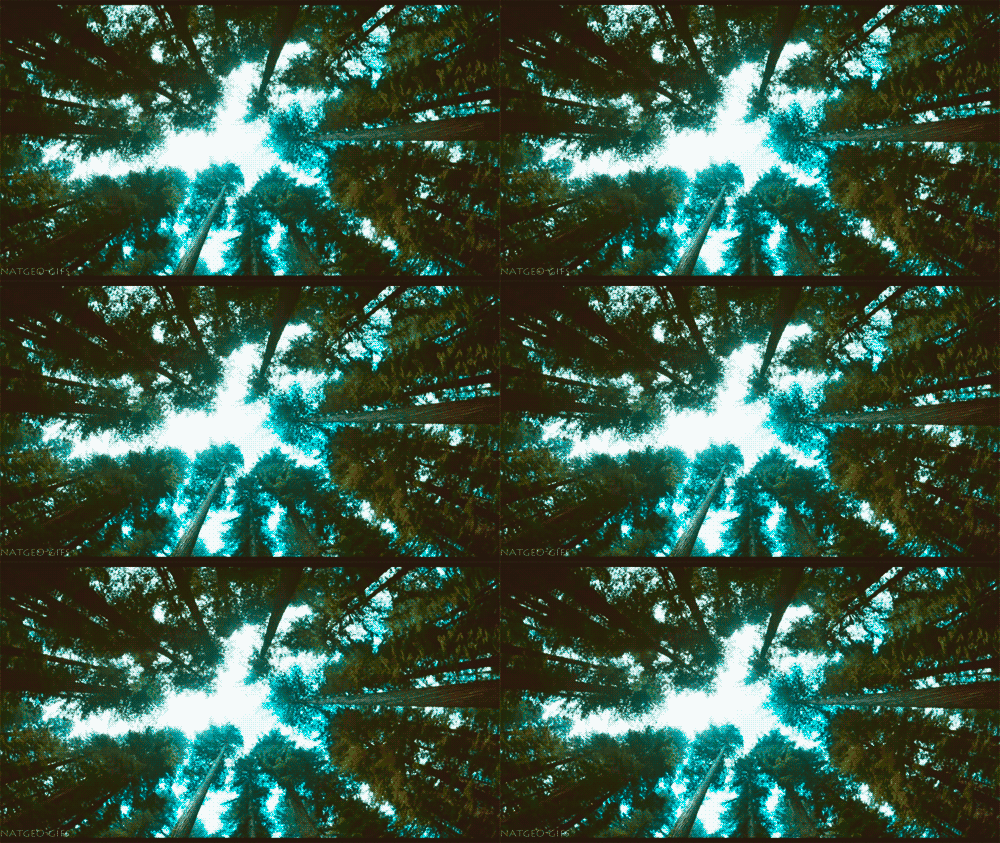
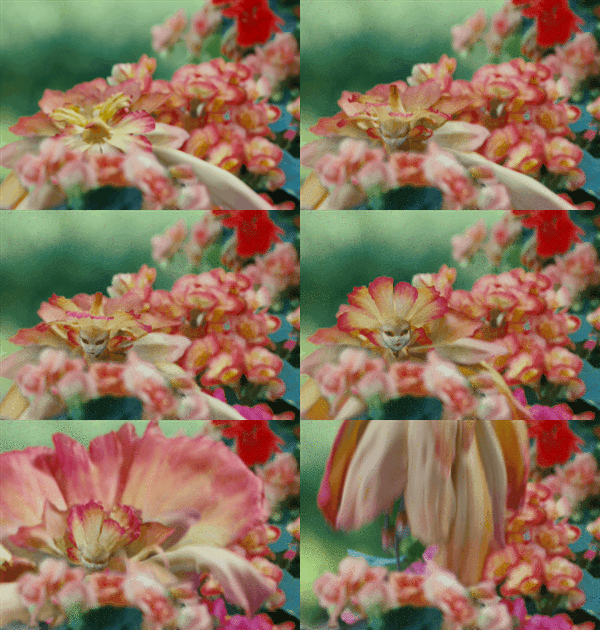
I spent the better part of this review discussing the post-apocalyptic aspect of huge trees springing up everywhere and making the world one big giant forest. A forest where chaos definitely happens. However, giant trees are not the only thing that spring out of nowhere in this new world. Like Shakespeare's classic, there are creatures that live in the woods. And not just squirrels, wolves, and chipmunks either.


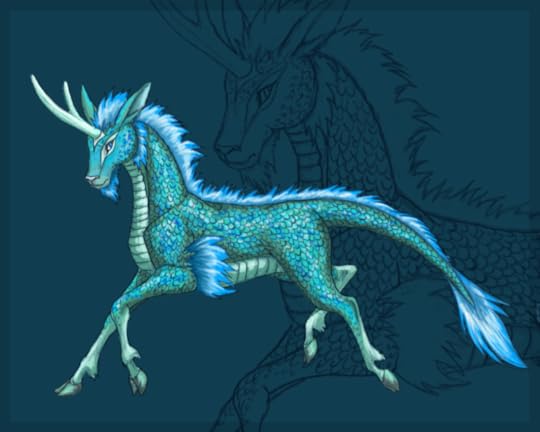
But as it always seems with magical stories, for every good and light magical being, there seems to be one of equal darkness. And this story is no exception. Trying to figure out the light from the dark-- well, that's a horse of a different color. Oh yeah, speaking of horses of a different color, guess what else roams these enchanted woods?

Mythical kirin show up every so often, and seem to be sort of physical and spiritual guides for our characters, only showing up when they truly need their guidance. I loved these creatures and though their presences are short-lived, really felt them to be well-rendered, imaginative, and truly beautiful. It makes me want to research their lore on my own.

Other than the kirin, other strange creatures that roam the woods are not so clearly defined, and I found their presence interesting but slightly odd. Especially their connection with our main characters which becomes more and more clear as the story progresses toward its conclusion, was confusing and intrusive and this is the biggest issue I had with the entire book. I didn't hate it, but felt like for a book which was so dependent on the rawness of human emotion and survival, it depended a little too much on magic in order to tie up loose ends. It's really a minor squabble, but as it is what comprised a huge part of the ending, I still find a need to discuss its oddness.

Other than the magicky bits, I really enjoyed the ending of this novel and found that parts of it really struck chords with me and I thought about them long after I finished. That is what the power of good writing and great characters does. It's something I still find it hard to express in words, it is just something that is felt. And I continue to feel a lot of things about this novel, and that's what makes it a success.

And that's all folks. Thanks for bearing with me though this monstrous review that I'm sure is too long and boring for all of you to read, but the whole point of my ramblings is that you should read this book. It is definitely worth it, not only for that gorgeous cover, but for all the gorgeous words too.

I received an ARC of this novel from Netgalley in exchange for an honest review.
Profile Image for Puck.
821 reviews348 followers
February 8, 2017
4 stars for this wonderful, fairy-like survival tale.

Wow, this book was something else. Not only does it have one of the most beautiful covers I have ever seen, but this book also tells an unusual but enchanting story. It’s a mix of an apocalyptic survival story, a magical fairy tale, and a heroic quest in one, told in less than 500 pages. Yes: it’s quite a beast of a tale, and the pace of this story isn’t fast and action-packed, but The Trees is such an engrossing read that you won’t notice how thick this book is. You only want to read more about the world and about our four leading characters, who all are strong and impressive in their own way.

First, the setting of this book is in our own world. One night, without warning, a gigantic forest bursts full-grown out of the earth. Large tree trunks break through buildings and roads and cause death, destruction, and chaos. If you don’t possess any nature knowledge or survival skills, you’re doomed. Our main character, Adrien Thomas, is one of those doomed people, but luckily for him he runs into nature-loving Hannah and her son Seb.
When they invite Adrien to come with them on their expedition into the forest to find Hannah’s brother, he joins them in the hesitant hope that he can find his wife. On their trip the three run into Hiroko, a young Japanese girl who knows her way around the wild, and whose practical mind-set is a more powerful weapon than Hannah’s plant knowledge.
Because this forest isn’t as inviting and beautiful as the forests we are familiar with: it has shadowy and dark parts where nature (and people!) take what they need without giving anything in return. Not because nature is evil and unjust, but because that’s how it works. The trees want to live too, not just the humans.

Eoin raised an eyebrow. 'You're right, you know. The sea can be a mean old bitch, but she makes no bones about it. A shark is a shark, my old captain used to say.'

Hannah nodded. ‘A shark is a shark, I like that. It’s not the same in the woods. Even something like a wolf, it…it disguises what it really is. Makes you think it’s beautiful. Even the trees starve each other of the light. I’ve always called myself a person who loves nature, but I suppose what I’ve thought of as nature has always been trees, mammals, flowers…so much life you can distract yourself from the death.’


Oh Hannah. Of all four leading characters, I felt and loved her the most. At the beginning of the story Hannah is a gentle, positive woman who loves nature, who even welcomes the new green landscape and sees it as a way of nature restoring balance. During the story however things happen to her that not only change her look on nature, but also on justice and fairness. She has to swallow some bitter pills but her character strength is amazing.

Hiroko and Adrien go through some powerful change as well. Hiroko’s first impression is of a standoffish girl who kicks ass and hides her emotions from everyone. However, thanks to her relationship with Seb, and her pet-fox Yasuo, secrets from her past slowly come to the surface that she has to confront.
Adrien is an unusual main character and our ‘hero’, although you wouldn’t call him that. He is more of a follower than a leader. He’s cautious and filled with self-loathing, and I’d even say he’s dealing with a depression. Despite his wish to find his wife Michelle, Adrien thinks more of how he failed her as a husband and how she’s better off without him, than of how he’s going to deal with the treepocalypse.
That makes him not the most exciting person to read about, but as someone who struggles with self-doubt as well, Adrien is the character I most identified with.

[Michelle:] ‘Little things overwhelm you. Sometimes it's as if everything overwhelms you.”

'You're right,' he'd said, wiping tears and rainwater alike from his cheeks. 'But in those times the world just seems so damned formidable.'

With one arm she'd held the umbrella over his head. With the other she'd reached around his waist and held on to him tight. 'I want to help you, Adrien. But you mustn't give up. You can't wait for the world to be perfect before you start living in it.'

I call this story a fairy tale, although the magic elements stay limited to a couple of mythological creatures that burst ‘out of the earth’ at the same time as the forest. The unicorn-like Kirin and the ‘Whisperers’ (I kept thinking of the little Kodama from Princess Mononoke) appear from time to time, but apart from the finale, they do very little.
It’s kind of disappointing that Ali Shaw hasn’t done more with the forest folklore, because last year a book like “Uprooted” showed how terrifying a magical forest can be.

But on a broader level it’s the unbalanced mix of all the story elements, not just the magical one, that keeps me from giving these book 5 stars. Shaw brings together so many different story ingredients in this book – like dystopian, mythological, and epic-quest ones - that none of them work out perfectly. The worldwide forest that suddenly appears comes as a big shock, but afterwards never forms a real threat. The Whisperes are there from the start, but only at the end of the novel you get a glimpse of their purpose. And while Adrien grows out to be the hero, Hannah and Hiroko get the most character development.

But on the bright side: the tempo of this story is a slow one, so none of the story-elements crash into each other or clash. We can calmly follow Adrien, Hannah, Seb, and Hiroko into the wild forest and see them all come face-to-face with overgrown reality, (magical) cruelty, and their own inner demons. The world has been drastically changed after all, and so all four change too, slow but steady.
The ending of this book brought a tear to my eye and a bittersweet smile on my face, so if that isn’t a recommendation, I don’t know what is.

This is Ali Shaw's third book - the two earlier ones are both shorter than this one - but with The Trees the writer clearly shows what his creativity is capable of. It's quite a trip, but this epic story is really worth its pages.
Profile Image for Kinga.
526 reviews2,718 followers
September 11, 2024
I asked karen for a recommendation for a book to read during this catastrophe we are riding through currently. I didn’t want any realistic family drama – how can I take their petty problems seriously given our current circumstances? I wanted an apocalypse, but of a different kind, so that it doesn’t hit too close to home. I said: give me nature, survival, forests, maybe some sea but mostly trees, please.

Rightly, she recommended The Trees.

The apocalypse our characters are finding themselves in is the opposite of our current one. While we have been forced inside, they have been forced outside – very literally. One morning they wake to realise everything has been covered by trees which sprung out overnight, destroying their homes and skewering many of the inhabitants. This has probably happened all over the world, the characters suspect but can’t verify as you can’t see very far in a dense forest.

Yes, it’s very much magical realism, and like any magical realism you just gotta get on board with the premise and suspend your disbelief. There will be no rational explanations forthcoming.
The characters we are saddled with for the duration of this journey represent the entire spectrum of the attitude towards nature – from the romanticising flower-child kind, through a ruthless and apt survivalist, through an adaptable teenager, to our main (anti)hero - very attached to his creature comforts and resentful of the apocalypse for daring to try to shake him out of his inertia.

This book is trying to be many things at once. Sometimes it is a sinister fairy tale, that swiftly turns itself into a gory thriller in the vein of The Walking Dead, to then again return to a more meditative piece on what nature’s nature is, and what relationship we could possibly have with it. This concoction of genres usually works and only occasionally jars.

What I particularly liked about this novel was its unlikely hero (the previously mentioned ‘anti-hero’) who routinely fails to live up to expectations, even as these are constantly lowered. And this isn’t a zero to hero kind of story, where the character finds inner strength and bravely saves the world. What really saves it is precisely his lack of ego, his indecisiveness and willingness to just drift with the flow. Because maybe the world has had enough of men trying to bend it to their will.
Profile Image for Mir.
4,968 reviews5,328 followers
Want to read
June 4, 2016

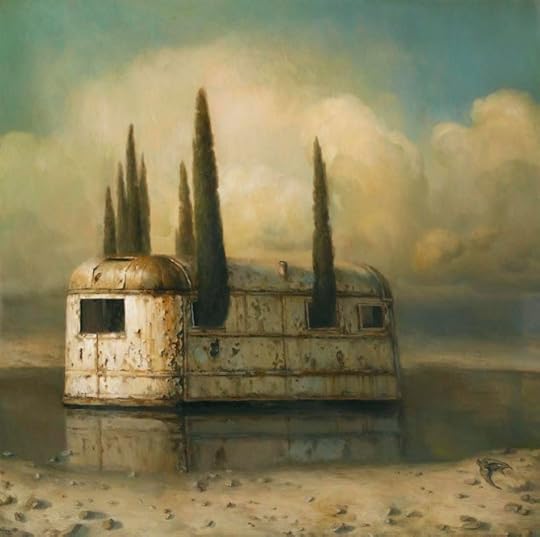
Martin Wittfooth, ‘Isle of the Dead
974 reviews247 followers
September 24, 2017
Eerie, lush and hauntingly lovely - doesn't sound exactly like a post-apocalyptic novel, right? Certainly not the "lovely" part. In fact, it's felt a little pre-apocalyptic recently, what with a Trump-filled week being swiftly followed by yet another devastating earthquake in the South.

Some people have even suggested, half-jokingly, that the quakes came in response to the political and humanitarian turmoil; I can't entirely agree. If Nature really were to respond to our pettiness, I would expect it to be more like The Trees: total, all-encompassing, complete.

The destruction here is simply of the current world, urban spaces replaced entirely by new growth. While most (or many) humans seem to have survived, how long they will do so is entirely down to adaptation. I've seen reviews that speak of a malevolence in the coming of the trees; I found the opposite. The real terror, true horror comes from the humans themselves.

Adrian is a remarkably unlikeable character, and if not for a somewhat surprising twist, he would have brought down the book entirely. Luckily book itself more than makes up for him - it's a very, very, very good read.

Note: I have to point you towards Carol.'s most excellent review, where she coins the phrase "apocalyptic fairytale" - never such an apt description have I found on Goodreads!
Profile Image for Sloane.
153 reviews12 followers
May 27, 2017
Bottom line:
A lifeless read. Apocalyptic fiction usually opens the door to literary ingenuity and critical observation on human nature and modernity, but “The Trees” has the same level of urgency, intrigue, and intellectual breadth as a primary school nature hike.

Shaw asks the right questions. In a society glued to screens and indoor environments, how prepared is man to face environmental change and catastrophe? Is murder only natural—a part of the life cycle?

So what deflates the book? The sheer 500 pages of unlikable, mechanical characters, choppy, unnatural and clichéd dialogue, and Shaw’s uneven tone. It is a promising concept to combine elements of fantasy and mythology with an environmental apocalypse, but Shaw never seems to find a happy accord. There is more. The character’s backstories and internal conflicts are so frequently revisited to the point of being tedious, Shaw’s descriptions of the environment and forest only work a third of the time (when they do, they are truly beautiful. When they do not, they are horribly awkward and a result, cringeworthy… and a reader can only handle so many similes and metaphors calling attention to foliage anyway), and finally, the plot barely moves for 300 pages (largely in parts II and III) to the point of being a complete and utter bore.

My main complaint, however, is how unbelievable human relationships are in this post-apocalyptic environment. Aside from two troublesome characters, everyone seems to be getting along just fine—no suspicion, no theft, little hostility, and very little murder. Like reviewers have said below, yes, the setting is very “twee.” (Near the climax, a character attempts to explain their ability to murder a human being by their background in landscape gardening.) Point being, there is not one character who reacts to this new, nightmarish world as they naturally would—this is not a situation where instinct has you adoring nature, befriending baby foxes, or making tribal headdresses near the top of a ruined lighthouse, watching the sunset. To Shaw’s characters, it's as if “The Trees” brought nothing more to the British Isles than a family-friendly camping ground.
Profile Image for Jennifer.
549 reviews313 followers
November 8, 2020
This is kind of a mashup between the environmental themes and surreal visuals of Miyazaki films and The Lord of the Flies. (Although, honestly, what post-apocalyptic books are not about the darkness in man's heart?) As in My Neighbor Totoro, the trees grow up out of nowhere overnight, like magic. But in The Trees, they grow up through houses and impale people like shishkebabs. I can't say I enjoyed reading it or liked any of the characters, but it got under my skin.

Apocalypse via overnight forest growth doesn't seem like the likeliest way human civilization will end, but it's an interesting one. Even ordinary trees can push up pavements, crack sewer pipelines, and cleave buildings in two. This ending also strikes me as fully justified, given how many millions of acres of forest humans have destroyed, and kind of awesome in the old sense of the word:

And then, from somewhere underground, a yawning creak began. Those who heard it dismissed it for the soughing of a branch in the wind, or of a telephone mast in need of repair. Yet both its sound and its source were deeper than that. It was a moan of some lumbering presence stirring, as of something drawing towards consciousness from overlong hibernation.


As a misanthopic botanist, I figured I would be rooting for Team Tree all the way. But The Trees is never that obvious, and within an overarching man vs. nature conflict that definitely doesn't go as expected, there is plenty of conflict between and within the characters as they try to adapt to their new lives. Our anti-hero is Adrien, who is (generously speaking) a waste of oxygen at the outset - a self-pitying drunkard, coward, saboteur of himself and what he loves best. He ends up traveling with his polar opposite, hippie vegetarian earth-loving Hannah (who is convinced that the trees are here to save humans from themselves), her son, and a wayward Japanese student, separated from her class on an unforgettable trip abroad.

Theirs is a meandering journey across a transformed England to find Adrien's wife in Ireland. There are encounters with humans who are dealing well with the new normal, and others who are decidedly not; there are glimpses of mythical animals and strange visions of branch-like creatures. There's something archetypal about many of these fleeting encounters, a hint of fairy tale or Greek myth in the helpful vicar, not-so-friendly hunter, lunatic prophet.

The writing that brings this brave new world to life is evocative, as often as not capped with unexpected gore or decay:
Water had flushed rot and dust up from under the dereliction but, finding its onward passage dammed by swathes of wreckage, had swirled back on itself and half submerged the town. The trees that stood in the streets looked engorged and drunk, their leaves dripping now and then into the water. Blanched branches floated on an opaque surface, and when Hiroko shot a duck she did not keep it, for its feathers were bubbled with noxious suds.


Incidentally, this is the second book I've read recently about the coming of age of a pudgy middle-aged man (the other being The House in the Cerulean Sea), and I much prefer the squick and unease of The Trees, which is almost exactly the opposite of a feel-good book. This is one weird, insidiously discombobulating read in which beauty and violence are finely balanced, and there are no easy characterizations or solutions. I didn't like it, but I didn't need to in order to find it interesting.
Profile Image for Sheila.
1,136 reviews115 followers
May 30, 2016
Rating this book is hard. I liked most if it, so should I give it 3 stars? I hated the ending, so should I give it 1 star? Settled on 2.5: somewhere between "I liked it" and "It was okay." (Warning: graphic violence toward animals in this book.)

First off, this book is gorgeous. The cover art is beautiful, and there's a little line sketch to open each chapter as well. Lovely design.

As far as apocalypse novels go, this was a very gentle end of the world. No one seems particularly upset (maybe it's that English stiff upper lip?), and if you're looking for details about how the survivors prepared food, how they washed, how women dealt with menstruation, that sort of thing--you won't find it here. These details are all glossed over.

The writing style was very simple, with stiff-sounding dialogue. However, there are themes explored here which I appreciated (what is evil? Does nature care? The cruelty of nature, etc.).

I don't want to give too much away, but this book verges on being twee. There are some fantastical elements that I can see some readers hating. Is this book fantasy? Horror? Dystopian novel? I don't know.

Finally, though I appreciate the character growth that happens in this book, I thought the ending was too abrupt. IMO it would have made more sense if: . I don't really understand Adrien's change, I guess. It seems to come out of nowhere.

I received this review copy from the publisher on NetGalley. Thanks for the opportunity to read and review; I appreciate it!
Profile Image for Gabrielle (Reading Rampage).
1,177 reviews1,740 followers
May 1, 2017
4 and a half stars, rounded up to 5.

Does nature actually care about you? Is it as gentle as a bunch of adorable hippies and vegetarians would have us believe? Or is it cruel, cold and sick of you and your shit and your baffling attempts to restrict, tame, organize and domesticate it?

Let’s be honest here: I totally succumbed to the “holy cow, this book has a gorgeous cover, I wants it!” urge. Granted, that urge was backed by the idea of a very unique apocalyptic tale, albeit one where trees sprout fully grown out of the ground in the middle of a quiet summer night, destroying houses, buildings, roads and cars, and killing countless people in the process. Now survivors have to figure out a way to travel this newly forested world they live in. Also, there are foxes. I love foxes. But I digress.

The story centers around Adrien, a middle-aged, out of work teacher, who only wants to get in touch with his wife Michelle and go back home - that is, once the authorities have sorted out this crazy tree business. He reluctantly teams up with Hannah, a nature loving single-mom, whose delight at this sudden change the world has undergone will soon be dampened… Along with Hannah’s teenage son Sebastian, and a young Japanese girl named Hiroko, they set out west to find Hannah’s brother and to try to get Adrian to Ireland so he can be reunited with his estranged wife.

This book sways from dystopian literature into magical realism and back. Does it manage to balance the two genres in any satisfying way? I think so. It is, not unlike “Station Eleven”, a “soft” apocalypse book: there are gruesome details, but this is not about how the world ends, it is about how the sudden arrival of the trees and destruction of their environment affects people and how they grow through the change. There seems to be a few titles like that out there these days, and I have to say, I love that kind of character study. Throw a few mysterious fairy-like creatures and (omg, omg, omg) weird unicorns in the mix and I will be a satisfied customer.

Adrien is a wonderful everyman: unable to function without electricity, used to his comfort and processed food, he’s the least prepared person when nature brutally reclaims his home and his town. He sees the entire situation as a terrible nightmare and expects that the government and the army will take the trees down and rebuild. When that doesn’t happen, he has no choice but to learn to navigate this new reality: his evolution from defeatist slacker into a loyal, strong friend who will go to great lengths to for his companion is the core of the novel, and it is fascinating. The new world he must deal with has more in stores for him than he could have imagined, and this is both shocking and delightful.

Hannah is his polar opposite: the “treepocalypse” is simply nature reclaiming what is rightfully hers in her eyes, and it takes a very personal shock to make her realize that the nature she held in such reverence can be as cruel and as bloodthirsty as humans. This almost ridiculously optimistic hippie’s disillusionment is heartbreaking: I’ve known plenty of adorable, deeply deluded Hannahs, and while she is much more resourceful than Adrien when it comes to navigating the new forest, she has no way to cope with the ruthlessness of nature. She undergoes a severe crisis of faith and I was very curious to see how she would resolve it.

Seb and Hiroko were my favorites. Their strengths complemented each other so well, and I loved watching them take down their respective walls and form a strong bond. And I want them around when the end is nigh, because while I would not be quite as helpless as Adrien, I’d still be majorly screwed if I was left to survive in the wilderness all by myself.

Reading “The Trees”, I was reminded of the gorgeous Brian Froud fairy drawings, that were stunning, erotic and disturbingly creepy all at once. We like to white-wash fairy tales, but in the older folk tales, those creatures were often malevolent and murderous. Even the pretty ones that set out to seduce mortal men would end up killing them. Clearly, Ali Shaw did his homework there and his supernatural creatures are not sanitized.

The reason I docked half a star is because the book is rather slow to start. For the first hundred or so pages I was like “Oooooook… what else is happening?”. That being said, I read the last 150 pages in one sitting, squeaking and (according to my husband) making funny face from my corner of the couch. You could not have pried the book out of my hand if you had tried, and that finale was simply awesome.

I strongly recommend this book to people who like dark fairy tales and who are looking for a completely unique and surprising book about the apocalypse. I will be looking into Ali Shaw’s other books eagerly.
Profile Image for Jane.
820 reviews777 followers
March 16, 2016
One day, in the early hours of the morning, the world changed.

“The forest burst full-grown out of the earth, in booming upper-cuts of trees and bludgeoning branches. It rammed through roads and houses alike, shattering bricks and exploding glass. It sounded like a thousand trains derailing at once, squeallings and jarrings and bucklings all lost beneath the thunderclaps of broken concrete and the cacophony of a billion hissing leaves. Up surged the tree trunks, up in a storm of foliage and lashing twigs that spread and spread and then, at a great height, stopped.

In a blink of an eye, the world had changed, There came an elastic aftershock of creaks and groans and then, softly softly chinking shower of rubbled cement. Branches stilled amid the wreckage they had made. Leaves calmed and trunks stood serene, Where, not a minute before, a suburb had lain, there was no only woodland standing among ruins ….”


Adrian Thomas was one of the few who survived. He was a middle-aged man who had been drifting through life, who was probably on the brink of divorce, who had been home in bed alone while his wife, Michelle, was away on business.

He didn’t know what to do, and so he got up and walked, hoping to find others.

He met Hannah, who was excited by what had happened. She thought – she hoped – that the trees might have come to save earth, that they might have risen up in protest at what man had done. I loved that idea. She planned to set off, with her teenage son, Seb, to find her brother. He was a forester, and she was sure that he would know how they should live in the very different new world.

She encouraged Adrian to travel with them, to find his wife, to take the initiative and to try to put things right between them. He wasn’t sure that he could do it, he wasn’t sure that he wanted to do it, but he didn’t want to be left behind.

The three of them set off into the west, through ruined towns and endless woodland.

They were all changed by their journey, and it was lovely to watch that happening and to watch the evolving relationships between them. A young woman joined them, and that changed the dynamics. They met other people, who were responding in very different ways to what was happening.

The human story is engaging; and there are many thoughtful details that enhance their stories. I particularly liked that Adrien, who had been a teacher and hated it, was worried about travelling with a teenage boy but found himself interested in Seb’s attitudes and ideas. I felt for Hannah, who struggled to come to terms with what she found and with what happened at her brother’s home.

There are weaknesses though. The dialogue is weighed down by clichés. The division – between those who want to work with nature and those who want to fight against it – is too black and white.

There were hints that there was life in the woods, that the forest was continuing to evolve, and I wish that side of the story had been developed a little more. But I’m not sure that it could have been without losing something important.

There’s a side to this book that I would loved to see expressed another way; in art, or in music. I almost wish it had been a graphic novel. It would make a wonderful film; and while we wait for that I have to say that I think this would be a great book club book.

It’s more commercial and less literary than I expected.

I loved the human drama; I loved the evocation of the beauty and the darkness of the strange new world; and I loved the ideas I was made to think about.

I appreciated the unpredictability of the story, and, while I was sorry that the final act was a little over-dramatic, I loved the ending that wasn’t really an ending at all.

I wish I could say that this is a great book. It isn’t; it’s missing a vital spark. And I think it may be a book for a different kind of reader.

But I can say that it is an interesting book, and that I’m glad that I read it.
Profile Image for Annikin.
103 reviews23 followers
February 2, 2017
There's a sailor character that talks like this: "You sound like a proper old salt. And you're right, you know. The sea can be a mean old bitch, but she makes no bones about it. A shark is a shark, my old captain used to say." Oh lord.
Profile Image for Elena .
53 reviews255 followers
Read
December 30, 2021
Read for the 2019 MacHalo Splendiferous Book Bingo Thingie: Annihilation & Rebirth.

Worms and millipedes crawled in their masses. Twigs shivered on roadside trees. And then, from somewhere underground, a yawning creak began.

The people of the suburbs slept.
Adrien Thomas slept.

Then the trees came.

If you thought trees couldn't be scary... after reading this book you'll continue to think so, I suppose. Because Ali Shaw doesn't seem to be interested in distressing you (well, I found the sudden appearance of the trees terrifying, but I spook easy), and The Trees isn't your typical post-apocalyptic story: the author's gaze passes over the seemingly ancient forest that grew overnight in an anonymous British town, simply registering its majestic beauty and the destruction it created when the trees sprung from the ground, but it doesn't dwell on the carnage. Nor does he seem to be particularly intrigued by the possibility of exploring humankind's fall into violence and debasement like dystopian fiction usually does (although, inevitably, you'll find a few people that went all "YUPPYYY!!!" at the thought of living in a lawless world here as well).

The Trees position itself on the opposite end of the spectrum from something like The Walking Dead, while staying true to the genre's core interests: where do we go from here? Is there a reason why it all happened? Is this the end? And what choices would you make in the characters' shoes? I love dystopian fiction in all of its forms and variations - I find it weirdly cathartic - but let's be honest, it isn't all that hard to appear profound and full of insightful truths about human nature when all of your musings on the subject end up concluding that Humans Are Bad.

Shaw's treatment of the "end of the world" theme is a little more elegant than usual for a genre that all too often devolves into misery porn. Here you have lots of trees, suddenly and violently showing up overnight: then the silence, interrupted by the occasional creaks and moans of a world that tries to adjust to its new inhabitants. Adrien, a self-proclaimed worm of a man, Hannah, who welcomes this new era with a smile, thinking it a new beginning, and a couple of less-sullen-than-usual teenagers will be your guide through this incredible, eerie landscape, journeying from the British hinterland to Ireland in search of their loved ones, or just of a reason to keep moving. It's a journey I strongly recommend you take too, especially if you love stellar writing, great characterization, trees, fox pups, and trapping frogs.
Profile Image for Elentarri.
2,054 reviews66 followers
March 26, 2022


This is a strangely compelling book, but not very well written.  I wanted to know more about the trees that just appeared one night.  I wanted to find out more about the little leafy creatures and the rhino shaped unicorn creature.  So I kept reading.  There isn't much of a plot to this novel.  The writing is uninspired, stiff and bland.  The characters come across as flat and not particularly realistic.  The main characters are annoying - one character is so full of self-loathing, self-pity and so timid he can barely get going in any direction without prodding; the other is unrealistically optimistic and seems to have forgotten than nature isn't always "nice".  And NO-ONE wonders why the trees suddenly appeared.  They whys and hows.  No speculation, nothing.  People being what they are, the people-dynamics is about what you would expect in an apocalypse-type novel (some or helpful and some need to become crow-chow).   The pace starts off slowly and picks up in the last third.  I can't say I particularly enjoyed reading about the most of the human-animal interactions.  I would have like more about the forest and less about the humans.  The ending was also a bit strange  - a bit more why that person and why the whole thing with the big tree would have been helpful.  The whole forest mystery also just petered out.  An intriguing idea but flawed execution.
Profile Image for Zuky the BookBum.
622 reviews435 followers
January 16, 2017
There is no warning. No chance to prepare. The trees arrive in the night: thundering up through the ground, transforming streets and towns into shadowy forest.

When Adrien wakes to the thundering of trees coming up from the earth and destroying his home, he has no idea what happening, but neither does anybody else. Confused, scared and afraid, Adrien sets out to find some answers, primarily is his wife, in Ireland, still alive? On his journey he comes across nature lover Hannah and her teenage son Seb who group together to tackle what the forest holds.

The reviews plastered all over this book are what got me really excited about picking this up, talking about Hitchcock, Tarantino and McCarthy’s book The Road (which I haven’t read yet but am really looking forward to picking up), all appealed to me so much that I put Room down and bought this one instead (or, rather, my boyfriend bought it)...

Read my full review here: https://bookbumzuky.wordpress.com/201...
Profile Image for Jo.
964 reviews48 followers
December 29, 2018
FINALLY FINISHED

This book took me SO LONG to read. Not because it wasn't engaging, but because it was so quiet and detailed (not sure if this is the right word) that it needed my full attention and I simply haven't had that to give. In the end I managed to sneak a couple of hours while both son and partner were napping and devote myself to it, and I loved it. It wavered a little towards three stars towards the end, as the pace went from a slow, thoughtful journey (very much in the vein of Station Eleven, which I adored) to a rush of plot points being worked through one after the other, culminating in a violent sequence that was more like The Walking Dead than anything else (no zombies though, calm down). I think it was my attachment to the characters - most of them suffering from anxiety or depression or both, because mental health issues don't stop with an apocalypse, why would they? - that pulled this back to four stars. And I really loved the ending.

Edit to add: bonus points for a strong male-female friendship that had nothing to do with physical attraction at any point. Really great to see.

Recommended, but make sure you've got time to sit with it.
Profile Image for Lauren.
301 reviews36 followers
July 29, 2024
a different kind of read for me was fascinated by the trees taking over the world- the end was kind of drifting off . i would try to read another book by this author-
Profile Image for MaryMartin.
65 reviews4 followers
April 11, 2016
'The Trees' is a dystopian novel with a fantastic premise: one stormy night an incredible forest of trees emerges suddenly from the earth, reclaiming cities and towns and destroying much of the man made world. Some people, including Hannah, see it as nature restoring balance. Others, such as the hapless Adrian, consider it an unmitigated disaster which will surely be rectified by the authorities soon. A perfect blend of magic realism and post-apocalyptic quest, this book will take you on fantastic journey full of eerie imagery and unexpected events. Highly recommended!
Profile Image for Vishakha ~ ReadingSpren ~.
229 reviews185 followers
October 19, 2018
2.5 stars!!

“You can’t wait for the world to be perfect before you start living in it.”

Part apocalyptic and part magical-realism, The Trees is truly unlike any book I have ever read. Too bad the characters were annoying af. They were good characters, in the sense that they were very real, very well fleshed out but oh so annoying. It all makes sense in the end but it made reading the whole book a chore. If I weren't so curious about the ending I wouldn't have bothered with finishing it.

The main protagonist Adrien, was a timid, overly cautious man and it was maddening to be in his head. I don't think everyone will find him annoying but I was furious with him. I couldn't sympathize with him at all and his narrative ruined an otherwise beautiful and atmospheric story.

It was a weird kind of apocalypse, like if hippies planned an apocalypse it would probably be like this. Trees everywhere, suddenly. People are dead, buildings are ruined, civilization as we know it is destroyed but it is also quite and weirdly calm. In the end they are just trees. Adrien tags along with Hannah and her son, both of whom are far more comfortable in navigating through this new terrain, on a journey which takes them places which they never would have imagined.

The world is a forest now, and forests are as brutal as they are beautiful. Quietly destructive, it would not just let you live unless you fight. But there is a deeper mystery in all of this, these visions of creature that Adrien keeps getting which might be the reason behind it all. That mystery is the biggest anchor that holds this book together and it was woven in the narrative splendidly. The climax was beautiful but it also left alot of questions open to your own interpretation. This can be frustrating for some readers.

All the characters go through significant growth and that is another thing that drives the narrative forward. This was probably the best part of the book for me. Watching them change and become better versions of themselves, few writers can pull of this transition so naturally.

Soooo it was a big hit and miss for it. I loved it. I hated it. I can objectively say that it was a good book, but I was also mostly thoroughly bored. Hence the relatively low rating. I wouldn't have minded missing out on it.

My Bookstagram
Profile Image for Camille.
478 reviews22 followers
January 29, 2016
Disclaimer: I received this book for free in a Goodreads giveaway.

I took part in the giveway because a) the cover is amazing (even better in real life!) and b) it sounded intriguing. It was slightly reminiscent of The Day of the Triffids, which I liked, although in the end it has nothing to do with it.
Overall, I was interested to read it but not enthralled.

Well, it was an amazing reading experience. It is strange and not my usual cup of tea. But I love it. It was slightly creepy without being scary - I don't do scary. It is magical and poetic. It doesn't really compare to anything else I have read. It even had me cry and I don't cry when I read. It had me sad, angry, happy and so many other emotions. I also loved that all the characters are different yet real people with flaws.

A must read!
Profile Image for Briane Pagel.
Author 25 books15 followers
January 7, 2017
Last night, when I got home from our weekly trip to the pool I went downstairs to my desk in the lower level and brought up two new books to start reading.

We go swimming almost every Friday night, the boys and I, something I decided to do a while back when I wanted to make Friday nights special. When I was a kid, Friday nights were "Hamburger Night," a night when Mom and Dad would cook us burgers on the Supergriddle (TM, no doubt) and we would eat burgers and chips -- actual potato chips, or sometimes Doritos!-- while watching TV with them in the living room, instead of boring old regular nonburger dinner at the kitchen table with no chips, me sitting next to my brother Bill bumping elbows because I was left-handed and he was right-handed and my parents for reasons unknown to me never changed our seating pattern in 17 years. My parents were not top-notch in the parenting department.

Anyway, Swimming Night is the new Hamburger Night: we eat dinner, clean up, and then the boys and I head off to one of the two swimming pools we can use via our health club memberships. When the weather is nice, we walk to the near one, just under a mile away. When it's not nice, we drive to that one or to the much farther away (but more beloved by Mr F) "Dolphin Pool," the one 20 minutes away which has a zero-depth kiddie pool AND a Dolphin-statue fountain and a warm-water pool all in one room.

The reason I got the two new books has both a lot to do and nothing to do with Swimming Night.

The main reason I got two new books was that the main book I'd been reading -- since before Xmas -- was The Trees by Ali Shaw. The Trees is not a bad book in most senses: it's got an interesting premise (one day a bunch of trees just grow out of the ground and wreck all the buildings and roads and whatnot, leaving most people dead and a few people thinking wtf) and the writing itself isn't bad, but despite those two things going for it, The Trees is not a good book, using 'good' in the only sense that it can have when related to books: worth bothering to read.

The Trees is slow, and focuses on characters who are both one-dimensional and unlikeable, but unlikeable in slow, boring, one-dimensional ways. I was roughly halfway through the book and nearly nothing had happened. The first chapter, when the trees almost literally erupt out of the ground, is a good start, but after that, the characters are just walking, and thinking, and talking, and whenever something seems about to happen it almost never does, with rare exceptions like when the foursome that has formed watches while one of them shoots a man in the head for killing her brother.
There are hints that something bigger is going on, even, than trees erupting out of nowhere. There are tiny stick-figure things that show up from time to time (and do nothing). There are prehistoric (or at least from the Woolly Mammmoth era, which is prehistoric, right?) animals suddenly appearing (and doing nothing). But it's all so much nothing.

Meanwhile, every character has -- as every character must, in such books -- one animating facet to them and little else. Adrien, the main character, is a loser. That is literally his shtick: he doesn't like life and wants to just sit and watch westerns while his wife is in Ireland probably having an affair for which even Adrien doesn't blame her.

Hannah, a woman who I think we meet shortly after the trees show up trying to talk people into helping her save a particular tree that has damaged a church or something, loves nature. That's her thing, and she's almost annoyingly upbeat, meds-adjusting-level upbeat, until she shoots that guy in the head for having shot her brother, at which point she hits the depressive phase and won't do much but eat some stale mushrooms in her backpack.

Seb, Hannah's son, loves technology and the Asian girl that they meet up with who is skilled in woodcraft because she was taught that by a guy in California before her dad took her back to Tokyo with his girlfriend, making her aggressively antisocial to everyone in the world except a baby fox, and Seb, whose nose she broke at the point where I stopped reading. It wasn't that point precisely which made me stop reading (the girl then goes ahead and kisses Seb, through the blood, even though it was pretty apparent right up until that moment that she did not want to kiss Seb and the kiss was entirely out of character for her and the moment.)

The characters vacillate between this is terrible we can't possibly go on and come on guys buck up little campers and make the most of this which okay I suppose maybe we all would do that in such a situation, but the fact that it might be realistic doesn't make it entertaining any more than every snapshot on a cameraphone is art. There is no real rhythm to when they do that. (The exception is the Asian girl, whose name I can't for the life of me remember even though she was a major part of the book and I was reading it a bit last night.)

While we were swimming on Swimming Night, I kept having my mind wander back to The Trees, but not in a good way. It wandered back because the day before I'd gotten a couple of additional books at the library that had finally come in after my hold, and I really, really, wanted to read them. I'd taken a stab at reading The Trees in the interlude between dinner and leaving for Swimming Night, and read a few pages, before getting bored and going to play Plants vs. Zombies 2.

So at the pool, I kept thinking I should just finish The Trees quick and then read the new books, but that thought literally made me sad and a bit tired. That's when I realized that since starting The Trees, I'd read four other books (not even counting audiobooks, which aren't really competition for physical books), and that I didn't really want to read The Trees any more. Not even a little.

So when I got home, I committed and got the new books up and put the old terrible books down, before my mind could tell me I was a quitter. That's how it feels sometimes when I give up on a book, like I'm a quitter.

But now, this morning, in the clear, minus-12-degrees light of day, I started thinking Why am I the bad person here? Why should I feel bad that a book couldn't even be good enough to want me to read it?

I have a pretty low tolerance for my culture. I've been watching Spider-Man 3, the one where Toby Maguire shows how he's getting evil by parting his hair on the other side (goatees are so 90s),


It's easier to carry around in public than a swivel chair and a white cat.


and I recognize that it is not a particularly good Spider-Man movie, and I rewatched Summer School recently enough to recognize an actor from it when he showed up, 30+ years later, in a television show. I'm not a snob, so if something isn't holding my interest that probably means that thing is too awful to appeal to someone who literally checks periodically to see if he can get the television show Herman's Head to watch again.

It's not my fault or a failing in me if your book can't hold my attention, and I don't think readers should feel bad about not working their way through books that aren't worth it. On IO9 recently there was a list of "10 Books You Pretend To Have Read (And Why You Should Actually Read Them)." The list was nonsensical in its very premise: do scifi fans really pretend to have read scifi books? I don't. I've made no bones about the fact that I think everyone telling me I have to read Isaac Asimov ought to shut up, his books sound boring and stupid to me and I don't want to read them. (Foundation is number 4 on the list.)


Worst spec fiction cover ever...


... until this one.


In the list, various 'experts' talk about why people should read these books. Of Cryptonomicon, one says "It's so long, and so dense." Something called Dhalgren by Samuel Delany was described as a "monumental achievement" which most people haven't read and is "a lot of work."

Infinite Jest is on there. I tried reading that, twice -- wasting seventeen actual dollars of my money on the book back when seventeen dollars was a lot of money to me, representing my book budget for two months. It was awful. The IO9 'expert' admits most people don't read this one, either, even though they own it.

Worst of all was the reason for reading Gravity's Rainbow:

This is sort of an odd one. Many of the authors we contacted for this article named Gravity’s Rainbow immediately as the book that everybody pretends to have read — but then they all admitted that they, too, had not actually read it. “I don’t believe that anyone has actually finished Gravity’s Rainbow. Thomas Pynchon has spent decades waiting for his audience to laugh at that cool twist right at the end, and is now starting to wonder. I’ve started it five times,” says Paul Cornell, author of the comic This Damned Band and the Shadow Police series of books.
So why should you read Gravity’s Rainbow where some of the coolest genre writers have failed? Several people said they’ve found the parts they were able to get through immensely enriching.

The parts they were able to get through. It reminds me of all the time I spent (wasted time) trying to read Ulysses before giving up on that dreck.

Why do we say bad books that are 'a lot of work' and are difficult to read are so valuable? I have read books that are dense -- Foucault's Pendulum by Umberto Eco (who used to be good before he got bad) comes to mind. I loved that book. It packed a lot of information into it but was good, and not a tough read at all. (Eco's The Name Of The Rose was terrible: another one I started and didn't finish). Catch-22, the best book of all time, is dense and packed with information and has important things to say, but isn't difficult to read at all. American Gods: dense, important, majestic, easy to read.

Jonathan Strange and Mr. Norrell, like The Lord Of The Rings before it, is a long and carefully-thought-out book about magic, with its own internal system that appears realistic because it is so carefully crafted, and a range of characters that is broad, if not vast. It makes the IO9 list for some reason (as does Dune) even though both Strange and Dune are books that pull you into them and make you want to read.

Books that are work are not books that are meant to be read. My philosophy textbook in undergrad was dense and difficult, but that was because it was a textbook, and learning philosophy was my job. Why should reading a novel about trees taking over England be the same level of difficulty as learning calculus? One of the experts on that IO9 article opines that we don't seem to value working at our reading. That's Jeff Vandermeer, whose Area X trilogy was challenging in a good way: it didn't spell things out for you and didn't cut corners and I'm not sure I've figured it all out yet even, but it was one of the greatest books I ever read because it was a great book.

Long books are okay. Dense books are okay. Books that present mysteries for you to figure out or which don't just explain things right up front are okay. Lots of great authors know how to write long dense books that make the reader invest some mental energy in the story which nonetheless are fun to read. Why should we bother with books that demand that mental energy be devoted to the very task of reading, as opposed to parsing the story.

There is a difference between challenging and bad. Books like Infinite Jest are bad because they are poorly written and present the task of reading as the challenge of the book: they make reading the book difficult apparently because the author wanted to do so. (S by JJ Abrams was like this: I gave up on it because the effort of reading that book, which sounded so good in premise, was not worth whatever payoff it promised.) Books like The Trees are bad along the same lines. There might be a noteworthy idea somewhere in the trees, but that idea is wrapped in a tedious story about unlikeable people whining their way through an English forest, a story that is not challenging in the sense that it requires me to think, and is not challenging in the sense that it presents ideas I might find difficult to agree with or comprehend. It's challenging in the sense that a 200-mile drive through Kansas is challenging: you just have to keep plodding along in hopes that eventually the scenery will be worthwhile.

I'm surprised that I felt bad about stopping reading the book. I'd thought I'd mostly gotten over that, and was willing to abandon books more quickly. Maybe I saw more of a glimmer of hope in The Trees, the way I used to think, about mid-season, that just possibly maybe the Buffalo Bills might make the playoffs this year before deciding no, they didn't. But now I'm more angry that I felt bad about it, because I feel like that's the author's fault, too: he showed me something that had promise, that I felt like might be worth it, and I even invested considerable time in it. And yet even halfway through, Shaw couldn't make me want to go on reading his book any more.

That's not my fault. It's his. I once said, after watching Superstar with our kids, that the director of the movie owed me two hours of my life back. I figure I blew about 12 hours of my life on Shaw's book, and he owes me twelve hours back. If life were fair, Ali Shaw would come over to my house and do 12 hours worth of chores so that I could spend those 12 hours reading something that was worth my time.

Briane Pagel is the author of "Codes" and reads 100 books a year, blogging about them at http://www.thinkingthelions.blogspot.com
Profile Image for Sana.
414 reviews7 followers
May 21, 2018
Blog| Facebook| https://www.instagram.com/gewispertew...


''How do you expect to survive in the world [...] if you turn away from the very sight of it?'' - Carter (p. 130)


Adrien Thomas konnte sein Leben noch nie in die Hände nehmen. Statt herauszufinden, was er will und damit seine Ehe mit Michelle zu retten, pflanzt er sich lieber mit einem Eimer Hähnchenschenkel vor den Fernseher. Doch eines Nachts erobert die Natur die moderne Welt zurück: überall sprießen Bäume hervor und hinterlassen nicht nur die Städte, sondern auch die Menschheit in purer Zerstörung. Ausgerechnet zu dem Zeitpunkt, in dem Michelle sich in Irland befindet. Gemeinsam mit der Naturliebhaberin Hanna, die in dieser Apokalypse ein Geschenk sieht, und ihrem technikvernarrten Sohn Sebastian schlägt sich das ungleiche Trio durch die Wälder, um Michelle - und auch sich selbst - zu finden.


Besondere Bücher sind immer diejenigen, die am schwersten zu bewerten und noch schwerer weiterzuempfehlen sind. Denn wenn die Floskel ,,Es ist Geschmackssache'' auf irgendeine Art von Buch zutrifft, dann auf dieses.
Wer sich von The Trees eine actionreiche und spannende Apokalypse mit vielen Kämpfen ums Überleben erwartet, der ist hier komplett an der falschen Adresse. Allgemein sollte man keine ausgeklügelte und wendungsreiche Handlung erwarten, denn Ali Shaw schreibt sehr geradlinig, gemächlich und fokussiert sich eher auf die Atmosphäre seiner Welt und die Vorstellung seiner Figuren. Wer sich irgendwelche Hintergründe dazu erwartet, weshalb die Bäume aus der Erde gesprossen sind und ob die ganze Welt oder nur Großbritannien davon betroffen ist, was die Regierung dagegen tut oder ob es sie überhaupt noch gibt, der wird sich mit bloßen Spekulationen zufriedengeben müssen. Zwar trifft man auf andere vereinzelte Menschen und Gruppierungen, allerdings haben diese genauso wenige Antworten auf diese Fragen wie Adrien, Hannah und Seb. Vielmehr tragen sie, wie die Hauptfiguren, zu einer eher ethischen und esoterischen Auseinandersetzung mit dem Thema Natur und ihrer Verbindung zum Menschen bei, auf die sich der Ausbruch dieser Apokalypse vermutlich zurückführen lässt. Ein sehr interessanter Einfall von Shaw, das übliche Klischee einer übertechnisierten Zukunft und von Menschen zerstörten Umwelt umzudrehen und die Natur selbst zum Urheber der Katastrophe zu machen, nur um sich letztlich vor der eigenen Zerstörung zu bewahren.
Allgemein ist dieses Buch eindeutig ein Plädoyer dafür, sich auf seine Verbindung zur Natur zurückzubesinnen und unsere gegenseitige Abhängigkeit anzuerkennen. Dies kommt vor allem durch Naturliebhaberin Hannah, die seit jeher eine enge Beziehung zu Wäldern hat und die technikgebundenen Hobbies ihres Sohnes vollkommen ablehnt. Der Autor bleibt jedoch nicht bei dieser plakativen Aussage, sondern zeigt auch die negativen und brutalen Seiten des Lebens. Nicht nur werden viele Menschen durch die Bäume aufgespießt oder von wilden Tieren gefressen, auch gibt es einige, die die vorherrschende Anarchie ausnutzen und nur noch sich selbst der nächste sind. Dadurch erlebt Hannah im Laufe des Buches eine Art Identitätskrise, da sie - ähnlich wie viele andere Freunde der Umwelt auch - vergisst, dass sie im Grunde genommen ziemlich blutrünstig sein kann. Leben wir deswegen nicht doch schon seit Anbeginn der Zeit im Einklang mit der Natur, wenn wir ihre Bäume fällen, während ihre Tiere sich gegenseitig zerfleischen? Dieser erweiterte Blickwinkel hat dem Buch sowie der Protagonistin die Naivität, die man sich von so einem Plädoyer erwartet, genommen, und es dem Leser selbst überlassen, in welchem Verhältnis er sich und Mutter Natur sieht.
Dennoch wäre es verständlich, wenn viele Leser sich von derart viel Philosophie abschrecken oder langweilen ließen. Dadurch, dass Ali Shaw Vieles dem Leser offen lässt, fühlt sich The Trees sehr verwirrend an und hinterlässt nicht nur seine Protagonisten mit einigen Fragen. Insbesondere die mysteriösen Wesen, die Adrien verfolgen, ebenso wie der riesige Baum, den nur er sehen kann, bleiben einem selbst am Ende ein Rätsel, auch wenn man die ein oder andere Vermutung dazu aufbauen kann. Diese ist jedoch sehr von Esoterik geprägt und könnte dem ein oder anderen sicherlich zu besonders sein. Gekoppelt an die beständig düstere Stimmung mit poetischen, wundervollen Naturbeschreibungen fühlt sich die Geschichte an wie ein surreales Erlebnis und vermag dadurch den Leser vollkommen in sich einzusaugen - vorausgesetzt, man kann sich auf diese Form des magischen Realismus einlassen.
Ebenso gewöhnungsbedürftig sind die Figuren, die alles andere als klassische Helden sind. Neben Hannah begleitet man den in sich selbst gefangen Adrien, der ständig an seiner Angst vor der Welt scheitert und dadurch weder sich noch seiner Frau Michelle der Mann sein kann, der er eigentlich sein möchte. Der Autor flechtet mit viel Einfühlungsvermögen die Kennlerngeschichte der beiden in seine Wanderung ein und erklärt seine Bedenken und Zwickmühle wirklich gut. Immer wieder reflektiert er sich selbst, indem er realisiert, dass er durch seine Reise nicht zu einem tapferen Kämpfer wird, sondern diese Wandlung vom Weichei zum Helden mehr beansprucht als ein einziges Abenteuer. Zwar wird das einigen Lesern bestimmt auf die Nerven gehen, für andere wird es jedoch sehr erfrischend sein, mal einen Hauptcharakter zu haben, der stetig gegen seinen Selbsthass verliert und das Rampenlicht anderen überlassen will.
Auch Seb ist kein uninteressanter Charakter, verliert jedoch durch eine später hinzukommende Figur - Hiroko - jegliches Potential zur Austragung seines inneren Konflikts. Dabei wäre es bei seiner Abhängigkeit von Technik noch am interessantesten zu zeigen, wie er mit der neuen Situation umgeht. Dies gerät jedoch sehr schnell in Vergessenheit und wird durch die Liebesgeschichte mit der eiskalten Japanerin ersetzt, die bestenfalls gewöhnlich ist. Andere auftauchende Figuren haben häufig nur die Aufgabe, einen neuen Standpunkt zu den bestehenden Fragen hinzuzufügen, weswegen sie zwar nicht sehr tiefgründig sind, dafür aber Shaws Thematik mehr Tiefgang verleihen.
Sich für über 400 Seiten ausschließlich Gedanken um die derzeitigen Zustände und die Natur zu machen, wird jedoch auf Dauer langwierig und ab und an auch langweilig. Man scheint sich von einem philosophischen Dialog in den nächsten zu hangeln ohne wirklich etwas Neues über die Charaktere oder die Welt zu erfahren. Meistens fühlen sich diese Gespräche sehr konstruiert und an, als müssten die Figuren ihre Vergangenheit und ihre Ansichten jedem darlegen, der ihren Weg kreuzt. Selbst in bedrohlichen Situationen zeigen sich die Charaktere äußerst redselig und können auch kurz vor einer Ermordung noch über die Anarchie der Natur sprechen. Daher fühlen sich, auch mit neuen Denkanstößen, viele Szenen repetitiv an und tragen dazu bei, dass sich die dünne Handlung noch langgestreckter anfühlt. Zwar mündet die Geschichte in einem recht spannenden Finale, jedoch nicht ohne eine dahingeschobene Motivation und die ein oder andere Länge.


The Trees ist definitiv nicht für jeden etwas. Durch eine langatmige, doch wunderbar blumig erzählte Wanderung durch ganz England versucht der Autor, seine Figuren und deren Einstellungen gegenüber Mutter Natur näherzubringen. Häufig dienen sie nur als Platzhalter, um seine Beschäftigung mit dem Thema auszuweiten, nur mit Hannah und Adrien schafft er Personen, die interessant genug sind, um den im Schneckentempo vorankriechenden Plot zu tragen. Wer auf gescheiterte Persönlichkeiten steht, der wird hier reichlich davon finden, ebenso wie eine tiefgehende ethische und differenzierte Auseinandersetzung über die Natur, die in den magischen Realismus übergeht. Ein Buch, für das man sich Zeit nehmen und worauf man sich einlassen muss, um es zu genießen, ansonsten könnte es wirklich schwer sein, sich durch den dichten Wald der Seiten zu kämpfen.

Gesamtwertung: 3.70/5.00 Sternen
Profile Image for Dustin the wind Crazy little brown owl.
1,434 reviews178 followers
June 21, 2020
Midway along the journey of our life
I awoke to find myself in a dark wood

-Dante Alighieri, Dante's Inferno

The Trees is a physical, emotional exploration of change and nature, a fairytale for adults and a symbolic journey about life. At times through the woods, characters and readers alike will pass through repeated cycles including: The Night the Trees Came, Murderers, The Grave, Slingshot, Heart of the Forest, Wolves, Fox, Unicorn, Gunman, Captain, Forest Law etc. As a traveler on the path, as we come to these points, it's easy to think that we are lost and give into frustration, but it's more beneficial to look at what lesson we still need to learn from this repeated theme and what we need to let go.

How very interesting that I found myself reading The Trees for the second time during the worldwide pandemic of 2020. Many correlations to current events came to mind. Humanity has been presented with a sudden far-reaching event, time to contemplate life's priorities and how we will react. There are opportunities and choices to make as we go forward. The Trees offer much to consider.

Ali Shaw has become one of my favorite authors, one who writes with mystery and beauty, taking readers to amazing places. I first experienced this magic & wonder of words by reading The Girl With Glass Feet. I now also own a copy of The Man Who Rained, which I might just get around to reading this year.

I love how immersed in nature readers of Ali Shaw become. These novels showcase the powerful connection to the natural world. I love the "What just happened?" moments :-) An enchanting mix of terror and wonder.

I'm thinking the fox on the cover would make a nice tattoo.


Favorite Passages:

"I know if feels scary, but give it time and we might see a blessing in disguise."
"People have died," said Adrien, with a touch of indignation. "My next-door neighbour was impaled by a branch."
Hannah frowned. "Oh . . . I'm sorry, Adrien, I didn't mean to sound flippant. I mean, I know people have died, and I'm sorry about your neighbour. I'm just . . . trying to see the bigger picture, that's all."
"You're not the only one," proclaimed Adrien, "and all I can see is endless bloody trees!"
________

Hannah clenched her fist around the handle of her mug, and waited for the memory's stab to fade. A stag beetle ran across the table, coming within a horn's length of her finger, and at once Hannah embraced the distraction, delighting in the insect's top heavy wiggle. Then she laughed doubly to see another two following it, a duo scuttling past with the waddle of slapstick clowns. Then three more rushed after them, and Hannah's smile began to vanish, and then a half-dozen more swarmed by and she rose uneasily to her feet. Feathers rustled, further down the garden, and Hannah frowned to see the dim outline of a blackbird hopping about, its beak tapped manically at the grass. All over the lawn, worms were oozing out of the soil. Bees, who should have been tucked up with their honeycombs at this hour, were in flight. The flowerbeds were pebble-dashed by snails.
______

How he hated gardening. The falseness of it. Digging out a weed because it wasn't pretty enough. Coming upon slugs who had melted after digesting pellets. One time blindly reaching into a spray of withered daffodils and finding a bird bleeding to death from someone's pet cat. 'Mother Nature is a psychopath,' he'd told Michelle, 'and I won't spend my weekends on my hands and knees, painting her toenails.'
______

She thought of Seb leaning over his laptop, and what kind of world he was growing himself up in. And when the news brought tales of louder disasters, and to her shame Hannah found them easy to forget in her day-to-day rush, she feared a flood or a tidal wave of heart-stopping magnitude sweeping through the landscapes of Seb's future, and him having simply no idea of how to cope.
And that was why she could not help but see some hope in the coming of the trees. They were as much a promise as they were an apocalypse, and she had the means to show Seb how to live amongst them.
_______

'Thank you, well . . . thank you for just being such a badass.'
'I'm just a country girl with a slingshot.'
'I'm just a techie kid with a useless memory stick. We don't have to beat ourselves up about it.'
She looked down at her hands. 'Do you really think I'm a badass?'
Seb grinned. 'Yeah.'
'I don't feel very badass.'
'You're the baddest I've ever met.' He nodded towards her slingshot. ' Now my turn. Can I take a look?'
_______

Talking was deceit, one of the games people played to keep themselves from looking the world in the eye.
_______

Pausing at the sight of something turquoise in the undergrowth, she found it to be a speckled segment of eggshell, underneath one of Zach's bird boxes. Nearby, with its head resting on the pillow of a wood anemone, lay a shrivelled chick, grey and rotting.
_______

The lead wolf lodged its jaws around his throat while a second tore open the cloth of his shirt, spat it out and ripped wide his belly. The bite was so powerful that Hannah could see Leonard's ribs raised like outstretched fingers.
_____

The wolf barked, as if to command Hannah's attention, and she looked to it obediently. Its maw was smothered in Leonard's blood, and the scarlet gore made its green eyes look all the greener. The wolf watched her with no readable expression, even as a red string of it's slather dripped neatly to the chapel floor. There are no policemen and no judges now, thought Hannah, but here was a judge like no other. She became almost calm as she waited for its verdict.
_____

A breeze rippled the willow leaves and white moonlight dappled the beast's coat. Only then did Hannah see its horn. More like a dorsal fin than a tusk, it grew from the animal's nose jagged and slender. At the sight of it Hannah could not help but clasp her hands to her head, not out of ear but out of wonder. If she had ever seen anything like this, it was in some picture book of giant animals extinct since the Ice Age.
To her own great surprise, Hannah felt oddly at ease in the company of this beast. Perhaps that was due to how deeply it slumbered, as if it had been dreaming beneath that willow for millennia. Forgetting all else, she let herself admire it, and as the minutes passed she did not move or think, only beheld. When at last a thought came, it was a clear one and untangled. Bestial things and beautiful things could be as one, she thought.
_______

The next day brought a change in the air. The ground softened underfoot, and Hannah could smell the minty tang of herbs that loved the damp places. The pale stars of wild primroses ringed the earth, and through them ran long-trodden trails of muntjac and hare. They had crossed an invisible threshold into ancient woodland, forested since long before the trees came . . .
_______

"Trees don't take sides."
Neither Seb nor Adrien rushed to contradict the girl, but Hannah was at least grateful for their conspicuous silence.
_______

. . . the worst kind of noose trap was the one that your heart made for you.
_______

. . . Adrien looked up at the church's ceiling. Sculpted into the beams that crossed it were devils and angels and stranger faces still. It took him a moment to realize that some of those faces were made out of leaves, albeit wood-carved ones. Their mouths hung open either to spew out more foilage or swallow it up. One puckish face had oak leaves for eyebrows and a chin of ivy. Another had cheekbones of holly and flat, stemmed lips. There was one with forget-me-not eyes and flowering whiskers. There was another with a hooked nose and ivy for a mane. Every one of them was different, but all were chiselled by the bold, crude skill of a country carpenter. They adorned every level as high as Adrien could see, but he could tell there were more on the edge of light. Sometimes, when the lamp flickered, they looked like they were moving, and he didn't like what they reminded him of.
_______

"Not just this one," said the vicar. "You'll find them in many old churches, not only in this country but in mainland Europe, too. I did some research on the carvings a few years back . . ."
"This one's as old as the church rafters, which are seven hundred years and counting."
"There would have been forests everywhere back then," mused Hannah. "The people here would have lived their whole lives in the woods."
The rain wetted the foliate gargoyle's lips, and seemed to make them salivate. Its eyes, livened by the moisture, stared keenly down.
_______

"I used to post pages on my website that no hyperlinks led to, and no search engines registered. You'd have to type the exact addresses to find them, and you couldn't do that if you didn't know what to type. But they still existed, do you see? They were still out there. Each page was like a letter, one for Callum, one for Mum, one for Zach . . . you get the idea. I changed what I'd put there whenever I felt like it, but you're the first person I've ever told of their existence. I don't think anybody ever read them, but the point was they'd been written."
_______

Standing there, submerged up to her knees, she thought she would have preferred some biblical flood to have swept the world, rather than the forest. It would have been cleaner, easier to comprehend.
_______

"I think," she said, "that the sea might be the truer face of nature. It's where everything came from, after all. The sea never hides what it can do to you, how deep it goes or how far. And every shell on the beach is a reminder . . . is like a bit of bone from something the sea has already killed. The sea is more honest than the woods."
_______

As a boy, stargazing had made him feel like there was something awe-inspiring about his own insignificance. It had let him be satisfied with smallness, instead of lacking for it. He had used to imagine himself neither as a space captain nor an intergalactic hero but as a comet, a nugget of cold rock whirling long orbits round a brilliant star.
The sea sifted. The trees creaked and shivered. Adrien closed his eyes and tried to pretend what he had not pretended since childhood. Cold to the bone and streaming out of a wake of ice. Hurtling unimpeded through the simplicity of nothingness. It brought a fraction of a smile to his otherwise troubled face. Outer space was no more complicated than an elaborate machine. There was nothing up there to eat you, nothing small and creeping to haunt you with its dead wooden stare, nothing to fall in or out of love with. Down on the Earth everything was so much more imperfect, and the most imperfect things of all was Adrien Thomas.
________

With a rustle, a whisperer stood up where the undergrowth met the beach. It was the thinnest Adrien had yet seen, its body as fragile and decorative as a fern. Near it rose another with a doleful face and stumpy legs. Then there was a third, a fourth and fifth, and two conjoined like grafted wood. When Adrien looked back to the throne tree he could see them crawling all over its branches and up and down the sombre bark of its trunk.
_______

"Were there always woods here?" asked Adrien of Eoin.
The shipwright shook his head. "Not this time last year."
_______

It was a sight so sweeping and empty of life that it took Hannah a moment to notice the kirin.
It lay on it's side in the deep middle of the pit. A man was crouching over it with is back to them, pulling things out of its body. By his side stood an eager Alsatian, transfixed by its master's butchery. Hannah covered her mouth, for although they were too far away to see the bullet wound, the opening the man had cut into the animal's belly was a smile, bright and red.
_______

"What kind of girl are you," asked the man, unamused, "carrying a fox about in your hood?"
"What kind of man are you," retorted Hiroko at once, "shooting a kirin?"
"Is that what you call one of these?" He stared dispassionately at his kill. "I wouldn't have called it that."
"It wouldn't have threatened you," said Hiroko. "It was a herbivore."
"You think I can't see that? But why should I care? I have mouths to feed."
_______

. . . someone had put a crow in the gruel pot. He had just about been coping with the steady slew of rabbits and other birds (and rats, there'd been a brace of rats that morning), all tossed in for the boil, but the crow had been too much. He had closed his eyes and felt the tickle at the back of his throat, that one that came from too much cawing, in the roost or on serrated wing. Merely remembering it had made his lips feel pinched and stretched, hard enough to peck meat off the bone.
_______

". . . looking at all these tiny light from down here, the Earth feels so massive, but we know it isn't really. If we put it alongside a star it would just be a speck. And even the stars are tiny, compared with all that emptiness surround them. Nothing is allowed to call itself the biggest, in out space. I always loved stargazing, because it made me feel insignificant."
_______

Love was a trail through the forest of yourself. If grief and savagery threatened, you could stick to its course and hope it would prevent you from disappearing into the shadows. Finding that trail in the first place was the hardest part, but now that she had found it she had no intention of letting it out of her sight.
_______

Each of his thoughts was a sycamore seed, spinning lonely in the air.
______

She could feel the immensity of all the mud and stone and bedrock beneath her feet. The sheer magnitude of the planet, somewhere on the far side of which was Japan. Seb had helped her learn to cope with it, but a weight didn't lighten just because you found the strength to carry it.
_______

'It's January, Hannah. It's the worst month for doing anything.'
_______

Their journey was a surreal experience . . .
Displaying 1 - 30 of 461 reviews

Join the discussion

Can't find what you're looking for?

Get help and learn more about the design.