Jump to ratings and reviews
Rate this book

The Many Selves of Katherine North

Rate this book
_______________'In this exhilarating, metaphysical white-knuckle ride, Geen takes us into the other worlds that crouch, slink and bark around us ... It will leave you reeling' - Charles Foster, author of Being a Beast_______________Kit has been projecting into other species for seven years.Longer than anyone else at ShenCorp.Longer than any of the scientists thought possible.But lately she has the feeling that when she jumps she isn't alone…_______________'Startlingly fresh ... Along with the protagonist I became a tiger, an eagle, a whale. I hunted, flew and swam in this extraordinary book which goes to the heart of what it means to be alive in a shared universe' - Jane Shemilt, author of Daughter'A compulsively readable sci-fi thriller ... a vivid and wildly engaging world around an incredibly compelling protagonist ... this is a great book, full stop' - Maine Edge_______________

369 pages, Kindle Edition

First published June 7, 2016

28 people are currently reading
1521 people want to read

About the author

Emma Geen

1 book46 followers
Emma Geen is an author and lecturer. She holds a PhD in Creative Writing from Bath Spa University.

Ratings & Reviews

What do you think?
Rate this book

Friends & Following

Create a free account to discover what your friends think of this book!

Community Reviews

5 stars
114 (18%)
4 stars
225 (36%)
3 stars
201 (32%)
2 stars
60 (9%)
1 star
19 (3%)
Displaying 1 - 30 of 166 reviews
Profile Image for Heidi Wiechert.
1,399 reviews1,524 followers
March 10, 2018
In The Many Selves of Katherine North by Emma Geen, humanity has harnessed the power of consciousness and mechanized the ability to place that consciousness in different bodies at will.

Katherine is a teenager who works for a large research company. She’s the longest lasting “phenomenaut” (person who’s consciousness is put into the body of an animal) because she seems to be special.

The process of consciousness transfer seems to stop working when the brain ages and loses its plasticity. Despite her age, Katherine’s brain seems to be fine.

But then, one day, Katherine sees something strange when she’s out of her body… and perhaps she’s not as well as she imagined.

The Many Selves of Katherine North asks some pretty powerful questions like: What is consciousness? How does our physical body change how we perceive the world? What is reality?

I think that this story has the potential to open up a dialogue about these questions between readers who may not have considered them before. In that way, this is a very powerful book.

I did not like how the story flips back and forth between the present and the past. I think Geen was using the shifting timeline to build the mystery, but, because of the nature of Katherine’s many consciousness experiences, it made things rather confusing.

It is a complicated story. At times, maybe too complicated.

The richness and variety of Katherine’s experiences drives a wedge between her reality and the rest of humanity’s reality.

The reader really sees difference in this moment, when Katherine is preparing to go into work: “Later, I lie in bed quivering… because it’s only hours until I’m out of here. Here- not just a room but skin. How can other people call this their totality? There is so much more.” pg 19

Katherine captures the impossibility of explaining out-of-body experiences very succinctly here: “Because how do you cram the lived experience on to a page? The words available to me were never enough. Something would always slip the sentences. Human language developed around human bodies, it never quite fits other ways of being." pg 66

I loved all of the chapters when Katherine was in the body of an animal. In this one, she was a snake: “Old scents have imprinted upon the world like spoor into soft mud, the past blundering prey. I wonder if this is one reason many animals have a poor memory compared to humans. What’s the use in remembering when the world does it for you?" pg 146 Fascinating.

Emma Geen included a disclaimer at the back of her book and it contained some of my favorite lines: “…what if there are other valid ways of knowing? What is the world is not one, but multitude, with as many ways of being as there are beings? What if literature were the opportunity to glimpse such refractions, thrown by the world as though from a diamond?” pgs 349-350 Loved that.

If you enjoyed The Many Selves of Katherine North, you may want to pick up Mythago Wood for more glimpses of worlds hidden within worlds.

Big thanks to Goodreads First Reads program, NetGalley, and Bloomsbury USA for providing an advance reading copy of this novel.

Thanks for reading!
Profile Image for Emma.
1,010 reviews1,211 followers
July 3, 2016
As soon as I saw the blurb for this novel, I was in. Using advanced technology, certain people can ‘jump’ their consciousness into lab created animals (Ressy/Ressies), to monitor and learn from their behaviour. Even before reading the brilliantly imaginative illustrations of human-as-animal created by Geen, this was appealing. Who wouldn’t want to know how it feels to howl with wolves under the moonlight, or steal chips out of unsuspecting human hands like the sneaky seagulls of the English seaside? This desire is both the fundamental lure of the novel, and of the undoing of its purity within the story. Of course, we would all want to do it. Of course, there is money to be made. Geen gives a harsh portrayal of the Shen Corporation: a company that takes an idea based on helping the environment and undermines it to make a profit. It’s a clear commentary on human behaviour. Yet Katherine (Kit) offers hope within the story, she wants to understand and help the animals like those she inhabits. She makes friends with a young fox, Tomoko, while occupying the body of a fox and their relationship is both moving and sad. If anything, it is these scenes Geen does particularly well. Katherine’s interactions with the animals are beautiful, disorientating, vivid. The way Kit takes her knowledge of animal behaviour gained through these sessions and applies it to humans is enlightening and amusing. As a reader, you can feel the connections she has with her Ressies; so much so than when the boorish tourists are given the opportunity to ‘jump’ and then bulldoze their way through the animal kingdom, it induces a kind of rage. I was immediately reminded of the American dentist, Walter Palmer, and his casual slaying of an endangered lion, Cecil. It is a sad fact that this depiction of humans as unconcernedly violent towards the animal world is far from rare. It’s a question the book brings to the fore.

There were, however, a few issues. At times the frenetic pace worked against the story. While Katherine jumped in and out of bodies, as well as the past and the present, it was difficult to maintain an emotional connection to her story. In part, the narrative style fit with her decreasing control and mental stability, yet it made the lens through which the reader sees her jagged and distorted. The plot feel confused, out of the control of the author. In addition, the romance angle did not work for me at all. Even so, Geen is an author that has a lot to offer.


Many thanks to Emma Geen, Bloomsbury USA, and Netgalley for this copy in exchange for an honest review.
Profile Image for Christine.
7,224 reviews570 followers
September 1, 2017
The two-star rating is somewhat misleading and perhaps unfair. The basic premise of the book is good and interesting. The basic premise is simple – Katherine’s job is that her consciousness inhabits constructs of animals. She does this for study. So, for instance, she wants to study foxes, she inhabits the body of a fox. Her real body is during this time connected to a basically life support. Over the course of the novel, secrets about the company she works for are revealed and you get the general idea.

Geen excels at imaging a person’s reaction to have as many limbs as, say, a squid. When she writes as Katherine adjusting to a different form, the book is really good. The problem is that when Katherine, Kit, leaves those animals you don’t give damn about her because she isn’t a fully realized character.

Now this could be in part because Geen wants to dwell on the question of real life versus the life of unreal – i.e. inhabiting a body that is really a construct as opposed to your own body. While sometimes the book does this, it really isn’t done well and Kit really does seem to lack any ability for interception. This might be because this science fiction book is really a young adult book. There are good ideas here but nothing really gets examined and it almost feels like there is another story here. The bits about Katherine’s past are interesting, a tad, but they come so late that you just don’t care. The romance just feels there.

Yet, I must admit my problem started much earlier and it isn’t just to this book. It was just a bit really. Kit is describing the machines that keep her body alive while she is animal surfing, and notes that there is a cup for when women get their period. She then tells the reader that she hasn’t had a period for years.

She’s 19.

Now, later in the book it is revealed that the process of animal surfing does harm the teens (who are best at it), but it is never clear if Kit’s lack of a period is because of this or some other issue. In fact, it is implied that it isn’t a result of animal surfing. She never seems curious about it. This is strange considering she apparently wrote some really good biology papers so it seems she has some scientific knowledge. Wouldn’t she wonder? I mean maybe she has an IUD, but then why mention the period at all. But Kat is already extra special because no one has animal surfed as long as she has. She’s the bestest. The lack of bleeding seems connected to this.

And she had her period at one point because she hasn’t had one in a while, in years, which implies she had one. Wouldn’t she wonder?

Now, look, I don’t except the female characters to tell readers every time they have to pull out a pad or what’s it. I just presume that’s happening, so when a character tells me information about a period, I pay attention.

And this isn’t the only book where I have seen this.

In much genre fiction, regardless of target age range, there is a tendency for a female character to be the sole female character who can do anything right. She is the unique female character. Written badly, she is simply a man with boobs who looks down on every other female character. If you have read the Anita Blake books that’s an example. At times, the character doesn’t have to be written badly for this to make an appearance. Kitty the werewolf in some of the books in the series is the unique and extra special woman. I’ve noticed that sometimes the extra special woman will not have a period.

Why?

Why is this even thought about? Here, it might be an excuse for why Kit can keep working, yet conversations with others in the book indicate that it isn’t simply a biological but also mental reason why people stop animal surfing.

The only answer I am left with is the lack of the period makes the female character more acceptable. To whom? I’m not sure. Perhaps it is wish fulfillment too. But I don’t think so. There is something strange and discomfiting about this. Perhaps it is because there are still societies were women are exiled because they are considered unclear during that time of the month. Perhaps it is because something natural is being seen as icky – strange in a book where biological animal function is discussed. But I think it comes down to specialness and pureness. A girl isn’t a girl unless she is unbloodied. Now, you can have the girl without the nasty woman bits.

And that frightens me to be honest. It seems to be saying, you can’t be a woman. Not really because it is unclear. Not nice. Just icky. Perhaps I’m just an old grouch. Perhaps I’ve had it with things after hearing about an all-female Lord of the Flies movie, created by two men.

But this rejection just seems so wrong. Look, I’m not saying she has do a Greer and taste her menstrual blood, hell, I don’t even think the period should really rate a mention unless it has a truly important role – pregnancy, starvation. What upsets me is the fact that women writers feel it necessary to point out that the female heroines are even more special because they don’t have a period.
This entire review has been hidden because of spoilers.
Profile Image for Elentarri.
2,069 reviews66 followers
March 16, 2025
Nineteen year old Kit is a phenomenaut working for a technological company ShenCorp. Her job requires that she project her consciousness into a variety of animals for research purposes in an attempt to better understand the Weltanschauung or world perspective of other species. When a "jump" goes wrong, Kit inadvertently gets a promotion to the new project, which seems to have sinister overtones.

This isn't a thriller, though it could have been. The novel alternates between Kit's past and her current predicament. The chapters that describe what it may be like to walk/swim/fly/slither/crawl a mile in another creatures body and experience their perception of their environment are very well written and thought out. The jump experience was almost visceral. The plot had promise but didn't quite reach its full potential, especially towards the end of the novel. The sinister company activities weren't really dealt with in a manner I found satisfying - I have questions!

This is an exploration of what it means to be human, but also an exploration of the other lives of creatures that inhabit this world with us; an exploration of consciousness and reality and whether a different physical body and different means of perceiving the world changes reality. This is a story of a teenager who has trouble distinguishing her humanness from all the creatures she has been required to "become". A teenager who still has to figure out who she is, who she can trust, and who has to deal with (and eventually come to terms with) family issues.

An interesting concept, visceral and delightful animal perception sections, and a character I wished to spend time with, made this a delightful reading experience.


Profile Image for Rebecca.
4,189 reviews3,452 followers
May 25, 2016
(Nearly 3.5) In her work for the shadowy ShenCorp, Kit projects herself into the lab-grown bodies of all kinds of creatures – especially foxes but also everything from spiders to seals – to better understand animal behavior. An inventive but somewhat disorienting debut novel. Like a lot of speculative fiction, it combines believable technology with far-fetched scenarios. There’s a lot of made-up jargon that can initially be a challenge to plow through, but once you get the hang of it you can suspend disbelief and happily follow Kit along on her jumps. All the same, the way the novel is structured makes it repetitive and confusing. You constantly have to work out who/what Kit is now, which makes the action hard to follow. A simple date, time and location marker at the head of every chapter or section would go a long way towards clearing this up. In the best passages, though, Geen really helps you imagine what it would be like to be another kind of creature.

See my full review at The Bookbag.
Profile Image for Carolyn.
2,751 reviews748 followers
June 3, 2016
I loved the premise of this very original debut novel. Set at a time slightly in the future where climate change is threatening endangered populations of animals, humans have developed the ability to transfer their consciousness into 3D synthetic living breathing animals. This allows them to live as that animal for short periods and mix with wild populations to study their habitat and ability to find food. Teenagers are generally recruited for this research as their brains are most plastic and able to cope better with the shock of finding themselves inside the body of another species. At 19, Katherine North has been working as a 'phenomenaut' for seven years, longer than anyone else. She dreads the day she will be deemed too old to continue and reluctantly takes on a new role for the corporation which will allow her to continue.

I loved the descriptions of what it's like to find yourself inhabiting a different body - that of a seal, snake, spider, tiger and polar bear to name a few. I particularly liked Katherine's time as a fox living in an urban environment. The author's description of running and foraging with a young cub were evocative and the prose redolent of the scents and sensations they experience.

For the most part the book was interesting and Katherine's concerns about the activities of the corporation developed slowly seeding an element of disquiet into the unfolding story. However, once matters came to a head I found the jumps between three different time frames often difficult to follow and some textual markers would have been helpful. I also felt the ending didn't totally resolve the reason behind some of the events at the corporation. 3.5★

With thanks to Netgalley and the publisher Bloomsbury for a digital copy to read and review
Profile Image for Eli  Lemons.
16 reviews17 followers
June 1, 2016

Thanks to NetGalley and Bloomsbury Publishing for the ARC!

The Many Selves of Katherine North caught my eye because of the beautiful cover. I have an affinity for foxes, sci-fi, and female leads. The cover alone ticked all of those boxes for me and the synopsis pulled me in the rest of the way.
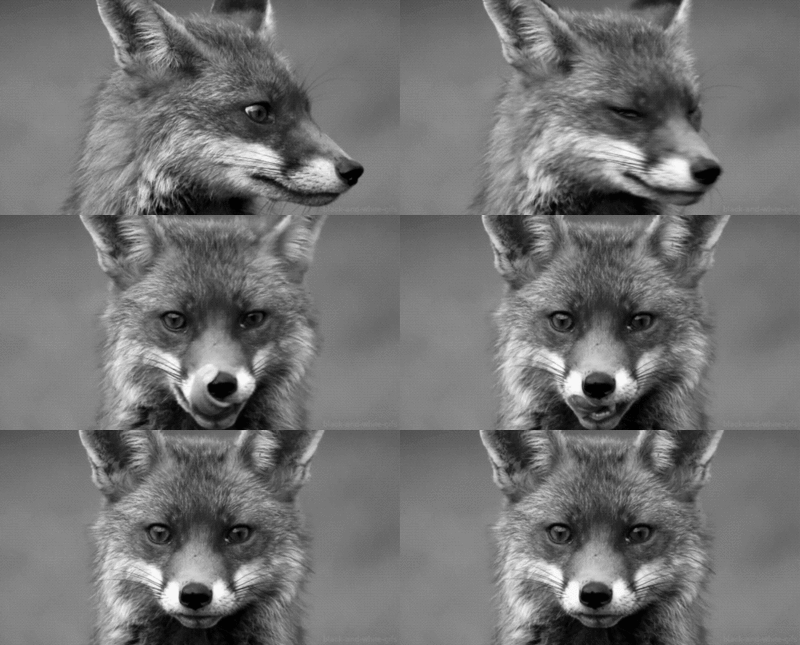
What does the fox say?

Katherine North, aka Kit, is a phenomenaut. In this universe, what that means is that she can project her consciousness to other animals. Basically, her human body is hooked up to a machine that takes care of her vitals while she becomes whatever animal her employer, ShenCorp, has told her to be.

Of course, as is with any corporation in a science fiction kind of world, ShenCorp is up to shady things. Kit is exposed to the shenanigans early on in the novel, but refuses to talk about what actually happened until the second half of the book. Since the book is narrated in first person, this was something that annoyed me until I found out what happened.

The story is told in parallel between the present and future. In the present, we have Kit running away and hiding from ShenCorp, chilling with a fox she's pretty sure she rolled with back in her fox-being days, and refusing to talk about why she's run away in the first place. The past is told via her sharing stories with the fox, or just reflecting on the things that have happened to her in the seven years she's been "jumping."

The first half of the story is taken as an opportunity to build this new world where humans can become almost any type of animal. We get to see Kit at work, live with her through experiences as a fox, spider, and a snake. We get to have the mechanics of how projecting works, how it affects the jumpers, and how Kit and ShenCorp ended up on bad terms.

The second half of the book is where the action is. My main complaint about the story (besides the narrator hiding information from the reader)is how slow the first half of the book went.

Get on with it!

That being said, overall the book was absolutely wonderful. Kit's experiences as different animals were so descriptive I would be absolutely shocked if they weren't as accurate as could be. The writing was all at once beautiful and blunt, hilarious and heart breaking. We went from thoughtful lines such as this:

It still amazes me that consciousness can come from such brute biology, from these tiny individual cells. But perhaps that's the truth of anything: one is nothing, connection is everything.

To hilarious lines such as this (describing Kit's experience as a whale):

The squirt of water from my sphincter feels like a wet fart.

Or when Kit summed exactly why meetings at work suck:

I can't remember her name. Introductions were made at the start of the meeting, yet there is a fungibility to all these smug, beautiful and young-looking faces. And they all turn out the same shit.

5 Stars — The Many Selves of Katherine North took me on a journey that, for the most part, I was expecting, but surprised me along the way with wonderful imagery, characters, and a hero worth cheering for.

Profile Image for Rosamund Taylor.
Author 2 books200 followers
February 3, 2017
Though there were some things I liked about this book, I can't justify giving it more than one star. The title is very clever, and so is the premise: it follows Kit, who can enter the consciousness of different animals and live as an animal. The author clearly spent a lot of time thinking about being different animals, and often she does a good job of creating the sensory world of snakes, foxes, octopuses, or birds. Another aspect that I liked is that Kit has spent so much time being an animal she has become a little like an animal herself: she does wolf-like dominance displays around other people, and prefers to defecate outdoors because she doesn't like to be surrounded by four walls.

There was a lot in this book that was clever and felt authentic, which underlined how BAD the prose is. Every sentence is wooden, there is no characterisation; the use of language is so simplistic that I found it hard to stay interested, and yet the structure of the novel is so convoluted that it's hard to remain engaged in the story. The author is young and is studying creative writing at university -- I have found that certain novels that are particularly clunky and wooden are the product of creative writing students, and there seems to be a very simplistic and superficial style that is being taught to writers at the moment. This book definitely suffers from that. It honestly felt like an early draft of a novel to me: lots of good ideas, maybe too many ideas, and absolutely no characterisation or plot to follow those ideas up.
Profile Image for Rob Forteath.
339 reviews7 followers
July 4, 2016
Very early, this book clearly establishes its genre with:
- an innocent young person doing fascinating, ground-breaking work for The Corporation;
- flash-forward to her on the run from The Corporation, due to some Horrible Discovery that the police won't believe, etc.

Chapters alternate between the two eras for most of the book, with the bits and pieces gradually filled in. There are light mysteries thrown in -- Can she trust The Boy?; Who is the bizarre feral character? -- these add a bit of suspense even though we instinctively know the answers. As the book progresses, it becomes more and more a coming-of-age story about the young heroine, and less and less of a dystopian rebellion; I didn't think that either of these were well handled by the conclusion, which essentially just drifts off into "now everything will be kind of ok while still being crappy because that is reality". I can't argue with that sentiment, but it makes for a fairly 'meh' ending to a novel.
Profile Image for Mike Finn.
1,595 reviews55 followers
July 16, 2020

The premise of this book, teenage children working as "phenomenauts", researching the reality of being a fox or a whale, or an eagle, by projecting their consciousness into constructed versions of the creatures and experiencing their lives in the wild, is so original, that it took me a long time to see that the book is really about a strong but damaged teenager who is, literally, trying to find herself.


At nineteen, with seven years of working for ShenCorp, jumping into the minds and senses of other creatures behind her, Kit North is the world's most experienced phenomenaut.  She loves what she does. She needs to do it. It is fundamental to her sense of who she is.


Kit does not love ShenCorp and what they want to do with her abilities, The book opens with Kit hiding from ShenCorp in the streets and parks of Bristol, hungry, cold and alone. Most of the rest of the novel is spent flipping between that timeline and the events that led up to it.  This structure misled me into thinking that the book is a thriller, but it isn't really, it's a personal journey into memory and identity being made by a vulnerable girl at the edge of her ability to hold herself together.


There was a lot to like about this book. The plot is original and well thought through. The descriptions of Kit's experience of being different animals, perceiving the world through their senses, being driven by their urges, having the joy of their ability to fly or swim or sing or hunt, are beautifully done.


The description of the difficulty of "coming home",  of being just human with all those memories of being yourself in other bodies, is subtle and effective.


The novel captures the corrosive anxiety of not knowing if you can depend on your own perceptions, of being unable to be certain of whether you're paranoid or whether you're being hunted, of whether your sense of self is fractured or simply expanded beyond most people's experience.


There are things in the novel that didn't work well for me. The ShenCorp bad guys are thinly drawn and unremittingly bad without any real explanation of why they behave that way.  The pace could have been tighter, especially if I read this with the expectation of it being a thriller. Sometimes the same facility for complex description that made the animal experiences vivid, clogged up the scenes that were there just to move the plot along.


The ending was well done if this is a book about a personal journey but a little anti-climatic if it's meant as a thriller.


This was an enjoyable read with an original premise but it got a little caught between thriller and personal journey, or, at least, my reading got stuck on that.


Profile Image for Lolly K Dandeneau.
1,933 reviews252 followers
February 23, 2016
"Sometimes a body is all the language you need."

This sounded different from my usual reads, in fact from a lot of reads on the shelves. Teenager 'Kit' is a Phenomenaut , able to jump into the consciousness of lab animals, with the guidance and help of her partner to keep her anchored to her human side. Trouble starts when she begins work for the tourism dept. , where anyone can also jump into wild animals. What is gorgeous about this story is her time being animals, creatures. Emma Green did a fantastic job and has one wild imagination to be able to give the readers a sort of out of body experience, a leap into another being. The story does get strange, but it works.
"The world thrums under my sonar. Below is the fuzzy path of a hedgerow, its leaves a gushing stream; far off is a pinches whisper of houses; to my right the mosquito whine of a pylon. Its spit grows at my approach, so I twitch my fingers into a somersault and the world flips back towards the hedge." Talk about becoming one with nature...
Even if everything goes belly up, and you can never truly understand another creature, or trust your own species- she gets as close as possible. Well done.
Profile Image for Karen Barber.
3,245 reviews75 followers
May 29, 2016
Katherine North spends her life jumping into the bodies/minds of animals, and the company she works for are considering ways to develop their technologies.
Such scientific advances will, naturally, explore ethical considerations and this is quite a leap into the unknown.
There is just enough of reality to keep the reader engaged and able to see the plausibility of the set-up, but it is quite a leap of faith to accept the reactions of key characters.
There's a lot of vocabulary linked to the procedure, and I did find myself wondering what was going on at a number of key moments. If I'm being honest, I never felt connected to the character and this did make it difficult to really settle into the story.
Thanks to NetGalley for the ARC.
Profile Image for Tasha.
219 reviews624 followers
did-not-finish
July 16, 2016
DNF at 28%
I've been trying to read this book for probably two months now but I just cannot get into it. I feel so detached from everything in this book - the characters, the story, the writing.
The blurb of this book sounded quite interesting to me but I just don't think that this book is for me.

I won't be rating this book since I haven't finished it and I don't feel like I could give it a true rating.
Profile Image for Megan.
1,224 reviews69 followers
October 10, 2017
3.5 stars.

This is one of the strangest books I have ever read. You're thrown headfirst into a futuristic Bristol, where, for the purpose of zoological research Kit and her fellow 'phenomenauts' project their consciousness into the bodies of various animals. At ShenCorp, the company that Kit works for, all the phenomenauts are teenagers, with the idea that the younger you are, the more your brain is able to adapt and cope with the constant psychological transitions. At 19, Kit has been projecting for seven years, which is the longest that anyone has been able to without feeling the mental side-effects.

I'm not going to lie, this novel may seem hard to get into, especially right at the beginning. It's both a fascinating world and concept that Geen has created, but there are so many terms she's created that go unexplained, and it's left to the reader to try and gather what they mean from the context in which they're used. And, while the chapters are short, they're told in an alternating timeline between past and present although it is not often that immeadiately clear which timeline you are in (even with the vague descriptions of 'Uncanny Shift' and 'Come Home' at the beginnings of the chapters).

Throughout the novel, it's clear that in the 'present', Kit is on the run from ShenCorp, but it's not revealed why until the end of the novel. One of the problems that I had was that I felt like the reveal and the catching up of the 'past' timeline to the events that take place at the beginning of the 'present' timeline right at the start of the novel took a bit too long to actually happen. The tension and anticipation kept being drawn out to the point that, when it finally did happen, it felt a little rushed and anticlimactic, and not as satisfying as it should have been because I'd had to wait so long.

That being said, I loved the whole idea of the novel, and it raised some interesting moral questions towards the end. Geen has a background in philosophy, and it really shows at various points. It's a strong novel, once you manage to wrap your head around what's happening, and it's one that is guaranteed get you thinking, even long after you've closed the covers and walked away.
Profile Image for Lauren Hinkle.
64 reviews1 follower
June 1, 2016
I'll post my review closer to the release date, but this was such an engaging story. It's always such a pleasure to pick up a debut novel and enjoy it because you know there are many good stories yet to come from the author. Would recommend.
-----Review Update--------------------
Ever since I finished this book, I have, honestly, had dreams at least every other night about being an animal of one sort or another. And I feel like I keep seeing foxes everywhere! Stuffed animal foxes, cute pictures of foxes, references to foxes in other books, it's like I'm being haunted by Katherine North. But I'm totally okay with that! Because I quite enjoyed this book and enjoy being reminded of it and having a chance to bring it up and recommend it to others.

Katherine North has an incredible job. She's a phenomenaut, which means she projects her consciousness into various animals for a day or a week or a month at a time in order to experience life as that animal and further scientific understanding. Wow. Can you imagine? It's a little bit Avatar, but sooo much better.

Katherine is a fox when we first meet her, and this persona becomes very important to her throughout the novel. Katherine is 19 and has been "projecting" since she was 12. The company she works for, ShenCorp, employs children because their brain plasticity allows them to adapt more easily. Unfortunately, it seems that there are some negative effects that come along with projecting, as most teens can only do it for a few years. Katherine is the longest-performing phenomenaut ever.

She is honored by ShenCorp for this accomplishment by being tasked with beginning several important, new, money-making ventures by the company: tourism and human-projection. Katherine finds these horrifying, and it's her response to the new jobs, as well as her mental and emotional experiences as a variety of animals that makes this story really come alive.

I REALLY enjoyed this novel. It continued to surprise me in its applications of phenomenautics and the effects of projecting. Honestly, it didn't even need to take the story beyond animal projections. I was enthralled by Katherine's experiences in various bodies and would happily read a novel that explored that alone. Adding in some political and social concern? Even better!

Katherine spends time as a fox, a spider, a whale, an elephant, a snake, a mouse, a bird, an octopus, and more. And each experience is incredible and unique and shows a different "self" of Katherine and of living things. Have you ever stopped to wonder how having different types of eyes or more limbs or no limbs would feel? Not in the abstract when you simply wish for more arms, but actually consider how disorienting suddenly having different inputs and outputs would feel? That's what Katherine must deal with. And I thought Geen did an incredible job of exploring this.

There's an afterward in which Geen mentions she isn't a biologist and doesn't claim any of this as accurate, and it totally came as a surprise to me. While I was reading the novel I assumed she had at least a bachelor's degree in biology. Her research in animal physiology, interaction, and environment is very evident. It really made me stop to think how I would feel experiencing the things Katherine experiences and how different animals' interpretations of the world are from each other and ours.

And, oh man, I am SUCH a sucker for an unreliable narrator. I hope I'm not giving anything away, because I don't want to claim that Katherine is or isn't unreliable, but as the novel continues you get the sense she might not be trustworthy and might be imagining or exaggerating or misunderstanding what's happening because of other character's responses and actions. It doesn't even matter to me whether she's actually unreliable. Just the hint that I can't totally trust her interpretation spawns a dozen alternate interpretations in my mind and I love that sense of uncertainty!

The background relationships in this story were also very powerful. I liked Katherine's complicated and unsure relationship with her parents. And, shoot, I've got to say it, I ship the romance in this story. Buckley and Katherine's interactions were adorable and painful and frustrating and real. It drew me in!

Katherine was a really great character and she felt very real to me. From her response to public speaking to her emotional confusion regarding her mother to her deep connection to science to her tendency to describe people with analogies to animals (I think I highlighted a dozen such examples, too many to share!), she felt so much like someone over-their-head and someone I'd like to know.

​One last thought: I applaud Geen for making an effort to explain the science behind the book. I kept finding myself wondering where the Ressies come from, how they get transported, how the neural connections work, etc. Not all the answers made me feel totally content, but I'm really glad she at least addressed them.

This novel follows a common pattern of switching back and forth in time between Katherine in the aftermath of her time as a fox and Katherine in the aftermath of, well, a big-bad thing we don't learn much about until most of the way through the book.

Maybe I've just read too many stories (both short and long!) with this format that I'm a bit worn out on it, but it felt a little force to me. I get that it's supposed to build tension and make you wonder about this upcoming Big-Bad, and it does do that. It's just, the whole thing seems to take place in less than a year. I think that organization works best when the two plot lines have a greater temporal or emotional separation.

All and all though, I enjoyed it and would recommend picking it up!
Profile Image for Luke Kono.
273 reviews43 followers
April 28, 2025
✒︎4 stars

The Many Selves of Katherine North was gifted to me by my cousin a while ago. I was hesitant to read it because I was uncertain as to whether I'd like it due to it's obscure concept, but at long last I finally picked up the book...

Our main character, Katherine North, is a phenomenaut. Essentially she can project her consciousness into "Ressies" which are lab-grown living animals. For her seven-year tenure at SehnCorp, she has worked with Ressies for research-purposes. For someone her age, it's amazing that she can continue to project into Ressies without issue; most people can't stay mentally fit to continue projecting for that long, let alone at the age of nineteen. When Katherine is recruited to join a new indenture within the company that is highly commercialized, she becomes dubious of the company's true intentions and whether they care about the ethics of what they're doing at all.

The plot switches between two timelines- the past (pre-Kit leaving the company) and present (post-Kit leaving). I found that the two separate timelines added some mystery and suspense to the storyline. Overall, I really loved the concept in the book. The reader is made to consider animal rights, life, consciousness, reality, and the exploitation all of these concepts by for-profit companies. This book is definitely sci-fi with a bit of speculative fiction, as I could see a reality where "projecting" is actually possible, and no-doubt some company like Amazon would find a way to exploit it for profit. I also enjoyed Kit's character and her backstory.

Beyond that though, the story felt a bit convoluted at times, which other readers pointed out may have been written that way due to Kit's increasing mental instability throughout the book. Regardless, this made the reading experience worse than it could have been. Geen's writing is kind of poetic and figurative at times which I found hard to understand at times, almost like the actions and "stage-directions" of the book weren't well described. The writing felt kind of dissociative, and disjointed. I will admit, I was a bit confuse by the ending as well which may have been a me problem and not the writing, per say, but I wish I could have felt more fulfilled by the ending as I did like most other parts of this book.

Overall, this book had a very strong concept with decent execution. It's a strong debut book by a small-author, so despite my misgivings, I still think it's worth the read.
Profile Image for Leah Bayer.
567 reviews270 followers
April 28, 2016
This is the kind of book that I love: slow, literary science fiction with a focus on animals. So many animals! We've got foxes, polar bears, tigers, seals, snakes, eagles, octopi, even spiders (it was hard, but I read the spider chapter. So proud of myself). The premise is that at some time in the future, humanity has discovered technology that allows people to leap consciousnesses and "live" in animals for extended periods of time. Our main character, Kit, is a phenomenaut who works in animal research.

The worldbuilding here is quite clever. We get bits and pieces of information about this future world, mostly through Kit's animal interactions. While there are some info-dump sections about the technology and Kit's job that seems part and parcel for this kind of novel, and it never felt jargon heavy or stopped the flow of the book.

My favorite aspect here was by far all of the descriptions of what it was like to inhabit these alien animal bodies. Emma Geen did a great job of making it seem very realistic: it's not glamorized or idealistic, and it's often quite scary. But we get moments of pure wonder (especially the eagle and tiger jumps) that made me want to be a phenomenaut so bad. The writing is really beautiful and fluid, and if anything I could have used more descriptive animal-life sections. Especially a housecat one. I wanted more kitty action.

While I loved almost everything about The Many Selves of Katherine North, I did get hung up on one aspect. There are two kind-of-mystery elements: the true purpose and devious intentions of the company Kit works for, and the strange presence that she thinks is following her during her jumps. One of these is resolved but the other is kind of left hanging. I found the last 15% really unsatisfying compared to the rest of the book. Honestly, up until then this was a 5-star read for me. I still enjoyed it, but all the loose threads and unresolved feelings kind of got to me.

[arc provided by netgalley in exchange for an honest opinion]
Profile Image for fromcouchtomoon.
311 reviews65 followers
February 19, 2017
A YA exploration of self in the context of other bodies and out-of-body. A very interesting premise with compelling relationships and tantalizing sensory information from animal perspectives, but it loses its sophistication in the YA form becomes unconvincing when evil boss and sketchy coworker and sketchy CEO scientist spend way too much time trying to maneuver this girl around in what's an obvious lost battle. Big bosses don't convince, they replace and move on.
Profile Image for Peter Reason.
Author 15 books12 followers
January 4, 2017
I loved the imaginative near future context of this novel, the way Emma Geen portrayed the experience of different animals, and the complex plot that unravels through the book
Profile Image for mad mags.
1,276 reviews91 followers
May 28, 2016
How do you say "AMAZING!!!" in bottlenose dolphin?

One. Mustn’t trust humans too much.
Two. I know what they can be like.
Three. I was one once—

###

How can they sell Phenomenautism as image and experience? How can they sell it at all? A Ressy isn’t a consumable. Phenomenautism is meant to consume you.

###

Buckley always said that reading is the closest an ex-phenomenaut can get to wearing another skin.

###

The year is 2050, or close enough, and while humans aren't yet locomoting via our own personal jet packs, we have developed all sorts of cool technology. Chief among them? Phenomenautism, which involves projecting one's consciousness, using a neural interface, into the bodies of other animals.

At just nineteen years old, Katherine "Kit" North is the longest projecting phenomenaut in the field, with seven years under her belt. She was recruited to join ShenCorp - whose founder, Professor Shen, all but invented phenomenautism - when she was a kid. Kit's Mum was a zoologist and her father, a wildlife photographer, so an affinity for our nonhuman kin runs in the blood. Kit works in the Research division, inhabiting the bodies of nonhuman animals to aid outside companies and nonprofits with their research; for example, as a fox Kit helped track the local population for a cub study orchestrated by the Fox Research Centre. She's been a bee, a whale, a polar bear, an elephant, a seal, a mouse, a spider, a octopus, a tiger, and a bat, not to various species of birds. Very rarely does she get to be herself - although that's not necessarily a bad thing. Nor is she quite sure what that means anymore.

ShenCorp is the only company to employ children exclusively, owing to their superior brain plasticity, which aids in adapting to the new bodies ("Ressies") they inhabit during jumps. As Kit watches her friends and peers disappear, one by one - let go for poor performance - she worries for her own future. When she's hit by a car inRessy - destroying the body and ending her study prematurely - termination seems imminent. Yet instead of a pink slip, her boss offers her a promotion, of sorts: to the new Tourism division, where the "animal experience" is sold to regular folks - for a hefty sum, natch. Kit finds the idea of Consumer Phenomenautism repugnant ... yet not quite as bad as giving jumping up altogether. Kit accepts, unwittingly stumbling into a corporate conspiracy that runs far deeper that she imagined.

I was so nervous about this book, y'all. On the one hand, the concept sounded incredible: seeing the world through the eyes (and nose and mouth and ears and whiskers) of other animals! I mean, how cool is that? And the potential for an animal-friendly, anti-speciesist point of view - in understanding that there are multiple ways of experiencing the world; acknowledging that all animals have unique, valuable, and worthwhile skills; in simply recognizing nonhuman sentience; and in encouraging empathy for those who are like us in all the ways that matter - is incredible.

And yet, as an ethical vegan, I find animal research morally indefensible. (Not to mention often wasteful, redundant, and downright misleading.) Given that the synopsis is rather vague about these "lab-grown animals" Kit and her peers inhabit, I worried that I might not care for the particulars of phenomenautism. If it's considered acceptable to subjugate nonhuman animals - forcing them to reproduce (or stealing their DNA for cloning), keeping them in captivity, and then using their bodies without their consent - then I'm afraid that phenomenautism's ultimate goal of "understanding animals" would be so much bullshit. How could we possibly exploit whales or grizzlies or dolphins when we know that to do so causes them suffering? That our own research tells us so?

Unless we're simply monsters - a sentiment with which Kit might very well agree.

As it turns out, I hemmed and hawed and wrung my hands over reading The Many Selves of Katherine North for no reason: Geen is surprisingly sensitive to the welfare of animals, though the book isn't without a few flaws in this regard.

It's a little misleading to say that the Ressies are lab grown; rather, they are lab printed, by a futuristic 3D printer that (re)creates organic matter. After they're done, the Ressies are kept in stasis in the BioLab until ready for use (and they are reused over multiple jumps, until the body is irreparably damaged). The Ressies have "no CNS, nothing higher than a thalamus, all in keeping with the ICPO standards," though they are outfitted with "inbuilt movement package[s]" to help phenomenauts adapt more quickly. As far as I can tell, the Ressies are closer to empty shells than sentient animals: hardware just waiting for the software to be downloaded (or projected, as it were). Of course, it probably took a shit ton of animal research to get to this point, but the Ressies in and of themselves don't seem to involve animal suffering.

What Kit does - and her specialization is in studying endangered animals, which is awesome - is more akin to observational (and possibly experiential) research than anything else: tracking cubs in a population study; counting the number of octopi near an oil rig; figuring out the mechanics of weaving a web, in order to help spiders negatively impacted by a certain pesticide.

This does come with its own set of problems, as the researcher's actions - or even her very presence - can alter the behavior of her subjects. We see this with Tomoko, the fox cub Kit was forced to leave behind when her body was killed, hit by a car, inRessy. Tomoko had been relying on Kit to protect, feed, house, and teach her; Kit's absence was a huge blow. Had she not entered Tomoko's life at all, she might have found a more stable adult to lean on. Or maybe not. We'll never know.

Of course, the Ressies do require regular, species-appropriate maintenance to stay operational. For carnivorous animals, this includes the consumption of meat. (Is it morally acceptable to kill some animals to feed a "tool" that helps other animals?) In Kit's case, this necessity introduces some trippy, identity- and empathy- bending conundrums. While testing a polar bear Ressy, Kit recognizes that the body is hungry, and she must feed it to keep it working. Seals are a popular polar bear snack, and yet ... Kit was once a seal, too!

"The chase sags from my shoulders. A taunt of its scent lingers on the breeze. Even here, even as a polar bear, I can remember the sensation of water over sleek skin. How can what I once was become my food? My guts growl in disappointment. Of course, I knew that seals are the staple polar bear diet, but I hadn’t fully faced what it would mean to eat one."

From prey to predator, what's a girl to do? (A: Leave it to the next phenomenaut to feed the Ressy. Moral conflict, avoided.)

Following this logic, Kit's disgust at Body Tourism isn't on behalf of the Ressies so much as the areas in which they operate: the lives and homes of living, breathing, thinking, feeling animals. Kit and her peers have received years of training, and for them, phenomenautism isn't a fun experience to be bought and sold. It's a way of life, a career, a passion. Phenomenauts is what they are, not what they do. Just as the field holds great potential for improving the lives of animals - both individuals and species - so too can it wreak great destruction when used carelessly or callously (as we see below).

On the other end of the animal philosophy spectrum, Geen introduces "pro-lifers" who want to "liberate" the Ressies. Whether they're animal rights "nuts" or religious fanatics who dislike it when scientists play God, we'll never know, since the plot is so sub that it's only brought up twice, maybe three times. If it's the former, I really resent being lumped in with anti-choice extremists through the use of such terminology; while anti-choice vegans do exist, to me infringing on a person's bodily autonomy is incompatible with an ethical vegan philosophy. Plus, if the Ressies are really just non-sentient shells, what's the problem? Make us seem irrationally knee-jerk in our response, why dontcha?

[Updated to add: The author saw my review and offered this clarification on twitter, which is pretty rad.

@vegandaemon btw, the pro-lifers are religious protesters who attack phenomautism on the grounds that Ressies are technically alive

— Emma Geen (@EmmaCGeen) May 28, 2016


@vegandaemon & therefore precious to God, regardless of whether they're conscious/feeling or not, hence same name as real-world pro-lifers

— Emma Geen (@EmmaCGeen) May 28, 2016



Thank you, Emma!]


Also, Kit's mom was a zoologist who loved animals. And she loved going to the zoo ... where animals are confined to cages just a fraction of the size of their natural habitats; forced to breed and then separated from their families; treated like exhibits instead of individuals; develop stereotypic behaviors and even psychosis (so common it has a name, zoochosis); and sold and/or killed when they no longer attract eyeballs. Zoos are awful places, both to animals and those who care for them.

(Actually, it's kind of interesting that Geen raises the specter of zoos, if only in passing, in light of Buckley's defense of Body Tourism: namely, that the experience of wearing another's skin will lead to an increase in empathy towards animals. This is one of many arguments given in defense of zoos, yet studies - not to mention casual observation; how many times have you witnessed visitors taunting the captives? - suggest that this isn't necessarily so.)

In summary: The Many Selves of Katherine North is what I'd call animal-friendly fiction. Not explicitly animal rights, but something ethical vegans could maybe get behind. Certainly less objectionable than 99% of the fiction out there. "Pleasantly surprised" doesn't even begin to cover it; The Many Selves of Katherine North is right up there with Rachel Vincent's Menagerie with books that knocked me for a vegan loop.

As for the rest of the book - plot, pacing, characters, world-building, potential for real-world moral implications - it's just spectacular. Let me put it this way: the ARC I read was littered throughout with random +1s and -0s, yet I was so engrossed in the story that they quickly faded from view. Geen held my attention and did. not. let. go.

The "thriller" aspect of the story is, paradoxically, low-key as far as thrillers go (Bourne this isn't!), and yet surprisingly rich and layered. Kit's efforts to infiltrate ShenCorp mostly involve hiding in the bushes outside the Center and stealing sammies from Buckley's cubicle rather than orchestrating an Oceans 11-type heist. Yet ShenCorp's new Tourism project - as awful as it promises to be - is just the tip of the iceberg.

** Caution: spoilers ahead! **

ShenCorp hopes to introduce home phenomenautism kits within the next decade - letting tourists loose in other animals' habitats without a professional phenomenaut to mitigate the damage. Which is pretty extensive: in Kit's guided tours, one blogger, dressed as a tiger, slowly throttled a boar to death - just for funsies (he didn't consume the body, nor did he eat the other boar Kit had killed in anticipation of his arrival). Later on, a tourist named Britta, inhabiting the body of a very aroused male elephant, invaded a herd of females, losing her footing and falling on and killing a calf in the process. But she offered to pay for the damage, so it's okay! (Not.)

Already in production: human Ressies, including a (very convenient) doppelgänger of Kit herself, made without her knowledge or consent. When she granted ShenCorp the legal right to use her likeness, she didn't count on exact copy.

The fourth layer in this ethical clusterfuck cake? A decades-long coverup of the deleterious effects of projection on children. It seems the asking kids to become other animals during a critical time in the development of their own self-identity? Not such a hot idea after all!

** end of spoilers **

Set in a not-so-distant future that's not too different from our own, The Many Selves of Katherine North introduces some rather exciting - and scary - what-ifs that make for compelling thought experiments. How can a human explain the subjective experience of another animal when our language, which evolved around our bodies, lacks the right words? Does the ownership of your identity extend to Ressies (Clones? Robots?) that wear your face? What is our ethical responsibility, if any, to the Ressies we inhabit - and the spaces they invade? Can phenomenauts fully hold onto their humanity after inhabiting the bodies of nonhuman animals ... and, if not, is this necessarily a bad thing? There is such fertile ground here!

The characters are equally complex and richly layered - particularly the phenomenauts, as their careers affect them, transform them, leave an indelible mark on their very selves. Many of the phenomenauts comes across as socially awkward, yet this phrase hardly begins to describe it. After weeks, months, sometimes even years living as other animals, many phenomenauts adopt a very non-human way of approaching the human world: engaging in threat displays when challenged, sleeping in dens, relying on senses other than sight (and then becoming frustrated by the many glaring deficiencies of the human body). It's fascinating to watch, and makes Kit's tenuous relationship with Buckley, an ex-phenomenaut and her neuroengineer, that much more compelling.

Geen's world-building, at least as it relates to the tech (the rest of the world is more or less recognizable as our own), is sensational. I loved learning about the "science" behind phenomenautism, the terms and phrases and slang, not to mention the many ways it can affect/be affected by the kids actually doing the jumping. Geen challenges her readers to imagine the world as it's perceived by other animals; these "stranger in a strange land" moments are among my favorites in the book.

Honestly, it's just fabulous. I could go on all day (and I think I already have!).

Read it if: you like a) animals; b) mind-bending speculative fiction; c) philosophical questions; d) Daiya cheese and Beast Burgers.

http://www.easyvegan.info/2016/07/08/...
Profile Image for Anna.
612 reviews23 followers
February 7, 2018
A very interesting book. I got into the story almost straight away in the "but what happens next!" kind of a way, and then in the middle (or maybe a bit later) got annoyed by the foreshadowing that was done in a way that even a 2-year-old got the idea. Several times. "But now I know what he is really like, because I just know, did I say I knew already?!"

But other than that it was a very good book. It made me think about our world in a different way, and, for a book that seems to be mostly about animals, included a lot of humanity and human issues. Hard to talk about anything much without spoiling it all, really. One of those books where the relatively vague blurb is a good idea, as the more you know, the less you will be surprised by it.

That being said, the ending was a bit of a let-down for me. It wasn't bad, but it also wasn't what I was hoping to see. That is just a me problem though, being more interested in the big story than the characters and what happens to them.

A good book. Waiting with interest to see what else she is going to write, as this is a debut book.
Profile Image for Karoliina.
87 reviews13 followers
December 13, 2018
Kit's story is very tightly and neatly woven together, almost to the point of being a little too nice and tidy. The writing is very goal-oriented, and there are moments in this book that could do with a little bit more room to breathe. That goal-orientedness of the story leaves the characters a little flat, although this was less of a problem when listening to the audiobook because Katy Sobey's confident narration adds a lot of personality to the main character.

The concept of the novel is wonderful though and really brilliantly executed. The attention to detail and the vivid descriptions of different animal experiences ground the far-fetched visions of our future and make them believable. Furthermore, the underlying environmentalist message makes it exactly the kind of sci-fi I like to read.

Profile Image for Allie Riley.
508 reviews209 followers
March 10, 2018
Proper review to follow tomorrow when I have clarified my thoughts. Fascinating novel which raises a lot of important questions. There was much that was disturbing here, too. I felt that the future presented here-in was dystopian in nature, really, even if the author didn't intend that to be the case (and I suspect not). While it would be interesting to project into an animal, to "wear their skin", ultimately I felt that it was wrong and would be, as is speculated here, psychologically damaging. I don't know how this can be squared with the fact that it would obviously be right and valuable to gain the perspective of other animals in terms of conservation, ecological responsibility and so forth.
Profile Image for Nathaniel.
Author 33 books282 followers
September 17, 2020
Hands down the coolest, most confusing, and most entertaining sci-fi adventures I have had recently.
Emma Geen covers a topic here that I think could make a great movie. What if humans could put their mind into animals and become them for a little while? This could help science study animals. It could also become tourism. This is such a real take on it, going through the pain, the struggle, and the psychology issues that can arise with switching bodies constantly. By the end of the book I felt so bad for the main character but also very hopeful. I highly recommend this book.
Profile Image for Dianne Wolfer.
Author 40 books35 followers
Read
October 3, 2021
Wow! Loved the concept of this book and the sensory exploration of how it 'feels' to be various animals (fox, octopus, snake, elephant...) was fascinating. Plus it's also a bit of a thriller which is a fun genre mix-up ... Slow in a few places in the second half but loved it nonetheless.
Profile Image for Jamie Wallace.
24 reviews9 followers
September 10, 2016
I have just finished listening to the astonishing debut of author Emma Geen. I wish I could remember who first told me about the novel, The Many Selves of Katherine North, because I would like to send that person a thank you note.

The reviews on this book use words like exhilarating, horrifying, compelling, and riveting to describe the story of a girl named Kit who is a phenomenaut – someone whose consciousness is projected into the bodies of lab-grown animals for research purposes. Readers quoted on her website refer to the book as a "literary thriller," "spine-chilling science fiction," and a "compulsively readable sci-fi thriller," but I like Havi Carel's description best, "Geen weaves together philosophy and science fiction to create a magical, intelligent and intense novel."

I was initially drawn to this book because I was intrigued by the idea of humans being able to project themselves into the lives of other animals, and I was not disappointed. While Geen's disclaimer at the end of the book makes it clear that she is not a zoologist, she is nonetheless able to transfix her readers with the way she describes life as other creatures: fox, spider, whale, eagle, tiger. Her immersion into these other lives goes beyond the physical perceptions and sensations. When Kit slips into another body, she also slips into another set of emotions and impulses. It was a fascinating and thought-provoking shift in perspective.

While I was definitely carried along by the story (even becoming so caught up in the last few chapters that I abandoned my Friday afternoon deadlines and surrendered to a half hour of dedicated listening in the middle of the day), as a writer, I was also impressed by Geen's prowess with both structure and language. Though I already own the audio version of this book (which was, by the way, beautifully narrated by Katy Sobey), I may end up purchasing a hard copy of the book. I want to be able to leaf through the pages so I can better understand the way Geen built the story, and there are probably (no lie) hundreds of passages that I'd end up underlining for future reference.

Kit's narrative bounces back and forth between two timelines – present and past – that eventually converge. To add to the complexity, much of the story takes place while Kit is projecting as other animals. Despite all this bouncing around in time and place and body, the story hangs together in a way that's easy to follow. Geen does an excellent job of creating a pattern of rhythm and context that makes it easy for the reader (even one who is listening as I was) to stay in-step with the story.

And then there is Geen's use of language. Had I been reading this as a print book, I would have had to keep a pencil with me at all times so I could make notes in the margins on every other page. In Geen's hands, something as simple as describing looking out onto the day turns into poetry, "I wake to the sky flashing lilac. Thunder follows soon after, a sound like the foundations of Heaven grinding loose. The silvered gleam of rain and vegetation writhes against the dark."

Coming back to theme, I once again have to agree with Havi Carel's assessment that this book is as much about philosophy as it is about science fiction. Or, perhaps, the two are so closely related as to be much the same thing. At any rate, I found this book to be a powerful catalyst for musings on what it means to be human, how we define self, the relationship between humans and animals, the relationships between humans, and how we perceive our lives. As deep as Geen dives into these waters, taking us along for the ride, it's clear to see that there are depths still waiting to be explored. The Many Selves of Katherine North is an invitation to sink a little further into the darkness in search of the light.

Originally posted on https://nhwn.wordpress.com/2016/09/10...
Displaying 1 - 30 of 166 reviews

Can't find what you're looking for?

Get help and learn more about the design.