Jump to ratings and reviews
Rate this book

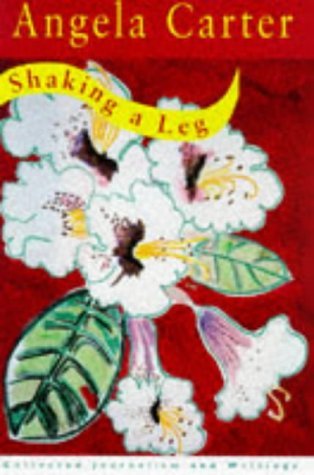
Shaking a Leg: Journalism and Writings

Rate this book
The third volume of Carter's essays and journalism which follows her from the 1960s onwards as she explores new territories and overturns old ideas. The material is derived from sources such as student magazines, "New Statesman", "Nova", "Vogue" and the "London Review of Books"

642 pages, Hardcover

First published January 1, 1997

25 people are currently reading
1029 people want to read

About the author

Angela Carter

212 books3,717 followers
Born Angela Olive Stalker in Eastbourne, in 1940, Carter was evacuated as a child to live in Yorkshire with her maternal grandmother. As a teenager she battled anorexia. She began work as a journalist on the Croydon Advertiser, following in the footsteps of her father. Carter attended the University of Bristol where she studied English literature.

She married twice, first in 1960 to Paul Carter. They divorced after twelve years. In 1969 Angela Carter used the proceeds of her Somerset Maugham Award to leave her husband and relocate for two years to Tokyo, Japan, where she claims in Nothing Sacred (1982) that she "learnt what it is to be a woman and became radicalised." She wrote about her experiences there in articles for New Society and a collection of short stories, Fireworks: Nine Profane Pieces (1974), and evidence of her experiences in Japan can also be seen in The Infernal Desire Machines of Doctor Hoffman (1972). She was there at the same time as Roland Barthes, who published his experiences in Empire of Signs (1970).

She then explored the United States, Asia, and Europe, helped by her fluency in French and German. She spent much of the late 1970s and 1980s as a writer in residence at universities, including the University of Sheffield, Brown University, the University of Adelaide, and the University of East Anglia. In 1977 Carter married Mark Pearce, with whom she had one son.

As well as being a prolific writer of fiction, Carter contributed many articles to The Guardian, The Independent and New Statesman, collected in Shaking a Leg. She adapted a number of her short stories for radio and wrote two original radio dramas on Richard Dadd and Ronald Firbank. Two of her fictions have been adapted for the silver screen: The Company of Wolves (1984) and The Magic Toyshop (1987). She was actively involved in both film adaptations, her screenplays are published in the collected dramatic writings, The Curious Room, together with her radio scripts, a libretto for an opera of Virginia Wolf's Orlando, an unproduced screenplay entitled The Christchurch Murders (based on the same true story as Peter Jackson's Heavenly Creatures) and other works. These neglected works, as well as her controversial television documentary, The Holy Family Album, are discussed in Charlotte Crofts' book, Anagrams of Desire (2003).

At the time of her death, Carter was embarking on a sequel to Charlotte Brontë's Jane Eyre based on the later life of Jane's stepdaughter, Adèle Varens. However, only a synopsis survives.

Her novel Nights at the Circus won the 1984 James Tait Black Memorial Prize for literature.

Angela Carter died aged 51 in 1992 at her home in London after developing lung cancer. Her obituary published in The Observer said, "She was the opposite of parochial. Nothing, for her, was outside the pale: she wanted to know about everything and everyone, and every place and every word. She relished life and language hugely, and reveled in the diverse."

Ratings & Reviews

What do you think?
Rate this book

Friends & Following

Create a free account to discover what your friends think of this book!

Community Reviews

5 stars
120 (42%)
4 stars
118 (42%)
3 stars
30 (10%)
2 stars
9 (3%)
1 star
3 (1%)
Displaying 1 - 23 of 23 reviews
Profile Image for Warwick.
Author 1 book15.3k followers
March 11, 2018
‘Books about books is fun but frivolous,’ Angela Carter once said to an interviewer – which just goes to show that she, unlike most, was capable of proving herself wrong. This collection of her reviews, essays, articles and general criticism is definitely fun but far from frivolous – on the contrary, having it all here in one brick-sized articulation gives it the contours of quite a serious cumulative argument, one focused on the intersection of eroticism, feminism, intellectual frustration and dry wit. And it's useful to have it. I always liked the baroque, oneiric oddness of her fiction, but I never quite understood what argument or philosophy was motivating it. Now, I feel like I do.

Carter was born in 1940, the year after Germaine Greer and Margaret Atwood, and one way to think about her is to recognise that she, like them, grew up imbibing and driving and reshaping the same intellectual currents of second-wave feminism and power politics. (If only she, like them, had also lived long enough to make bloody-minded comments on the latest iterations of the gender debates.) Feminism is, for her, not so much a political position as an inherent facet of her common sense, and when you read Angela Carter on gender issues (which is an utter joy), you never feel that she's writing to work out some animus against anyone.

Rarely, in other words, is she interested in facile attributions of blame. Instead, her basic position is one of bemused frustration, which she makes seem incredibly productive. Surveying the profusion of women's magazines, for instance, she examines the photo-strips and romance tips confusedly, before concluding:

It is as if marriage functions as the sexuality of women. It occupies the imagination of these magazines to the same obsessive extent that sexuality itself does in the tit mags. Perhaps, like the tit mags, these magazines do not truly reflect the central preoccupations of the readers.


This is a theme she develops in several pieces – nowhere more thrillingly than in a virtuoso essay called ‘Alison's Giggle’ which she wrote in 1983 for a book called The Left and the Erotic. The essay's title comes from an incident in The Miller's Tale where, if you remember, a cheating wife sticks her bottom out of the window and contrives for her cuckolded husband, who is confused by the darkness, to kiss her arse. This makes Alison the wife giggle – as Chaucer tells us (‘Tehee! quod she’).

Carter takes this bawdy heroine as a foundational example in English literature of ‘the assumption that men and women share an equal knowledge of the basic facts of sexual experience’, an assumption that lasts ‘up until, curiously enough, that very time in the eighteenth century when women in significant numbers take up their pens and write’. It's a thesis she follows through Austen, Eliot, Colette, and up to Doris Lessing and Jean Rhys, full of fascinating detours and pointed conclusions on how women are treated in literature.

But at least Alison managed to get herself fucked by the man of her choice, to her own satisfaction and with no loss of either her own self-respect or the respect of her male creator, which is more than a girl like her will be able to do again, in fiction, for almost more than half a millennium.


Though fair-minded and full of humour, she is especially fun to read when she does take exception to something. She opens a review of Arthur Marwick's Beauty in History by noting drily that the author

certainly knows what he likes and a fitting subtitle for Beauty in History might be: ‘Women I have fancied throughout the ages with additional notes on some of the men I think I might have fancied if I were a woman’.


Carter pauses to ponder, uncensoriously, ‘the way in which appearance functions as a kind of visible sexuality for women’; then, with that hanging in the air, she turns her attention back to Marwick's approach. Ruthlessly unpicking the prurience underlying his book, and quoting him to devastating effect (‘Twiggy, with her 31-inch bust, had beautiful, small but perfectly proportioned breasts, as can be seen from the photograph of her in a bikini reproduced III, 116’), Carter summons up a sort of dismissive indulgence which is more withering than any denunciation:

There is something almost – but, again, not quite – touching about the boyish enthusiasm Professor Marwick evinces towards his subject. There are whole pages off which one can feel the acne rise.


Christ! One pictures Professor Marwick limping towards the nearest burns centre…. In real life (she says, in the introduction to Expletives Deleted), she is ‘notoriously foul-mouthed’, and spent a lot of time when writing reviews struggling to translate her initial reactions (‘bloody awful’, ‘fucking dire’) into more high-minded language. The results are impressive.

Of course, it helps that the range of her interests is so broad – in here is everything from travelogues of Japanese fertility festivals, through reviews of Bertolucci, to a Bob Dylan gig in 1966 (‘thin and black-clad and linear, a Beardsley hobgoblin’), from thoughts on fashion and cooking, all the way to explorations of fanzines and an investigation into the ethics of HP Lovecraft's horror stories (in which ‘Evil is…it is not what men do’).

She was a powerhouse, and this collection – huge but still not complete – makes you miss her voice more than ever. No one has really replaced her, and indeed, reading through Shaking a Leg, you wonder how anyone could.
Profile Image for Zanna.
676 reviews1,084 followers
February 5, 2015
I don't always agree with Angela Carter, but I adore her (similarly, I am very glad that the contemporary fiction by other women that Carter made more publishable exists, though I do not always want to read it). I wish I'd known her! She is like the friend who rescues you from the abyss of loneliness. She always writes with the distinctive combination of generosity to her audience, scintillating wit and uncompromising forthrightness that makes her fiction such a feast, like a dinner party with a charismatic and considerate host.

This fat volume took me two weeks to read. I'm a soup-to-nuts person and I struggle not to eat everything on my plate whether I want it or not; less obsessive readers (like my mum) might find this book fun to dip into, or read one piece a day - there are about 145. The book is equipped with a helpful index, so certainly amenable to browsing.

Carter's analysis is sometimes so mercilessly acute it makes your eyes water. She cuts through any and all stuff and nonsense like a hot machete through a block of margarine, and she squashes snobbery underfoot, along with the agents of patriarchy. D H Lawrence, so often lauded for 'understanding women' (my eye! His contemporary and close acquaintance Katherine Mansfield saw through the ruse), gets no quarter; especially in 'Lorenzo the Closet Queen' in which his fascination with women's clothing is ridiculed (and exposed as a device mistaken for insight). Her piece on Gone with the Wind 'The Belle as Businessperson' offers razor sharp critique, deep understanding of the appeal, and consoling feminist wish-fulfilment.

Her insight is often strikingly original and thought-provoking. Her essay on Playgirl style male pornography is very funny, but goes much further then laughing at absurdly nude sky-divers. Carter points out the contrast between female and male nudes in European-Christian art history - while a woman has only to take off her clothes to step into a time honoured (though obviously problematic) role, the male nude is historically a tormented dead or dying martyr, and to avoid evoking such imagery naked men must look alive even at the cost of looking kitsch. Of course, we can go right back to the ancient Greeks, but with them the male nude is unacceptably homoerotic. So, while women wield such influence and control as they have unveiled, men's power is in their clothes, in their status; without them they are ridiculous, like the emperor in the story. Carter points out that this tale would have a wholly different meaning were the empress to walk out naked: her appearance would be read as an audacious flaunting of erotic power.

Carter disliked the idea that her writing had a 'mythic quality' because '[myths are] extraordinary lies designed to make people unfree'. 'I'm in the demythologising business' she asserts, and she describes The Passion of New Eve as an anti-mythic novel. The unwriting and rewriting of myth is, I guess, her speciality as a feminist writer. In contrast, she seems to savour vernacular and folk culture everywhere, not 'eating the other' as a coloniser (she is too aware generally to fall into that mode - she is in that minority of white writers who own their privilege and think critically about whiteness) but deconstructing, reweaving, reflecting. 'Folklore is a much more straightforward set of devices for making real life more exciting and is much easier to infiltrate with different kinds of conciousness' This sensibility gives bite and clarity to writing on Japan, where she lived for a while. She is at once richly appreciative of, fascinated by, some aspects of her experience in Japan, such as irezumi tattooing, and resistant to the mythologyzing exotification of Japan that Westerners normally indulge in. She writes about Yukio Mishima as a fascist - she is not seduced. Her travel writing on all places is amusing, illuminating, idiosyncratic.

In the omnivorousness of her interests, and especially her folklore fancies, Carter reminds me of Cerys Matthews, who, I feel, is gentle and generous, and sometimes gleefully ascerbic in her lyrics. Matthews also seems to manage the difficult act of avoiding being contained in a gendered box as a public figure. If you love Angela, I advise you to look up Cerys' radio show.

My favourite piece of the collection is, I think, 'Alison's Giggle'. I have never made the effort to read Chaucer, though I once heartily enjoyed observing (and participating in - the teacher allowed me the indulgence of reading the final product in a USian accent, to the kids' delight) a year 8 lesson in which we translated a comic excerpt into modern English and then a south USian dialect, so reading this was an illumination. Carter uses The Miller's Tale as a jumping off point to discuss the changing representations of women's sexualities in literature. In many ways, it was largely downhill from Alison for several hundred years, but thanks to Carter and a clutch of others, not entirely without exception.
Profile Image for Jean-Luke.
Author 3 books482 followers
July 27, 2024
Shaking a Leg collects the nonfiction of Angela Carter, but some of it (most of the pieces comprising the 'Body Language' section) need not have been reprinted. These pieces are largely reviews of works of now obscure nonfiction which reflect Carter's own experiences and interests—sex, feminism, food, anorexia, fashion. From the memoirs of Linda Lovelace to the cookbooks of Elizabeth David, of whom she is a fan.

There's a section of autiobiographical essays—Scottish father, English mother—as well as sections roughly centered on travel/culture (even the 'local' pieces are interesting), literature—she hate-loved DH Lawrence—and performing arts/entertainment. There's a deliciously savage take-down of Gone with the Wind and a Myra Breckinridge-like disgust with television, a medium she later comes to embrace and appreciate.

When I lived in Japan is a common refrain (her essays on Japan are a hightlight) and, because the pieces were written for varying publications, there is a good deal of overlapping/repetition, with whole phrases sometimes being recycled verbatim. When she refers to a person or subject on which she has previously written something, the advantage of a carefully arranged collected works—which should never be published just for the sake of it—is most apparent. Often sprawling and almost overzealous in scope, her nonfiction is always authentically Angela.

However, once one has obtained the nobs' interest, how is one to maintain it? Since the nobs make fame. Fame is infectious; you catch it by mixing with famous people. But you need to keep them continuously interested until you yourself are the infectiously famous one.

The Mother Lode - 5
My Father's House - 3
Sugar Daddy - 4
Notes from the Maternity Ward - 3
Fools Are My Theme - 4
Notes from the Front Line - 3
Anger in a Black Landscape - 5

Fleshly Matters - 5
Fat Is Ugly - 5
A Well-Hung Hang-Up - 4
Health on the Brain - 4
Georges Bataille: Story of the Eye - 3
Edward Shorter: A History of Women's Bodies - 3
EricRhode: On Birth and Madness - 3
Food Fetishes: The New Vegetarians - 3
Saucerer's Apprentice - 4
Jessica The Anthropologist's Cookbook - 3
Food in Vogue - 3
Elizabeth David: English Bread and Yeast Cookery - 4
An Omelet and a Glass of Wine and Other Dishes - 3
Patience Gray: Honey from a Weed - 4
Dressing Up and Down - 3
The Wound in the Face - 4
Trouser Protest - 5
Year of the Punk - 4
The Bridled Sweeties - 4
Ted Polhemus and Lynn Proctor: Fashion and Anti-Fashion - 3
David Kunzle: Fashion and Fetishisms - 3
The Recession Style - 4
Lou Taylor: Mourning Dress - 5
Elizabeth Wilson: Adorned in Dreams - 4
Roland Barthes: The Fashion System - 3
Arthur Marwick: Beauty in History - 5

What the Hell - It's Home! - 4
Fin de Siecle - 4
The Boss Has His Day - 5
Bath, Heritage City - 5
What the Hell - It's Home! - 4
The Donnie Ferrets - 5
The Paris of the North - 4
D' You Mean South? - 4
Poets in a Landscape - 5
So There'll Always Be an England - 4
Masochism for the Masses - 4
Michael Moorcock: Mother London - 3
lain Sinclair: Downriver - 3
Travelling - 5
The Back of Beyond - 5
Triple Flavour - 5
Wet Dream City - 5
A Petrified Harvest - 5
Bread on Still Waters - 5
Munch and Antibiotics - 5
Constructing an Australia - 4
Japan: Tokyo Pastorals - 5
People as Pictures - 4
Mishima's Toy Sword - 5
Once More into the Mangle - 5
Poor Butterfly - 5
Death in Japan - 4
A Fertility Festival - 4
Murasaki Shikibu: The Tale of Genji - 4
lan Buruma: A Japanese Mirror - 3
Junichiro Tanizaki: Naomi - 3
Amerika: Tom Wolfe - 4
That Arizona Home - 3
Snow-Belt America - 4
The Rise of the Preppies - 3
Anne Campbell: The Girls in the Gang - 5
Edmund White: The Beautiful Room Is Empty - 5

Animalia - 4
Animals in the Nursery - 4
In the Bear Garden - 5
Little Lamb, Get Lost - 3
All Creatures Great and Small - 3
Now Is the Time for Singing - 5
Bob Dylan on Tour - 3
A Busker (Retired) - 4
The Good Old Songs - 5
Giants' Playtime - 4
Wagner and the Mistral - 4
Fun Fairs - 3
Carlos Moore: Fela Fela - 3
Phyllis-RQs.EJazz Cleopatra - 4
Screen and Dream - 4
Japanese Erotica - 3
Much, Much Stranger than Fiction - 5
Bertolucci: La Luna - 4
Hal Ashby: Being There - 3
The Draughtsman's Contract - 3
The Belle as Businessperson - 5
Jean-Luc Godard - 3
Robert Coover: A Night at the Movies - 3
Hollywood - 4
Barry Paris: Louise Brooks - 4
In Pantoland - 5
The Granada, Tooting- 3
The Box:Theatre of the Absurd - 3
Acting It Up on the Small Screen - 3
The Box Does Furnish a Room - 3
Monkey Business - 3
The Wonderful World of Cops - 4
Making Art - 4
Treasures of Ancient Nigeria - 4
Artists of the Tudor Court - 5
Pontus Hulten: The Arcimboldo Effect - 3
Three Women Artists - 5
Frida Kahlo - 5

Tell Me A Story - 3
The Hidden Child - 4
The Art of Horrorzines - 5
The Better to Eat You With - 4
An I for Truth - 3
Latin-Rhythms - 3
Yashar Kemal: The Lords of Akchasaz - 3
William Burroughs: Ah Pook Is Here - 3
William Burroughs: The Western Lands - 4
The German Legends of the Brothers Grimm - 4
The Sweet Sell of Romance - 4
Robert Darnton: The Great Cat Massacre - 3
Irish Folk Tales Arab Folk Tales - 3
Bruce Chatwin: The Songlines - 4
Through a Text Backwards: The Resurrection of the House of Usher - 4
Milorad Pavic: Dictionary_Qf the Khazars - 3
Milorad Pavic: Landscape Painted with Tea - 3
Lorenzo the Closet-Queen - 4
The Life of Katherine Mansfield - 4
The Alchemy of the Word - 4
F. Scott Fitzgerald: The Great Gatsby - 4
Grace Paley: The Little Disturbances of Man and Enormous Changes at the Last Minute - 4
Colette - 3
Carol Ascher: Simone de Beauvoir - 4
D. H. Lawrence, Scholarship Boy - 4
Envoi: Bloomsday - 4
Alison's Giggle - 5
Trials of a Booker Judge - 5
J. G. Ballard: Empire of the Sun - 5
The End: Reading South Africa- 5
Christina Stead - 4
Vladimir Nabokov: The Enchanter - 4
Peter Carey: Oscar and Lucinda - 3
Salman Rushdie: The Satanic Verses - 3
Love in a Cold Climate - 3
Colin Greenland: Michael Moorcock: Death Is
No Obstacle - 4
Appendix: Introduction to Expletives Deleted - 4
Profile Image for Kim.
11 reviews
December 31, 2008
Angela Carter thinks everything looks like a penis. Or a vagina, or maybe, occasionally, a tit. Partly this is because she seems to spend half her time traveling to Japanese penis festivals, but mostly it's because, you know, she's one of those feminists who think everything looks like a penis.

At my right-on university, you were expected to agree with her about everything, but not, bizarrely, to have actually read anything she wrote. It was presented as dogma, rather than thought, which is a shame since she turns out to be far more open-minded and witty than her acolytes.

I saw someone else had described this book in a one-word review as "sharp," which is right, absolutely. I'd say she's whip-smart, except that is the kind of loaded compliment she'd write an 10,000 word essay about, invoking De Sade and proving that I'm a male chauvinist pig. All right, I'm a male chauvinist pig.

This book made me very nostalgic for Britain.
Profile Image for Alison.
Author 4 books37 followers
June 10, 2009
I was right in thinking I'd like Carter's journalism a lot better than her novels (apart from "The Magic Toyshop," which was full of wonderful sexual menace--the good kind and the bad kind). Carter was interested in a great many things that interest me, but the essays and review I thought I'd enjoy--the food section, Nabokov, artists of the Tudor court--were sometimes, surprisingly, rather dull. And the section "Travelling" is almost all unbearable: it never ceases to amaze me how otherwise intelligent and sophisticated people think nothing of perpetuating myths of national character of the people they encounter while travelling (friendly Turks, weird Japanese). But, apart from a few major bloopers like that, and the occasional bits of laziness, Carter's writing was so smart, witty, funny, unapologetically political, and terribly gentle and generous and wry at the same time, that it provoked me to take an interest in things I ordinarily would avoid reading about (Japanese erotica, William Burroughs, surrealism, and, notably, D.H. Lawrence); that is, her own intellectual curiosity was able to spark it off in me, overcome my own reluctance to engage with those subjects, and make me see things in a new way. Her essay "D.H. Lawrence, Scholarship Boy" is the first written work to make me laugh aloud--in delight--in a while, when I didn't think I was capable of doing such a thing in regard to DHL. She inspired me to think harder about my approach to Frida Kahlo, Grace Paley, fashion, and autobiography, and she actually enhanced my affection for Yorkshire, feminism, and thinking-about-animals. I have a headache, so that's all I'm going to say, but I'm glad I didn't throw this out in the great Yard Sale Purge.
Profile Image for Ena.
12 reviews
May 5, 2018
I found this collection of essays and critical analyses extremely entertaining, probably because most topics that Angela Carter explored are also of interest to me, e.g. literature (a very wide range of authors and works discussed here- from Borges and Marquez, through Tanizaki and Mishima, to Grace Paley, Nabokov and Rushdie), folklore and its echo in modern society, fine art, aesthetics of the body image, travel, film (Goddard, Greenaway, Bertolucci etc), history, contemplation on the tradition of literary criticism itself. Even those topics that did not particularly appeal to me at first glance while I was skimming through the Contents list, e.g. fashion and cooking, I found surprisingly captivating to read about. Angela Carter has a wonderful depth and breadth of culture and writes with such wit and passion that I found myself ready and willing to read about anything she chose to discuss. I did not necessarily agree with her opinions and views in all cases but certainly found something valuable for myself in many of the pieces in this collection. At the very least, this collection is a good reference point to the literary texts, social and cultural phenomena, as well as historical events that shaped Carter’s own work. There is a strong autobiographical element in some of these works.
**
This big volume curiously omits Carter’s brilliant essay on Charlotte Bronte’s ‘Jane Eyre’, which can be found in ‘Expletives deleted’
Profile Image for Kitzel.
146 reviews7 followers
July 25, 2016
What started as secondary material for my thesis became a source of infinite inspiration. Carter has such a bright, associative mind - don't be distracted by the titles of her pieces. Every piece is worth reading. Every piece has something of value.
Profile Image for Ellen.
256 reviews35 followers
November 7, 2018
Very good essays mainly written in the 1960s-1980s. Angela Carter presents a clear picture of life in Britain during those times. If you enjoy reading essays that are both wry and humorous I think you’ll have fun reading this book.
Author 1 book6 followers
January 25, 2013
Angela Carter on evil in the works of H.P. Lovecraft:

"Evil is. . . It is not what men do. Evil is an abstraction, something like mathematics. It may be studied in arcane law. It can concretise and become objective, like a theorem; then an unfortunate can accidentally stumble on it. (Aaaaaaagh!)"

Yeah, I pretty much love this woman. The sheer range of stuff she wrote about in her lifetime is incredible. In addition to her literary insights (she covers a lot of writers you might not expect: Ballard, Moorcock, and Burroughs, just to name a few), you get essays exploring...oh god, I won't even bother making a catalogue. Basically everything, including a bunch of stuff I didn't think I'd be interested in, but Carter made it all interesting. Of course the quality varies a bit here and there, as with any exhaustive collection of this type. Oh well. The book (mostly) rocks, and it'll keep you busy for a long time.
Profile Image for Christine.
7,213 reviews565 followers
August 8, 2009
Carter's essay are entertaining and thought provoking. Also, very often funny. In this collection, there are book reviews, travelogues, and political commentary. My favorite essay is the comparison/contrast essay about Paddington and Winne the Pooh.
Profile Image for Ruben Aguirre Barba.
6 reviews3 followers
October 11, 2015
A worthy trip into British culture and beyond... In her own words about the work of another author: "It is a book to play with, to open up and take things out of, a box of delights and a box of tricks."
Profile Image for Elizabeth.
549 reviews13 followers
July 4, 2017
[4.5]

This book made me fall in love with a dead woman.

I'm in literal awe of her genius.

(The only reason there is a half star missing from my rating is that as an overall collection, it can get a teensy bit repetitive, but not so much that it loses its charm.)
46 reviews5 followers
September 5, 2011
Provides loads of detail that illuminates (and sometimes anticipates) things that happen in her fictions.
Profile Image for Stephen Coates.
362 reviews10 followers
December 12, 2020
Angela Carter (1940-1992) was a journalist, novelist and short story writer and this book is a collection of some of her published non-fiction from her long career and although I acquired the collection some 28 years after her death and at least that long since the last of her writing was published, I read almost all of her essays and enjoyed most of them. Some have dated to irrelevance today including reviews of 1960s fashion, movies and television series but others covering travel, politics and especially books and writers have held their readability and relevance – informing me so I now won’t read some books and authors I was considering but perhaps will read others I may or may not have come across. What I most enjoyed about the book is the insight, quality and freshness of the writing, a quality I’ve also appreciated in the works of Christopher Hitchens and Clive James. Interestingly, Angela Carter, as with Christopher and Clive, died, much too young in her case, due at least in part to their long term addictions to smoking.
Profile Image for Jake Cooper.
472 reviews19 followers
February 10, 2021
I skipped writings that focused on, eg, authors I haven't read, etc, and even so I find Carter hard to follow. When I could follow, she's wonderful. Favorite: A Well-Hung Hang-Up.
Profile Image for Bel.
892 reviews57 followers
June 10, 2022
Sharp, fascinating and often hilarious. I loved having Angela Carter talking to me on every topic under the sun for months on end.
Profile Image for Tôpher Mills.
262 reviews6 followers
January 19, 2023
Rugged, rigorous, well researched and down to earth. What comes through is Carter's integrity and wonderfully sassy sense of humour.
Profile Image for Anita.
752 reviews
October 28, 2025
It's so fun seeing a different side of Angela Carter (or rather, sides!) and this collection is everything.
27 reviews1 follower
June 4, 2016
If you like her fiction then this will make you smile. It is such a variety of good prose!
Displaying 1 - 23 of 23 reviews

Can't find what you're looking for?

Get help and learn more about the design.