Ficacci (curator of the National Institute of Graphic Arts in Rome) presents the complete copperplate etchings of Piranesi, one of the greatest draftsmen of architectural spaces both real and imagined. The works provide exquisitely detailed views of ancient and modern Rome's prisons, churches, bridges, arches, temples, gardens, piazzas, villas, tombs, ornamental letters and architectural details. Each of the 31 sections is introduced by text in English, German, and French. The book contains 1,030 illustrations. Annotation c. Book News, Inc., Portland, OR (booknews.com)
The works of Giovanni Piranesi are stunning, have no doubt in that. But I think that the idea of putting works of such intricateness in a tiny format - sometimes even two per page - wasn't thought over very well... Talking about quantity over quality...
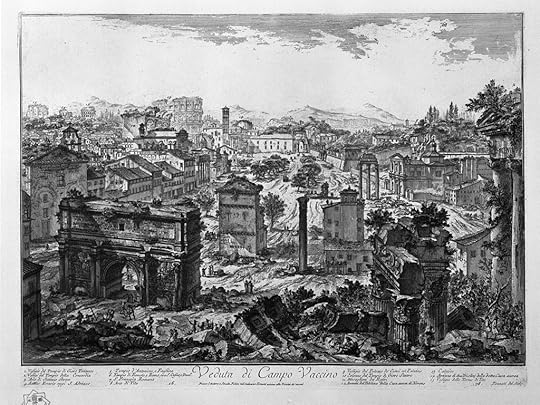
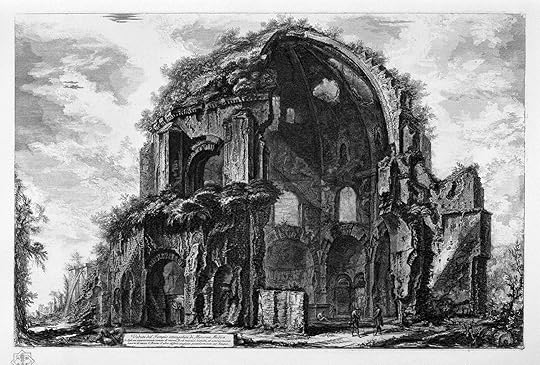
Hell's Architect? It sounds cool, and it does conform with the artist's rep, and the fantastically sadistic prisons Dante might have found a way to work into his rhyming tour of the Inferno. It's not remotely accurate, but who gives a shit about accuracy? Piranesi did, oddly enough, and conscientiously spent a large part of his life capturing on paper the crumbling remnants of Ancient Rome as they existed a couple centuries ago. His reputation for dark fantasy has been exaggerated, as the material that inspired it makes up a pretty small percentage of his oeuvre, compared to the cityscapes. His meticulous engravings capture a Rome that was haunted by its history; every square foot of stone told the stories of a magnificent past and people, irrevocably lost to time and the whims of fortune. The Romans of the Enlightenment lived and worked amongst these moss and vine covered relics of the classical age, ignoring them until they disassembled them, recycling the raw materials and making space... or until the keystone finally dropped from a 2000-year-old arch and completely ruined the ruins. These half-collapsed bridges and aqueducts and temples to forgotten gods still had a tragic beauty and monumental significance that Piranesi captured with an objective eye; the meticulous technical skill is indicative of a patience that seems to contradict his reputation for Salvator Rosa-like ‘savagery’… an artist to whom Piranesi was apparently compared, for some fucked-up 18th Century reasoning lost to the ages. This double-volume hardcover set, collecting 'The Complete Etchings' of the 18th century artist Giovanni Battista Piranesi, is another beautiful, remarkably affordable release from Taschen. Piranesi is one of the most renowned artists to make engraving/etching his chosen medium, and this comprehensive slip-cased set shows off both the genius of Piranesi and the stunning possibilities of a now dying, if not dead, art-form.
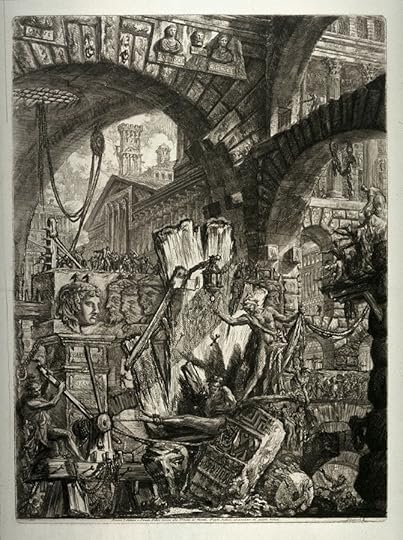
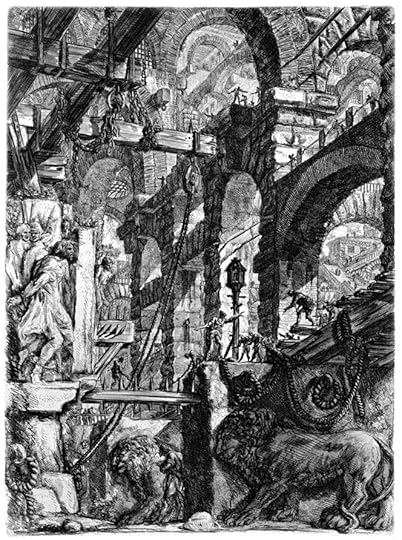
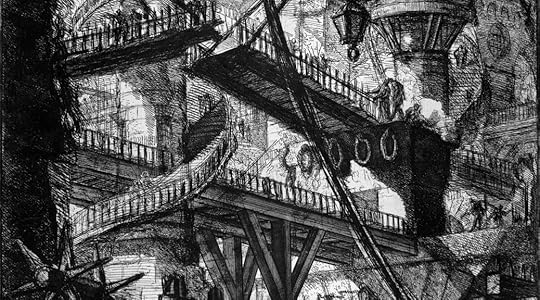
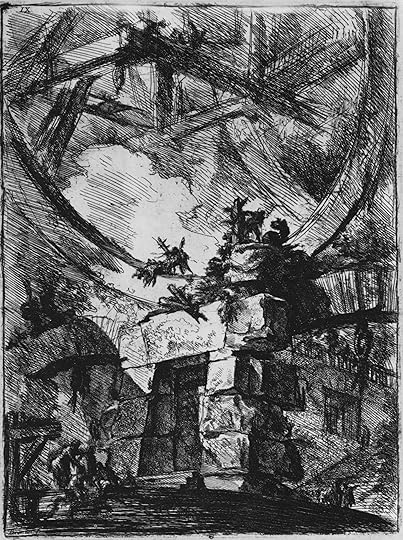
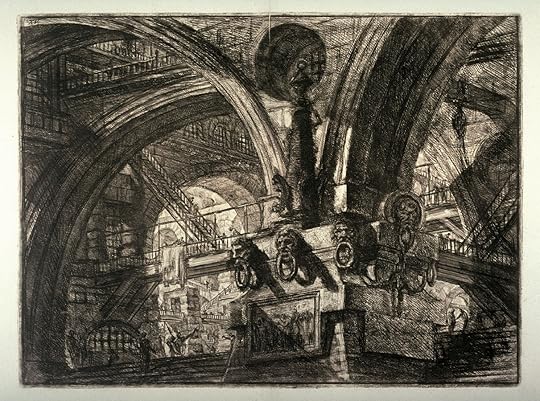
Speaking personally, between the late Baroque painters like Rembrandt or Rubens or Rosa, and the Neo-classicism/Romanticism of the early 19th century ushered in by Goya, not much worth mentioning was being created in Europe. Others will take exception to that sweeping dismissal and temporal bigotry, and to be fair, there was probably some cool stuff happening under all the make-up, powdered wigs and velvet. Mozart and Bach. Voltaire said some funny-clever shit, but Newton had already made everyone else feel stupid in the 17th. All that damn fine French and American revolting signalled the end of the age. In the context of art history, the Rococo period was defined by the ugly, sickly sweet style of painters like Watteau, Fragonard and Boucher; a decadent, soulless approach that is inextricably linked to the luxurious excesses of the doomed French monarchy. Strangely, it was during this period that Paris replaced Rome as the cultural capital of Western civilization. The Renaissance and Baroque masters were gone, and Italy would never again be the center of European Art. He is likely most famous for his 'Carceri d'invenzione' (see below), a sixteen print group depicting imaginary, sometimes slightly fantastic prisons. Justice and Law were still firmly anchored to Catholic dogma in the 1700's, and the penitentiaries were not concerned with rehabilitating criminals; instead they smaller versions of purgatory and hell. The pain one suffered on the rack was nothing compared to Satan's infernal machinations (this ‘logic’ made the Inquisition one of those strange eras where psychopaths who got off on torturing, mutilating and murdering innocent people were considered ‘godly men’ of the highest order); for a man whose crimes weren’t deadly ones, still capable of redemption, torture was a warning, a taste of the eternal pain to come. In that spirit, Piranesi's 'Imaginary Prisons' can be seen as dreamlike, proto-surrealist imagery that captures the black essence of the 18th century prisons and dungeons.
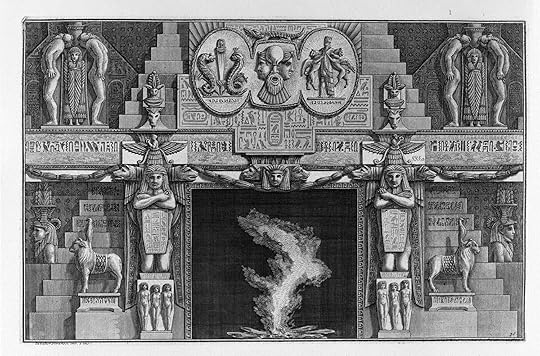
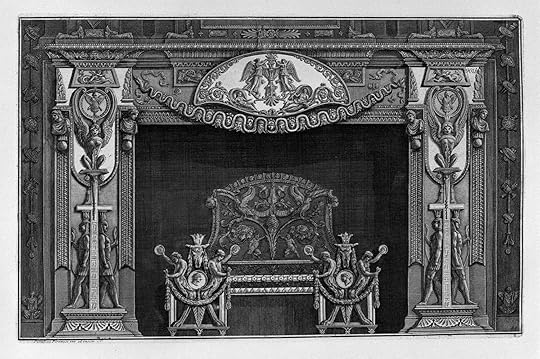
Frontispiece and Plates #2, 3, 5, 7, 9, 13, and 15, 'Carceri d'invenzione': Rome was his true and unwavering inspiration. It is his series of etchings and engravings on the crumbling architectural detritus of a fallen empire, which map out the structural decay with the forensic fidelity of a coroner performing an autopsy, that is perhaps his most important work. His Roman vedute -- or views -- of temple ruins, sagging arches and broken edifices capture the sad, beautiful evidence of Rome's former glory to perfection: 'Le Antichità Romane de' tempo della prima Repubblica e dei primi imperatori' ("Roman Antiquities of the Time of the First Republic and the First Emperors"). Beyond these unique projects, his gifts as an architectural designer are demonstrated in the hundreds of plates he executed of chimneypieces and vases; above are two examples. If that doesn't sound interesting, I'd have to concur. But when Piranesi was set loose on anything, it became a grand and daring experiment. Editor Luigi Ficacci provides an illuminating biography with historical context, and because this is Taschen, it's provided three times over... in different languages. I wish Taschen would just publish separate English, German, and French editions separately, but it's something they do to cut down on costs, and for the price, it's a decent compromise. Each volume is about 10.25"w x 12.25"h, and together are a total of 800 pages. Instead of the thick, glossy art-book pages everyone loves, the paper-stock is a medium matte-finish, light-weight but acid-free. It works quite well for this release, however, since it's reproducing monochromatic and black and white artwork. Yeah, I know, this kind of thing isn’t going to interest everyone; but if you have any curiosity about Rome’s history, or this beautiful but now all but vanished artistic medium, it’s well worth the price-tag. 84/100
I have underestimated the intellectual and imaginative impact of looking at pictures.
This book brought to mind a crowd of thoughts about inhabiting shared space with the past. Piranesi (Susanna Clarke's protagonist is named for him) fills his etchings with tiny people gesturing, carousing, lounging with their cows and hanging their laundry in the midst of the ruins of some of the grandest buildings human beings have ever designed. I think a lot of these images are probably meant to suggest a contrast between the squalor and indolence of the 18th century present with the glories of the past, although I couldn't help but love the vision of muddy little (presumably) Christian peasants trampling with their livestock all over Neptune's derelict temples.
Piranesi's worlds, whether real or imagined, are absolute *magic* and undoubtedly responsible for much of fantasy aesthetics today - especially his submerged halls, grand broken ceilings, crumbling walls that fight a losing battle with the trees, and his so- called "fantasy prisons." The seemingly porous border between the "rational" and the "romantic" in his pictures makes me think I have a great deal to learn about neo-classicism.
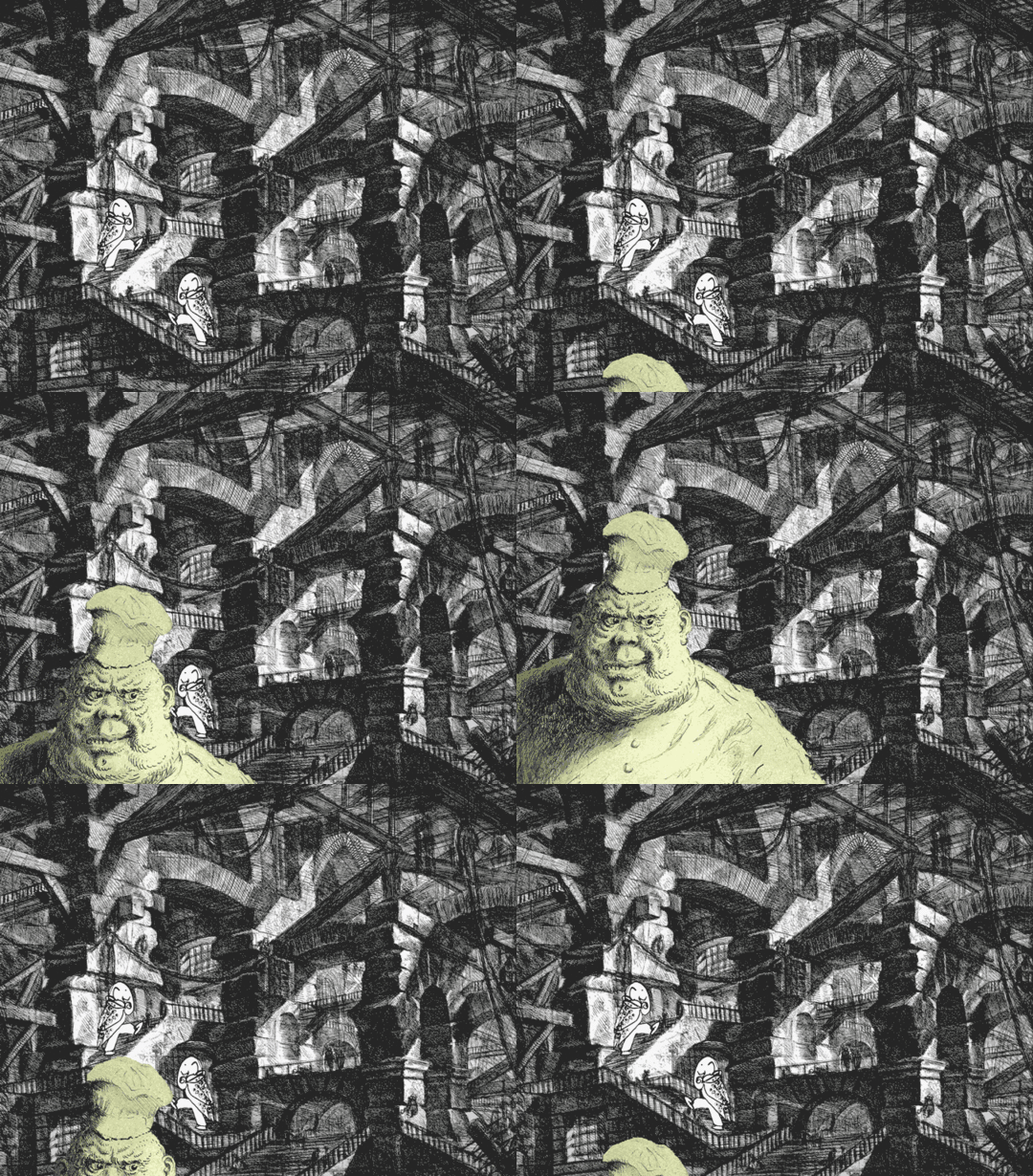
Giovanni Battista Piranesi (1720–1778) was an Italian engraver and architect best known for his romantic renditions of Rome, The Views or Vedute, and the sixteen plates which carry the inventive (sometimes geometrically impossible) sinister-looking dungeons referred to as the Imaginary Prisons or Carceri d'invenzione.
Piranesi left behind hundreds of etchings covering all manner of Rome-related architectural elements, including: ancient Rome recreated, the ruins thereof, the ruins enhanced, ornaments, columns, tombs, urn details, road details, shrines, vaults, grottos, halls, friezes, fireplaces, altars, pilasters, candelabra.
Taschen’s trilingual edition focuses almost exclusively on exhibiting these etchings. Of the 840 pages, only the first 50 are devoted to Piranesi’s biography (split up according to language), but the rest are replete with high-quality reproductions of varying sizes, which depend on the proportions of the original work and how it can best be fitted onto each fine, glossy page.
That said, bear in mind the size of the book if purchasing a copy online or if thinking about obtaining it from a library. This Taschen edition is 14 x 19.5 cm, which means a couple of centimetres shorter than a standard A5 (half of A4). In other words, you might have to strain your eyes or use a magnifying glass to see some of the details on Piranesi’s stunningly intricate works. Expect no poster-size. However, at 1.3 kilograms, it’s the small format of the book that makes it a manageable and useful overview of Piranesi’s oeuvre.
Stunning, too.
A quote on the back advertises that this is “A must read for architecture and graphic art enthusiasts.” I’d also recommend it to anyone enthusiastic about the ancient world, or about ruins and ornaments in general.
I’ll also add this: if you’ve ever looked at Thomas Cole’s paintings, in particular The Course of Empire, and felt the romantic in you break out with goosebumps—well, then Piranesi too is your man.
Piranesi's work could be largely divided in to three catagories; views; imagined works; antiquarian records. For me, the imagined works were the most interesting and the works that are primarily about preserving a record of antiquities the least. Of course there is overlap. Title pages of various collections are imagined compositions, even if the contents are engravings of architectural diagrams. Views of ancient Roman remains act as antiquarian records even if the main objective was to sell souvenirs to rich Brits on the Grand Tour. But for me the pinacle is the Imagined Prisons that inspired the purchase of the book in the first place.
What gains here from completeness, one loses in scale. Most of the reproductions are two per not particularly large page, making appreciation of the wealth of fine detail difficult. Making the pages larger in area or number, however, would make for a very unwieldy book indeed, considering the already 800p+ scale of this edition. Hence I might look for books containing subsets of the whole but reproduced much larger.
Anyone interested in Roman architectural remains should probably give this volume a perusal.
I saw a Piranesi sketch print framed in a local restaurant ("A Group of Columns") and I was very taken with the level of detail in the "imagined architecture" of super-elaborate and complex, ridiculously-oversied, buildings that were never built , but that existed only in the mind of this very talented sketch artist / draftsman / architect / dreamer who lived in the 1700's.
This is a hardcover two-book-set that comes in a slipcase that holds the two volumes together. It is printed on very high-quality paper, and it features ALL of the sketch works of Piranesi... (not just selected works on a particular theme as most Piranesi books offer)... which is why this set is eight hundred (800) pages long. This is a magnificent, breathtaking compendium of the life work of Piranesi.
In addition to the fantasy-world drawings, in which the artist imagines buildings with impossibly-large arches and columns and complications upon complications that would undoubted cost hundreds of millions of dollars to actually attempt to build... he also did some very impressive detailed sketches of real-work ancient Greek and Roman architecture, such as The Colosseum, The Parthenon, etc. He also did a few sketches of people and individual architectural elements such as a single corbel or column or other such device.
It is however, his Romanesque fantasy-building sketches that would give any engineer (or city planner or accountant) a heart attack, that are the most enjoyable feast for the eyes and the mind. His imagined multi-level dungeon / prison sketches are also quite compelling. Whether as an addition to your art or architecture library, or as a jaw-dropping coffee table book set... you are sure to get lost for hours in the strange and intriguing world of Piranesi.
As a final note... the only other "Complete Works of Piranesi" is a slightly larger format "fine paper" edition that costs close to $400... and this one is a very tiny fraction of that cost. You will never regret adding this marvelous two-volume books set to your home library.
Mi series absolutamente preferidas: lo Grotteschi y las chimeneas -más bien, los fuegos de las chimeneas-. Me gustan, sobre todo, las versiones originales y las segundas a las que les aparecen nuevas estructuras y se oscurecen. Y las secciones de todo: muros, obeliscos, la misma tierra. ¡Qué manera de hacer láminas! Lo más impresionante es la escala monumental y los personajitos chiquititos chiquitos que la habitan. ¿Así se sentía el medievo? Los 'various etruscan' son hojas de tatuajes tal cual! El alfabeto mola! No he encontrado nadie que haya juntado todas las letras aún...
To be upfront this is an architectural book I read (glanced over) for reference with Suzanne Clarke's book Piranesi. It seems as if the 18th century copper engraver Giovanni Batista Piranesi was an inspiration to many painters and writers alike. Which is what drew me to him. Many are architectural replications of his journey through Italy but others are fanciful prisons and detailed mazes always with European statues throughout.
Dieser Doppelband kann einem interessierten Leser leider nur als Index der von Piranesi erstellten bzw. vertriebenen Stiche dienen, da man zum einen sehr wenig über ihn und sein Leben bzw. Werk erfährt und zum anderen die meisten Bilder eher klein geraten sind, so dass man die Details oft gar nicht genau sehen kann.
5 Stars for completeness. 1 star for image quality.
If you are looking for a book of classical architectural motifs you may like this. If you are looking to appreciate the technique of one of history's finest etchers, hard pass. Without a jeweler's loupe, you won't be able to see any of Piranesi's fine line work.
The etchings were reproduced well, but lacking any real explanatory context other than a translation of Piranesi’s text. The introductory essay was also fairly perfunctory, and my edition had some damage on arrival. Worth keeping as a fan of Roman history, but not on par with other fine art monographs from the same publisher
This guy was just mindblowing in his design, artistry, and passion for ancient Rome. I really want to find a copy of this after stumbling across this tome at the library.
The etchings are fabulous, of course, but the book would have been worth five stars if the text had provided context. It's academic and dense but it does not illuminate the images.