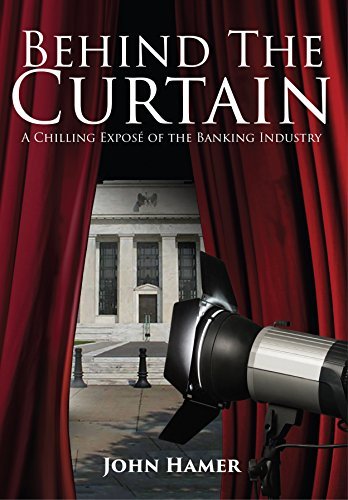
Behind The Curtain December 1968 saw a landmark court case in the appropriately named township of Credit River, Minnesota, USA. First National Bank of Montgomery vs. Daly was an epic courtroom drama and although unsurprisingly, not widely reported either at the time or subsequently, is actually extremely significant. Jerome Daly a lawyer by profession, defended himself against the bank’s attempted foreclosure on his $14,000 mortgage on the grounds that there was no ‘consideration’ for the loan. ‘Consideration’ in legalese, refers to ‘the item exchanged’ and is an essential element of any legal contract. Daly contended that the bank offered ‘no consideration’ for his loan on the grounds that they had ‘created the money out of thin air’ by bookkeeping entry and had therefore not suffered a loss (another relevant point of law) by his refusal or inability to pay back the money. The proceedings were recorded by Justice William Drexler, who had given no credence whatsoever to the defence, until Mr. Morgan, the bank’s president, took to the witness stand. To Drexler’s and indeed everyone else present’s great surprise, Morgan casually admitted under questioning from Daly’s lawyer, that the bank routinely ‘created money out of thin air’ for all its loans and mortgages and that this indeed was standard practice in all banks. Presiding Justice, Martin Mahoney declared that, “It sounds exactly like fraud to me,” accompanied by nods and murmurs of assent from all around the courtroom. In his summation of the case, Justice Mahoney reported that… “Plaintiff (the bank) admitted that it, in combination with the Federal Reserve Bank of Minneapolis, did create the entire $14,000.00 in money and credit upon its own books by bookkeeping entry. That this was the consideration used to support the Note dated May 8, 1964 and the Mortgage of the same date. The money and credit first came into existence when they created it. Morgan admitted that no United States Law or Statute existed which gave him the right to do this. A lawful ‘consideration’ must exist and be tendered to support the Note.” So, the court duly rejected the bank’s claim for foreclosure and the defendant kept his house. The implications of this case therefore, should have been far-reaching. If bankers are indeed extending credit without consideration (which they most definitely are) i.e. without backing their loans with real money they actually have stored in their vaults and were entitled to lend, any judicial decision declaring their loans void, would topple the entire worldwide financial and banking system. Since this precedent, many other defendants have attempted to have mortgages and loans nullified using the same defence as Daly, but there has been extremely limited success only. In fact, one judge said, strictly ‘off the record,’ “If I let you do that, you and everyone else, it would bring the whole banking system down. I cannot let you go behind the bar of the bank... We are not going behind that curtain!” Well suffice to say, we certainly are going on a highly revealing trip ‘ behind the curtain!,’ so strap-in and be prepared for the ride of your life, as we investigate the sordid and murky history of the world of banking and high finance and the people who run it… with an iron fist encased in a velvet glove. This book is an indictment, not just of the totally corrupt financial system that today permeates the whole world, but also of the people that control it.
It's all about money. Very informative on how the world works, those you think are in charge are really not, everyone's a puppet. I did have to fast forward through some of the wars, but again all based on money power. I do agree with some other reviews that references would be helpful to further research certain areas of interest.
An excellent read for anyone seeking the truth about what is really going on in the world. It’s not that I agree with all the author is saying but a lot really resonated with me.
Took me 2 months of solid reading to get through but was worth it The Rothschild family wrote the blueprint on how to dominate the world through Central banks. This book shows step by step how they did it. The surreptitious creation of the Federal Reserve bank on Dec 23 1913 is an eye opener. One beef is this book claims Hitler never wanted war which is a lie as Hitler expanded his military exponentially ( why do that?) and always had his eye on lebensraum and in particular the grain belt of Ukraine as he wrote in Mein Kampf which was to be gotten how, even though he was funded by the same banking families? Other than that this book is a monumental trip into the shams of banking, wars, false flag operations, stock market crashes, communism, democracy ,vaccines and how they are all connected and controlled by the same groups to reach an end goal of having total control over all of us and they are nearly there in 2025. Nothing is what it seems and this book pulls back the veil.
Documented and explained - Bankers pulling all strings except bell's
I read Icke & Ganser. They dwarf compared tp Hamer. Not everything was new to me, but usually better explained. Reading it should be mandatory. 1800 pages & never boring.
Hamer's grasp of History is considerable and it allows him to contextualize the influence of the banking sector - and of those who in turn control the banking sector. The History departments of universities would benefit from using this book as a foundational basis for evaluating events. The basic question (Qui Bono?) is rarely asked, which is unfortunate. This book addresses the vacuum.