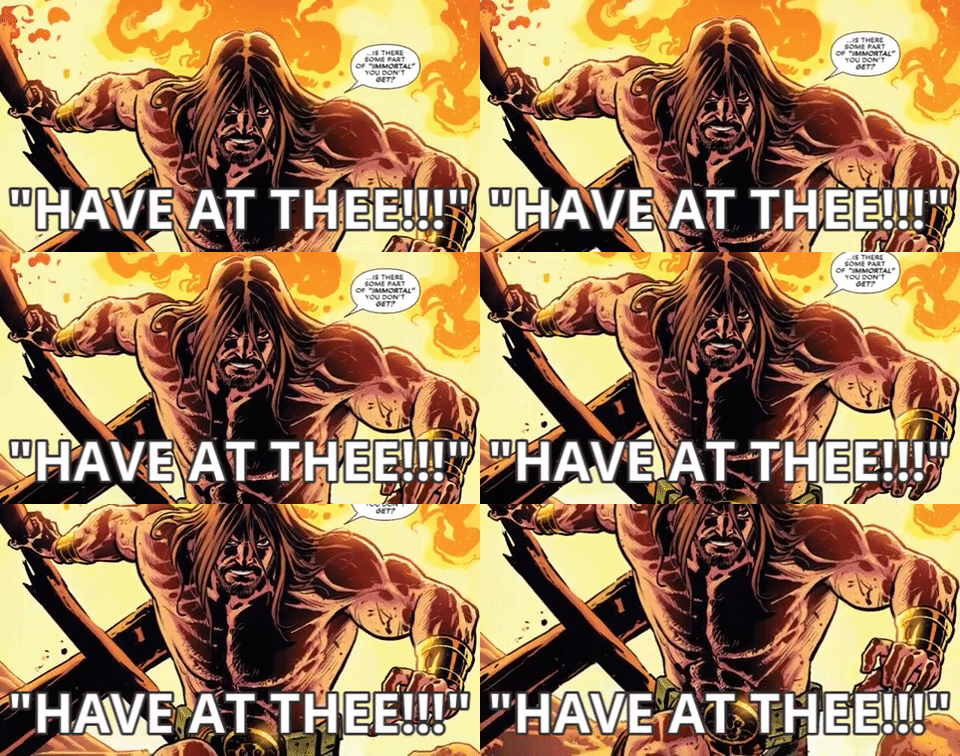
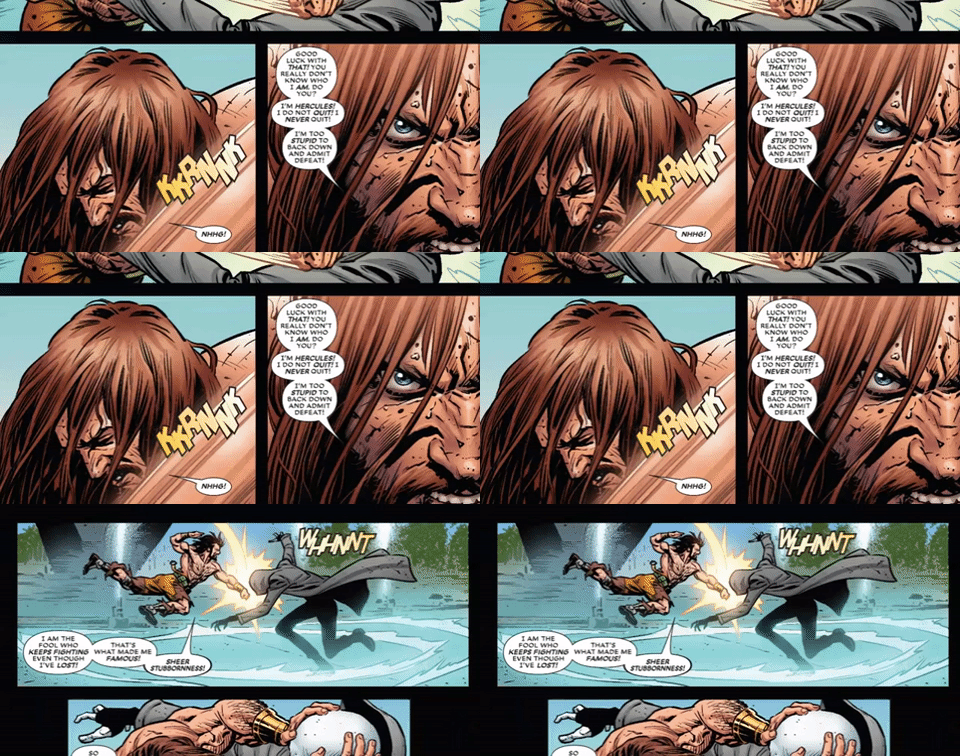
The world's first super hero is getting back in the game to remind everyone why he set the bar for valor in the first place. Make way — Hercules is back! The creatures of ancient myth lingering in the present day are on the brink of extinction, with no place in the modern world. But Hercules has moved with the times, and only he can protect them against the crushing weight of the future. Clean, sober and determined, the Lion of Olympus gathers his deadliest weapons to face the Uprising Storm that threatens to wipe out the old ways forever — but which old friends and unlikely allies will stand with him? An age-old warrior battles to be a modern-day hero — and it will be legendary!
Hercules wants to be taken seriously as a hero so he’s given up the sauce. Shame that change doesn’t make him any more interesting to readers! New gods called The Uprising Storm are fighting old gods and Herc’s gotta put these young whippersnappers in their place to prove that the olds are classics for a reason… zzz….
Want to read a comic where Herc punches mythical Greek creatures in a contemporary setting? This is the book for you! To be fair to Dan Abnett, he doesn’t do a terrible job. There’s some amusing banter between Herc and Gilgamesh (aka Gil) who’s crashing with Herc while he’s down in the dumps, and the story is coherent. It’s just not terribly interesting to read a strongman character punching big monsters, which is largely what this is.
Luke Ross’s art is decent and polished but is very much Marvel house style which isn’t the most unique look and doesn’t help this title stand out.
Still Going Strong sets out to make the case that Hercules is still relevant and instead left me unconvinced. Will Herc stay sober? Don’t care. Maybe having an off-the-wagon alcoholic superhero in the Marvel Universe would be more fun? Hercules proves that being the first superhero doesn’t necessarily make you the best, nor the most enduring.
It's basically American Gods except worse in every aspect. Less subtle, more preachy, with an infinitely more annoying Technical Boy, and perhaps most important of all, injecting it into an established setting to which it does not fit and which never needed it. In many places it reads as an old man's effort to explain why modern day is so much worse than when he was young, without ever actually realizing how it all works. I should give more credit to Abnett, but this is definitely not one of his best works.
Honestly, it should not come across as a complete trainwreck - it started on a far stronger note than in which it finished, the art is acceptable, some of the fights good, and I rather liked Gilgamesh - but in this case its flaws, the decayed core, far eclipse its few merits.
Really loved the storyline and the "American Gods" vibe of Abnett's Herc, immortal ex-alcoholist demi-god looking for redemption.
Sadly artworks were just decent ones and this excellent (mini) series was cancelled by Marvel, ending with a cliffhanger, and the author signed an exclusive contract with DC comics and now writes Titans and Aquaman. Can you go back to work on Black Library's Gaunt's Ghosts and Eisenhorn novels as soon as possible, mr Abnett? Thank you.
A fun read. Not familiar with the Marvel version of Hercules at all so this was a nice book if nothing too special and it was great to read some more Dan Abnett outside of Black Library.
It's common to hear old fans grumbling about Marvel's explicit focus on new audiences and readers. But wait - here is a hero they can surely relate to, in a comic starring a classic character that directly addresses ageing, changing social norms, and the crisis of masculinity. It addresses them quite poignantly, too, with Hercules and his mate Gilgamesh The Forgotten One respectively solving monster related crises by thumping them, and sitting around on a sofa unemployed. Luke Ross, like Dan Abnett and Hercules a veteran, turns in a fine art job giving a warmth to the domestic stuff and a crackle to the thumpage.
Alas, a plot intervenes, and it's a plot involving new gods representing technology and the Internet and hacking and whatnot, with dialogue in - I am sorry to have to say this - a millennial argot. This bit is excruciating, though the comic recovers by saving the best to last - a conversation between Hercules (newly sober) and Tony Stark (long-term sober) which is refreshingly candid and nicely makes the point that just because you're in recovery doesn't mean you stop being an arsehole. Is there hope for Herc? Possibly not. Often pedestrian and with unreadable antagonists, there's also an honesty and sympathy here which makes it stand out a little - shame the rest of the comic wasn't better.
I like a lot the concept/idea of this Hercules in the more recent years of the 21st century of the modern world in this graphic novel with a self aware Hercules embarks on a journey of self discovery, redemption & identity to have himself to be taken as a more seriously & heroic person, god/demigod & man by many people particularly other gods/demigods, simple citizens, heroes & villains who only see & know him as an alcoholic, stupid, musclebound, obnoxious brute oaf & a dangerous serious threat with no brains but only muscles & strength that drinks, partys & destroys everything around him at all almost plenty of times without logic, remorse, shame, guilt & conciousness as it was usually depicted in plenty old golden & silver age marvel comics of 1960s, 1970's, 1980's & 1990's eras.
This miniseries which is trying to be a little or a lot of Neil Gaiman's American Gods with Hercules just like Shadowmoon of American Gods starts & ends just decently, not epic or more philosophical & way deeper just like American Gods does, but still decent in many ways at all especially for Hercules & Gilgamesh themselves.
This miniseries should have been a relaxing ambient, simplistic, funny & quirky, whimsical roadtrip adventure or a bloody & gory daily life shenannigans routine & emotional Lgbtq+ romance love story between Hercules & Gilgamesh the way that I see it & feel it very much a lot in some particular panels, atmosphere & the vibe of the main plot including enough the subplots as well enough.
This graphic novel book it is decent in action/plot/art/characters but it needed more issues or to be an actual 60-100 issues comicbook series not only just a mini series graphic novel book like it really is written to by Dan Abnett himself whom has written way better comicbooks & novels in his life than this book with Hercules in the modern world of 2016 Trump American Era during The Marvel Civil War 2 Event.
P.S. The 2nd volume though of this graphic novel miniseries of Hercules & sequel volume called marvel civil war 2:war gods(which definitely takes place during the 2nd marvel superhero civil war)includes in a very pivotal & significant way other ancient legendary heroes/demigods & old Hercules companions/friends such as Gilgamesh The Forgotten One(Hercules Roommate), The Witch Ire of Crua, Beowulf, Lorelei with Sigmund & Theseus to help Hercules fight & destroy the 3 evil gods of the modern century.
Some of Hercules old avengers allies & friends such as She-Hulk, Brawn(Amadeus Cho), Spider-Man, Captain America, Queen Medusa of the Inhumans & Captain Marvel(whom is the recent main leader of the new avengers with Captain America as a 2nd leader)also make an appearance as well to help Hercules somehow in some way if they can or to confront him for many reasons/issues of his.
Bits of this are fabulous. For instance, the idea of Hercules in modern New York, happily undertaking 'labors' for anyone from local kids to the Secretary General, with a confused and dispirited Gilgamesh sleeping on his sofa and complaining how tablets were simpler when they were made of clay. Whereas Hercules, having battled through the centuries, is happy to adopt whatever weapons work in the course of battle. As for the mythical creatures seeking refuge in New York from some coming storm driving their kind from the world - and Hercules seeking less lethal solutions than he once would have, because he recognises how much they have in common now? Well, it feels very similar in outline to the current Doctor Strange run, but considered in isolation, it's a good angle. And yet I hate the nasty puritanical streak (and the landlady who embodies it) which suggests that if Hercules is to be a real hero, he has to knock the drinking and shagging on the head and be as boring as his modern counterparts. No, fuck it - he was the hero first, his way was more fun, and they need to raise their game, not him lower his. And beyond that, once the antagonists do materialise...they're just American Gods. Except much less good, more nineties, and with inexplicably classical names given they're meant to be so bloody on-trend!!! and right now!!! An infuriatingly mixed bag.
I actually really liked this! The main conceit (old gods vs new) was clearly lifted from Gaiman's American Gods, but Abnett deflects from that by showing us a Hercules who is trying to learn from his mistakes and better acclimate to this "modern age". Chief among that is going sober and not partying so much, but also helping out other old heroes like Gilgamesh and Ire of Crua-Before-The-Ice. And the series ends with Hercules at a bar ordering whiskey — a cliffhanger! I really hope this is continued somewhere, at some time, because I really want to see this resolved.
Solid concept. Hercules decides to stop being a party animal and start being more heroic. Which means quitting the boozes. His buddy Gilgamesh and some centaurs threaten to take him back down the wrong path, as those types are known to do. Goddamn centaurs.
Only thing I didn't like, Hercules is clearly infected with some kind of techno virus, which he totally knows about, and just leaves it alone because story reasons. Not cool, Hercules.
This is a miniseries of Marvel's Hercules character, where he is sobered up and is put on a path of redeeming himself in the public eye while fighting a new evil force. As I am not a hardcore comic-fan, I actually enjoyed this series for what it's worth a reformed hero story. My only complaint is that it appeared to have end on a cliffhanger with little of the plot completed.
I read these as single issues and was INCREDIBLY DISAPPOINTED when it became a miniseries instead of an ongoing title, which accounts, sadly, for the way this wraps and sends us into (of course) another stupid Marvel Universe event. But listen to me. LISTEN TO ME:
These six issues are glorious. GLORIOUS. Hercules is a perfect blend of ancient and modern, and the way he engages with the world and the way the world is engaging with him -- you guys, if you love mythology, grab this ASAP because I kid you not, after reading the first issue, I immediately flipped back to the beginning and reread it again, it was that good.
Classicists should never read figures based on Greek mythology. I spent the entire time reading this thinking “wow, the mythology is so much more interesting”
Reprints Hercules #1-6 (January 2016-June 2016). For years, Hercules has been a joke. His carefree style of fighting has brought destruction and damage and his drunken revelry are just as legendary as his labors. Hercules is trying to change all of it, but his decision might have come too late. There is something hunting immortals and the Rising Storm seems to make the term “immortal” a thing of the past. Hercules, Gilgamesh, and others who once thought themselves unkillable are facing a new threat…and this danger might be too great for even Hercules to overcome!
Written by Dan Abnett, Hercules: Still Going Strong is a six-issue limited series. Falling under Marvel’s “All-New All-Different” line, the collection features art primarily by Luke Ross but with additional art by Emilio Laiso, Goran Sudzuka and Dalibor Talajic.
Hercules is one of my favorite Avengers. He was part of the team when I started reading, and I always liked his “likes to fight” nature. Here, Hercules is facing the consequences of this behavior. The story is an interesting tale of redemption…but it has a major problem.
Hercules has kind of been aimless most of his comic book career. The character is fun, but he often doesn’t have much of a goal. The Prince of Power limited series were an interesting trek through space with the immortal aspect of Hercules, and Greg Pak’s Incredible Herc (which took over the Incredible Hulk comic after World War Hulk) was a fun read with the convoluted Chaos War tied in. Abnett seeks to give Hercules a purpose…or a “labor” here.
The comic comes at you fast. Hercules is almost like Angel in the Buffy the Vampire spinoff series as he casually deals with threats in the New York City area while interacting with other immortals. It is a worthwhile concept, but it is also set-up to build to the Uprising Storm which seeks to wipe out immortals…also a decent storyline. Unfortunately for Hercules, the series is truncated.
Though it is often now considered a “limited series”, I think Hercules was supposed to be a much longer idea that got slammed by average sales. The series ends just as it gets going. Rather continuing as Hercules, the series is finished up in the four issue Civil War II limited series Civil War II: Gods of War…but you wouldn’t know that here. The story just ends on a dark note.
Hercules always has my back when it comes to a comic book, but he also is a character that if written right is a better team player than a solo book holder. This collection demonstrates that Hercules can work as a lead character, but he also isn’t top tier enough to make it with characters like Spider-Man and even Captain America who can carry their own books. Hercules is immortal, and I hope he keeps coming back for more.
Nowy, a zarazem stary bohater, który musi się odnaleźć w zmieniającym się świecie, którego nie rozumie, a świat nie zamierza mu tego ułatwiać. O tym jest ta historia. O tym, ze stare musi się pogodzić, z tym, że trzeba zejść ze sceny, ustąpić miejsca. Tyle, czy aby na pewno czasem trzeba, bo przecież nowe nie jest równoznaczne z lepszym...
I tak jest z Herkulesem. Ma swoją metę u ciekawej, charakternej wynajmującej babeczki, a waletuje u niego Gilgamesz. Obaj bohaterowie będą musieli stawić czoła stagnacji i ruszyć do walki, choć zdecydowanie to Herkulesowi idzie lepiej. Te kilka zeszytów to całkiem niezła siekanina z mitologicznymi wtrętami.
Na pewno doceniam fakt, co bohater "żąda" za swoje usługi. Jest to koncept prosty, ale uroczy. Na horyzoncie zaś pojawia się spore zagrożenie i tylko Herkules będzie umiał stawić temu czoła. Choć bez małego wsparcia się nie obędzie. Nie jest to absolutnie nic nowego, ale jest na tyle dynamiczne, że historia Abnetta daje radę. Mimo, faktu że samego bohatera tu nieco ugrzeczniono.
Czy to dobry kierunek? Czas pokaże. Mi się podobało. I ta smętna końcówka...
"Hercules: Still Going Strong" was a solid comic. They are trying to kick off a new, "reinvented" Hercules here, and for the most part they succeed. I had previously only read Hercules when he had been a guest/side character in Avengers or Thor comics of the 80s and 90s, and here he is trying to straighten out his life and get serious. Hercules is more than interesting enough to carry a series, but I wouldn't necessarily say he is more interesting now than his earlier characterization (and not nearly as interesting as Thor, who Hercules is rather similar too). The supporting characters of Gilgameth, Sophia, and Tiresias are solid enough, as are the mythological creatures like the Centaurs. As with many comics, however, Hercules's fights are resolved rather easily, and in most of them it ends with them just stopping fighting and becoming allies. The main villains, the "Storm" or the "New Gods", were pretty odd. I get that they were supposed to be over-the-top modern cliches, but they just seemed strange next to ancient heroes.
Didn't even know Hercules was a character in the Marvel Comics universe, so decided to give it a try and read more about him. I'm into the whole hero's journey, where from the ancient world he was a hero, and now in the modern world he's just like a loser. He's trying to be that hero again, although that was the angle of this whole series. It doesn't really show that depth and that character building. He just felt like there was some new god attacking, and he had to defend against them, so there wasn't really much of that in-depth characterization where he looks inside and tries to build his persona to be the better hero. There were a few panels in the beginning, but it wasn't really throughout the whole series, so I didn't really feel like he was really trying at redemption, to be honest.
Wanted to like this, I really did. I'm a huge fan of the big guy and this series had a great creative team and a really good direction for Herc.
But, all he ever gets to fight is other mythological beings and creatures and I'm so tired of it! Five minutes in and it's all mythology and 'Oh look! A bad mythological thing is coming!"
He's in New York! There are 4 million supervillains there! Yet, Hercules never sees one, unless he's hanging out with the Avengers.
Herc is going through changes and I'm not sure its for the best. Some of the best parts of Pak and Van Lente's Hercules are missing and this reads more like a Thor story. The antagonists are interesting but aren't original. Luke Ross delivers some very impressive panels. Overall, not the book I was hoping for.
I honestly don't remember the last time I read something by Dan Abnett which I liked, but this was pretty good. Having Luke Ross as the primary artist helped.
Hercules is sober, wearing pants, and ready to get serious. Just in time to face some new gods for the modern era.
I was really enjoying the first two issues but by the time "the storm" showed up i almost immediately lost interest. their designs are so fucking cringe and awful. otherwise has fun bits and is relatively enjoyable, but i did not like the ending
Good story! If you like the Percy Jackson nobels I think you would enjoy this book. Interior art is serviceable with terrific layouts and the covers are works of art.
Note that this storyline is concluded in Civil War II: Gods of War.
This was surprisingly well written! I really enjoyed the story and the take of a classic here in a modern age. Parts of it did remind me of American Gods though.
Missed this in single issue form but had been intrigued when it was announced. Glad I finally read it. Enjoyed what the creators did with Herc, Gilgamesh and the new supporting cast.
I really enjoyed this but at the same time I feel like Abnett was overselling the "Hercules is a laughingstock to all the modern heroes" theme. I did like Herc's more thoughtful and modern approach to heroism, and his focus on doing the work, which I think was in keeping with his development under Pak and Van Lente. The actual plot, to me at least, was much less intriguing than the characterization. The plot was basically American Gods without the grift, but there was no resolution in this book. Instead, we have Hercules on a cliffhanger apparently about to fall off the wagon and in denial about the technovirus brand one of the new gods gave him. This marks the end of the series, but apparently the second half of the story can be found in an ancillary Civil War II miniseries. I guess I'll have to track it down too.
Hercules is one of my all time favorite Marvel characters, and it has everything to do with the fact that he is Hercules in the Marvel Universe. As soon as I saw they were publishing another run of Herc, I had to pick it up. Being a Herc fan also means that you have to put up with a lot of writers treating him as a joke, not quite getting the idea of what it would be like to be an immortal. I wasn't expecting a lot from the series, but I knew I would have to pick it up anyway. All I can say about this book/series is: I love Dan Abnett's style. His take on Hercules is truly awesome. Couple that with Luke Ross' art (issues 1-5), and I fell in love. And this is one of the few times where I think the lettering (done by VC's Joe Sabino) really helps set the tone for the story being told. Abnett's Hercules has adapted to the modern world in all things. His arsenal is filled with past and current technology. He texts. And finally he has decided that this carousing and partying (well, mostly the partying) is also a thing of the past and must be put behind him. He is the legendary hero, after all. So now he faces the perils of the modern world with modern tools. Except what he keeps running into are beings of the old world. Herc must face off against demons, Titans, and Kentaur. But what is driving these ancient world beings out into the open? A new mythology. Fortunately, Herc is not alone. Living on his couch is non other than Gilgamesh, Hero of Sumer. Tiresias the Seer is also around. Herc is also able to recruit new allies as he finds the new mythology is out to kill the old. What I love so much about this short run is that even though Hercules has decided to clean up his act, he is still a man of action. While Gilgamesh wallows in a funk because he can't find a use for himself in this new world, Hercules makes a place for himself. And he is attempting to help Gil find his way while he is at it. But the old ways are hard to overcome, and Herc is faced with a decision that may ruin his reputation forever. I really dig the story, but what really gets me interested in this story is Luke Ross's art. The Kentaur in #3 are awesome. They look as if straight off of Greek pottery. I also really liked the Urmut in #1. While I didn't much care for the Titans in #2, they were still interesting to look at. Finally, the colors (Guru-eFX)are quite good, especially the night scene where Herc meets Iron Man. I just love looking at those pages. The fill in artists for #6(Goran Sudzuka and Dalibor Talajic) were decent, but it made me wish that Ross had finished the series out. Not that I am complaining about the art of #6, but Ross' work just felt better. I would definitely recommend this book. I have the single issues AND the collected edition. Too bad it is so short. Can't wait until they pick it back up with Gods of War. I REALLY want to see more of Ire of Crua-Before-The-Ice. And her possible friendship with Gilgamesh.
Just the image of Hercules living with Gilgamesh, another sad mythological superhero, crashed out on his couch is worth the read alone. How this deals with the aftereffects and public image of the character's flaws is quite touching, and the new villains introduced here are fascinating, I hope we'll be seeing more of them in the future. Dan Abnett excels once again with what is another of the best current Marvel titles.
I thought this would be a short mini-series since there isn't a volume number, but it looks like the story continues on which makes this a bit hard for me to review.
This is more like a 3.5 star read because I want to know what happens next and how Hercules continues to develop.
I just finished the Cosmic saga and picked this up to see what Abnett could do with an older character in the modern age without Lanning.
Abnett managed to give us a Hercules who has decided to give up his stereotypical "godly" ways (heavy drinking, womanizing, violence for violence's sake) and learn to adapt to the modern world. Abnett includes Gilgamesh to remind us what Hercules used to be like. Hercules' foes end up mocking him for using modern technology in combat. Hercules is doing his best to stay relevant and get back to being a hero.
This trade is a combination of a man-out-of-time/anachronistic character a la Captain America and the tone of Thor: Ragnarok.
Like I said, the story seems to continue and ends with a "The end?", so it's hard to judge the character's story especially since they introduced the concept of these New Gods trying to eliminate the Old Gods.
This entire review has been hidden because of spoilers.