Cigars of the Pharaoh is one of Tintin's earliest adventures. He and Snowy are on a cruise to Egypt when they happen to meet Professor Sophocles Sarcophagus (the first of Tintin's absent-minded professors) and join his expedition. But they become embroiled in a complicated scheme involving a fakir, cigars marked with an unusual brand, and Rajijah, the poison of madness. Most significantly, Tintin meets the detectives Thompson and Thomson as well as the movie mogul Rastapopolous. While Cigars of the Pharaoh is a self-contained story, some of the mysteries are resolved in The Blue Lotus. Herge wrote Cigars in 1932 then revised it in 1955, which is why the art has the more polished look of later stories as well as the anachronistic glimpse of a copy of Destination: Moon. --David Horiuchi
Georges Prosper Remi (22 May 1907 – 3 March 1983), better known by the pen name Hergé, was a Belgian comics writer and artist. His best known and most substantial work is The Adventures of Tintin comic book series, which he wrote and illustrated from 1929 until his death in 1983, leaving the twenty-fourth Tintin adventure Tintin and Alph-Art unfinished. His work remains a strong influence on comics, particularly in Europe.
"Hergé" is the pseudonym of George Remí, making a game with the initials of his name inverted. Throughout the evolution of his star character, Tintin, we can see the progress of this author: from the first titles marked by the ultraconservative doctrine of the director of the newspaper Le Petit Vingtième, to the breaking of conventions embodied from The Blue Lotus , as well as the evolution of the society of his time. The research carried out by Hergé to historically contextualize his Adventures, as well as his implicit social criticism, have made Tintin a masterpiece of the 20th century.
Here is a very well-constructed Tintin adventure. We visit many places (primarily India and Egypt), and unlike in previous volumes, the experience has a genuine interest. We are no longer in Tintin in the Congo. Here, we had plunged into the heart of drug trafficking on a large scale. So, as always, it is approached with a lot of humor, sometimes a few facilities. But we find everything we love in Tintin's adventures. And even if some cult characters are still missing, the optics of the adventurer as we know him are already taking shape.
●چرا «سیگارهای فرعون» یکی از طلاییترین ماجراهای تنتن برای نوجوانهاست؟ تنتن و سیگارهای فرعون یکی از اون داستانهایی عه که فقط یه ماجراجویی ساده نیست؛ انگار دروازهایه به دنیایی پیچیدهتر، پر از رمز و راز، توطئه و سفر. هرژه توی این جلد، برای اولین بار بچهها رو از فضای یکخطی و ساده ۳ جلد قبلی، میبره به دنیای داستانهای جنایی بینالمللی، جهانی که هم خنده داره، هم تعلیق، و هم نکتههای پنهان برای ذهن کنجکاو نوجوانان. ....... ماجرا از مصر شروع میشه؛ سرزمینی با مقبرههای طلسم شده، نقشههای پنهان، و سیگارهایی که داخل تابوت جا گذاشته شدن! بعد به عربستان و هند میرسه، و تنتن دائم داره از دست دسیسهها و تلههای مختلف فرار میکنه (به قول یکی از ریویوهای گودریدز: کتاب های تنتن پر از معجزاته که فقط برای تنتن رخ میدن). این سفر پرماجرا، برای نوجوانی که تازه داره با جهان آشنا میشه، مثل باز شدن پنجرهایه به فرهنگها و مکانهای غریب. حتی اگه تصویری که داده شده گاهی کلیشهای باشه، ولی همین اگزوتیسم و رمزآلود بودن، جذابیتش رو دوچندان میکنه. ............. توی سیگارهای فرعون اولین باریه که هرژه تنتن رو وارد دنیای سازمانهای مخفی و باندهای جنایی بینالمللی میکنه؛ ماجرای قاچاق مواد مخدر و یک تشکیلات جهانی ناشناس که نشونهاش «چشم در دایره» است. این رمزها، تعقیبوگریزها، لباس مبدل، و تلاش تنتن برای افشای حقیقت، درست همون چیزیه که نوجوانا عاشقشن و باهاش همذاتپنداری میکنن؛ یک قهرمان جوان علیه قدرتی ناشناخته و ترسناک. در کنار همه اینها، کارآگاهان دو قلو (تامسون و تامپسون) وارد صحنه میشن و داستان رو با شوخیهای باحالشون جذابتر میکنن. این تعادل بین تعلیق و طنز، باعث میشه بچهها هم بخندن، هم فکر کنن، هم هیجانزده شن. ............... سیگارهای فرعون بهشکل هوشمندانهای مفاهیمی مثل هویتسازی، اعتماد، توطئه، و حقیقتجویی رو وارد داستان میکنه. تنتن نماینده نوجوانیه که به حرف بزرگترا بسنده نمیکنه، به ظاهر قضایا شک داره، دنبال سرنخه، و برای پیدا کردن حقیقت، حتی از دیوونهخونه هم فرار میکنه! درمورد "دیگری سازی" توی کتابهای تنتن تغییر موضع ندادم و شاخکهام هنوز تیزن. درسته که هنوز توی بعضی صحنهها، شرق به چشم مکانی جادویی یا خطرناک نشون داده میشه، ولی این سوگیری نسبت به بیگانهها به شدت ۲ جلد اول نیست و خیلی کمرنگ شده. شخصیت تنتن هم به عنوان قهرمانی که نه زور بازو داره، نه جادو، فقط عقل، شجاعت، و وفاداری داره، کاملاً با جهان ذهنی نوجوانان همخوانه. بچهها توی تنتن یه نسخه ماجراجوی خودشون رو میبینن که دنیا رو کشف میکنه، بیعدالتی رو نمیپذیره، و از همه مهمتر، سؤال میپرسه. همه اینها کنارهم باعث شده این جلد از مجموعه، برای اغلب نوجوانان و کودکان جدید و قدیم طرفدار تنتن تبدیل به درخشانترین و بهیادموندتیترین جلد بشه و عنوان محبوبترین رو یدک بکشه.
نسبت به کتاب قبلی با داستانی پخته تر و نقاشی های بهتر روبروییم همینطور معجزات الهی کمتری رو هم شاهدیم و بیشتر استعداد های تن تن او رو نجات می دن ناگفته نماند وجود دو کاراگاه تامسون و تامپسون(دوپون و دوپونه)داستان رو خیلی شیرین تر هم کرده بود
معجزات:
تن تن رو در تابوت حبس می کنند و در دریا می اندازن و دریا هم طوفانی میشه، از شانس خوبش بعد از غرق شدن توسط یک کشتی نجات داده می شه
یکی از بادیه نشین های عربستان از دوست تن تن صابون میخرد و به جای کیک می خورد و دهنش کف می کنه ، برای همین تن تن رو دستگیر می کنند! و پیش شیخ خودشون می برند شیخ می خواد تن تن رو برای مسموم کردن غلامش بکشه ، وقتی اسم تن تن رو می پرسه کلی ذوق میکنه میگه تن تن رو میشناسه و عاشق کاراشه حالا این که این بادیه نشینانی که صابون رو با کیک اشتباه گرفتن چجوری روزنامه خارجی گیر میاوردن و تن تن رو چجوری شناسایی کردن به کنار ی اسب هم به تن تن هدیه می دن
در نبرد بین قاچاقچیان اسلحه و پلیس ، تن تن از دست قاچاقچیان رها میشه و دست برادران پلیس (کاراگاه) میوفته ، میلو ضامن یک نارنجک رو تو انبار مهمات می کشه و پلیس ها، تن تن رو رها می کنند و فرار می کنند از شانس خوب تن تن، نارنجک چاشنی نداشت
تن تن در صحرا آبش رو از دست می ده ولی باز نجات پیدا میکنه
تن تن به مرگ با تیرباران محکوم میشه ولی کاراگاه ها تن تن رو نجات میدن تا خودشون دستگیرش کنند
تن تن از سقوط هواپیما نجات پیدا می کنه
مُرتاض و تن تن در کوه آماده برای درگیر شدن هستند که یک سنگ به سر مرتاض میخوره و بی هوشش می کنه
This is by far the well-constructed adventure in the series. There is a proper plot here. The pace of the story is good and there is enough of Tintin's adventures to entertain.
In this installment, Tintin helps to unravel an international drug trafficking organization. The leader of the organization, however, escapes the authorities and his identity is not known. It isn't difficult to guess who he is and we will be meeting him again in future Tintin adventures.
The best part of this installment is that we meet Thompson and Thomson - the detective duo, Dr. Sophocles Sarcophagus and the villain Rastapopoulos. I also enjoyed the quick-paced adventure and the touch of humor.
Overall, it was quite an enjoyable read. And I would like to consider this installment as the proper beginning of the Tintin series.
ফারাওয়ের চুরুট ছিল আমার পড়া টিনটিনের প্রথম বই। এই গল্পটার কাহিনী তাই আমার সারাজীবন মনে থাকবে। এবারে ইংরেজি অনুবাদটা পড়লাম। টিনটিন তো টিনটিনই। যতবারই পড়ি ভালো লাগে। এবারেও লাগলো। এই বইয়েই প্রথম থম্পসন ব্রাদার্সদের(রনসন-জনসন) দেখা মেলে। গোটা সিরিজের নামকরা এক অ্যান্টাগনিস্টকেও প্রথমবারের মতন দেখা যায়। প্লট বেশ গোছানো ছিল। সিগার্স অফ ফারাও যখন লেখা হয়, তখন নিশ্চয়ই ইন্টারনেট ছিল না। চাইলেই কিছু একটা উইকিপিডিয়া থেকে খুঁজে বইয়ে জুড়ে দিলাম, এমন ব্যাপার-স্যাপারও ছিল না। কিন্তু এই একটা বইয়েই তিন-তিনটা দেশের আর্থ সামাজিক চিত্র দারুণ দেখিয়েছেন আর্জে। ভাগনেকে উপহার দেয়ার জন্যে কেনা হয়েছিল, এক বসায় পড়ে ফেললাম। আরো পড়বো সামনে।
جزو بهترین خاطرات کودکی و نوجوانی من! حتی هنوز هم که اینجا دیدمش دلم خواست دوباره گیرشون بیارم و بخونمشون سرشار از خلاقیت و سرگرمی و البته که بامزه و دوست داشتنی!
This is the fourth volume in Hergé’s eminent comic series, “The adventures of Tintin.”
I read this for the first time a few years ago and loved the characters and the storyline! This is just one of those comics you can’t help but finish in one sitting! It will keep you immersed right until the very end!
Tintin and his pet dog Snowy are on vacation on a cruise when they stumble upon Doctor Sophocles Sarcophagus, an absent minded archaeologist. Sarcophagus was trying to find the tomb of Pharaoh Kih-Oskh and he was successful in doing so but he paid a terrible price…he vanished right after he found the tomb and now Tintin and Snowy are bestowed the honor of finding the deranged archaeologist! Everywhere they go, they find uncanny symbols etched on trees, on cigars and many more places! Can Tintin figure out the mystery behind these symbols and find Doctor Sarcophagus before it’s too late?
Read this book to find out!! It was definitely worth the re-read! However the sense of humor didn’t really “wow” me.
This book has nothing on Corto Maltese. It’s full of cheap coincidences and racist clichés. And Tintin and his punchable face can’t hold a candle to sexy sailor Corto Maltese… It was good for French practice, though, so I’ll definitely stick with the series. I learned some old-timey cuss words and phrases like “Nom d’une pipe!” “Sapristi!” and “Saperlipopette!”
یکی از نقات قوت اصلی مجموعه تن تن,سفر به نقاط مختلف دنیاست..انچنان که ما نیز به همراه تن تن جهان را میبینیم,در قاره ها,کشور ها, فرهنگ ها و شخصیت های مختلف زندگی می کنیم..گویی که با هر سفر و ماجرای تن تن ما نیز ماجراجویی بزرگی از سر میگذرانیم..
اولین تنتنای که خوندم. نمیدونم از کجا بهم رسید، اما یادمه که کادو گرفتم. کی کادو داد؟ نمیدونم. اول کتاب اسمشو ننوشته. وقتی بچه بودم جلد مورد علاقهم بود. حالا هم تصمیم دارم دوباره کل مجموعه رو بخونم و باز هم شاید همین جلد مورد علاقهم بشه. اما چرا؟
یکی از جذابیتهای تنتن برای من، فضاهای مختلفشه. هر جلد، توی چند مکان میگذره که این مکانها همه یه جورایی حال و هوای اگزاتیک دارن و خوندن داستانی که اونجا میگذره یه لذتِ خاصی بهم میده. این قسمت تو کشتی شروع میشه، بیابون داره، عربستان داره، مصر داره، هند داره و جنگل داره، حتی کوکلاکسکلان داره :)) خونهی دکتری که وسط جنگله و ... این لوکیشنهای متنوع و جذاب، همیشه برام دلنشین بودن.
همونطور که دیگریها هم میگفتن فرار از مخمصههای تنتن گاهی خیلی امداد غیبی میشه و ضعف به حساب میاد، اما در کنار این امدادها، گاهی هم ایدههای خیلی بامزه و البته نه چندان واقعگرایانهای برای فرار از مشکلات به فکر هرژه میرسه که نقطهی قوت کتاب به حساب میاد. در کل هم در ژانری که داره انتظار یه قصهی پلیسی و پیرنگ بینقص ندارم. برای همین امتیاز پایینی هم براش قائل نیستم. به قول یه دوست دیگهای توی گودریدز اصلا تنتن همین معجزاتشه که خوبه! که خیلی مخالف این حرف نیستم.
چندتا کمدیِ درجه یک هم توی این کتاب بود که حسابی به خنده اورد منو :))) یکیش همین تامسون و تامپسون! خیلی خوبن واقعا :))
در کل خیلی بهم چسبید؛ اینکه پس از مدتها نشستم پاش و خوندم و عشق کردم.
This is the adventure that begins to form the long-lasting traits of Tintin for the years to come. It’s immediately more mature, grander in scope. Hergé began to lay out characters that would come back over and over again, making the story evolve into a universe. This, I believe, is the reason why many treasure these stories. You are allowed to throw memories of a simpler time into a fully formed and well-structured world. Farr puts it well: “In this adventure, Tintin has moved on from mere helter-skelter, rough and tumble to a narrative rich in mystery and drama, making Cigars of the Pharaoh as much of a landmark in the series as its more widely acclaimed sequel, The Blue Lotus.”
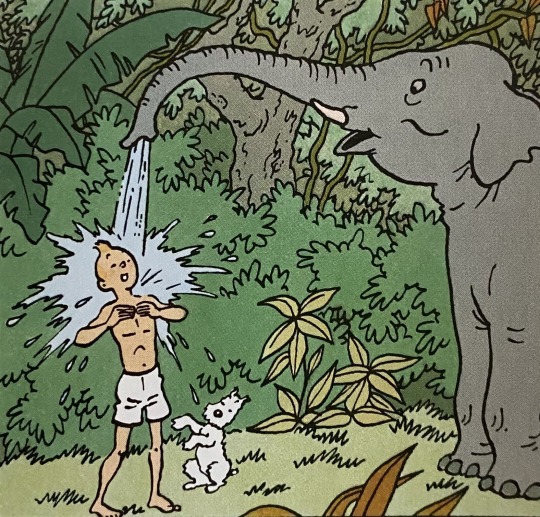
My favourite bits here are the introduction of the Thom(p)sons, a couple of comic relief detectives from Scotland Yard, as well as the beautiful imagery of Tintin discovering the tombs in Egypt. The discovery of the tomb of Tutankhamen was all the craze at the time of original publication in the 30s, and so Hergé’s take on the ills that befell the discoverers and explorers is fascinating. Finally, this panel always amused me: Tintin learned how to speak to Elephants while in the jungles of India, and he ordered one of them to help out with a shower.
The first of Tintin's full length adventures 4 February 2012
This is the story where Tintin comes on his own. While it was still written in a serialised form when it first appeared back in 1934, this story has a proper story arc where Tintin stumbles on a sophisticated drug smuggling ring that stretches across the entire Eurasian continent. It is here that Tintin's companions begin to be developed (namely the Thompson twins) and we also begin to see Tintin going on real adventures and chasing after a singular bad guy. Where Tintin in America seemed to be a hodge podge of different stories thrown together, here we begin to see a well constructed adventure. Tintin is on a Mediterranean cruise (much to Snowy's annoyance - and here we begin to see the character of Snowy, the loyal and faithful companion, developed as well) when he runs into the first of Herge's many absent minded professors, Dr Sophocles Sarcophagus. He is travelling to Egypt to uncover a lost tomb. Tintin also meets one of the recurring villains of the piece, the film mogul Rastapopolous. Herge developed this character very well in this book because we do not, at this stage, realise that he is the bad guy, and in fact when the master of the drug ring falls off a cliff at the end, we are left wondering who it was and whether we will ever find out. While this story can be read on its own, it does carry over to the Blue Lotus, however I never got to read the Blue Lotus until a long time afterwards. As for this story, it is by far my favourite of the Tintin adventures. Some have suggested that Herge had not got the culture element right here, but we will note that after the Blue Lotus, Herge begins to create his own countries where the adventures are placed, and maybe it is a move away from raising clearly raising his concerns to being much more subtle in his criticism. Yet we do have criticism within this story (as we do with the next one as well). It is not until Tintin reaches India that we are confronted with the destruction that a lot of these drug smuggler's are causing. While as a kid we read this book and considered that drugs smuggling was bad because Tintin is out to get them, it is when he meets the Raj of Gaipajama that the major concern is raised. The Raj is out to stop the smugglers because of the suffering they cause his people (and Herge is obviously trying to raise awareness of the practice, which still occurs today), namely that the smugglers force the peasants to grow opium poppies and purchase the poppies off of them at a significant discount. However, because the peasants are growing poppies they are unable to grow their own food, and as such are forced to purchase food off of the smuggler's at a significant premium. The comedy is ramped up a lot here as well. Tintin in America was simply silly in a lot of cases, but now we have the Thompson twins, two Interpol Agents (I believe, though the English versions suggest that they are Scotland Yard) who bumble their way through the investigation, and but end up being the assistance that Tintin needs to crack the case. The most amusing part was where they think they see Tintin sitting behind a dune and whack him on the head with a cane only to discover it is a sheik. In the next panel, Tintin arrives at a city that is being mobilised for war because one of their sheiks was attacked. Then there are the three huge Indians let into Tintin's cell, to teach him a lesson, and then we hear the sounds of fighting, and an ambulance rushing off to pick up the wounded, only to discover that it was the three Indian dudes – golden.
You know you want to. It's Tintin. The guy every kid wants to be. The guy you grow up to be. I even had the same dog.
The guy in my corner shop was the absent minded professor and my dad's mate was Captain Haddock.
The artwork is awesome and the stories are intriguing and full of mystery.
I confess I've read the whole series and loved every minute of them. This was a time before social media when a kid could let his imagination run away with him.
And if you love the book there are also cartoon versions of them.
Als ze op reis zijn in Egypte, ontdekken Kuifje en Bobby de tombe van een farao en sarcofagen met daarin dode egyptologen. Er zijn ook vele dozen met sigaren. Om het mysterie van deze sigaren te ontrafelen, moeten Kuifje door Arabië en India reizen. Ze komen op het spoor van een internationale drugsbende. En ze beleven hachelijke avonturen eer ze aan de misdadigers kunnen ontsnappen.
بنظرم سیگارهای فرعون شروع اصلی داستان های تن تنه. هم معمایی بود و هم جنایی رازآلود و هم پر تعقیب و گریز همراه با شوخی و کمدی مناسب. ناپیوستگی که در قسمت های قبلی دیده میشد تو این قسمت خیلی کمتر بود و انسجام داستانی بیشتری داشت. تن تن باید معما را حل میکرد و سرنخ را دنبال میکرد. به نسبت قسمت های قبلی کاراکتر تن تن تغییر کرده بود هم از نظر برخورد با مشکلات و برخورد با آدمها و حتی حیوانات. ( از انفجار کردگدن با دینامیت در کنگو گرفته تا نگرانی برای یک فیل که تب کرده و گنه گنه بهش میده بخوره در سیگار های فرعون). هرژه از این قسمت جاپای داستان رو پیدا کرده. به طوری که خواننده برای خواندن ماجرای بعدی اشتیاق داره.
Written in 1936 , The Blue Lotus is the sequel to the colourful Cigars of the Pharaoh. In the Cigars of the Pharaoh , Tintin has almost succeeded in smashing an international gang of drug traffickers , managing to capture all of them except the leader who mysteriously crashes over a ravine. His further investigations lead him to China , then under threat from Japanese agression. Tintin comes up against a madman infected with a dart that sends the recipient insane , enraged British colonists out for revenge after having been humiliated by Tintin and the Japanese army , with the chief villain of the piece being Japanese businessman Mitsuhirato. This album drew protest form the Japanese government of the time , and was praised by Chiang Kai Shek , President of the Republic of China. However, it was banned by China's Communist regime until 1984 , due to some of their own insane Maoist reasoning-and even then was still chopped up and heavily edited. Other albums having been banned by the Communist dictatorship in China where Tintin in tibet (for recognizing tibetan culture) , Tintin in the Land of the Soviets (for exposing Communism)and Tintin in the Congo ('Colonialist').
প্রথম তিন বই থেকে অনেক উন্নতি। বর্নবাদ আর উপনিবেশিকতার ছায়া অনেক কমেছে। আর্টওয়ার্ক আরো পরিশীলিত, ডিটেইলিং আরো নিখুঁত। টিনটিনের তার চরম শত্রুর প্রথম দেখাও পায় এই বইয়ে, যদিও তার পরিচয় প্রকাশ করা হয় নাই। মরুভূমির পটভূমি থেকে ভারতের ঘন জংগল, সব জায়গাতেই ব্যাকগ্রাউন্ডের ডিটেইলিং প্রায় নিখুঁত এবং নজরকাড়া। পিরামিডের ভিতরের দৃশ্য নিঃশ্বাস বন্ধ করে দেওয়ার মতো সুন্দর এবং নিখুঁত। প্লেন, ট্রেন, গাড়ি, পাল চালিত ডৌ নৌকা, নানা রকম যানবাহনের দেখা পাওয়া যায়, সবগুলোই আসল বাহনের সাথে নিখুঁত মিল রেখে আঁকা হয়েছে।
বইটার দূর্বলতা কিছু অতি প্রাকৃতিক ঘটনা গল্পে জুড়ে দেওয়া, হাতির সাথে টিনটিনের ট্রাম্পেট বাঁজিয়ে কথা বলা।
মোটের উপর টিনটিন সিরিজের মোড় যে ঘুরতে যাচ্ছে, সে আভাস দেওয়া একটা বই।
I just loved this new adventure! I did not remember any more (since I read these books so LOOOONG ago) that this was the adventure in which Dupont et Dupond appear for the first time, as well as the well known Portuguese character Oliveira da Figueira, the salesman who can make business even in the middle of the desert!
There is always a bit of xenophobia in the Belgian perspective in which the book was written, but we have to take into account the epoch in which it was written... Anyway, it is better than Tin-tin in Congo, that is really racist!!!!!
Anyway, these adventures are lots of fun and remind me of nice moments of my youth. Because my parents were teachers and I was born in Lisbon, Portugal during the beginning of the sixties, there was a certain "intellectual prejudice" against reading comics... the idea was that children who got used to reading comics would never get used to enjoy real books and would not develop their reading skills. Therefore, there were NO such books in our house. And it took until I was in my teens, maybe around 13 or more, to be "allowed" to read the Tin-tin books that belonged to my neighbours,and then only because it was the French original version, so my family thought that I would be developing my French - which was true and gave me the appetite for reading the originals whenever possible, when I can read the languages...
I've always been absolutely crazy about Egyptian history ... so Egypt + Tintin sounded like Heaven to me! I had to read this one! And I did, and it didn't disappoint. :)
I still remember the day clearly—1993, the summer I was promoted to Class VIII. There was a quiet excitement in the air, a mix of pride and anticipation as I walked home with my new textbooks clutched in my hands. I was ready, at least in theory, for more algebra, longer history lessons, and essays that seemed to grow in length with each passing year.
Yet, tucked among those textbooks, I had another prize, one that promised a different kind of adventure:Tintin #4: Cigars of the Pharaoh by Hergé.
Buying that comic on the same day as my Class VIII books felt almost illicit, like sneaking in a slice of indulgence before the world demanded seriousness from me.
There was a thrill in knowing that the pages inside were not going to teach me grammar or fractions but would instead carry me far from the classroom, far from the monotony of school routines. Hergé’s line drawings, crisp and precise, seemed almost to vibrate with possibility.
Tintin, with his shock of blond hair and unwavering courage, promised a universe where curiosity was more powerful than fear and where danger was only part of the fun.
I opened the book that afternoon, sitting cross-legged in the corner of my room, sunlight pooling lazily across the floor. The first pages carried me to a world of mysterious tombs, shadowy conspiracies, and exotic lands—Egypt, with its deserts and palaces, and the hidden secrets of Pharaohs long gone. What struck me then, even as an eleven-year-old, was the sense of pace Hergé maintained.
The narrative moved swiftly but deliberately; every frame, every panel, demanded attention. There was humour too—Captain Haddock’s exclamations and Snowy’s sly antics provided moments of lightness amid danger.
I remember laughing out loud at Haddock’s bewilderment when confronted with the bizarre schemes and yet feeling my heart race when Tintin found himself cornered by hidden enemies.
Reading Cigars of the Pharaoh was not just about the story. It was about the thrill of immersion, the joy of following Tintin as he pieced together mysteries with logic, intuition, and sometimes sheer luck. For a brief few hours, I lived in that world. The patterns of my daily life—the bells, the homework, the lessons—faded into the background. It was an escape, certainly, but also an introduction to something subtler: the pleasure of curiosity and the reward of careful observation. Tintin’s attention to detail, his persistence, and his courage were subtly inspiring.
I realised that adventure could exist in imagination as well as reality, and that cleverness and courage could triumph over confusion and danger.
Looking back now, thirty years later, I can see why this comic left such a lasting impression. It was my first real encounter with serialised storytelling that combined suspense, humour, and moral clarity. There was a rhythm to Hergé’s work, a balance of tension and relief, that made me want to read not just this book but the entire series.
Even as a child, I understood that Tintin’s adventures were more than escapades; they were lessons in observation, empathy, and resilience, packaged in the most entertaining way possible.
That single afternoon with Cigars of the Pharaoh remains vivid in my memory. It marks a moment when school responsibilities and childhood curiosity coexisted, when a young boy could sit with the weight of textbooks at his side and still let his imagination soar across deserts, tombs, and the secret corridors of history.
Tintin was my companion in those days, a guide through danger and laughter alike, and reading that comic was the beginning of a lifelong love for stories that combine intelligence, adventure, and heart.
Even now, when I return to Tintin, I feel that same excitement—the echo of a boy on the cusp of adolescence, discovering that the world is both mysterious and thrilling, waiting to be explored panel by panel.
Cigars of the Pharaoh was more than a comic; it was an invitation to adventure, and one I gladly accepted.