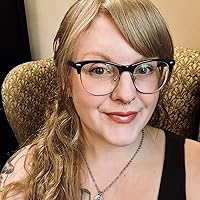
Award-winning novelist and memoirist Amber Dawn reveals a gutsy lyrical sensibility in her debut poetry a collection of glosa poems written as an homage to and an interaction with queer poets such as Gertrude Stein, Christina Rossetti, and Adrienne Rich. By doing so, Dawn delves deeper into the themes of trauma, memory, and unblushing sexuality that define her work.
Amber Dawn is the author of the Lambda Award-winning novel Sub Rosa and the memoir How Poetry Saved My Life (winner of the Vancouver Book Award). Her other awards include the Writers' Trust of Canada Dayne Ogilvie Prize.
Amber Dawn is a writer, filmmaker and performance artist based in Vancouver. She is the author of the novel Sub Rosa (Arsenal Pulp Press, 2010), editor of the Lambda Award-nominated Fist of the Spider Woman (Arsenal Pulp Press, 2008) and co-editor of With a Rough Tongue: Femmes Write Porn (Arsenal Pulp Press, 2005). Her award-winning, genderfuck docu-porn, "Girl on Girl," has been screened in eight countries and added to the gender studies curriculum at Concordia University. She has toured three times with the infamous Sex Workers' Art Show in the US. She was voted Xtra! West's Hero of the Year in 2008. She has an MFA in Creative Writing from the University of British Columbia. Currently, she is the director of programming for the Vancouver Queer Film Festival.
Have you ever heard of something called a glosa poem? If you haven’t, you’re like me when I picked up Amber Dawn’s debut poetry collection Where the Words End and My Body Begins, which is comprised of these things called glosa poems. I admit, I was intrigued and surprised: I mean, you don’t read a lot of contemporary poets who are using strict forms, let alone archaic forms that even a former English major like me hasn’t heard of! This book of poems is a welcome change from the sea of free verse that you usually find written by today’s poets.
If you’re at all familiar with 20th century queer, lesbian, feminist, and survivorship poetry (especially from Canada), you’ll recognize a lot of the poets Amber Dawn has chosen for her glosas: Trish Salah, Gertrude Stein, Rachel Rose, Lucille Clifton, Adrienne Rich, Leah Horlick, Sina Queyras, Jillian Christmas, Lydia Kwa, Leah Lakshmi Piepzna-Samarashinha, and more! I love the idea that Where the Words End and My Body Begins is an ode to being a reader and writer, and a conversation between women poets. Despite the fact that writing can be about as isolating as work can get, these glosa poems create a kind of community on the page...
I got a review copy of this from the publisher in exchange for an honest review. I normally save poetry to April but this was expiring prior to that date!
All the poems in this book are in glosa form, something I hadn't heard of before - you take a stanza from a poem by someone else, and use one line in each of your own poem's stanzas. I thought it might be too formulaic but I love what the poet did with the lines. They allow her to be in dialogue with poets such as Gertrude Stein, Adrienne Rich, Leah Horlick, and others that were less known to me - and either magnifying or twisting their meaning.
There are themes here - of queer identity first and foremost, but also mental illness, family, and love.
My favorites include:
-Queer Infinity "Never confuse hold fast with hold still"
-Queer Grace "Fisting the forsaken mystery right out of each other."
-Sandra Anna's Baby Book "You've asked me to forgive, and maybe this is how"
-Together Six (partly because it turns the glosa upside down) "our love made us fabulists"
I have to say that my queer lit class has the best syllabus I've ever seen. Without ego, since all I had to do with it was curation, and all admiration and appreciation since the queer Canadian writers I put on this syllabus are literally everything. This book, which I assigned without pre-reading because I've read and loved all of Amber Dawn's other books, prose, collected and poetry, was my favourite of her works.
While reading, I cried and I also stopped and said both "fuck yes" and "oh fuck yes." This book is an "oh fuck yes" kind of book.
This was the worst poetry book I have ever read and likely will ever read. Most of the time I had no idea what Amber was attempting to convey to me--the sentences were largely random, the ideas impossible to follow. I feel that a lot of the terms and phrases thrown in here were used simply for shock value, like "I found my clit in a railway yard" etc.
A lot of huge words are thrown in here, and it really felt like the author was going out of her way to shove them in there to look impressive. Reading this was an absolute chore, and I recommend this to exactly no one.
So much of writing is imitation, and Amber Dawn’s book of glosa poetry, which breaks another poet’s stanzas into lines which will begin her own poems’, is a great example of the creative explosion that can occur in these moments of “theft.” Her voice, which travels between multiple forms but circles around themes of queer, sex worker culture and survivorship, is both sharp and incredibly playful, allowing her to draw from more formal and more avant-garde poets alike.
I tried to get past the over abundance of $10 words and arrogance that seemed to come from the page, but I eventually stopped when Ginsberg was the figure used to mention the Stonewall riots. This is very clearly a book written by a queer White woman for other queer White women. Not much in there for anyone else.
Brilliant, I so love the form that she uses throughout the book. It makes me want to try my hand at that form myself. So glad to have more of her work on my shelf.
Just really incredible, beautiful poetry--the form made me feel sort of grounded, and there are so many lines that are so beautiful--Amber Dawn does an amazing job of weaving the lines she's used in between her own work in just really remarkable and awesome ways. If you, like me, are a person who feels like you struggle to read poetry, I think this really helped me feel like I understood how to approach the poems in ways I normally don't. Even if you feel more at home in poetry, though, you should read this.
Where the words end and my body begins is a fascinating collection of poems that work in lines from other poets. Dawn's use of these external words is seamless most of the time, and the poems themselves are gritty, yet beautiful. This is an ode to queer love, all the harsh and breathtaking aspects of it.
This is such a beautiful collection of poetry that celebrates queer survival. Every line is truly a work of art and I am definitely gonna reread this when I am in the mood for queer poetry.
A wonderful collection of glosses of queer poems old and new. This took me all over the place emotionally, and was sad, and beautiful. I never have the words to describe poetry, but I loved this collection, and would happily slip it into bags and purses in a guerrilla advertising campaign.
I struggle with poetry and I struggled with this collection. I'm grateful to now know what a glosa poem is, but I didn't care for the majority of poems she based her poems off of, so I was starting from a wonky place. The cover is beautiful.
So, this is my introduction to the glosa poem - never formally encountered this poetic form before, and really appreciate the author's introductory commentary on what it is, and why it's a form that can blend queer history, trauma, activism and present. That being said, I actually wished this volume was significantly longer...I was really starting to get into the meld of AD's voice with that of poets from the past and present, when it ended. I suppose I can't be too upset about that - since I don't imagine writing in this style is particularly easy - however, I did feel a little unexpectedly cut off right when I was starting to hear AD's voice really start to emerge in a coherent way above the voices of the poets she quoted.
This poetry collection was so refreshing in its innovation and callback to previous poets' works. I had never heard of the glosa poem before, which takes a quatrain from another poet and uses it like a prompt for conversation; each poem has four ten-line stanzas, with the last lines being sequentially taken from the established poem. It was so interesting to see Dawn's mind work from the original poem to these new messages. Themes explored in this collection center on suicidal/trauma survivorship, LGBT sexuality and community, and feminism.
this book did not cut it for me which was a bit disappointing considering some of the hype around it :// there was only one “poem” (more of a phrasing) in this that stuck out to me and the rest was hard to follow and i found myself waiting to see how long there was left. it almost seemed as if the author searched for ‘big vocabulary words’ to use and just threw them in there 🤷♀️. the writing style i absolutely could not connect with. perhaps if i was a bit older i could actually understand what it was even about lol, but nope, not for me.
I was pulled in by the cover and title of this book, but it didn’t turn out to be a good representation of how much I would enjoy the book itself. Basically, I don’t like glosa poems, like at all. But! I did end up bookmarking two of them... for what it’s worth.
There are some great lines in this. And I bet great poems inspired these glosas.
But, I found myself missing the longer stories and confessions of "How Poetry Saved My Life". Which is an amazing and vulnerable memoir.
I started in the middle as I have a tendency to do with poetry and short story collections. I didn't realize the form until.reading the introduction. I haven't heard of glosa poems before. I may have to try them.
But lines like "Money is a poor man's myth" are really, really good.
I still need to give Sub Rosa another try, I did buy it. And I really appreciate Amber Dawn's voice. I'm glad she survived being a sex worker. Some don't. We need to hear their voices and do so much better.
I expect I will pick this up again. I think I didn't get everything on the first reading.
There are many great moments in this book. Some of these poems are heart-wrenching and some are kind of badass and some are sneakily hot (or all of the above). The poet shows a thoughtful use of the glosa form with lots of interesting, surprising twists, but overall I don’t think the book consistently delivered the emotional punch I expected it to. Or maybe it did, and the language toward the end grew in tenderness yet slackened a bit. Love poems are notoriously hard to pull off without into sliding into the sentimental, and maybe it's OK to be sentimental and political all at once and I've internalized the misogyny around confessionalism in poetry (though I myself have been called a confessional poet). At the end of the day, a book of queer femme glosas is a pretty great thing.
I don't really know how to rate this book, since I'm not a poetry reader. This was a book club pick, and having the group discussion helped me get into it more and make some sense of things. I didn't hate it, but I didn't love it either. I still feel like poetry isn't for me, though the experience of reading this collection probably made me less resistant to trying other poems in the future. I'm still hesitant to give Brown Girl Dreaming a go because I'm just not wild about the form. Maybe I'll get there eventually.
I've never read gloss poetry before, so I was pleasantly surprised by the format and style of Dawn's writing! That being said, the overall perspective and execution of certain ideas felt really... White. I wasn't super impressed with how events led by prominent black activists were viewed through the lens of whiteness when, uh, yeah. I'll definitely keep an eye out for more poetry in this style though!
Another modern poetry book that just disappointed me. No flow or depth in the writing, it just seemed like jumbled story telling or a piece from some girls diary. I'm not sure if that was the intention but I couldn't read most of the writing and ended up skimming through this book. Maybe it's how I couldn't relate to any of it but I'll be giving this one star. (This has been on my tbr for years now, can't fathom why I ever added it).
2.5 stars. My housemate suggested I read this—they lent it to me after I read one of their tommy pico books so I thought it would be similar. Turns out, this poetry is not my jam, but the author seems very interesting and I wanna read her memoir: queer, ex-sex worker, ex heroin user? Sign me up.
I read Amber Dawn's earlier book "How Poetry Saved My Life" because how can you not read a book with that name? She writes about a world that is unfamiliar to me, but in a way that doesn't make me turn away from it. I appreciate that. I found parts of "Where the Words End and My Body Begins" achingly beautiful. If you're looking for a fresh voice in poetry I recommend Amber Dawn.
It took me awhile to warm up to what Amber Dawn is doing here, but once our rhythm was established, I sank into these brazen poems dealing with queer community, sex work, gentrification, and love. This is my first encounter with the glosa form, and now I want to start collecting quatrains to experiment with writing my own.
God, I loved this book. I have never read any glosa poetry before, and I really love the form. But most of all, the subject matter of these poems really hit close to home. They really do bring you on a heartfelt journey of queer life, full of rage and love and beauty.
fittingly, my quest this year for poetry that speaks to me ends with the book that also tops off my @goodreads reading goal for the year. beautiful, heart wrenching, agonizingly lovely queer poetry by @amberdawnwrites ..this brought me to tears and filled me with pure love. 5/5.
candid, powerful poems of survivorship, healing, queer lineage, solidarity and shared pain, these poems are thunderclap and fireplay, sex and sensuality. when read aloud, they sing love like a rebel yell: more, more, more.