

What do you think?

In the Mountains of Madness: The Life, Death, and Extraordinary Afterlife of H.p. Lovecraft
In the Mountains of Madness: The Life, Death, and Extraordinary Afterlife of H. P. Lovecraft interweaves the biography of the legendary writer with an exploration of Lovecraft as a phenomenon. It aims to explain this reclusive figure while also challenging some of the general views held by Lovecraft devotees, focusing specifically on the large cross-section of horror and science fiction fans who know Lovecraft through films, role-playing games, and video games directly influenced by his work but know little or nothing about him. More than a traditional biography, In the Mountains of Madness will place Lovecraft and his work in a cultural context, as an artist more in tune with our time than his own. Much of the literary work on Lovecraft tries to place him in relation to Edgar Allan Poe, M. R. James, or Arthur Machen; these ideas have little meaning for most contemporary readers. In his provocative new book, W. Scott Poole reclaims the true essence of Lovecraft in relation to the comics of Joe Lansdale, the novels of Stephen King, and some of the biggest blockbuster films in contemporary America, proving the undying influence of this rare and significant figure.
Audio CD
First published August 22, 2016
Ratings & Reviews
Friends & Following
Create a free account to discover what your friends think of this book!
Community Reviews
Displaying 1 - 30 of 100 reviews

October 3, 2016
”H. P. Lovecraft found in his personal dreamlands a place he considered no less real than the physical world, dimensions of the imagination that Poe never uncovered despite the help of morphine, opium, and booze.”
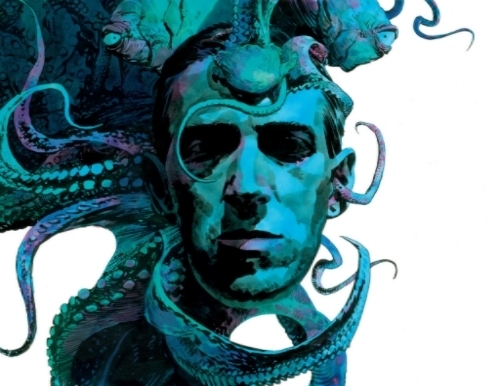
Vivid night terrors seems to be a common thread that connect authors like Robert Louis Stevenson, Edgar Allan Poe, and H. P. Lovecraft. These nightmares that bring them out of a restless, sweaty sleep, screaming, clutching their hair, and trembling with fright became the plots of their stories. Lovecraft must have had the worst dreams of any writer in history. His tentacled beast, misshapen creatures, and terrifying winged visions have influenced writers, artists, and musicians for generations, none more evident than with the artist H.R. Giger.
Lovecraft was a sickly person from childhood to adulthood, much the same as Stevenson and Poe. His father went mad at a young age with whispers of syphilis being the debilitating underlying cause. His mother also eventually found herself staring at the same walls of the same building as her husband. With both parents going mad, what chance does a young lad have to keep his sanity?
Maybe he writes.
He worked at night and slept during the day. For most of his life, he interacted with few people. He did marry, which is frankly shocking. I can’t imagine this pale, awkward, cave dwelling creature convincing any woman that he was a good catch. All became more clear when I realized that he met Sonia Greene mere days after his mother’s death. I don’t have to be a psychologist to know that he was looking for a surrogate mother. He realized very quickly he didn’t like being married and especially so in New York, away from his ”dearest jewel,” Providence, Rhode Island.
He was involved with a precursor to social media, which involved pen and paper and his mailbox. He corresponded with hundreds of people from around the country who enjoyed his writing. He wrote long letters at times, sometimes novelette in length, on a variety of subjects, showing the depth of his interest in everything. He also was an antiquarian, chasing down the past when he traveled by seeking out period architecture and antique stores. He was a man out of time.
The horrors that he created are horrifying in any era.
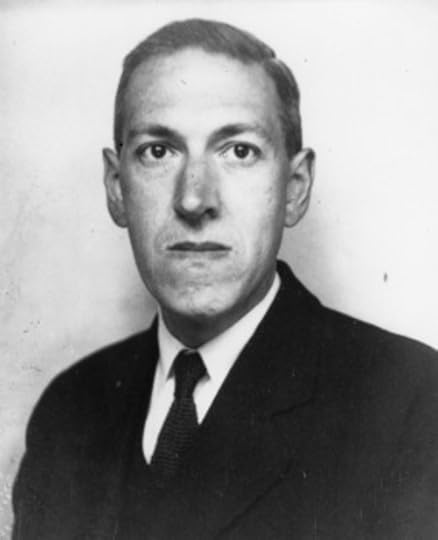
A pensive looking lad, Howard Phillips Lovecraft.
I never played any role playing games growing up. I didn’t have access to the right friends during those heady D&D days of the 1980s. I’ve never been much for games anyway, so even if I had a group of nerdy friends like the kids on the Netflix original show Stranger Things, I probably would have been a wet blanket about spending hours upon hours building worlds around dice throws. Though I marvel at the intricacy, creativity, and detail that was involved with gaming. J.R.R. Tolkien had the most influence on role playing games, but according to W. Scott Poole, H. P. Lovecraft had the second most. Lovecraft really came back around in the 1960s with the flower power generation who were getting high, getting laid, and looking for alternative understandings about how the world should work. Of course, Lovecraft probably goes well with LSD and peyote buttons. If you are looking for an experience outside yourself, Cthulhu, Dagon, or Azathoth manifested on a trip would certain create terror you’ve never felt before.
Lovecraft didn’t need alcohol or drugs to dream what he dreamed.
There has been quite a bit of controversy surrounding Lovecraft’s views on race and his flirtation with Nazism. Both are hard to excuse. We do expect our literary men to be ahead of the curve on basic rights and to be harbingers of coming evil, such as the Third Reich. When they embrace racism or have personal extremist beliefs, it can impact how we relate to their writing. The World Fantasy Awards since 1975 have been awarding writers busts of Lovecraft to the category winners. In 2015 it was announced that the awards would no longer be modeled after H. P. Lovecraft. We could say he was a product of his era, but I think most of us have come to the conclusion that he might have been a little more embracive, especially of racism, than the average New Englander in the 1930s.
It is difficult to separate the man from his work, but with a bit of misdirection for my brain, I can do it. I can still enjoy his unique style, his creative creature concoctions, and the pacing of terror he brings to a story. He was a fearful man, housebound for most of his life, trapped in a horror of his own making. He died young at age 46, but left a lasting impact on the genre of horror and even well beyond the restrictions of a genre. You can see his face or the horrifying visions of one of his creatures on t-shirts, mugs, in tv shows, and on posters. He is still popular and still relevant when many of his peers have faded away into obscurity.

Cthulhu
Poole’s style of writing felt spastic in the beginning. He was throwing so much great information at me in a shotgun blast manner that I was having to double back and reread sentences to make sure I caught everything he was trying to convey. Either he settled down as the book progressed or my brain made the proper adjustments because I started to feel more comfortable by about the one-third mark. I didn’t really know that much about Lovecraft, so it was nice to have some color added to his tintype image.
May monsters only stalk the pages of your books and not the hallways of your life.
If you wish to see more of my most recent book and movie reviews, visit http://www.jeffreykeeten.com
I also have a Facebook blogger page at:https://www.facebook.com/JeffreyKeeten

Vivid night terrors seems to be a common thread that connect authors like Robert Louis Stevenson, Edgar Allan Poe, and H. P. Lovecraft. These nightmares that bring them out of a restless, sweaty sleep, screaming, clutching their hair, and trembling with fright became the plots of their stories. Lovecraft must have had the worst dreams of any writer in history. His tentacled beast, misshapen creatures, and terrifying winged visions have influenced writers, artists, and musicians for generations, none more evident than with the artist H.R. Giger.
Lovecraft was a sickly person from childhood to adulthood, much the same as Stevenson and Poe. His father went mad at a young age with whispers of syphilis being the debilitating underlying cause. His mother also eventually found herself staring at the same walls of the same building as her husband. With both parents going mad, what chance does a young lad have to keep his sanity?
Maybe he writes.
He worked at night and slept during the day. For most of his life, he interacted with few people. He did marry, which is frankly shocking. I can’t imagine this pale, awkward, cave dwelling creature convincing any woman that he was a good catch. All became more clear when I realized that he met Sonia Greene mere days after his mother’s death. I don’t have to be a psychologist to know that he was looking for a surrogate mother. He realized very quickly he didn’t like being married and especially so in New York, away from his ”dearest jewel,” Providence, Rhode Island.
He was involved with a precursor to social media, which involved pen and paper and his mailbox. He corresponded with hundreds of people from around the country who enjoyed his writing. He wrote long letters at times, sometimes novelette in length, on a variety of subjects, showing the depth of his interest in everything. He also was an antiquarian, chasing down the past when he traveled by seeking out period architecture and antique stores. He was a man out of time.
The horrors that he created are horrifying in any era.

A pensive looking lad, Howard Phillips Lovecraft.
I never played any role playing games growing up. I didn’t have access to the right friends during those heady D&D days of the 1980s. I’ve never been much for games anyway, so even if I had a group of nerdy friends like the kids on the Netflix original show Stranger Things, I probably would have been a wet blanket about spending hours upon hours building worlds around dice throws. Though I marvel at the intricacy, creativity, and detail that was involved with gaming. J.R.R. Tolkien had the most influence on role playing games, but according to W. Scott Poole, H. P. Lovecraft had the second most. Lovecraft really came back around in the 1960s with the flower power generation who were getting high, getting laid, and looking for alternative understandings about how the world should work. Of course, Lovecraft probably goes well with LSD and peyote buttons. If you are looking for an experience outside yourself, Cthulhu, Dagon, or Azathoth manifested on a trip would certain create terror you’ve never felt before.
Lovecraft didn’t need alcohol or drugs to dream what he dreamed.
There has been quite a bit of controversy surrounding Lovecraft’s views on race and his flirtation with Nazism. Both are hard to excuse. We do expect our literary men to be ahead of the curve on basic rights and to be harbingers of coming evil, such as the Third Reich. When they embrace racism or have personal extremist beliefs, it can impact how we relate to their writing. The World Fantasy Awards since 1975 have been awarding writers busts of Lovecraft to the category winners. In 2015 it was announced that the awards would no longer be modeled after H. P. Lovecraft. We could say he was a product of his era, but I think most of us have come to the conclusion that he might have been a little more embracive, especially of racism, than the average New Englander in the 1930s.
It is difficult to separate the man from his work, but with a bit of misdirection for my brain, I can do it. I can still enjoy his unique style, his creative creature concoctions, and the pacing of terror he brings to a story. He was a fearful man, housebound for most of his life, trapped in a horror of his own making. He died young at age 46, but left a lasting impact on the genre of horror and even well beyond the restrictions of a genre. You can see his face or the horrifying visions of one of his creatures on t-shirts, mugs, in tv shows, and on posters. He is still popular and still relevant when many of his peers have faded away into obscurity.

Cthulhu
Poole’s style of writing felt spastic in the beginning. He was throwing so much great information at me in a shotgun blast manner that I was having to double back and reread sentences to make sure I caught everything he was trying to convey. Either he settled down as the book progressed or my brain made the proper adjustments because I started to feel more comfortable by about the one-third mark. I didn’t really know that much about Lovecraft, so it was nice to have some color added to his tintype image.
May monsters only stalk the pages of your books and not the hallways of your life.
If you wish to see more of my most recent book and movie reviews, visit http://www.jeffreykeeten.com
I also have a Facebook blogger page at:https://www.facebook.com/JeffreyKeeten

September 7, 2017
HP Lovecraft must be in the top three all time worst writers ever and maybe he is actually the worst. Here’s an example:
I felt the strangling tendrils of a cancerous horror whose roots reached into illimitable pasts and fathomless abysms of the night that broods beyond time
His puerile most-purple-ever prose shovels on the gigantic nerve-wracking superlatives as if by shouting so loudly it will force the reader to bow before its terrible power.
Shrieking, slithering, torrential shadows of red viscous madness chasing one another through endless, ensanguined corridors of purple fulgurous sky … formless phantasms and kaleidoscopic mutations of a ghoulish, remembered scenes; forests of monstrous overnourished oaks with serpent roots twisting and sucking unnamable juices from an earth verminous with millions of cannibal devils; mound-like tentacles groping from underground nuclei of polypous perversion … insane lightning over malignant ivied walls and daemon arcades choked with fungous vegetation …
Or try this one
The muffled, maddening beating of drums and thin, monotonous whine of blasphemous flutes from inconceivable, unlighted chambers beyond time
So, heard any blasphemous flutes lately? Maybe Jethro Tull?
HPL was stuck in this ridiculous teenage zone all his life. Scott says “He could not care less for his characters and, for the most part, he didn’t wish us to care either”. When even he realised he’d overused the words “blasphemous” and “unnameable” and “loathsome” he would invent monsters with really-far-out very-alien-indeed names just like a little kid would do, such as
Cthulhu
Xoth
Idh-yaa
Gthanothoa,
Ythogtha,
Zoth-ommog
Nyarlathotep
Yibb-Tsll
Yomagn’tho
Y’Golomac
Lu-kthu
Mordiggian
Yig
Er, Yig?? Yig! !
It turns out that W Scott Poole, our guide through the life and afterlife of HPL, an affable fellow whose company I very much enjoyed, takes this crap seriously, as do many thousands of HPL fans. I remember reading a few Lovecraft stories years ago in old horror anthologies and thinking uh what? What is this? at the time.
So maybe all of HPL’s readers are reading him a little bit of tongue in cheek, like as an exercise in camp. Could be, there are enough cuddly-toy knitted Cthulhus out there, but it’s more than that, I think. In spite of his silliness and camp quality, nevertheless, he really does have some genuinely weird and horrible ideas. I think the fans may be looking past the awful gnarled ghastly overwritten surface of Lovecraft’s prose which so puts me off.
Maybe. I’m just trying to find some kind of an excuse for all the HPL fans. They need one.
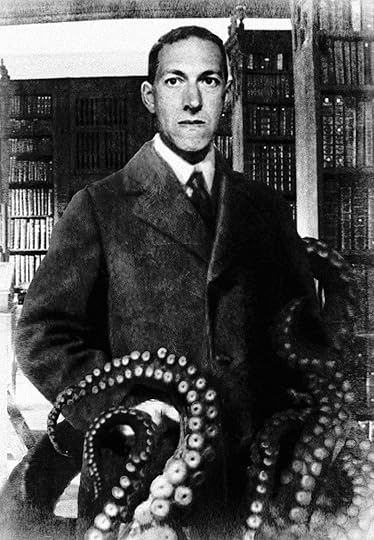
NOT ONLY A TERRIBLE WRITER, ALSO A MORALLY BAD PERSON
He married a Jewish woman. The marriage was a disaster. His wife noted
That he referred “to Semitic peoples as beady-eyed rat-faced Asiatics” and bitterly insisted “all foreigners were mongrels”.
He briefly lived in New York and wrote to a friend:
The New York mongoloid problem is beyond calm mention
Okay so the next big thing about HP was that he was a flat-out 100% no-getting-away-from-it racist. Although Scott is a major HPL fan, he does not pull his punches here :
In both formal and informal conversations I’ve had with young Lovecraft fans, most have dodged my question about how they deal with Lovecraft’s attitude to race. … Some assert that his attitudes changed before his death, that he’d realised he’d been mistaken…. They are catastrophically wrong… He infused his fiction with racism, indeed attempted to use conceptions of “mongrelisation” (a favorite word of his) to induce a sense of terror among his assumed readership of white, male Anglo-Saxons.
Scott does not let HPL off the hook with their “he was a product of his times” arguments. But it seems to me that he pretty much reformulates it here :
The most we can say is that racism so completely structured the worldview of the white ruling class…that an otherwise brilliant man succumbed to the blandishments of fascist rhetoric. … Lovecraft’s literary reputation, and certainly his invincible place in popular culture, remains as secure as the many white racists who wrote before and after him.
Well, I know all too well the misery of finding out some unacceptable truth about a particular artistic hero. For years a guy called John Martyn was a musical hero of mine – beautiful gentle folksy stuff mutating over the years into extended guitar dreamscapes and almost into jazz, very unique, fabulous, I loved him. Then after he died I read his ex-wife’s memoir and hey, what do you know, he was an alcoholic wife-beater just like all the other alcoholic wife-beaters you’ve encountered, just exactly as nasty, just exactly as grovelling and promising never to hit her again, every disgusting cliché. So now what do I think when his gorgeous music comes up on my ipod shuffle? Answers on a postcard, please.
The World Fantasy Convention began awarding the best fantasy fiction in 1975 with trophies in five categories. The winners got a comedy bust of HPL
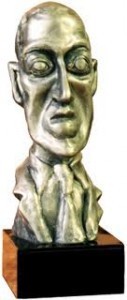
After a lot of vigorous debate about HPL’s racism, and following some awards going to writers of colour, and them publicly admitting how conflicted they were about it, this bust was retired in 2015 and replaced by a strange bonsai tree holding a moon. No official reason was given.
THE AFTERLIFE OF HP LOVECRAFT
How completely Lovecraft has become a lodestone in scholarly discourse as well as in pop culture
[we are almost] lost amongst the piles of Lovecraftiana threatening to bury us
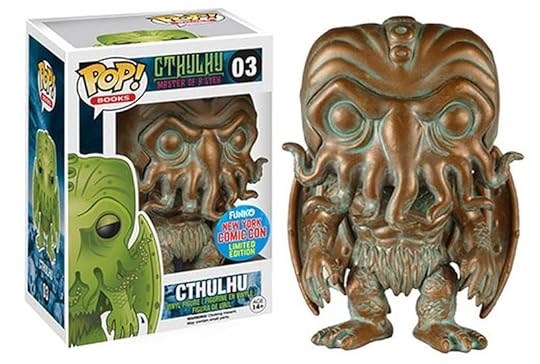
Scott takes us on a tour of Lovecraftian pop culture, beginning with the 1967 band H P Lovecraft, proceeding on to Black Sabbath and other metal bands –
It’s doubtful that a man whose musical taste never got much beyond popular tunes of the early century and Gilbert and Sullivan musicals would have subjected himself to Cradle of Filth
Even though they are all about the Cthulhu. Scott then tries to claim every horror movie since Night of the Living Dead as a spiritual descendent of HPL and he goes way too far, there’s not a horror movie he can’t see HPL’s ghostly presence inside looking out.
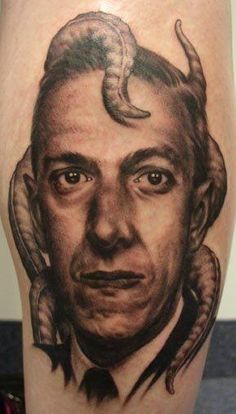
But there’s no doubt that the world of comics and graphic novels has featured Lovecraft’s world many times, and, maybe most interestingly, has featured HPL himself as the hero of various stories. For a genre author with an even greater appeal, who still reaches millions of readers, we can suggest Conan Doyle, but whilst Sherlock Holmes is even more obviously everywhere than the Cthulhu mythos, you don’t get graphic novels with Sir Arthur as a character, and you don’t get people tattooing the likeness of Sir Arthur on their lower backs. All of this is unarguable – HPL is a star, outshining Edgar Allen Poe, and for these young kids, bigger than names like Kafka.
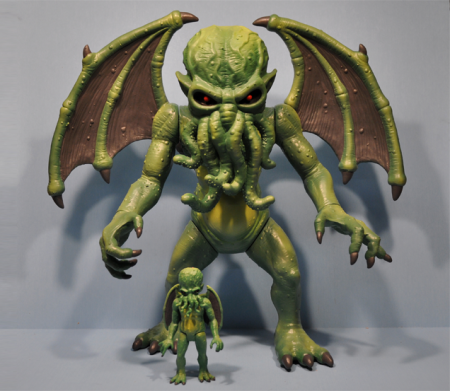
LOVECRAFT AND SEX
Scott is at pains to assure is that
Many of Lovecraft’s monsters don’t even begin to resemble genitalia
So that’s a relief. But here’s another thing to worry about :
A bizarre but perhaps unsurprising sideline to the Cthulhu/tentacle obsession has emerged in so called “tentacle porn”, a fetish popular among many, including a number of fans who want to stretch the boundaries of what that much used adjective “Lovecraftian” can mean.
You can google “tentacle porn” yourselves, but really, I wouldn’t recommend it. I turned slightly green and had to take an aspirin.
THE RECLUSE WITH A HUNDRED FRIENDS
Yes, you could call HPL a recluse. He never had a job, he lived mostly with his mother and after she died with his aged aunts. But he was just like a modern shut-in type, says Scott.
At one point Lovecraft may have been trading letters with up to one hundred regular correspondents
Scott says this was the early 20th century version of Facebook and Instagram. HPL saw very few people but he was in communication with a great many. And some of those letters were more than 20 pages long!
CONCLUSION
A great sort-of biography, which is much more a very entertaining debate about what HPL was and what everyone has made of him since his death at the age of 47 in 1937.
Highly recommended!
FURTHER READING
The Ballad of Black Tom by Victor LaValle
My Work is Not Yet Done by Thomas Ligotti
The Annotated HP Lovecraft by H P Lovecraft and Leslie Klinger
- You may be laughing at the last one but W Scott Poole has really convinced me that HPL has got something – something! – going on, and I need to put away my prejudice against racists who have the worst prose style and check out what these stories are all about, so I’m going to do that. I may be some time.
I felt the strangling tendrils of a cancerous horror whose roots reached into illimitable pasts and fathomless abysms of the night that broods beyond time
His puerile most-purple-ever prose shovels on the gigantic nerve-wracking superlatives as if by shouting so loudly it will force the reader to bow before its terrible power.
Shrieking, slithering, torrential shadows of red viscous madness chasing one another through endless, ensanguined corridors of purple fulgurous sky … formless phantasms and kaleidoscopic mutations of a ghoulish, remembered scenes; forests of monstrous overnourished oaks with serpent roots twisting and sucking unnamable juices from an earth verminous with millions of cannibal devils; mound-like tentacles groping from underground nuclei of polypous perversion … insane lightning over malignant ivied walls and daemon arcades choked with fungous vegetation …
Or try this one
The muffled, maddening beating of drums and thin, monotonous whine of blasphemous flutes from inconceivable, unlighted chambers beyond time
So, heard any blasphemous flutes lately? Maybe Jethro Tull?
HPL was stuck in this ridiculous teenage zone all his life. Scott says “He could not care less for his characters and, for the most part, he didn’t wish us to care either”. When even he realised he’d overused the words “blasphemous” and “unnameable” and “loathsome” he would invent monsters with really-far-out very-alien-indeed names just like a little kid would do, such as
Cthulhu
Xoth
Idh-yaa
Gthanothoa,
Ythogtha,
Zoth-ommog
Nyarlathotep
Yibb-Tsll
Yomagn’tho
Y’Golomac
Lu-kthu
Mordiggian
Yig
Er, Yig?? Yig! !
It turns out that W Scott Poole, our guide through the life and afterlife of HPL, an affable fellow whose company I very much enjoyed, takes this crap seriously, as do many thousands of HPL fans. I remember reading a few Lovecraft stories years ago in old horror anthologies and thinking uh what? What is this? at the time.
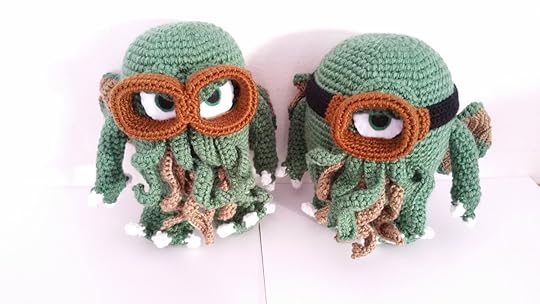
So maybe all of HPL’s readers are reading him a little bit of tongue in cheek, like as an exercise in camp. Could be, there are enough cuddly-toy knitted Cthulhus out there, but it’s more than that, I think. In spite of his silliness and camp quality, nevertheless, he really does have some genuinely weird and horrible ideas. I think the fans may be looking past the awful gnarled ghastly overwritten surface of Lovecraft’s prose which so puts me off.
Maybe. I’m just trying to find some kind of an excuse for all the HPL fans. They need one.
NOT ONLY A TERRIBLE WRITER, ALSO A MORALLY BAD PERSON
He married a Jewish woman. The marriage was a disaster. His wife noted
That he referred “to Semitic peoples as beady-eyed rat-faced Asiatics” and bitterly insisted “all foreigners were mongrels”.
He briefly lived in New York and wrote to a friend:
The New York mongoloid problem is beyond calm mention
Okay so the next big thing about HP was that he was a flat-out 100% no-getting-away-from-it racist. Although Scott is a major HPL fan, he does not pull his punches here :
In both formal and informal conversations I’ve had with young Lovecraft fans, most have dodged my question about how they deal with Lovecraft’s attitude to race. … Some assert that his attitudes changed before his death, that he’d realised he’d been mistaken…. They are catastrophically wrong… He infused his fiction with racism, indeed attempted to use conceptions of “mongrelisation” (a favorite word of his) to induce a sense of terror among his assumed readership of white, male Anglo-Saxons.
Scott does not let HPL off the hook with their “he was a product of his times” arguments. But it seems to me that he pretty much reformulates it here :
The most we can say is that racism so completely structured the worldview of the white ruling class…that an otherwise brilliant man succumbed to the blandishments of fascist rhetoric. … Lovecraft’s literary reputation, and certainly his invincible place in popular culture, remains as secure as the many white racists who wrote before and after him.
Well, I know all too well the misery of finding out some unacceptable truth about a particular artistic hero. For years a guy called John Martyn was a musical hero of mine – beautiful gentle folksy stuff mutating over the years into extended guitar dreamscapes and almost into jazz, very unique, fabulous, I loved him. Then after he died I read his ex-wife’s memoir and hey, what do you know, he was an alcoholic wife-beater just like all the other alcoholic wife-beaters you’ve encountered, just exactly as nasty, just exactly as grovelling and promising never to hit her again, every disgusting cliché. So now what do I think when his gorgeous music comes up on my ipod shuffle? Answers on a postcard, please.
The World Fantasy Convention began awarding the best fantasy fiction in 1975 with trophies in five categories. The winners got a comedy bust of HPL
After a lot of vigorous debate about HPL’s racism, and following some awards going to writers of colour, and them publicly admitting how conflicted they were about it, this bust was retired in 2015 and replaced by a strange bonsai tree holding a moon. No official reason was given.
THE AFTERLIFE OF HP LOVECRAFT
How completely Lovecraft has become a lodestone in scholarly discourse as well as in pop culture
[we are almost] lost amongst the piles of Lovecraftiana threatening to bury us
Scott takes us on a tour of Lovecraftian pop culture, beginning with the 1967 band H P Lovecraft, proceeding on to Black Sabbath and other metal bands –
It’s doubtful that a man whose musical taste never got much beyond popular tunes of the early century and Gilbert and Sullivan musicals would have subjected himself to Cradle of Filth
Even though they are all about the Cthulhu. Scott then tries to claim every horror movie since Night of the Living Dead as a spiritual descendent of HPL and he goes way too far, there’s not a horror movie he can’t see HPL’s ghostly presence inside looking out.
But there’s no doubt that the world of comics and graphic novels has featured Lovecraft’s world many times, and, maybe most interestingly, has featured HPL himself as the hero of various stories. For a genre author with an even greater appeal, who still reaches millions of readers, we can suggest Conan Doyle, but whilst Sherlock Holmes is even more obviously everywhere than the Cthulhu mythos, you don’t get graphic novels with Sir Arthur as a character, and you don’t get people tattooing the likeness of Sir Arthur on their lower backs. All of this is unarguable – HPL is a star, outshining Edgar Allen Poe, and for these young kids, bigger than names like Kafka.
LOVECRAFT AND SEX
Scott is at pains to assure is that
Many of Lovecraft’s monsters don’t even begin to resemble genitalia
So that’s a relief. But here’s another thing to worry about :
A bizarre but perhaps unsurprising sideline to the Cthulhu/tentacle obsession has emerged in so called “tentacle porn”, a fetish popular among many, including a number of fans who want to stretch the boundaries of what that much used adjective “Lovecraftian” can mean.
You can google “tentacle porn” yourselves, but really, I wouldn’t recommend it. I turned slightly green and had to take an aspirin.
THE RECLUSE WITH A HUNDRED FRIENDS
Yes, you could call HPL a recluse. He never had a job, he lived mostly with his mother and after she died with his aged aunts. But he was just like a modern shut-in type, says Scott.
At one point Lovecraft may have been trading letters with up to one hundred regular correspondents
Scott says this was the early 20th century version of Facebook and Instagram. HPL saw very few people but he was in communication with a great many. And some of those letters were more than 20 pages long!
CONCLUSION
A great sort-of biography, which is much more a very entertaining debate about what HPL was and what everyone has made of him since his death at the age of 47 in 1937.
Highly recommended!
FURTHER READING
The Ballad of Black Tom by Victor LaValle
My Work is Not Yet Done by Thomas Ligotti
The Annotated HP Lovecraft by H P Lovecraft and Leslie Klinger
- You may be laughing at the last one but W Scott Poole has really convinced me that HPL has got something – something! – going on, and I need to put away my prejudice against racists who have the worst prose style and check out what these stories are all about, so I’m going to do that. I may be some time.

May 12, 2017
Updated review after November 2024 re-read.
I decided to re-read this book as research for a writing project I have been working on recently that is heavily inspired by Lovecraft’s work (which I am also re-reading for the umpteenth time). I wanted to refresh my mind on his life and how it had influenced his writing, because I feel like a good understanding of his inspiration could inform my own work. It had been a while, so while I remembered the highlights, some details had gotten blurry with time, and I was happy to revisit them.
I know this isn’t the most deep-dive bio of H.P. there is out there, but as I’ve mentioned in all my reviews of his books, Poole is a fantastic and engaging writer and considering that the purpose of my research was not to gather biographical elements but rather think of Lovecraft’s work and its impact, this book more than suits my purpose.
Howard was a complicated dude, who made his life much harder than it had to be by being so reclusive and often narrow-minded. I wrote in my previous review of this book that he was born at the wrong time, and I truly think that if he had had access to decent mental health support and accommodations for the limitations he struggled with, he would have been a different man. But we’ll never know. I found myself having fond feelings for his mother, who had few resources but did the best she could to raise her (rather peculiar) son, to encourage his passions and to make him feel loved. He was honestly very lucky to have her. I also found myself feeling sad for Sonia Greene, who probably loved him very much, but for whom she most likely was a bit of a surrogate mother instead of the wife she was hoping to be. If, as another reviewer put it, Lovecraft was asexual and homosocial, a different time would have been easier for him to navigate healthily than the early 20th century.
I am not, nor am I ever going to be, an apologist for his prejudices and bigotry, and whether or not those opinions were common at the time is not really relevant. Of course it’s awful, of course I wouldn’t have gotten along with him, but I also wonder if these positions might have been softened if his social anxiety and other health issues had allowed him to travel more broadly, meet more people and gather more experiences. He didn’t live the kind of life that would have broadened anyone’s horizon. That’s not an excuse, it’s just a thing to remember. The fact that he was opening his mind to socialism after the Great Depression shows that when faced with human misery, he was capable of empathy and of changing his mind.
I was reminded by this book that he never saw his work read by a broad public in his lifetime, and only gained his popularity posthumously, which is kind of sad, and that some of his friends turned into vultures and snatched as much of his work as they could, some going as far as to try to make it pass as their own, before he was cold in his grave. Some friends.
There is also something to be said for the fact that he refused to write stuff that would sell more easily (and allow him a more comfortable lifestyle) because he wanted to write exactly what he wanted and refused to compromise his visions and his ideas for a paycheck. It’s not the fiscally responsible move, but as someone who grew up at a time when selling out was just about the worst crime an artist (or anyone, really) could commit, I tip my hat at his stubbornness and commitment to his vision. He was obviously right, considering the massive influence his supposedly unsellable stories ended up having on horror literature, but also on culture in general. And as a proud owner of multiple Cthulhu statues (and yes, even a few lovely plushies), I’m glad he stuck to his guns. Weirdos rule.
A very good book that any Lovecraftiana enthusiast should check out!
---
My first copy of "The Call of Cthulhu and Other Stories" (https://www.goodreads.com/review/show...) was a present from a friend who had bought it after reading an interview with Neil Gaiman (yes, him again! It always comes back to Neil, doesn't it?) where he talked about the huge influence Lovecraft had on his writing. She handed it to me with a shrug: "I don't get it…", she told me, looking disappointed. I confess that on the first read, I didn't get it either. Fast-forward to Fantasia Film Festival 2011: I went to a viewing of "The Whisperer in Darkness", produced by the H.P. Lovecraft Historical Society. And it was so… freaking… cool. I left the theater and dug the "Call of Cthulhu" right back out and re-read it, this time paying attention to the actual writing instead of expecting it to be something it wasn't.
Yes, there were repetitive elements; yes, some passages made me feel like whoever wrote this didn't get out much and had some issues with "foreigners" and women. But the stories also fascinated me and gave me goosebumps. The strangeness of the events and creatures describes, the heaviness of the unknown, the subtle hints of terrible things happening just outside of our perception: I loved it!
I soon realized that the world was already in love with Lovecraft and that in a typical Gabrielle way, I was late to the Cthulhu party; but I joined it with a vengeance. I got the Joshi-edited Penguin Modern Classics short story collections and devoured them. After reading the stories, I realized that they felt oddly familiar because good old H.P.'s influence was everywhere, sometimes very subtly so, but for someone like me who loved fantasy and sci-fi and had a natural dark and morbid imagination, it was undeniably omnipresent in other books I read, movies I had watched, music I listened to and art I admired. Now I "got it".
I wondered what kind of mind creates those lurid, almost hallucinatory worlds and creatures. I wasn't surprised to learn that it was a skinny, sickly-looking, misanthropic nerd who suffered night terrors. I picked up this book because I wanted to learn more about Lovecraft, but I also wanted to hear more about how his work had been an influence on writers, game-creators, artists, film-makers. How did this loner's work spread like one of his imaginary plagues and come to sneak its way into pop culture to the extent it did?
Poole's book is the study of Lovecraft I had been searching for, maybe not all my life, but at least for a few years. I must say first and foremost, that the man can write. His turns of phrase are beautiful and clever, he infuses his writing with a great humor that had me laughing more than I have ever laughed reading non-fiction, and he does a marvelous job of giving his readers a concise and comprehensive historical and/or sociological background to enrich their understanding of the thin, pale man and his work.
I learned so many fascinating things (but to be fair, I'd never read any biographies about him; if you have, you may find this redundant): his love of classic mythology, his rejection of organized religion, his enthusiasm for science, his obsessive hoarding of antiques and fanatical nostalgia for the British eighteenth century. He seems to have been born in the wrong era - either too early or too late. He suffered from serious social anxiety, which was the most important factor for his reclusive habits and the abandonment of his formal education - at a time when social anxiety was not recognized as a real problem.
Poole doesn't try to white-wash (no pun intended) Lovecraft's less pleasant side, but nor does he try to excuse them with a banality about Howard being a man of his time. He simply states documented facts, admits that they are problematic when you take his work into social and political contexts. Retroactively forgiving H.P.'s racism is not that easy when it becomes obvious that plenty of his contemporaries, who were less educated than him, had more progressive views about race.
He also spends a lot of time talking about the women in Lovecraft's life, a subject I understand has not often been tackled. He explores at length his relationship with his emotionally distant, but unfailingly supportive mother, who basically encouraged him to pursue whatever weird interests he developed. She has been vilified by many biographers who seemed to love the idea of a Mrs. Lovecraft who behaved like Mrs. Bates, but Poole brings other sides of her personality into light and shows a multi-dimensional new portrait of an unconventional woman and mother. While she certainly spoiled her son, she also tuned him to literature and encouraged his pursues of chemistry and astronomy.
His doomed marriage is also clarified, showing that while his wife was intellectually stimulating and generous, his aristocratic snobbery, increasingly vocal racism and lack of interest in sex drove an insumountable wedge between them. That part really bummed me out, because Sonia Greene seems to have been a very interesting and caring woman; but H.P. had never had the chance to observe married couples, and clearly hadn't the faintest idea what being a husband entailed. The trauma of this failed relationship seems to have also brought out the worst in him as far as his prejudices were concerned. It is interesting to note that no matter how brilliant he was, his lack of structured education left some strange gaps in his understanding of the world, which definitely did not help in overcoming his fear and hatred of other races and cultures.
The biggest problem with this book is really the ultimate lack of structure: I had expected a part that was biographical and a part that was more about Lovecraft's influence, but Poole really kinda jumbled everything together. I don't really mind, I can see how at some points it was relevant that the two narratives cross-reference each other, but generally, it could be confusing if I wasn't extremely focused. The third part, which was about how Lovecraft's work became such an omnipresent element of pop culture (in general - geek culture, more specifically), also lacked cohesion, but held itself a little bit better than the rest of the book.
In short, a very informative, readable and entertaining book about the 20th century's most influential weirdo. Lovecraft newbies will find a well-structured recommended reading section at the end, and more seasoned fans will enjoy the detailed context and humor of the book. Highly recommended!
I decided to re-read this book as research for a writing project I have been working on recently that is heavily inspired by Lovecraft’s work (which I am also re-reading for the umpteenth time). I wanted to refresh my mind on his life and how it had influenced his writing, because I feel like a good understanding of his inspiration could inform my own work. It had been a while, so while I remembered the highlights, some details had gotten blurry with time, and I was happy to revisit them.
I know this isn’t the most deep-dive bio of H.P. there is out there, but as I’ve mentioned in all my reviews of his books, Poole is a fantastic and engaging writer and considering that the purpose of my research was not to gather biographical elements but rather think of Lovecraft’s work and its impact, this book more than suits my purpose.
Howard was a complicated dude, who made his life much harder than it had to be by being so reclusive and often narrow-minded. I wrote in my previous review of this book that he was born at the wrong time, and I truly think that if he had had access to decent mental health support and accommodations for the limitations he struggled with, he would have been a different man. But we’ll never know. I found myself having fond feelings for his mother, who had few resources but did the best she could to raise her (rather peculiar) son, to encourage his passions and to make him feel loved. He was honestly very lucky to have her. I also found myself feeling sad for Sonia Greene, who probably loved him very much, but for whom she most likely was a bit of a surrogate mother instead of the wife she was hoping to be. If, as another reviewer put it, Lovecraft was asexual and homosocial, a different time would have been easier for him to navigate healthily than the early 20th century.
I am not, nor am I ever going to be, an apologist for his prejudices and bigotry, and whether or not those opinions were common at the time is not really relevant. Of course it’s awful, of course I wouldn’t have gotten along with him, but I also wonder if these positions might have been softened if his social anxiety and other health issues had allowed him to travel more broadly, meet more people and gather more experiences. He didn’t live the kind of life that would have broadened anyone’s horizon. That’s not an excuse, it’s just a thing to remember. The fact that he was opening his mind to socialism after the Great Depression shows that when faced with human misery, he was capable of empathy and of changing his mind.
I was reminded by this book that he never saw his work read by a broad public in his lifetime, and only gained his popularity posthumously, which is kind of sad, and that some of his friends turned into vultures and snatched as much of his work as they could, some going as far as to try to make it pass as their own, before he was cold in his grave. Some friends.
There is also something to be said for the fact that he refused to write stuff that would sell more easily (and allow him a more comfortable lifestyle) because he wanted to write exactly what he wanted and refused to compromise his visions and his ideas for a paycheck. It’s not the fiscally responsible move, but as someone who grew up at a time when selling out was just about the worst crime an artist (or anyone, really) could commit, I tip my hat at his stubbornness and commitment to his vision. He was obviously right, considering the massive influence his supposedly unsellable stories ended up having on horror literature, but also on culture in general. And as a proud owner of multiple Cthulhu statues (and yes, even a few lovely plushies), I’m glad he stuck to his guns. Weirdos rule.
A very good book that any Lovecraftiana enthusiast should check out!
---
My first copy of "The Call of Cthulhu and Other Stories" (https://www.goodreads.com/review/show...) was a present from a friend who had bought it after reading an interview with Neil Gaiman (yes, him again! It always comes back to Neil, doesn't it?) where he talked about the huge influence Lovecraft had on his writing. She handed it to me with a shrug: "I don't get it…", she told me, looking disappointed. I confess that on the first read, I didn't get it either. Fast-forward to Fantasia Film Festival 2011: I went to a viewing of "The Whisperer in Darkness", produced by the H.P. Lovecraft Historical Society. And it was so… freaking… cool. I left the theater and dug the "Call of Cthulhu" right back out and re-read it, this time paying attention to the actual writing instead of expecting it to be something it wasn't.
Yes, there were repetitive elements; yes, some passages made me feel like whoever wrote this didn't get out much and had some issues with "foreigners" and women. But the stories also fascinated me and gave me goosebumps. The strangeness of the events and creatures describes, the heaviness of the unknown, the subtle hints of terrible things happening just outside of our perception: I loved it!
I soon realized that the world was already in love with Lovecraft and that in a typical Gabrielle way, I was late to the Cthulhu party; but I joined it with a vengeance. I got the Joshi-edited Penguin Modern Classics short story collections and devoured them. After reading the stories, I realized that they felt oddly familiar because good old H.P.'s influence was everywhere, sometimes very subtly so, but for someone like me who loved fantasy and sci-fi and had a natural dark and morbid imagination, it was undeniably omnipresent in other books I read, movies I had watched, music I listened to and art I admired. Now I "got it".
I wondered what kind of mind creates those lurid, almost hallucinatory worlds and creatures. I wasn't surprised to learn that it was a skinny, sickly-looking, misanthropic nerd who suffered night terrors. I picked up this book because I wanted to learn more about Lovecraft, but I also wanted to hear more about how his work had been an influence on writers, game-creators, artists, film-makers. How did this loner's work spread like one of his imaginary plagues and come to sneak its way into pop culture to the extent it did?
Poole's book is the study of Lovecraft I had been searching for, maybe not all my life, but at least for a few years. I must say first and foremost, that the man can write. His turns of phrase are beautiful and clever, he infuses his writing with a great humor that had me laughing more than I have ever laughed reading non-fiction, and he does a marvelous job of giving his readers a concise and comprehensive historical and/or sociological background to enrich their understanding of the thin, pale man and his work.
I learned so many fascinating things (but to be fair, I'd never read any biographies about him; if you have, you may find this redundant): his love of classic mythology, his rejection of organized religion, his enthusiasm for science, his obsessive hoarding of antiques and fanatical nostalgia for the British eighteenth century. He seems to have been born in the wrong era - either too early or too late. He suffered from serious social anxiety, which was the most important factor for his reclusive habits and the abandonment of his formal education - at a time when social anxiety was not recognized as a real problem.
Poole doesn't try to white-wash (no pun intended) Lovecraft's less pleasant side, but nor does he try to excuse them with a banality about Howard being a man of his time. He simply states documented facts, admits that they are problematic when you take his work into social and political contexts. Retroactively forgiving H.P.'s racism is not that easy when it becomes obvious that plenty of his contemporaries, who were less educated than him, had more progressive views about race.
He also spends a lot of time talking about the women in Lovecraft's life, a subject I understand has not often been tackled. He explores at length his relationship with his emotionally distant, but unfailingly supportive mother, who basically encouraged him to pursue whatever weird interests he developed. She has been vilified by many biographers who seemed to love the idea of a Mrs. Lovecraft who behaved like Mrs. Bates, but Poole brings other sides of her personality into light and shows a multi-dimensional new portrait of an unconventional woman and mother. While she certainly spoiled her son, she also tuned him to literature and encouraged his pursues of chemistry and astronomy.
His doomed marriage is also clarified, showing that while his wife was intellectually stimulating and generous, his aristocratic snobbery, increasingly vocal racism and lack of interest in sex drove an insumountable wedge between them. That part really bummed me out, because Sonia Greene seems to have been a very interesting and caring woman; but H.P. had never had the chance to observe married couples, and clearly hadn't the faintest idea what being a husband entailed. The trauma of this failed relationship seems to have also brought out the worst in him as far as his prejudices were concerned. It is interesting to note that no matter how brilliant he was, his lack of structured education left some strange gaps in his understanding of the world, which definitely did not help in overcoming his fear and hatred of other races and cultures.
The biggest problem with this book is really the ultimate lack of structure: I had expected a part that was biographical and a part that was more about Lovecraft's influence, but Poole really kinda jumbled everything together. I don't really mind, I can see how at some points it was relevant that the two narratives cross-reference each other, but generally, it could be confusing if I wasn't extremely focused. The third part, which was about how Lovecraft's work became such an omnipresent element of pop culture (in general - geek culture, more specifically), also lacked cohesion, but held itself a little bit better than the rest of the book.
In short, a very informative, readable and entertaining book about the 20th century's most influential weirdo. Lovecraft newbies will find a well-structured recommended reading section at the end, and more seasoned fans will enjoy the detailed context and humor of the book. Highly recommended!

February 13, 2017
(Reprinted from the Chicago Center for Literature and Photography [cclapcenter.com]. I am the original author of this essay, as well as the owner of CCLaP; it is not being reprinted illegally.)
As W. Scott Poole rightfully says in his new book, In the Mountains of Madness, despite how we long-time fans might still think of him, there is just no way anymore to describe Early Modernist horror writer HP Lovecraft as "obscure" or "unknown;" with his concepts popping up in things like Guillermo del Toro movies, top-40 music albums, and Stephen King novels, and his stories themselves now part of the Library of America and Penguin Classics collections, "Lovecraftian" horror has in fact become the most dominant form of this entire genre in the Millennial Age, much more than, say, the "Things That Go Bump In The Night" horror of his own time, or the "Ghosts in the Suburbs" trope that used to dominate horror during the Postmodernist era. And that's what makes Poole's book so intriguing, in that it's not just a traditional biography of Lovecraft himself (although it's that too), but perhaps the first-ever probing look at the fandom that has built up around Lovecraft over the years, one that started literally on the day of his death (the day August Derleth first mentioned the idea of opening Arkham House, the small press in the 1940s devoted to keeping Lovecraft's work in print), and a scholarly community that can get oddly protective and argumentative about the "proper" way to view this complicated man and the complicated work he left behind. (Indeed, Poole admits that several Lovecraftian scholars stopped corresponding with him when he admitted that he was planning in his book on taking a nakedly honest look at Lovecraft's notorious racism, an especially touchy subject now that writers of color are starting to win horror awards named after him.)
This is easily the biggest takeaway from this just-long-enough book, that how we currently perceive Lovecraft as a person has been largely influenced by the biases and personal opinions of previous biographers, and that a close, objective look at the historical documents left behind paints a slightly different picture than the one most of us carry around in our heads: Lovecraft was in fact not as anti-social as we've been led to believe over the years; he was not as hen-pecked by his mother and brief wife as the 100-percent male previous biographers of the sexism-friendly Modernist era have made him out to be; and although not exactly mainstream-popular during his lifetime, certainly he had the normal kinds of sales and influence as pretty much every other semi-amateur B-list genre writer of the 1920s and '30s who published mostly through the murky world of fanzines, and whose passionate audiences mostly kept in touch with each other through the "Letters to the Editor" pages of such zines. But on the other hand, Lovecraft was way more racist than previous biographers have given him credit, and it wasn't the kind of "everyone did it back then" racism because you can clearly see his more enlightened friends passionately arguing in their letters to him why he shouldn't be so racist (an attitude he seems to have picked up during his disastrous short stint in multicultural Brooklyn, the one and only time in his life that he didn't live in lily-white Providence, Rhode Island); and it also becomes clear through an unbiased look at his papers that he wasn't as dedicated to creating a unifying "Lovecraft Mythos" as later fans have attributed to him (the main culprit instead seems to be Derleth himself, who invented the idea of the "Mythos" simply to sell more books), and in fact Lovecraft actually had a kind of self-deprecating humor about the Great Old Ones he created for his stories, often calling himself "Grandpa Cthulhu" in his letters to his teenage fans.
All in all it's an eye-opening book, a great read not just for brand-new acolytes who are looking to learn basic information about Lovecraft for the first time (including a great reading plan in the back for tackling his stories in order of how influential they've been over the years), but also for long-time fans who think they know everything there is to know about this notoriously downbeat, misanthropic writer, and will be surprised to learn that he was actually a funnier and friendlier guy than they ever realized. It comes strongly recommended to such people; although as usual with biographies about specific individuals, it can be easily skipped if you have no interest in Lovecraft to begin with.
Out of 10: 8.9, or 9.5 for fans of HP Lovecraft
As W. Scott Poole rightfully says in his new book, In the Mountains of Madness, despite how we long-time fans might still think of him, there is just no way anymore to describe Early Modernist horror writer HP Lovecraft as "obscure" or "unknown;" with his concepts popping up in things like Guillermo del Toro movies, top-40 music albums, and Stephen King novels, and his stories themselves now part of the Library of America and Penguin Classics collections, "Lovecraftian" horror has in fact become the most dominant form of this entire genre in the Millennial Age, much more than, say, the "Things That Go Bump In The Night" horror of his own time, or the "Ghosts in the Suburbs" trope that used to dominate horror during the Postmodernist era. And that's what makes Poole's book so intriguing, in that it's not just a traditional biography of Lovecraft himself (although it's that too), but perhaps the first-ever probing look at the fandom that has built up around Lovecraft over the years, one that started literally on the day of his death (the day August Derleth first mentioned the idea of opening Arkham House, the small press in the 1940s devoted to keeping Lovecraft's work in print), and a scholarly community that can get oddly protective and argumentative about the "proper" way to view this complicated man and the complicated work he left behind. (Indeed, Poole admits that several Lovecraftian scholars stopped corresponding with him when he admitted that he was planning in his book on taking a nakedly honest look at Lovecraft's notorious racism, an especially touchy subject now that writers of color are starting to win horror awards named after him.)
This is easily the biggest takeaway from this just-long-enough book, that how we currently perceive Lovecraft as a person has been largely influenced by the biases and personal opinions of previous biographers, and that a close, objective look at the historical documents left behind paints a slightly different picture than the one most of us carry around in our heads: Lovecraft was in fact not as anti-social as we've been led to believe over the years; he was not as hen-pecked by his mother and brief wife as the 100-percent male previous biographers of the sexism-friendly Modernist era have made him out to be; and although not exactly mainstream-popular during his lifetime, certainly he had the normal kinds of sales and influence as pretty much every other semi-amateur B-list genre writer of the 1920s and '30s who published mostly through the murky world of fanzines, and whose passionate audiences mostly kept in touch with each other through the "Letters to the Editor" pages of such zines. But on the other hand, Lovecraft was way more racist than previous biographers have given him credit, and it wasn't the kind of "everyone did it back then" racism because you can clearly see his more enlightened friends passionately arguing in their letters to him why he shouldn't be so racist (an attitude he seems to have picked up during his disastrous short stint in multicultural Brooklyn, the one and only time in his life that he didn't live in lily-white Providence, Rhode Island); and it also becomes clear through an unbiased look at his papers that he wasn't as dedicated to creating a unifying "Lovecraft Mythos" as later fans have attributed to him (the main culprit instead seems to be Derleth himself, who invented the idea of the "Mythos" simply to sell more books), and in fact Lovecraft actually had a kind of self-deprecating humor about the Great Old Ones he created for his stories, often calling himself "Grandpa Cthulhu" in his letters to his teenage fans.
All in all it's an eye-opening book, a great read not just for brand-new acolytes who are looking to learn basic information about Lovecraft for the first time (including a great reading plan in the back for tackling his stories in order of how influential they've been over the years), but also for long-time fans who think they know everything there is to know about this notoriously downbeat, misanthropic writer, and will be surprised to learn that he was actually a funnier and friendlier guy than they ever realized. It comes strongly recommended to such people; although as usual with biographies about specific individuals, it can be easily skipped if you have no interest in Lovecraft to begin with.
Out of 10: 8.9, or 9.5 for fans of HP Lovecraft

October 7, 2024
This year my Fall Spooky Season reading has been dominated by a deep dive into the works of horror master extraordinaire H.P. Lovecraft. Reading this unique and fascinating biography of the writer as I am immersed in his work fit the mood of my seasonal reading perfectly.
This is not a traditional biography by any means. In the Mountains of Madness: The Life and Extraordinary Afterlife of H.P. Lovecraft focuses at least as much, if not more, on Lovecraft’s overwhelming and ongoing impact on pop culture as it does on the author’s life. (Indeed, the circumstances of Lovecraft’s death are not the climax of the book, but are related with at least a third of the pages yet to go.) Poole explodes the outdate idea that Lovecraft remains a niche or obscure writer for a small cult of dedicated fans. He explores the absolute dominance that Lovecraft’s writing and influence has had on pop culture since the ‘70s, with tentacles reaching into rock music, movies, comic books, role playing and video games, even tattoo art, and that’s all on top of his extensive influence on modern horror writing. Poole argues convincingly that Lovecraft’s special brand of horror that emphasizes humanities absolute insignificance in the cosmos is the dominate form of the genre for our time.
But don’t think that Poole’s book skimps on Lovecraft’s actual life. He brings this truly odd writer to life on the page while confronting several thorny issues that often cloud him. He confronts the misogyny that previous Lovecraft biographers have displayed when writing of Lovecraft’s mother and wife, and reveals both to be fascinating women whose influence was crucial to Lovecraft developing into the unique writer he became. And he confronts head on Lovecraft’s detestable racism, refusing to ignore, excuse, or rationalize it in any way, even pointing out that it went well beyond the cultural racism of his times, and that Lovecraft had friends within his orbit who would confront him on this issue.
Perhaps the aspect of this biography that I most enjoyed was how it confronted the artificial dichotomy between high and low culture. It takes on the short sighted snobbery of critic Edmund Wilson’s scathing dismissal of Lovecraft’s writing. But better even than that, it compares Lovecraft’s best work to T.S. Eliot’s vaunted The Waste Land, and finds Lovecraft’s contribution to be a more significant cultural touchstone than Eliot’s elite snoozer.
This is not a traditional biography by any means. In the Mountains of Madness: The Life and Extraordinary Afterlife of H.P. Lovecraft focuses at least as much, if not more, on Lovecraft’s overwhelming and ongoing impact on pop culture as it does on the author’s life. (Indeed, the circumstances of Lovecraft’s death are not the climax of the book, but are related with at least a third of the pages yet to go.) Poole explodes the outdate idea that Lovecraft remains a niche or obscure writer for a small cult of dedicated fans. He explores the absolute dominance that Lovecraft’s writing and influence has had on pop culture since the ‘70s, with tentacles reaching into rock music, movies, comic books, role playing and video games, even tattoo art, and that’s all on top of his extensive influence on modern horror writing. Poole argues convincingly that Lovecraft’s special brand of horror that emphasizes humanities absolute insignificance in the cosmos is the dominate form of the genre for our time.
But don’t think that Poole’s book skimps on Lovecraft’s actual life. He brings this truly odd writer to life on the page while confronting several thorny issues that often cloud him. He confronts the misogyny that previous Lovecraft biographers have displayed when writing of Lovecraft’s mother and wife, and reveals both to be fascinating women whose influence was crucial to Lovecraft developing into the unique writer he became. And he confronts head on Lovecraft’s detestable racism, refusing to ignore, excuse, or rationalize it in any way, even pointing out that it went well beyond the cultural racism of his times, and that Lovecraft had friends within his orbit who would confront him on this issue.
Perhaps the aspect of this biography that I most enjoyed was how it confronted the artificial dichotomy between high and low culture. It takes on the short sighted snobbery of critic Edmund Wilson’s scathing dismissal of Lovecraft’s writing. But better even than that, it compares Lovecraft’s best work to T.S. Eliot’s vaunted The Waste Land, and finds Lovecraft’s contribution to be a more significant cultural touchstone than Eliot’s elite snoozer.

November 6, 2018
It was hard for me to pick a rating for this book. It was by a cultural historian writing about Lovecraft, but ended up being a fans ode to HPL’s writing. Intitally I got this book thinking that it would be a non-biased history. But it didn’t turn out that way.
I will say that it is a good source book for those first getting into HPL’s writing.
Maybe someday a definitive biography of HPL will come out that is non-biased that focuses on all aspects of his life, including his racist views.
I will say that it is a good source book for those first getting into HPL’s writing.
Maybe someday a definitive biography of HPL will come out that is non-biased that focuses on all aspects of his life, including his racist views.

August 29, 2016
This incredibly uneven, sometimes satisfying, sometimes infuriating biography of H.P. Lovecraft almost won itself a two star rating by ruining its previously fairly good handling of the question of racism with some truly ambivalent waffling at the conclusion, including the always delightful evocation of the "but other famous writers were racist too" defense. I decided to spare him the demotion, though, because overall I still enjoyed this book. Its spirited defense of the women in Lovecraft's life was especially welcome.
It was a little more biography and a little less lit crit than I would have liked, and included a lot of peculiarly disdainful editorializing about Lovecraft fans. Probably would not recommend to any but the dedicated Lovecraft fan, but overall not sad I read it.
Although as I write this review I'm kind of talking myself into a two star rating.
It was a little more biography and a little less lit crit than I would have liked, and included a lot of peculiarly disdainful editorializing about Lovecraft fans. Probably would not recommend to any but the dedicated Lovecraft fan, but overall not sad I read it.
Although as I write this review I'm kind of talking myself into a two star rating.

August 27, 2017
This is a fine mix between biography and historical significance for a writer who was seldom celebrated in life and was almost forgotten thereafter. Poole does an excellent job of sketching H. P. Lovecraft without becoming hagiographic. He acknowledges some of the uncomfortable aspects of his personality—his persistent racism, somewhat ambiguous sexuality, and enduring friendships with young men. Poole doesn't suggest Lovecraft was gay, but he doesn't rule it out either.
Poole also takes care to vindicate the women in Lovecraft's life. His mother and his short-lived marriage are often the targets of those who see controlling women impinging on Lovecraft's genius. Neither seems to be true. These women loved him and tried to nurture him, but H. P. was not an easy person to draw into the comforts of family care.
Poole examines Lovecraft's major writings, again, not in a worshipful way. Clearly Poole has a deep appreciation for Lovecraft, but he doesn't overstate his ability as a writer (plot and character often don't measure up to what expected standards were and are, for example). He does take the time to show the tremendous influence Lovecraft's work has come to have on popular culture. Indeed, this influence is somewhat incredible. Horror films and horror writing, and even the internet meme of Cthulhu have been legacies that sometimes aren't even aware of their debt to Lovecraft.
A balanced biography and consideration of Lovecraft's importance, this book is well written and enjoyable. I posted a few more thought on it on my blog as well: Sects and Violence in the Ancient World.
Poole also takes care to vindicate the women in Lovecraft's life. His mother and his short-lived marriage are often the targets of those who see controlling women impinging on Lovecraft's genius. Neither seems to be true. These women loved him and tried to nurture him, but H. P. was not an easy person to draw into the comforts of family care.
Poole examines Lovecraft's major writings, again, not in a worshipful way. Clearly Poole has a deep appreciation for Lovecraft, but he doesn't overstate his ability as a writer (plot and character often don't measure up to what expected standards were and are, for example). He does take the time to show the tremendous influence Lovecraft's work has come to have on popular culture. Indeed, this influence is somewhat incredible. Horror films and horror writing, and even the internet meme of Cthulhu have been legacies that sometimes aren't even aware of their debt to Lovecraft.
A balanced biography and consideration of Lovecraft's importance, this book is well written and enjoyable. I posted a few more thought on it on my blog as well: Sects and Violence in the Ancient World.

April 12, 2019
Finally, someone gets to the roots of Lovecraft's real life. Joshi, DeCamp, and Carter all glazed over the facts about the heart of Lovecraft and his racist, misogynistic, misanthropic, and xenophobic views. His wife was a Jew, as was his best friend. He was friends and gave his entire estate to a gay man that he had a relationship ("platonic") since the boy was 13 years old. People like Derleth, the Wandrei brothers, and others raped and pillaged Howard's work for their own profit, crafting it into their own, even threatening to expose the friendship that Howard had with Robert Barlow (the aforementioned 13 y/o) as being pedophilic just to get their hands on Lovecraft's works.
Howard lived a hard life, much of it created by himself and his lack of open-mindedness, but if it were not for these things, we would not have the works from his brain and those who he inspired to take the works into the modern age.
Howard lived a hard life, much of it created by himself and his lack of open-mindedness, but if it were not for these things, we would not have the works from his brain and those who he inspired to take the works into the modern age.

February 4, 2017
Please give me a helpful vote on Amazon - https://www.amazon.com/review/R3QV6R0...
I am probably the test case of author W. Scott Poole's thesis: I am loaded with Cthulhu jargon and tropes, but I have never read a Lovecraft book. (Although I've read short stories that play off the Howard storyline, and I am a big fan of Charles Stross, who is indebted to Lovecraft's ideas.)
So, why did I read a book about the master, but not his actual works?
I am not sure. Perhaps, the answer is that Poole is correct in identifying Lovecraft as a phenomenon in himself. I certainly intrigued by Poole's discussion of Lovecraft's strange life, his books, and his substantial afterlife. I was amazed at how Lovecraft intersected with so many writers that I grew up reading.
Poole's book is structured into three sections. The first section details H.P. Lovecraft's frankly strange life. Lovecraft's father was committed to a mental institution. Howard was permitted to stay out of school and define his own education, which involved an interest in science, notwithstanding his marginal math ability. Lovecraft was married once, but he seemed more interested in hanging out with his friends than being a proper husband. He developed an interest in self-publishing his own articles and journals as an independent journalist, an activity that had some popularity at the end of the 19th century/beginning of the 20th century, and anticipating blogging. Lovecraft was also an inveterate reader of "Weird Tales." His interest induced him to try his hand at writing and he turned out a number of stories for Weird Tales. His stories were popular at the time and he made some money from them, but not a great deal of money.
Poole, however, betrays the ideological bias of his academic roots in two issues. First, in opposition to the majority of Lovecraft partisans, Poole takes the position that Lovecraft's mother was a powerful and enlightened woman who gave Lovecraft the opportunity to become Lovecraft. Most of the successors to Lovecraft have taken the contrary position that his mother was an oppressive force that warped and repressed Lovecraft. Poole makes a good argument, but there seemed a bit too much of contemporary feminism in Poole's approach to seem entirely objective.
Another issue was the question of whether Lovecraft was a pedophile. Poole points out that Lovecraft had many long, strange, intimate relationships with pre-teen and teen boys, which could have been innocent. This is a tough question for any biographer; the issue of disentangling the good of an artist's work from the bad of an artist's life is fraught with confusion. Faced with this issue, Poole decides to exonerate pedophilia:
"I don’t believe, by which I really mean I don’t know, that Lovecraft’s relationships with these young men proceeded to sexual activity. No such assertion can be made even in the suspicious case of Barlow. Lovecraft spent enormous amounts of time with Barlow who, later in life, had numerous affairs with young Mexican men, including his students, while holding a professorship in Mexico City. Barlow later committed suicide when one of his young male partners threatened to out him and destroy his career.
Why would we be shocked, and what exactly does it do to the image of Lovecraft or the meaning of his work, if we learned that he had a sexual experience of some sort with one or more of his male friends?
Anxiety about pedophilia, of course, lurks like a night gaunt in the shadows. This concept, and the terror it invokes, did not become current in American culture until the 1970s. Some might see this as presenting Lovecraft as a predatory homosexual. But that idea of the older, dangerous queen, a notion literally invented by conservative interests in post–World War II America, warrants no meaningful discussion. His relationship with men like Galpin and Barlow had intensity and a depth that cannot be encompassed by such culture-bound constructions. We might as well call Plato a pedophile.
No direct historical evidence has come to light about the nature of Lovecraft’s sexual identity. But his life and fiction point to a period in American history that produced vastly original ways of talking about sexuality. Freudian readings of fiction often run aground on the premise that Freud’s view of the world tells us something fundamental about human nature. In fact, his influence pushed writers and artists to take what we can only call the Freudian Mythos as a touchstone for their work. Surrealism did this very self-consciously. Other kinds of artists, Lovecraft included, may have worried around the edges of Freudianism in a less self-aware manner. Stephen King once noted, in a comment similar to Alan Moore’s observation of Lovecraft’s work, that when we consider “psychoanalysis as it existed in HPL’s time” in relation to the author’s slurping, sucking genitalia monsters “we’re in a Freudian three-ring circus.”
So, Poole's position seems to be, "So what if Lovecraft was a pedophile? Different times and different practices, perhaps less hung with forty-year-old men having sex with teenage boys."
As a Catholic, who has seen all Catholic priests tarnished with perpetually damaging boys because of the bad actions of a small percentage of priests this kind of insouciance is stunning. Someone who has been paying attention to the tropes and calumnies against Catholics would note that Barlow, who may have been, in the vernacular, "molested" by Lovecraft grew up to commit suicide because of being outed as to his propensity for boys.
These, however, are odd points. For the most part, I felt that Poole was giving me a fair rendition and interpretation of the facts.
The second part involves a discussion of the Lovecraft canon. I thought that this section was particularly good. It offers a wonderful substructure for anyone, such as myself, who intends to take a dive into Lovecraft.
The third section involves Lovecraft's legacy, including the appropriation of Lovecraft's work by August Derleth and other writers whose names I grew up with. Robert Bloch, the author of Psycho, was a boy acolyte/correspondent of Lovecraft. One of my favorite authors, Fritz Leiber, was another. Poole writes:
"While seemingly playing the old man in his teens and calling himself “Grandpa” by the time he reached thirty, he reserved his deepest affection for young friends and, in the case of Long, Derleth, Bloch, Barlow, Fritz Leiber, and numerous lesser-known, aspiring weird writers, he drew enormous inspiration from their fanboy love of his creations and their personal devotion to him."
Concerning Lieber, Poole also observes:
"In an introduction to two sections in the The Satanic Rituals that employ Lovecraftian themes, “The Metaphysics of Lovecraft” and “The Call to Cthulhu,” LaVey and Aquino show significant awareness of Lovecraft’s actual body of work and how far it departed from various revised versions of it. They are even aware of Derleth’s effort to create a “Cthulhu Mythos” that told a tale of good and evil and occultist claims of the “reality” behind his stories.
LaVey came to understand Lovecraft from Fritz Leiber, perhaps one of the most acute observers of what his mentor had been attempting in his fiction. Leiber, largely out of curiosity it seems, attended some of LaVey’s seminars at “The Black House” in San Francisco during the 1960s, a discussion group from which emerged the Church of Satan."
Lovecraft, LaVey and Leiber...what a small, strange world.
After reading Poole's book, I found myself reading Henry Kuttner's [[ASIN:B01MSJW5XV The Time Axis]], which is a very minor, strange work by a great writer. Although The Time Axis is nominally science fiction, the McGuffin in the book involves a thing of pure evil and death somehow existing outside of time and space but trying to enter human reality to pollute and destroy existence, i.e., a quintessential Lovecraftian theme. It turns out that Kuttner was also a friend of Lovecraft. In fact, Kuttner met his wife and writing partner, C.L. Moore, one of the great authors of science fiction, through a "Lovecraft Circle", a group of writers and fans who corresponded with H. P. Lovecraft.
Small world, indeed.
I am fascinated by the many writers I admired who were touched by Lovecraft. Likewise, the circle of correspondence is also an interesting historical phenomenon. The world of horror/science fiction/fantasy writers was a small one prior to the 1960s. It was probably possible for everyone in that world to know everyone else.
I found this an interesting introduction to Lovecraft.
I am probably the test case of author W. Scott Poole's thesis: I am loaded with Cthulhu jargon and tropes, but I have never read a Lovecraft book. (Although I've read short stories that play off the Howard storyline, and I am a big fan of Charles Stross, who is indebted to Lovecraft's ideas.)
So, why did I read a book about the master, but not his actual works?
I am not sure. Perhaps, the answer is that Poole is correct in identifying Lovecraft as a phenomenon in himself. I certainly intrigued by Poole's discussion of Lovecraft's strange life, his books, and his substantial afterlife. I was amazed at how Lovecraft intersected with so many writers that I grew up reading.
Poole's book is structured into three sections. The first section details H.P. Lovecraft's frankly strange life. Lovecraft's father was committed to a mental institution. Howard was permitted to stay out of school and define his own education, which involved an interest in science, notwithstanding his marginal math ability. Lovecraft was married once, but he seemed more interested in hanging out with his friends than being a proper husband. He developed an interest in self-publishing his own articles and journals as an independent journalist, an activity that had some popularity at the end of the 19th century/beginning of the 20th century, and anticipating blogging. Lovecraft was also an inveterate reader of "Weird Tales." His interest induced him to try his hand at writing and he turned out a number of stories for Weird Tales. His stories were popular at the time and he made some money from them, but not a great deal of money.
Poole, however, betrays the ideological bias of his academic roots in two issues. First, in opposition to the majority of Lovecraft partisans, Poole takes the position that Lovecraft's mother was a powerful and enlightened woman who gave Lovecraft the opportunity to become Lovecraft. Most of the successors to Lovecraft have taken the contrary position that his mother was an oppressive force that warped and repressed Lovecraft. Poole makes a good argument, but there seemed a bit too much of contemporary feminism in Poole's approach to seem entirely objective.
Another issue was the question of whether Lovecraft was a pedophile. Poole points out that Lovecraft had many long, strange, intimate relationships with pre-teen and teen boys, which could have been innocent. This is a tough question for any biographer; the issue of disentangling the good of an artist's work from the bad of an artist's life is fraught with confusion. Faced with this issue, Poole decides to exonerate pedophilia:
"I don’t believe, by which I really mean I don’t know, that Lovecraft’s relationships with these young men proceeded to sexual activity. No such assertion can be made even in the suspicious case of Barlow. Lovecraft spent enormous amounts of time with Barlow who, later in life, had numerous affairs with young Mexican men, including his students, while holding a professorship in Mexico City. Barlow later committed suicide when one of his young male partners threatened to out him and destroy his career.
Why would we be shocked, and what exactly does it do to the image of Lovecraft or the meaning of his work, if we learned that he had a sexual experience of some sort with one or more of his male friends?
Anxiety about pedophilia, of course, lurks like a night gaunt in the shadows. This concept, and the terror it invokes, did not become current in American culture until the 1970s. Some might see this as presenting Lovecraft as a predatory homosexual. But that idea of the older, dangerous queen, a notion literally invented by conservative interests in post–World War II America, warrants no meaningful discussion. His relationship with men like Galpin and Barlow had intensity and a depth that cannot be encompassed by such culture-bound constructions. We might as well call Plato a pedophile.
No direct historical evidence has come to light about the nature of Lovecraft’s sexual identity. But his life and fiction point to a period in American history that produced vastly original ways of talking about sexuality. Freudian readings of fiction often run aground on the premise that Freud’s view of the world tells us something fundamental about human nature. In fact, his influence pushed writers and artists to take what we can only call the Freudian Mythos as a touchstone for their work. Surrealism did this very self-consciously. Other kinds of artists, Lovecraft included, may have worried around the edges of Freudianism in a less self-aware manner. Stephen King once noted, in a comment similar to Alan Moore’s observation of Lovecraft’s work, that when we consider “psychoanalysis as it existed in HPL’s time” in relation to the author’s slurping, sucking genitalia monsters “we’re in a Freudian three-ring circus.”
So, Poole's position seems to be, "So what if Lovecraft was a pedophile? Different times and different practices, perhaps less hung with forty-year-old men having sex with teenage boys."
As a Catholic, who has seen all Catholic priests tarnished with perpetually damaging boys because of the bad actions of a small percentage of priests this kind of insouciance is stunning. Someone who has been paying attention to the tropes and calumnies against Catholics would note that Barlow, who may have been, in the vernacular, "molested" by Lovecraft grew up to commit suicide because of being outed as to his propensity for boys.
These, however, are odd points. For the most part, I felt that Poole was giving me a fair rendition and interpretation of the facts.
The second part involves a discussion of the Lovecraft canon. I thought that this section was particularly good. It offers a wonderful substructure for anyone, such as myself, who intends to take a dive into Lovecraft.
The third section involves Lovecraft's legacy, including the appropriation of Lovecraft's work by August Derleth and other writers whose names I grew up with. Robert Bloch, the author of Psycho, was a boy acolyte/correspondent of Lovecraft. One of my favorite authors, Fritz Leiber, was another. Poole writes:
"While seemingly playing the old man in his teens and calling himself “Grandpa” by the time he reached thirty, he reserved his deepest affection for young friends and, in the case of Long, Derleth, Bloch, Barlow, Fritz Leiber, and numerous lesser-known, aspiring weird writers, he drew enormous inspiration from their fanboy love of his creations and their personal devotion to him."
Concerning Lieber, Poole also observes:
"In an introduction to two sections in the The Satanic Rituals that employ Lovecraftian themes, “The Metaphysics of Lovecraft” and “The Call to Cthulhu,” LaVey and Aquino show significant awareness of Lovecraft’s actual body of work and how far it departed from various revised versions of it. They are even aware of Derleth’s effort to create a “Cthulhu Mythos” that told a tale of good and evil and occultist claims of the “reality” behind his stories.
LaVey came to understand Lovecraft from Fritz Leiber, perhaps one of the most acute observers of what his mentor had been attempting in his fiction. Leiber, largely out of curiosity it seems, attended some of LaVey’s seminars at “The Black House” in San Francisco during the 1960s, a discussion group from which emerged the Church of Satan."
Lovecraft, LaVey and Leiber...what a small, strange world.
After reading Poole's book, I found myself reading Henry Kuttner's [[ASIN:B01MSJW5XV The Time Axis]], which is a very minor, strange work by a great writer. Although The Time Axis is nominally science fiction, the McGuffin in the book involves a thing of pure evil and death somehow existing outside of time and space but trying to enter human reality to pollute and destroy existence, i.e., a quintessential Lovecraftian theme. It turns out that Kuttner was also a friend of Lovecraft. In fact, Kuttner met his wife and writing partner, C.L. Moore, one of the great authors of science fiction, through a "Lovecraft Circle", a group of writers and fans who corresponded with H. P. Lovecraft.
Small world, indeed.
I am fascinated by the many writers I admired who were touched by Lovecraft. Likewise, the circle of correspondence is also an interesting historical phenomenon. The world of horror/science fiction/fantasy writers was a small one prior to the 1960s. It was probably possible for everyone in that world to know everyone else.
I found this an interesting introduction to Lovecraft.

October 8, 2017
It's no secret that I love HP Lovecraft. This isn't his first biography that I've read (and it won't be the last). He was an incredibly interesting and complicated man who had a huge influence on modern horror, however not many people realize his reach. But say a few phrases from his works, "Necronomicon", "Cthulhu", or even "Arkham", and many people will recognize these things, gods, and places.
While Lovecraft is incredibly interesting, he is also incredibly problematic. He was a weird guy and he had some really awful world views that sometimes crept into his fiction. Those that know of his views are often quick to sweep them under the "product of his times" rug, or separate the man's beliefs from his work. Poole did a fantastic job with this biography to really examine and bring to light Lovecraft's personality and beliefs, and how they were awful and strange when compared to some of his decisions in his life.
In the Mountains of Madness: The Life and Extraordinary Afterlife of H.P. Lovecraft is divided into roughly three parts. Lovecraft's life, his friends and influencers, and how his works have shaped numerous forms of media and artists today. Poole also does something I haven't seen in a Lovecraft biography: takes a closer look at the women in Lovecraft's life and examines their influence on him, as well as the struggles they faced in the time. Specifically, while many Lovecraft biographers often dismiss Lovecraft's mother as controlling and crazy, and his wife as a kind of interloper, Poole recognizes that they were real, complex people. Without their influence on Lovecraft's life, we may have never even had HP Lovecraft as we know him today.
This biography does not shy away from some of the uglier parts of Lovecraft. I appreciated Poole's deep look at this complicated man. I think anyone with an interest in horror, sci-fi, or fantasy should read this biography to learn more about the man whom so many artists today draw inspiration from (Stephen King, Guillermo del Toro, Thomas Ligotti, and more).
While Lovecraft is incredibly interesting, he is also incredibly problematic. He was a weird guy and he had some really awful world views that sometimes crept into his fiction. Those that know of his views are often quick to sweep them under the "product of his times" rug, or separate the man's beliefs from his work. Poole did a fantastic job with this biography to really examine and bring to light Lovecraft's personality and beliefs, and how they were awful and strange when compared to some of his decisions in his life.
In the Mountains of Madness: The Life and Extraordinary Afterlife of H.P. Lovecraft is divided into roughly three parts. Lovecraft's life, his friends and influencers, and how his works have shaped numerous forms of media and artists today. Poole also does something I haven't seen in a Lovecraft biography: takes a closer look at the women in Lovecraft's life and examines their influence on him, as well as the struggles they faced in the time. Specifically, while many Lovecraft biographers often dismiss Lovecraft's mother as controlling and crazy, and his wife as a kind of interloper, Poole recognizes that they were real, complex people. Without their influence on Lovecraft's life, we may have never even had HP Lovecraft as we know him today.
This biography does not shy away from some of the uglier parts of Lovecraft. I appreciated Poole's deep look at this complicated man. I think anyone with an interest in horror, sci-fi, or fantasy should read this biography to learn more about the man whom so many artists today draw inspiration from (Stephen King, Guillermo del Toro, Thomas Ligotti, and more).

September 29, 2019
A thoughtful biography of Howard Phillips Lovecraft, providing a balanced overview of his upbringing, authorial output, and cultural impact. Author Scott Poole gives appropriate credit to his subject’s childhood influences, notably grandfather Whipple Phillips and mother Sarah Susan Phillips, and does not try to whitewash adult HPL’s putrid racism and fascist sympathies.
What struck me in reading Poole’s analysis of Lovecraft’s writing was HPL’s increasing inclination away from fantasy and toward science fiction. Beginning around 1930 his tales increasingly centered on sfnal elements: time travel, brain swapping, lost alien cities, even planetary romance (“In the Walls of Eryx”). WEIRD TALES rejected one of his most famous stories, “At the Mountains of Madness,” as too science-fictiony for their taste. That Lovecraft’s biggest influence on late twentieth-century culture probably came via the big-budget scifi movies ALIEN and THE THING, both written or designed by HPL fans, reflects (I think) Lovecraft’s late-career recognition that cosmic horror needs to have a credibly cosmic setting. I think he would have liked ALIEN’s tagline, “In space no-one can hear you scream.”
What struck me in reading Poole’s analysis of Lovecraft’s writing was HPL’s increasing inclination away from fantasy and toward science fiction. Beginning around 1930 his tales increasingly centered on sfnal elements: time travel, brain swapping, lost alien cities, even planetary romance (“In the Walls of Eryx”). WEIRD TALES rejected one of his most famous stories, “At the Mountains of Madness,” as too science-fictiony for their taste. That Lovecraft’s biggest influence on late twentieth-century culture probably came via the big-budget scifi movies ALIEN and THE THING, both written or designed by HPL fans, reflects (I think) Lovecraft’s late-career recognition that cosmic horror needs to have a credibly cosmic setting. I think he would have liked ALIEN’s tagline, “In space no-one can hear you scream.”

June 22, 2020
I have mixed feelings on this book.
This is a decent Lovecraft biography that has some fresh takes on the author's life. Specifically I like Poole's account of the the women in Lovecraft's life.
The book starts to lose stars for me whenever Poole flexes his "Cultural Historian" muscles. He bounces back and forth along the timeline of Lovecraft's life, and spends a lot of time doing surface-level musing on how certain institutions and media in Lovecraft's time compare to institutions and media in our time. Would Lovecraft have liked Dungeons and Dragons? Did you know Lovecraft influenced Dungeons and Dragons? I did, actually. I did know that. I'm not even a cultural historian!
There are a few really solid insights into why Lovecraft's work manages to reach so many despite it's overt bigotry towards many who love it. Poole also has a very straight forward take on Lovecraft's many flaws and hypocrisies.
Overall I liked the book, but I suspect that Poole was trying to keep this book accessible to a general audience who may not know Lovecraft at all, and I was looking for something a little deeper.
This is a decent Lovecraft biography that has some fresh takes on the author's life. Specifically I like Poole's account of the the women in Lovecraft's life.
The book starts to lose stars for me whenever Poole flexes his "Cultural Historian" muscles. He bounces back and forth along the timeline of Lovecraft's life, and spends a lot of time doing surface-level musing on how certain institutions and media in Lovecraft's time compare to institutions and media in our time. Would Lovecraft have liked Dungeons and Dragons? Did you know Lovecraft influenced Dungeons and Dragons? I did, actually. I did know that. I'm not even a cultural historian!
There are a few really solid insights into why Lovecraft's work manages to reach so many despite it's overt bigotry towards many who love it. Poole also has a very straight forward take on Lovecraft's many flaws and hypocrisies.
Overall I liked the book, but I suspect that Poole was trying to keep this book accessible to a general audience who may not know Lovecraft at all, and I was looking for something a little deeper.

April 2, 2019
Poole's well researched book on all things HPL isn't just a bio, but digs deep into how HPL's stories have permeated popular culture in movies, television, Role Playing games, clothing, and pretty much everything else.
The main takeaway I got from the book was the defense of HPL's mother and her upbringing of a young Howard. She isn't portrayed as the over-protective shrew that she has been written as being through pretty much every single biography prior to this one. Instead, Poole's research describes her as a nurturing and caring woman who not only survives the death of a spouse, but strives to make a life for her rather odd son. She purchases him a chemistry kit and comes off not as wicked and evil as she once was thought to be. Even Lovecraft's married life is detailed and Poole gets to the very root of the relationship as best he can and how it all went wrong.
Poole's writing style flows well throughout the book and he touches on just about every single facet of HPL's life. He includes a brief summary of every Lovecraft story written in the back including the year written and any publishing date.
I disagreed with Poole on his flippant disregard for "sword and sorcery" fiction in a part of the book near the end when he writes about Robert E. Howard ( who I am a HUGE fan of ) and how the genre "quickly became its own dead end". Since I am a major fantasy reading fan I continue to see Howard's influence in just about every single fantasy book I read through 2019.
Overall, I would recommend this book to any fan of Lovecraft who wants to get a different perspective on the man, his mother, his ex-wife, his friends, and his life.
The main takeaway I got from the book was the defense of HPL's mother and her upbringing of a young Howard. She isn't portrayed as the over-protective shrew that she has been written as being through pretty much every single biography prior to this one. Instead, Poole's research describes her as a nurturing and caring woman who not only survives the death of a spouse, but strives to make a life for her rather odd son. She purchases him a chemistry kit and comes off not as wicked and evil as she once was thought to be. Even Lovecraft's married life is detailed and Poole gets to the very root of the relationship as best he can and how it all went wrong.
Poole's writing style flows well throughout the book and he touches on just about every single facet of HPL's life. He includes a brief summary of every Lovecraft story written in the back including the year written and any publishing date.
I disagreed with Poole on his flippant disregard for "sword and sorcery" fiction in a part of the book near the end when he writes about Robert E. Howard ( who I am a HUGE fan of ) and how the genre "quickly became its own dead end". Since I am a major fantasy reading fan I continue to see Howard's influence in just about every single fantasy book I read through 2019.
Overall, I would recommend this book to any fan of Lovecraft who wants to get a different perspective on the man, his mother, his ex-wife, his friends, and his life.

June 24, 2019
A good introduction to the life and writings of Lovecraft, with a foucus on de-demonizing the women in his life and then mainly his mother. The book is devided into three chapters: early life, late life and "afterlife". And I would have liked if Poole had put in more chapters, as it will be pretty hard to find things in this book if I would go back and check things out. Also, sometimes the text is a bit all over the place, almost as the author thought about something and put it in where he was. A bit better organizing of the text would not have hurt.
But other then that its a really good book. Easy to read. Keeps the interest up and as the scoope is wider then Lovecraft we learn a fair bit about other people important to his life and afterlife. As an introduction to the man and his writing (with a lot of to-read tips in there as well, both Lovecraft and other authors) I think it works really well. And I also like that the book is the lenght it is. Not all biographies needs to be 500+ pages. I have a tendency to get bored by the subject before the book is over in these cases. And Lovecraft lived a short and not very interesting life. So the book is long enough.
Enough have been said about Lovecrafts racism that I dont need to say more about it. He was a sad little geek that thought that he was better then others, but mostly seems to have been scared out of his wits by the Other. And as some have said, that might be why he wrote some really good and really wierd fiction. I pitty him.
Last: great cover! I love it.
But other then that its a really good book. Easy to read. Keeps the interest up and as the scoope is wider then Lovecraft we learn a fair bit about other people important to his life and afterlife. As an introduction to the man and his writing (with a lot of to-read tips in there as well, both Lovecraft and other authors) I think it works really well. And I also like that the book is the lenght it is. Not all biographies needs to be 500+ pages. I have a tendency to get bored by the subject before the book is over in these cases. And Lovecraft lived a short and not very interesting life. So the book is long enough.
Enough have been said about Lovecrafts racism that I dont need to say more about it. He was a sad little geek that thought that he was better then others, but mostly seems to have been scared out of his wits by the Other. And as some have said, that might be why he wrote some really good and really wierd fiction. I pitty him.
Last: great cover! I love it.

October 13, 2020
If you just have a passing interest in Lovecraft, then this is a good enough bio.
The problem here is that Poole is far more interested in Lovecraft's legacy than in his life. When Poole is talking about Lovecraft himself, he almost seems to be giving a cliff notes version. Lovecraft's death, for example, is barely given any attention. When he talks about the works and people that were inspired by Lovecraft, however, he gives quite a deep analysis.
The problem here is that Poole is far more interested in Lovecraft's legacy than in his life. When Poole is talking about Lovecraft himself, he almost seems to be giving a cliff notes version. Lovecraft's death, for example, is barely given any attention. When he talks about the works and people that were inspired by Lovecraft, however, he gives quite a deep analysis.

June 26, 2019
A really interesting and well researched, all encompassing look at Lovecraft, his life, and his influence on popular culture. I learned so many interesting things about him, like: he loves cats more than people. He was hella ace. He was also hella racist.
Read if: you like Lovecraft and his works, geek culture, biographies, or history.
Read if: you like Lovecraft and his works, geek culture, biographies, or history.

August 19, 2022
I really enjoyed this book. Yes, I'm one of those persons who, even when I understand how problematic Lovecraft is, loves his works. And what I liked here was that the author didn't shy away from the worst characteristics of either Lovecraft or his books.
This is part biography, part analysis literary, part analysis of Lovecraft's fandom and part a reflection of how modern thinking deals with his racism, misogyny and xenophobia som yes, there is a lot to unpack here. It's very interesting not only for those who are old fans but also for those who are new to his originally weird worlds.
And let's not forget it, the narration is really, really good.
This is part biography, part analysis literary, part analysis of Lovecraft's fandom and part a reflection of how modern thinking deals with his racism, misogyny and xenophobia som yes, there is a lot to unpack here. It's very interesting not only for those who are old fans but also for those who are new to his originally weird worlds.
And let's not forget it, the narration is really, really good.

December 22, 2020
De adolescente me encantaba Lovecraft, ese terror primario, básico, nunca bien especificado, pero que me dejaba durmiendo con un ojo abierto y con miedo a los rincones oscuros. Este libro presenta la vida de Lovecraft, pero deja más vacíos que respuestas, y su influencia en los "nuevos" escritores de terror.
Lo mejor: el análisis de sus cuentos.
Lo mejor: el análisis de sus cuentos.
July 18, 2017
When I saw this book title, I guessed that it was yet another Biography of Lovecraft. It is in some ways, and in many ways, it is not.
the main distinction between this and many of the other biographies I have seen is that discusses the other biographers and biographies that are written about Lovecraft. This goes beyond Lovecraft's life but also addresses Lovecraft's influence on Popular Culture and Media.
There were many things addressed in the book that I had not seen before and the author takes some of Lovecraft's biographers to task for sloppy/shoddy writing and being bad stewards of history.
If you are a Lovecraft fan, and also like to read about pop-literature and how it interacts with society, this will be a treat for you, as it was for me.
I thought this is very well done and will look for more from Mr. Poole.
the main distinction between this and many of the other biographies I have seen is that discusses the other biographers and biographies that are written about Lovecraft. This goes beyond Lovecraft's life but also addresses Lovecraft's influence on Popular Culture and Media.
There were many things addressed in the book that I had not seen before and the author takes some of Lovecraft's biographers to task for sloppy/shoddy writing and being bad stewards of history.
If you are a Lovecraft fan, and also like to read about pop-literature and how it interacts with society, this will be a treat for you, as it was for me.
I thought this is very well done and will look for more from Mr. Poole.

August 14, 2024
An interesting exploration of the life and legacy of H. P. Lovecraft. I felt the revelation that Lovecraft's father died in an asylum from the effects of tertiary syphilis alone justified the price of admission, as it gave me an entirely new perspective on HPL's obsession with tainted bloodlines and cursed family histories. And the book is fascinating on the contradictory aspects of its subject: definitely odd but generous of his time, witty and entertaining to his friends while also consumed by a terrible racism that occasionally seeps into his works themselves and which he apparently never fully renounced. But for all that the book does not shy away from the less appealing aspects of its subject, it never loses a sense of a great author and someone whose strange works are considerably better than those of his slavish imitators.

December 23, 2023
I'm very glad a read this bio of Lovecraft. I learned a lot about him and can see how his life and attitudes directly affected his style of Horror writing. One of a kind, indeed!

June 12, 2021
In the Mountains of Madness, one of the most recent biographies of Lovecraft, is not very famous in the fandom, yet I still heard a lot of things about it. It seems a lot of the people who read it have strong opinions about it, opinions that vary from “incredibly inaccurate crap” to “the only valid biography of Lovecraft”. I usually avoid pop biographies of Lovecraft, but such reactions and some author’s interpretations I heard about made me make an exception. I read it quickly and didn’t quite know what to make of it, yet it stayed in my thoughts until I decided that maybe writing them down would help me to make sense of it.
What I liked:
- While Poole doesn’t spend much time explaining why he wrote the book, he makes his reasons to do this easy to understand nevertheless. With the amount of information available about Lovecraft from his numerous letters, it’s sometimes easy to fall under the illusion that we know everything, but in fact there are so many aspects of his life that we know little about, and I applaud Poole’s intention to deal with this. His book contains a lot of fresh and unusual interpretations, though the author often doesn’t provide enough arguments to support them.
- Convincing arguments for the importance of women in Lovecraft’s life; Poole tries hard to dispel the “common knowledge” that Lovecraft’s mother was an abusive monster; he also focuses more than usual on his wife, grandmother and aunts, though not on his female friends or rumored romances. This is the point that rightfully gets praised even by some harsh critics of the biography. I never bought the theory that his mother was that horrible or stupid - by all accounts it seems that she respected Lovecraft’s interests and spoiled him quite a lot, and that’s exactly what Poole is saying. He also suggests that she might have been even not that mentally ill by the time of her institutionalization, and points out that at that time women, especially women who defied conventions, got institutionalized by the drop of a hat, which, frankly, didn’t occur to me. The author’s interpretation of her as an intelligent and non-conformist woman is probably also closer to reality than other portrayals of her as shallow. The possibility of her being a suffragette is fascinating, and, unlike Joshi who says he didn’t find any proof and drops the subject, Poole does try to explore it further (though he didn’t find more than Joshi did). I wonder: does it mean that she was a bit of a rebel (if so, she definitely passed this quality of HPL) or was the otherwise conservative family a bit softer on women’s rights like it was on religion?
That being said, Poole does tend to conveniently ignore any arguments that don’t support his interpretations, and this is noticeable in his discussion of Lovecraft’s mother. Nowhere it’s mentioned that she might have influenced HPL’s low opinion on his looks, or that, according to Sonia, Lovecraft himself suggested that her treatment of him was “devastating”. The author could have even explained it away as Lovecraft blaming his failures on mother, but he just… doesn’t bring it up at all.
- Providing historical context, with a particular focus on treatment of sexuality and human rights. I didn’t learn anything new here, but it’s incorporated smoothly and strengthens the author's analysis.
- Poole doesn’t dwell on “classics” that much but pays a lot of attention to Lovecraft’s early stories. Many of them are very good yet don’t get discussed enough by fans, so I, of course, welcome this decision. Too bad that he ignores some memorable revisions like “The Mound”.
- The section on Lovecraft’s “literary afterlife” was alright, actually. The author didn’t delve deep into anything, but it was understandable considering the sheer amount of topics. Here, I think, one of the main problems of the books gets especially noticeable - the book is just too damn short to properly realize the author's intentions. That said, it’s a nice overview of the most remarkable Lovecraftian adaptations, writers, and fandom in general, that would probably be helpful for a newbie fan.
- The “Danse macabre” anecdote. So adorable that it gets an individual paragraph, and apparently so obscure it’s the first biography to feature it! Though Poole then tries to undermine it with some weird argument about atonal music.
- The writing is quite good, even poetic sometimes, and the book reads easily and quickly. It has the melancholy tone that may be unusual for a biographical work, but doesn’t feel out of place in this particular biography.
What I have mixed feelings about:
- Poole’s book quickly got the reputation of being the “woke” Lovecraft’s biography, and I think it was somewhat of his intention. But the strange thing is, it almost fails to live up to this reputation. Poole doesn’t talk about Lovecraft’s racism and conservatism all that much, and when he does, he doesn’t offer any particularly interesting insights. One of the largest sections related to this is him going on a long rant over the name of Lovecraft’s cat, and why the rant is correct, its placement is really unfortunate, considering that pretty much everything is a better example of Lovecraft’s racism than that quite period-typical cat name. And the venomous tone in relation to that cat makes the whole thing come off more unpleasant than it should have been - well, Poole does later confess that he’s a dog person.
But this is not the only example of this tendency. Poole doesn’t address at all the interpretation that Lovecraft was neurodivergent, even to refute it, and considering that it’s a fairly popular interpretation in some circles, this makes its absence in this kind of a book even more noticeable. While he discusses gender and sexuality quite a lot, he, surprisingly enough, doesn’t mention any remarkable female and LGBT Lovecraftian creators like Kiernan and Pugmire in the “afterlife” section, which makes me wonder if he intended to present Lovecraftian fandom as a “cishet white male” place than it really is. Or maybe he just doesn’t like any female or LGBT Lovecraftians enough to mention them in his book. Lastly, all connections of Lovecraft with leftism, whether through his friends or through any engagement with ideas, are mostly glossed over.
- The treatment of the “was Lovecraft gay” question. This is by far the “queerest” biography of Lovecraft: while Poole rarely discusses this premise directly, it’s easy to see that a lot of the book is influenced by it. And the thing is, I don’t mind exploring this question and I can see why one would - there are certainly some moments that make me pause and say “hm” - but I’m not particularly satisfied with how Poole does it. And what he does is mostly saying some bold thing and not following it with any proofs, not even the flimsiest things interpreted in the most galaxy-brain way possible. He says that there is more evidence that Lovecraft was attracted to men than he was asexual… and doesn’t give any examples of either. He claims that Barlow was in love with Lovecraft… and that’s it, though it’s definitely closer to an interpretation than to the confirmed fact, and he doesn’t even say what made him arrive to such interpretation. Perhaps this is where the problem of Poole’s approach and the format he chose not mixing well is especially glaring. Here and there, one can see where he’s possibly coming from if one is familiar enough with HPL’s life and writings, but Poole’s book is a short pop bio, and as such, it fails to make his premise convincing and just makes him look like a sensationalistic crank.
What I didn’t like:
- Poole is sometimes way too intellectually lazy. One would expect him to use Lovecraft’s poetry at least for the insights it may give on the writer’s emotional life, but he just says it’s mostly bad and moves on. His treatment of Robert Howard is too bizarre even considering his hateboner for the sword and sorcery genre. He, if his notes are to be believed, has read only a few of the many published volumes of Lovecraft’s correspondence.
- Poole decides that the possibility of Lovecraft being gay or bi also raises the possibility of him being a pedophile (of “ephebophile” variety at least, though Poole doesn’t use the word), and his solution is… to imply that pedophilia is so not a big deal. Really, he gets way too cozy with this subject, saying that predatory gay men are mostly the fantasy of conservatives (mostly yes but it ends up looking like such kind of pedophilia doesn’t exist and this clearly bullshit) and that it’s like saying Plato was a pedophile or something. Considering that “Greek love” was indeed pedophilia and that pedophiles used this excuse for centuries, it all comes off unbelievable insensitive and really out of place for a person with Poole’s views, and I’m surprised that this part of the book didn’t create much controversy.
- He really gets carried away with his “fresh interpretation” approach from time to time, becoming contrarian for the sake of being contrarian. For example, he keeps arguing that Poe’s and Dunsany’s influence on Lovecraft is hugely overblown, including by Lovecraft’s himself, and it’s just ludicrous, he obviously was a huge fan of both and the influences are strong and visible. He calls The Outsider overrated and says it owes its popularity mostly to Derleth who overemphasized it. The problem is, most fans don’t even know what Derleth thought about the story and are drawn to it for other reasons. He also, I think, makes too much of Lovecraft’s supposed ambivalence towards Freudianism. I guess it’s a nice change over the usual interpretation that makes his feelings more negative, but again: proofs, proofs.
I’d say the main problem of Poole’s book is that it should have been much longer and deeper. Both his approach and his decision to talk about Lovecraft’s fandom and not just his life would work so much better in a more serious biography. As it is now, it looks too sloppy and unfinished and easy to criticise. Which is a damn shame, because it’s also original and well-written, but it just says things and doesn’t follow through again and again and again, and the end result is too frustrating to read.
What I liked:
- While Poole doesn’t spend much time explaining why he wrote the book, he makes his reasons to do this easy to understand nevertheless. With the amount of information available about Lovecraft from his numerous letters, it’s sometimes easy to fall under the illusion that we know everything, but in fact there are so many aspects of his life that we know little about, and I applaud Poole’s intention to deal with this. His book contains a lot of fresh and unusual interpretations, though the author often doesn’t provide enough arguments to support them.
- Convincing arguments for the importance of women in Lovecraft’s life; Poole tries hard to dispel the “common knowledge” that Lovecraft’s mother was an abusive monster; he also focuses more than usual on his wife, grandmother and aunts, though not on his female friends or rumored romances. This is the point that rightfully gets praised even by some harsh critics of the biography. I never bought the theory that his mother was that horrible or stupid - by all accounts it seems that she respected Lovecraft’s interests and spoiled him quite a lot, and that’s exactly what Poole is saying. He also suggests that she might have been even not that mentally ill by the time of her institutionalization, and points out that at that time women, especially women who defied conventions, got institutionalized by the drop of a hat, which, frankly, didn’t occur to me. The author’s interpretation of her as an intelligent and non-conformist woman is probably also closer to reality than other portrayals of her as shallow. The possibility of her being a suffragette is fascinating, and, unlike Joshi who says he didn’t find any proof and drops the subject, Poole does try to explore it further (though he didn’t find more than Joshi did). I wonder: does it mean that she was a bit of a rebel (if so, she definitely passed this quality of HPL) or was the otherwise conservative family a bit softer on women’s rights like it was on religion?
That being said, Poole does tend to conveniently ignore any arguments that don’t support his interpretations, and this is noticeable in his discussion of Lovecraft’s mother. Nowhere it’s mentioned that she might have influenced HPL’s low opinion on his looks, or that, according to Sonia, Lovecraft himself suggested that her treatment of him was “devastating”. The author could have even explained it away as Lovecraft blaming his failures on mother, but he just… doesn’t bring it up at all.
- Providing historical context, with a particular focus on treatment of sexuality and human rights. I didn’t learn anything new here, but it’s incorporated smoothly and strengthens the author's analysis.
- Poole doesn’t dwell on “classics” that much but pays a lot of attention to Lovecraft’s early stories. Many of them are very good yet don’t get discussed enough by fans, so I, of course, welcome this decision. Too bad that he ignores some memorable revisions like “The Mound”.
- The section on Lovecraft’s “literary afterlife” was alright, actually. The author didn’t delve deep into anything, but it was understandable considering the sheer amount of topics. Here, I think, one of the main problems of the books gets especially noticeable - the book is just too damn short to properly realize the author's intentions. That said, it’s a nice overview of the most remarkable Lovecraftian adaptations, writers, and fandom in general, that would probably be helpful for a newbie fan.
- The “Danse macabre” anecdote. So adorable that it gets an individual paragraph, and apparently so obscure it’s the first biography to feature it! Though Poole then tries to undermine it with some weird argument about atonal music.
- The writing is quite good, even poetic sometimes, and the book reads easily and quickly. It has the melancholy tone that may be unusual for a biographical work, but doesn’t feel out of place in this particular biography.
What I have mixed feelings about:
- Poole’s book quickly got the reputation of being the “woke” Lovecraft’s biography, and I think it was somewhat of his intention. But the strange thing is, it almost fails to live up to this reputation. Poole doesn’t talk about Lovecraft’s racism and conservatism all that much, and when he does, he doesn’t offer any particularly interesting insights. One of the largest sections related to this is him going on a long rant over the name of Lovecraft’s cat, and why the rant is correct, its placement is really unfortunate, considering that pretty much everything is a better example of Lovecraft’s racism than that quite period-typical cat name. And the venomous tone in relation to that cat makes the whole thing come off more unpleasant than it should have been - well, Poole does later confess that he’s a dog person.
But this is not the only example of this tendency. Poole doesn’t address at all the interpretation that Lovecraft was neurodivergent, even to refute it, and considering that it’s a fairly popular interpretation in some circles, this makes its absence in this kind of a book even more noticeable. While he discusses gender and sexuality quite a lot, he, surprisingly enough, doesn’t mention any remarkable female and LGBT Lovecraftian creators like Kiernan and Pugmire in the “afterlife” section, which makes me wonder if he intended to present Lovecraftian fandom as a “cishet white male” place than it really is. Or maybe he just doesn’t like any female or LGBT Lovecraftians enough to mention them in his book. Lastly, all connections of Lovecraft with leftism, whether through his friends or through any engagement with ideas, are mostly glossed over.
- The treatment of the “was Lovecraft gay” question. This is by far the “queerest” biography of Lovecraft: while Poole rarely discusses this premise directly, it’s easy to see that a lot of the book is influenced by it. And the thing is, I don’t mind exploring this question and I can see why one would - there are certainly some moments that make me pause and say “hm” - but I’m not particularly satisfied with how Poole does it. And what he does is mostly saying some bold thing and not following it with any proofs, not even the flimsiest things interpreted in the most galaxy-brain way possible. He says that there is more evidence that Lovecraft was attracted to men than he was asexual… and doesn’t give any examples of either. He claims that Barlow was in love with Lovecraft… and that’s it, though it’s definitely closer to an interpretation than to the confirmed fact, and he doesn’t even say what made him arrive to such interpretation. Perhaps this is where the problem of Poole’s approach and the format he chose not mixing well is especially glaring. Here and there, one can see where he’s possibly coming from if one is familiar enough with HPL’s life and writings, but Poole’s book is a short pop bio, and as such, it fails to make his premise convincing and just makes him look like a sensationalistic crank.
What I didn’t like:
- Poole is sometimes way too intellectually lazy. One would expect him to use Lovecraft’s poetry at least for the insights it may give on the writer’s emotional life, but he just says it’s mostly bad and moves on. His treatment of Robert Howard is too bizarre even considering his hateboner for the sword and sorcery genre. He, if his notes are to be believed, has read only a few of the many published volumes of Lovecraft’s correspondence.
- Poole decides that the possibility of Lovecraft being gay or bi also raises the possibility of him being a pedophile (of “ephebophile” variety at least, though Poole doesn’t use the word), and his solution is… to imply that pedophilia is so not a big deal. Really, he gets way too cozy with this subject, saying that predatory gay men are mostly the fantasy of conservatives (mostly yes but it ends up looking like such kind of pedophilia doesn’t exist and this clearly bullshit) and that it’s like saying Plato was a pedophile or something. Considering that “Greek love” was indeed pedophilia and that pedophiles used this excuse for centuries, it all comes off unbelievable insensitive and really out of place for a person with Poole’s views, and I’m surprised that this part of the book didn’t create much controversy.
- He really gets carried away with his “fresh interpretation” approach from time to time, becoming contrarian for the sake of being contrarian. For example, he keeps arguing that Poe’s and Dunsany’s influence on Lovecraft is hugely overblown, including by Lovecraft’s himself, and it’s just ludicrous, he obviously was a huge fan of both and the influences are strong and visible. He calls The Outsider overrated and says it owes its popularity mostly to Derleth who overemphasized it. The problem is, most fans don’t even know what Derleth thought about the story and are drawn to it for other reasons. He also, I think, makes too much of Lovecraft’s supposed ambivalence towards Freudianism. I guess it’s a nice change over the usual interpretation that makes his feelings more negative, but again: proofs, proofs.
I’d say the main problem of Poole’s book is that it should have been much longer and deeper. Both his approach and his decision to talk about Lovecraft’s fandom and not just his life would work so much better in a more serious biography. As it is now, it looks too sloppy and unfinished and easy to criticise. Which is a damn shame, because it’s also original and well-written, but it just says things and doesn’t follow through again and again and again, and the end result is too frustrating to read.

January 31, 2019
I think 4 1/2 stars, because there was some jumping around on topics. The book could have used a bit more proofreading, too.
Overall, though, I learned some interesting things about H.P. Lovecraft and how themes and creatures from his work made it into pop culture. The author looks at the women in Lovecraft's life, and doesn't dismiss them as evil, as apparently some other biographers have. I could see how Lovecraft could have been hard to live with, especially in New York, where he spent a lot of time wandering the streets at night with his friends rather than spending time with his wife. Sonia Greene Lovecraft came off as relatively sympathetic to me.
There was some biography, and some placing Lovecraft within the context of his times and the circle of his friends. August Derleth seemed to mostly be thinking of how to profit from Lovecraft's death. R.H. Barlow was named literary executor, and it didn't seem as though he'd been cheated out of the inheritance. He donated most of Lovecraft's collection to the library at Brown University.
Poole doesn't excuse Lovecraft's racism and anti-Semitism. Even some of Lovecraft's friends were more enlightened than he was. Perhaps Lovecraft's stories should be presented to younger people with an explanation that some of his views were very prejudiced. I'm not saying that the stories should be banned, but when a person is reading a book and runs into hatred for who and what they are, it hurts.
I enjoyed the descriptions of the pop culture expressions of Lovecraftian themes and beliefs and characters. There's a whole world of fans and fan culture there, and even a convention, the NecronomiCon. Some modern horror books and movies were influenced by Lovecraft's work, as well.
There are some different interpretations in the book than other biographers have taken, but Poole has apparently done a lot of research, and lays out the information he collected.
Overall, though, I learned some interesting things about H.P. Lovecraft and how themes and creatures from his work made it into pop culture. The author looks at the women in Lovecraft's life, and doesn't dismiss them as evil, as apparently some other biographers have. I could see how Lovecraft could have been hard to live with, especially in New York, where he spent a lot of time wandering the streets at night with his friends rather than spending time with his wife. Sonia Greene Lovecraft came off as relatively sympathetic to me.
There was some biography, and some placing Lovecraft within the context of his times and the circle of his friends. August Derleth seemed to mostly be thinking of how to profit from Lovecraft's death. R.H. Barlow was named literary executor, and it didn't seem as though he'd been cheated out of the inheritance. He donated most of Lovecraft's collection to the library at Brown University.
Poole doesn't excuse Lovecraft's racism and anti-Semitism. Even some of Lovecraft's friends were more enlightened than he was. Perhaps Lovecraft's stories should be presented to younger people with an explanation that some of his views were very prejudiced. I'm not saying that the stories should be banned, but when a person is reading a book and runs into hatred for who and what they are, it hurts.
I enjoyed the descriptions of the pop culture expressions of Lovecraftian themes and beliefs and characters. There's a whole world of fans and fan culture there, and even a convention, the NecronomiCon. Some modern horror books and movies were influenced by Lovecraft's work, as well.
There are some different interpretations in the book than other biographers have taken, but Poole has apparently done a lot of research, and lays out the information he collected.

January 16, 2017
I view myself as a reader, and not a critic. I like some collections of words and dislike others. I also don't make a habit of reading biographies, although one of the best books I've ever read was The Unforgiving Minute: A Life of Rudyard Kipling, by Harry Ricketts. Intersectionality is also a word I don't use lightly, particularly as I don't view myself able to defend its use correctly, should I choose to use it. Horror is also the genre I least read.
Long paragraph short, this brief review is bound to say more about me than the book or the way the author chose to present it.
Generally enlightening, in the end, I found myself disappointed. As someone who knows people who have absorbed the mythos, I was looking for insight into his enduring, and snowballing, popularity. This isn't to say that the creators Lovecraft inspired weren't touched on but rather I felt those sections were presented as vignettes and not as a coordinated whole.
Lovecraft is problematic in the same way many giants of history, and indeed people generally, are. I would have appreciated more contextualisation and comparison, rather than just a look at his boon comrades and those who claimed him after his death.
I appreciated:
The attempt to be fair to the women in Lovecraft's life - which seems to be unusual
The brief overview of his life and times
The word choice - great use of vocabulary
The length: it seems a bit odd to praise the length and also complaint about the book not including enough but I'm also complicated
I didn't appreciate:
The repetition - could have used another ruthless edit, in my opinion
The skipping around
I feel somewhat churlish with this complaint, as I think the author did what he felt he could, but where were the women, particularly the modern writers whom Lovecraft inspired?
Long paragraph short, this brief review is bound to say more about me than the book or the way the author chose to present it.
Generally enlightening, in the end, I found myself disappointed. As someone who knows people who have absorbed the mythos, I was looking for insight into his enduring, and snowballing, popularity. This isn't to say that the creators Lovecraft inspired weren't touched on but rather I felt those sections were presented as vignettes and not as a coordinated whole.
Lovecraft is problematic in the same way many giants of history, and indeed people generally, are. I would have appreciated more contextualisation and comparison, rather than just a look at his boon comrades and those who claimed him after his death.
I appreciated:
The attempt to be fair to the women in Lovecraft's life - which seems to be unusual
The brief overview of his life and times
The word choice - great use of vocabulary
The length: it seems a bit odd to praise the length and also complaint about the book not including enough but I'm also complicated
I didn't appreciate:
The repetition - could have used another ruthless edit, in my opinion
The skipping around
I feel somewhat churlish with this complaint, as I think the author did what he felt he could, but where were the women, particularly the modern writers whom Lovecraft inspired?

July 3, 2018
About four years ago, I started reading S.T. Joshi’s “H.P. Lovecraft: A Life”. I took about a year to read it as I read just shy of every short story and longer fiction works by HPL concurrently to avoid spoilers. It was a great experience even if I did come to two conclusions:
1. I like HPL’s concepts and ideas more than I enjoy his writing. With a few rare exceptions, I find his style tedious.
2. I admire S.T. Joshi for his scholarship, dedication and hard work towards keeping HPL from sinking into obscurity, but I’m not a huge fan of...dunno, Joshi’s attitude (?). It’s kind of hard to put my finger on it.
This book replaces the other as my favorite biography of HPL. It is a biography, but also a social study. It does not flinch from HPL’s racism and it does not apologize, but it also lets the reader know that it’s okay to still enjoy HPL. He is more than a person that has racist attitudes. He was also brilliant.
That’s hard to wrap your head around, but many modern readers immediately dismiss any author that smacks of racism, sexism, any “ism” refusing to believe that they could be worth more than their faults. I’m not suggesting we forgive, or pretend the racism isn’t there, but I think of my grandfather.
My Grandpa Pete was a great guy. All who knew him, loved him. He spoiled me rotten and without a doubt was my best friend. He was also a raging racist, especially towards Blacks. I can’t change that about him, and I can’t pretend it wasn’t true; however, I love him fiercely to this day and have missed him in my life for 30 years.
People are and can be more than their faults.
I very much enjoyed Poole’s exploration of HPL’s influence upon modern Geek culture. He made me sniffle a bit with his dismal of my all time favorite Robert E Howard, but overall this was a delightful read.
1. I like HPL’s concepts and ideas more than I enjoy his writing. With a few rare exceptions, I find his style tedious.
2. I admire S.T. Joshi for his scholarship, dedication and hard work towards keeping HPL from sinking into obscurity, but I’m not a huge fan of...dunno, Joshi’s attitude (?). It’s kind of hard to put my finger on it.
This book replaces the other as my favorite biography of HPL. It is a biography, but also a social study. It does not flinch from HPL’s racism and it does not apologize, but it also lets the reader know that it’s okay to still enjoy HPL. He is more than a person that has racist attitudes. He was also brilliant.
That’s hard to wrap your head around, but many modern readers immediately dismiss any author that smacks of racism, sexism, any “ism” refusing to believe that they could be worth more than their faults. I’m not suggesting we forgive, or pretend the racism isn’t there, but I think of my grandfather.
My Grandpa Pete was a great guy. All who knew him, loved him. He spoiled me rotten and without a doubt was my best friend. He was also a raging racist, especially towards Blacks. I can’t change that about him, and I can’t pretend it wasn’t true; however, I love him fiercely to this day and have missed him in my life for 30 years.
People are and can be more than their faults.
I very much enjoyed Poole’s exploration of HPL’s influence upon modern Geek culture. He made me sniffle a bit with his dismal of my all time favorite Robert E Howard, but overall this was a delightful read.
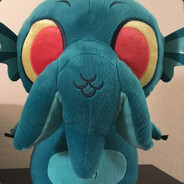
May 26, 2021
I think I mostly got through this one because it was an audiobook, which many/most Lovecraft biographies are not. It’s most unique contribution compared to others of its kind is that it occasionally examines the pop culture phenomena that is the Cthulhu Mythos/Lovecraft fandom, but I wish he would have focused more on that. Since it didn’t, most of the book just retreads facts and info that previous books have already gone over (such as S.T.’s voluminous body of work) while also including some random asides on the women in Lovecraft’s life that comes a bit close to white-knighting. If he was interested in more closely examining the life of Lovecraft’s mother/aunts/wife and how they impacted him, then he could have just gone with that - but I guess that wouldn’t sell as well as something devoted to Lovecraft’s life?
Either way, since it didn’t focus on the few things that could have been unique in the realm of Lovecraft biographies, it becomes just yet another to add to the pile. Lovecraft seems like an author that holds a special place for a lot of people, and most just can’t seem to resist giving their own personal takes on his life and work. In that way, all of these biographies that aren’t scholarly/definitive and don’t examine anything new about the Lovecraft phenomena, instead has become a fascinating (in its own way) trend of seeing how an author has personally impacted so many people. A lot of these less scholarly biographies tend to become more about the author’s relationship with Lovecraft and his works rather than Lovecraft himself.
Anyway, I’m still waiting on a good book that examines the pop culture impact and spread of the Mythos/Lovecraft phenomena. Back to my Crypt of Cthulhu issues I suppose.
Either way, since it didn’t focus on the few things that could have been unique in the realm of Lovecraft biographies, it becomes just yet another to add to the pile. Lovecraft seems like an author that holds a special place for a lot of people, and most just can’t seem to resist giving their own personal takes on his life and work. In that way, all of these biographies that aren’t scholarly/definitive and don’t examine anything new about the Lovecraft phenomena, instead has become a fascinating (in its own way) trend of seeing how an author has personally impacted so many people. A lot of these less scholarly biographies tend to become more about the author’s relationship with Lovecraft and his works rather than Lovecraft himself.
Anyway, I’m still waiting on a good book that examines the pop culture impact and spread of the Mythos/Lovecraft phenomena. Back to my Crypt of Cthulhu issues I suppose.

August 30, 2018
I loved this unwieldy and uneven book. It combines a rather conventional biography and literary analysis with an examination of Lovecraft in contemporary pop culture.
For years I have been confused my nephew's identification as a Lovecraft fan, despite the fact that he has never read anything HPL wrote. Poole convinced me that he is right - young people who know the master through gaming are true fans. Their experience is much like mine at the same age, although mine came from tattered used paperback books.
Poole is direct about HPL's racism - describing it as far worse than many of his contemporaries.
Misogynism is more complicated. Lovecraft's mother, aunts, and wife were the most important people in his life. None of them were conventional women of their age.
Now we really need a biography of Sonia Green.
For years I have been confused my nephew's identification as a Lovecraft fan, despite the fact that he has never read anything HPL wrote. Poole convinced me that he is right - young people who know the master through gaming are true fans. Their experience is much like mine at the same age, although mine came from tattered used paperback books.
Poole is direct about HPL's racism - describing it as far worse than many of his contemporaries.
Misogynism is more complicated. Lovecraft's mother, aunts, and wife were the most important people in his life. None of them were conventional women of their age.
Now we really need a biography of Sonia Green.

November 27, 2016
There are three parts to this new book about Lovecraft:
The first is a brief, very informative biography. I learned a lot here. *****
Second is more of a psychoanalysis including a lengthy discussion of his marriage, which should have been more interesting. **
Third is a nice summary of Lovecraftiana -- music, games, movies, based on HPL's work to mid-2016. **** (docked a star because it missed a significant number of worthwhile short story collections). HPL "controversies" were also discussed here (not just the racism issue). Poole's hints of ST Joshi's resistance to the dissemination of any disparaging words about HPL were tantalizing.
Overall, a worthwhile read both if you're into HPL, or if you're just curious about him and are wondering where to get started.
The first is a brief, very informative biography. I learned a lot here. *****
Second is more of a psychoanalysis including a lengthy discussion of his marriage, which should have been more interesting. **
Third is a nice summary of Lovecraftiana -- music, games, movies, based on HPL's work to mid-2016. **** (docked a star because it missed a significant number of worthwhile short story collections). HPL "controversies" were also discussed here (not just the racism issue). Poole's hints of ST Joshi's resistance to the dissemination of any disparaging words about HPL were tantalizing.
Overall, a worthwhile read both if you're into HPL, or if you're just curious about him and are wondering where to get started.

March 11, 2020
You can tell the book has been written recently because instead of focusing on the subject it obsesses over the author's personal views and on explaining to the reader that racism is bad. Thank you, it's a good thing you told me you're not racist yourself, I always start by assuming everyone is unless they explicitly declare themselves not racist. To be honest I'd prefer you instead weren't so self-obsessed. I don't know you personally so I don't really care if you're racist or not but I do care about what your main interest is when writing because I read your book because I was interested in Lovecraft and not you.
Displaying 1 - 30 of 100 reviews