

What do you think?

The Art & Science of Ernst Haeckel
IN A NUTSHELL
Microbial marvels
Ernst Haeckel, the 19th-century pioneer who captured the artistic beauty of the natural world
Ernst Haeckel (1834 1919) was a German-born biologist, naturalist, evolutionist, artist, philosopher, and doctor, who spent his life researching flora and fauna from the highest mountaintops to deepest ocean.
A vociferous supporter and developer of Darwin s theories of evolution, he denounced religious dogma, abandoned an early career in medicine, authored philosophical treatises, gained a doctorate in zoology, and coined scientific terms which have passed into common usage, including ecology, phylum, and stem cell.
Haeckel s colossal legacy has fascinated, confounded, and polarized generations. But what was at the heart of his extraordinary life s work? Rather like his intellectual forebear, Alexander von Humboldt, Haeckel was motivated not only to discover but also to explain. To do this, he created hundreds of detailed drawings, watercolors, and sketches of his findings which he published in successive volumes during the 20th century, including several marine organism collections and the majestic Kunstformen der Natur (Art Forms in Nature), which could serve as the cornerstone of Haeckel s entire life project.
Like a meticulous visual encyclopedia of living things, Haeckel s work was as remarkable for its graphic precision and meticulous shading as for its understanding of organic evolution and cellular development. From bats to the box jellyfish, lizards to lichen, and spider legs to sea anemones, he emphasized the essential symmetries and order of nature, and found biological beauty in even the most unlikely of creatures. The prints not only furthered the study of natural history but also influenced generations of 20th-century artists and architects, from the emerging proponents of Art Nouveau to architects such as Hendrik Petrus Berlage, whose Amsterdam Commodities Exchange was inspired by Haeckel s illustrations.
In this book, we celebrate the scientific, artistic, and environmental importance of Haeckel s work, with a collection of prints from several of his most important tomes on marine biology, including Die Radiolarien, Monographie der Medusen, Die Kalkschwamme: eine Monographie, and Kunstformen der Natur. At a time when biodiversity is increasingly threatened by human activities, the book is at once a visual masterwork, an underwater exploration, and a vivid reminder of the precious variety of life.
Text in English, French, and German.
CONTRIBUTORS
The Authors
Rainer Willmann holds a chair in zoology at Göttingen University, is director of its Zoological Museum, and is cofounder of its Centre for Biodiversity and Ecology Research. A specialist in phylogenetics and evolution, he conducts research into biodiversity and its history.
Julia Voss studied German literature, art history, and philosophy at the Albert-Ludwigs-Universität in Freiburg, at the Humboldt-Universität in Berlin, and at Goldsmith’s College in London. Her doctoral dissertation on visual representations of Darwinian evolution theory received the Otto Hahn Medal from the Max Planck Society. She is Deputy Editor of the Feuilleton and co-Editor of the Fine Arts section for the Frankfurter Allgemeine Zeitung.
PRODUCT DETAILS
The Art and Science of Ernst Haeckel
Rainer Willmann, Julia Voss
Hardcover, 28.5 x 39.5 cm, 704 pages
ISBN 978-3-8365-2646-3
Multilingual Edition: English, French, German
Microbial marvels
Ernst Haeckel, the 19th-century pioneer who captured the artistic beauty of the natural world
Ernst Haeckel (1834 1919) was a German-born biologist, naturalist, evolutionist, artist, philosopher, and doctor, who spent his life researching flora and fauna from the highest mountaintops to deepest ocean.
A vociferous supporter and developer of Darwin s theories of evolution, he denounced religious dogma, abandoned an early career in medicine, authored philosophical treatises, gained a doctorate in zoology, and coined scientific terms which have passed into common usage, including ecology, phylum, and stem cell.
Haeckel s colossal legacy has fascinated, confounded, and polarized generations. But what was at the heart of his extraordinary life s work? Rather like his intellectual forebear, Alexander von Humboldt, Haeckel was motivated not only to discover but also to explain. To do this, he created hundreds of detailed drawings, watercolors, and sketches of his findings which he published in successive volumes during the 20th century, including several marine organism collections and the majestic Kunstformen der Natur (Art Forms in Nature), which could serve as the cornerstone of Haeckel s entire life project.
Like a meticulous visual encyclopedia of living things, Haeckel s work was as remarkable for its graphic precision and meticulous shading as for its understanding of organic evolution and cellular development. From bats to the box jellyfish, lizards to lichen, and spider legs to sea anemones, he emphasized the essential symmetries and order of nature, and found biological beauty in even the most unlikely of creatures. The prints not only furthered the study of natural history but also influenced generations of 20th-century artists and architects, from the emerging proponents of Art Nouveau to architects such as Hendrik Petrus Berlage, whose Amsterdam Commodities Exchange was inspired by Haeckel s illustrations.
In this book, we celebrate the scientific, artistic, and environmental importance of Haeckel s work, with a collection of prints from several of his most important tomes on marine biology, including Die Radiolarien, Monographie der Medusen, Die Kalkschwamme: eine Monographie, and Kunstformen der Natur. At a time when biodiversity is increasingly threatened by human activities, the book is at once a visual masterwork, an underwater exploration, and a vivid reminder of the precious variety of life.
Text in English, French, and German.
CONTRIBUTORS
The Authors
Rainer Willmann holds a chair in zoology at Göttingen University, is director of its Zoological Museum, and is cofounder of its Centre for Biodiversity and Ecology Research. A specialist in phylogenetics and evolution, he conducts research into biodiversity and its history.
Julia Voss studied German literature, art history, and philosophy at the Albert-Ludwigs-Universität in Freiburg, at the Humboldt-Universität in Berlin, and at Goldsmith’s College in London. Her doctoral dissertation on visual representations of Darwinian evolution theory received the Otto Hahn Medal from the Max Planck Society. She is Deputy Editor of the Feuilleton and co-Editor of the Fine Arts section for the Frankfurter Allgemeine Zeitung.
PRODUCT DETAILS
The Art and Science of Ernst Haeckel
Rainer Willmann, Julia Voss
Hardcover, 28.5 x 39.5 cm, 704 pages
ISBN 978-3-8365-2646-3
Multilingual Edition: English, French, German
704 pages, Hardcover
Published November 28, 2017
About the author
Ernst Haeckel
978 books129 followersErnst Heinrich Philipp August Haeckel (February 16, 1834 – August 9, 1919), also written von Haeckel, was an eminent German biologist, naturalist, philosopher, physician, professor and artist who discovered, described and named thousands of new species, mapped a genealogical tree relating all life forms, and coined many terms in biology, including anthropogeny, ecology, phylum, phylogeny, stem cell, and the kingdom Protista. Haeckel promoted and popularized Charles Darwin's work in Germany and developed the controversial recapitulation theory ("ontogeny recapitulates phylogeny") claiming that an individual organism's biological development, or ontogeny, parallels and summarizes its species' evolutionary development, or phylogeny.
The published artwork of Haeckel includes over 100 detailed, multi-colour illustrations of animals and sea creatures (see: Kunstformen der Natur, "Art Forms of Nature"). As a philosopher, Ernst Haeckel wrote Die Welträtsel (1895–1899, in English, The Riddle of the Universe, 1901), the genesis for the term "world riddle" (Welträtsel); and Freedom in Science and Teaching to support teaching evolution.
The published artwork of Haeckel includes over 100 detailed, multi-colour illustrations of animals and sea creatures (see: Kunstformen der Natur, "Art Forms of Nature"). As a philosopher, Ernst Haeckel wrote Die Welträtsel (1895–1899, in English, The Riddle of the Universe, 1901), the genesis for the term "world riddle" (Welträtsel); and Freedom in Science and Teaching to support teaching evolution.
Ratings & Reviews
Friends & Following
Create a free account to discover what your friends think of this book!
Community Reviews
Displaying 1 - 13 of 13 reviews

July 30, 2019
Perusing this monolith of fascinating drawings and articles while "enjoying" the dubious charms of CNN & whiskey or reality tv & weed, staring gape-mouthed at the often beautifully colored and always intricately drawn and mainly microscopic creatures, most of which looked variously cthulhic, chthonic, oleaginously intestinal, gorgeously alien, disturbingly sexual, and/or bizarrely hallucinatory, was an often personally instructive experience: I was reminded and reassured that there existed an entire otherworld that did not include petty, vindictive, self-destructive human beings. Three cheers for the weird wonders of nature!
My favorite, the amusingly named Discomedusae:
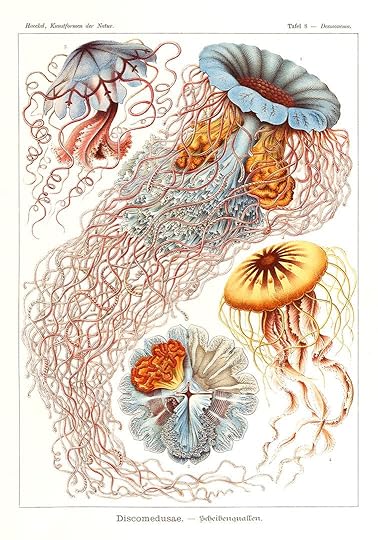

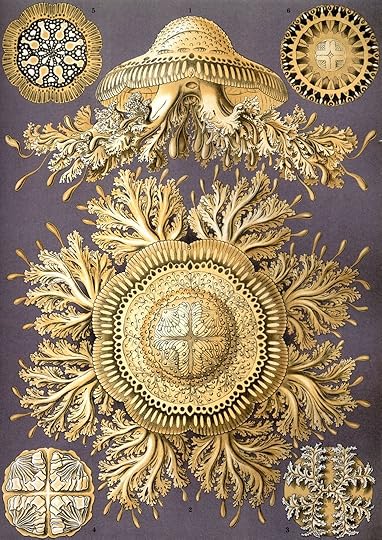
My favorite, the amusingly named Discomedusae:


December 30, 2024
The book starts with some 80 pages of text about the life and career of Ernst Haeckel, a German biologist turned artist turned philosopher who lived at the end of the 19th century. The following 200ish pages show excerpts from his major works where he documented small marine biology in elaborate drawings.
I did not know of Haeckel and it was interesting to read that he seems to have had a lasting impact of biology and genealogy, promoting Darwin’s new Evolutionary theory and later lobbying for the separation of religion from science and thus education.
The real reason one might read this book are the drawings of the marine biology, drawn by hand by Haeckel who was using the best microscopes of the time he had access to because of his relationship with Carl Zeiss. The drawings are hauntingly beautiful, incredibly accurate and seem terribly modern.
I did not know of Haeckel and it was interesting to read that he seems to have had a lasting impact of biology and genealogy, promoting Darwin’s new Evolutionary theory and later lobbying for the separation of religion from science and thus education.
The real reason one might read this book are the drawings of the marine biology, drawn by hand by Haeckel who was using the best microscopes of the time he had access to because of his relationship with Carl Zeiss. The drawings are hauntingly beautiful, incredibly accurate and seem terribly modern.

December 13, 2021
Beautiful book on the works and life of Ernst Haeckel. This was a great gift from my boss. This book is MASSIVE, and weighs a lot (probably 2 kilos?). The images are of high quality. Really nice to just look through with a coffee and feel inspired by the beautiful drawings.

February 16, 2021
The best book about Ernst Haeckel's life and work bar none.
400 full-color pages of his illustrations of medusa, siphonophores, sponges, radiolaria etc. etc.
It is clear how Haeckel has been a core inspiration for art movements such as Art Nouveau and Jugendstil. Still today, I feel biologically-inspired aesthetics are relevant in a world where we are only starting to learn about viral behavior and synthetic biology. Another nice compendium by Taschen with lots of details about the man himself, including the controversial aspects of his race segregation ideas. Haeckel was a man of science but also an artist in love with zoology. This book also contains many plates from Kunstformen der Natur / Art Forms in Nature, so if you are considering it, buy this one instead. The only thing left to desire is larger format prints.
400 full-color pages of his illustrations of medusa, siphonophores, sponges, radiolaria etc. etc.
It is clear how Haeckel has been a core inspiration for art movements such as Art Nouveau and Jugendstil. Still today, I feel biologically-inspired aesthetics are relevant in a world where we are only starting to learn about viral behavior and synthetic biology. Another nice compendium by Taschen with lots of details about the man himself, including the controversial aspects of his race segregation ideas. Haeckel was a man of science but also an artist in love with zoology. This book also contains many plates from Kunstformen der Natur / Art Forms in Nature, so if you are considering it, buy this one instead. The only thing left to desire is larger format prints.
April 20, 2022
This is a beautiful book. I was gifted this copy by my granny, who thought I'd have fun trying to copy the prints. I usually don't dabble with nonfiction, but in the spirit of branching out and to my granny's dismay, I actually read the book instead of painstakingly mimicking the geometric, meticulous draftsmanship of Haekel. At first, I was daunted by the length and the...weight. But I soon realized a majority of the bulk was attributed to the gorgeous prints tucked between the pages. I'd recommend this book to most people, especially those who appreciate eye candy and dead Germans who married their cousins.

September 15, 2026
Es hermoso este libro y la edición de Taschen. La verdad que sé bastante poco sobre biología y entiendo que mucho de lo que está en el libro quedó completamente obsoleto, pero lo valioso de este ejemplar es la belleza de las ilustraciones de Haeckel, cada página te invita a quedarte un ratito medio embobada viendo los colores y las formas, y conocer la influncia que este científico tuvo no sólo en la ciencia sino también en el arte.
April 30, 2024
Amazing nature artwork from a 19th century artist-biologist. The copy I have is extensive set of pictures (the book is over 500 pages with pix on almost every page). The only problem is the book is very small form factor (about 7x9 inches). It needs to be about four times that size. Otherwise, very neat stuff.
October 14, 2024
Setting aside the figure of the author and his political beliefs, it is moving to look at the works of someone who was deeply moved by nature. The book is simply a showcase of his works with descriptions that are by no means exhaustive. It is very well bound and organized, not so much by historical period but rather by grouping of organisms. The works of the father of ecology range from the microworld (which is predominant) to aquatic environments, and to those of insects and animals.
March 13, 2025
Anthologic work gathered in a superbly edited book with high-quality illustrations, for a surprisingly affordable price. Ernst Haeckel's lifelong dedication in the scientific area was not only a milestone in Biology, but also in Art.
June 14, 2023
Est-il possible de faire autant de choses en une vie?

January 31, 2024
Each page a delight
Read
April 29, 2024Gotta be one of the prettiest books I own.

February 16, 2019
Exquisite. Gorgeous reproductions of colorful drawings rich in detail. Beautifully produced. This book is a treasure.
Displaying 1 - 13 of 13 reviews