

What do you think?

Kristin Lavransdatter #1
Kransen
The acknowledged masterpiece of the Nobel Prize-winning Norwegian novelist Sigrid Undset, Kristin Lavransdatter has never been out of print in this country since its first publication in 1927. Its story of a woman's life in fourteenth-century Norway has kept its hold on generations of readers, and the heroine, Kristin—beautiful, strong-willed, and passionate—stands with the world's great literary figures. Volume 1, The Bridal Wreath , describes young Kristin's stormy romance with the dashing Erlend Nikulausson, a young man perhaps overly fond of women, of whom her father strongly disapproves.
From the Trade Paperback edition.
From the Trade Paperback edition.
353 pages, Hardcover
First published January 1, 1920
About the author
Sigrid Undset
321 books943 followersSigrid Undset was a Norwegian novelist whose powerful, psychologically rich works made her one of the most significant literary figures of the 20th century. Best known for her medieval sagas Kristin Lavransdatter and The Master of Hestviken, she was awarded the Nobel Prize in Literature in 1928 for her vivid portrayals of life in the Middle Ages, written with remarkable historical detail and emotional depth.
Born in Denmark to Norwegian parents, Undset spent most of her life in Norway. After her father's early death, she had to forgo formal education and worked as a secretary while writing in her spare time. Her debut novel Fru Marta Oulie (1907) shocked readers with its opening confession of adultery and established her bold, realist style. In early works like ,i>Jenny (1911), she explored modern women's struggles with love, freedom, and morality, often critiquing romantic idealism and social expectations.
Though she gained recognition for her contemporary novels, Undset felt increasingly drawn to historical fiction. This shift led to her masterwork Kristin Lavransdatter, a trilogy published from 1920 to 1922, which follows the life of a woman in 14th-century Norway as she navigates love, faith, motherhood, and spiritual growth. With its intricate character development and deep moral themes, the trilogy brought her international acclaim and remains a cornerstone of Scandinavian literature.
In 1924, Undset converted to Roman Catholicism, a profound personal decision that shaped her later writing. Her tetralogy,i>The Master of Hestviken (1925–1927) centers on a man burdened by unconfessed guilt, offering a deeply spiritual and psychological portrait of sin and redemption. Her Catholic faith and concern with ethical questions became central to her work and public life.
A vocal critic of both communism and fascism, Undset fled Norway after the Nazi invasion in 1940. Her books were banned by the occupying regime, and she lived in exile in the United States during the war, advocating for Norway and the Allied cause. The loss of her son in the war deeply affected her, and although she returned home after the war, she published little in her final years.
Undset’s legacy rests not only on her historical novels but also on her fearless exploration of conscience, duty, and the human condition. Her characters—especially her women—are fully realized, flawed, and emotionally complex. Her writing combines psychological insight with stylistic clarity and spiritual depth, making her work enduringly relevant and widely read.
Born in Denmark to Norwegian parents, Undset spent most of her life in Norway. After her father's early death, she had to forgo formal education and worked as a secretary while writing in her spare time. Her debut novel Fru Marta Oulie (1907) shocked readers with its opening confession of adultery and established her bold, realist style. In early works like ,i>Jenny (1911), she explored modern women's struggles with love, freedom, and morality, often critiquing romantic idealism and social expectations.
Though she gained recognition for her contemporary novels, Undset felt increasingly drawn to historical fiction. This shift led to her masterwork Kristin Lavransdatter, a trilogy published from 1920 to 1922, which follows the life of a woman in 14th-century Norway as she navigates love, faith, motherhood, and spiritual growth. With its intricate character development and deep moral themes, the trilogy brought her international acclaim and remains a cornerstone of Scandinavian literature.
In 1924, Undset converted to Roman Catholicism, a profound personal decision that shaped her later writing. Her tetralogy,i>The Master of Hestviken (1925–1927) centers on a man burdened by unconfessed guilt, offering a deeply spiritual and psychological portrait of sin and redemption. Her Catholic faith and concern with ethical questions became central to her work and public life.
A vocal critic of both communism and fascism, Undset fled Norway after the Nazi invasion in 1940. Her books were banned by the occupying regime, and she lived in exile in the United States during the war, advocating for Norway and the Allied cause. The loss of her son in the war deeply affected her, and although she returned home after the war, she published little in her final years.
Undset’s legacy rests not only on her historical novels but also on her fearless exploration of conscience, duty, and the human condition. Her characters—especially her women—are fully realized, flawed, and emotionally complex. Her writing combines psychological insight with stylistic clarity and spiritual depth, making her work enduringly relevant and widely read.
Ratings & Reviews
Friends & Following
Create a free account to discover what your friends think of this book!
Community Reviews
Displaying 1 - 30 of 1,408 reviews

March 21, 2015
"She whimpered silently in fear at the inconstancy of her own heart and at the transitory nature of all things.”
Published in 1920, The Wreath is the first volume in the Kristin Lavransdatter medieval trilogy written by Danish born Sigrid Undset. Undset moved to Norway at the age of two, and this series takes place in that country during the early fourteenth century at a time when the Catholic Church was firmly established and played a significant role in the lives of its people. In 1928, Sigrid Undset won the Nobel Prize for Literature for “her powerful pictures of Northern life in medieval times.” Naturally, I was quite curious to read this book. The time period fascinated me, as well as the fact that it was written by a strong voice in European literature with Undset being one of the youngest recipients of the Nobel Prize as well as only the third woman to receive this honor.
Having now satisfied my curiosity about this writer, I’m of two minds about the novel itself. It is surprisingly easy to read given the time in which it is set as well as the fact it’s a classic – it is completely accessible. I expected it to be more difficult for some reason. I thought Undset did a fine job in depicting the rural communities, the social customs, and the Church’s strong influence. Despite the power of the Church, the older beliefs have not been entirely relinquished. "She knew that wolves and bears reigned in the forest, and under every rock lived trolls and goblins and elves, and she was suddenly afraid, for no one knew how many there were, but there were certainly many more of them than of Christian people." Yet the authority of the Church reigns over all, breeding fear of punishment should you stray too far from its path. "God hates me for my sins… He has cast me out, for my heart is a viper’s nest of sin and sorrow." I found it interesting to see the juxtaposition of two different religious figures in this work – that of the priest, Sira Eirik, the harsher hand of justice, and that of the monk, Brother Edvin, the kinder, forgiving soul. Alongside these two, there exists another fascinating character – Fru Aashild. An eccentric older woman who went against the teachings of the Church and was skilled in herbs and medicine, Aashild was naturally whispered as being a witch. Only her high birth kept her from execution. Her story is one I would have enjoyed all on its own. I suspect this book will hold no appeal for those that do not want to examine Christian faith to this extent! There is a lot of this woven throughout the entire story. Coming from a historical standpoint, it does make sense to include these discussions, but naturally they will not be to everyone’s taste. I grew weary of it a bit myself.
I’m having a difficult time making this clear and succinct. It’s not an easy novel to review! I can’t fail to mention the heart of the story, however, which is the coming of age of the main character, Kristin Lavransdatter. In a nutshell, girl is promised to the ‘good’ guy in an arranged marriage, girl falls in love with the ‘bad’ guy, and trouble ensues. Of course, it’s not as clear cut as all that, and initially I was completely hooked. I did believe that Kristin’s father wanted the best for his daughter. In fact, Lavrans Bjørgulfsøn was one of my favorite characters in the novel. "… he was known as a strong and courageous man, but a peaceful soul, honest and calm, humble in conduct but courtly in bearing, a remarkably capable farmer, and a great hunter." Kristin is independent and headstrong - admirable qualities in a young girl, no doubt. But she was also silly, whiny, and a bit too willful. I didn’t like Erlend, the man she fell in love with. I didn’t think much good could come out of this relationship; therefore, I failed to sympathize with Kristin. My interest waned in the second half of the book as a result of this lack of connection. It very nearly verged on the side of a young adult love triangle… something that holds little interest for me personally as a reader.
I had planned to read the entire trilogy, one book after the other. I will eventually read the next two, just not right away as planned. I am curious to see if Kristin matures more in the next; I hope she does. I did like Undset’s writing quite a bit. I have to wonder if I selected an entirely different novel with a heroine quite distinct from Kristin if I would be more gripped by the story. I’m not ready to part ways with Sigrid Undset yet. After all, there must be good reason she’s on the list of Nobel Prize winners.
"Good days can last a long time if one tends to things with care and caution; all sensible people know that. That’s why I think that sensible people have to be satisfied with the good days – for the grandest of days are costly indeed."
Published in 1920, The Wreath is the first volume in the Kristin Lavransdatter medieval trilogy written by Danish born Sigrid Undset. Undset moved to Norway at the age of two, and this series takes place in that country during the early fourteenth century at a time when the Catholic Church was firmly established and played a significant role in the lives of its people. In 1928, Sigrid Undset won the Nobel Prize for Literature for “her powerful pictures of Northern life in medieval times.” Naturally, I was quite curious to read this book. The time period fascinated me, as well as the fact that it was written by a strong voice in European literature with Undset being one of the youngest recipients of the Nobel Prize as well as only the third woman to receive this honor.
Having now satisfied my curiosity about this writer, I’m of two minds about the novel itself. It is surprisingly easy to read given the time in which it is set as well as the fact it’s a classic – it is completely accessible. I expected it to be more difficult for some reason. I thought Undset did a fine job in depicting the rural communities, the social customs, and the Church’s strong influence. Despite the power of the Church, the older beliefs have not been entirely relinquished. "She knew that wolves and bears reigned in the forest, and under every rock lived trolls and goblins and elves, and she was suddenly afraid, for no one knew how many there were, but there were certainly many more of them than of Christian people." Yet the authority of the Church reigns over all, breeding fear of punishment should you stray too far from its path. "God hates me for my sins… He has cast me out, for my heart is a viper’s nest of sin and sorrow." I found it interesting to see the juxtaposition of two different religious figures in this work – that of the priest, Sira Eirik, the harsher hand of justice, and that of the monk, Brother Edvin, the kinder, forgiving soul. Alongside these two, there exists another fascinating character – Fru Aashild. An eccentric older woman who went against the teachings of the Church and was skilled in herbs and medicine, Aashild was naturally whispered as being a witch. Only her high birth kept her from execution. Her story is one I would have enjoyed all on its own. I suspect this book will hold no appeal for those that do not want to examine Christian faith to this extent! There is a lot of this woven throughout the entire story. Coming from a historical standpoint, it does make sense to include these discussions, but naturally they will not be to everyone’s taste. I grew weary of it a bit myself.
I’m having a difficult time making this clear and succinct. It’s not an easy novel to review! I can’t fail to mention the heart of the story, however, which is the coming of age of the main character, Kristin Lavransdatter. In a nutshell, girl is promised to the ‘good’ guy in an arranged marriage, girl falls in love with the ‘bad’ guy, and trouble ensues. Of course, it’s not as clear cut as all that, and initially I was completely hooked. I did believe that Kristin’s father wanted the best for his daughter. In fact, Lavrans Bjørgulfsøn was one of my favorite characters in the novel. "… he was known as a strong and courageous man, but a peaceful soul, honest and calm, humble in conduct but courtly in bearing, a remarkably capable farmer, and a great hunter." Kristin is independent and headstrong - admirable qualities in a young girl, no doubt. But she was also silly, whiny, and a bit too willful. I didn’t like Erlend, the man she fell in love with. I didn’t think much good could come out of this relationship; therefore, I failed to sympathize with Kristin. My interest waned in the second half of the book as a result of this lack of connection. It very nearly verged on the side of a young adult love triangle… something that holds little interest for me personally as a reader.
I had planned to read the entire trilogy, one book after the other. I will eventually read the next two, just not right away as planned. I am curious to see if Kristin matures more in the next; I hope she does. I did like Undset’s writing quite a bit. I have to wonder if I selected an entirely different novel with a heroine quite distinct from Kristin if I would be more gripped by the story. I’m not ready to part ways with Sigrid Undset yet. After all, there must be good reason she’s on the list of Nobel Prize winners.
"Good days can last a long time if one tends to things with care and caution; all sensible people know that. That’s why I think that sensible people have to be satisfied with the good days – for the grandest of days are costly indeed."

October 15, 2012
I really do try to be stingy with five star ratings--this came close. Sigrid Undset was one of the first women writers to win the Nobel Prize for literature--and the Kristin Lavransdatter trilogy following the life of a 14th century woman more than any work is where she made her reputation. The Wreath, the first novel of the trilogy, opens in 1306 Norway when Kristin's little more than a toddler and continues through to her young womanhood--so this is her coming of age story.
For me the key measure of a work of historical fiction is how well does it inhabit its age. Its characters should be more than contemporary people in period dress-up, and very few historical works I've ever read puts you into the mindset and immerses you into the surroundings of another age better than the The Wreath. It follows Kristin's perspective closely, and I can't imagine plucking her from her setting into a time centuries removed. Yet though she inhabits what is for us an alien world where the Catholic faith was central, she feels very relatable and real. Which is not to say I didn't want to throttle her at times. It's amazing to me because from a modern view I suppose I should feel more sympathetic to how she acts in the name of love, but Undset makes you fully feel how foolish and hurtful is Kristin's behavior so much of the time; this is a willful young woman very much ruled by her passions. For a book published in 1920 it's surprisingly sensual and frankly sexual without ever being crude.
I often cared more for the secondary characters to be honest. Especially Kristin's parents and such characters as her childhood friend Arne and Brother Edvin. I loved Aashild--a noblewoman wrapped in scandal and rumored to be a witch. I loved Simon Darre too, less flashy a character than Kristin's love Erlend, but to me much more endearing. (Truth to tell, I despised Erlend. Which rather keeps this from being a romance--strictly speaking it could be said to fall into that category in plot--but not in spirit. You feel like you're watching a trainwreck.) In fact, I think if anything deprives this of its fifth star it is that I cared much more about those secondary characters than Kristin--who in comparison seems rather shallow. But she's very young in The Wreath, and that might change in the next two books of the trilogy dealing with the mature woman.
This read extraordinarily fast--I read its 300 pages in one sitting. It started out rather slow--it was hard to get used to those Norwegian names at first, but I became more engrossed as I read and in the end it read almost too fast, with no brakes in the smooth prose to force me to savor the narrative. A page-turner in other worlds, that you perhaps speed through too quickly the first time to fully appreciate. I can tell you though that after reading The Wreath I'll certainly be continuing on someday to The Wife and The Cross. I read the Nunally translation which is very readable--I've heard the same can't be said for other translations so be aware of the issue in choosing an edition.
For me the key measure of a work of historical fiction is how well does it inhabit its age. Its characters should be more than contemporary people in period dress-up, and very few historical works I've ever read puts you into the mindset and immerses you into the surroundings of another age better than the The Wreath. It follows Kristin's perspective closely, and I can't imagine plucking her from her setting into a time centuries removed. Yet though she inhabits what is for us an alien world where the Catholic faith was central, she feels very relatable and real. Which is not to say I didn't want to throttle her at times. It's amazing to me because from a modern view I suppose I should feel more sympathetic to how she acts in the name of love, but Undset makes you fully feel how foolish and hurtful is Kristin's behavior so much of the time; this is a willful young woman very much ruled by her passions. For a book published in 1920 it's surprisingly sensual and frankly sexual without ever being crude.
I often cared more for the secondary characters to be honest. Especially Kristin's parents and such characters as her childhood friend Arne and Brother Edvin. I loved Aashild--a noblewoman wrapped in scandal and rumored to be a witch. I loved Simon Darre too, less flashy a character than Kristin's love Erlend, but to me much more endearing. (Truth to tell, I despised Erlend. Which rather keeps this from being a romance--strictly speaking it could be said to fall into that category in plot--but not in spirit. You feel like you're watching a trainwreck.) In fact, I think if anything deprives this of its fifth star it is that I cared much more about those secondary characters than Kristin--who in comparison seems rather shallow. But she's very young in The Wreath, and that might change in the next two books of the trilogy dealing with the mature woman.
This read extraordinarily fast--I read its 300 pages in one sitting. It started out rather slow--it was hard to get used to those Norwegian names at first, but I became more engrossed as I read and in the end it read almost too fast, with no brakes in the smooth prose to force me to savor the narrative. A page-turner in other worlds, that you perhaps speed through too quickly the first time to fully appreciate. I can tell you though that after reading The Wreath I'll certainly be continuing on someday to The Wife and The Cross. I read the Nunally translation which is very readable--I've heard the same can't be said for other translations so be aware of the issue in choosing an edition.

Did Not Finish
January 17, 2019I wish it was made clear by other reviewers that this book was more about Christian faith than anything else, really.
I did some word searches in my digital copy of the whole trilogy. “Church” appears in it 451 times, “sin” - 397, “God” - 476. You get the picture.
I did some word searches in my digital copy of the whole trilogy. “Church” appears in it 451 times, “sin” - 397, “God” - 476. You get the picture.

June 16, 2019
This is one trilogy of books, Kristin Lavransdatter, where the experience changes with age. Deeply profound, this book can be hard to read as it can touch so many bruises. This time around I felt far more sympathy for Kristin’s mother. I felt like I knew her very well and loved her. Poor Kristin now she will live a life her parents would have saved her from if they could have.

June 3, 2014
كريستين لافرانسداتر: تناقضات امرأة

كان يا ما كان و على زمن الفرسان، فتاة جميلة في أراضي النرويج البعيدة، و كان اسمها كريستين لافرانسداتر... ولدت هذه الفتاة في القرون الوسطى لأبوين من عائلة نبيلة قد آثرا أن يعيشا في ضيعتهما يتابعان شؤونها و فلاحيها، كبرت الفتاة لهذين الأبوين المحبين، ثم خطبت من قبل شاب من عائلة نبيلة يتسم بالحصافة و الرزانة و اسمه سايمون... بيد أن كريستين لم تحب خطيبها الذي اختاره لها والدها... و ظلت تماطل الزواج، حتى تعرفت على إرلند، و هو أيضا شاب من عائلة نبيلة و ثرية، أعلى مقاما من عائلتها، و لكنه معروف بطيشه و رعونته... فأحبته وفتنت بوسامته و حيويته و نبالته، و خالفت أعراف مجتمعها و فرطت بفضيلة دينها و أثمت و أصرت على أنها تريد هذا الإرلند... والدها الذي كان معروفا بورعه لم يعجبه هذا الاختيار نظرا لسمعة إرلند السيئة و علاقاته الغرامية... و لأنه أب طيب و محب، استسلم لإرادة ابنته بحزن و بارك لها هذا الزواج... تزوجت أخيرا كريستين من إرلند الذي أحبها هو بدوره و شغف بها و تاب عن كل حياته السابقة... و من ثم أخذها إلى ضيعته لتكون سيدة آمرة فيها... و ولدت له صبيانا وسيمين أصحاء في زمن كانت النساء تفقد الكثير من أولادها...0
و بعد أن رزق الله كريستين كل هذه النعم، هل عاشت سعيدة أو حتى ممتنة، هل استمتعت بالحب و بأولادها و بدلال الرفاهية؟
الحقيقة أن كريستين هذه هي مخلوقة رافعة للضغط، مثل كثيرات من اللواتي ما بتعرف شو بدهم... قلبها مترع بمرارة الغضب، لا تفتأ تعيد الأسطوانة المشروخة و تفتح الدفاتر القديمة كلما حدث خلاف، مع منة بعبارات قاسية... ما حصل أن كريستين و بمجرد زواجها عاشت حياتها و كأنها تعاقب إرلند لأنها أحبته و اختارته و عاندت أهلها بسببه و أثمت لأجله... 0
والدها لم يرض بطريقة تعاملها مع زوجها، فأنبها، فجرحته بكلامها، مذكرة إياه أنه لم يكن راض به أصلا، فقال لها: مشكلتك أنك تعاملين بقسوة كل من تحبيه...
هذه هي مشكلتها باختصار... لا تستطيع إلا أن تكون قاسية مع من تحب، و بدل أن تظهر محبتها بكلمات ود، فإنها تخرجها على شكل لكمات... نعم يا سادة، بعض الناس تحب بهذه الطريقة المريضة، يعذبونك و يحاسبونك لأنهم أحبوك، حتى لتود أن يكرهوك قليلا فلربما ذلك يجعلهم يعاملوك بطريقة أفضل...0
إرلند رغم شجاعته و نبالته و فروسيته إلا أنه رجل طائش طفولي لا مبال، قد تسبب بسخط الملك عليه و تجريده من رتبته و مصادرة كل ثروته... و هكذا عادت الأسرة لتعيش في ضيعة كريستين التي ورثتها عن والدها... 0
كريستين كانت تعلم بصفات إرلند التي تفتقر للحكمة مذ أحبته، و الجميع نصحها بأنه كذلك... حتى أنا لو سألتني لقلت أنه رجل لا يعتمد عليه و عريس "مو لقطة"، و هو ليس كسايمون خطيبها الأول الرزين... و لكن القلب و ما يريد، و هي أحبته كما هو، بل أكثر ما أحبت فيه هو رعونته و طيشه و طفوليته... و ظلت تحب صفاته هذه طول عمرها... فما المشكلة إذن يا كريستين... ألا تعلمين كيف تستمتعين قليلا؟
بسبب تناقض و فوضى داخلها، لم تكن تفتأ تحاول تقويمه و تغييره بتعليقاتها الجارحة، متصيدة أخطاءه... هو رجل معتد بنفسه لا يقبل الاهانة... يعني باختصار هي تحبه كما هو تماما، و لكنها تريد تغييره، و لكن إن تغير فلن تحبه حينها لأن ما تحبه فيه هو ما تود أن تغيره فيه... و كأنها تحاول معاقبة كل شيء جميل أحبته فيه... 0
و في يوم و بعد شجار شديد بينهما، ذهب فخانها ليغيظها، فسامحته لتغيظه... و ساءت علاقتهما، فوقع في محنته مع الملك، فما كان إلا أن وقفت معه إلى حد أنها كانت مستعدة أن تشنق بدلا عنه برضى و سعادة، و لكن ما إن فرج عنهما، و عاد إليها و صار معها عادت لعادتها القديمة...0
"علي الشعور بالخجل من أن أفكاري عن زوجي كانت في أحيان كثيرة مريرة أكثر من سم الأفاعي... إن اللذين يحبان واحدهما الآخر برغبة شديدة الحرارة يصبحان في النهاية حييتين خبيثتين جدا تعض الواحدة ذيل الأخرى"
أغرقت كريستين نفسها في أعمال البيت و الحقل، مع أنها تملك عمالا و خدما... كانت تنتقم عبر العمل ليل نهار، حتى باتت تبدو مجهدة كنساء العامة الفقراء... و لأن زوجها لم يعتد العمل فهو اعتاد حياة الفروسية الثرية المتبطلة، و لأنه يرى أن هذه مهمة الخدم و ليس عليها اجهاد نفسها... فكان هذا سبب آخر لغيظها المستمر منه، و مقارنته بأبيها و منّتها عليه بما تفعل... يا كريستين من طلب منك بذل كل هذا الجهد؟ كنت أسأل نفسي... أريحي نفسك و أريحي من حولك...
لكنما هذا سؤال منطقي لمشاعر لا منطق فيها... بعض الناس تستمتع بتعذيب نفسها، ثم تمن عليك بما عذبت نفسها به...0
كريستين كانت كثيرة القلق على أولادها، خائفة عليهم، غاضبة من والدهم لأنه لم يكن اظهاره لحبه لهم مثل حب والدها لها، لم تعلم كيف تستمتع بهم، و لم تعلم كيف تشكر الله لأنه رزقها بهم، و لأنهم يشبهون زوجها فقد عشقتهم أكثر، و لأنهم كذلك فقد كانت قلقة أكثر طوال الوقت... يا كريستين قد رزقك الله، أفلا تكفين عن هذا القلق قليلا و تحمديه؟
رغم كل هذا فإن إرلند بقي شغوفا بها و بكل تناقضاتها... بيد أنه لم يعد يطيق الحياة معها... فافترقا عن بعضيهما أخيرا... و كلما افترقا عشقا بعضاهما و عادا... و كلما عادا تعاركا حتى افترقا... و هكذا حتى قـُتل و هو يدافع عنها في مشكلة حصلت بسبب شجاراتهما... فبكته بكاء شديدا و نذرت نفسها للكنيسة من بعده حتى قابلت خالقها...0
الرواية مقسمة لثلاثة أجزاء...0
إكليل العروس: هو الجزء الأول من حياتها، طفولتها، و من ثم قصة حبها مع إرلند حتى زفافها... و هو أكثر الأجزاء التي أحببتها... الأسلوب كان مثل الأحلام... قصة لفتاة جميلة في تلك السهوب البعيدة... قراءته كالاستلقاء على ظهر غمامة و مشاهدة العالم يمر تحتها بوداعة... 0
سيدة هوسابي: و هو الجزء الثاني من حياتها، من انتقالها إلى ضيعة زوجها (هوسابي) و حتى محنته... في هذا الجزء سقطت الرواية من عالم الأحلام على أم رأسها إلى الواقع... خلافاتهما، حملها و ولاداتها المستنزفة للصحة، ادارتها شؤون ضيعة زوجها، قلبها المليء بالمرار اللامنطقي، المحنة التي نزلت بهم... يعني هي الرواية التي تخبرنا ما يحدث بعد أن يتزوج البطل من البطلة...
و أظنها ستعجب الذين يميلون للروايات الاجتماعية، كما أن الشخصيات باتت أكثر تطورا...0
الصليب: و هو الجزء الثالث من حياتها، من عودتها إلى ضيعتها بعد فقدانهم لثروة زوجها، و كبر أولادها و هجر زوجها لها و موته، و نذر نفسها للكنيسة... هنا أصابني الكثير من السأم بسبب خلافاتهما اللامنتهية... و بعض الإسهاب الوعظي نظرا لازدياد تدينها... و لكن الأسلوب أيضا كان ناضجا و متقنا في تحليل الشخصيات و تناقضاتها...0
الرواية تستحق القراءة، على أي حال كنت و أي ذائقة امتلكت، فأنا التي لا أميل كثيرا للروايات الواقعية الاجتماعية و لا التي يكثر فيها الوصف بإسهاب، و لو أني كرهت كلا من كريستين و زوجها إرلند و تمنيت ضربهما على رأسهما حتى يتوقفا عن طفوليتهما، إلا أني استمتعت بها كثيرا... لن أقول أنها من الروائع، لأنها رفعت ضغطي... و لكنها رواية تـُقرأ و أنصح بها، و خاصة في فصل الصيف، لكثرة البرد و الثلوج التي تفوح منها... مؤلفتها النرويجية سيغريد أوندست التي نشرتها عام 1920 إلى 1922 قد حصلت على جائزة نوبل بسببها عام 1928... و أراها تستحق الجائزة... و إن كان هذا هو الأدب النسوي، _على افتراض جدلي بوجود هكذا تسمية_ فأنعم به من أدب...0
إنما هي رواية كلاسيكية طويلة، محكمة الصنع تحترم قارئها...0
الترجمة لـ توفيق الأسدي من النرويجية مباشرة مع شرحه لبعض المصطلحات التاريخية التي تتبع تلك الفترة، و هي ترجمة متقنة و جميلة...0
ثم شاهدت الفيلم النرويجي الذي أنتج عام 1995 و حصل على جائزة، مجسدا الجزء الأول من الرواية فقط... الفيلم ممتع أيضا، و خاصة مشاهدة التفاصيل في أسلوب حياة أناس تلك المناطق في القرون الوسطى و ملابسهم و أعرافهم و أناشيدهم و منازلهم و بيئتهم، و من اللافت للنظر كيف كان العرف حينها ارتداء النساء للحجاب بمجرد أن يتزوجن... 0
و إن كنت أعترف أني كرهت أيضا كلا من الممثلين الذين جسدا كريستين و إرلند و استثقلت دمهما، و ربما هذا دليل على أنهما كانا مناسبين للدورين...0

مع الرواية شعرت بأني استعدت معنى الأدب... ألم يوجد فن القص و الأمثولات لأجل أخذ العبرة؟
الحياة القاسية المجهدة للنساء في العصور القديمة، جعلتني ممتنة للإله على نعمة عصرنا... رغم كل قبحه و مساوئه، إلا أني استطعت رؤية الوجه الإيجابي له... كيف أعطيت النساء الوقت و الفرصة ليفعلن شيئا آخر غير العمل المنزلي اللامنتهي و إنجاب الأولاد... فهل استثمرنه فيما يفيد؟
لكلٍ جوابها الذي سيدمغها حين ستُسأل كيف أنفقته...0
ثم هذا العرض لحياة امرأة متناقضة من مبتدأها لمنتهاها، جعلني أشعر بشيء من الرهبة... تلك حياة كاملة شهدتها تمر أمامي بداخلها و خارجها، كما تمر حياتي بكل ما فيها أمام الله الخالق...0
رأيت فيها مكامن الخطأ في تصرفاتها و ما جرته عليها خياراتها و كلماتها... و هل أنا قادرة على رؤية هذا في قصة حياتي و أنا مسجونة في حبكتها؟
و كم منا سقيم بتناقضه الداخلي... و معتد بنفسه لأجل سفاسف لا تستحق الاعتداد لأجلها... و مخطئ في حين يحسب نفسه مصيبا... و يجرح الذين يحبهم مع أنه لا يرغب بجرحهم حقا... مفرغا غضبه و عصبيته فيهم... و يعتبر حياته الزوجية مصارعة مستمرة لتسجيل النقاط على شريكه الذي يحب، و إثبات الموجودية... منتظرا أصغر هفوة لينقض عليه بها... 0
لو أنه يتاح لواحدنا فرصة رؤية حياته بهذا الوضوح من مبتدأها لمنتهاها قبل أن يفوت الأوان...0
أنهي بهذه الأغنية من وقع العصر
Rolandskvadet By Mediaeval Trio
--
الصورة: Like a King By Afarin Sajedi
لا أظن هناك صورة معبرة عن كريستين في ذهني أفضل من هذه الصورة التي عثرت عليها مصادفة
تموز 2014
كان يا ما كان و على زمن الفرسان، فتاة جميلة في أراضي النرويج البعيدة، و كان اسمها كريستين لافرانسداتر... ولدت هذه الفتاة في القرون الوسطى لأبوين من عائلة نبيلة قد آثرا أن يعيشا في ضيعتهما يتابعان شؤونها و فلاحيها، كبرت الفتاة لهذين الأبوين المحبين، ثم خطبت من قبل شاب من عائلة نبيلة يتسم بالحصافة و الرزانة و اسمه سايمون... بيد أن كريستين لم تحب خطيبها الذي اختاره لها والدها... و ظلت تماطل الزواج، حتى تعرفت على إرلند، و هو أيضا شاب من عائلة نبيلة و ثرية، أعلى مقاما من عائلتها، و لكنه معروف بطيشه و رعونته... فأحبته وفتنت بوسامته و حيويته و نبالته، و خالفت أعراف مجتمعها و فرطت بفضيلة دينها و أثمت و أصرت على أنها تريد هذا الإرلند... والدها الذي كان معروفا بورعه لم يعجبه هذا الاختيار نظرا لسمعة إرلند السيئة و علاقاته الغرامية... و لأنه أب طيب و محب، استسلم لإرادة ابنته بحزن و بارك لها هذا الزواج... تزوجت أخيرا كريستين من إرلند الذي أحبها هو بدوره و شغف بها و تاب عن كل حياته السابقة... و من ثم أخذها إلى ضيعته لتكون سيدة آمرة فيها... و ولدت له صبيانا وسيمين أصحاء في زمن كانت النساء تفقد الكثير من أولادها...0
و بعد أن رزق الله كريستين كل هذه النعم، هل عاشت سعيدة أو حتى ممتنة، هل استمتعت بالحب و بأولادها و بدلال الرفاهية؟
الحقيقة أن كريستين هذه هي مخلوقة رافعة للضغط، مثل كثيرات من اللواتي ما بتعرف شو بدهم... قلبها مترع بمرارة الغضب، لا تفتأ تعيد الأسطوانة المشروخة و تفتح الدفاتر القديمة كلما حدث خلاف، مع منة بعبارات قاسية... ما حصل أن كريستين و بمجرد زواجها عاشت حياتها و كأنها تعاقب إرلند لأنها أحبته و اختارته و عاندت أهلها بسببه و أثمت لأجله... 0
والدها لم يرض بطريقة تعاملها مع زوجها، فأنبها، فجرحته بكلامها، مذكرة إياه أنه لم يكن راض به أصلا، فقال لها: مشكلتك أنك تعاملين بقسوة كل من تحبيه...
هذه هي مشكلتها باختصار... لا تستطيع إلا أن تكون قاسية مع من تحب، و بدل أن تظهر محبتها بكلمات ود، فإنها تخرجها على شكل لكمات... نعم يا سادة، بعض الناس تحب بهذه الطريقة المريضة، يعذبونك و يحاسبونك لأنهم أحبوك، حتى لتود أن يكرهوك قليلا فلربما ذلك يجعلهم يعاملوك بطريقة أفضل...0
إرلند رغم شجاعته و نبالته و فروسيته إلا أنه رجل طائش طفولي لا مبال، قد تسبب بسخط الملك عليه و تجريده من رتبته و مصادرة كل ثروته... و هكذا عادت الأسرة لتعيش في ضيعة كريستين التي ورثتها عن والدها... 0
كريستين كانت تعلم بصفات إرلند التي تفتقر للحكمة مذ أحبته، و الجميع نصحها بأنه كذلك... حتى أنا لو سألتني لقلت أنه رجل لا يعتمد عليه و عريس "مو لقطة"، و هو ليس كسايمون خطيبها الأول الرزين... و لكن القلب و ما يريد، و هي أحبته كما هو، بل أكثر ما أحبت فيه هو رعونته و طيشه و طفوليته... و ظلت تحب صفاته هذه طول عمرها... فما المشكلة إذن يا كريستين... ألا تعلمين كيف تستمتعين قليلا؟
بسبب تناقض و فوضى داخلها، لم تكن تفتأ تحاول تقويمه و تغييره بتعليقاتها الجارحة، متصيدة أخطاءه... هو رجل معتد بنفسه لا يقبل الاهانة... يعني باختصار هي تحبه كما هو تماما، و لكنها تريد تغييره، و لكن إن تغير فلن تحبه حينها لأن ما تحبه فيه هو ما تود أن تغيره فيه... و كأنها تحاول معاقبة كل شيء جميل أحبته فيه... 0
و في يوم و بعد شجار شديد بينهما، ذهب فخانها ليغيظها، فسامحته لتغيظه... و ساءت علاقتهما، فوقع في محنته مع الملك، فما كان إلا أن وقفت معه إلى حد أنها كانت مستعدة أن تشنق بدلا عنه برضى و سعادة، و لكن ما إن فرج عنهما، و عاد إليها و صار معها عادت لعادتها القديمة...0
"علي الشعور بالخجل من أن أفكاري عن زوجي كانت في أحيان كثيرة مريرة أكثر من سم الأفاعي... إن اللذين يحبان واحدهما الآخر برغبة شديدة الحرارة يصبحان في النهاية حييتين خبيثتين جدا تعض الواحدة ذيل الأخرى"
أغرقت كريستين نفسها في أعمال البيت و الحقل، مع أنها تملك عمالا و خدما... كانت تنتقم عبر العمل ليل نهار، حتى باتت تبدو مجهدة كنساء العامة الفقراء... و لأن زوجها لم يعتد العمل فهو اعتاد حياة الفروسية الثرية المتبطلة، و لأنه يرى أن هذه مهمة الخدم و ليس عليها اجهاد نفسها... فكان هذا سبب آخر لغيظها المستمر منه، و مقارنته بأبيها و منّتها عليه بما تفعل... يا كريستين من طلب منك بذل كل هذا الجهد؟ كنت أسأل نفسي... أريحي نفسك و أريحي من حولك...
لكنما هذا سؤال منطقي لمشاعر لا منطق فيها... بعض الناس تستمتع بتعذيب نفسها، ثم تمن عليك بما عذبت نفسها به...0
كريستين كانت كثيرة القلق على أولادها، خائفة عليهم، غاضبة من والدهم لأنه لم يكن اظهاره لحبه لهم مثل حب والدها لها، لم تعلم كيف تستمتع بهم، و لم تعلم كيف تشكر الله لأنه رزقها بهم، و لأنهم يشبهون زوجها فقد عشقتهم أكثر، و لأنهم كذلك فقد كانت قلقة أكثر طوال الوقت... يا كريستين قد رزقك الله، أفلا تكفين عن هذا القلق قليلا و تحمديه؟
رغم كل هذا فإن إرلند بقي شغوفا بها و بكل تناقضاتها... بيد أنه لم يعد يطيق الحياة معها... فافترقا عن بعضيهما أخيرا... و كلما افترقا عشقا بعضاهما و عادا... و كلما عادا تعاركا حتى افترقا... و هكذا حتى قـُتل و هو يدافع عنها في مشكلة حصلت بسبب شجاراتهما... فبكته بكاء شديدا و نذرت نفسها للكنيسة من بعده حتى قابلت خالقها...0
الرواية مقسمة لثلاثة أجزاء...0
إكليل العروس: هو الجزء الأول من حياتها، طفولتها، و من ثم قصة حبها مع إرلند حتى زفافها... و هو أكثر الأجزاء التي أحببتها... الأسلوب كان مثل الأحلام... قصة لفتاة جميلة في تلك السهوب البعيدة... قراءته كالاستلقاء على ظهر غمامة و مشاهدة العالم يمر تحتها بوداعة... 0
سيدة هوسابي: و هو الجزء الثاني من حياتها، من انتقالها إلى ضيعة زوجها (هوسابي) و حتى محنته... في هذا الجزء سقطت الرواية من عالم الأحلام على أم رأسها إلى الواقع... خلافاتهما، حملها و ولاداتها المستنزفة للصحة، ادارتها شؤون ضيعة زوجها، قلبها المليء بالمرار اللامنطقي، المحنة التي نزلت بهم... يعني هي الرواية التي تخبرنا ما يحدث بعد أن يتزوج البطل من البطلة...
و أظنها ستعجب الذين يميلون للروايات الاجتماعية، كما أن الشخصيات باتت أكثر تطورا...0
الصليب: و هو الجزء الثالث من حياتها، من عودتها إلى ضيعتها بعد فقدانهم لثروة زوجها، و كبر أولادها و هجر زوجها لها و موته، و نذر نفسها للكنيسة... هنا أصابني الكثير من السأم بسبب خلافاتهما اللامنتهية... و بعض الإسهاب الوعظي نظرا لازدياد تدينها... و لكن الأسلوب أيضا كان ناضجا و متقنا في تحليل الشخصيات و تناقضاتها...0
الرواية تستحق القراءة، على أي حال كنت و أي ذائقة امتلكت، فأنا التي لا أميل كثيرا للروايات الواقعية الاجتماعية و لا التي يكثر فيها الوصف بإسهاب، و لو أني كرهت كلا من كريستين و زوجها إرلند و تمنيت ضربهما على رأسهما حتى يتوقفا عن طفوليتهما، إلا أني استمتعت بها كثيرا... لن أقول أنها من الروائع، لأنها رفعت ضغطي... و لكنها رواية تـُقرأ و أنصح بها، و خاصة في فصل الصيف، لكثرة البرد و الثلوج التي تفوح منها... مؤلفتها النرويجية سيغريد أوندست التي نشرتها عام 1920 إلى 1922 قد حصلت على جائزة نوبل بسببها عام 1928... و أراها تستحق الجائزة... و إن كان هذا هو الأدب النسوي، _على افتراض جدلي بوجود هكذا تسمية_ فأنعم به من أدب...0
إنما هي رواية كلاسيكية طويلة، محكمة الصنع تحترم قارئها...0
الترجمة لـ توفيق الأسدي من النرويجية مباشرة مع شرحه لبعض المصطلحات التاريخية التي تتبع تلك الفترة، و هي ترجمة متقنة و جميلة...0
ثم شاهدت الفيلم النرويجي الذي أنتج عام 1995 و حصل على جائزة، مجسدا الجزء الأول من الرواية فقط... الفيلم ممتع أيضا، و خاصة مشاهدة التفاصيل في أسلوب حياة أناس تلك المناطق في القرون الوسطى و ملابسهم و أعرافهم و أناشيدهم و منازلهم و بيئتهم، و من اللافت للنظر كيف كان العرف حينها ارتداء النساء للحجاب بمجرد أن يتزوجن... 0
و إن كنت أعترف أني كرهت أيضا كلا من الممثلين الذين جسدا كريستين و إرلند و استثقلت دمهما، و ربما هذا دليل على أنهما كانا مناسبين للدورين...0
مع الرواية شعرت بأني استعدت معنى الأدب... ألم يوجد فن القص و الأمثولات لأجل أخذ العبرة؟
الحياة القاسية المجهدة للنساء في العصور القديمة، جعلتني ممتنة للإله على نعمة عصرنا... رغم كل قبحه و مساوئه، إلا أني استطعت رؤية الوجه الإيجابي له... كيف أعطيت النساء الوقت و الفرصة ليفعلن شيئا آخر غير العمل المنزلي اللامنتهي و إنجاب الأولاد... فهل استثمرنه فيما يفيد؟
لكلٍ جوابها الذي سيدمغها حين ستُسأل كيف أنفقته...0
ثم هذا العرض لحياة امرأة متناقضة من مبتدأها لمنتهاها، جعلني أشعر بشيء من الرهبة... تلك حياة كاملة شهدتها تمر أمامي بداخلها و خارجها، كما تمر حياتي بكل ما فيها أمام الله الخالق...0
رأيت فيها مكامن الخطأ في تصرفاتها و ما جرته عليها خياراتها و كلماتها... و هل أنا قادرة على رؤية هذا في قصة حياتي و أنا مسجونة في حبكتها؟
و كم منا سقيم بتناقضه الداخلي... و معتد بنفسه لأجل سفاسف لا تستحق الاعتداد لأجلها... و مخطئ في حين يحسب نفسه مصيبا... و يجرح الذين يحبهم مع أنه لا يرغب بجرحهم حقا... مفرغا غضبه و عصبيته فيهم... و يعتبر حياته الزوجية مصارعة مستمرة لتسجيل النقاط على شريكه الذي يحب، و إثبات الموجودية... منتظرا أصغر هفوة لينقض عليه بها... 0
لو أنه يتاح لواحدنا فرصة رؤية حياته بهذا الوضوح من مبتدأها لمنتهاها قبل أن يفوت الأوان...0
أنهي بهذه الأغنية من وقع العصر
Rolandskvadet By Mediaeval Trio
--
الصورة: Like a King By Afarin Sajedi
لا أظن هناك صورة معبرة عن كريستين في ذهني أفضل من هذه الصورة التي عثرت عليها مصادفة
تموز 2014

January 21, 2019
I know there is a lot you could critize about this story, particularly Kristin's choice for Erlend, but I just love this book. There you have it.

June 13, 2021
This is the first in a trilogy of Kristin Lavransdatter. The story takes place in medieval Norway. At first, I struggled a bit with remembering all the various names, but then I was fine. All in all, it was a lovely read, and I can’t wait to read the other two books. I want to know what’s going to happen with Kristin. I’m worried about her! Regardless, I plan on taking a short break to read some other books, before moving on to the second book in the series.

December 7, 2019
The three volume set of Kristin Lavransdatter has been on my currently reading shelf since 2016. :-( I finished book one, and started book two at that time, but there it sat. So I'm deleting the set from my shelves, and separating them out, as I re-start book 2.
The Wreath enchanted me. I loved the story: the complex emotions of the family members, the intensity of their feelings, the descriptions of their work and their rituals. I wish I could write a real review, but too much time has gone by. I just know I loved spending time in this world.
The Wreath enchanted me. I loved the story: the complex emotions of the family members, the intensity of their feelings, the descriptions of their work and their rituals. I wish I could write a real review, but too much time has gone by. I just know I loved spending time in this world.

June 11, 2016
This is the first book in a trilogy set in Norway in the fourteenth century. The central character is Kristin Lavransdatter who we first meet as a young girl spending a good deal of time with her father on visits to various parts of their large estate farm in eastern Norway. Through the father-daughter interactions we, the readers, get an introduction to rural life, farming, social customs and religious beliefs of early 14th century Norway. We also fall in love with the sweet innocent girl that Kristin is at that point in the story.
Later, when Kristin has been engaged to a local notable man, quite a few years her senior, she is unsure about the marriage. Her understanding and caring father agrees with her plea to let her spend a year or so in a convent near Oslo. Through Kristin's experiences in the convent we learn about both 14th century city and convent life.
She may be living at the convent, but her life is certainly not cloistered. She is allowed to go into the city for market and social occasions. Through these trips she meets Erlend who becomes the love of her life. But she is betrothed to another man, so things get complicated.
Breaking the engagement of course has its own difficulties. But it turns out that her new love, Erlend, has had a wife and a paramour with whom he has two children. Kristin's parents think Erlend is an unwise choice for their daughter, so several years pass in which their marriage is forbidden.
They eventually become married by the end of this book, but by then Kristin is pregnant and has been an accomplice in themurder death of Erlend's former mistress. So their marriage begins under the cloud of guilt for grave sin. This is in contrast to the young innocence with which the book began.
Sigrid Undset won the 1928 Nobel Prize in Literature largely because of the Kristin Lavransdatter trilogy. This book provides a well done descriptive portrayal of 14th century Norway. But the plot itself impresses me as a soap opera sort of romance novel. At this point I haven't read the second and third books of the trilogy so it's possible my appreciation of the story may improve as I advance through the trilogy. It's clear to me that guilt is going to be part of the coming plot of the next two books. Also, I'm pretty sure her new husband (in my opinion) can not be trusted to be a faithful companion. We'll see if my suspicions are correct.
Later, when Kristin has been engaged to a local notable man, quite a few years her senior, she is unsure about the marriage. Her understanding and caring father agrees with her plea to let her spend a year or so in a convent near Oslo. Through Kristin's experiences in the convent we learn about both 14th century city and convent life.
She may be living at the convent, but her life is certainly not cloistered. She is allowed to go into the city for market and social occasions. Through these trips she meets Erlend who becomes the love of her life. But she is betrothed to another man, so things get complicated.
Breaking the engagement of course has its own difficulties. But it turns out that her new love, Erlend, has had a wife and a paramour with whom he has two children. Kristin's parents think Erlend is an unwise choice for their daughter, so several years pass in which their marriage is forbidden.
They eventually become married by the end of this book, but by then Kristin is pregnant and has been an accomplice in the
Sigrid Undset won the 1928 Nobel Prize in Literature largely because of the Kristin Lavransdatter trilogy. This book provides a well done descriptive portrayal of 14th century Norway. But the plot itself impresses me as a soap opera sort of romance novel. At this point I haven't read the second and third books of the trilogy so it's possible my appreciation of the story may improve as I advance through the trilogy. It's clear to me that guilt is going to be part of the coming plot of the next two books. Also, I'm pretty sure her new husband (in my opinion) can not be trusted to be a faithful companion. We'll see if my suspicions are correct.

September 23, 2020
Updated review after a reread.
Unfortunately this time around I dont feel like i got into the story well enough. Most likely because the edition im reading from now has a lot of older Swedish words that I dont usually read nor use. Think I will either pick up this boob again or the text when and if I read more classics in Swedish or read another edition.
---
I found the book to be very well written and easy to read even tough it's a classic from 1920's. It's a compelling story set in 1300 and it's was quite enjoyable.
Unfortunately this time around I dont feel like i got into the story well enough. Most likely because the edition im reading from now has a lot of older Swedish words that I dont usually read nor use. Think I will either pick up this boob again or the text when and if I read more classics in Swedish or read another edition.
---
I found the book to be very well written and easy to read even tough it's a classic from 1920's. It's a compelling story set in 1300 and it's was quite enjoyable.

November 7, 2022
3.5 stars rounded down
I am happy to have finally gotten to this first in the trilogy of Kristin Lavransdatter this year, although I am struggling with how to rate it and review it. This was published in 1920 and originally written in Norwegian and I could sense a formality to the translation that sometimes slowed me down and kept my flow of reading from being as smooth as it could be. I have just learned that a newer, easier translation is available. I read the original translation done between 1923 and 1927 by Charles Archer and J.S. Scott. All that aside, the story of Kristin was one that took a little time to draw me in.
We meet Kristin in childhood and follow her all the way to her wedding day. The story takes place during the Middle Ages, specifically in the 14th century Norway. The landscape is prominent as well as the rural lifestyle of this period. It was very interesting to read about the culture and the way they lived in the Jorundgaard communities. The depiction of medieval life has come to be viewed as accurate which always enhances the authenticity of an historical novel.
This is something of a coming of age story and at the same time it is a romance. Kristin is the eldest daughter of Lavrans who is a well-respected nobleman. His wife, Ragnfrid is often moody and withdrawn from the family and Kristen is doted on by her father. The family is devoutly religious and follow the Catholic faith raising Kristin to live according to the rites of their religion. Yet, evidence of the old pagan rituals and beliefs still linger throughout the culture. Kristin’s willful personality, however, puts her into some situations that change her life’s trajectory. She is betrothed to a good match set up by her father but when tragedy occurs she cannot come to grips with getting married. She is sent to live for a year with the nuns at Nonneseter Abbey in Oslo where her life is further transformed when she meets and falls in love with a reckless but charming man. Kristin is caught between her vow of betrothal and her feelings of true love and the guilt and shame she endures for the many sins she has committed.
The Church seems to be another character and Kristin befriends a kind monk called Brother Edvin, a person she looks to for counsel. His insights and advice are always loving and helpful. Life at this time was centered on Church traditions as well as the conventions of their society. Modern readers may not enjoy reading about how a father has complete control over his young daughter but that was the way it was.
Sigrid Undset won the Nobel prize in 1928 for her portrayal of life in medieval Norway.
I plan to return to the continuing saga of Kristin Lavransdatter at some point in the near future.
I am happy to have finally gotten to this first in the trilogy of Kristin Lavransdatter this year, although I am struggling with how to rate it and review it. This was published in 1920 and originally written in Norwegian and I could sense a formality to the translation that sometimes slowed me down and kept my flow of reading from being as smooth as it could be. I have just learned that a newer, easier translation is available. I read the original translation done between 1923 and 1927 by Charles Archer and J.S. Scott. All that aside, the story of Kristin was one that took a little time to draw me in.
We meet Kristin in childhood and follow her all the way to her wedding day. The story takes place during the Middle Ages, specifically in the 14th century Norway. The landscape is prominent as well as the rural lifestyle of this period. It was very interesting to read about the culture and the way they lived in the Jorundgaard communities. The depiction of medieval life has come to be viewed as accurate which always enhances the authenticity of an historical novel.
This is something of a coming of age story and at the same time it is a romance. Kristin is the eldest daughter of Lavrans who is a well-respected nobleman. His wife, Ragnfrid is often moody and withdrawn from the family and Kristen is doted on by her father. The family is devoutly religious and follow the Catholic faith raising Kristin to live according to the rites of their religion. Yet, evidence of the old pagan rituals and beliefs still linger throughout the culture. Kristin’s willful personality, however, puts her into some situations that change her life’s trajectory. She is betrothed to a good match set up by her father but when tragedy occurs she cannot come to grips with getting married. She is sent to live for a year with the nuns at Nonneseter Abbey in Oslo where her life is further transformed when she meets and falls in love with a reckless but charming man. Kristin is caught between her vow of betrothal and her feelings of true love and the guilt and shame she endures for the many sins she has committed.
The Church seems to be another character and Kristin befriends a kind monk called Brother Edvin, a person she looks to for counsel. His insights and advice are always loving and helpful. Life at this time was centered on Church traditions as well as the conventions of their society. Modern readers may not enjoy reading about how a father has complete control over his young daughter but that was the way it was.
Sigrid Undset won the Nobel prize in 1928 for her portrayal of life in medieval Norway.
I plan to return to the continuing saga of Kristin Lavransdatter at some point in the near future.

September 5, 2018
A classic set in medieval Norway, written by a Nobel Prize laureate in the 1920s. Hardly the sort of thing one would expect to be a quick, enjoyable read.
Yet, through Undset's clean and sparing style, the world of Kristin Lavransdatter, her village, her friendships and loves, all come to life with such vividness, that you will find yourself reaching for the book constantly, wanting to know what will happen next. Remarkably, even though I am a twenty first century woman, and strongly believe in people's autonomy and free will, Undset seamlessly set me in the mores of the times, so that I found myself outraged at Kristin's behaviour sometimes, and sat in judgement of the man of her choice. There is an honesty in Undset's characterisation, that cuts through cultures and centuries, so that everybody, including all the main side-characters, made me feel things. A lot of things.
I can't wait to get the two novels that follow this one, to see what will happen to Kristin, and to the rest of the cast. If you love historical fiction, I recommend this.
Yet, through Undset's clean and sparing style, the world of Kristin Lavransdatter, her village, her friendships and loves, all come to life with such vividness, that you will find yourself reaching for the book constantly, wanting to know what will happen next. Remarkably, even though I am a twenty first century woman, and strongly believe in people's autonomy and free will, Undset seamlessly set me in the mores of the times, so that I found myself outraged at Kristin's behaviour sometimes, and sat in judgement of the man of her choice. There is an honesty in Undset's characterisation, that cuts through cultures and centuries, so that everybody, including all the main side-characters, made me feel things. A lot of things.
I can't wait to get the two novels that follow this one, to see what will happen to Kristin, and to the rest of the cast. If you love historical fiction, I recommend this.

January 11, 2021
This is a historical fiction set in Medieval Norway that brought Sigrid Undset her Nobel prize.
The best part of the book for me was the first part. The part about Kristin’s childhood and her family. Her incredibly kind father and her poor chronically depressed melancholic mother.
Kristin is growing up, she is promised in marriage to a boring and portly Simon and then suddenly her life trajectory is shattered when she meets a beautiful guy Erlend and all her problems start from there.
And that’s where I started to lose interest. And I do mean they are suddenly deep in love, this is no slow burn. I felt I was missing something, that’s how quickly they start with their vows of love and fidelity. Then we get a lot of wanting Erlend, being with him, wanting to marry him, battling her father over him etc.
Some people hate her choice but it was telegraphed in the first part of this book.
“Fru Aashild looked down at the child, smiling. “You mean because now I’m separated from all those things?” She laughed quietly and then she said, “I’ve had my glory days, Kristin, but I’m not foolish enough to complain because I have to be content with sour, watered-down milk now that I’ve drunk up all my wine and ale. Good days can last a long time if one tends to things with care and caution; all sensible people know that. That’s why I think that sensible people have to be satisfied with the good days—for the grandest of days are costly indeed. They call a man a fool who fritters away his father’s inheritance in order to enjoy himself in his youth. Everyone is entitled to his own opinion about that. But I call him a true idiot and fool only if he regrets his actions afterward, and he is twice the fool and the greatest buffoon of all if he expects to see his drinking companions again once the inheritance is gone.”
And I see where the story is going in the next two books. There will be a lot of paying for what she's done in this book and repenting and procreating I guess.
I don’t know whom to recommend this book. If you want beautiful prose this is not it. If you want a romance - this is not it. Here are a few samples of romance:
Kristin was trembling—she thought it was because her heart was pounding so hard—and her hands were clammy and cold. When he kissed the bare skin above her knee, she tried powerlessly to push him away. Erlend raised his face for a moment, and she was suddenly reminded of a man who had once been given food at the convent—he had kissed the bread they handed to him. She sank back into the hay with open arms and let Erlend do as he liked.
****
But he had taken her, partly by force, but with laughter and with caresses too, so she has been unable to show him that she was serious in her refusal.
If you want epic saga - better try Independent people or The Greenlanders, those are really epic. I’ve read a little about Sigrid Undset, and she basically “married” a painter who was already married and gave him 3 kids while he was a bigamist. So I guess this book is Sigrid working on her devout catholicism and marriage issues. And to think she was a contemporary of Jean Rhys. It’s like they wrote in different centuries. Where Rhys’ prose is alive and experimental this one is dour and bleak.
In the end I just don’t care about Kristin or Erlend or their story enough to continue.
The best part of the book for me was the first part. The part about Kristin’s childhood and her family. Her incredibly kind father and her poor chronically depressed melancholic mother.
Kristin is growing up, she is promised in marriage to a boring and portly Simon and then suddenly her life trajectory is shattered when she meets a beautiful guy Erlend and all her problems start from there.
And that’s where I started to lose interest. And I do mean they are suddenly deep in love, this is no slow burn. I felt I was missing something, that’s how quickly they start with their vows of love and fidelity. Then we get a lot of wanting Erlend, being with him, wanting to marry him, battling her father over him etc.
Some people hate her choice but it was telegraphed in the first part of this book.
“Fru Aashild looked down at the child, smiling. “You mean because now I’m separated from all those things?” She laughed quietly and then she said, “I’ve had my glory days, Kristin, but I’m not foolish enough to complain because I have to be content with sour, watered-down milk now that I’ve drunk up all my wine and ale. Good days can last a long time if one tends to things with care and caution; all sensible people know that. That’s why I think that sensible people have to be satisfied with the good days—for the grandest of days are costly indeed. They call a man a fool who fritters away his father’s inheritance in order to enjoy himself in his youth. Everyone is entitled to his own opinion about that. But I call him a true idiot and fool only if he regrets his actions afterward, and he is twice the fool and the greatest buffoon of all if he expects to see his drinking companions again once the inheritance is gone.”
And I see where the story is going in the next two books. There will be a lot of paying for what she's done in this book and repenting and procreating I guess.
I don’t know whom to recommend this book. If you want beautiful prose this is not it. If you want a romance - this is not it. Here are a few samples of romance:
Kristin was trembling—she thought it was because her heart was pounding so hard—and her hands were clammy and cold. When he kissed the bare skin above her knee, she tried powerlessly to push him away. Erlend raised his face for a moment, and she was suddenly reminded of a man who had once been given food at the convent—he had kissed the bread they handed to him. She sank back into the hay with open arms and let Erlend do as he liked.
****
But he had taken her, partly by force, but with laughter and with caresses too, so she has been unable to show him that she was serious in her refusal.
If you want epic saga - better try Independent people or The Greenlanders, those are really epic. I’ve read a little about Sigrid Undset, and she basically “married” a painter who was already married and gave him 3 kids while he was a bigamist. So I guess this book is Sigrid working on her devout catholicism and marriage issues. And to think she was a contemporary of Jean Rhys. It’s like they wrote in different centuries. Where Rhys’ prose is alive and experimental this one is dour and bleak.
In the end I just don’t care about Kristin or Erlend or their story enough to continue.

March 20, 2016
This trilogy has been on my to-read list for years, but motivating myself to read a 1100-page classic novel isn’t easy. Finally I decided to simply read the first book, which is just under 300 pages long. It worked, and got me interested enough that I’m now halfway through the second. Turns out this really is more a three-volume novel than a trilogy; while the first has a complete plot arc and can be read alone, they must be read in order because there’s no filling in new readers later on.
Kristin Lavransdatter tells the life story of a woman in 14th century Norway. The books were published in the 1920s, and the early English translation is full of archaic language that makes difficult reading, but the newer Nunnally translation is excellent, fluid and accessible. This first book relates Kristin’s life as a child and a young woman, falling in love with the wrong man while engaged to someone her family chose for her. Nowadays this a well-worn plotline in historical fiction, but Kristin Lavransdatter predates those tropes, and the strong character development keeps it from ever feeling cliché. It’s apparently been said that Kristin was the first real woman in literature, and while I wouldn’t discount all 19th-century heroines so quickly, she’s certainly a realistic and nuanced character, nothing like the insipid protagonists that define so much of today’s historical fiction.
Meanwhile, the book has an engaging plot, with more drama than I expected, and its medieval world is detailed and three-dimensional, incorporating a great deal of information about the lifestyle, religion and history of the times. I can see that Undset thoroughly researched the time and place, without compromising the storytelling, and the characters all feel like real products of their times. All-around, this is a good book, and much more enjoyable that I expected upon sampling the first paragraph (like many classics, it begins with a brief history of a family and their lands, before getting to the good stuff). Recommended.
Kristin Lavransdatter tells the life story of a woman in 14th century Norway. The books were published in the 1920s, and the early English translation is full of archaic language that makes difficult reading, but the newer Nunnally translation is excellent, fluid and accessible. This first book relates Kristin’s life as a child and a young woman, falling in love with the wrong man while engaged to someone her family chose for her. Nowadays this a well-worn plotline in historical fiction, but Kristin Lavransdatter predates those tropes, and the strong character development keeps it from ever feeling cliché. It’s apparently been said that Kristin was the first real woman in literature, and while I wouldn’t discount all 19th-century heroines so quickly, she’s certainly a realistic and nuanced character, nothing like the insipid protagonists that define so much of today’s historical fiction.
Meanwhile, the book has an engaging plot, with more drama than I expected, and its medieval world is detailed and three-dimensional, incorporating a great deal of information about the lifestyle, religion and history of the times. I can see that Undset thoroughly researched the time and place, without compromising the storytelling, and the characters all feel like real products of their times. All-around, this is a good book, and much more enjoyable that I expected upon sampling the first paragraph (like many classics, it begins with a brief history of a family and their lands, before getting to the good stuff). Recommended.

April 10, 2018
Understated masterpiece - they don't hand out Nobel prizes for nothing you know! Wonderfully evocative of both time and place (comprising social conventions, descriptions of landscape), superbly realised characters (particularly the old priest Brother Edvin and Kristin's father Lavrans). Some soap-opera-like plot misunderstandings/tribulations blended with more serious/thoughtful /emotional passages. Success on every level makes this a remarkable achievement, and I still have the other two books to look forward to!
(P.S. I read the early Archer & Scott translation, which I found excellent, but if it's true that the more recent Nunnally translation is better then I would probably need more than 5 stars!)
edit - re-read: Nunnally translation this time - 5 Stars still correct ;o)
(P.S. I read the early Archer & Scott translation, which I found excellent, but if it's true that the more recent Nunnally translation is better then I would probably need more than 5 stars!)
edit - re-read: Nunnally translation this time - 5 Stars still correct ;o)

January 12, 2017
To be honest I'd never really heard of the famous Kristin Lavransdatter trilogy until a few years ago, a reflection on the shocking lack of attention I pay to most great European classics that aren't British. I'm slowly filling in my patchy reading history and the Scandinavian greats have been a wonderful delight.
This is first of the three and deals with the strong headed and stubborn as you like Kristin deciding to choose the 'bad boy' rather than the sensible but unexciting 'good boy' favoured by her father. After spending some time with the 'bad boy' all I can say is that love must be blind. The guy's a douche.
He's older than her, has a rather sordid past, doesn't have much of a care for her honour and none at all for her virtue and generally has 'bad news' stamped on his arse. Does Kirstin notice this? Yeesss. I think she does but she does a good job of not thinking about it and concentrating instead on his general hotness, his tragic circumstances (whether he caused them or not) and the strength of her plighted oath to marry him. Clever thinking Kirstin! I mean she is young and all but still, for such a clever girl she really acts like a complete moron...
As this is a trilogy the story doesn't end with a 'and they lived happily ever after' but more with a 'to be continued' feel. And I will very shortly.
This is first of the three and deals with the strong headed and stubborn as you like Kristin deciding to choose the 'bad boy' rather than the sensible but unexciting 'good boy' favoured by her father. After spending some time with the 'bad boy' all I can say is that love must be blind. The guy's a douche.
He's older than her, has a rather sordid past, doesn't have much of a care for her honour and none at all for her virtue and generally has 'bad news' stamped on his arse. Does Kirstin notice this? Yeesss. I think she does but she does a good job of not thinking about it and concentrating instead on his general hotness, his tragic circumstances (whether he caused them or not) and the strength of her plighted oath to marry him. Clever thinking Kirstin! I mean she is young and all but still, for such a clever girl she really acts like a complete moron...
As this is a trilogy the story doesn't end with a 'and they lived happily ever after' but more with a 'to be continued' feel. And I will very shortly.

February 3, 2016
I don't think any of the three volumes were meant to stand alone without the other two. I think if you decide to read this you should plan on reading the next two volumes. Taken together they tell the story of Kristin's life beginning in about 1300's Norway. For English readers I recommend the most recent translation.
Read
July 27, 2026no other book do I so consistently just make a noise in my head instead of pronouncing a name

July 13, 2011
Historically, I agree it is an awesome book. The daily life of a farmer and his family in the 14th century and the descriptions of the Norse environment are all very real and life like. I just want to prance around in a fjord. The story however of Kristen just frustrated me. She falls in love with a man who isn't a "proper" man at all. Perhaps the theme then is: you can't help whom you fall in love with. But then, Kristen knows and feels the guilt that this will have on her family. What's even more tragic is all the signs around her that she shouldn't try to marry this man. I just wanted to stab the man in the eyes too. He is definitely not a fine catch. Yet, I guess she just can't help herself. And maybe that's where I was the most frustrated with her. Furthermore, just reading the ending and learning more about her parents relationship with each other, I just wanted to bang my head into a wall. Honestly, the real theme in this book should be: communication people. I feel like if her parents had communicated with each other long ago and THEN communicated with their daughter when she came of age for her hormones to take over, that life would have been happier for them. Ugh.
October 24, 2023
I have set out to read Kristin Lavransdatter several times, but I have an omnibus copy and the length always made me stop at some point. So this time I decided to just aim for The Wreath and go from there. A much better decision because I finished it in a few days and enjoyed every page.
Concurrently, I'm reading Anna Karenina for the first time, and though the books are set centuries apart in separate nations, they were published close enough to each other and consider some of the same questions, especially marriage and fidelity in society. We follow Kristin from childhood and get to know her family intimately, and her decisions regarding marriage. They're not exactly comparable novels in some ways, but they do talk to each other well.
After one point in the novel, I found it hard to like Kristin. However, those final few pages made me even more interested in the book than I was before, and I am eager to read the rest of it. I absolutely love the setting and Undset's talent for description. Tiina Nunnally's translation is marvelous and very readable.
Concurrently, I'm reading Anna Karenina for the first time, and though the books are set centuries apart in separate nations, they were published close enough to each other and consider some of the same questions, especially marriage and fidelity in society. We follow Kristin from childhood and get to know her family intimately, and her decisions regarding marriage. They're not exactly comparable novels in some ways, but they do talk to each other well.
After one point in the novel, I found it hard to like Kristin. However, those final few pages made me even more interested in the book than I was before, and I am eager to read the rest of it. I absolutely love the setting and Undset's talent for description. Tiina Nunnally's translation is marvelous and very readable.
November 25, 2025
Scritto con un'intensità che fa impallidire tanti romanzi storici di oggi, spesso tutti uguali. Qui ci sono, finalmente, un mondo medievale ricreato con maestria e una protagonista indimenticabile. Immeritatamente poco conosciuto dal grande pubblico, ma probabilmente è questo il segreto del suo valore.

January 16, 2018
Sigrid Undset's The Wreath is the first volume in a trilogy entitled Kristin Lavransdatter set in 14th century Norway. The heroine is the daughter of a well-to-do farmer in the Gudbrandsdal Valley located midway between Trondheim and Oslo.
While in her mid-teens, Kristin is betrothed to another successful farmer named Simon Darre, but in the intervening time, she falls in love with a knight named Erlend Nikolausson and begs her father to dissolve the betrothal.
In Medieval Norway, this was not done simply without conflict within the family. It seems that Sir Erlend has lived with a mistress for many years and had children with her. As a result of this, he fell afoul of both the Church and his king. Also, whereas Simon Darre's estate would enrich Kristin's family, Erlend is by no means such a good manager of a farm estate.
Undset wrote about her ability to put herself in the mindset of the Middle Ages:
In 1928, Undset was awarded the Nobel Prize in Literature, primarily for her historical novels. Based on what I have read in The Wreath, it is richly deserved. I intend this year to read the other two novels in the trilogy, The Wife and The Cross, which continue the story of Kristin Lavransdatter to the end.
While in her mid-teens, Kristin is betrothed to another successful farmer named Simon Darre, but in the intervening time, she falls in love with a knight named Erlend Nikolausson and begs her father to dissolve the betrothal.
In Medieval Norway, this was not done simply without conflict within the family. It seems that Sir Erlend has lived with a mistress for many years and had children with her. As a result of this, he fell afoul of both the Church and his king. Also, whereas Simon Darre's estate would enrich Kristin's family, Erlend is by no means such a good manager of a farm estate.
Undset wrote about her ability to put herself in the mindset of the Middle Ages:
If you peel away the layer of ideas and conceptions that are particular to your own time period, then you can step right into the Middle Ages and see life from the medieval point of view -- and it will coincide with your own view. And if you try to reproduce precisely what you have seen, the narrative form will follow automatically. Then you will write as a contemporary.This is where Undset excels. She herself is a convert to Catholicism, which helps her understand the role of the Church in that time and place.
In 1928, Undset was awarded the Nobel Prize in Literature, primarily for her historical novels. Based on what I have read in The Wreath, it is richly deserved. I intend this year to read the other two novels in the trilogy, The Wife and The Cross, which continue the story of Kristin Lavransdatter to the end.

April 2, 2016
There is something so refreshing about the stark simplicity of Undset's language. It's just so clean! And yet the simplicity of language gave us quite beautiful descriptions, particularly of the natural world. I’m not sure I ever realized that simplicity could be so lyrical. Her ability to lead us by the hand into the mindset of the middle-ages was fascinating. She leaves us asking, in the end, which is more worthy, love or traditional obedience and morality? And we are so immersed in the morality of the middle-ages by that point that the answer is not at all clear to us. Reading this was a beautiful experience!

March 24, 2025
Lavrans is our hero and was scammed. He deserves better
Read two: Lavern’s still deserves better but he is imperfect. Also my rating is significantly higher because I love book club
Read two: Lavern’s still deserves better but he is imperfect. Also my rating is significantly higher because I love book club

August 20, 2014
I thought this was the kind of book I'd read one day when for some reason I am prescribed bedrest by a doctor and I have already used up all of the internet.
A couple of years ago, my partner read them, and after each one he said, "Wow! These are so good!" And I would say, "Isn't it sort of boring, though? Hard to get into? Dry? Dull?" And he would say, "No, not at all!" And I wouldn't believe him because sometimes, men, you know?
Well, I never did hear anybody say: THIS IS A SOAP OPERA! A GOOD ONE! It is essentially unputdownable! Just rejoice, turn those pages, and try to find emoji to describe your contorted expressions of delighted distress as yet one more thing manages to happen, while you text your partner over your lunch break who is like, I told you they were good.
So, it's all a big drama, yes for sure. It is also, as advertised, an epic of Catholicism — even this first volume, which barely scratches the surface of the religious contemplation within. But these things are twinned, I now understand. For this author, the route to the penetrating inner life of these incredibly human characters is through their faults and reckonings. The way she writes it, the Church is their moral ballast — but that doesn't mean that the only thing these people do is pray. Indeed, I was swept right away.
I think I'll talk about the characterisations later, since I'm behind in writing up my thoughts and I've nearly finished all three books at this point. But one magical thing that hurtles itself at you from the very beginning of the first book is the absolutely transportive powers of this author to bring to life a world that is gone. Medieval Norway, mountain homes. The Earth, untouched and forested, clear rivers and privacy, not one single machine more technical than a millstone. It is profound, and vivid as can be.
And: So. Few. People. The world, so small, and vast. Here is a pano of a farm near "Sil" today (now Sel). Just try not to heart-eyes it. What's stunning, for me, is in considering that all of the world was left this way, once. Except for that newfangled paved road.
There's a line in the introduction to the second volume, laying out the historical context of the books, that says, "For many people medieval Norway simply is the world Sigrid Undset portrayed in her fiction. It is fortunate, therefore, that she was such a meticulous scholar and historian." This comes as a welcome relief, because the writing is so good that you'll start to think you know everything you need to know about people's thoughts and buildings and customs and clothes, all of it foreign to us and all of it necessary for knowing who we used to be when we were like this.
I found the beginning of this video about the wardrobe of 14th-century women an absolutely magnificent illustration (thanks to a friend who pointed out that the whole YouTube series is an awesome way of seeing in action some of the things you only encounter in novels). Although it's based on English dress, it looks exactly like the clothing described in Kristin's life, except for hose made of leather. The second half of the video is based on fashion trends too late to appear in these books (which is sort of crazy), but gives a good example of a married woman's wimple.
There's a video of agricultural men's dress too, which, as a sidebar, gives a pretty humbling example of the way people in these books are always sleeping on benches. (I wish I could find a video for noblemen's dress, though, because there is absolutely nothing in one's mind's eye that could possibly be equal to Erlend.)
I desperately want some media around the architecture, too, even just some drawings to show me what it was like inside all these "loft" buildings on the farms, the windowless rooms with smoke holes in the roof, and the "courtyards" outside. As far as I can tell, the two-story houses often looked like this from the outside, which is intriguing enough on its own. Being that most of these buildings were made of wood and sod, it isn't likely we can explore many of them in the 21st century, but some illustrations would be neat.
Reading something as incredibly masterful as this also really gives clarity to the enormous annoyance that was hard for me to articulate during the last historical novel I read, which tried to handle a similar level of historical detail in a far less genuine way.
If you've got a copy of this languishing on your shelves, just crack open the thing and try your best to start it. I'm so happy to finally know them.
EDITED: OH MY ACTUAL GOODNESS, I didn’t even MENTION the ending!! I think, aside from pure enjoyment, the five-star gleam for me came straight off the feeling of quiet wonder I had at that sad, understated little scene in a side room acting as the ending to this dramatic book. UGH it gutted me right out. I guess we’re gonna have to talk about it LATER.
.
Found this at More Than Words Bookstore & Cafe in Waltham, MA which is my new favorite thing in the entire world, honestly, can we all have these, please.
A couple of years ago, my partner read them, and after each one he said, "Wow! These are so good!" And I would say, "Isn't it sort of boring, though? Hard to get into? Dry? Dull?" And he would say, "No, not at all!" And I wouldn't believe him because sometimes, men, you know?
Well, I never did hear anybody say: THIS IS A SOAP OPERA! A GOOD ONE! It is essentially unputdownable! Just rejoice, turn those pages, and try to find emoji to describe your contorted expressions of delighted distress as yet one more thing manages to happen, while you text your partner over your lunch break who is like, I told you they were good.
So, it's all a big drama, yes for sure. It is also, as advertised, an epic of Catholicism — even this first volume, which barely scratches the surface of the religious contemplation within. But these things are twinned, I now understand. For this author, the route to the penetrating inner life of these incredibly human characters is through their faults and reckonings. The way she writes it, the Church is their moral ballast — but that doesn't mean that the only thing these people do is pray. Indeed, I was swept right away.
I think I'll talk about the characterisations later, since I'm behind in writing up my thoughts and I've nearly finished all three books at this point. But one magical thing that hurtles itself at you from the very beginning of the first book is the absolutely transportive powers of this author to bring to life a world that is gone. Medieval Norway, mountain homes. The Earth, untouched and forested, clear rivers and privacy, not one single machine more technical than a millstone. It is profound, and vivid as can be.
And: So. Few. People. The world, so small, and vast. Here is a pano of a farm near "Sil" today (now Sel). Just try not to heart-eyes it. What's stunning, for me, is in considering that all of the world was left this way, once. Except for that newfangled paved road.
There's a line in the introduction to the second volume, laying out the historical context of the books, that says, "For many people medieval Norway simply is the world Sigrid Undset portrayed in her fiction. It is fortunate, therefore, that she was such a meticulous scholar and historian." This comes as a welcome relief, because the writing is so good that you'll start to think you know everything you need to know about people's thoughts and buildings and customs and clothes, all of it foreign to us and all of it necessary for knowing who we used to be when we were like this.
I found the beginning of this video about the wardrobe of 14th-century women an absolutely magnificent illustration (thanks to a friend who pointed out that the whole YouTube series is an awesome way of seeing in action some of the things you only encounter in novels). Although it's based on English dress, it looks exactly like the clothing described in Kristin's life, except for hose made of leather. The second half of the video is based on fashion trends too late to appear in these books (which is sort of crazy), but gives a good example of a married woman's wimple.
There's a video of agricultural men's dress too, which, as a sidebar, gives a pretty humbling example of the way people in these books are always sleeping on benches. (I wish I could find a video for noblemen's dress, though, because there is absolutely nothing in one's mind's eye that could possibly be equal to Erlend.)
I desperately want some media around the architecture, too, even just some drawings to show me what it was like inside all these "loft" buildings on the farms, the windowless rooms with smoke holes in the roof, and the "courtyards" outside. As far as I can tell, the two-story houses often looked like this from the outside, which is intriguing enough on its own. Being that most of these buildings were made of wood and sod, it isn't likely we can explore many of them in the 21st century, but some illustrations would be neat.
Reading something as incredibly masterful as this also really gives clarity to the enormous annoyance that was hard for me to articulate during the last historical novel I read, which tried to handle a similar level of historical detail in a far less genuine way.
If you've got a copy of this languishing on your shelves, just crack open the thing and try your best to start it. I'm so happy to finally know them.
EDITED: OH MY ACTUAL GOODNESS, I didn’t even MENTION the ending!! I think, aside from pure enjoyment, the five-star gleam for me came straight off the feeling of quiet wonder I had at that sad, understated little scene in a side room acting as the ending to this dramatic book. UGH it gutted me right out. I guess we’re gonna have to talk about it LATER.
.
Found this at More Than Words Bookstore & Cafe in Waltham, MA which is my new favorite thing in the entire world, honestly, can we all have these, please.

May 29, 2013
Last night I finished reading Kristin Lavrandatter Book I, The Wreath. It is the fourth time I read this book. Is it beginning to become predictable or boring? Quite the contrary—I loved it this time more than ever. It is a different read than it was the first time when I read it mostly to find out what would happen. I now I know what becomes of the rest of Kristin's life. And with knowing, there is deeper resonance. Just as in our own lives, we can sometimes look back at earlier events and see value and meaning and order where we could not see it while we lived it, I can see these things in Kristin's early life, having seen all the years that follow. This is one of the great benefits of rereading: it is like a contemplated life. When we don't reread, it is a bit like living without contemplation; it is the contemplation that makes our life richer. Spending time thinking about events in our life can sometimes be as good or even better than the event itself. I am reminded of the great poem Tintern Abbey by William Wordsworth,
Though absent long,
These forms of beauty have not been to me,
As is a landscape to a blind man's eye:
But oft, in lonely rooms, and mid the din
Of towns and cities, I have owed to them,
In hours of weariness, sensations sweet,
Felt in the blood, and felt along the heart,
And passing even into my purer mind
With tranquil restoration
There have been many times, in the years since I first met Kristin Lavransdatter, that in my own hours of weariness, I thought of her, and sensations sweet, such as courage to continue faithfully on, were felt in my heart and passed into my mind. I can't wait to read the book again, and eventually, I'm sure, to read this again, too.
I finished reading this for the third time March 25, 2014. God willing, it won't be the last.
The Wreath, part one of Sigrid Undset's trilogy of fourteenth century Norway, sets the stage and introduces the main characters of this masterful epic--Kristin Lavransdatter, her loving, pious father Lavrans, her rather mysterious mother Ragnfrid, and the handsome and dangerous Erlend Nikulausson, the man she falls passionately and faithfully in love with, regardless of everything demanded of her by her family and the rules of the society she lives in.
I highly recommend this novel. It is definitely worth the time spent.
Though absent long,
These forms of beauty have not been to me,
As is a landscape to a blind man's eye:
But oft, in lonely rooms, and mid the din
Of towns and cities, I have owed to them,
In hours of weariness, sensations sweet,
Felt in the blood, and felt along the heart,
And passing even into my purer mind
With tranquil restoration
There have been many times, in the years since I first met Kristin Lavransdatter, that in my own hours of weariness, I thought of her, and sensations sweet, such as courage to continue faithfully on, were felt in my heart and passed into my mind. I can't wait to read the book again, and eventually, I'm sure, to read this again, too.
I finished reading this for the third time March 25, 2014. God willing, it won't be the last.
The Wreath, part one of Sigrid Undset's trilogy of fourteenth century Norway, sets the stage and introduces the main characters of this masterful epic--Kristin Lavransdatter, her loving, pious father Lavrans, her rather mysterious mother Ragnfrid, and the handsome and dangerous Erlend Nikulausson, the man she falls passionately and faithfully in love with, regardless of everything demanded of her by her family and the rules of the society she lives in.
I highly recommend this novel. It is definitely worth the time spent.

May 14, 2013
Ah, Middle Ages, times of patriarchy and mother church blooming, when woman's obedience and objectification of females was a norm. Times, when Christian Grey would get a permanent boner.
Sarcasm aside, I really liked this book. Undset's style is calm but passionate at same time, she portrays life and emotions of people so well. She was not afraid to get inside their hearts and describe their sins, real and imaginary, they all were so afraid of. She was not afraid to give Kristin some feminist thinking (not that much, but for Undset's times I'm sure it was progressive).
Too many "god this, god that" for my tastes, but I guess it was inevitable in the novel about Middle Ages.
4,5 stars. And I'm going to read next books too.
Sarcasm aside, I really liked this book. Undset's style is calm but passionate at same time, she portrays life and emotions of people so well. She was not afraid to get inside their hearts and describe their sins, real and imaginary, they all were so afraid of. She was not afraid to give Kristin some feminist thinking (not that much, but for Undset's times I'm sure it was progressive).
Too many "god this, god that" for my tastes, but I guess it was inevitable in the novel about Middle Ages.
4,5 stars. And I'm going to read next books too.

June 27, 2016
I think this trilogy will be a new favorite of mine. Full of haunting religious imagery, The Wreath begins the story of Kristin Lavransdatter a young woman growing up in 14th century Norway and is her spiritual journey. In this volume we see Kristin's life and soul destroyed by her all-consuming desire for sin. Being so drawn in and taken by what she wants she is willing to sacrifice everything else - her family, her reputation, and her chastity in order to have something she knows deep down will not bring her true happiness. This is very much so not a politically correct book and I don't know what those who are offended by Christianity would think of it but I loved this first volume!
April 11, 2013
I know this is an "Epic Classic" written by a Noble prize winning author, Sigrid Undset, but for me, it was a read between a "Harlequin Romance" and a Danielle Steel "Bodice Ripper" of which, I will admit, I read part of each before having to them down because I could not take them. I struggled through this book trying to understand the fascination and immenseness that other readers have lauded on this book. If it wasn't the book chosen for our book club discussion, I would have never finished it. I will admit, I did find a couple of redeeming qualities in the book. First, I did learn something about Norwegian life and the Christian/Catholic church of the fourteenth century. Second, the philosophical/religious statements by the monk, Brother Edvin, which I think are worth reading and re-reading, that helped me to begin to get an insight to life and religion. Third, I found that the advice and philosophy on life by Lady Ashild also had some impressive meaning for me. These two characters were the only shinning lights in the darkness of this medieval romance novel.

Read
July 13, 2026This is the first book in a trilogy about Kristin Lavransdatter, the daughter of a landowner in 14th century Norway. It was written by Sigrid Undset, who was born in Denmark in 1882 but grew up in Norway, where she died in 1949. The series was published between 1920 and 1922 (so Undset would have been a mature but young woman, 38-40), and contributed to her winning the Nobel Prize in Literature in 1928. She was only the third female recipient, after Selma Lagerlöf (Sweden, 1909) and Grazia Deledda (Italy, 1926). Undset was married to a man who was older than her, married when they met, the father of three children by his first wife – and the theme of adultery is prominent in her works and in this trilogy in particular. Later in life, she converted to Catholicism and Christian faith is another great theme. So this is a book set in the Middle Ages, with a lot of piety and prudishness and intolerance and belief in the importance of the sacred over the profane – but it is also a modernist book, written by a woman who was competing for recognition as an author in the 1920s with the likes of Fitzgerald, Faulkner, Hemingway, Remarque, Woolf, Joyce, Cather, and Mann (Mann won the prize the year after Undset).
The result has been, for me, utterly fascinating. The push and pull of modern themes kept me on my toes throughout – this is not a serious comment, but just to amuse myself I’ll ask you to imagine a mash-up of Sir Walter Raleigh and Virginia Woolf. But it’s nothing like that.
We are introduced in this first volume to Kristin as a young girl, living with her parents and younger sister (a third sister follows) in rural Norway. Her father is well-respected and a property owner, but not from a grand or royal family. He dutifully produces children with his wife, but does not long for her and cannot satisfy her own desires to be held, loved, sexually appreciated. He dresses modestly and works hard, when he returns from the fields he is not “dressed much differently from the workmen, in an undyed, knee-length homespun tunic and ankle-length leggings of the same fabric. He was barefoot and carried his scythe over his shoulder. The only thing that distinguished his attire from that of the servants was a shoulder collar of leather for the hawk that was perched on his left shoulder.” (267)
Even this brief passage serves to give a sense of the historically rich descriptions throughout the novel. Undset apparently did a lot of research into the daily life of medieval Norway and shares what she has learned about betrothal practices, farming, cooking, clothing, rituals and celebrations, methods of travel, rules of inheritance, the brewing of beer (don’t add yeast until the brew has cooled in the vats to a gentle tepid temperature) and much more – not pedantically, but as if we know it already, as if it makes sense to us. We simply see these practices unfold, we observe the rules as they are followed and broken, with only as much commentary as is necessary among people who expect one another to understand the import of their actions.
When we first meet Kristin, she is a Good Girl. So good, in fact, that the novel seems almost painfully naive. By the middle of this first volume, however, it becomes clear that it is not Undset who is naive, but her young heroine – a girl who could never, ever do anything that would upset her parents. Nothing could tempt her to disobey or dishonor them. And then in a flash, she meets a man who whisks her into sexual maturity and she is carried away by her desire for him. She confesses their relationship to a priest, and even as he lovingly chastises her for this terrible sin, she cries, “Don’t you see, Brother Edvin, … we couldn’t control ourselves God help me, if I met him here outside the church, after I leave you, I would go with him if he asked me to.” (159) Our rebel heroine, like so many before her, is ready to throw away all the rules of her society, all the privileges of her birth, all the comforts of her home and family, for passionate love.
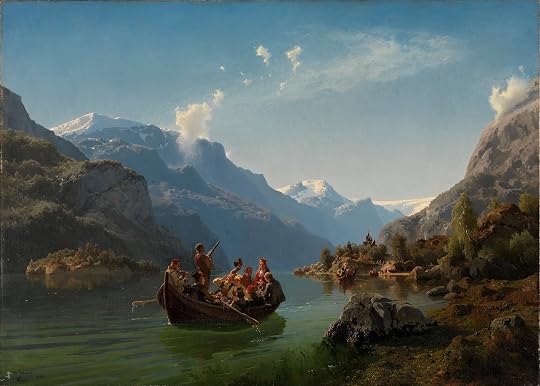
Adolph Tideman and Hans Guden, Bridal Party, 1848 (owned by National Museum of Art in Oslo, Norway, image courtesy of Wikimedia Commons)
We readers sense that Kristin has not made the wisest choice. Her love is dashing and handsome, a kind of bon vivant in a world utterly inappropriate to joyful ease – a world in which animals are likely to starve when the harvest is poor, when the difference between keeping moths out of your wool and allowing an infestation might be the difference between a child freezing to death in the winter and staying warm enough to see another summer. She, too, comes to realize that he is somewhat childish, that he wants to have his cake (a sumptuous wedding with Kristin) and eat it too (premarital sex!!!). “In the end, no doubt, he would realize that no one could have both,” she fears – that is, one cannot give into sinful desire and escape without penitence, without atonement.
And so we have women here who have sexual desires (Kristin and her mother), women who are vulnerable to rape (again, Kristin and her mother as well as others), women who are resentful when their own lovers “take” them, “partly by force, but with laughter and with caresses too, so she had been unable to show him that she was serious in her refusal” (264). But we also have a looming danger of retribution, a price that our young lovers haven’t yet paid for ignoring God’s rules, for honoring their own bodies and their own desires and their own wills above His demand for chastity. A heady brew.
Over the course of the book, Kristin becomes much wiser than anyone realizes (with the possible exception of a wise woman herself nearly banished from polite society). Her father doubts if she can manage an estate and expects that she will need to be ruled by her husband. Her husband delights in her body but seems unaware of her maturation since their first meeting. When the priest in whom she confided dies, Kristin must face a world that has no idea who she is. “He alone had known the foolish child that she had been under her father’s care, and he had known of her secret life with [her lover]. So he was like a clasp, she thought, which bound everything she had loved to all that now filled her heart. She was now quite cut off from the person she had been” (260).
On to book 2!
The result has been, for me, utterly fascinating. The push and pull of modern themes kept me on my toes throughout – this is not a serious comment, but just to amuse myself I’ll ask you to imagine a mash-up of Sir Walter Raleigh and Virginia Woolf. But it’s nothing like that.
We are introduced in this first volume to Kristin as a young girl, living with her parents and younger sister (a third sister follows) in rural Norway. Her father is well-respected and a property owner, but not from a grand or royal family. He dutifully produces children with his wife, but does not long for her and cannot satisfy her own desires to be held, loved, sexually appreciated. He dresses modestly and works hard, when he returns from the fields he is not “dressed much differently from the workmen, in an undyed, knee-length homespun tunic and ankle-length leggings of the same fabric. He was barefoot and carried his scythe over his shoulder. The only thing that distinguished his attire from that of the servants was a shoulder collar of leather for the hawk that was perched on his left shoulder.” (267)
Even this brief passage serves to give a sense of the historically rich descriptions throughout the novel. Undset apparently did a lot of research into the daily life of medieval Norway and shares what she has learned about betrothal practices, farming, cooking, clothing, rituals and celebrations, methods of travel, rules of inheritance, the brewing of beer (don’t add yeast until the brew has cooled in the vats to a gentle tepid temperature) and much more – not pedantically, but as if we know it already, as if it makes sense to us. We simply see these practices unfold, we observe the rules as they are followed and broken, with only as much commentary as is necessary among people who expect one another to understand the import of their actions.
When we first meet Kristin, she is a Good Girl. So good, in fact, that the novel seems almost painfully naive. By the middle of this first volume, however, it becomes clear that it is not Undset who is naive, but her young heroine – a girl who could never, ever do anything that would upset her parents. Nothing could tempt her to disobey or dishonor them. And then in a flash, she meets a man who whisks her into sexual maturity and she is carried away by her desire for him. She confesses their relationship to a priest, and even as he lovingly chastises her for this terrible sin, she cries, “Don’t you see, Brother Edvin, … we couldn’t control ourselves God help me, if I met him here outside the church, after I leave you, I would go with him if he asked me to.” (159) Our rebel heroine, like so many before her, is ready to throw away all the rules of her society, all the privileges of her birth, all the comforts of her home and family, for passionate love.
Adolph Tideman and Hans Guden, Bridal Party, 1848 (owned by National Museum of Art in Oslo, Norway, image courtesy of Wikimedia Commons)
We readers sense that Kristin has not made the wisest choice. Her love is dashing and handsome, a kind of bon vivant in a world utterly inappropriate to joyful ease – a world in which animals are likely to starve when the harvest is poor, when the difference between keeping moths out of your wool and allowing an infestation might be the difference between a child freezing to death in the winter and staying warm enough to see another summer. She, too, comes to realize that he is somewhat childish, that he wants to have his cake (a sumptuous wedding with Kristin) and eat it too (premarital sex!!!). “In the end, no doubt, he would realize that no one could have both,” she fears – that is, one cannot give into sinful desire and escape without penitence, without atonement.
And so we have women here who have sexual desires (Kristin and her mother), women who are vulnerable to rape (again, Kristin and her mother as well as others), women who are resentful when their own lovers “take” them, “partly by force, but with laughter and with caresses too, so she had been unable to show him that she was serious in her refusal” (264). But we also have a looming danger of retribution, a price that our young lovers haven’t yet paid for ignoring God’s rules, for honoring their own bodies and their own desires and their own wills above His demand for chastity. A heady brew.
Over the course of the book, Kristin becomes much wiser than anyone realizes (with the possible exception of a wise woman herself nearly banished from polite society). Her father doubts if she can manage an estate and expects that she will need to be ruled by her husband. Her husband delights in her body but seems unaware of her maturation since their first meeting. When the priest in whom she confided dies, Kristin must face a world that has no idea who she is. “He alone had known the foolish child that she had been under her father’s care, and he had known of her secret life with [her lover]. So he was like a clasp, she thought, which bound everything she had loved to all that now filled her heart. She was now quite cut off from the person she had been” (260).
On to book 2!
Displaying 1 - 30 of 1,408 reviews