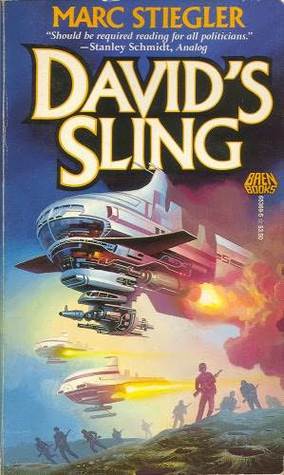
A blueprint for saving reason in the age of disinformation
Someone suggested I read David's Sling because it presents an idea I've been working on for 17 years: using technology to combat misinformation and propaganda through systematic reasoning. I was expecting a dated Cold War techno-thriller. Instead, I found a book that predicted the internet before it existed, remote work before COVID, and laid out a field manual for fighting misinformation, dogma, and fake news.
It's genuinely unsettling how much Marc Stiegler got right in 1988. He predicted information warfare, organized deception, and conflicts fought through perception and narrative, all long before social media turned prediction into reality. But what separates this book from other prescient fiction is that it doesn't just admire the problem. It proposes a solution.
The core idea is that the protagonists win not through brute force, but by building a system that organizes arguments with reasons to agree and disagree on the same page. Think Wikipedia for debates. Stiegler sketches out decision support systems where you can see the cost-benefit analysis overlaid on the argument, where evidence gets weighted by quality, and where tribal reflexes get replaced by transparent logic.
Reading it now feels less like science fiction and more like a blueprint we ignored. We built the surveillance half of the internet (tracking everything), but we skipped the reasoning half. We could have built tools that proportioned beliefs to evidence. Instea,d we got Twitter.
There's also a sharp strategic argument running through the plot. Stiegler demonstrates that "smart" systems (information-rich, feedback-driven, reasoning-heavy) systematically outperform "heavy" systems that rely on industrial might. Small groups with better information architecture defeat superpowers with bigger budgets. It's not just a plot device. It's a testable hypothesis about how leverage actually works.
The book isn't perfect. Characters sometimes lecture instead of talk. The libertarian economics occasionally overwhelms the narrative. And Stiegler was way too optimistic about adoption timelines. We're 35 years later and politicians still make decisions the old way.
But if you care about building tools that help society resist manipulation, this matters. It's not just entertaining. It's a specification document for infrastructure we desperately need and still haven't built. We're living in Stiegler's predicted world of bot farms and weaponized misinformation. We just never built the defenses he described.
Read this if you want to understand why systematic reasoning infrastructure isn't just nice to have. It's how we complete the Enlightenment project.
Consider this an alternate history novel, where the Berlin wall did not come down in 1989 and the Russians remained hawkish. Due to an ill-advised series of treaties with the USSR President Mayfield has withdrawn smart missiles from Western Europe and the Russians have rolled the dice and invaded Denmark and West Germany in a ‘police action’. Meanwhile, the Zetetic Institute is working on a new kind of smart weapon known as David’s Sling. It basically drops smart crowbars from orbit to surgically target leadership, using the theory that cutting off the head of the chicken will have it running around aimlessly, ripe for conventional mop-ups. True to form however, the military won’t buy private enterprise equipment unless commissioned and the project languishes. Until Russia invades. The book devolves a bit into military fiction and game theory toward the end as battle is joined in Europe, and it reads much like a transcription of a game of Strategy & Tactics with a smattering of psychocybernetics. Marc Stiegler’s book has the distinction of also being available (at the time - 1988) as a Hypercard stack.
When I read this Scifi book I thought it was brilliant in its simplicity. The prose and narrative were tight and it moved. It starts a little left field with the protagonist being a lawyer and seeing the end of that profession. Then getting into project management and overseeing simple mass-produced weapons with sophisticated iterative upgrades winning a war of attrition.
This is still one of the most thought provoking books I have read. It is full of really big ideas and lots of believable hard science fiction. This book was also my first introduction to Hypertext (a forerunner to HTML and XML). I recently read it again and was amazed to find it has really held up very well, which just shows how predictive many of the ideas in the book were.
I read this many years ago, finding the thought it expressed greatly impacted me, and still does. It is an example of looking at a problem from a different perspective and finding a different solution, substituting elegance to replace complexity.
An IT entrepreneur tries to save the world (back before everyone was doing it). The good part of the book (and it's really good) is the account of this guy putting together a team of engineers to design, build, and project-manage the first military drones. There are passages in there that ring very true. The World-War-III stuff doesn't fit, and the book would have been better without it. The biggest tragedy is a glorious bad-guy who vanishes halfway through. Still worth reading.
3.5 stars. This is one of those books where the story is clearly just a vehicle for the underlying philosophical discussion, but I enjoyed the underlying philosophy, so that was okay.
The Zetetic Institute and its maxims were interesting, and the decision duel construct was great. The Prisoner's Dilemma was well illustrated rather than info-dumped. The portrayal of software developers as heroic protagonists was unusual and well done; I enjoyed that and the portrayal of the project manager as a functional equivalent to the general of a small Information-Age-equivalent "army." Admittedly, my bias as a programmer and rookie project manager is showing here. :)
I'd actually be interested in seeing a sequel that placed the Zetetic Institute in today's more complex world of varied threats from various actors. This book is oriented entirely toward the two-actor setting of the Cold war, which is a much simpler problem.
The two-superpower setting is obviously dated; that didn't bother me as much as the exclusive language. The book did have several strong women characters who were important to the plot, but the entire rest of the book talked about "men" instead of people. 1988 is a bit too late to get a pass for that. Also, every one of the women ended up neatly paired off with a man, except the one who started paired and ended up widowed. Oy. (The man who started paired and was widowed by the end of chapter 1 ends up paired with one of the other women.)
The book's blurb touts the discussion of "smart weapons," and it was interesting to compare the scenes of programmers watching video feeds from self-directed weapons that they could not pilot with today's descriptions of remotely-piloted drones.
political future not exactly fulfilled in reality, but interesting concept of creating a weapon that seeks out the responsible party instead of blasting the foot soldiers (so to speak).... a little too simplistic, but definitely technology forecasting from several decades ago. Never really found the characters engaging though.
Geeky Silicon Valley engineers save the world by developing smart weapons which, like, just kill the bad guys and don't cause a lot of collateral damage and all that shit. Cool, huh?
There's this great sequence where a software bug looks like it's going to result in the weapons Doing Something Bad, but the alpha geek manages to fix it in time. Sometimes deadlines bring out the best in you.
Parts of this book truly appealed to me, but others had me nodding offf. It was clearly a vehicle for views with storytelling seconded, and that works well sometimes but didn't really do so brilliantly here. Recommended for hardened sF fans or those with a particular cold war interest.
Clearly the story only serves as a vehicle to allow the author to express his opinions about human rationality, but as the story isn't bad, and I hold the same views about human rationality, I found it an enjoyable read that I finished in two settings.
It was a fun read of a very 80s book. Funny to see the places where there was such boundless optimism now transformed into mundane aspects of everyday life.