In The Science and Spirit of the Ocean, writer, sailor, and surfer Jonathan White takes readers across the globe to discover the science and spirit of ocean tides. In the Arctic, White shimmies under the ice with an Inuit elder to hunt for mussels in the dark cavities left behind at low tide; in China, he races the Silver Dragon, a twenty-five-foot tidal bore that crashes eighty miles up the Qiantang River; in France, he interviews the monks that live in the tide-wrapped monastery of Mont Saint-Michel; in Chile and Scotland, he investigates the growth of tidal power generation; and in Panama and Venice, he delves into how the threat of sea level rise is changing human culture-the very old and very new. Tides combines lyrical prose, colorful adventure travel, and provocative scientific inquiry into the elemental, mysterious paradox that keeps our planet’s waters in constant motion. Photographs, scientific figures, line drawings, and sixteen color photos dramatically illustrate this engaging, expert tour of the tides.
Jonathan’s love for the sea is lifelong. He grew up on the beaches of southern California. He’s built and sailed many boats, logged more than a hundred thousand miles on the Pacific and Atlantic, and surfed all over the world. He has served on numerous conservation boards and committees, including the San Juan Preservation Trust, the San Juan County Marine Resources Committee, and the Northwest Straits Marine Conservation Initiative.
As founder and former director of the Resource Institute, a nonprofit educational organization based in Seattle, Washington, he spent eleven years building a seminar program aboard the schooner Crusader in the Pacific Northwest, from Puget Sound to Southeast Alaska. Resource Institute sponsored weeklong seminars aboard the sixty-five-foot schooner, with subjects ranging from navigation, anthropology, and whale research to poetry, writing, music, and photography. Psychologist James Hillman taught a seminar on the role of animals in dreams; scientist Lynn Margulis discussed the Gaia Hypothesis; poet Gary Snyder pondered the role of killer whales and bears in Haida mythology. Robert Bly, Gretel Ehrlich, Richard Nelson, Paul Winter, Art Wolfe, and William Stafford were among the many others who taught aboard Crusader. Jonathan’s first book, "Talking on the Water," grew out of these experiences.
While on a seminar in Southeast Alaska, Crusader ran aground on a spring tide. After nearly losing the boat, Jonathan vowed to learn more about this mysterious and implacable force. Ten years of research took him to five continents where he saw the largest, fastest, scariest and most amazing tides in the world. With Lukasi Nappaaluk, an Inuit elder, he slithered through a hole in the arctic ice and gathered mussels in the dark cavities left behind by a dropping tide. In China, he witnessed the world’s largest tidal bore, a 25-foot wave that charges upriver at twenty miles an hour. And at the Royal Society of London, he learned that Plato and Aristotle, Leonardo de Vinci, Newton, Descartes, and many other noted thinkers had been captivated – and befuddled — by the tide’s mystery. The book that led to Galileo’s arrest for heresy by the Catholic Church, in fact, was a treatise originally called “The Flux and Reflux of the Tides.” It’s been that important to mankind for centuries. But the story has never been properly told.
I put this on my to-read list a second or two after reading Lisa's review and it washed up as an early Christmas present. (That's just another beauty of Goodreads: the easily accessible Christmas gift list for readers).
This came at the end of a flurry of science/nature books that I read to close out what has, I think, been a pretty shitty year. For everyone. It's given me a sloshy feeling. Maybe it's the Tide. Or the Moon. Or it could be the wine.
-- The moon is receding at a rate of 1 1/2 inches per year.
--The Earth's day never was and never will be exactly twenty-four hours. And tides are the reason.
-- You better get to the Maldives soon before they are all underwater.
-- Linnaeus had a "flower clock" in his garden, meaning he had a golden poppy which opened its petals at 9:30 a.m. and closed them at 3:30 p.m. and a field rose that opened at 4:30 a.m. and closed at 8:30 p.m. The clock was completed by planting species that opened and closed at intervals in between. Linnaeus's flower clock was so accurate that rumors spread that it would replace the mechanical clock, which was frustratingly unreliable during that era.
As I mentioned, this was one of a series of science/nature books that I've read this year-end. And it didn't always square, at least in my mind, with the others. For example, in Fathoms, I learned that whales will eat anything: plastic bags, which get all the attention, but also a whole greenhouse. Yet, here, the author says Whales are smart, and thus unlikely to put their heads anywhere near a turbine.
This came up because there is a lot of energy under the waves. We can reduce our dependence on fossil fuels by accessing that, which is potentially doable. But the very accessing can cause environmental issues, like disrupting spawning routes . . . and chopping up the odd Orca. Dismissing the issue by saying Whales are smart seemed kind of glib. Humans are smart, but some of us can not stay out of the turbines, figuratively or otherwise.
Well, that's all I got. It's late, and I have to go howl at the moon.
Ah, the ebb and flow of the tide. It invades my life as a metaphor, but I have precious little interaction with it in reality. That's how I ended up setting up my tent naively close to the water, up on the Côte-Nord where the St-Lawrence River is really the ocean. I stayed dry. When daylight broke, I took a closer look at the different lines of seaweed, one of which was above my tent. Another camper looked askance at me. I felt inclined to check tide tables for the first time in my life. I moved the tent. I stayed drier.
It dawns on me now just how lucky I was.
I picked through natural wonders in the intertidal zone, slow-drying sea urchins and crabs and seaweed with bulbous ochre fingers. More than once, I sat on rocks until I was marooned and had to rescue valuables in a hurry. It became a game. A fairly low-risk way of feeding adrenaline into your bloodstream, I suppose. Nothing compared to the big-wave surfers encountered in this wild ride.
Jonathan White answered many of my questions about the tide, and fed my fascination besides. This is science taught through eye-opening excursions across the globe and treatises on the beauty of nature and our attempts to understand it; in other words, just the way I like it. I had once read about harvesting mussels from under the sea ice in Northern Quebec, but couldn't fully imagine it. Now I have a strong desire to visit this magical space under the sea ice, unveiled at low spring tides and vastly warmer than the winter air outside. I wish to travel to China to watch a tidal bore rip up the Qiantang river. I dream of a time when the moon was closer and tides rose hundreds of feet to cover the world, and retreat mere hours later. I see periods of resonance everywhere. I want to be a sea captain. Is it too late?
It's entirely possible that this deserves 5 stars. The thing is, I awarded another book 5 twinkle-toes just days ago, so I'm starting to wonder if I'm just in awe of the world as translated through books. Kudos for a well-researched and well-executed labour of love, Mr. White.
Okay, I just saw this video going viral in Twitter https://twitter.com/lerkvd/status/148... (a tidal bore in a river in Riau, Indonesia) and immediately got reminded of the videos I've watched about Qiantang river's tidal bore (world's largest tidal bore, 9-m high, 40 km/h) because of this book, which dedicated a chapter about it.
The book is part scientific history, philosophical musing and then scientific elaboration as well as travelogue. I've love a bit less of the first two - like, I don't need to know the life stories of some dead scientists mentioned, which were a lot, and prefer the later two. I think the author really excel in elaborating these. I highlighted so many parts - everything is connected! from celestial bodies to mudshrimps - and truly enjoyed the way he described the tides he saw and experienced in various places. The fact that he captains his own boat and had to dealt with tides himself is really cool.
It is not a perfect book - I wish he spent more pages on some subjects - but it is successful in making me curious for more. So far, I only pay attention to tides when it's related to my dive trips, preferably done in periods other than new or full moon, except for whale sharks sighting since the best chance is during new moon. Certainly now, I see tides in whole new different ways.
Covers much of the same historical and scientific material as Aldersey-Williams’ The Tide, but White’s more conversational style makes for livelier travel writing as he joins an Inuit guide in an ice cave beneath Ungava Bay in Canada’s Arctic, attends China’s Bore-Watching Festival on the Qiantang River, and interviews monks about the tides at northern France’s Mont Saint-Michel. The book also includes a thorough discussion of the possibility of using tidal power for renewable energy. White poetically concludes, “The tide is vibration, music, time.” Practical and passionate.
I remember exploring Orcas Island in 2018 and seeing this book everywhere, and it has lingered on my shelves for a while. I finally read it for Science September and I'm glad I did. White travels to places that have dramatic or peculiar tides and discusses the science of what we know about tides, the history of knowledge about tides, what we don't know, and ways humans are trying to harness tide energy. I was most fascinated by tidal bores and the combination of storms and high tides.
This is one of those books where I had to keep stopping to look things up, from mudshrimp to tidal bores... you can see my YouTube playlist for more.
Tides is not a quick, easy read. It's a very thoughtful analysis of the relationship between our oceans and the sun and moon, and between the oceans and humanity. As such, it is simultaneously history, astronomy, physics, biology, philosophy, tourism, and current events, combined in a thoroughly readable book.
Author Jonathan White has successfully combined all of these elements into his work, relating many of his own personal experiences as introductions to the effects of tides in various locations ranging from the Arctic to the Straits of Magellan. He conveys scientific information in a way that is both easily understood and interesting. His first-hand accounts of unusual tidal events in places such as California, China, and Canada are exciting. And his respect for the oceans is made abundantly clear.
Mr. White writes with the mind of a scientist, the heart of an adventurer, and the soul of an artist. It's a combination that makes his work worth reading.
This was a very interesting book and a topic that I have really never read much about. I was afraid it was going to be very dense but it was actually a really easy book to read. The author talks about a lot of things including the relationship between the sun & moon and the ocean and also between humans and the ocean. I also believe that the author talked about a variety of different topics concerning the ocean including biology, astronomy, history and the world's current events. It wasn't just a bunch of scientific facts, it included a wide range of information from different fields, which made it all the more interesting.
Thank you to the publisher, Trinity University Press, for sending me a review copy of this book.
Foreword by Peter Matthiessen, in 2014. First chapter, Fundy, North America, with tidal mudflats and sandpipers feeding. Since this has a high range between low and high tide, engineers were considering dams to capture energy, until they were told these would silt up fast. I enjoyed the accounts of studying the sandpipers. Tides meant a lot to native fisherfolk.
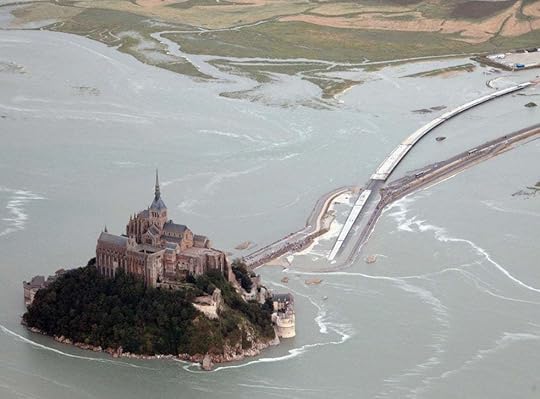
Mont Saint Michel, France. Causeway at low tide. Since this is a historical place, the author talks about tribal studies and beliefs about the moon and its phases. Moses didn't need to part the Red Sea - there is a sandbar across at low tide, but Pharaoh's chariot wheels would have got stuck and trapped the army as water returned. And just what did everyone think caused the tides?
Quiantang bore in China. As well as much folk belief, history and modern history, the author tells us of standing on the mud watching a stacked series of waves coming fast for him....
The Royal Society and the age of scientific study begins. Newton creates laws to match observed gravity. Galileo noticed water in jugs on a boat sloshing back and forth and realised that the tides did the same.
Surfing big waves. Now we start to see the irregularities - global explorers found some places had one tide a day, others four and so on. Storm surges, tsunamis.
While the book is copiously illustrated, sadly none of the photos showed properly in my e-ARC and the maps and diagrams, if they did show, stalled and dragged their way down the page screen. I had set it to the smallest resolution to speed the trip but it stalled halfway on the map of British Columbia and could not progress. I am sure the book will be fine on paper. This means I was unable to read the index and references and see how many references contained female names.
I enjoyed the style and found the book mostly easy to follow. This seems intended for adults but mature teens would be fine with the read. I downloaded an e-ARC from Net Galley. This is an unbiased review.
3.4 This is a sometimes interesting, sometimes not-so-interesting explanation of tides and their effects. There are many digressions, personal stories, some of which are interesting, but in general, I felt the book was a bit too long for the subject it was addressing.
4.5 stars. This book was the perfect blend of science, history, and travel memoir. The author writes beautifully and while an interest in tides is obviously necessary, it's certainly not a dry read at all. There were a couple of minor errors that I noted- the Indonesian (Sumatran) earthquake was listed as occurring in 2002 (it's 2004) and the moon phases were labeled incorrectly (corrected in a later edition)- that caused me to lose a little confidence in the parts of the book that I was less familiar with, and lower my rating by a half star. (I bought this book new from Amazon just a month ago, but unfortunately didn't receive the newest edition).
I learned a lot about tides and enjoyed reading the book, so I do highly recommend it.
What I like best about Tides was how, as promised in the subtitle, White balances science and spirit. There is a great deal we learn about Tides in a way the lay reader can grasp. But there's plenty of tales from Native Americans and mythology , personal revelations and searching that I think make the book even stronger. I liked the sections best where White traveled around the world sharing his experiences in such places as the Bay of Fundy and Mont Saint Michel. The last chapter on the possibility of harnessing the tides for energy is tantalizing .
4.5 living by the sea my life is driven by the tides so this book was my perfect companion as I walked low tide. Really enjoyed learning worldwide facts as I googled away from my kindle, fascinated by bores and spent too much time watching YouTube videos. Was a wonderful book if you are fascinated with the sea.
Fascinating looks at the tides - starting with the complex history of humans attempting to understand the force behind them as well as how to predict their comings and goings. The reader is taken along to experience the massive tidal differences at the Bay of Fundy and its migrating seabirds. Then there is diving for mussels with the Inuit in Alaska. The massive tidal bores that race up various rivers - the most notorious being the Silver Dragon that thunders up the Qiantang River in eastern China.
There are the multiple views on how various locals are attempting to deal with sea level rise and its increasing tides - the city of Venice sells colorful waders and just continues their business, making sure that they don't splash boxes of books and deal with the trash, mud and silt left behind. The Kuna Indians on islands off the coast of Panama who are figuring out how to remove themselves from their slowly inundating islands and deal with the Panamanian government. The Maldives who are looking to buy another country for their populace.
Admittedly, the author does seem to get a bit sidetracked when discussing the massive waves along the coasts of California, Hawaii and other locales as he is also a surfer as well as a sailor (he takes the reader along on a couple trips with his boat).
But if you're a fan of the ocean as well as geology and lunar effects on the planet, it's a captivating and extensive look at our oceans.
Some of the information is a bit out of date by now, but I really enjoyed learning more about tides, especially when it came to to waters that I am familiar with.
While I really enjoyed this book, I’m not sure how to catalog it. It’s part travelogue, as White travels to globe to experience various tide phenomenon. It’s part historical narrative as the author discusses various understandings to tide theory, from the ancient world myths to the present. There’s a part of the book that is an astrological primer, as we learn of the moon and sun’s role in creating tide. But in addition to the pull heavenly bodies, there’s also a discussion of the role of geology, wave theory, and how vibration (resonance) plays a role in tides. And after explaining tide theory, Write discusses ecological issues and how tides can help provide power (as it once did in England where it powered many mills around the seacoast).
A researcher provided the author an example of how tides slosh around the ocean. It’s not all uniform as if the ocean is a pan where the water moves back and forth, from one side to the other. Instead, it’s like having a table full of pans. When someone kicks the leg of the table, the water in each pan sloshes at different rates. Because of other factors like geology, the ocean doesn’t act uniform with the gravity pull of the sun and moon. Some places experience great tides while other places (especially nearer the equator or in lakes), the tides are barely noticeable.
I learned many things from this book including that spring tides have no relationship to the season, but to an old Anglo-Saxon word that means “to rise or swell or bust.” Spring tides generally occur at New or Full Moons. The opposition, which occur seven days later, are “neap tides.”
Having grown up near the coast in North Carolina, I’ve been aware of tides my whole life. But the coast in North Carolina has only a tide that averages 3 feet. I also knew that in South Florida, the tides were much less. When I moved to Savannah, I was shocked to realize that its tides were much higher than those to the north or south (the spring tides often being over 10 feet). Sadly, Wright does not discuss the tides within the blight (indention) along the Georgia coast that creates larger tides by forcing in more water.
A ten-foot tide might seem to be a lot, but there are places in the world where tides can be as high as 50 feet! Another interesting phenomenon are tidal bores. Wright travels to the Qiuntang River in China to explore the “Silver Dragon,” a tidal wave that rushes up the river. In another chapter he goes under the ice in the Canadian arctic with an Inuit elder to hunt mussels. With extreme low tides, the natives supplemented their diet by forging under the ice, but they had to be careful to exit the ice caves before they were filled with water. In addition, he explores surfing off California and Hawaii and his own sailing in some of the tidal straits that can be challenging when caught at a time when the tide is running fast.
In the closing of the book, he discusses climate change, sea-level rise, and such dangers posed to coastal areas. He visits the Scotland’s Orkney Islands and South Chili to learn about using tides to generate electricity. Interestingly, John Kennedy spoke about using tides in New England to create electricity just weeks before his death. Kennedy said:
“The problems of the world cannot possibility be solved by skeptics and cynics whose horizons are limited by the obvious realities. We need people who can dream of things that never was.”
I enjoyed listening to this book and recommend it to anyone interested in the sea.
i came for some understanding and appreciation of tides - and it did exactly that.
listening to this audiobook while walking along the beach was particularly fitting. but audiobook'ing this meant i couldn't follow along with figures and diagrams - so i didn't get the full experience. but hey, i can kind of tell you what the deal is about tides, and some interesting places where tides are particularly large/important.
didn't need so much personal history about Newton, Galileo, etc. 🤷♂️
Jonathan White's book, TIDES, includes interesting facts about the way our earth functions AND about the way people have learned to adapt over time to earth's cycles.
TIDES is a non-fiction book with such captivating prose that I wanted to keep reading until I hit the end.
Here are a few of my favorite passages:
"From a practical point of view, it didn't matter if the tide was caused by a waterwheel or a beast or a god; it only mattered that daily survival was easier if you observed the tide and worked with it, not against it. The more you knew, the better." (page 8)
"The roadside is overgrown with alder and black spruce, but at times it opens to sweeping green fields of hay and corn, punctuated by large gambrel-roofed barns and crisp white Victorian farmhouses." (page 14)
"Patches of hard, damp sand stretch for miles, their heavy corduroy surface dazzled in sunlight and shadow." (page 45)
I highly recommend TIDES to anyone who is interested in learning about the earth or anyone who is simply interested in reading a well written book.
This book was interesting enough to read, and I gained an appreciation for the complexities of tides, as well as some of what causes them (a lot of the explanations read well enough for me but probably didn't stick). The writing overall is just ok; most of the science books I read at this stage of my life are by exceptional writers, so this stuck out. As an example, this was a sentence that didn't make sense to me: "As I unfold the chart, I see hundreds of skinny passages between Vancouver Island and mainland British Columbia, as if the two were once a single loaf of bread that has been pulled mostly apart."
I've never lived near water so I never gave much thought to tides. I figured it was just the water level rising and falling with the moon. Turns out there's a whole lot more to them than I'd known. Parts of this book are admittedly dry, but the variety in settings and cultures keeps the interest level up most of the time. I especially was interested to learn about the people who scavenge underneath the frozen surface of the sea when the low tide empties out beneath.
I've spent my entire life close to the ocean, but I knew very little about what caused the 10 foot tidal swings we routinely experience here in Puget Sound. Mr. White explains the science behind tidal prediction in an engaging way with historical anecdotes and his own travels along the way. I’m looking forward to putting this newfound knowledge to work when we take our trawler up to Alaska this summer. Great read.
A little too much history of science (and not tides), and a few too many attempts by the author to create analogies between everyday non-tide events and tides. The links between some of them were strained nearly to the point of breaking and detracted from the actual, interesting tide-related content. Overall an enjoyable read.
There are so many things in this book I absolutely loved. For starters, I can't remember the last time I read so many things that blew my mind in amazing stories and anecdotes from around the globe. From ice caves in Canada to tidal bores inspiring dragon myths in China and so much more... The author has a way of weaving scientific discovery together with stories of time spent interacting with tides in various parts of the world and the people that engage with them. The rhythm of his writing follows that of waves and organically brings into consciousness our own part in nature, in the cosmos and our deep connection to this planet. All that, and it reveals the secret of Moses after all these thousands of years. Very well done indeed.
I love the ocean, and am fascinated by the whole ecosystems impacted on shores and in the water because of tides. This is well-researches and mostly written on a level that the average person can understand. There were a couple of dry spots though. I think my favorite part was the way he described different coastal cultures and their uses of the tides or the ways they’ve just adapted to it.
De verwondering en nieuwsgierigheid van de schrijver is heel aanstekelijk. Ook de veelzijdigheid is leuk: het gaat van ecologie naar wetenschapsgeschiedenis en van sport naar de energietransitie.
Life. If you are interested in the ebb and flow of how life exists on planet Earth this book is for you. Understanding the nature of the oceans, and how it affects our daily lives has been a human endeavor since the dawn of time. The author of Tides: The Science ad Spirit of the Ocean, Jonathan White, brings to the forefront the overwhelming human need to extrapolate the interplay between ocean and life.
The word "awesome" is not typically part of my conversational style. In this case, however, it is fully deserved. This is an awesome book!
I was moved to look up from reading almost every page-spread, to think about what I had just read in awe. White's writing is very clear, and also quite beautiful, especially when describing the natural world he encountered in his travels.
For me, the chapters on the Qiantang River tidal bore and collecting blue mussels under the ice on Ungava Bay would be, on their own, worth buying the book. White writes about these and other adventures with astonishing immediacy, and the revelations about the world - OUR WORLD - are simply amazing.
You know that the moon and the tide are interconnected, right? Did you know there are 400 other factors that influence the tide - and that does not even include weather factors?
If you like your science to be written lyrically and with a feeling of being *right there,* you may enjoy this book.
(Disclosure)--In the early 1990s, I was a very occasional cook aboard Jonathan White's boat, Crusader, for the seminars in the Northwest and Alaska as part of Resource Institute. The boat and the seminars are mentioned in this book, and that made some parts of the book very personal and full of life for me. I hope other readers will love reading this book as much as I did.