Jump to ratings and reviews
Rate this book

Jungle of Stone: The Extraordinary Journey of John L. Stephens and Frederick Catherwood, and the Discovery of the Lost Civilization of the Maya

Rate this book
NEW YORK TIMES  BESTSELLER
The "masterful chronicle" of the discovery of the legendary lost civilization of the Maya and the quest to unlock their secrets.  Featuring a history and description of the major Maya sites, including  Chichen Itza, Tulum,   Palenque, Uxmal, Copan, and more.  Illustrated with a map and more than 100 images. In 1839, rumors of extraordinary yet baffling stone ruins buried within the unmapped jungles of Central America reached two of the world’s most intrepid travelers. Seized by the reports, American diplomat John Lloyd Stephens and British artist Frederick Catherwood—both already celebrated for their adventures in Egypt, the Holy Land, Greece, and Rome—sailed together out of New York Harbor on an expedition into the forbidding rainforests of present-day Honduras, Guatemala, and Mexico. What they found would upend the West’s understanding of human history. In the tradition of  Lost City of Z  and  In the Kingdom of Ice , former  San Francisco Chronicle  journalist and Pulitzer Prize finalist William Carlsen reveals the remarkable story of the discovery of the ancient Maya. Enduring disease, war, and the torments of nature and terrain, Stephens and Catherwood meticulously uncovered and documented the remains of an astonishing civilization that had flourished in the Americas at the same time as classic Greece and Rome—and had been its rival in art, architecture, and power. Their masterful book about the experience, written by Stephens and illustrated by Catherwood, became a sensation, hailed by Edgar Allan Poe as “perhaps the most interesting book of travel ever published” and recognized today as the birth of American archaeology. Most important, Stephens and Catherwood were the first to grasp the significance of the Maya remains, understanding that their antiquity and sophistication overturned the West’s assumptions about the development of civilization. By the time of the flowering of classical Greece (400 b.c.), the Maya were already constructing pyramids and temples around central plazas. Within a few hundred years the structures took on a monumental scale that required millions of man-hours of labor, and technical and organizational expertise. Over the next millennium, dozens of city-states evolved, each governed by powerful lords, some with populations larger than any city in Europe at the time, and connected by road-like causeways of crushed stone. The Maya developed a cohesive, unified cosmology, an array of common gods, a creation story, and a shared artistic and architectural vision. They created stucco and stone monuments and bas reliefs, sculpting figures and hieroglyphs with refined artistic skill. At their peak, an estimated ten million people occupied the Maya’s heartland on the Yucatan Peninsula, a region where only half a million now live. And yet by the time the Spanish reached the “New World,” the Maya had all but disappeared; they would remain a mystery for the next three hundred years. Today, the tables are turned: the Maya are justly famous, if sometimes misunderstood, while Stephens and Catherwood have been nearly forgotten. Based on Carlsen’s rigorous research and his own 1,500-mile journey throughout the Yucatan and Central America, Jungle of Stone is equally a thrilling adventure narrative and a revelatory work of history that corrects our understanding of Stephens, Catherwood, and the Maya themselves.

544 pages, Paperback

First published April 26, 2016

857 people are currently reading
4913 people want to read

About the author

William Carlsen

3 books36 followers
William Carlsen was a reporter for two decades at the San Francisco Chronicle, where he was a finalist for the 1999 Pulitzer Prize for explanatory reporting. He has also worked for the New York Times and taught journalism at the University of California, Berkeley. He and his wife lived for many years in Antigua, Guatemala; they currently reside in Sonoma County, California.

Ratings & Reviews

What do you think?
Rate this book

Friends & Following

Create a free account to discover what your friends think of this book!

Community Reviews

5 stars
914 (36%)
4 stars
1,036 (41%)
3 stars
461 (18%)
2 stars
86 (3%)
1 star
20 (<1%)
Displaying 1 - 30 of 328 reviews
Profile Image for Dmitri.
250 reviews244 followers
November 21, 2023
I found this book through a friend I met in the online book review community. The subjects of the book are John Lloyd Stephens and to a lesser extent Frederick Catherwood. Stephens was a 19th century travel writer, and Catherwood was an artist and architect who worked shortly before photography became prevalent. Together they 'discovered' and popularized the remains of Mayan civilization in the Yucatan and Central America at a time when archeology as a science was still yet unknown. The books Stephens wrote, some illustrated by Catherwood, were bestsellers in the United States and later worldwide.

The work at hand is primarily a biography of Stephens, who grew up in New York in the early 1800's. Although trained as a lawyer he never practiced much. Following an illness he was advised to convalesce in the Mediterranean. Rather than rest he chose to travel through Greece, Turkey and Russia. Afterwards he extended his trip to Egypt and areas currently in Jordan and Israel. He was an early explorer of Petra, the ancient city carved from red rock cliffs. After his return to America he was involved in politics and appointed as a diplomat to Central America. His ulterior motive was to find ruins rumored to lie in the jungle.

On the mission was Catherwood, a British expat Stephens met earlier in New York. They had covered much of the same ground in the middle east separately. His accurate and artistic renderings, aided by the camera lucida, became the first views the world would see of the Mayan wonders. On their way to discover many unknown sites the pair narrowly avoided death from disease and civil war. If Guatemala is dangerous now it's nothing compared to 1839. In addition to Copan (which Stephens 'bought' for $50) they made it to Quirigua and Palenque. Later they visited Uxmal, Chichen Itza, Tulum and less famous sites.

Besides being a biography of Stephens the book revisits the itineraries of his four travelogues and weaves in a lot of contemporary history. The author William Carlsen is a longtime journalist and sometime lecturer at Berkeley. He lived in Guatemala for many years and was nominated for a Pulitzer prize. Although not a historian, this is history and it is written in a readable but serious way. I've felt challenged lately by 500 page academic tracts and had forgotten how good well written and researched journalism can be. The book is a good reminder that you don't always need to be a professor in order to present the past.
Profile Image for Paul.
1,187 reviews40 followers
July 27, 2016
This was an interesting story, but it seemed like it really went all over the place. I was really interested in the Maya part of the story, but there were so many digressions into thorough biographies of practically everyone involved that I feel like I frequently lost the thread of the central american exploration story.
Profile Image for Nancy Oakes.
2,019 reviews917 followers
May 31, 2017
4.5 rounded up.

Very good book -- well written and highly informative. Carlsen's book does a fine job picking up the highlights of both accounts by Stephens and Catherwood ( Incidents of Travel in Central America, Chiapas & Yucatan, 2 Vols and
Incidents of Travel in Yucatan 1-2), also examines the lives of both men. More importantly though, Carlsen shows how the current view before Stephens' and Catherwood's trek of discovery was that

"the Americas had always been a land occupied by primitive, inferior people,"

and how that notion would be radically altered after the publication of Stephens' books.

Much more here at my reading journal, where I look at all three books at once.

I'm a history nerd so I did read both of Stephens' and Catherwood's original accounts that Carlsen covers here, but this book is ideal for non-history geeks who may prefer the shorter version.

Profile Image for Alice.
920 reviews3,564 followers
November 28, 2020
Loved the parts about the adventure, exploration and the Maya culture and history, but found a lot of the other stuff a bit uninteresting.
Profile Image for Joy D.
3,134 reviews330 followers
October 4, 2025
This book provides a dual biography of American diplomat John Lloyd Stephens (1805 – 1852) and British artist Frederick Catherwood (1799 – 1854). It documents their journeys to the jungles of Central America to rediscover the locations of the Maya civilization. They traveled through what is now Belize, El Salvador, Guatemala, Honduras, and Mexico. Local guides took them to see the carved stones hidden in the tropical forests. Stephens recorded their expeditions in his journals, and later published a book, and Catherwood created detailed drawings. They endured onerous challenges during these trips, catching multiple mosquito-borne diseases and dealing with violent political unrest.

Carlsen weaves together stories of their adventures with archaeological discoveries (which took place even before archeology was a defined term). He provides historical context about the warring political factions in the region and the locals’ distrust of outsiders. He addresses cultural imperialism, especially the fact that many scholars of the time refused to believe the indigenous people of Central America could have created such sculptures, architectural designs, and complex civilizations well before the arrival of the first Europeans. Stephens and Catherwood challenged that viewpoint, and of course, they were ultimately proven correct.

The author also addresses the less appealing aspects of their expedition, including the removal of Mayan artifacts and the Western tendency to "discover" places where people had lived for centuries. Carlsen’s writing combines adventure narrative and scholarly analysis. It is a great book to pick up to understand the history of the Maya civilization. I feel like I learned a great deal from this book. It is top rate non-fiction. I highly recommend it to readers interested in the history of the pre-Columbian Americas.
Profile Image for Allison.
303 reviews118 followers
February 5, 2022
What a story of human endeavour, artistry, and resilience. I was engrossed from the first pages of this narrative about two men’s friendship and journey into the mysterious, treacherous jungles of present-day Honduras, Guatemala, and Mexico in search of a long lost civilization. Nonfiction that tackles daring tales of exploration, adventure, and history are some of my favourite stories, particularly when it reads with the grip and pace of a novel. The author’s writing is engaging and lyrical, vividly bringing to life the dense, sweltering jungles of Central America, putting a face to the intense racial and political conflicts of the era, and making me fervently wish I could sit down with Stephens and Catherwood and hear of their adventures firsthand.

John Lloyd Stephens was an American lawyer turned diplomat. Loquacious, charming, and intensely personable, he possessed a boundless energy and curiosity. I loved reading the excerpts from his books, and I will definitely be seeking out his publications. His writing turned the travel narrative on its head. Instead of a dry, stiff recounting of his discoveries, Stephens’s writing invited the reader to join him on the arduous journey. Frederick Catherwood was a British artist, intensely private, reserved, and astonishingly talented. He was a tireless worker, and his ability to capture details so precisely through his drawings is nothing short of magnificent. The two men shared an unlikely friendship, brought together by a kindred wanderlust. Both possessed incredible fortitude, insight, daring, and an insatiable thirst to explore parts unknown. When a diplomatic assignment in 1839 sends him to war-torn Central America, Stephens capitalizes on the proximity to mysterious ruins about which he had heard only rumours. What ensues is an adventure through a tumultuous region where danger lurks around every turn and history is rewritten.

The author’s writing is so transportive I could feel the humidity. When something tickled my arm while reading, I slapped at my skin, fully expecting to find a mosquito. The author’s photos of the modern day sites the two men found and copies of Catherwood’s illustrations pepper the story. The back cover showcases a map outlining the men’s two journeys to the region, and a detailed bibliography is included. The pace of the narrative kept me turning the pages, and three sections are interspersed throughout the tale that give a biographical sketch of Stephens, Catherwood, and the most mysterious character to them in their explorations: the ancient Maya.

This is a riveting work of nonfiction that both taught me a tremendous amount of history with which I was unfamiliar and took me on a journey I will not soon forget. The end is bittersweet, and the two historical figures who loom large on the pages were truly remarkable, exceptional men. You will want a fan and a large, frozen margarita as you delve into this one.
Profile Image for Titi Coolda.
217 reviews115 followers
March 1, 2021
Ce carte! Aventuri, oameni de excepție, locuri exotice,revoluții,ambiții ,realizări și eșecuri,un Titanic avant la lettre. Cartea asta mi-a deschis alte 10 căi de must read.
Profile Image for Suzanne.
893 reviews135 followers
July 18, 2017
n 1839, John Lloyd Stephens and Frederick Catherwood decided to chase rumors of ancient ruins in Central America.  Their difficult trek across jungle, facing hostile soldiers and deadly Malaria is chronicled in William Carlsen's Jungle of Stone.

If Carlsen had attempted a narrative non-fiction of this journey, I think I would have enjoyed the book more.  The stone temples of the Maya were truly magnificent, and Catherwood's illustrations were a wonderful window into what they stumbled across and how it appeared to them nearly two centuries ago.  The biggest problem I had with this book was all the background information on every actor included in the narrative.  It was just too much information about the other parts of their lives - it dwarfed the adventures of finding the ruins.

I also would have liked more information about the Mayans themselves.  I know very little about this civilization and obviously the reason this discovery was important was that it revealed so much about these ancient peoples.
Profile Image for Lauren .
1,834 reviews2,550 followers
Read
July 26, 2021
• JUNGLE OF STONE: The True Story or Twos Men, Their Extraordinary Journey, and the Discovery of the Lost Civilization of the Maya by William Carlsen, 2016.

#ReadtheWorld21 📍Central America

Eager to follow up on the history I read of the Nahua (Aztec) peoples in May - Fifth Sun by Townsend, during RTW21 in Mexico - I sought a book about the ancient Maya, the peoples that inhabited much of Central America for thousands of years, roughly 2600 BCE until the decades after the Spanish Conquest in the 16th century CE.

JUNGLE OF STONE is more of a travelogue and biography of the 19th-century North American and British "explorers" who uncovered the Mayan ruins under the dense vegetation and centuries of jungle of Guatemala, Belize, Honduras, and Mexico. It was more about the expeditions and the archaeology than about the Maya themselves. This book closely follows John Lloyd Stephens, and Frederick Catherwood and the multiple expeditions to Central America to explore and document their findings.

So, not quite what I was hoping for, but still quite interesting nonetheless. There is a single chapter on the Maya in terms of their culture and their advanced technologies, and modern scholarship in Mesoamerican archaeology and history.

I was struck again (and again) while reading, that as Stephens and Catherwood made new discoveries - the pyramids at Chichén Itzá and Tikal, the portrait stelae at Copàn - that both the explorers and the general public denied the idea that the modern people of Guatemala, Belize, Honduras, El Salvador, and the Yucatan could be descendents of the Maya.

Over time, Stephens and Catherwood shifted their stance, looking at comparative art and linguistics. Racism clouded the general deductive reasoning. The Maya were not a "lost tribe of Israel" or ancient Phoenicians blown (way) off course, but a stunningly vibrant and advanced society completely indigenous to Central America.
79 reviews5 followers
March 28, 2016
I received an advance copy of this book through Goodreads First Reads, and am grateful for the opportunity.

This was an excellent historical narrative that gave sufficient attention to the personal character of the key figures while remaining connected to a larger social and political environment including everyone from generals to farmers. I liked how the book connected several different threads of history and focus - not just the history of Mesoamerican groups and their rediscovery, but also the larger history at the time of the discoveries, as doing so helps place the achievements of Stephens and Catherwood into context and demonstrates their significant contribution to historiography of Central America.

Even with this being an uncorrected proof, I have no major concerns with the work. My only minor issue was that the organization of the narrative was sometimes jumbled. For instance, just after the two adventurers found the first of the lost cities, the following chapter jumps back to the beginnings of Stephens' life, which I feel would have served better in an introductory section prior. Still, there are very few problems with the book, and I expect that the final, published version is even better.
Profile Image for Donna.
4,552 reviews165 followers
February 13, 2020
This book sounded interesting to me...I mean, what a great title - Jungle of Stone. Plus this has a decent GR rating. So yay for the expectation Then once I started, the reality hit me. And it wasn't even close to my expectation. The whole first half is all about the subtitle, which in hindsight, I should have paid attention to that before picking this one up. It was all about the people and every possible detail (even the minutia) that was scraped up about them and then add to that all of their world travels....help me. "Just kill me now," I thought on several occasions.

Thankfully around the halfway mark, it migrated to this Jungle of Stone that I wanted to read about. The last half was fascinating to me. I have two boys who have lived in Central America, and I have a daughter who is in Peru now. So it was fun to hear about the places they have been and know about. I liked that part. So 3 stars is a great average since I was all over the place with this one.
Profile Image for Elaine.
463 reviews19 followers
January 18, 2019
This is a deeply researched history of the exploration of South America and the discovery of numerous hidden cities in the Amazon. The very depth of the research makes the book somewhat unapproachable as the reader must wave through highly accurate descriptions of sleeping conditions, individuals who are encountered (both important and not) and what people ate. The book also goes backwards in time and explores the activities of a British team that is competing for locating the antiquities before the American team can succeed. Overall there is a sense of just too much information.

I read the first 300 pages (which means I gave this publication plenty of chances to hook me) and finally jumped ahead to the final chapters. I am sure that avid historians would find this much more interesting than I.
Profile Image for Blake Charlton.
Author 7 books439 followers
October 30, 2017
a thrilling examination of two men history has mostly forgotten but who did the world, and in particularly western civilization, a tremendous favor, by fully describing the mayan ruins and identifying that the were not the work of some lost and sea-wondering old world civilization but the product of native american genius.
Profile Image for Jean-Luke.
Author 3 books484 followers
February 24, 2024
John Lloyd Stephens and Frederick Catherwood left the United States for Central America in 1839 and soon became pivotal in the rise of popular interest in, and study of, Maya civilization through the rediscovery of archaeological sites which had long since been consumed by the jungle. The Maya predated both the Incas and the Aztecs and left behind spectacular architectural wonders indicative of a civilization much more advanced than previously throught.

What remains astounding (but not at all surprising) is the absolute refusal at the time to attribute these astounding ruins to the people who lived and thrived there, with alternative architects ranging from the Lost Tribes of Israel to the people of Atlantis. Stephens, in many respects a ready-to-plunder man of his time, changed all that with his contrarian conclusions. He became a writer of travel books in his thirties and his first travel volume was reviewed by none other than Edgar Allan Poe. Before traveling to Central America, Stephens was the first American to visit Petra, and Carlsen includes a fascinating account of it, along with an overview of the complex political tensions in Central America at the time. Central America in 1840 was not for the faint of heart, and Jungle of Stone beautifully caputes its splendors as well as its dangers.

The unnecessary final chapters cover Stephens's attempt to build a railroad across Panama, with the author making reaching references and awkward parallels to the Maya.

Fun fact: Overpopulation and enviromental degradation contributed to the downfall of the Maya civilization as much as to our own today. Who'd have thought? Lesson not learned, clearly.
12 reviews
June 3, 2017
Jungle of Stone is a captivating book that I was almost sorry to finish. The author brilliantly weaves the personal stories of these two remarkable men with their herculean efforts to discover and document ancient Mayan ruins that were previously known only to the indigenous people. Following rumors of massive structures covered in impenetrable jungle, they endured tropical diseases, stinging insects, storms, debilitating humidity, frightfully dangerous mountain passes, and revolutions. John Lloyd Stephens was an engaging and precise writer whose skill is revealed in snippets of letters and reports. Frederick Catherwood's drawings of the ruins and glyphs are stunning, and so accurate that they are still used for study long after many of the carvings became too weatherworn to interpret.

Stephens and Catherword were real world Indiana Jones', and this book makes me want to search out and savor Stephens original account. Jungle of Stone is the perfect read for the archeologist wannabe who prefers an armchair to balancing on top of a burro and swatting mosquitos while wracked with malaria.
Profile Image for Joe Vigil.
206 reviews
December 2, 2018
It is a very good book. It's very broad historical scope has to do with the fact that John Lloyd Stephens and Frederick Catherwood explored damn near everything the ancient world left behind; including Greece, Egypt and Rome. But their trips into the jungle make this a history rich-high adventure-dual biography juggernaut. History buffs, adventure lovers and Maya freaks will love it.
Profile Image for Overbooked  ✎.
1,725 reviews
December 28, 2016
The fascinating story of the two explorers Stephens and Catherwood, who embarked in two expedition in 1839 and 1841 to Central America and their findings at several ancient Maya sites.

Stephens documented their arduous journeys in dangerous Mesoamerica, where he and his companion had to overcome physical obstacles, illnesses and threats of violence by bands of hostile revolutionaries. Stephens published his travel memoirs including many of Catherwood’s stunning illustrations in two books: Incidents of Travel in Central America, Chiapas, and Yucatan in 1841 and Incidents of Travel in Yucatán in 1843. These publications proved extremely popular, Edgar Allen Poe described the first as “perhaps the most interesting book of travel ever published”, sparking interest and appreciation for Mayan civilization.
Now the books have been digitazed and are publicly available via Internet Archive

From the original Stephens diaries:
We could not see ten yards before us, and never knew what we should stumble upon next. At one time we stopped to cut away the branches and vines which concealed the face of a monument, and then to dig around and bring to light a fragment, a sculpted corner of which protruded from the earth. I leaned over with breathless anxiety while the Indians worked and an eye, an ear, a foot, or a hand was disentombed. The beauty of the sculpture, the solemn stillness of the woods, disturbed only by the scrambling of monkeys and the chattering of parrots, the desolation of the city, and the mystery that hung over it, all created an interest higher, if possible, than I had ever felt among the ruins of the Old World.


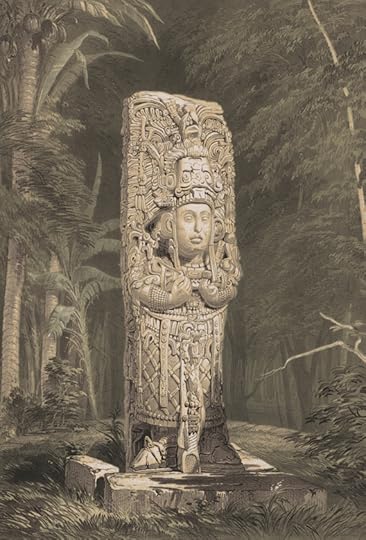
Lithograph from an original drawing by Frederick Catherwood, of Stela at the Mayan site of Copán

The adventures of the two explorers described in Carlsen’s book are exciting, but the author goes on tangents giving detailed accounts of the lives of other characters or episodes in early Central America history, that often distract the reader from the main subject of the book: the discoveries of the Mayan ruins.

The author presents a sobering perspective about the consequences of arrival of Europeans to the region:
They now calculate that up to 100 million “Amerindian” peoples lived throughout the Western Hemisphere, though an accurate count will never be known. If true, this upper range means that the population of the Americas equaled or exceeded Europe’s at the time of Columbus’s first voyage. Yet by 1650, only 160 years later, the Indian population had plummeted to no more than six million, a decline of as much as 95 percent.
Although the initial population figures and the amount of the decline are still debated, most scholars now agree that Europe’s discovery of America almost certainly resulted in the greatest demographic calamity in human history.


The passages describing the Maya sites, convey the excitement and awe of their discoveries. As an example, this extract well describes the explorers’ wonder at the Copan ruins:
A huge sculpted head, embedded in the steps, stared at them from across the plaza. They crossed toward it, climbed the steps to a long, narrow terrace, and found themselves looking down at the river more than a hundred feet below. They had come to the crest of the wall they had viewed hours before from across the river. Above them, looming over the amphitheater, were two giant ceiba trees, their smooth gray trunks as much as twenty feet in circumference, their buttressed roots stretching out for hundreds of feet like the tentacles of an octopus holding down mounds of stones in its tight grip. The two men, emotionally and physically exhausted, sat down on the edge of the plaza and tried to comprehend what they had just found.


On the perils of the jungle at Palenque, where Stephens’ foot got infected:
Like Caddy before him, he fell victim to an insect the Indians called a nigua. This tiny tick, according to Stephens, ate its way into the flesh and deposited its eggs, which quickly hatched and multiplied. He carried one in his foot for several days, not knowing what was wrong. Finally Pawling tried to pick it out with a penknife, leaving a large hole. Soon the foot swelled to the point that Stephens had to sit for a day with his foot up. It was attacked by a swarm of small black flies, which inflicted hundreds of punctures. The swelling increased such that on his tenth day at the ruins, Stephens decided he had to return to the village. The foot was too swollen to fit in the stirrup and he could not let it hang down without feeling that his pulsating blood would burst through his skin. Resting it on a pillow over the pommel of the saddle, he managed to make his way slowly down through the forest to Santo Domingo.


The book is thoroughly researched and extremely interesting, though I would have liked the section on Maya civilization (history, their religion and social costumes) to be more comprehensive.

Personally, I found the last part of the book, with Stephens working for the Panama Railroad Company interesting but less compelling, instead the last years of Catherwood, investing in the goldfields of California and the SS Artic tragedy, were fascinating.

The audio version is generally enjoyable, but is not without small annoyances, e.g. the narrator’s fake accents (e.g. French) may be fine in a novel but sound ridiculous and are unnecessary in a non-fiction book.
3.5 stars
Profile Image for Margaret.
364 reviews54 followers
September 12, 2017
I mean the correct subtitle should be "rediscovery", and having a more comprehensive discussion about what we know now about the Maya would have greatly improved it.


Update: The author decided to respond! So here's his response and then mine:

Thanks you for your review and stars. I'm very curious about what the first "discovery" of the Maya civilization would be like. My editor and I thought this through carefully and rejected "rediscovery" in the title because: first, there was the period of the civilization, then its demise, then its disappearance as a civilization under the forests and jungles of Mesoamerica -- until finally 44 ruined cities were found (discovered) by Stephens and Catherwood and pieced together as an entire civilization and not isolated ruins. Also, I was extremely careful in the title to refer to the "discovery" of this civilization and hoped the title and attendant book flap description did not lead a reader to think that this was a book about the Maya per se, but its discovery. I did include a long chapter on the ancient Maya. I'm really sorry you were disappointed there was not more, but there are a tremendous amount of such books and I refer to some of the best in my footnotes, I would really appreciate any comments you might have especially on the "rediscovery" issue because I don't really quite understand what that word refers to (it has come up before). Wishing you the best, William Carlsen

My response:
So, my contention is that the Maya have never actually disappeared, which I think would also be the contention of the 6 million Mayan language speakers today. From some light Googling, I couldn't find the exact number of Mayan books destroyed by the Spanish when they arrived, but there are some I think rather telling quotes about the connection between the people in Mesoamerica at the time and the destruction of their cultural material. Bishop Diego de Landa wrote in July 1562:
We found a large number of books in these characters and, as they contained nothing in which were not to be seen as superstition and lies of the devil, we burned them all, which they regretted to an amazing degree, and which caused them much affliction.
With multiple book burning events, only 4 remained. I think it's fair to say a not small number of written records of Classical Mayan culture survived the end of that period and were preserved and valued after. This also isn't consistent with the idea that the Maya disappeared or were forgotten to history, or at least history as it was remembered by the peoples of Mesoamerica. The disappearance that did happen was a part of a genocidal campaign to destroy the pre-existing cultures in the Americas, rather than some benign fall or petering out of a civilization.

Additionally, the Toltec used the same calendar and multiple similar glyphs to the Maya (discussed in An Indigenous Peoples' History of the United States), which I think is a fair indication that while the cities were not as inhabited as they once had been, the innovations that the Classical Maya era were adopted more widely in the region.

This doesn't fit with the rise, fall, forget paradigm of non-Western civilizations that tends to get perpetuated. For example, in Arizona there are lots of structures that, while not in continuous occupation, have significant cultural relevance to indigenous peoples today and have been in continuous use (e.g. Casa Grande). If there were rumors of pyramids in the jungle before Catherwood and Stephens, this means there was some collective knowledge about what was actually in the jungle. While much of the paper record was destroyed, it's difficult for me to imagine that even after contact, that the people who lived their whole lives in the areas around these sites were 1) not aware of them or 2) not aware of their cultural history.

This is why I take issue with "discovery"--once can't discover something that was never lost. However, it's possible to re-dsicover something if a bulk of one particular type of memory (like books) is destroyed, especially if the people doing the "discovering" are from outside that culture.

As much as I understand this book was not about the Maya themselves but more about the shift in understanding of Western history from the noble savage paradigm to more of a 1491: New Revelations of the Americas Before Columbus understanding, it would have been neat to have a "Stephens", "Catherwood" and then "18 Rabbit" instead of "The Maya". Not everything can be captured about the Maya (or even the Classical Maya) in a chapter, but it would have been neat to see a classical Mayan king elevated to the same position given Stephens and Catherwood in the history of his city.
Profile Image for Todd Stockslager.
1,831 reviews32 followers
July 13, 2016
Review Title: Indiana Jones and the lost Mayan cities

Fictional archeologist-hero Indiana Jones has nothing to do with this book, but real life adventurers John Lloyd Stephens and Frederick Catherwood actually did what the movies only imitated 150 years later. While they didn't "discover" the Mayan ruins of Central America--they weren't the first humans to see them, usually being lead by local native guides, and they weren't even the first European or American travelers to see many of the sites--they were the first to realize the importance of what they were seeing and publish thrilling words and pictures of what they saw.

Carlsen wisely avoids the Indiana Jones comparison and lets the real biographies and histories tell the story. In 1839,and again on a second trip in 1842, our two real life adventurers headed to Central America. Stephens was an American lawyer and diplomat who had already written best selling books about his travels through Europe and the Middle East, and was now sent south to wind up a treaty with the crumbling Guatemalan government. Catherwood was a British architect and artist who had already done his share of adventuring in Egypt and Palestine including an undercover visit to the Muslim Holy place the Dome of the Rock to provide the first visual images from a Western Christian perspective. Stephens had hired on Catherwood as his official diplomatic assistant and unofficial artist in residence to capture the visual imagery to go with Stephens's text, and after the official work was done, they headed into the jungles in search of these rumored ruins.

What they found and described in the most comprehensive survey of the sites yet attempted exceeded their wildest imagination. Out of seemingly trackless jungle rose massive stone temples, walls, palaces, statues, stone art and even what appeared to be writing. While it would be another century or more (Carlsen concludes in 2016 that more ruins and artifacts are still being found) before the writing was deciphered and Mayan history reconstructed from it, Stephens and Catherwood recognized that these were unique remains of an unknown civilization uniquely American in origin. All theories up to the time had posited Egyptian, Greek, Chinese, or "lost tribes of Israel" origins for the ruins, assuming that no native American culture had the intelligence, population, government, economy and agriculture to create such massive cities and stunning artifacts. While their guesses about the ages of the ruins were mostly wrong (both earlier and later than the current best archeological evidence suggests) their descriptions, pictures, and theories opened up a new way to view the age, provenance and worth of the still-new continents of the New World.

And in keeping with the Indiana Jones adventure, Carlsen documents the many perils of the 19th century travelers--snakes and insects, roaming bands of revolutionaries (Mexico and its Central American neighbors were breaking free of their Spanish colonial pasts, and of each other), rainy season monsoons and dry season droughts, narrow paths clinging to steep cliffs or raging riversides. Both men suffered multiple bouts of malaria (Stephens would die at age 47 in New York from liver damage caused by his many infections) but survived all their narrow escapes to live to tell about them. The books they wrote were immensely popular and remain in print today. Catherwood's drawings, here paired with modern photographs on many pages, were startlingly accurate, and a two-volume oversized folio first edition of his drawings sell today for $50,000 and up in the monochrome version; the exceedingly rare hand colored version (only about a dozen are known to exist) sells for five times that or more when they hit the market.

Carlsen intersperses biographical details of the two men throughout and in separate chapters. Like many such adventurers, their lives back home were often sad, and they seemed most at home on the trail of the Mayan ruins rumored over the next hill. Carlsen provides footnotes and bibliography for those who wish to dive deeper into Mayan archeology and history. Reading this book took me back to my younger self discovering musty books on the library shelves and wanting to be an archeologist when I grew up. While I never realized that ambition, the love of books that take me places never left, and my life's work has enabled me to visit many of the places I read about. Carlsen takes me back to make me feel like that little boy's desire, and he may do the same for you.
Profile Image for Rosemary.
Author 7 books67 followers
June 1, 2017
Jungle of Stone is both enthralling and enlightening. I was captivated from beginning to end by Carlsen’s masterful storytelling, which whisked me away on a breathtaking adventure while filling my mind with fascinating facts.

Fans of the Peabody and Emerson Egyptology mysteries by Elizabeth Peters may find themselves as captivated as I was by the real-life extraordinary adventures of Stephens and Catherwood in Central America. They began their explorations together in 1839, discovering for themselves mysteries of the Maya civilization. The book is rich with Catherwood’s drawings and Carlsen’s photographs, enhancing the perfectly paced text.

I was especially draw to this book because my son, like Stephens and Catherwood, was captivated early in life by Egyptian, Mesopotamian, Greek, and Roman cultures--and one thing led to another. Central and South American cultures caught his imagination, and he found his calling as an archaeologist, deciphering Maya glyphs. While reading Jungle of Stone, I was delighted to recognize places and details that my son had shared with me, and I've gained an even greater appreciation of the daring and insatiable curiosity of explorers. Also, I shuddered at the dangers described!
Profile Image for Jan Mc.
735 reviews98 followers
November 16, 2019
I am absolutely the target audience for this book, and I really enjoyed it. The story concentrates on the two explorers, Stevens and Catherwood, but has a lot of other information about the time period, the Mayan civilization, the locations as they were in the 1840s, and the consequences of their trips.

The author quite obviously did a bucketload of research on these two men, although there were periods when that research ran dry. What he did find is pretty interesting; these two were definitely men of their time. Their findings included wonderful, realistic illustrations by Catherwood of the ruins (which you can see online), and many measurements and observations that were invaluable to later historians.

The audiobook was greatly enhanced by the narration of Paul Michael Garcia.
Profile Image for Ash.
1,095 reviews131 followers
December 18, 2018
More reviews at Bookish Muggle.

3.5 stars (On second thoughts, reduced rating from 4 to 3.5 as there are better sources to read up on Maya civilization).
I read Jungle of Stone book by William Carlsen just in time for my Mexico trip and I liked it. The book is about John Stevens and Frederick Catherwood as they both make their journey to Mexico and Central America in search of stones in Jungle and end up discovering Maya Civilization. Even the locals had no idea about this civilization and it is because of the expedition of these two men that the Europeans realized that western hemisphere had an advanced civilization which could match some of the ancient civilizations in the East.

The author has done extensive research on the lives of these two men who were involved in the discovery of the Maya Civilization. However, there is not a whole lot of information on the Mayans or their civilization or their stone structures. This is where I ended up getting disappointed with this book. I am not sure why the author thought that we would be interested in the lives of these men, instead of the civilization. I did like the portion of the book that spoke about the ruins and the civilization but beyond that, I got bored reading about biographies of every person involved in the discovery. I was least interested in reading about the personal lives of these men. For me, they were just explorers and I got bored with any detail about their life that did not involve exploration or adventure. Instead of dedicating chapters and chapters on their lives, the author could have given us more information about the Mayan civilization. I wanted to understand what each building meant in the ruins, how the hieroglyphics were decoded, how the Mayan calendar can be read and so much more about Maya but all these were very briefly touched upon.

So the book starts with the men making a trip to Central America in search of stone buildings and after that, the author gets distracted with the political turmoil in Guatemala. There is mention about others who had seen these ruins before these two men and had written reports about them. But these reports were lost in some archives and never came to light. Author spends next few chapters on the politics of the country which was slightly intriguing since I had no idea about that country. After that, he goes back in time and talks about Stephen's expedition to Greece, Egypt, Petra, Jerusalem etc, which was also interesting to read since it was again a travel story. But I did not understand how it was relevant for a book on Maya Civilization.

He talks about another expeditions put forth by the British to explore these ruins. Then finally when the author starts talking about the ruins, he skims over their discoveries as if in a rush to get to other topics. He is always talking about mosquitoes,  malaria, rain and other problems faced by these men. The temples, palaces and other stone structures are briefly touched upon. Nothing is described in detail in any of the sites they visit. This is where the problem lies since anyone picking this book would want to read more about the ruins and not about the men involved in finding the ruins.

These two men make two different trips to Mayan Ruins. Their second trip is mostly to Yucatan which is when they find Chichen Itza and Tulum. Again, I felt these chapters lacking in details. The author did make up for it by having a dedicated section which talks about everything we know currently about this civilization. That section of the book was the best and I did learn a lot about these ancient people. After this section, the author again goes into some tangent about Panama Railroad construction and politics of US and Central American countries. This is where I lost interest in the book. The last few chapters were dragging, talking about some random people and events in history, which had nothing to do with the topic of the book. I skimmed through the last few chapters and ended up closing the book after being disappointed with the content.

I wish the book had less of these digressions and the author focused on the topic at hand - which was ruins. The author wanted to highlight how difficult it was to make a trip to Central America and Mexico due to all the political issues, but he ended up putting readers to sleep in the process. The editor could have done a better job I guess. There is a comparison of Mayan pyramids with Egyptian pyramids and I loved that section a lot. It was interesting to see how two different civilizations who were not in contact with each other ended up building similar structures for different purposes. While one was a tomb, the other was a temple. The chapter that mentions self-mutilation and human sacrifice practices in Maya was great as were the descriptions about their Gods and how the King was considered to be a shaman of the God. There is a short section about Cenotes too and how the civilization disintegrated and fell.

Anyway, it was interesting to learn how Europeans thought these structures were built by someone who had come from Europe or Asia. It was only after the fall of Spanish Empire that these ruins came into light. They did not think the indigenous population of America, whom they considered to be savages could build something that spectacular. The author also highlights the destructive nature of Europeans and the way they destroyed all the stone structures that were constructed by native Americans in the past. Some of these were hidden into thick jungles and thankfully survived. I think not much is known about this civilization even today and the scholars themselves have multiple theories since this civilization was long gone when Europeans landed in the western hemisphere. They only have the hieroglyphs and stone inscriptions to make deductions about these lost people and their lives.

What blew my mind was that this civilization had invented their own calendar system using which they were able to predict eclipses and other cosmic events. They had their own hieroglyphics and wrote about their kings. They cultivated corn and did not domesticate animals it seems. They did not use pulley or wheels and did not use metals, yet ended up building such wonders. They were not in touch with the rest of the world so everything they built, they built on their own. There was always exchange of information and ideas in Europe and Asia, but they did not have that advantage. I would love to read and learn more about this lost civilization.

I give this book 4 stars. The middle section of the book was amazing and deserves 5 stars. I am cutting 1 star for all the irrelevant material and biographies present in the book. The book about Machu Picchu that I read earlier was perfect and I sort of expected this book to match that book I guess, which is why I ended up getting disappointed. Please let me know if you have read a better book about the Maya Civilization.
Profile Image for Forrest.
270 reviews8 followers
May 10, 2023
Not altogether uninteresting,  but much of the first half of the book is more of a biography on the life and travels of John Lloyd Stephens and then a chapter long biography on his partner Catherwood about halfway through. 

While Stephens' discovery and excavation of Mesoamerican archeology sites such as Copan in Guatemala appears to be central to the story,  the author Elaborates extensively on Stephens' travels through Egypt and the Middle East, his travel to Petra.

He covers Stephens' relationship with Thomas Jefferson, other American government officials, and politics of the time,  as well as U.S. diplomacy with the era's central American rulers and governing authorities.

At one point he spends a lot of time discussing the history of New York and Washington DC while providing a biography of Benjamin Stephens, John Lloyd's father.   Had the book been a biography of Stephens this would have been appropriate but Given the length of the book the author should have reserved this for another writing.

Other topics include:

-Rafael Correa,  Fransisco Morazan, and 19th century warfare for Guatemala.

-Stephens' repeated bouts with malaria.

-His mission for the U.S. State department to find a suitable route for a transoceanic canal.

-The author also includes a chapter devoted to the Walker-Caddy expedition to the ruins of Palenque in 1839.

-I skipped Catherwood's biography entirely.

-Bookmark 2- Palenque ... classical frame of reference described by artilleryman Del Rio of Spain.

-The abandonment and extramarital affair of Catherwoods wife Gertrude while he was in Central America and the legal drama that followed.

-Chichen itza

-Tulum

The final 6 chapters covered the lives of Stevens and Catherwood following their archeological expeditions in Central America.
Profile Image for K..
4,727 reviews1,136 followers
October 1, 2020
Trigger warnings: colonialist ideas, horrifying medical stuff, cheating, death of a friend.

I am aware that this book is probably of interest to very few people but my archaeology nerd self. But it was FASCINATING. I honestly don't know how the freaking hell Catherwood and Stephens made their way through the Central American jungle, let alone finding cities along the way. I mean, obviously the local population were often aware of the cities. But it's not until White People find them that they EXIST. But, like, it's still a pretty amazing feat.

I have no idea how the hell they managed to draw the amazingly detailed illustrations that they did when they were trekking for months at a time with limited supplies, but the knowledge that their drawings gave archaeologists a century later to translate Mayan glyphs that had since eroded off the stelae was mindblowing.

Will other people enjoy this as much as I did? Probably not. Did I enjoy it? Absolutely. (It helped that I've been to Mayan cities in Guatemala and Mexico so I knew a lot of the places that were being discussed)
Profile Image for Todd Payne.
69 reviews1 follower
March 30, 2018
A very interesting exploration (see what I did there) of the beginnings of modern anthropology/archaeology. I especially enjoyed it as a sort of prequel to Lost City of Z. These two gentlemen explorers had the success which one can only imagine Percy Fawcett dreamed of. Interesting description of the turmoil and revolution in Central America ca. 1840 -- I had never heard of the ill fated Central American Republic. What might have been if it had succeeded. Makes one wonder about the societal pre-requisites for launching a successful republic - few outside of the US have done so successfully. But I digress. So too, does the author, unfortunately and it is is one of the shortcomings of the narrative. I did enjoy the mini-biographies of both men - and I was inspired to want to read more about the Panama Canal, but I felt shortchanged. I wanted to learn more about the Mayan history - and while he does, ultimately, get around to it. It was too long in coming -- at the end of the book and sort of rushed. Still and interesting and educational read on a variety of fronts.
Profile Image for Leonide Martin.
Author 7 books142 followers
February 9, 2019
Stephens and Catherwood are deservedly called the "fathers of archaeology in the Americas." Although there were several Spanish excursions into the jungles of Guatemala, Honduras, and southern Mexico in the two preceding centuries, theirs were the books that gave worldwide fame to Mayan lost cities of stone. Their two "Incidents of Travel" books published in 1841 and 1843 became instant best-sellers.

Carlsen retraces the historic journeys of Stephens and Catherwood in this engaging, well researched book. Hacking trails through dense jungles, navigating twisting waterways, climbing daunting mountains, enduring torments of ticks and mosquitoes, the intrepid explorers wended through over 30 overgrown, mostly hidden stone cities known only to locals. Stephens kept a sprightly journal detailing their encounters with nature, local people, and warring armies. He made prophetic comments about the advanced culture, sophisticated people, and antiquity of the ruins. He believed these were works of contemporary native's ancestors, while most scientists believed they resulted from old world civilizations. Catherwood, an artist, meticulously documented architecture in sketches and daguerreotypes.

Reading like fiction, the book keeps you gripped in adventures, politics, and the personal lives of Stephens and Catherwood. It gives an immediate experience of their extraordinary discoveries, and the turbulent times and challenging lives of the discoverers.
Profile Image for Ravi Singh.
70 reviews3 followers
August 20, 2016
What a wonderful introduction to the Mayan civilisation and their incredibly advanced culture which existed long before the western one this bok was for me! The story of two courageous explorers with an indomitable spirit, who made discoveries which rank as high as any other anywhere. Stephens and Catherwood opened up a whole new world in Central America by their sheer will and determination, fighting unfavourable odds, in hostile weather, during the middle of a civil war, with severe illnesses. It probably couldn't get harder if someone had planned it. It's hard to imagine that the giant ruins of Tikal, Chichen Itza, Tulum, Copan etc which are so familiar today, were all explored and documented and captured in great detail in form of drawings by these two in just a couple of expeditions. Time and again they overcome adversity to keep going using their ingenuity to stave off one disaster after another. The author firmly plants the two on centre stage, interspersing the narrative of discovery with their biographies and an insight into the Mayan culture and architecture in a seamless manner which just flows so well, that you'll find it very hard to put this book down.
Profile Image for Joan.
127 reviews
January 18, 2019
I loved this book but make no claim of objectivity. In 1971 I made my first visit to Mexico, a two week adventure, with the two volumes of "Incidents of Travel in Central America, Chiapas and Yucatan" by Stephens, gloriously illustrated by Catherwood as company in the Yucatan. Never expected to every get to Chiapas or Central America. I loved the books and Mexico.

Never imagined that 15 years later I'd spend 5 years living in Mexico, then Guatemala with same books in hand, tracing their routes while on leave, wonderful puentes, and in a Mexican police helicopter to two very remote sites.

Now 35 years after reading their books, "Jungle of Stone" tells the story of these two men, their extraordinary journey and the discovery of the "lost" civilization of the Maya. Finding this book was a joy! I highly recommend it as well as Stephens/Catherwood's books. Ideally, start while in the Yucatan.
Displaying 1 - 30 of 328 reviews

Can't find what you're looking for?

Get help and learn more about the design.