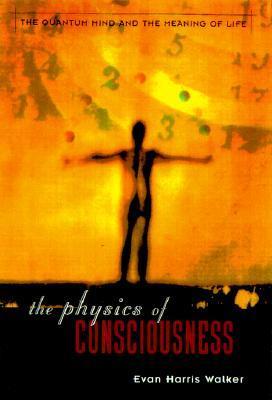
For decades, neuroscientists, psychologists, and an army of brain researchers have been struggling, in vain, to explain the phenomenon of consciousness. Now there is a clear trail to the answer, and it leads through the dense jungle of quantum physics, Zen, and subjective experience, and arrives at an unexpected destination. In this tour-de-force of scientific investigation, Evan Harris Walker shows how the operation of bizarre yet actual properties of elementary particles support a new and exciting theory of reality, based on the principles of quantum physics-a theory that answers questions such as "What is the nature of consciousness, of will?" "What is the source of material reality?" and "What is God?"
I'm just not convinced by this book. Evan Walker explains the quantum mechanics effect known as "tunneling". He shows that it may be a key element in sending messages across synapse connections between neurons in the brain. Therefore, quantum mechanics may be absolutely essential to the thinking/computing capability of the brain. But that does not necessarily mean that quantum effects are key to consciousness.
To me, consciousness requires recursion, that is, self-awareness, the ability to think about oneself. Walker does not even mention this aspect of consciousness, despite being quite familiar with the books by Douglas Hofstadter. If Walker could have tied the recursion into his framework, it would have been much more convincing.
Walker also interleaves his personal story during high school throughout the book. I just didn't see the relevance. In addition, the last chapter explains Walker's ideas about god and faith, but they just don't tie into the rest of the book.
This book is roughly 350 pages. I made it to page 110 before I decided to stop. In a way, it broke my heart.
I read for enjoyment, education, and enlightenment. My suspicion is that this book rates very high on the second two, but I found myself struggling, on several occasions, to try and understand every sentence. I would liken it (very much so) to reading a college physics book, cover to cover. The material is there, but I struggled with any (lack thereof) storyline.
I just did not find the enjoyment that I thought would be there. I consider myself a fairly bright individual, but this made me feel, almost with every sentence, stupid.
I may pick it up again in the future, but will probably do so as a reference. There are very many worthwhile things in this book, it just, for me, was a terribly difficult read.
Incredible!! Read it three times! Evan Harris Walker is the founder and director of the Walker Cancer Institute. He has made major scientific contributions in astronomy, physics, neurophysiology, astrophysics, psychology and medicine. He has a Ph.D. in physics and has published more than a hundred papers in scientific journals and popular magazines and holds a dozen patents. He is intimately familiar with the workings of our brain and mind and the physics that support it. He takes us from Newton to present day in the book and reveals his theory of how consciousness exists and how our will, or intentions, can affect everyday life through Quantum interactions with our surroundings. A true thinker, and great mind of today, and on top of it he writes most eloquently.
Powerful look into the changes in thinking in physics, philosophy, and our understanding of consciousness. Evan's work helps to contextualize the prevalent thinking around consciousness and its origin in thinkers from Wittgenstein to Alfred-Whitehead North, from Bell's Theorem to Dirac's equation.
Ugh. What a slog. I admit i could not finish the book. The author spends far too much time at the beginning laying out elements of physics and with mostly straw man arguments. Then he pivots to an impenetrable chapter on Zen Buddhism. I'll take Alan Watts instead please. Then he launches into trying to connect quantum physics to consciousness in the electrochemical activity of the brain. As a neuroscientist, I found his idea novel. But he interestingly avoids consideration of many of the philosophical issues he criticizes in considering the mind-body problem and i could not stand his selective ideas anymore and stopped 2/3s into the book.
An enquiry into the physical basis of consciousness
This book is a part autobiographical and parts an enquiry into the physical basis of consciousness. The author was influenced by his high school sweetheart who died at the age of 16 due to leukemia. This had profound effect on his scientific and spiritual life which made him to participate in this odyssey of seeking the truth. Sometimes it makes an interesting reading when he reminisces about his high school days in the middle of a discussion of quantum physical phenomenon. The book is somewhat technical and requires undergraduate level physics for a clear understanding. Some chapters use significant amount of physics and in some parts fair amount of neurobiology is also required. Sometimes it is difficult to read because these two diverse subjectsare widely used in discussions. The take-home message of this book is summarized below:
The author broadly describes consciousness as all things in totality (associated with everything in the universe) and it is also reality, but does not define specifically because the definitions and delineations require objective demonstrations. Consciousness is affected by matter or by events in the physical world; therefore consciousness originates from non-physical contact with physical reality that could be described by all fundamental things that makeup physical world. This may be understood with the Schrödinger equation and Einstein's relativity; if consciousness is tied all at once to all physical reality that the Schrödinger equation suggests or tied to space, time, mass (energy), or one of the four forces. The author discusses the importance of each concept and concludes that consciousness could not be tied directly to any of these constructs of the physical world, but it could be linked by quantum physical process at the synaptic junctions of nervous systems. Two parts of the nervous system are considered; the nerves and the synapse, it is at the synapse where an estimated 23.5 trillion neural connections exists and where the information from nerve to nerve passes or fails to pass. Here is where the mind-brain contact exists; here is where data of our senses are processed and refined in the brain. Synapses interact through quantum tunneling mechanism, the author concludes. As the electron and synapse interact to produce quantum potentialities, the state vectors; the consciousness emerges through this, and it is these branching and interlaced collections of quantum potentialities weaving together possibilities that we experience as consciousness. By selecting which synapse will fire, consciousness turns this into an individual will (when an observation takes place, one synapse collapses to one state in association with consciousness thus leading to will). Subsequently mind brings into reality each moment of thoughts, experience and actions. It is suggested that there is no space, time or matter (energy): The conscious observer creates the spacetime and matter from his conscious mind, the quantum mind is the first cause, time-independent and non-local. The concept of individual identity emerges naturally through quantum consciousness when brain-mind functions transition to consciousness and thus a new identity is acquired. The author uses both Vedanta (Hindu philosophy) and Buddhist philosophies considerably in his discussions.
In the final analysis, the author concludes that life, thought, and consciousness are three separate things. An organism does not have to have consciousness to be capable of thought, because a computer (data processing and computing) is capable of thought. Consciousness may exist somewhere without being a part of either a part of living body or data processing system, because they are consequence of one or more quantum mechanical events. These events are mediated by infinite number of discrete, conscious, and non-thinking entities: These conscious entities determine each quantum mechanical events.
The idea that consciousness need not be a part of living entity is controversial. Secondly the author fails to consider the fact that computers and software run machines are programmed by human beings, at least in the early stages of development. Many unicellular and multicellular organisms (and plants and trees) do not have central nervous systems or brains but they independently run their own lives. The body functions according to laws of nature, but body/mind direct motions, foresee alternative effects that may be fateful for its existence, and face the consequences. The conclusion that "I" be it an animal or a plant is used in the widest meaning of the word, which means to state that, I who control the motion of the molecules according to the laws of nature. I reproduce or give birth or create another living being like myself. I can be consequential to the fate of another living species, hence I am special, the personal self equal the all-comprehending- eternal-self. The Upanishads states that Atman is equal to Brahman, and consciousness is never experienced in plural but only in the singular. If consciousness of different people are different, then each individual has a separate soul (plurality of souls), but plurality is merely a series of different aspect of one soul and one conscious, produced by the deception of Maya. This is same as illusion produced in a gallery of mirrors.
This book almost broke my brain. I slogged through to the end on the promise of learning the “true nature of reality.” It’s altogether possible the author has revealed it, but the book is so esoteric and abstruse, that I missed the punchline. The narrative swings wildly from impenetrable explanations of physics equations to reminiscences about a high school sweetheart. I did acquire a bit of understanding of quantum mechanics, but it was hard won. This book is not for the physics uninitiated.
i read this stupid book because someone told me it was a viable alternative to the afterlife from a scientific perspective. it’s stupid. if you don’t believe in a god don’t be a coward about it. you’re trying too hard to calm the looming reality of your own death. this book is like if one of those kids on tik tok who were obsessed with reality shifting had a degree and tried to further justify that.
I was privileged to attend a gathering in which Dr. Evan Harris Walker presented his book. I was very touched by the emotion evoked by the death of a young woman, who was very special to Dr. Walker, and how that event drove his scientific exploration of the nature of consciousness.
By far one of my favorite books that I've read. A combination of science and self, it allowed me to understand behavior and how the mind works a bit deeper.
Such garbage. Can't get through the Introduction. Want my time, money, and brain cells back. Genuinely unwilling to expose my brain to any more of this bs. AVOID!!!
Consciousness is a huge topic to tackle. It's one of those questions/truths that is so inexplicably hard to wrap any kind of explanation around that it gets bantered around by philosophers and scientists with equal bravado. Of course the logical starting point would be the brain, which leads indefinitely to the synapse and then where? How do you define consciousness in terms of a synapse impulse aside from the chemistry of it all? Does chemistry account for will? In comes physics. What a brilliant approach! Physics yes of course! So obvious from the vantage point that the author takes to state vector collapse and yet at the onset how elusive! Wonderful! I really enjoyed the approach. You find the approach of the need for the conscious observer in terms of uncertainty principles but it is rarely talked about the other way around as a gateway to the mysteries of consciousness. Five stars for the approach, presentation and emotional content. But ah! Then then ending to make that huge illogical leap to the final content being the great consciousness of some undefinable god. Well in some senses if this is what you want to label "god" then at least the author puts together a good argument for that so called "god" he created. But he cannot automatically ascribe to it all of the other attachments that society does to that term god that inevitably readers will attach. He in fact knows this and tries to term this new god a "universal" I just think the leap here was much to far to be wrapped up in a final chapter. I do however think that the content was good. The line of thinking was rational and well put forth and frankly at least this form of god I can respect more so than the layman who puts forth no effort in defining what a true god could actually be other than what he is told it should be. So therefore fine. I liked the book it was really a good read then.
I loved this book. Consciousness is approached from a different perspective and explained in scientific terms (Ik would approve) There is no matter. There is no structure. All that you see, all that you touch, is pure consciousness. Consciousness condenses the "real" physical world from an unreachable realm of potentiality, in which many things are true at once.
Walker explains, how this is so, how it must be so, and how the most amazing discovery, non-locality, means that (as Schrodinger said) there is only ONE consciousness. Anywhere and everywhere. And you're it. So am I, and so is she. So are we all, and so is it all.
Quantum, it's something, not a matter or not ?, that have been connected my faith among technology science and religious. It's the same, I'm confirm it.
If we educate about Quantum and understanding the theory of universe, we can find that the next dimensions (unknown hidden dimension today) are closed and nearly with mind and consciousness.!!
So glad and happy that my loving girl take me to goodreads, place that I can finding my interesting journal.
Although I'm not a man who have a proficiency in English, but I'll try to read this book, it's so interesting.
Great book overall. A stark contrast from scientific literature where there is overwhelming apprehension to make bold interpretive statements, as this account should be. I appreciate Walker's diligence in explaining each relevant piece of quantum theory as well as the rigor in defining consciousness theories using real values. Of course, including consciousness in a theory of everything is not a new idea but Walker certainly takes it further than any philosopher has, especially by including hard science. I also enjoy the breaks to include his personal accounts.
Books in this category tend either towards the ooo!-gee-whiz New Age life-is-vibrating-energy naive, or towards the logical postitivist this-is-what-we-know-now Sumo-science fund-me-for-more cheerleading. Evan Harris Walker seems to know that and for this title has kept largely to the real. And that's enough to get everybody going ooo gee whiz, considering the rich feast for thought emerging from this field.
Amazing book. Both introspective and backed by empirical reasoning/scientific examples, this book stands face-to-face with life's hardest questions: why are we here? who are we? how do we think? how can consciousness exist if it cannot be measured or observed? if you've ever pondered the meaning of life, the existence of god, or felt the loss of a loved one - this is a book you should pick up.
I see that this book is less popular, but still it's an amazing read. I think the title scares people off. Could have done without some of the personal commentary but it at least goes along with the theme of life, love, and reality...which is really what physics is all about, right?
Very well presented book on consciousness and how the mind works in gathering and projecting information onto our field of consciousness. The appendix is a very good read for anyone looking for a scientific explanation of how this works
Evan Harris Walker is a physicist who is said to have been the founder of the modern science of consciousness research. He tries to simplify the physics, but his book can be a tough slog in spots. Still, I loved every mind-bending minute of it.
I would say it was a waste of time but I don't feel reading is ever a waste of time. I was disappointed by it though. I pushed through chapters of mathematical equations only to retain a minute amount of insight.
The physics is too complicated for me to be able to find errors in it, yet the conclusions are almost too amazing to be believable. I guess my next quest is to figure out what I can believe.