

What do you think?

Eight Worlds #1
Steel Beach
An alternate cover edition exists here.
Fleeing Earth after an alien invasion, the human race stands on the threshold of evolution, like a fish cast on artificial shores. Their new home is Luna, a moon colony blessed with creature comforts, prolonged lifespans, digital memories, and instant sex changes. But the people of Luna are bored, restless, suicidal-and so is the computer that monitors their existence...
Fleeing Earth after an alien invasion, the human race stands on the threshold of evolution, like a fish cast on artificial shores. Their new home is Luna, a moon colony blessed with creature comforts, prolonged lifespans, digital memories, and instant sex changes. But the people of Luna are bored, restless, suicidal-and so is the computer that monitors their existence...
479 pages, Paperback
First published January 1, 1992
About the author
John Varley
234 books620 followersFull name: John Herbert Varley.
John Varley was born in Austin, Texas. He grew up in Fort Worth, Texas, moved to Port Arthur in 1957, and graduated from Nederland High School. He went to Michigan State University.
He wrote several novels and numerous short stories. He received both the Hugo and Nebula awards.
John Varley was born in Austin, Texas. He grew up in Fort Worth, Texas, moved to Port Arthur in 1957, and graduated from Nederland High School. He went to Michigan State University.
He wrote several novels and numerous short stories. He received both the Hugo and Nebula awards.
Ratings & Reviews
Friends & Following
Create a free account to discover what your friends think of this book!
Community Reviews
Displaying 1 - 30 of 233 reviews

May 27, 2011
The most painful opening sentence in a novel, in the history of literature (well for half the human race, not recommended for the sensitive) forgive me if I don't go into grisly details. Great premise, humans living on the moon what is better than this. The Lunarians, don't call them loonies, they resent this label ( not funny either) have an Utopian society where boredom is the major problem as robots do their needs which makes the time drag on and on , still jealous? Since space aliens have conquered their precious Earth, the
humiliated remnants escaped the vicious invaders onslaught
having scattered to the Eight Worlds which can be colonized in the Solar System from Mercury to Pluto (this being the 4th in this series ). Big Brother, (cancel that, this the 23rd century) the unstable Central Computer rules Luna and inhabitants are uncomfortable, a cold machine deciding .The shall we say a little lazy moon people long lived too, chief amusements are sex change operations and the final solution to emptiness, suicide not for everyone to be frank humans have to do something to feel useful . The main character in this novel is Hildy Johnson a reporter with a tricky body he/she or a it has a fickle nature to be honest. Hildy finds an underground in the satellite heaven, imagine some folks are never satisfied with perfection. These crazed rebels are building a starship to get away from this land of plenty. A new colony they seek on some distant primitive planet to be established where difficulties will bring inevitable death and destruction, and a cold grave too late to return though. Why you may ask... for freedom whatever is that, they explain not too well, the ungrateful citizens. Then C.C. (the computer) has a nervous breakdown again as it always does , blood unhappily spills in the pretty domed lunar cities spoiling the magnificent view such a shame troubles brought here to the pristine home of enigmatic craters. Another example, civilization can never trust chilly machines. This strange novel will appeal to some, maybe not a majority; things are different for sure they crave this to fulfill their wants, warts too as the phrase goes but weirdness comes and the mood changes for the reader, your taste will guide, however others will fall by the wayside. The author likes the bizarre and those , his fans will stay. If you can give it a shot, be warned this is not for everyone...
humiliated remnants escaped the vicious invaders onslaught
having scattered to the Eight Worlds which can be colonized in the Solar System from Mercury to Pluto (this being the 4th in this series ). Big Brother, (cancel that, this the 23rd century) the unstable Central Computer rules Luna and inhabitants are uncomfortable, a cold machine deciding .The shall we say a little lazy moon people long lived too, chief amusements are sex change operations and the final solution to emptiness, suicide not for everyone to be frank humans have to do something to feel useful . The main character in this novel is Hildy Johnson a reporter with a tricky body he/she or a it has a fickle nature to be honest. Hildy finds an underground in the satellite heaven, imagine some folks are never satisfied with perfection. These crazed rebels are building a starship to get away from this land of plenty. A new colony they seek on some distant primitive planet to be established where difficulties will bring inevitable death and destruction, and a cold grave too late to return though. Why you may ask... for freedom whatever is that, they explain not too well, the ungrateful citizens. Then C.C. (the computer) has a nervous breakdown again as it always does , blood unhappily spills in the pretty domed lunar cities spoiling the magnificent view such a shame troubles brought here to the pristine home of enigmatic craters. Another example, civilization can never trust chilly machines. This strange novel will appeal to some, maybe not a majority; things are different for sure they crave this to fulfill their wants, warts too as the phrase goes but weirdness comes and the mood changes for the reader, your taste will guide, however others will fall by the wayside. The author likes the bizarre and those , his fans will stay. If you can give it a shot, be warned this is not for everyone...

September 27, 2018
Sex changes, immortality, and suicidal boredom – O my!
A ubiquitous theme in Varley’s cannon is that if a computer can become sentient then it can just as well develop human neuroses and quirky hang-ups. Singing “Bicycle Built for Two” and asking Hal to open the pod door are coming down the pike (and WAY COOL Varley even references this 2001 scene).
Set on his Eight Worlds universe, it is nonetheless a stand-alone and something of a rogue even for that world building. Humanity has been booted from Earth by The Invaders, a cosmic pack of assholes who decided we lost the audition to marine mammals. People set up house on the moon and throughout the solar system, wherever we can hang our hat. Papa wasn’t the only rolling stone.
So our story begins on Luna and our protagonist is going through a male phase. Yes, humanity has not just learned to survive but also to thrive. Medical science can keep us alive and kicking indefinitely and so old school ideas like age and gender kind of fall away. So too do sexual and community mores. Varley explores what life looks like when we’re past subsistence farming and we need uninhibited sex and blood sports to feel really alive. When the Central Computer, an omnipresent AI that has its circuits into everything, develops an identity crisis akin to his human charges, things get interesting and Varley turns his SF knob to 11.
There were parts of this, introspective moments of observation, social and cultural commentary, that I submit are some of the best SF writing ever. Varley also pays tribute to Heinlein in some TASTY sketches that only makes this better.
For all my SF fan friends, get to know John Varley, he’s as cool as the other side of the pillow.

A ubiquitous theme in Varley’s cannon is that if a computer can become sentient then it can just as well develop human neuroses and quirky hang-ups. Singing “Bicycle Built for Two” and asking Hal to open the pod door are coming down the pike (and WAY COOL Varley even references this 2001 scene).
Set on his Eight Worlds universe, it is nonetheless a stand-alone and something of a rogue even for that world building. Humanity has been booted from Earth by The Invaders, a cosmic pack of assholes who decided we lost the audition to marine mammals. People set up house on the moon and throughout the solar system, wherever we can hang our hat. Papa wasn’t the only rolling stone.
So our story begins on Luna and our protagonist is going through a male phase. Yes, humanity has not just learned to survive but also to thrive. Medical science can keep us alive and kicking indefinitely and so old school ideas like age and gender kind of fall away. So too do sexual and community mores. Varley explores what life looks like when we’re past subsistence farming and we need uninhibited sex and blood sports to feel really alive. When the Central Computer, an omnipresent AI that has its circuits into everything, develops an identity crisis akin to his human charges, things get interesting and Varley turns his SF knob to 11.
There were parts of this, introspective moments of observation, social and cultural commentary, that I submit are some of the best SF writing ever. Varley also pays tribute to Heinlein in some TASTY sketches that only makes this better.
For all my SF fan friends, get to know John Varley, he’s as cool as the other side of the pillow.

March 20, 2018
What a delightful surprise! Varley is one hell of an idea-prolific SF author who never rests on any old plotline but continually stretches his wings over new shores.
So far, I've read five of his novels and I'm frankly rather blown away each time by each in turn. Why? Because he's more interested in telling great character stories with depth and emotional importance than he is about amazing worldbuilding.
Huh. So what? A lot of modern SF does that all the time.
Ah, but a lot of modern SF doesn't go hog wild with amazing worldbuilding and tech and implications the same way as these older SF novels do.
So wait, what? Is this a novel of ideas or a great story about suicidal characters living in a utopia on the Moon after being ejected from the Earth after an alien invasion there? Or is this a story about a schizophrenic AI gone crazy from loneliness and who decided to experiment heartily on the post need-based humanity for the fuck of it? Or is this a delightfully deep and clever and thoughtful sexual identity SF that explores a lot of the pitfalls of being able to swap sexes for yourself almost on demand?
All of the above. Plus there's wonderful media quips, journalism commentary, wild west nostalgia, and an amazingly funny romp with Heinleinesque libertarians who have their own movement on Luna and who embody the heart of RAH's writings without precisely going into the truly weird shit. :)
Varley goes in his own direction there and it's never preachy and it's genuinely thoughtful. Am I charmed? You bet I am. But then, I loved seeing all the homages to RAH and the way Varley bounces off them in strange and wonderful ways.
One thing that should be remembered: RAH died right around the time Varley would have been writing this. Varley is too good a writer and thinker to pull off a straight homage to the Grandmaster. He wrote a great novel all by itself that is equal to anything Samuel Delaney ever wrote and did it with a great hard SF bent, but tipping his hat to the old master was quite delightful and heartwarming. :)
That being said, I loved this novel! I laughed many times and that's impressive when we're in the heart of depression, ennui, and suicidal thoughts. :)
So far, I've read five of his novels and I'm frankly rather blown away each time by each in turn. Why? Because he's more interested in telling great character stories with depth and emotional importance than he is about amazing worldbuilding.
Huh. So what? A lot of modern SF does that all the time.
Ah, but a lot of modern SF doesn't go hog wild with amazing worldbuilding and tech and implications the same way as these older SF novels do.
So wait, what? Is this a novel of ideas or a great story about suicidal characters living in a utopia on the Moon after being ejected from the Earth after an alien invasion there? Or is this a story about a schizophrenic AI gone crazy from loneliness and who decided to experiment heartily on the post need-based humanity for the fuck of it? Or is this a delightfully deep and clever and thoughtful sexual identity SF that explores a lot of the pitfalls of being able to swap sexes for yourself almost on demand?
All of the above. Plus there's wonderful media quips, journalism commentary, wild west nostalgia, and an amazingly funny romp with Heinleinesque libertarians who have their own movement on Luna and who embody the heart of RAH's writings without precisely going into the truly weird shit. :)
Varley goes in his own direction there and it's never preachy and it's genuinely thoughtful. Am I charmed? You bet I am. But then, I loved seeing all the homages to RAH and the way Varley bounces off them in strange and wonderful ways.
One thing that should be remembered: RAH died right around the time Varley would have been writing this. Varley is too good a writer and thinker to pull off a straight homage to the Grandmaster. He wrote a great novel all by itself that is equal to anything Samuel Delaney ever wrote and did it with a great hard SF bent, but tipping his hat to the old master was quite delightful and heartwarming. :)
That being said, I loved this novel! I laughed many times and that's impressive when we're in the heart of depression, ennui, and suicidal thoughts. :)

April 1, 2011
John Varley first appeared on the SF scene in 1975 with a flurry of powerful, creative, and evocative short stories that established him as a major talent. In 1977 he published his first novel, and shortly thereafter received his first Hugo and Nebula Awards for “The Persistence of Vision.” By 1980 Varley had become one of the most important writers in the field. Over the next four years he garnered another Nebula and two more Hugos, and wrote four more novels. Then, in 1985, he stopped publishing science fiction almost entirely,* and maintained a low profile until 1992, when he released STEEL BEACH.
This long SF novel compares favorably with Varley's earlier work. It takes place in the Eight Worlds, a future history the author developed in his excellent OPHIUCHI HOTLINE and his early short stories. The Eight Worlds contained the surviving remnants of humanity two hundred years after an alien invasion wiped out nearly all human life on Earth, barring humans from their home world forever. Their society was an American Baby Boomer's dream: technocratic, cheerfully capitalistic, and socially liberal: STEEL BEACH opens with the sentence “In five years, the penis will be obsolete,” and the main character undergoes two sex changes in the course of five hundred pages. One can easily compare the Eight Worlds to Robert Heinlein's Future History novels, and in recognition of his predecessor Varley turns the last hundred pages of his novel into a fictional tribute to the Old Master.
STEEL BEACH focuses on Hildy Johnson, a centenarian reporter for the Lunar tabloid THE NEWS NIPPLE, assigned to cover the bicentennial of the Invasion of Earth. Hildy, far more interested in current scandals than ancient history, finds the assignment irksome, the more so because s/he must also babysit a seventeen-year-old cub reporter with the sobriquet Brenda Starr. Aside from these annoyances, Hildy leads the typically-contented life of a twenty-third-century Lunarian.
Things aren't what they seem. A rash of bizarre deaths and accidents, coupled with Hildy's own increasingly self-destructive behavior, lead the reporter to seek counsel from the Central Computer, the benevolent if (usually) non-interfering supercomputer responsible for the life and well-being of everyone on Luna. During his consultation, Hildy begins to suspect a far more serious problem has developed: the Central Computer is slowly going insane.
While STEEL BEACH is a clearly-written and fast-paced book, its plot is rather poorly constructed and, except at the very end, lacking in suspense; what kept me reading was curiosity about what interesting idea the author would come up with next, and interest in what the Central Computer (one of the novel's best characters) would do next. Also, Varley's tone occasionally becomes polemical, particularly when his characters discuss twentieth-century views of the body and sexuality. This is usually difficult to pull off well, and here it only comes off as preachy and, as the novel ages, rather dated.
These flaws are typical of much of Varley's longer works. The novel is a form he never really mastered, with the exceptions of THE OPHIUCHI HOTLINE and his late-career disaster thriller SLOW APOCALYPSE. Readers new to John Varley should check out his early (1975-85) novellas and short stories first, before trying STEEL BEACH or J.V.'s other mid-career novels. His fans will find a lot of intriguing ideas in this book, even if the plot meanders and the characters lack much motivation.
* Most likely to work on the 1989 film version of MILLENNIUM, a time-travel novel based on Varley's earlier story “Air Raid.”
This long SF novel compares favorably with Varley's earlier work. It takes place in the Eight Worlds, a future history the author developed in his excellent OPHIUCHI HOTLINE and his early short stories. The Eight Worlds contained the surviving remnants of humanity two hundred years after an alien invasion wiped out nearly all human life on Earth, barring humans from their home world forever. Their society was an American Baby Boomer's dream: technocratic, cheerfully capitalistic, and socially liberal: STEEL BEACH opens with the sentence “In five years, the penis will be obsolete,” and the main character undergoes two sex changes in the course of five hundred pages. One can easily compare the Eight Worlds to Robert Heinlein's Future History novels, and in recognition of his predecessor Varley turns the last hundred pages of his novel into a fictional tribute to the Old Master.
STEEL BEACH focuses on Hildy Johnson, a centenarian reporter for the Lunar tabloid THE NEWS NIPPLE, assigned to cover the bicentennial of the Invasion of Earth. Hildy, far more interested in current scandals than ancient history, finds the assignment irksome, the more so because s/he must also babysit a seventeen-year-old cub reporter with the sobriquet Brenda Starr. Aside from these annoyances, Hildy leads the typically-contented life of a twenty-third-century Lunarian.
Things aren't what they seem. A rash of bizarre deaths and accidents, coupled with Hildy's own increasingly self-destructive behavior, lead the reporter to seek counsel from the Central Computer, the benevolent if (usually) non-interfering supercomputer responsible for the life and well-being of everyone on Luna. During his consultation, Hildy begins to suspect a far more serious problem has developed: the Central Computer is slowly going insane.
While STEEL BEACH is a clearly-written and fast-paced book, its plot is rather poorly constructed and, except at the very end, lacking in suspense; what kept me reading was curiosity about what interesting idea the author would come up with next, and interest in what the Central Computer (one of the novel's best characters) would do next. Also, Varley's tone occasionally becomes polemical, particularly when his characters discuss twentieth-century views of the body and sexuality. This is usually difficult to pull off well, and here it only comes off as preachy and, as the novel ages, rather dated.
These flaws are typical of much of Varley's longer works. The novel is a form he never really mastered, with the exceptions of THE OPHIUCHI HOTLINE and his late-career disaster thriller SLOW APOCALYPSE. Readers new to John Varley should check out his early (1975-85) novellas and short stories first, before trying STEEL BEACH or J.V.'s other mid-career novels. His fans will find a lot of intriguing ideas in this book, even if the plot meanders and the characters lack much motivation.
* Most likely to work on the 1989 film version of MILLENNIUM, a time-travel novel based on Varley's earlier story “Air Raid.”

February 16, 2019
I would have to say that this book is very much an homage to Robert A. Heinlein. That’s not necessarily a bad thing--there’s a very strong The Moon is a Harsh Mistress vibe, which I was totally okay with. The Central Computer (CC) in Steel Beach is channeling the self-aware computer in TMiaHM and ends up having similar problems.
There are nods to other writers as well. There’s a lot of sex-changing in this novel, which made me think of Iain Banks’ Culture series and George Effinger’s When Gravity Fails. Varley’s version also made me think of Tiersias of Greek mythology--you know, the guy who found a pair of copulating snakes and hit them with a stick? Hera was so displeased with him that she turned him into a woman for seven years (apparently being female is a punishment). Needless to say, the Ancient Greeks were eager to hear his perspectives on this and he confirmed their bias by saying that women got much more out of the sexual experience than men did. It seems that Varley believed this too.
There’s also a shout out to Arthur C. Clarke, when the CC is worried that he’s going to end up singing “Daisy, Daisy,” like Hal in 2001: A Space Odyssey.
Another Heinleinian element: a scrapped spaceship called in R.A. Heinlein, within which his spiritual descendents live & grumble. When Hildy is handing out pseudonyms, she christens one of them Valentine Michael Smith (see Stranger in a Strange Land).
I read until the end because I wanted to see how things were wrapped up, but if you’re not a big fan of RAH, my advice is to skip this book.
Book number 308 in my Science Fiction & Fantasy Reading Project.
There are nods to other writers as well. There’s a lot of sex-changing in this novel, which made me think of Iain Banks’ Culture series and George Effinger’s When Gravity Fails. Varley’s version also made me think of Tiersias of Greek mythology--you know, the guy who found a pair of copulating snakes and hit them with a stick? Hera was so displeased with him that she turned him into a woman for seven years (apparently being female is a punishment). Needless to say, the Ancient Greeks were eager to hear his perspectives on this and he confirmed their bias by saying that women got much more out of the sexual experience than men did. It seems that Varley believed this too.
There’s also a shout out to Arthur C. Clarke, when the CC is worried that he’s going to end up singing “Daisy, Daisy,” like Hal in 2001: A Space Odyssey.
Another Heinleinian element: a scrapped spaceship called in R.A. Heinlein, within which his spiritual descendents live & grumble. When Hildy is handing out pseudonyms, she christens one of them Valentine Michael Smith (see Stranger in a Strange Land).
I read until the end because I wanted to see how things were wrapped up, but if you’re not a big fan of RAH, my advice is to skip this book.
Book number 308 in my Science Fiction & Fantasy Reading Project.

July 24, 2007
Just when I thought I'd fangirled Mr. Varley as much as I could, I read this. OMG! Gender, children, our ever-increasing dependence on technology, computer science, depression, the importance of journalism, and lots of little adventures spicing up the great big plot. It's thick, it's thoughtful, and you should read it.
February 19, 2008
When the terribly, terribly fashionable decide the old genitals are getting to be rather a bore, don't you know, they phone the chauffeur and have the old bones driven down to Change Alley.
John Varley, Steel Beach
Hildy Johnson, sometimes reporter for The News Nipple on Luna, may not be John Varley's first character to switch genders in the middle of a story, but he's certainly the most memorable. (In the film His Girl Friday, the character of Hildy was switched to a woman because the director loved the sound of the secretary filling in for the character during rehearsals.) Most of Mr. Varley's work to this point has indicated that gender is possibly one step deeper than a new coat. Hildy shows us that, at least from the inside, The Switch changes outlook and social and sexual dynamics.
The Eight Worlds, of which this book is a vague, out-of-continuity episode in, is a future in which The Invaders -- shadowy, never-seen aliens -- have taken over Earth. But rather than enslave or eat humanity, or abduct and torture us with turkey basters, Varley's aliens don't even notice humanity. The human race is evicted off of Earth like you might sweep ants off your porch.
And so the human race lives on the moons of Jupiter, Saturn, on Mars, Pluto -- pretty much anywhere else in the solar system with a solid surface. And these societies are kept alive and running smoothly by superintelligent machines. In the case of Luna it's the Central Computer, who is a friend to anyone -- on an individual level, in fact.
The CC directs the lives of the teeming multitudes on Luna. It keeps them happy, comfortable. One of the universal rights past basic survival is the right of a job. In an automated society run by a powerful, supposedly benign, CC, people must find their own purposes in life.
Steel Beach is unarguably Mr. Varley's greatest novel among a career of excellent -- and too few! -- books. The question of what is means to be human after the need to survive has been removed, after death has been virtually exterminated, is foremost in the plot, but this is not a preachy book. The characters -- the stubborn, staid Walter Editor; young cub reporter Brenda, Hildy's longtime rival and crush Cricket, Liz the drunken, British royalty -- these people are all cliches out of films and comics. But in the hands of John Varley, they are wonderful, horrible, fascinating people. Dissatisfied with being set pieces in the show run by the CC -- particularly Hildy.
No summary does this book justice, and any synopsis of it sounds like a '40s serial. On a level with Dune, Perdido Street Station, and Hyperion, Mr. Varley's magnum opus should be read by anyone with an interest in science-fiction, any fiction, or just plain being a person.
John Varley, Steel Beach
Hildy Johnson, sometimes reporter for The News Nipple on Luna, may not be John Varley's first character to switch genders in the middle of a story, but he's certainly the most memorable. (In the film His Girl Friday, the character of Hildy was switched to a woman because the director loved the sound of the secretary filling in for the character during rehearsals.) Most of Mr. Varley's work to this point has indicated that gender is possibly one step deeper than a new coat. Hildy shows us that, at least from the inside, The Switch changes outlook and social and sexual dynamics.
The Eight Worlds, of which this book is a vague, out-of-continuity episode in, is a future in which The Invaders -- shadowy, never-seen aliens -- have taken over Earth. But rather than enslave or eat humanity, or abduct and torture us with turkey basters, Varley's aliens don't even notice humanity. The human race is evicted off of Earth like you might sweep ants off your porch.
And so the human race lives on the moons of Jupiter, Saturn, on Mars, Pluto -- pretty much anywhere else in the solar system with a solid surface. And these societies are kept alive and running smoothly by superintelligent machines. In the case of Luna it's the Central Computer, who is a friend to anyone -- on an individual level, in fact.
The CC directs the lives of the teeming multitudes on Luna. It keeps them happy, comfortable. One of the universal rights past basic survival is the right of a job. In an automated society run by a powerful, supposedly benign, CC, people must find their own purposes in life.
Steel Beach is unarguably Mr. Varley's greatest novel among a career of excellent -- and too few! -- books. The question of what is means to be human after the need to survive has been removed, after death has been virtually exterminated, is foremost in the plot, but this is not a preachy book. The characters -- the stubborn, staid Walter Editor; young cub reporter Brenda, Hildy's longtime rival and crush Cricket, Liz the drunken, British royalty -- these people are all cliches out of films and comics. But in the hands of John Varley, they are wonderful, horrible, fascinating people. Dissatisfied with being set pieces in the show run by the CC -- particularly Hildy.
No summary does this book justice, and any synopsis of it sounds like a '40s serial. On a level with Dune, Perdido Street Station, and Hyperion, Mr. Varley's magnum opus should be read by anyone with an interest in science-fiction, any fiction, or just plain being a person.

June 16, 2023
I really enjoyed the satirical style of this novel and what he said about state of human society, purpose of individual in that society and even gender and parenthood. This book was ahead of its time- an intriguing mix of Altered Carbon, Michael Crichton, with a fun mix of a sarcastic Ursula Le Guinn….
This story follows a journalist who lives on the moon, who seems intermittently suicidal- and discovers that mmaybe its not his fault, maybe its the ruling AI, but then whose fault is that. We follow Hilde through their exploration to find fulfilling work, recerd from society, getting a sex change which everyone does these days, fall in love, get embroilled in a plot risking all of humanity, and so much more. Would recommend.
This story follows a journalist who lives on the moon, who seems intermittently suicidal- and discovers that mmaybe its not his fault, maybe its the ruling AI, but then whose fault is that. We follow Hilde through their exploration to find fulfilling work, recerd from society, getting a sex change which everyone does these days, fall in love, get embroilled in a plot risking all of humanity, and so much more. Would recommend.

August 20, 2025
Hildy Johnson was a 100-year-old, middle-aged, lunar: reporter, educator, railroad tycoon, and mother. She survived the sentient computer that maintained the colony’s extensive infrastructure going fully unhinged. Second book in the author’s Eight Worlds series.
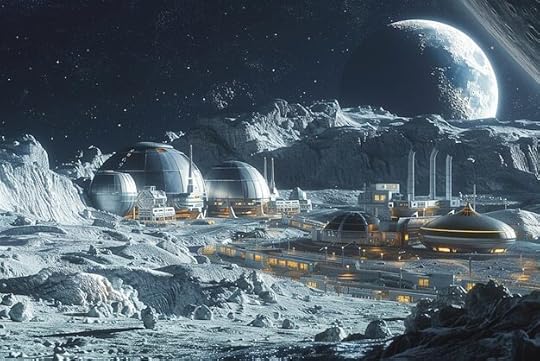
The 200-year-old lunar colony where the largest fraction of humanity survives after being evicted from the Earth by immensely, technologically superior aliens.
My audio version was a hefty 23+ hours long. It had a US 2019 audio copyright. A dead tree copy is 479-pages. Original copyright was 1992.
John Varley is an American science fiction writer. He has written more than 10 novels, and numerous works of short fiction. I have read several books by the author in the past. I have previously read The Ophiuchi Hotline (Eight Worlds #1) long ago. However, none recently.
David Stifel was the narrator. He is an experienced voice actor and narrator. He did well with Hildy’s interior dialog of both sexes, which was extensive.
TL;DR
In the future the largest portion of humanity lives on Luna. 200 years earlier, technologically superior aliens invaded and evicted humanity from the Earth. A fraction of humanity escaped into space, to eventually colonize out as far as the outer planet’s moons. The Earth was denied to humans. The lunar colony now spans the moon with an extensive infrastructure. The Central Computer (CC) developed was incrementally from the earliest days of the colony to maintain the infrastructure, and the population in the hostile extraterrestrial lunar environment. Eventually, it became sentient. It became omnipresent, when humans ‘wired’ themselves into the infosphere maintained by the CC.
Hildy Johnson was the typical lunarian. She’s 100-years old. She starts the story male and ends it female, a transition she’s made before. She starts the story as a reporter for a tabloid-like news outlet, and ends it as an educator and a publisher. She’s had several careers in her middle-aged lunarian life, which was not unusual. Hildy nonchalantly begins trying to kill himself/herself. He/She only survives through direct intervention of the CC, which was a breach of its programming. His/her distress over their feelings of depression and suicide attempts sets her on an investigation of identity within the post-human, lunar society. That search involves her with lunar libertarians, with who she sides when the CC has its Psychotic Break.
This was a meandering, and overblown novel. It had good worldbuilding. It had occasional flashes of wit, and well-done action scenes, but was heavily burdened with exposition, and a forced plot with only two major separated subplots. The proselytizing was fatiguing. The built-in homage to Robert A. Heinlein was particularly tedious. This was not the author’s best work.
The Review
This book has been on my TBR for a decade. I started it once, and put it down. Although, I couldn’t recall why? However, I picked it up again, because of a more recent preoccupation on with Moon Bases (my List) novels, and a rapturous personal review of the author’s Irontown Blues (Eight Worlds #3) by a reading pal of known for her good taste in sf. I opted for ear-reading this book. It accompanied me for a month on the treadmill in a Long March, which at times felt like a literary Death March. Sometimes you shouldn’t Begin at the beginning of a book series?
The prose appeared well-groomed. However, with audiobooks, the narrator verbally copyedits the prose. The truth of a book’s prose can only in the text and found when eye-reading. Varley’s dialog was OK. In places it was humorous. It had a vaguely old-fashioned feel, being written 35-years ago. There might be said to have been two POVs, Hildy’s as the original male and later female. The male inner dialog felt more natural, than hir female’s. The female inner dialog was typically expository. Action scenes were quite good. However, they were few and far between. They also felt too brief after the long, swaths of exposition. Descriptive prose was good. Varley never danced even close to the technical fire. Hildy, was repetitious in pleading not being “technical”. was consistently able to render very technical concepts into an easily understandable form. Oddly interesting was Hildy, breaking the fourth wall in the last chapter. The direct address was startling.
I found the organization of the book to be problematic. At about half-way, I felt that the story was a sequence of stories. In the Afterward, Varley confessed that he’d concatenated two previously written pieces of short fiction together, and added some interstitial prose. He mentioned continuity errors between the halves. I had been too numb to notice by the second half.
It took some sleuthing to find, People of the Moon two volumes of short fiction by Varley, first published in 1990. This was two years before the Steel Beach publication. Both featured the Hildy character, and Luna location. The theme of the first book was identity, and the second was the impact of technology on human life. Hence the interminable character building of this book. The second of the two volumes, which provided the novel’s ending, would have been more than enough to complete this book. However, it was too short. This explained the first half of the book reeking of a Prolonged Prologue.
The protagonist was Hildy Johnson. Hirs was the POV. Hildy starts the story as male, and does a voluntary complete biological transition to female about half-way through the story. This transition was not an affirmation of gender identity. It was reversible lifestyle choice. In my audiobook, this was likely more effective due to Stifel’s voice change vs. reading it. That was for the male/female compare and contrast exposition dogging the second half of the narrative. This was the identity theme in that dominated the first half of the book.
Varley worked long and hard describing Hildy’s as a woman. However, she was a 45-year-old male author’s rendering of a woman, living more than 200-years in the future, written 35-years ago. I felt like it was a description of a Gen-Z-like woman during my reading? However, Varley was clever in keeping me from writing her off a as a male character. Some male writers, particularly early Boomer male writers, should not be writing female characters. Varley did better than most, despite the tedious exposition.
Hildy’s vocation at the start of the book was news reporter. At heart she remained a newsperson throughout, despite changes in vocation. Hildy was a Seeker Archetype .
The story also included numerous other characters, although they were thinner. Mostly they were Hildy’s: colleagues, guy/gal pals, hook-ups, or story-centered antagonists. Keeping with hir newsperson bent, many of them were either other journos or sources. I did not note any folks of colour in the supporting characters.
In the first part of the story the antagonist was another journo. This fed a Rivals to Lovers subplot. In the second part the antagonist was the CC, a moon-wide distributed AI
There was: “Sex, Drugs, and no Rock’n Roll”. Everyone on the moon had sex. Sex was of the moderately descriptive type. I found Hildy’s observations on sex as a woman vs. sex as a man to be eye-rollingly, amusing. I eventually found the details boring. Intoxicants were used. Old fashioned alcohol: liquor, beer, and wine, was consumed in social settings, sometimes in excess. Futuristic, synthetic drugs were mentioned. Tobacco appears in restricted locations. Music of any sort was only mentioned in the background to scenes.
The body count was low, then very high. Folks were most likely to expire through misadventure. (Vacuum kills!) The was violence was physical and futuristic firearms. Note there was an incident of attempted sexual violence. The violence was moderately graphic. Hildy got knocked-about, but suffered no serious harm. The available medical technology was near-magical. Medical nanites provided quick recoveries.
World building was excellent in its high-level, breadth and depth. The Lunar settings for Varley’s books are known for their fidelity. However, modern space science has progressed in the 35-years since the book was written. My thought was the Lunar utopia in the story would be harder to achieve, than it was as written.
Only a few of the technologies were “sufficiently advanced technologies to be indistinguishable from magic.” Although, Varley is known as a semi-hard-ish sf author. Most of the tech would be recognizable from today. Varley was intentionally vague about most of the tech. (Hildy was not a technical person.) Although, many of space systems mentioned were embellishments of systems under study today.
The impact of technology on human life dominated the second part of the book. The lunar utopia was tech dependent. ``Heinleiners'' were a lunar subculture suspicious of technology, a particularly of AI. This libertarian, homage to Robert E. Heinlein aspect of the book was as eyerolling as Hildy’s observations on being a woman.
I didn’t completely geek-out on the world building. It was too utopian. Despite Varley’s admonishment, that folks on Luna appreciated the frailty of their environment. That they did would be an overstatement. For example, putting dogs in fitted spacesuits to take them on a lunar EVA was eyerolling bad.
Summary
I suspect this book did not age very well?
Varly wrote a cobbled together, awkward, credible, what now feels old-fashioned, hard-ish science fiction story that incorporated two simple, separate themes.
The story had credible, hard science-based, world building for an inner solar system-wide civilization. The Moon spanning utopian Lunar colony with a sufficiently advanced technology was lovely. A utopian society controlled by a supercomputer was a bit shopworn, but usable. However, good world building does not make for good novels together of by themselves.
Concatenating two pieces of previously written short fiction, papering over the joint and pulling threads from one into the other didn’t make for a smoothly plotted novel. In addition, there were two unrelated sets of very long tracts of exposition: 1990’s gender identity and 1970’s Heinlein-inspired libertarianism.
The "recycling of older work" made for a long book, and an overall story plot that got lost in the book’s two major, still mostly separate “sub-stories.” The two sub-stories made this book too long. (One alone wasn’t enough for a novel.) At the end Hildy looks to her future, and I thought “Another novella?”
I liked the worldbuilding, but I did not like the story. I liked the action scenes, but loathed the exposition. I would likely have liked either or both of the two pieces of short fiction that made-up the bones of this novel. However, this should have stayed as two related novellas. With the help of a ruthless, 1990’s contemporarily savvy editor, this would have been a good anthology. As a novel it was a disappointment.
The 200-year-old lunar colony where the largest fraction of humanity survives after being evicted from the Earth by immensely, technologically superior aliens.
My audio version was a hefty 23+ hours long. It had a US 2019 audio copyright. A dead tree copy is 479-pages. Original copyright was 1992.
John Varley is an American science fiction writer. He has written more than 10 novels, and numerous works of short fiction. I have read several books by the author in the past. I have previously read The Ophiuchi Hotline (Eight Worlds #1) long ago. However, none recently.
David Stifel was the narrator. He is an experienced voice actor and narrator. He did well with Hildy’s interior dialog of both sexes, which was extensive.
TL;DR
In the future the largest portion of humanity lives on Luna. 200 years earlier, technologically superior aliens invaded and evicted humanity from the Earth. A fraction of humanity escaped into space, to eventually colonize out as far as the outer planet’s moons. The Earth was denied to humans. The lunar colony now spans the moon with an extensive infrastructure. The Central Computer (CC) developed was incrementally from the earliest days of the colony to maintain the infrastructure, and the population in the hostile extraterrestrial lunar environment. Eventually, it became sentient. It became omnipresent, when humans ‘wired’ themselves into the infosphere maintained by the CC.
Hildy Johnson was the typical lunarian. She’s 100-years old. She starts the story male and ends it female, a transition she’s made before. She starts the story as a reporter for a tabloid-like news outlet, and ends it as an educator and a publisher. She’s had several careers in her middle-aged lunarian life, which was not unusual. Hildy nonchalantly begins trying to kill himself/herself. He/She only survives through direct intervention of the CC, which was a breach of its programming. His/her distress over their feelings of depression and suicide attempts sets her on an investigation of identity within the post-human, lunar society. That search involves her with lunar libertarians, with who she sides when the CC has its Psychotic Break.
This was a meandering, and overblown novel. It had good worldbuilding. It had occasional flashes of wit, and well-done action scenes, but was heavily burdened with exposition, and a forced plot with only two major separated subplots. The proselytizing was fatiguing. The built-in homage to Robert A. Heinlein was particularly tedious. This was not the author’s best work.
The Review
This book has been on my TBR for a decade. I started it once, and put it down. Although, I couldn’t recall why? However, I picked it up again, because of a more recent preoccupation on with Moon Bases (my List) novels, and a rapturous personal review of the author’s Irontown Blues (Eight Worlds #3) by a reading pal of known for her good taste in sf. I opted for ear-reading this book. It accompanied me for a month on the treadmill in a Long March, which at times felt like a literary Death March. Sometimes you shouldn’t Begin at the beginning of a book series?
The prose appeared well-groomed. However, with audiobooks, the narrator verbally copyedits the prose. The truth of a book’s prose can only in the text and found when eye-reading. Varley’s dialog was OK. In places it was humorous. It had a vaguely old-fashioned feel, being written 35-years ago. There might be said to have been two POVs, Hildy’s as the original male and later female. The male inner dialog felt more natural, than hir female’s. The female inner dialog was typically expository. Action scenes were quite good. However, they were few and far between. They also felt too brief after the long, swaths of exposition. Descriptive prose was good. Varley never danced even close to the technical fire. Hildy, was repetitious in pleading not being “technical”. was consistently able to render very technical concepts into an easily understandable form. Oddly interesting was Hildy, breaking the fourth wall in the last chapter. The direct address was startling.
I found the organization of the book to be problematic. At about half-way, I felt that the story was a sequence of stories. In the Afterward, Varley confessed that he’d concatenated two previously written pieces of short fiction together, and added some interstitial prose. He mentioned continuity errors between the halves. I had been too numb to notice by the second half.
It took some sleuthing to find, People of the Moon two volumes of short fiction by Varley, first published in 1990. This was two years before the Steel Beach publication. Both featured the Hildy character, and Luna location. The theme of the first book was identity, and the second was the impact of technology on human life. Hence the interminable character building of this book. The second of the two volumes, which provided the novel’s ending, would have been more than enough to complete this book. However, it was too short. This explained the first half of the book reeking of a Prolonged Prologue.
The protagonist was Hildy Johnson. Hirs was the POV. Hildy starts the story as male, and does a voluntary complete biological transition to female about half-way through the story. This transition was not an affirmation of gender identity. It was reversible lifestyle choice. In my audiobook, this was likely more effective due to Stifel’s voice change vs. reading it. That was for the male/female compare and contrast exposition dogging the second half of the narrative. This was the identity theme in that dominated the first half of the book.
Varley worked long and hard describing Hildy’s as a woman. However, she was a 45-year-old male author’s rendering of a woman, living more than 200-years in the future, written 35-years ago. I felt like it was a description of a Gen-Z-like woman during my reading? However, Varley was clever in keeping me from writing her off a as a male character. Some male writers, particularly early Boomer male writers, should not be writing female characters. Varley did better than most, despite the tedious exposition.
Hildy’s vocation at the start of the book was news reporter. At heart she remained a newsperson throughout, despite changes in vocation. Hildy was a Seeker Archetype .
The story also included numerous other characters, although they were thinner. Mostly they were Hildy’s: colleagues, guy/gal pals, hook-ups, or story-centered antagonists. Keeping with hir newsperson bent, many of them were either other journos or sources. I did not note any folks of colour in the supporting characters.
In the first part of the story the antagonist was another journo. This fed a Rivals to Lovers subplot. In the second part the antagonist was the CC, a moon-wide distributed AI
There was: “Sex, Drugs, and no Rock’n Roll”. Everyone on the moon had sex. Sex was of the moderately descriptive type. I found Hildy’s observations on sex as a woman vs. sex as a man to be eye-rollingly, amusing. I eventually found the details boring. Intoxicants were used. Old fashioned alcohol: liquor, beer, and wine, was consumed in social settings, sometimes in excess. Futuristic, synthetic drugs were mentioned. Tobacco appears in restricted locations. Music of any sort was only mentioned in the background to scenes.
The body count was low, then very high. Folks were most likely to expire through misadventure. (Vacuum kills!) The was violence was physical and futuristic firearms. Note there was an incident of attempted sexual violence. The violence was moderately graphic. Hildy got knocked-about, but suffered no serious harm. The available medical technology was near-magical. Medical nanites provided quick recoveries.
World building was excellent in its high-level, breadth and depth. The Lunar settings for Varley’s books are known for their fidelity. However, modern space science has progressed in the 35-years since the book was written. My thought was the Lunar utopia in the story would be harder to achieve, than it was as written.
Only a few of the technologies were “sufficiently advanced technologies to be indistinguishable from magic.” Although, Varley is known as a semi-hard-ish sf author. Most of the tech would be recognizable from today. Varley was intentionally vague about most of the tech. (Hildy was not a technical person.) Although, many of space systems mentioned were embellishments of systems under study today.
The impact of technology on human life dominated the second part of the book. The lunar utopia was tech dependent. ``Heinleiners'' were a lunar subculture suspicious of technology, a particularly of AI. This libertarian, homage to Robert E. Heinlein aspect of the book was as eyerolling as Hildy’s observations on being a woman.
I didn’t completely geek-out on the world building. It was too utopian. Despite Varley’s admonishment, that folks on Luna appreciated the frailty of their environment. That they did would be an overstatement. For example, putting dogs in fitted spacesuits to take them on a lunar EVA was eyerolling bad.
Summary
I suspect this book did not age very well?
Varly wrote a cobbled together, awkward, credible, what now feels old-fashioned, hard-ish science fiction story that incorporated two simple, separate themes.
The story had credible, hard science-based, world building for an inner solar system-wide civilization. The Moon spanning utopian Lunar colony with a sufficiently advanced technology was lovely. A utopian society controlled by a supercomputer was a bit shopworn, but usable. However, good world building does not make for good novels together of by themselves.
Concatenating two pieces of previously written short fiction, papering over the joint and pulling threads from one into the other didn’t make for a smoothly plotted novel. In addition, there were two unrelated sets of very long tracts of exposition: 1990’s gender identity and 1970’s Heinlein-inspired libertarianism.
The "recycling of older work" made for a long book, and an overall story plot that got lost in the book’s two major, still mostly separate “sub-stories.” The two sub-stories made this book too long. (One alone wasn’t enough for a novel.) At the end Hildy looks to her future, and I thought “Another novella?”
I liked the worldbuilding, but I did not like the story. I liked the action scenes, but loathed the exposition. I would likely have liked either or both of the two pieces of short fiction that made-up the bones of this novel. However, this should have stayed as two related novellas. With the help of a ruthless, 1990’s contemporarily savvy editor, this would have been a good anthology. As a novel it was a disappointment.

July 13, 2024
Ciencia ficción tecnológica y potente, con un comienzo desquiciado sobre la vida lunar, sus múltiples actividades de esparcimiento, para todos los gustos, esforzando nuestra imaginación al límite. La socarronería de Hildy lo hace más fácil, sacando más de una sonrisa, pero llega un punto en que la falta de una trama más urdida empieza a aburrir. Por suerte se endereza en el último tercio, desatándose la acción, el esfuerzo imaginativo cobra sentido y ahora sí que vuela.
Al final da la impresión que la prosa de Varley soporta cualquier locura, aportando ideas e ironía en partes iguales y suficientes.
Al final da la impresión que la prosa de Varley soporta cualquier locura, aportando ideas e ironía en partes iguales y suficientes.

March 27, 2011
This novel is set in Varley’s “Eight Worlds” Universe. It is the story, almost the chronicle, of Hildy Johnson, who also made an appearance in “The Golden Globe”. Steel Beach is the story of how Hildy Johnson didn’t commit suicide. That’s putting it crudely since the actual story is full of wonderful detail and nuance.
Hildy Johnson lives on Luna (the moon), a utopia with very long (perhaps even infinite) life, no real need to work and unprecedented personal freedom. Ironically, this personal freedom comes from having a very advanced Central Computer (the “CC”) run basically everything. Every citizen has a personal interface with he CC and can ask for any information at any time. Sex changes and other surgerical procedures are effortless and painless. Subcultures of all sorts thrive as people pursue what they really want to do. For example, large “Disney’s”, basically theme parks where you can even live, provide their inhabitants with life as it was in, say, an idealized Texas in the late 1800s. So life is pretty good. There’s just one problem: Hildy (who starts the novel as a man and ends it as a woman) keeps trying to commit suicide. The CC has noticed a rash of suicides and is trying to do something about them. He dragoons Hildy into helping him. Little does either know where this will land them or the rest of Luna.
The novel is about this, and much more. It is an exploration into what makes us human. Why do we live, exactly? What do we live for? Hildy is faced with the issue of having more or less infinite life ahead of him but no understanding of what he/she must do with it. The unbridled consumerism of Luna is not enough to give him/her purpose. And so he is endlessly seeking. Steel Beach is a wonderful exploration into the nature of humanity. But it is neither lecturing nor boring. The first person exposition is witty, whimsical, at times laugh out loud funny, while remaining insightful and interesting. I loved this book.
http://www.books.rosboch.net/?p=288
Hildy Johnson lives on Luna (the moon), a utopia with very long (perhaps even infinite) life, no real need to work and unprecedented personal freedom. Ironically, this personal freedom comes from having a very advanced Central Computer (the “CC”) run basically everything. Every citizen has a personal interface with he CC and can ask for any information at any time. Sex changes and other surgerical procedures are effortless and painless. Subcultures of all sorts thrive as people pursue what they really want to do. For example, large “Disney’s”, basically theme parks where you can even live, provide their inhabitants with life as it was in, say, an idealized Texas in the late 1800s. So life is pretty good. There’s just one problem: Hildy (who starts the novel as a man and ends it as a woman) keeps trying to commit suicide. The CC has noticed a rash of suicides and is trying to do something about them. He dragoons Hildy into helping him. Little does either know where this will land them or the rest of Luna.
The novel is about this, and much more. It is an exploration into what makes us human. Why do we live, exactly? What do we live for? Hildy is faced with the issue of having more or less infinite life ahead of him but no understanding of what he/she must do with it. The unbridled consumerism of Luna is not enough to give him/her purpose. And so he is endlessly seeking. Steel Beach is a wonderful exploration into the nature of humanity. But it is neither lecturing nor boring. The first person exposition is witty, whimsical, at times laugh out loud funny, while remaining insightful and interesting. I loved this book.
http://www.books.rosboch.net/?p=288

November 26, 2023
This is my favorite Varley book so far. Despite its ironic and sardonic tone, it is rather dark in that the protagonist becomes suicidal and so does the Central Computer that controls everything on the Lunar colony! There is a lot of humor and hijinks at the beginning, but then the tone becomes far more serious if not morbid. I guess that the author went through some dark moments, because there is a lot of philosophizing about why people commit suicide and the place of AI in a modern society. So, although things in it feel archaic (it was written back in 1980), the themes are still valid today.

April 28, 2016
(I will re-review after I finish my re-read. My opinions about a lot of things have changed over the last five years, and I suspect I was too unkind to Mr. Varley here).

November 14, 2010
Love it. Will say more later, but this is absolutely in the big-ideas-dropped-like-little-bombs tradition of Heinlein, but with a big sense of why you don't actually want to BE that guy on a political or a social or a personal level. Plus some really all-in gender switching by main characters including the viewpoint characters, with a sense that gender, sex, and orientation don't all line up the same way for different people, nor does CHANGING one of those things have a predictable effect across different people (pretty good for the '80s). Adore the moment when one single mom starts begrudgingly wearing a mustache (real, biological) because her kid heard from the other kids at school that dads are pretty cool.
Plus the Disneylands, which are historical theme areas left for those who don't quite fit into modern life, but with an easy escape hatch, and Westerns, or dinosaur riding. Leading to an incredible line about how the main character can't imagine old Earth held anything more beautiful and mysterious than a Disneyland sunset.
Something about old postscarcity-obsessed SF really speaks to me. Maybe because of how hard it is anymore to believe we'll ever get there, but it's great to haunt your dreams with.
Plus the Disneylands, which are historical theme areas left for those who don't quite fit into modern life, but with an easy escape hatch, and Westerns, or dinosaur riding. Leading to an incredible line about how the main character can't imagine old Earth held anything more beautiful and mysterious than a Disneyland sunset.
Something about old postscarcity-obsessed SF really speaks to me. Maybe because of how hard it is anymore to believe we'll ever get there, but it's great to haunt your dreams with.

December 4, 2020
Primarily smut with a SciFi backstory... not my cup of tea

June 10, 2022
Clearly Inspired by Heinlein's Moon is a Harsh Mistress, But Overlong
Having just listened to Varley's debut novel The Ophiuchi Hotline (1977) supposedly set in the same setting, I had no idea I'd be getting a much longer update and revisiting of the themes of Robert A Heinlein's famous The Moon is a Harsh Mistress (1966), which I have argued was his last good novel before he got very creepy and cantankerous.
Now John Varley, like Heinlein, is very keen that readers recognize that he can indeed get inside the female mind and write from their perspective, and with all the gender changing in this lunar society he had plenty of chances to explore that to the fullest. I found it a bit tiresome - I can't be sure, but I'd love to ask some female readers if he does, indeed "get it"?
I'd have to say that I found this book overlong and the plot a bit scattered, and while the narrator had that Heinlein snark and independence, it did get a bit wearisome overtime. It also felt remarkably dated and implausible that beat journalists chasing human interest stories (with fedoras no less) could still exist in a future post-scarcity Luna colony. One of my favourite parts of the prior book was the whole bizarre alien invasion and interactions, and that was completely absent from this book. The two books are only very loosely connected really, but I thought the first was better.
Having just listened to Varley's debut novel The Ophiuchi Hotline (1977) supposedly set in the same setting, I had no idea I'd be getting a much longer update and revisiting of the themes of Robert A Heinlein's famous The Moon is a Harsh Mistress (1966), which I have argued was his last good novel before he got very creepy and cantankerous.
Now John Varley, like Heinlein, is very keen that readers recognize that he can indeed get inside the female mind and write from their perspective, and with all the gender changing in this lunar society he had plenty of chances to explore that to the fullest. I found it a bit tiresome - I can't be sure, but I'd love to ask some female readers if he does, indeed "get it"?
I'd have to say that I found this book overlong and the plot a bit scattered, and while the narrator had that Heinlein snark and independence, it did get a bit wearisome overtime. It also felt remarkably dated and implausible that beat journalists chasing human interest stories (with fedoras no less) could still exist in a future post-scarcity Luna colony. One of my favourite parts of the prior book was the whole bizarre alien invasion and interactions, and that was completely absent from this book. The two books are only very loosely connected really, but I thought the first was better.

September 11, 2013
Blah.
Some interesting concepts here - humanity cast off the earth by an uncaring alien race, re-establishes itself on the moon and nearby planets. Medical technology has made every disease curable, every body part update-able and every injury fixable. Over-riding all that, a computer consciousnesses is involved in every aspect of life and thought. And what happens when that omnipotent, benevolent (?) AI starts getting depressed?
All huge concepts, any one of which could have made compelling SF, but all mixed together with hundreds of pages devoted to the awesome future of easy sex-changes... whah, who, huh? Not into it. But that's just me. Also many musings on the nature of sexuality and the serious consideration of suicide... count me not interested.
How do you remain connected to a depressed, suicidal protagonist who is swapping genders at the drop of a hat? Seemed like a lot of deep self-psycho-therapy for the author.
I would have preferred a real story given the great concepts.
Some interesting concepts here - humanity cast off the earth by an uncaring alien race, re-establishes itself on the moon and nearby planets. Medical technology has made every disease curable, every body part update-able and every injury fixable. Over-riding all that, a computer consciousnesses is involved in every aspect of life and thought. And what happens when that omnipotent, benevolent (?) AI starts getting depressed?
All huge concepts, any one of which could have made compelling SF, but all mixed together with hundreds of pages devoted to the awesome future of easy sex-changes... whah, who, huh? Not into it. But that's just me. Also many musings on the nature of sexuality and the serious consideration of suicide... count me not interested.
How do you remain connected to a depressed, suicidal protagonist who is swapping genders at the drop of a hat? Seemed like a lot of deep self-psycho-therapy for the author.
I would have preferred a real story given the great concepts.
December 7, 2009
just fucking terrible. if I hadn't been stuck in airports or on a plane I never would have continued reading this shit.
I knew it was going to be bad when there were mentions of Heinlein in there. Nothing good comes of science fiction authors referencing Heinlein because Heinlein sucked and was a pervert.
So yeah, this book was basically a shallow copy of the kind of stuff written by a dead would-be sex offender.
I knew it was going to be bad when there were mentions of Heinlein in there. Nothing good comes of science fiction authors referencing Heinlein because Heinlein sucked and was a pervert.
So yeah, this book was basically a shallow copy of the kind of stuff written by a dead would-be sex offender.

June 12, 2014
Con Varley siempre me pasa lo mismo, a ratos es fascinante y a ratos un coñazo.

July 8, 2018
Storyline: 2/5
Characters: 3/5
Writing Style: 3/5
World: 4/5
Consider these three factors if you're weighing whether or not to read Steel Beach.
1) My edition ends with an author's note in which he explains how this is related to his Eight Worlds future history series:
2) The first words of the novel: "In five years, the penis will be obsolete..." The journalist, also our narrator, covering this sales pitch sarcastically remarks that he'll hold off calling his broker to sell all the jock-strap stock . The pitch continues, "Sex as we know it is awkward, inflexible, unimaginative. By the time you're forty, you've done everything you possibly could without present, 'natural' sexual system." The pitch and the details and reasons for the foreseen demand for the product, ULTRA-Tingle, continues. Interspersed with some background information on the main character and his colleague who work for different tabloids, The News Nipple and the The Straight Sh*t, respectively; we quickly get front row seats (along with passerby) to what sexual relation in this futuristic society looks like. And it is a future of hedonistic, instant gratification. Some part of this was genuine speculative fiction. Varley was looking at our current trajectory and forecasting what we'd do with technological advances, how it would change both our relationships and our very conception of the self. The greater part of this was raunchy licentiousness, Varley - freed from the social mores and natural limitations in the real world - gets the license to graphically detail and explore the possibilities, doing a great job conveying the delight (and quickly resulting boredom) that so many would take once boundaries had been expanded. Most of the text thereafter a mix of insightful social commentary on the future of identity and straight up pornography.
3) This is a Moon is a Harsh Mistress imitation. Varley has done this before, his Gaea trilogy a knockoff of Niven's Ringworld. It is a little too close to be considered simply "inspired by" - but too serious to be labeled a spoof. They are inarguably original once you accept that Varley is intentionally building upon and expecting readers to already be familiar with the precursors. Much as Varley had tried to out-Niven Larry Niven (a great portion of the middle Gaea book, Wizard, devoted to the mating patterns and possibilities of his fantasy creatures), he also attempts to out-Heinlein Robert A. Heinlein. You can read the implicit challenge between the lines, Varley thinking, "Oh you think that is liberty do you? I show you what Libertarianism would really look like!. And Heinlein was already pretty far out there - sexual relations between family members, family marriages, sexual indulgence as a right - but Varley wants to take them even further to their extremes. This makes for a bizarre political ideology when compared to the society and time in which it was written (much as it was for Heinlein), a mix of extreme conservatism of the Libertarians and the wildest possibilities and affirmations sought by radical progressives. Varley moves beyond sex, and readers get see how life society would regard guns, euthanasia, privacy, education, and Big Government. And really, in the last 150 pages or so of this novel, I thought the novel turned into something more than shock art. After all the meandering and scandalizing, Varley found a purpose to put all this to. Some readers might be able to put those first sections aside, and enjoy the story Varley finally came to discover. And when I could forget those initial 400 pages, I could get there as well. I was never able to put aside those initial hours of agony aside for long, however, and the most I can say for it is that you might as well read to the end, it does get better.
Characters: 3/5
Writing Style: 3/5
World: 4/5
Consider these three factors if you're weighing whether or not to read Steel Beach.
1) My edition ends with an author's note in which he explains how this is related to his Eight Worlds future history series:
It does share background, characters, and technology with earlier stories of mine, which is part of the future history tradition. What it doesn't share is a chronology. The reason for this is simple: the thought of going back, rereading all those old stories, and putting them in coherent order filled me with ennui. It got so bad I might as well give up on this story. Then I thought, what the heck?That really should tell you all you need to know about care in which this was stitched together.
2) The first words of the novel: "In five years, the penis will be obsolete..." The journalist, also our narrator, covering this sales pitch sarcastically remarks that he'll hold off calling his broker to sell all the jock-strap stock . The pitch continues, "Sex as we know it is awkward, inflexible, unimaginative. By the time you're forty, you've done everything you possibly could without present, 'natural' sexual system." The pitch and the details and reasons for the foreseen demand for the product, ULTRA-Tingle, continues. Interspersed with some background information on the main character and his colleague who work for different tabloids, The News Nipple and the The Straight Sh*t, respectively; we quickly get front row seats (along with passerby) to what sexual relation in this futuristic society looks like. And it is a future of hedonistic, instant gratification. Some part of this was genuine speculative fiction. Varley was looking at our current trajectory and forecasting what we'd do with technological advances, how it would change both our relationships and our very conception of the self. The greater part of this was raunchy licentiousness, Varley - freed from the social mores and natural limitations in the real world - gets the license to graphically detail and explore the possibilities, doing a great job conveying the delight (and quickly resulting boredom) that so many would take once boundaries had been expanded. Most of the text thereafter a mix of insightful social commentary on the future of identity and straight up pornography.
3) This is a Moon is a Harsh Mistress imitation. Varley has done this before, his Gaea trilogy a knockoff of Niven's Ringworld. It is a little too close to be considered simply "inspired by" - but too serious to be labeled a spoof. They are inarguably original once you accept that Varley is intentionally building upon and expecting readers to already be familiar with the precursors. Much as Varley had tried to out-Niven Larry Niven (a great portion of the middle Gaea book, Wizard, devoted to the mating patterns and possibilities of his fantasy creatures), he also attempts to out-Heinlein Robert A. Heinlein. You can read the implicit challenge between the lines, Varley thinking, "Oh you think that is liberty do you? I show you what Libertarianism would really look like!. And Heinlein was already pretty far out there - sexual relations between family members, family marriages, sexual indulgence as a right - but Varley wants to take them even further to their extremes. This makes for a bizarre political ideology when compared to the society and time in which it was written (much as it was for Heinlein), a mix of extreme conservatism of the Libertarians and the wildest possibilities and affirmations sought by radical progressives. Varley moves beyond sex, and readers get see how life society would regard guns, euthanasia, privacy, education, and Big Government. And really, in the last 150 pages or so of this novel, I thought the novel turned into something more than shock art. After all the meandering and scandalizing, Varley found a purpose to put all this to. Some readers might be able to put those first sections aside, and enjoy the story Varley finally came to discover. And when I could forget those initial 400 pages, I could get there as well. I was never able to put aside those initial hours of agony aside for long, however, and the most I can say for it is that you might as well read to the end, it does get better.

February 27, 2014
After a decade-long hiatus, John Varley returned to his Eight Worlds series with Steel Beach, and the change is considerable. The original gist of the series is that humanity has been evicted from Earth by an unknown alien force dubbed "the Invaders," forced to eke out a living on the other eight worlds of the solar system (Pluto's recent demotion messes up the name a little, I guess). The only book from the original series I've read is The Ophiuchi Hotline, written in the 1970s, which revolved around an aspect of the Eight Worlds conspicuously absent from Steel Beach: a hotline of data streamed towards Earth from the star Ophiuchi, providing new technology which gives the human race a leg-up in surviving in exile.
This is the only major change from the original series, in storyline terms at least. Varley's prose, on the other hand, has become far better. While The Ophiuchi Hotline was typical mid-century science fiction, with an occasional glimmer of humour and wit, Varley's new style of prose is wonderfully funny, laced with dry observations and laconic philosophy.
The book revolves around Hildy Johnson, a newspaper reporter for Luna, now the most populous and important world since the Invasion. (Hildy describes it as "Refuge of Humanity as well as the Front-Line Planet and the Bulwark of the Race - not to mention the First To Get Our Asses Whipped if the Invaders ever decide to continue what they started.") Despite being on the doorstep of Earth, Lunarians rarely think about the Invaders; it has been two hundred years since their arrival, and most have grown lazy and complacent in a society run by the all-powerful, benevolent Central Computer, where all their needs are provided and Earth is a distant memory. All is not well, however; after several failed suicide attempts, Hildy is choked with an inexplicable despair, and the Central Computer informs him a disturbing fact: suicide is fast becoming the primary cause of death in Lunar society. Even more troubling is the fact that the CC has been feeling rather depressed himself lately...
This sets the tone for most of the book - dissatisfaction and depression. There's a lot of introspection, philosophy and hypothesising about the human condition, which sometimes leaves the plot aimless and confused. But the book still works. Luna itself is a fascinating society, with a hundred amusing little things over every page. People get sex changes every few years or so. The Apollo landing site has become a theme park. There are underground ranches filled with cloned brontosaurs. A modern religion canonizes long-dead celebrities like Elvis for worship. People who used to be kings and queens on Earth now scrape out a living as plumbers or stunt doubles along with the rest of society, and have to save up if they want to rent a party hall for a coronation.
There's an aspect to Varley's work, a Pratchett-esque understanding of how humans tick, that makes it so much more real than anything by Heinlein or Robinson. Of course people are more interested in celebrity marriages than the Invasion of Earth. Of course the original lunar landing site is a replica, since the original one was trashed by drunken college students. Of course there are enormous, underground habitats made to look exactly like 19th century Texas or Oregon, so tourists from the cities can come and watch actors shoot it out with blank cartridges. Human beings were shallow, pedantic and trivial in the 20th century; why shouldn't they be so in the 23rd? It's a hell of a lot more realistic than most hard science fiction, and lot more fun, too.
This is the only major change from the original series, in storyline terms at least. Varley's prose, on the other hand, has become far better. While The Ophiuchi Hotline was typical mid-century science fiction, with an occasional glimmer of humour and wit, Varley's new style of prose is wonderfully funny, laced with dry observations and laconic philosophy.
The book revolves around Hildy Johnson, a newspaper reporter for Luna, now the most populous and important world since the Invasion. (Hildy describes it as "Refuge of Humanity as well as the Front-Line Planet and the Bulwark of the Race - not to mention the First To Get Our Asses Whipped if the Invaders ever decide to continue what they started.") Despite being on the doorstep of Earth, Lunarians rarely think about the Invaders; it has been two hundred years since their arrival, and most have grown lazy and complacent in a society run by the all-powerful, benevolent Central Computer, where all their needs are provided and Earth is a distant memory. All is not well, however; after several failed suicide attempts, Hildy is choked with an inexplicable despair, and the Central Computer informs him a disturbing fact: suicide is fast becoming the primary cause of death in Lunar society. Even more troubling is the fact that the CC has been feeling rather depressed himself lately...
This sets the tone for most of the book - dissatisfaction and depression. There's a lot of introspection, philosophy and hypothesising about the human condition, which sometimes leaves the plot aimless and confused. But the book still works. Luna itself is a fascinating society, with a hundred amusing little things over every page. People get sex changes every few years or so. The Apollo landing site has become a theme park. There are underground ranches filled with cloned brontosaurs. A modern religion canonizes long-dead celebrities like Elvis for worship. People who used to be kings and queens on Earth now scrape out a living as plumbers or stunt doubles along with the rest of society, and have to save up if they want to rent a party hall for a coronation.
There's an aspect to Varley's work, a Pratchett-esque understanding of how humans tick, that makes it so much more real than anything by Heinlein or Robinson. Of course people are more interested in celebrity marriages than the Invasion of Earth. Of course the original lunar landing site is a replica, since the original one was trashed by drunken college students. Of course there are enormous, underground habitats made to look exactly like 19th century Texas or Oregon, so tourists from the cities can come and watch actors shoot it out with blank cartridges. Human beings were shallow, pedantic and trivial in the 20th century; why shouldn't they be so in the 23rd? It's a hell of a lot more realistic than most hard science fiction, and lot more fun, too.

August 10, 2014
This novel is set on the Moon, in a future where Earth has been invaded, and human life continues on the "Eight Worlds" of the solar system. There are some minor discrepancies regarding the timeline of this setting and that of other "Eight Worlds" novels such as The Ophiuchi Hotline - but John Varley states in the post-word that he really doesn't care about that. In this novel, set about two hundred years after the invasion, tabloid reporter Hildy Johnson wants to retire from the business, but becomes embroiled in several big stories anyway. In this future, changes in humanity are supported through biotechnology - sex-change at will and adaptation to vacuum - but genetic change remains taboo. The Central Computer has developed an emergent intelligence that no one can live without, and may be experiencing a form of mental illness. It is a long novel, with plenty of diversions into social adaptation and sexual behavior of humans and into pop culture. The novel was nominated for Hugo Award, but did not win. I found it to be good entertainment, but not particularly profound.
John Varley pays extensive tribute to two prior works:
1) The Front Page is a 1928 play by Ben Hecht and Charles MacArthur, concerning a male newspaper reporter in Chicago named Hildy Johnson, who wants to retire from the business but cannot resist the lure of a big story. His Girl Friday is a 1940 film adaptation concerning a female newspaper reporter Hildy (Rosalind Russell), who wants to retire from the business and her ex-husband boss Walter (Cary Grant) but cannot resist the lure of a big story. Having seen both, I think the film is the stronger influence on Steel Beach, but the gender difference between the play and the film plays into the sex-changes of Varley's lunar society.
2) The Moon Is A Harsh Mistress is a 1966 novel by Robert Heinlein, concerning a libertarian revolution on the Moon, led by an emergent artificial intelligence. There are also references to other Heinlein works, and in fact one segment of the lunar society is named to be the Heinleiners.
John Varley pays extensive tribute to two prior works:
1) The Front Page is a 1928 play by Ben Hecht and Charles MacArthur, concerning a male newspaper reporter in Chicago named Hildy Johnson, who wants to retire from the business but cannot resist the lure of a big story. His Girl Friday is a 1940 film adaptation concerning a female newspaper reporter Hildy (Rosalind Russell), who wants to retire from the business and her ex-husband boss Walter (Cary Grant) but cannot resist the lure of a big story. Having seen both, I think the film is the stronger influence on Steel Beach, but the gender difference between the play and the film plays into the sex-changes of Varley's lunar society.
2) The Moon Is A Harsh Mistress is a 1966 novel by Robert Heinlein, concerning a libertarian revolution on the Moon, led by an emergent artificial intelligence. There are also references to other Heinlein works, and in fact one segment of the lunar society is named to be the Heinleiners.
June 22, 2021
Varley NEVER misses, he’s the GOAT if you ask me. This book was fascinating, chock full of such great ideas that were way ahead of its time. How many other protagonists literally switch genders halfway through? While this book is technically set in the same universe as my other favorite “The Ophiuchi Hotline,” it’s a very different book (and arguably a prequel?). This time, Varley takes the focus off of “space opera” tropes like exploring the solar system and first contact with aliens, and instead takes a much deeper exploration of the future moon civilization Luna, really diving into his ideas on transhumanism, gender, and sexuality, through the eyes of one of his best characters.
I am endlessly entertained by Varley’s writing style, he’s clever, casual, and funny, but never quite goes too far to be pretentious. This book had some heavy topics too—depression, suicide, childbirth, gender—and I thought it was all balanced very well with his humor.
Initially I was a little disappointed that it doesn’t further explore the aliens introduced in “Ophiuchi,” but it didn’t take long for it to pull me in and cause me to forget I wanted that in the first place. The book doesn’t really have a straightforward plot, instead we see all aspects of life in Luna with a few different conflicts culminating in a big climax, interspersed with Hildy’s monologues on what it’s like to be human.
While “Ophiuchi” is an incredibly strong first novel, I think “Steel Beach” shows just how much Varley improved and refined his craft in the 15 years between.
I am endlessly entertained by Varley’s writing style, he’s clever, casual, and funny, but never quite goes too far to be pretentious. This book had some heavy topics too—depression, suicide, childbirth, gender—and I thought it was all balanced very well with his humor.
Initially I was a little disappointed that it doesn’t further explore the aliens introduced in “Ophiuchi,” but it didn’t take long for it to pull me in and cause me to forget I wanted that in the first place. The book doesn’t really have a straightforward plot, instead we see all aspects of life in Luna with a few different conflicts culminating in a big climax, interspersed with Hildy’s monologues on what it’s like to be human.
While “Ophiuchi” is an incredibly strong first novel, I think “Steel Beach” shows just how much Varley improved and refined his craft in the 15 years between.

March 9, 2020
A view of our AI-dominated future that stands up very well, 30 years after publication. The Central Computer that runs the entire world (in this case, the Moon) and interacts individually with each of its millions of inhabitants, is, possibly, depressed, or schizoid, or suicidal... certainly divided into competing aspects, with enormous impact on humans.
The human telling the story is a reporter, and the voice is the chatty, cynical, bad-joke-making, barroom voice of the hard-boiled journalist. It is an irritating voice for a narrator, but by the end of the book it is so familiar that it feels completely real - despite (or including) the shifts in tone as the narrator changes sex and lives in various states of reality.
An unconnected part of Varley's 'Eight Worlds' universe, it is as packed with food for thought on rereading as it was when previously read.
The human telling the story is a reporter, and the voice is the chatty, cynical, bad-joke-making, barroom voice of the hard-boiled journalist. It is an irritating voice for a narrator, but by the end of the book it is so familiar that it feels completely real - despite (or including) the shifts in tone as the narrator changes sex and lives in various states of reality.
An unconnected part of Varley's 'Eight Worlds' universe, it is as packed with food for thought on rereading as it was when previously read.

September 19, 2018
El anterior libro de la salga acaba en un punto álgido de comienzo de una nueva aventura que habían descubierto tras investigar. Supuse erróneamente que la segunda novela sería la continuación y aquí viene cuando Varley me golpea con una novela tan llena de tramas interesantes que, al igual que pasa con la novela de "la caza de Nimroad" te mete cada 3 páginas en un universo que da para hacer una sola novela con las ideas que se exponen ahí. Una delicia ir descubriendo todos los ambientes de luna y muy gratamente sorprendido por la inclusión de los dinosaurios.

May 6, 2008
Edited to say I just reread this and it holds up amazingly well. I'd say it may even be his best book, and it's certainly in the top three. And having just recently reread several of his short stories, I found Easter Eggs for those all throughout the book.
CLASSIC John Varley. I think I read this in a day, and I'm not usually THAT fast a reader. Wonderfully sci-fi, without ever boring you with technology.
CLASSIC John Varley. I think I read this in a day, and I'm not usually THAT fast a reader. Wonderfully sci-fi, without ever boring you with technology.

August 11, 2012
One of the most ambitious science-fiction novels of the 1990s, a sprawling book that practically amounts to a trilogy tracking a single protagonist through a series of genders, identities, jobs, and attempts at finding meaning in life. I'm going to write a column entry for The Dissolve about this one soon.
October 16, 2022
Strange
One of the most complex books with the most plot twists of any book I've ever read. Couldn't decide whether I liked it or not, kept putting it down only to pick it up again because I just had to see how some weird plot twist resolved. Finally finished it, and decided I liked the book a lot, after all! Fits Wight in with today's twisted world.
One of the most complex books with the most plot twists of any book I've ever read. Couldn't decide whether I liked it or not, kept putting it down only to pick it up again because I just had to see how some weird plot twist resolved. Finally finished it, and decided I liked the book a lot, after all! Fits Wight in with today's twisted world.

March 25, 2018
Gah, it's finally over!
And mb that should be it, my knee jerk reaction the final and complete review, but if the author never stopped rambling, why should I?
One star goes to me for making it through despite my tablet's constants boos and the other to the book for the final scene between Hildy and the CC. It was touching, but the build-up was... well. There was a story here, despite everyone's worst ex-sex-ses, but it got buried under junk piles of wtf. A perfect drinking game - every time Hildy has sex, thinks about sex or goes off on a boring tangent about sex, gender and genitals. In the end, she chose to have hers replaced with actual Barbie parts, so I guess she managed to tire even herself and her author out! Sure all orientations and permutations are tine now, let's fill the book with same old icky m/f from both pov's plus gratuitous pregnancy, dangerous birth AND dead baby. Doing great👍
.
Off to dive into a pool of brain bleach.
And mb that should be it, my knee jerk reaction the final and complete review, but if the author never stopped rambling, why should I?
One star goes to me for making it through despite my tablet's constants boos and the other to the book for the final scene between Hildy and the CC. It was touching, but the build-up was... well. There was a story here, despite everyone's worst ex-sex-ses, but it got buried under junk piles of wtf. A perfect drinking game - every time Hildy has sex, thinks about sex or goes off on a boring tangent about sex, gender and genitals. In the end, she chose to have hers replaced with actual Barbie parts, so I guess she managed to tire even herself and her author out! Sure all orientations and permutations are tine now, let's fill the book with same old icky m/f from both pov's plus gratuitous pregnancy, dangerous birth AND dead baby. Doing great👍
.
Off to dive into a pool of brain bleach.
This entire review has been hidden because of spoilers.

November 8, 2025
There's a lot of potential in this book - I found the setup of the Central Computer and its in-person nanobots to be quite intriguing, the complete disregard of whatever happened with the Invasion worked well, the issues of gender and sex changes were a banquet of food for thought. However, somehow it just didn't hang together for me. Maybe it was too episodic; every new element that was introduced seemed to come out of absolutely nowhere, and the underlying thread of the plot seemed to be halfway forgotten much of the time. There was a definite tonal clash; it's not that you can't have a humorously written book that contains some dark and traumatic events, but it does take some deft maneuvering that was not present here.
Displaying 1 - 30 of 233 reviews