Jump to ratings and reviews
Rate this book

Les Rougon-Macquart #5

La Faute de l'abbé Mouret

Rate this book
Librarian's note: Alternate cover edition of ISBN 9782070338290.

« Ce fut ainsi qu'Albine et Serge marchèrent dans le soleil, pour la première fois. Le couple laissait une bonne odeur derrière lui. Il donnait un frisson au sentier, tandis que le soleil déroulait un tapis d'or sous ses pas. Il avançait, pareil à un ravissement, entre les grands buissons fleuris, si désirable, que les allées écartées, au loin, l'appelaient, le saluaient d'un murmure d'admiration, comme les foules saluent les rois longtemps attendus. Ce n'était qu'un être, souverainement beau. La peau blanche d'Albine n'était que la blancheur de la peau brune de Serge. Ils passaient lentement, vêtus de soleil ; ils étaient le soleil lui-même. Les fleurs, penchées, les adoraient. »

512 pages, Mass Market Paperback

First published January 1, 1875

85 people are currently reading
2335 people want to read

About the author

Émile Zola

2,731 books4,483 followers
Émile Zola was a prominent French novelist, journalist, and playwright widely regarded as a key figure in the development of literary naturalism. His work profoundly influenced both literature and society through its commitment to depicting reality with scientific objectivity and exploring the impact of environment and heredity on human behavior. Born and raised in France, Zola experienced early personal hardship following the death of his father, which deeply affected his understanding of social and economic struggles—a theme that would later permeate his writings.
Zola began his literary career working as a clerk for a publishing house, where he developed his skills and cultivated a passion for literature. His early novels, such as Thérèse Raquin, gained recognition for their intense psychological insight and frank depiction of human desires and moral conflicts. However, it was his monumental twenty-volume series, Les Rougon-Macquart, that established his lasting reputation. This cycle of novels offered a sweeping examination of life under the Second French Empire, portraying the lives of a family across generations and illustrating how hereditary traits and social conditions shape individuals’ destinies. The series embodies the naturalist commitment to exploring human behavior through a lens informed by emerging scientific thought.
Beyond his literary achievements, Zola was a committed social and political activist. His involvement in the Dreyfus Affair is one of the most notable examples of his dedication to justice. When Captain Alfred Dreyfus was wrongfully accused and convicted of treason, Zola published his famous open letter, J’Accuse…!, which condemned the French military and government for corruption and anti-Semitism. This act of courage led to his prosecution and temporary exile but played a crucial role in eventual justice for Dreyfus and exposed deep divisions in French society.
Zola’s personal life was marked by both stability and complexity. He married Éléonore-Alexandrine Meley, who managed much of his household affairs, and later had a long-term relationship with Jeanne Rozerot, with whom he fathered two children. Throughout his life, Zola remained an incredibly prolific writer, producing not only novels but also essays, plays, and critical works that investigated the intersections between literature, science, and society.
His legacy continues to resonate for its profound impact on literature and for his fearless commitment to social justice. Zola’s work remains essential reading for its rich narrative detail, social critique, and pioneering approach to the realistic portrayal of human life. His role in the Dreyfus Affair stands as a powerful example of the intellectual’s responsibility to speak truth to power.

Ratings & Reviews

What do you think?
Rate this book

Friends & Following

Create a free account to discover what your friends think of this book!

Community Reviews

5 stars
524 (22%)
4 stars
751 (32%)
3 stars
703 (30%)
2 stars
297 (12%)
1 star
57 (2%)
Displaying 1 - 30 of 252 reviews
Profile Image for Fergus, Weaver of Autistic Webs.
1,270 reviews18.4k followers
October 26, 2024
This is the remarkable story of the transformation of a young Catholic priest from a callow, unawakened but sensitively mystical youth into a man imbued with the full, fallen spectrum of his Humanity.

It is at once Abbe Mouret's Fall from Grace and Rise to Full Maturity!

And it is my life story in a nutshell...

Some people, reading this book, have concluded it's a complete write-off: "Why, in Heaven's name, does the great Emile Zola expend so much ink and effort to focus, often in effusive passages of purple prose, on what can only be construed as a fizzled life - a totally wrong-headed vocation?"

Well, that vocation is founded in self-interest, which is the young priest's sin. And the besetting sin of us All.

"But again - why, then, this long, complex book?"

OK - it's meant as piercing social criticism: it's primarily an effort to burst the garish balloon of humid 19th-century spiritual materialism (based on its OWN sin of self-interest) and turn its face to its true self.

Do you remember, that across the Channel Zola's counterpart Charles Dickens was deflating its earthly equivalent of endless materialistic progress (a myth we still share today)?

So both writers show the results of these two materialistic manias: temporary madness in the one, and extreme poverty for the other, in such Dickens novels as Bleak House.

So Abbe Mouret's sin, as I say, leads to his temporary insanity - and then it leads to his rehabilitation. Again, because his root sin is selfishness - Alas! - his newfound health, which has Its source in physical love for the young Albine, is also short-lived.

It's short-lived because Abbe Mouret is bipolar like me, and can only gain his footing again - in a world of sexual relationships - by embracing a new kind of materialism: the sin of ethical materialism, so ably conveyed here in the misogynistic fire-and-damnation preaching of Brother Archangais.

As Abbe Mouret regains his spiritual footing, in the end, by re-embracing his faith only with the help of the dark Calvinist judgements of Brother Archangais, but aware all the while of his true face - and that of the world.

"So is this novel then useless?"

No - not at all! It is Zola's Cri du Coeur over a Church without an ordinary human heart!

As social criticism it exposes the claustrophobic hothouse of a then-current French spiritual materialism...

An attitude that was sentimentally unhealthy - and nasty in its fiery judgements. Cyclical in its essence!

Zola conclusively shows the French church that too much sentiment is just unhealthy. Because it implies its fire-and-brimstone damning opposite.

We must in the end suspend our judgements to be saved. "Judge not, that you be not judged."

So as social criticism it works!

And as psychological and religious commentary as well...

For in my case, with my (thankfully recessive) bipolar history, it clarified much that I'd long misunderstood about my own Faith journey...

And how it was temporarily disfigured and malformed by my illness. Real spirituality is rational - AND perpetually sunny and gentle, and I wasn’t any of the above.

So I was extremely happy I found this one:

Four and a half very grateful stars!
Profile Image for Luís.
2,370 reviews1,358 followers
August 29, 2023
In the Conquest of Plassans, Serge Mouret, during an illness, was watched over by Father Faujas, who took the opportunity to brainwash him. Finally healed, he asked to enter the seminary.
This novel is divided into three parts.
In the first, Serge is a priest in a poor parish in southern France. This village is inhabited by disbelievers much more concerned with their plantations and harvests than their soul's salvation. But he does not suffer, tries to do his best, and takes care of his sister Désirée, a simple-minded who lives among the animals. But he neglects his health and stays for hours in prayer. Nevertheless, his faith is exalted, entirely turned towards the Virgin, the bride, until sickness due to excessive religious practices.
In the second, Doctor Pascal installed him for his recovery at Paradou in the company of Aline, a savage. The latter has lived there for several years under the very tolerant supervision of the young girl's uncle. When Serge emerges from the fever, he no longer remembers his previous life, and the intimacy between the two young people is immediate. The cut is total both in his mind and in space. Above all, Paradou is an immense and entirely enclosed garden except for a small gap through which Serge will recall the century because it is a kind of monastery but a sanctuary where Nature is deified. Even when it is carnal, love is pure, unlike the village.
It has plethoric descriptions of plants, as in La Curée's greenhouse. This greenhouse took part in the disturbances of the loves of Renée and her stepson Maxime. Here, they revive the terrestrial Paradise before the fault.
Finally, in the third part, Serge sees through a breach in the wall, the outside. He returns to his parish and engages in a fight against the flesh. Between this fight and his duties towards his parishioners, he has no compassion for Albine's sorrow.
Zola's characters are often indifferent to the consequences of their actions, frozen in what they believe to be correct.
The idea of ​​this wild garden, almost a jungle, excited me at the time. But I did not find the same pleasure there.
And some characters, such as the maid and even Désirée, seemed caricatured to me.
Profile Image for Helga.
1,386 reviews481 followers
September 6, 2023
Émile! Émile! Mon vieux! What was this? You did not write this triviality, did you? Or, perhaps you were ill and indisposed? Or, you wanted to write a nice little Novella but your almost non-existent romantic side took over? Or, this was just a joke played on the poor reader, describing literally every flower, tree and animal en détail for virtually 500 pages over and over again?
What was this boring drivel?

No ordinance of man shall override
The settled laws of Nature and of God;
Not written these in pages of a book,
Nor were they framed to-day, nor yesterday;
We know not whence they are; but this we know,
That they from all eternity have been,
And shall to all eternity endure.


I know this was meant to portray the battle between the Law of Divinity and the Law of Nature; a Catechism of Religion as opposed to Nature, but this, even for you was too much surrealism and not enough realism.
Oh, Émile! Mon ami! But for my enduring love for you, I would have given up on the book altogether!


Profile Image for E. G..
1,175 reviews797 followers
June 9, 2017
Introduction
Translator's Note
Select Bibliography
A Chronology of Émile Zola
Family Tree of the Rougon-Macquart


--The Sin of Abbé Mouret

Explanatory Notes
Profile Image for Tony.
1,030 reviews1,911 followers
March 29, 2016
(Some plot spoiling occurs in this review, but, come on, the novel is 140 years old.)

This novel is considered by scholars as one of Zola's lesser works, and you'll get no disagreement from me. Too many fevered hallucinations, too many over-the-top Garden of Eden re-imaginings.

The garden had no shame now: it welcomed Albine and Serge, acting like good children who bother no one, as it had for so long welcomed the sun.

Until, of course, Shame came to the Garden, and Albine and Serge became aware of their nakedness, and Serge (Father Mouret), being the guy, slunk out of the garden like a snake.

Zola, he of the Realist school, painstakingly spends dozens of pages dressing a priest: stole, maniple, cordon, alb, amice, chasuble, biretta. A hundred pages it takes for Zola to cure Mouret of an unexplained illness, requiring, apparently, the listing of every plant in a French garden. I love you! I love you! the sixteen year-old Albine says with - (I'm not kidding) - her pearly girlish voice. The twenty-six year-old priest tells her he loves her back. More than anything he really says.

"I love you," he continued. . . . "I love your cheeks; they're as smooth as satin. I love your mouth; it smells like a rose. I love your eyes, where I see me and my love. I love even your eyelashes, even those tiny blue veins on your pale temples. That's to say that I love you, I love you, Albine."

Even her eyelashes!

There are pages and pages of that.

So, how did one of the greatest novelists of all time handle the inexorable sexual act between these two crazy kids?

Albine surrendered. Serge possessed her. And the entire garden shared the couple's orgasm in one last cry of passion.

_____ _____ _____ _____ _____

I didn't see myself in this novel. And I'm actually kind of new to Zola. But Van Gogh was a fan. And we know from his letters that he read this. What must he have thought when Brother Archangias kept pulling the ear of Vincent, the altar boy with the unruly red hair? And what thought must have spawned in the artist's unruly mind when he read how Jeanbernat, Albine's grandfather, stood behind Archangias in church? As Father Mouret was finishing his prayers, he calmly pulled a knife from his pocket, opened it, and chopped off the friar's ear.


Profile Image for Zahra.
255 reviews86 followers
August 20, 2021
گناه کشیش موره، پنجمین کتاب از مجموعه بیست جلدی روگن ماکاره و زیرمجموعه کتاب قبلی محسوب میشه. داستان این کتاب هم درست مثل کتاب قبل به نقد مذهب می‌پردازه. در طول کتاب مقایسه های زیادی بین طبیعت و مذهب صورت گرفته که اولی بعنوان نشانه‌ای از زندگی و دومی بعنوان نشانه‌ای از مرگ و رنج و سختیه، به طوری که نخستین گناه کشیش موره زمانی اتفاق افتاد که از دیدن طلوع خورشید شگفت زده و از یاد مذهب غافل شد
موقع خوندن کتاب خیلی یاد فیلم مهر هفتم افتادم. کلیسای این کتاب و الزام کشیش ها به سرکوب امیال هاشون و تمرکز بر روی رنج و درد، خیلی شبیه نحوه به تصویر کشیدن کلیسای قرون وسطایی مهر هفتم بود
ضعیف ترین کتاب مجموعه تا اینجا برای من بود.
Profile Image for Julie.
561 reviews310 followers
abandoned
August 14, 2018
5.0/10

I doubt I will return to this one, despite my determination to make my way through Zola's Rougon-Macquart series. This may have to be one wherein I'm satisfied to complete my education of it by reading the Introductory Notes, and other readers' reviews.

I'm beginning to wonder why, now, I ever began this onerous task, for I am realizing that Zola was not quite the writer I thought he was. While his technical and artistic skills are not in question, I am left completely nonplussed in terms of his message. To date, I don't much care to read about his opinions, his views of the world. Except for Nana, I've avoided Zola my entire reading life, and now I'm beginning to think that my better angels kept me away from him, with good purpose.

This particular one brought me to a shrieking halt on page 101. Having survived all the repressed sexuality, the long, feverish religious ecstasies, the peep-show quality of Zola's opinion of the priesthood, and Catholicism generally, I was utterly defeated when Serge "... fell asleep like a child, watched over by Albine, who blew gently on his face to cool him in his sleep."

While wondering about the state of a grown man's mind who can conjure such an image, let alone put it down with pen and paper for the whole world to read, I questioned my own compos mentis for reading it. For some reason, this particular phrase brought the bile gorging and I just couldn't read another word.

While the Rougon Macquart series may well be interpreted as Zola's opinion of corrupt, debased and debauched humanity, I'm beginning to see it more as the ramblings of a diseased mind: all his own perversions brought forth in a veritable table d'hôte of an exposé. I think that Zola, more than most, might have benefitted from a few months on Sigmund's chaise longue.


Profile Image for Dagio_maya .
1,107 reviews350 followers
April 30, 2021
Seguendo il percorso di lettura tracciato dallo stesso Zola, “La faute de l’abbé Mouret", è il nono romanzo; quinto, invece, nell’ordine cronologico di pubblicazione.

Il soggetto del romanzo indicato da Zola stesso è:

” La lutte intérieure d’un prêtre contre l’amour, la femme, et le paradis terrestre »

Il protagonista è Serge Mouret, già presentato ne “La conquista di Plassans” dove si defilava velocemente avendo scelto di andare in convento.
Lo ritroviamo qui, in un villaggio sperduto di campagna, nei pressi di Aix-en-Provence, dove conduce una vita molto ritirata.

Da un lato si entra nei pensieri di questo giovane prete che vive ed interpreta la sua religiosità con un fanatismo ai limiti del reale, dall’altro c’è un contesto naturale che in una proprietà chiamata "Pardou" esprime tutta la dimensione dei sensi incarnata poi dalla giovane Albine.

Un romanzo che congiunge il protagonista strettamente alle stesse allucinazioni sofferte dalla madre così da collocare un altro tassello nella trama genetica di questo ciclo.

Ho trovato la lettura molto faticosa per pagine e pagine di descrizioni vegetali e di allucinazioni che sinceramente, alla lunga, ho trovato superflue.
Molto metaforico e, a tratti, parodistico di generi come il gotico-romantico.

Non lo metto tra i preferiti ma meno di tre stelle a Zola non posso darle!
Profile Image for Greg.
561 reviews143 followers
December 21, 2024
This, the eleventh of the twenty Rougon-Macquart novels I’ve read since setting the goal of reading them all, is incredibly frustrating and the least satisfying of them yet. Written a year after The Conquest of Plassans , Zola adds more to what he viewed as innate hypocrisies of organized religion or, more specifically, the Catholic Church.

Divided into three books—the first two bring to mind the cliché “beating a dead horse” by how Zola endlessly drones on with descriptive paragraphs—the novel a revolves around two central characters, Serge Mouret, of the Rougon-Macquart clan, and Albine. The first book focuses on Serge, a young, idealistic priest overcome with devout faith, very much the antithesis of the conniving, corrupt Abbé Faujas in The Conquest of Plassans. Zola explores every metaphorical crevice of Serge’s ecstasy of belief which ultimately leads him to a complete psychic, emotional and physical breakdown that culminates in a complete amnesia. In the second book, Serge is slowly nursed back to health by Albine, a peasant girl who lives in an isolated, natural “estate,” the Paradou, or a paradise removed from the town and isolated by a wall. There they lead an Adam and Eve-like existence. Albine helps Serge to recover from his physical existence which leads to a predictable, naive relationship that is consummated in the wilds of the Paradou. But that act begins to restore Serge’s memory of his priestly life. The culmination of their love is, in essence, the beginning of the end of their primal, natural love. This second book has the feeling of being filled with excerpts from Zola’s practice notebook of expressive writing. His overwhelming use of metaphors had me hating the word “like” by the beginning of the climatic third book. One can flip to almost any page to find a seemingly never-ending paragraph from which this is excerpted as an example:
They went down a wide flight of steps, whose toppled urns still blazed with the tall purple flames of irises. Along the steps flowed a stream of wallflowers like a carpet of liquid gold. On each side, thistles held up their spindly candelabra of green bronze, spiky and curved like the beaks of fantastic birds, products of some strange art, and elegant like Chinese incense-burners. Between the broken balustrades sedums let fall their blond tresses, their hair of river-green, stained with patches of mildew.
Zola was a master of descriptive writing, but in, for example, The Belly of Paris and The Ladies’ Paradise , similar passages are integral to the flow of the plot, they emphasize the action. Here they seem like endless writing exercises.
The concluding book highlights the internal back-and-forth struggles Serge goes through to come to grips with his love for Albine and his devotion to his church. The best parts show the duplicity of clerics, the disdain they have for women and anything that might compromise the supremacy of the Church. These are Zola’s sermons and the highlights of the novel. From a contemporary viewpoint, I felt as though my own beliefs about the inconsistency and immorality of priestly celibacy were confirmed. Perhaps that’s another reason why Zola’s writing always seems so fresh to me. But even his resolution of the plot left me with a bitter taste and questioning whether it was worth sticking with the story until the end.

Ultimately, I can think of only two limited audiences that might be interested in this novel. One would be aspiring completists of the Rougon-Macquart novels like me. But if they were to start with this one, I fear they might abandon the desire to read more. The other are those who struggle with the differing approaches to theology; the ones who seek a comparative approach about the essence of faith between naturalistic and organized, hierarchical points of view. I started this review with the intention of giving it two stars, talked myself into giving in three in deference to those with the latter motivation, but finally had to go back to two. In today’s parlance, “meh” might be the best way to sum up my final verdict.
Profile Image for David.
1,682 reviews
May 25, 2023
“Que sert à l'homme de conquérir l'univers, s'il perd son âme?”

Serge Mouret sinned. How can a man who conquers the universe only to lose his soul? Easy when you are a priest.

Serge Mouret* was the abbé of a small town of Artaud near the fictional town of Plassans in the south of France. Excited for his first position he had a big problem - hardly anyone went to mass let alone cared for religion. As another priest Frère Archangias points out, “Les Artaud vivent comme leurs cochons” (the people of Artaud live like their pigs).

* We first met Serge in “La Conquête de Plassans.”

Frère Archangias is not far from wrong about the townspeople. One young woman Désirée, who literally lives with the farm animals, shows up for lunch with a nest of blackbirds. Another young lad, Fortune wants to marry pregnant Rosalie. The abbé is asked to allow this. Life in town was a scandal. All the abbé wanted was to devote his new career to the Virgin Mary. And that was a real problem because he was a little too close to the statue of Mary (literally, ouch).

His uncle Doctor Pascal noticed his fervent belief to do good, calling him “le saint de la famille.” Supportive words! Except the village had changed the abbé. Doctor Pascal suggests to clear his head he should visit his brother Octave in Paris, who is doing well in finance.** After refusing this advice, the good doctor pushes for the priest to enter Le Paradou, a converted estate where the priest can recover. In the time of a Louis XV, Paradou was once a beautiful garden built by a lord for his beloved, who died and the place was abandoned. It still retains the beautiful gardens. Foreshadowing beckons.

** Pot-bouille and Au Bonheur des Dames.

“C'était le jardin qui avait voulu la faute.” That sin was called Albine, who lived there. Now this is where the book took an interesting change.

According to the Bible, Adam and Eve were cast out of paradise because Eve tempted Adam with the forbidden fruit. In this case, we have a reverse of the Adam and Eve story. Albine wants the priest to enter the garden of Le Paradou with her, to fall in love with her, and in doing so, tempt Serge. The forbidden fruit is herself.

Originally a paradise or paradeisos comes from “walled hunting garden” of the the ancient Persian kings. It was a forbidden place. In the first and second centuries CE, the Ancient Greek novel, developed the garden into a romantic place. Think “Daphnis and Chloe” by Longus or Achilles Tatius’ “Leucippe and Clitophon.”

A trope called an ekphrasis was developed in these novels to foreshadow the romance of the story. An ekprasis describes a wondrous garden that centers a pavilion featuring an erotic image. The Christians returned the garden into something more divine (and changed the erotic images to angels and cherubs). Émile Zola uses the ekphrasis trope to motivate our couple to find paradise.

Well in this story, a priest alone in an erotically charged garden with a beautiful maiden leads to trouble. However our lovers can’t live in bliss forever. Outside of that walled garden was the real world and Serge Mouret needed a reality check. Frère Archangias like to think of himself as “le gendarme de Dieu.” He is the reality check.

A very interesting premise. Is love the villain here? Albine is not a seductress but rather a naive young girl who fell in love with this young man convalescencing. A Romeo and a Juliet kind of story where the two rival families are Mother Nature versus the Church. Serge is conflicted, Albine is determined, and Frère Archangias is determined to save Serge at all costs. Nothing like a moral conflict to weigh on your mind!

Damn this was good and with all the flowery descriptions, worthy of Virgil’s Eclogue. Who said Zola is a realist all the time? Sometimes he just needs to be a romantic at heart (at least in a Greek romance).
Profile Image for Mikey B..
1,136 reviews481 followers
February 20, 2018
I have read other works by Zola (Germinal) and thoroughly enjoyed them. But, not this one. Why I endured 300 pages is beyond me.

The book is divided into three sections and the first part is very good. It is the psycho-sexual-religious struggle of a young priest, Mouret, in a small French village. This part of the story has a good setting with interactive characters. Zola takes direct aim through-out at the repressive sexual codes of the Roman Catholic Church – as well as their icons (the Virgin Mary, the Crucifix...).

The second part is an Adam and Eve fable where our young priest is placed in a vast garden to de-contaminate and de-program him from the cult of the Roman Catholic Church. He is “taught” by a young woman to appreciate nature and its’ sensuality. There are endless tedious passages of every flower, vine, trail, tree, branch, leaf and shrub in this Adam and Eve garden. Over one hundred pages of floral descriptions - granted a few are erotically titillating. In this garden our couple – Mouret and Albine – are completely isolated from the village where Mouret was the priest.

In the third part Mouret returns to the village to resume his priestly duties (I couldn’t understand why this happened).In this last part the characters mostly talk of themselves; its’ mostly Mouret, his rapture and the evils of the flesh. We get the idea after a few paragraphs. It is strained with an endless flow of anti-ecclesiastical themes. Poor Albine, (Mouret’s muse) never gets it and keeps pursuing the psychologically inhibited Mouret.

Of interest is that this very anti-Catholic novel was written in 1875. For this, Zola was neither murdered nor vilified. As we know, there are some parts of the world today where people who speak out against religion are not so fortunate.

This story is just too excessive and overstated. It becomes strained and is way too long. It could have been a good short-story.


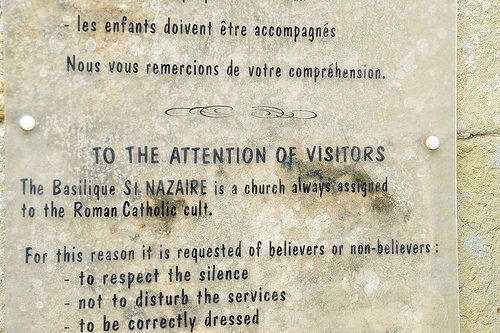
Cité de Carcassonne - la basilique Saint-Nazaire et Saint-Celse

an interesting plaque in front of a church in Carcasonne, France
Profile Image for Carmo.
726 reviews566 followers
July 13, 2016
A originalidade deste livro de Émile Zola não está no enredo. Histórias à volta de romances pecaminosos envolvendo padres não são nenhuma novidade. O que o distingue dos restantes é a fabulosa escrita de Zola que usando de um poder descritivo como poucos, brinda-nos com uma alegoria dum exuberante Paraíso, onde todo o ambiente recriado apela à constante renovação da natureza, à voluptuosidade, e à reprodução abundante.
Um padre desmemoriado e uma rapariga, qual Eva, que na sua inocência lhe desperta os sentidos, são lançados neste Éden selvagem e inspirador. Por ali deambulam numa busca inquietante -nem eles sabem bem de quê – tendo à sua volta o permanente apelo à consumação dos impulsos sensuais que os devoram.
Concretizada a tentação, veio a consciência da nudez, a vergonha e um mau presságio. Uma vez recuperada a memória, e ao ter noção do pecado cometido, o Padre Mouret , arrependido e penitente aceita a expulsão e o regresso à paróquia, numa vã tentativa de esquecer.
Daqui até ao fim foi um calvário de sofrimento e dúvidas para o padre dividido entre a paixão terrena e a adoração divina. O final não teve nada de surpreendente, mas valeu pela excelente narrativa e pela riqueza descritiva.
Do que já li de Zola, este foi o que mais evidenciou o movimento naturalista do autor. As personagens são pouquíssimas e o enredo é básico. O destaque vai sobretudo para a beleza e prodigalidade das descrições.
E claro, a crítica subjacente aos dogmas da igreja também está presente.
E é mais que merecida!

Profile Image for MJ Nicholls.
2,274 reviews4,844 followers
June 23, 2021
Tony’s review captures perfectly my feelings about this fifth entry in the R-M series. You know what? You should read Tony’s excellent review, that’s what. What’s that? You’d like me to make use of the archaic GR HTML option to create an easily clickable link to Tony’s review?

OH GO ON THEN


Profile Image for Fabien.
65 reviews8 followers
April 29, 2012
Pas facile de dire que l'on a pas aimé un élément de ce monument de la littérature française. C'est donc un peu honteux et en gardant la tête basse que je l'écris.

Bien sûr, l'écriture est habile et Zola enrobe tous ses propos du style le plus subtile.
Bien sûr, la poésie se glisse en tout, transformant les longues descriptions en morceaux de bravoure.
Bien sûr, la mise en parallèle de morceau de l'histoire de l'Abbé Mouret avec des références à la Bible est très intelligemment mené. C'est suffisamment discret pour que le lecteur soit heureux du déclic et suffisamment visible pour que même moi, je fasse la relation.
Bien sûr c'est plein de petits moments savoureux, notamment ces nombreuses réflexions sur la religion et sur l'église.

Mais... je me suis ennuyé terriblement. Et c'est vraiment parce que je me suis lancé dans la lecture intégrale de cette fantastique saga, que je n'ai pas abandonné dix fois la lecture de l'Abbé Mouret. Les descriptions interminables me portent aux confins de l'agonie, et ça en devient même douloureux parfois. Cette remarque porte principalement sur l’énorme partie du Paradou où les pages se tournent et où rien n'avance dans le jardin d'Eden. Je comprends bien ce que souhaite faire l'auteur, mais je n'arrive pas à m’en imprégner.
Les personnages sont globalement pénibles de simplicité dans leur façon d'être. Seul évidemment l'abbé Mouret, car en plein un combat intérieur, est un peu intéressant. Les autres sont tous taillés d'un bloc à la limite de la parodie. Là aussi je comprends le sens, mais cela m'agace.

Finalement, reste la définition de chacun de ce qu'est un bon livre ou de ce qu'est l'art. Ce n'est évidemment pas un mauvais livre, c'est simplement un livre avec lequel je ne suis pas du tout en phase.
Profile Image for John.
1,680 reviews131 followers
July 29, 2025
This was a difficult novel to read and the new ninth novel in the Rougen-Macquart series. I felt at times i needed a plant dictionary. The story revolves around Serge a young fanatical priest obsessed with the Virgin Mary. He is the parish priest who craves solitude and aspires for an existence of Godlike purity. He falls ill and his Uncle Pascal, a doctor decides he needs a change of scenery so puts him in a place called Paradou to recuperate. Basically a huge walled garden. He is under the care of Albine and he falls to temptation with the two of them falling in love. The garden seems enchanted and also an allegory of Eden.

The second part of the book is like a dream. Serge suddenly comes to his senses with all the Catholic guilt you can imagine. The teenager love they had is swept away and Albine realizes she has lost him. Here we have a bizarre suicide. Can you really die from asphyxiation from the scent of flowers?

The story is anticlerical with way too much symbolism for my liking. Zola went crazy with descriptions from flowers, the garden, church to Desiree’s animals the simple sister of Serge. It is an indictment of the celibacy of the priesthood.
Profile Image for AiK.
726 reviews268 followers
March 17, 2021
Сначала казалось, что Золя повторяется, воспроизводя историю невинной любви Сильвера и Мьетты. Сад Параду играет важную роль в исцелении Сержа и развитии чувства, сад – это гимн жизни, его самое чистое воплощение. Но после соития все изменилось, первородный грех разрушил рай, и поджидавший змей монах Арканжиас возвращает Сержа на землю, отпускать грехи смертным и соединять брачующихся. В битве между сердцем и разумом, выбором между любовью к женщине и любовью к Богу, Серж мучается желанием вернуться к своей любви, но он выбирает Бога. Серж – подлец и лицемер, и в этом, я согласна с Альбиной. Неистово поклоняясь Деве Марии, Серж бросает беременную подругу. Понравилась метафора победы природы над церковью. Это было сильно, но это было в воображении. Победили лицемерие и жестокость. Не Бог.
Profile Image for gufo_bufo.
379 reviews36 followers
May 9, 2021
Degenerazione e ancora degenerazione dell’eredità genetica di Adelaide, doppiamente declinata in termini Rougon (dalla parte della madre Marthe) e Macquart (per parte di padre), diversamente realizzata nella vitale, fisica, idiota Désirée e nell’esangue semi-tisico maniaco-religioso fratello Serge. La scarna trama prevede un paesino campagnol-materialista, una povera chiesetta dalle soglie erbose, un Giardino dell’Eden completo di albero proibito e di angelo con la spada di fuoco (poco camuffato sotto le specie di Frère Archanjas col suo bastone), uno zio medico bene intenzionato e impiccione che pensa bene di mandare il pretino doppiamente castrato dalla natura e dall’educazione a passare la sua convalescenza presso una sedicenne rigogliosa e selvaggia… e poi, guarda caso, Adamo ed Eva ascoltano il richiamo della foresta e della natura fino al prevedibile patatrac finale.
La notevole inverosimiglianza psicologica dei personaggi, tutti inquadrati nel loro ruolo, il pesante, insistito simbolismo, l’abilità descrittiva qui talmente ridondante da diventare un esibizionistico trattato di botanica, rendono il risultato noiosamente indigeribile. Zola sa fare di meglio.
Profile Image for Janelle.
1,620 reviews344 followers
January 5, 2022
Zola writes so wonderfully. A book about an overly devout priest and his inevitable fall would surely not keep me interested if written by anyone else! Right from the start this is a book of contrasts. The vicar of Artaud, Serge Mouret, obsessed with the Virgin Mary, cannot see the glories of nature all around him. In fact, he is repulsed by the flourishing of nature in the farmyard of his sister, Desiree (womanly body, childlike mind).
Zola makes it obvious the comparison he is making between the cold, sterile church and the glorious bounty of nature in Paradou, an enclosed estate that has been left to grow in marvellous abundance with only the caretaker and his niece, Albine living in the lodge to oversee it. After a feverish illness that leaves Serge feeble and with amnesia, his uncle, Doctor Pascal takes him to Paradou to be nursed back to health by Albine where biblical parallels follow. Lots of vivid and lush descriptions, Serge’s visions, the horrible misogynist friar, the joyous Desiree and her animals, the so alive peasants ; all made this reread such a pleasure for me.
Profile Image for Hiba.
1,062 reviews413 followers
August 19, 2018
Je ne sais pas quoi en faire de celui-là, je n'ai pas senti que je lisais du Zola, et je ne sais pas si c'est à cause de mon état ces derniers jours ou bien le livre fait chier tout simplement.

Je n'en ai pas d'avis, je ne pense rien de ce cinquième tome, et je ne sais même pas si je dois le marquer comme lu, parce que je ne l'ai pas lu avec esprit, je me sentais très détachée tout au long de l'ouvrage.
Voilà deux livres de la série que je n'ai pas aimé, j'espère que le prochain sera mieux.
Profile Image for Camille .
305 reviews187 followers
March 14, 2015
J'ai lu deux fois la Faute de l'abbé Mouret, et pourtant, je ne le considère pas comme l'un des travaux majeurs de Zola - j'aime mieux le Zola industriel, le Zola des bas-fonds, que celui de la campagne.
Mais la notion de faute me fascine. J'aurais aimé que l'abbé faillisse ailleurs que dans ce maudit jardin.
Mangez des pommes.
Profile Image for Electra.
631 reviews53 followers
December 31, 2024
Volume 5 : fait ! Les vacances c’est fantastique pour lire autant qu’on le veut. J’attends le prochain !
Done. My mind is so much better during holidays I can read as much as I want. I am ready for the next one !
Profile Image for ‎.
135 reviews30 followers
March 12, 2025
juste envie de citer l’entièreté de l’œuvre.

il l’aimait d’un amour universel et absolu.
elle emplissait le ciel et la terre, il ne voyait qu’elle, il ne vivait qu’en elle. il la sentait en toutes choses. elle était partout, autour de lui, en lui, mêlée à l’air qu’il respirait, à la lumière qui l’enveloppait.

il se fondait en elle, il s’anéantissait dans son amour.
il ne se sentait plus homme, il n’avait plus de désirs terrestres, plus de chair, plus de sang. il flottait dans une extase continuelle, porté par une foi si ardente qu’elle le consumait doucement, comme une flamme qui ne s’éteint que lorsqu’elle a tout dévoré.

Profile Image for Kuszma.
2,849 reviews285 followers
September 13, 2019
Amúgy zolásan kezdődik, egy remekül beállított nagyjelenettel, ahogy azt csak a kaporszakállú mester tudja: Mouret abbé az ürességtől kongó templomban szabályosan és lelkesen misét celebrál. Egyszerű, szép, erős jelenet, ami máris megvilágítja a főszereplő és környezete egymáshoz való viszonyát, az ilyen drámai képekhez ő nagyon ért. A táj bemutatása is stimmel: az artaud-i völgy leírása hibátlan, érzem a talpam alatt a kiszáradt talajt. Aztán Zola sutba dobja a naturalizmust, és elmerül a romantika mocsarában… nem véletlenül: egy átélten vallásos katolikust akar bemutatni Mouret személyében, és vén megátalkodott ateista lévén ilyet csak úgy tud elképzelni, mint egyben mélységesen romantikus embert*, aki a nagy szenvedély eszközével köti magát valamihez, amit objektíven nem tud megérinteni. És egy ilyen figura bemutatásához a romantika eszközei dukálnak. A csapdát pedig, amit neki állít (mert Zolának sajnos mániája, hogy a szereplők azért vannak, hogy csapdát állítsunk nekik), szintén a romantika eszköztárából kölcsönzi: megteremti Albine-t, Rousseau vademberének női megfelelőjét, a féktelen, irányíthatatlan, természetmániás süldőlányt.

És ha ez nem lenne elég, Zola megteremti Paradout, a misztikus kertet, ami nem is kert igazán, hanem az ember vágyainak és félelmeinek projekciója, az ősdzsungel, csapda és menedék egyszerre. Megteremtéséhez felhasználja gyakorlatilag a Dél-Franciaország flórája és faunája című többkötetes mű teljes névmutatóját, valamit egy vagon hasonlatot, ami igazi jelzőorgiát eredményez. Paradou és Albine együtt olyan elegy, aminek igazán nehéz ellenállni. El is időz itt Zola a könyv középső harmadában, hogy aztán visszadobja Mouret-t a való világba – hát elég erős a kontraszt.

Nem a legjobb Zola-regény, az szinte bizonyos. Az író szükségét érzi, hogy a regénytestbe komplett teológiai értekezéseket iktasson a Mária-kultuszról, talán mert maga sem érti, Mouret hogy hihet ilyesmiben. Amúgy a maguk módján jól sikerült értekezések ezek, de megtörik a regény dinamikáját. Továbbá Zola a szenvedélyes hitet mintha csak valamiféle pszichológiai betegség tüneteként tudná elképzelni, én a magam részéről nem feltétlenül értek egyet, de végül is ez csak egy regény, Mouret abbé pedig csak fiktív személy. Paradou sűrű leírásával is lehet problémája annak, aki Zolától nem ilyet várt, de az nekem speciel tetszett. Erős, nehéz, emlékezetes fejezetek voltak ott a sűrű lombok alatt.

* A romantikus keresztényen kívül persze ismer ő másfélét is: a moralista keresztényt. Nincsenek kétségeim, hogy Zola melyik fajtával szimpatizál inkább: Archangias testvér a zolai univerzum egyik legundorítóbb figurája. Nőgyűlölő fanatikus, kárörvendő, ostoba impotens, bakkecskeszagú pokolfajzat. Aranyos.
Profile Image for Louise.
434 reviews47 followers
May 17, 2020
Un éblouissement de quatre-cents pages : la plume déliée et virtuose de Zola est un délice, les descriptions du Paradou sont vibrantes de vie et de sensualité, le tissage serré des thématiques entre elles est parfaitement maîtrisée : chrétienté vs. paganisme, vie vs. mort, spiritualité vs. sensualité… Les motifs contrastent violemment entre eux mais Zola parvient à les marier dans des évocations sublimes : l’église qui croule sous les assauts de la nature, la communion avec la Vierge qui prend la forme d’une véritable union charnelle… La faute de l’abbé Mouret est un immense poème (je vole cette analyse à Huysmans, c’est écrit sur ma 4ème de couverture), une métaphore brodée sur le désir, la vie, les sens…
On reconnait à Zola d’être le maître incontesté du naturalisme, mais La faute de l’Abbé Mouret est un roman aux accents très surnaturels : le Paradou est un îlot aberrant, exubérant, hyperbolique, presque anormal, en réalité surnaturel. C’est le mythologique jardin d’Eden descendu sur Terre, on s’y enfonce en laissant son intellect de côté, en ratissant les moindres recoins pour se saturer de couleurs, d’odeurs et de sensations débridés.
L’opulence du Paradou fait croire à l’abbé qu’il perd la raison. C’est plutôt son fanatisme religieux qui l’assèche et le mortifie. En fuyant obstinément les forces vitales, le jardin d’Albine ressemble à une hallucination. Est-ce la stricte vérité, est-ce une vue de son esprit assoiffé ?
La narration est aussi parfaitement balancée, en trois mouvement qui vont de la Mort à la Vie puis réconcilie les deux, dans un final ironique.

Un véritable chef d’oeuvre finement brodé, tant sur la forme foisonnante, que sur le fond riche de réflexions.
Profile Image for Marie.
Author 2 books27 followers
December 21, 2014
Émile Zola at his best. This book is my favorite in the series so far.
Profile Image for Jim.
420 reviews287 followers
July 20, 2022
Wow!!

Easily the best Zola book I've read so far... right up there with Germinal.

He really got into the whole religion as death versus animal "sin" as life.
Profile Image for Frank.
846 reviews43 followers
July 24, 2020
I read this in an excellent Dutch translation by Floor Borsboom. For English readers I think the modern translation by Valerie Minogue (OUP 2002) is the only viable option. Don’t bother with the free translations available on the internet (except if you want to compare): those are 19th century translations that were heavily bowdlerized. Fork out some money and buy the OUP editions (or Penguins if available, which is not the case for this particular novel).

Anyone under who was still the impression that naturalism automatically means descriptions of slum life and a tawdry kind of photographic realism, that it always amounts to pure vérité, is bound to be surprised by this book. For all his explicitly stated naturalistic intentions, Zola wrote books that could be surprisingly heavy on symbolism and melodrama, and this is the most pregnant example of this that I have read so far.
That entire middle section reads like a dream, an allegory (in fact, the entire book has strong allegorical overtones). It’s more a prose poem than a novel, this story.
And I suppose teachers of literature wanting to demonstrate to their students what the pathetic phallacy is, could hardly do better than set them this novel by Zola, because the entire middle third of this is one big happy vibrating piece of pathetic (and phallic, or Freudian) phallacy.
That doesn’t mean this novel is failed. (That’s not what the word phallacy is intended to mean in this case anyway.) It doesn’t mean it’s an unequivocal success either. I just found it interesting, and am increasingly curious where the rest of this Rougon-Macquar cycle took Zola. Because it’s starting to be a far cry from the straightforwardly documentalist naturalism I had expected, and after having read zeven of the twenty novels, what I’m impressed by most so far is the sheer variety of his subjects and settings.

As usual, this novel feels like it’s too long by at least a third. Some of the length is necessary, to set up certain scenes. But he does go on. And since most of this book is about Mouret’s interior life, you also begin to notice a certain lack. Zola seems to be better at social life than at the interior life. He’s not without flashes of real psychological insight and pithy formulations on that score, but he’s not a novel of interiority like Henry James, George Eliot or Proust could be. At least that’s how I feel.

As so often, the novel feels a little bit constructed, it feels like it was a connect-the-dots exercise for the writer, who thought out a scenario beforehand, with interesting metaphors and (metaphorical) social commentary, and then set out to fill in this blank canvas with his words in a very workmanlike fashion. More transpiration than inspiration. If that means anything.

That’s why for me, so far, Zola is a very interesting writer (whose Rougon-Maquart cycle I’d like to read in full just to see where the variety of his interests took him) rather than a writer that gets close to my heart.

Still, it’s a good read. And one thing he is rather good at, or so it seems to me, is describing the idyll of young love, of teenagers discovering love and sexuality. I’m referring again to that weird and wonderful middle third (as it was nearing its end I was thinking: surely in the next part we will learn that this was all one big feverish dream – yet it wasn’t which in a way was kind of disappointing), which in a way re-enacted the very similar idyll of Silvère and Miette in the first volume, La Fortune des Rougon.

Fun fact: in the very same year, 1875, Eca de Queiroz published the very similarly titled yet in ?many respects very different novel The Crime of Father Amaro
(O Crime do Padre Amaro). Anticlericalism was rife that year – although to be fair, I’m not sure how anticlerical Zola really is in this novel. Anyway, a nice blog post about the two novels (though mostly about the Portugese one) can be read here.
Profile Image for Mark.
533 reviews22 followers
September 17, 2023
The Sin of Abbé Mouret is the fifth volume in Émile Zola’s twenty-novel series featuring various members of the Rougon and Macquart families, the latter being the illegitimate branch spawned by a matriarch several generations prior to when this story takes place. The story, in fact, is a reimagining of the fall from grace of Adam and Eve, and Zola supplies ample biblical parallels, including a beautiful but somewhat untamed garden called Paradou (only a gentle imaginative stretch from “Paradise”!).

“Adam” is personified by Abbé Serge Mouret, a young priest who is desperately aspiring for “spiritual purity and sanctity” through constant, passionate, and strenuous prayer, even to the point of self-neglecting his health and well-being. The object of his intense devotion is Mary, the Mother of Christ. After completing his seminary training, in a deliberate act of self-imposed punishment, Serge requests the worst placement possible, a village called Artaud, whose population is almost exclusively one large incestuous family, a clear indication of the flagrantly loose morality the young priest is guaranteed to face on a daily basis.

Zola gives us “Eve” in the form of Albine, a young woman in her late teens described by Serge’s uncle as “an odd girl, quite wild.” Albine is ungoverned and undisciplined and lives with a broad-minded, benign, forgiving uncle. He lives as caretaker in the lodge or gatehouse of a massive, boarded-up estate, which includes the lush, dense gardens of Paradou. Albine’s favorite pastime appears to be unfettered wanderings around the abandoned estate and Paradou.

What brings these two people together is Serge being struck down by a perilous fever after a bout of particularly intense and intoxicating prayer to Mary. His devotion transcends mortal senses and emotions to reach a psychedelic, hallucinatory state that wracks his body into comatose insensibility. Zola’s description of this event is mesmerizing! Readers may find themselves in the grip of satisfied exhaustion as they empathize with the sheer psychological weight of the young priest’s devastating, religious experience. Serge’s uncle, Doctor Pascal, hastens to remove Serge, now suffering from amnesia, from the primitive confines of the church and the village and to put him in the care of Albine.

The middle part of this three-part book concerns Serge’s slow but steady recuperation from his illness, and a big part of his rehabilitation is to accompany Albine on her wanderings in Paradou. This affords Zola the opportunity to favor readers with some of the most lyrical narrative I’ve encountered. Without descending into cloying excess, Zola’s prose is rapturous and effusive, rhapsodic and poetic, and his knowledge of flora and fauna is impressively vast. And though Paradou does not have a forbidden apple tree, it does have a giant tree of unknown classification, which Albine and Serge eventually discover. By this time, their mutual emotions are genuinely and deeply entwined with each other, and the irresistible aura of sinful temptation exuded by the giant tree easily overwhelms whatever innocent self-control the two young people have.

In part three of the story, Serge’s amnesia disappears in a sudden flash when he accidentally catches sight of the village and the church beyond Paradou’s walls. Restoration of memory brings with it a flood of recollection of his priestly status, and a crushing, shameful awareness of the vile sin he has committed. His atonement commences immediately with harsh abandonment of Albine and a redoubling of his religious fervor, but now he redirects his prayer away from Mary towards the suffering of Christ.

But the consequences of sin cannot be prayed away. Albine’s uneducated innocence sees things differently to Serge, and her love for him continues unabated and increasingly demanding. How Zola resolves this final conflict is equal parts poignant drama and heartbreaking tragedy. I realize The Sin of Abbé Mouret is only the fifth in the twenty-book series, but thus far, it is easily the best!
Profile Image for Daniel Sevitt.
1,419 reviews137 followers
November 9, 2025
Slightly more grueling than strictly necessary, but an effective tale about the sanctity of the Catholic priesthood up against the fecundity of nature. Our priest is supposed to advise his parishioners on the importance of marriage while abstaining from worldly encumbrances. He is contrasted always with his simple sister who lives surrounded by animals and has little understanding of or need for religious belief. He is more than a little in love with Mary worshipping her divine purity perhaps even more than the Father or the Son. And so... inevitably... he falls. The middle section of the book is an extended visit to paradise as this young Adam encounters an Eve to accompany him through Eden. It all goes horribly wrong, of course.

Despite its extreme take on the compatibility or otherwise of celibacy with community leadership, despite wrestling with questions about how the purest love can be a sin, the novel manages to deliver a coherent if melodramatic ending and tell a story in a slightly different register than the previous entries in the series.
Displaying 1 - 30 of 252 reviews

Can't find what you're looking for?

Get help and learn more about the design.