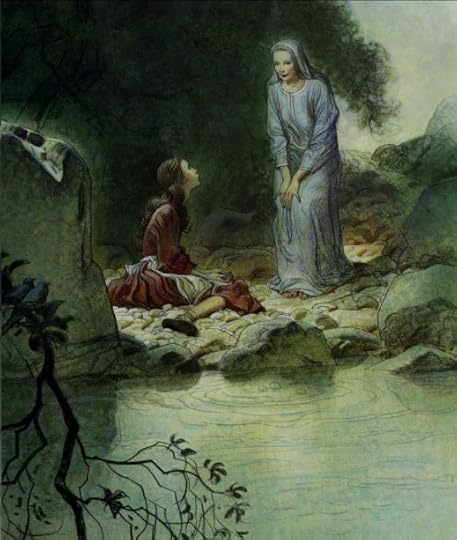
Blessed Mary rewards Teresa's good deeds with a shining gold star. Later she punishes Teresa's unkind stepsisters, Isabel and Inez, with hideous horns and donkey's ears that they try to hide under heavy veils! But will Teresa outshine her stepsisters at the festival? Robert D. San Souci retells this popular folktale in a lilting narrative that includes all the magic of the beloved Cinderella story and traditional elements from Spanish tales. Luminous watercolors by Sergio Martinez accentuate the beauty and goodness that radiate from Little Gold Star. A Selection of the Junior Library Guild A Selection of Nest Literary Classics
Robert Daniel San Souci (October 10, 1946 – December 19, 2014) was a multiple award-winning children's book author, who resided in San Francisco, California. He often worked with his brother, Daniel San Souci, a children's book illustrator. He was a consultant to Disney Studios and was instrumental in the production of the film Mulan, for which he wrote the story. He studied folklore in graduate school. He died after suffering a head injury while falling from a high height in San Francisco in December 2014. He was only 68 years old.
When a widowed New Mexican sheepherder named Tomás remarries, his new wife and stepdaughters treat his own daughter, Teresa, with unkindness. A kind and obedient girl, Teresa encounters the Virgin Mary while washing a sheepskin at the local stream, and after a miraculous visit in which she cares for Saint Joseph and the infant Jesus, she is given a blessing - a blessing which manifests itself as a little gold star on her forehead. Her stepsisters do not fare so well, and after they treat the Holy Family with scorn, are given horns and donkey ears. When Teresa catches the eye of the handsome Don Miguel, and dances with him at his feast, he is determined to find and wed her. Teresa's stepmother stands in the way of the marriage, until the Virgin Mary once again interceded...
Taken from a variety of sources, this folktale from the American Southwest - New Mexico is the setting - is a lovely variant of the Cinderella tale-type. It is quite interesting to note that in Little Gold Star: A Spanish American Cinderella Tale the magical elements provided by the fairy godmother in the more well-known French variant of this story, are instead provided by a religious figure. There seems to be a wealth of stories in the American Southwest concerning the Virgin Mary - see Eric A. Kimmel's The Lady in the Blue Cloak: Legends from the Texas Missions for one example - so it isn't really surprising that she would surface in regional retellings of widespread tales. I appreciated the different outlook that the inclusion of religious elements provided, and I liked the fact that the wicked stepmother and stepsisters were reformed in the end. This latter feels more appropriate, given the inclusion of Christian elements, and the fact that that religion emphasizes redemption and forgiveness. The accompanying artwork here, from Mexican illustrator Sergio Martinez, is absolutely lovely, and added to my reading pleasure. Recommended to young folk and fairy-tale lovers, and to anyone interesting in the Cinderella tale-type.
Name: Little Gold Star Genre: Fairy Tale/Folk Lore Version: Spanish / Catholic culture
Cinderella: Teresa Magical element/"fairy godmother": Blessed Mary/Virgin Mary Glass Slipper: A gold star on Teresa's forehead The ball: A party at Don Miguel's villa Message: Kindness carries its own blessing. Being rewarded for kind acts. Illustrations:
This is a unique Cinderella story. Teresa is the only child of a widower. He then marries a neighbor with two daughters, Inez and Isabel. The behavior of Inez and Isabel is greatly different than that of Teresa. Teresa is a very caring girl, while Inez and Isabel are not. Unknowing, Teresa cares for a baby (Jesus) and his father (Saint Joseph) after a woman in blue (Mary) asked her to visit them. She thought she was visiting someone who needed her support and did not know she was following the direction of Mary to help Jesus and Saint Joseph. There are twists on the classic Cinderella story, but the story generally aligns to the classic. Teresa does end up marrying Miguel and her stepmother and stepsisters changed their ways.
I think this text is a bit religious for a read aloud, but I think it is a good text for children to have access to. Not having much background in Christianity I did not realize that Jesus, Mary, and Joseph were represented until it was explicitly stated.
The illustrations really support the text in this book. The drawings are very detailed and really convey the characters' personalities. Some of the illustrations might be frightening to young children as the characters grow horns and look very angry. I think this text could be used with older students (middle school) who want to relate it to other issues studied in school.
This story is ridiculous. Cinderella is a poor farmers daughter and her father doesn't die in the story. Cinderella (Theresa) lives during the colonial times in Mexico but she is visited by Mary and she in turn visits baby Jesus and Joseph. And the blasphemy continues, one of the sisters spanks baby Jesus because he was crying and the other ignored the Holy Infant. The Golden Star is a rip off of the Russian tale The Princess with the golden star. Honestly, the illustrations depict them as Caucasian Spaniards in Spanish traditional attire and the only Mexican thing about this book is their devoted love and worship of Guadalupe. I wish they would have made themselves clear about whether this book is Spanish or Mexican because there is a difference. The Caucasians in Mexico are Spanish but this story takes place in Mexico, thus it is a Mexican tale, not Spanish from Spain.
An amazingly different version, here Cinderella is aided by the Virgin Mary. The wonderful illustrations really capture the eye, although the one with the stepsister with horns on her head is a little scary! Since the illustrations make them so sinister, the anticlimactic ending, where they gradually grow kinder, isn't as effective as a worse punishment would have been.
If you've ever heard of Cinderella or the lesser-but-still equally validating French fairytale of Diamonds and Toads, this is the Spanish-American version of that.
Young Teresa is bullied by her stepmother and stepsisters. Her father is often away on business and generally avoiding his new wife and daughters. He still gifts things to her, including a lamb before he leaves. The stepmother kills the lamb and insists that Teresa take the fleece to the river to wash it. At the river, Teresa meets a kindly woman who gives her a star on her forehead. From there, the adventure and often humor/punishment and traditional Cinderella story elements unfolds.
Traditional well-known elements are told through a Hispanic perspective. The Prince is a wealthy Don hosting a party, the Fairy Godmother is a representation (that is very clearly stated) is the Blessed Virgin Mary from Catholic faith, and the trials and tribulations that Teresa or Little Star Girl faces are also tied to Biblical imagery. The punishments of each of the stepsister ties more closely to the French fairytale of Diamonds and Toads or the Native American Cinderella, Ash Girl, about the wickedness of selfishness, greed, impatience and laziness. This particular version of Cinderella also intrigued me as it is one of the first (of many that I have read) that featured such a theological take on the fairytale.
Lastly, #OwnVoices illustrator Sergio Martinez does a very nice job of the beautiful lines, architecture and historic cultural appearances of the landscape and characters, while making each image tell the story even if there were no words written by award-winning picture book author, Robert D. San Souci.
This version of the classic Cinderella tale is written by author Robert D. San Souci and beautifully illustrated by Sergio Martinez. This popular Southwestern tale includes many elements of the traditional Cinderella story, with a few twists. In this version Cinderella is actually a young woman named Teresa. Teresa's father marries a cruel woman, who also has 2 daughters whom she treats well. Teresa is also required to serve the 3 women, while her father is often away. The most prominent difference in this tale is that the fairy Godmother has been replaced by Blessed Mary. Mary blesses Teresa with a gold star on her forehead, while the stepsisters are cursed with donkey ears and horns. A wealthy young man falls in love with Teresa, and he searches for the beautiful woman with the gold star. In spite of her efforts to sabotage his efforts, the man does find Teresa. He asks for the stepmother's permission to marry Teresa. The stepmother agrees to allow the wedding, as long as Teresa can complete 3 impossible tasks. With the guidance of Blessed Mary, Teresa is able to finish all of the tasks and marries in the end. This book is a great choice to add to a classroom library .
I don't think I've read a fairy tale where I think this is one of my favorite versions of Cinderella. The story line was interesting and slightly different from the norm. Also the artwork was lovely as well. Overall a wonderful story to read with your children. Recommended? Yes Buy/Borrow? Either or although I think I may buy it just to have.
Wow, this was cool. Very different retelling, and I like that. First off, Isabel really spanked Baby Jesus and that is fucking hilarious. Something I did not expect to read in a Cinderella retelling, but there you go I suppose. This version also had elements of The Three Little Men in the Woods and Mother Holle, which was an interesting dynamic to add to a Cinderella retelling. I've also never seen a version of Cinderella where Cinderella has to do tasks after the prince character asks to marry her. I also really like how the stepmother and stepsisters get redemption in this version, becoming more kind and good to the point where the stepsisters' donkey ears and horns gradually disappear. Last thing: Miguel is fine and I'm not usually into mustaches, but damn he looks so good in that suit I'm here for it.
2, but 4 stars for the illustrations. The style is really cool— it’s kinda sketchy and looks like it’s maybe watercolor overtop. I don’t think I’ve ever seen an artist exactly like this. The story is unique for what it is, but there are some parts that are inherently problematic with a tale like this. Even stuff like the Father saying he would marry the stepmom because she was crying even though he didn’t want to. That just wouldn’t happen. Also, the stepmother learning to love Teresa AFTER she’s filthy rich? Really? And how come Teresa told Miguel her step mother had to approve— like, your cowardly father is still ALIVE! This just brushes the surface of my questions
Teresa receives the blessing of a little gold star on her forehead as a reward for her kindness to an old man and a baby in this beautifully illustrated Spanish-American version of the classic fairy tale, "Cinderella."
I honestly love Cinderella retellings. Not because of the story, but because the art and the culture really makes the difference. And this one had lovely art.
Picked Little Gold Star up at the library to read to my toddlers, only to find out it's a perverted Xtian retelling of Cinderella and nothing like any of the traditional versions.
One of the most simultaneously unique and stereotypical retellings of the classic Cinderella fairytale is Little Gold Star, a Spanish-American folktale that takes everything you know about Cinderella and gives it a decidedly Spanish spin — think sopapillas instead of pumpkins, celestial signs instead of glass slippers, and the Blessed Mary herself instead of a fairy godmother.
A little New Mexican girl named Teresa begs her widowed father Tomás to remarry the kind widow next door, but she soon regrets her decision when her new stepmother, along with her spoiled daughters Isabel and Inez, begins treating her like a servant and kills her beloved lamb. After a chance encounter with the Blessed Mary, Saint Joseph, and the Holy Child by the river, Teresa’s kindness is rewarded with a shining gold star on her forehead; her jealous stepmother sends Isabel and Inez to receive the same star, but their unkindness and impatience result in them receiving a donkey’s ear and a cow’s horn on their foreheads. At a festival, a wealthy man named Don Miguel falls in love with Teresa, and though her stepmother tries to hide her, Miguel is led to her home by a talking cat. Before she can accept Miguel’s offer of marriage, Teresa is tasked by her stepmother with three impossible tasks, but with the help of the Blessed Mary, Teresa is able to complete her tasks and win her stepmother’s blessing.
I came across Little Gold Star while researching multicultural Cinderella stories for my tenth grade classes to read. While it’s not the strongest storyline, Little Gold Star provides a fascinating glimpse into some of the values of 1800s Spanish-Americans. In this version, Teresa (our Cinderella) is responsible for bringing an evil stepfamily home, and their treatment of her feels especially wicked after her stepmother kills and skins Teresa’s pet lamb, an obvious symbol of Christianity (talk about a Silence of the Lambs situation). The fairy godmother is replaced by a heavily Catholic depiction of Mary, Jesus, and Joseph, who bless Teresa for her kindness and give her another strikingly biblical symbol of blessing: a gold star, much like the one that led the shepherds to Jesus’ cradle. Their reasoning is that kindness is its own reward, and the star serves as a symbol of Teresa’s kindness to strangers.
What follows is much more stereotypical for a Cinderella retelling. The lazy stepsisters try to replicate Teresa’s success but receive a twisted version of the beautiful gold star on her forehead: parts from a donkey and a cow, which interestingly are often used as symbols of hard work, peace, and usefulness. Prince Charming in this narrative is Don Miguel, a wealthy landowner, and Teresa’s shining gold star functions as the glass slipper to lead him to his love after she is locked away by her stepmother. Little Gold Star also features a slight subversion of the usual Cinderella sequence of events: much like the versions that draw from the Greek Cupid and Psyche myths, Teresa is given several impossible tasks and aided by her magical helper (thanks, Mother Mary), which is a trope normally employed when the heroine is wishing to go to the royal ball. Even more unusually, Teresa actually reconciles with her repentant stepfamily once they realize that she truly is divinely blessed.
Though it certainly deserves its place in the multicultural Cinderella collection, this fairytale feels lacking in many areas and just plain weird in others. Little Gold Star has so many religious overtones and western Americana vibes that it hardly feels like a true fairytale, but it has a cozy New Mexican flavor that reminds me of American Girl’s Josefina Montoya.
Little Gold Star: A Spanish American Cinderella Tale, by Robert D. San Souci, is a picture book intended for readers in preschool through grade three. I gave it three stars. In this tale, beautiful Teresa takes care of both her mean-hearted stepfamily and also Blessed Mary, Saint Joseph, and the Holy Child. Blessed Mary rewards Teresa for her kind acts with a gold star upon her forehead while her stepmother and two sisters are given horns for their selfish and less than honorable acts. Ultimately, Teresa is allowed to marry Don Miguel after her gold star helps her complete three tasks put forth by her stepmother as a condition of her marriage to the rich man. This story is very religious in nature, with the presence of the Holy Family, which may prove controversial for classroom use. However, the central theme of being rewarded for kind acts can reach all readers, no matter what background they may have. As Blessed Mary says, “kindness carries its own blessing and unkindness carries its own penance.” The illustrations are very simple and earthy, with hues of brown, greens, and blues throughout. The use of color almost enhances the religious undertone, as the illustrations are very Biblical and traditional in nature. Overall, this text reveals that being rewarded for kind acts can have its roots in religious aspects.
This version of the classic Cinderella tale is beautifully illustrated and elegantly reflects deep seeded religious beliefs of the Spanish American culture. Rather than a fairy godmother who appears and gifts pumpkins and glass slippers, the godmother in this story is the "Blessed Mary" who bestows gold stars upon Teresa for her self-less service to an elderly man and baby after her father's bride-to-be kills a lamb that was gift from her father. The star is a visual testimony to her service that enrages her step-mother to be. The step-mother then sends her daughters to receive gold stars as well but much to her dismay, fail. This book is a great choice to add to a classroom library and gives a beautiful twist to a popular fairytale.
Hundreds of Cinderella versions exist worldwide. Little Gold Star is a popular Southwest American version told by Robert San Souci. Adapted from traditional Spanish origin with roots in the original folktale, this version tells the story of Teresa’s struggle to adapt in new surroundings. Obeying the demands of her evil stepmother, Teresa is visited by the Blessed Mary who places a gold star on her forehead. The authentic language of Souci is complemented by the muted water color paintings of Sergio Martinez to tell the tale of survival Teresa endures by staying true to her nature and guided by the blessed gold star.
This story follows the Cinderella story, but it has an influence that goes well with Spanish tradition, the inclusion of the Blessed Mary. Mary is a huge part of the Spanish culture so it makes sense that she should be the "fairy godmother" role in this story. It is also interesting how the Holy Family plays a part in this story too, because as Catholics, we are taught that Jesus could be anywhere at anytime. Obviously the step-sisters did not realize this and treated almost everyone, including Teresa and the Holy Family with no respect. I like the way the Cinderella story was adapted along with this story.
It starts out like a Cinderella retelling, but a LOT of extra bits get added on.
There’s elements of the Diamonds and Toads fairy tale with the sisters’ punishments, the Eros and Psyche ‘impossible tasks’ at the climax, a lot of Spanish-American 1830’s culture throughout, and oh boy a lot of Jesus time – first fairy tale I’ve ever seen to have the Holy Trinity walk in – and not even as subtext or symbols – they practically have name tags!
So, a bit of a kitchen sink of myths, but I think it works. After all – it does take place in a setting that is a cultural melting pot, so it makes sense to see so many elements grafted together.