

What do you think?
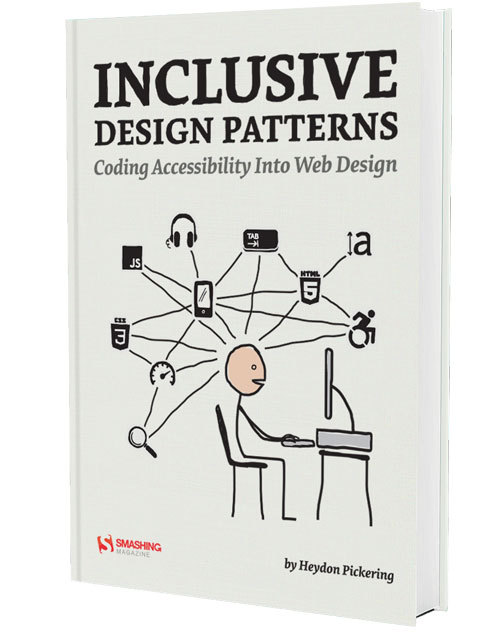
Inclusive Design Patterns - Coding Accessibility Into Web Design
Many web design articles and books are all about improving your workflow and making your life easier as a developer. Should you wish to adopt a framework or employ a processor to speed up your development process, be our guest. However, this book is not about you; it’s about your audience.
The Inclusive Design Patterns book covers all the techniques, gotchas and strategies you need to be aware of when building accessible, inclusive interfaces. We’ll explore the document outline, external links and “skip” links, navigation regions and landmarks, labelling and alternative text for illustrations, buttons, tables of contents, JavaScript patterns, touch targets, filter widgets and infinite scrolling and “load more” button and grid display and dynamic content and tab interfaces and password validation and web forms and error messages — and pretty much anything else you need to know about accessibility, including how to prototype with inclusivity in mind, how to deal with legacy browsers and dozens of practical snippets to use when building inclusive interfaces.
The Inclusive Design Patterns book covers all the techniques, gotchas and strategies you need to be aware of when building accessible, inclusive interfaces. We’ll explore the document outline, external links and “skip” links, navigation regions and landmarks, labelling and alternative text for illustrations, buttons, tables of contents, JavaScript patterns, touch targets, filter widgets and infinite scrolling and “load more” button and grid display and dynamic content and tab interfaces and password validation and web forms and error messages — and pretty much anything else you need to know about accessibility, including how to prototype with inclusivity in mind, how to deal with legacy browsers and dozens of practical snippets to use when building inclusive interfaces.
312 pages, Hardcover
Published January 1, 2016
Ratings & Reviews
Friends & Following
Create a free account to discover what your friends think of this book!
Community Reviews
Displaying 1 - 19 of 19 reviews

December 30, 2022
Zatím nejlepší kniha o přístupnosti webů a přístupném UX, na kterou jsem narazila. Obsahuje srozumitelné a dobře vysvětlené kusy kódu, užitečné odkazy, a co je hlavní - dobře se čte a místy je dokonce překvapivě vtipná. Naopak skoro úplně vynechává otravné vysvětlování vyšších principů přístupnosti - věnuje se jen praktickým aspektům problematiky a jde přímo k věci bez zbytečných odboček.

December 28, 2022
Really valuable book for not only designers, but mostly for developers. Majority of ideas presented are still relevant now, even more so I’d say.
The content is structured logically, each chapter kinda builds up on top of the last one, but you can read every one of those in isolation which is great if you’d like to go back to this book in the future. I know I will!
The content is structured logically, each chapter kinda builds up on top of the last one, but you can read every one of those in isolation which is great if you’d like to go back to this book in the future. I know I will!

January 17, 2018
Review originally posted at https://timkadlec.com/read/2018/inclu...
------
Accessibility is one of those topics that can be very intimidating to folks. There is a lot to know and a lot you can get wrong. Plus, since accessibility is felt so personally by many, the reaction to accessibility mistakes online tends to be…unpleasant. It makes a lot of people I’ve talked to feel stuck, not sure how to proceed.
Heydon’s book doesn’t attempt to teach you everything you need to know about accessibility. It does something more important: it teaches you how to think about building inclusivity into your application throughout the process of designing and building it.
Instead of walking you through a checklist of what to do for each of the various impairments users may have to battle, the book walks you through building different components. For example, there’s a section where it walks through marking up a blog post. Sounds simple, but there’s a lot of thought and care being applied to ensure that the post is accessible: the markup used, how screen readers will interact with the post, transcripts for videos, link labels, reading level and more. As a result, you learn to think critically what you’re building and how different people will want to use it.
I have a few minor nitpicks from some of the early performance recommendations, though to be fair the book came out in 2016 and I’m not sure how many of my critiques would’ve been applicable then. They are, also, minor. Nothing he states there is wrong, just a few things that are a bit less than ideal.
That minor nit aside, Inclusive Design Patterns is a fantastic resource for any developer—and this should be all of us—who wants to build a web that can be used by everyone.
One last parting shot, I have to note the quality of the physical book itself. I love a beautifully crafted hardcover and Smashing did a great job with this one.
------
Accessibility is one of those topics that can be very intimidating to folks. There is a lot to know and a lot you can get wrong. Plus, since accessibility is felt so personally by many, the reaction to accessibility mistakes online tends to be…unpleasant. It makes a lot of people I’ve talked to feel stuck, not sure how to proceed.
Heydon’s book doesn’t attempt to teach you everything you need to know about accessibility. It does something more important: it teaches you how to think about building inclusivity into your application throughout the process of designing and building it.
Instead of walking you through a checklist of what to do for each of the various impairments users may have to battle, the book walks you through building different components. For example, there’s a section where it walks through marking up a blog post. Sounds simple, but there’s a lot of thought and care being applied to ensure that the post is accessible: the markup used, how screen readers will interact with the post, transcripts for videos, link labels, reading level and more. As a result, you learn to think critically what you’re building and how different people will want to use it.
I have a few minor nitpicks from some of the early performance recommendations, though to be fair the book came out in 2016 and I’m not sure how many of my critiques would’ve been applicable then. They are, also, minor. Nothing he states there is wrong, just a few things that are a bit less than ideal.
That minor nit aside, Inclusive Design Patterns is a fantastic resource for any developer—and this should be all of us—who wants to build a web that can be used by everyone.
One last parting shot, I have to note the quality of the physical book itself. I love a beautifully crafted hardcover and Smashing did a great job with this one.

January 24, 2018
"Everybody is a keyboard user when they are eating with their mouse hand."
Really enjoyable book with lots of practical examples (navigation, forms, dynamic content, etc) and the always important theme of "accessibility makes the experience better for everyone." Aimed towards people with some basic knowledge of HTML/Javascript/CSS.
I did skim/skip the sections on TDD and making paper prototypes as part of the design process as they felt a bit out of place given the topic of the book.
Really enjoyable book with lots of practical examples (navigation, forms, dynamic content, etc) and the always important theme of "accessibility makes the experience better for everyone." Aimed towards people with some basic knowledge of HTML/Javascript/CSS.
I did skim/skip the sections on TDD and making paper prototypes as part of the design process as they felt a bit out of place given the topic of the book.

November 22, 2016
This book had some great tips and points to consider when designing a website. However, it was written toward someone who is both a designer and developer. As a UX/UI designer, there were a lot of things I found very valuable, but there was also a lot of coding examples I simply skimmed over. If you're just a designer, I recommend having your developers read it as well and vice versa.

October 22, 2018
I’ve always found the topic of accessiblity an interesting one, and I this book had so many great ideas that I ended up turning it into the basis of a lightning talk at work.
I really appreciated that each section started off with typical bad practices, then shows you how to change what you’ve done to make it fully inclusive. It also includes the reasons why what you were doing wasn’t the correct way to go about things, and why their suggested way is better.
I found the descriptions of inclusive design particulary enlightening. I’d always just assumed that it was for people with sight problems, but being inclusive is about way more than that. Inclusive means including everyone, regardless of ability (physical or mental). But it also means being inclusive of those on slower/more expensive internet connections (as developers we often forget that not everyone is as lucky as we are in terms of access).
I would highly recommend this book to anyone involved in building websites, even if you think you know everything there is to know about inclusive design, I’m sure that this book will still be able to teach you something. And if you’re a complete novice, the HTML examples given throughout are extremely helpful in making you understand what’s going on.
Posted on: http://emmaloui.se/2018/10/14/heydon-...
I really appreciated that each section started off with typical bad practices, then shows you how to change what you’ve done to make it fully inclusive. It also includes the reasons why what you were doing wasn’t the correct way to go about things, and why their suggested way is better.
“The best part is that designing inclusive interfaces, like designing robust data schemas, doesn’t have to be any harder or more complex than making exclusive or otherwise obsolete ones.”
I found the descriptions of inclusive design particulary enlightening. I’d always just assumed that it was for people with sight problems, but being inclusive is about way more than that. Inclusive means including everyone, regardless of ability (physical or mental). But it also means being inclusive of those on slower/more expensive internet connections (as developers we often forget that not everyone is as lucky as we are in terms of access).
“Everybody is a keyboard user when eating with their mouse hand”
I would highly recommend this book to anyone involved in building websites, even if you think you know everything there is to know about inclusive design, I’m sure that this book will still be able to teach you something. And if you’re a complete novice, the HTML examples given throughout are extremely helpful in making you understand what’s going on.
Posted on: http://emmaloui.se/2018/10/14/heydon-...
October 1, 2025
Great discussion of web accessibility!
It’s always useful to think about the things you build holistically: not just “how do I make X happen with the least amount of hassle for me personally”, but “does my interface work with existing standards”, “what is the performance cost of doing it this way as opposed to another”, “what if the user’s hardware is not what I expect it to be”, etc.
However, while I do agree with the push for simplicity and adherence to open standards (do you *really* need that fancy JS framework that generates a non-compliant web page, or would a good old HTML form work just fine?), I don’t think you should dismiss the possibilities of modern UI design for reducing cognitive load either.
As someone with ADHD, I love UIs that are minimal, fully searchable, and use instant feedback and progressive disclosure. But this requires fancy JavaScript and breaks the principle of consistency. A basic form which puts all the options in front of you immediately as standard HTML inputs is simple, won’t break any screen readers, and should render just fine on literally anything that has a web browser and was made in the last two decades. But reading through hundreds of options is so tedious that I’d actively avoid it if I can.
Clearly there’s a trade off to be made. We need accessibility and standards compliance, but to some extent the onus should also be on the developers of accessibility tools (especially for commercial browsers and operating systems - say Safari or Chrome) to get on with the times and not push web design back into the 1990s :)
It’s always useful to think about the things you build holistically: not just “how do I make X happen with the least amount of hassle for me personally”, but “does my interface work with existing standards”, “what is the performance cost of doing it this way as opposed to another”, “what if the user’s hardware is not what I expect it to be”, etc.
However, while I do agree with the push for simplicity and adherence to open standards (do you *really* need that fancy JS framework that generates a non-compliant web page, or would a good old HTML form work just fine?), I don’t think you should dismiss the possibilities of modern UI design for reducing cognitive load either.
As someone with ADHD, I love UIs that are minimal, fully searchable, and use instant feedback and progressive disclosure. But this requires fancy JavaScript and breaks the principle of consistency. A basic form which puts all the options in front of you immediately as standard HTML inputs is simple, won’t break any screen readers, and should render just fine on literally anything that has a web browser and was made in the last two decades. But reading through hundreds of options is so tedious that I’d actively avoid it if I can.
Clearly there’s a trade off to be made. We need accessibility and standards compliance, but to some extent the onus should also be on the developers of accessibility tools (especially for commercial browsers and operating systems - say Safari or Chrome) to get on with the times and not push web design back into the 1990s :)

March 19, 2021
A great read, one of those I consider a must-read if you wanna dig into either Accessibility or UX as a developer. It is also IMO a book that designers must not read but would be a great read for designers too, especially if they are working with the developers.
The best part with this book, IMO the part I love, is consistently being able to apply the things I learned along the way to my own side project.
A wonderful week, feeling grateful that I read this book.
The best part with this book, IMO the part I love, is consistently being able to apply the things I learned along the way to my own side project.
A wonderful week, feeling grateful that I read this book.

March 10, 2022
Accessibility explained would be a great subtitle for this book. Where I work, we don't always consider accessibility as we write internal applications. However this book has through the examples provided in each chapter given me things to think about the next time I sit down to design an application. Instead of just listing the key concepts, the author would sit down with a theme for the chapter and we'd walk through how to make that more accessible and why.
November 4, 2020
Heydon's good at getting you to think about making inclusive websites. He also cites a lot of references which explore certain concepts in more detail. I have a slight issue with the book in that some of the advice is a bit out of date and I'm not sure if base64'ing a font is a good idea.
I'm curious to see how this does against Accessibility for Everyone by Laura Kalbag.
I'm curious to see how this does against Accessibility for Everyone by Laura Kalbag.
August 29, 2017
This books is an excellent resource for those who really want to empathize with people with disabilities. It shows how web developers can take small steps to make an application that much more usable.
January 2, 2020
Heydon Pickering not only explains the base rules of web accessibility, he also provides specific implementation details for common patterns. I consider myself an experienced web accessibility developer, yet I have learned some new things from this book.

July 2, 2017
Incredibly helpful and fun to read. Wish I had this book years ago. 👍

March 8, 2018
a must read. clear, actionable, defensible approach to making websites and web apps accessible.

November 17, 2018
A good reference source on a complicated topic.

October 30, 2016
Incredible. I only dabble in website development (I can tear down an php file, but if you ask me to rebuild it, I'd come away with some extra else statements). I've been interested in user experience and accessibility from a web design standpoint for a while, but mostly as an appreciator of the way solid, conventional structure simply works so well. There's something inherently interesting about the simplicity of simple things working for as many people as possible.
This book takes a few steps beyond Don't Make Me Think, Revisited: A Common Sense Approach to Web Usability (which is another book that I absolutely recommend), by diving into actual code examples, specifically in terms of how websites should be built to be functional for users with various impairments.
I'm an SEO nerd at heart, and for me it makes so much sense to think about accessible websites (websites that are easily parsable by screen reading devices, for example) would be most accessible by search engine bots. This excites me.
This book takes a few steps beyond Don't Make Me Think, Revisited: A Common Sense Approach to Web Usability (which is another book that I absolutely recommend), by diving into actual code examples, specifically in terms of how websites should be built to be functional for users with various impairments.
I'm an SEO nerd at heart, and for me it makes so much sense to think about accessible websites (websites that are easily parsable by screen reading devices, for example) would be most accessible by search engine bots. This excites me.

December 31, 2016
Very good read, that provides useful tips and a lot of references regarding web accessibility and common design structures.
I like how the author explains the importance of using semantically valid elements and correct ARIA attributes. The different design patterns covered in the book are well described, backed up with good arguments.
However I found the structure of the book a bit chaotic, without following any specific order, but this is just my preference on the overall presentation.
Definitely I can recommend the book to front-end developers who want to improve their knowledge on web accessibility.
I like how the author explains the importance of using semantically valid elements and correct ARIA attributes. The different design patterns covered in the book are well described, backed up with good arguments.
However I found the structure of the book a bit chaotic, without following any specific order, but this is just my preference on the overall presentation.
Definitely I can recommend the book to front-end developers who want to improve their knowledge on web accessibility.

April 11, 2017
Down in the weeds. In a good way.
Displaying 1 - 19 of 19 reviews