An accessible and inspiring guide by the pianist and international bestselling writer James Rhodes, who promises that this book gives anyone with two hands, a piano or an electric keyboard and just 45 minutes a day the tools they need to learn to play Bach's Prelude No. 1 in C Major in 6 weeks, even if they know nothing about music and have never even touched a piano before.
How often do we convince ourselves that it's just too late - too late to learn how to ride a bike, too late to know how to meditate, too late to travel the world... As we get older and time slips through our fingers like water, we become resigned, almost defeatist, about abandoning our dreams.
For James Rhodes, after the inevitable "How many hours a day do you practice?" and "Show me your hands", the most common thing people say to him when they hear he's a pianist is "I used to play the piano as a kid. I really regret giving it up".
Where does this mourned and misplaced creativity go? For Rhodes, it's still there to be tapped into by all of us, at any point. This inspirational book gives us the means to do this, by breaking up Bach's seminal Prelude No. 1 from the Well-Tempered Clavier into manageable segments, teaching us the basics of piano playing - how to read music, the difference between the treble and the bass clef, sharp and flat notes, how to practice etc.. - and encouraging personal interpretation in a way that is guaranteed to soothe the mind, feed the soul and unleash creative powers we didn't know we still had. All of this will culminate in an ability to perform one of Bach's masterpieces.
Born into a middle-class Jewish family in St John's Wood, North London, he was educated at Arnold House School, a local all-boys independent preparatory school, where he was sexually abused by a teacher.
Aged seven, Rhodes became interested in classical music and began learning the piano. He entered the BBC Young Musician of the Year competition, but failed to make it past the second round. In 1993, he was offered a scholarship to the Guildhall School of Music and Drama. But due to mental health issues and his father's insistence, Rhodes took a psychology degree at University College, London. On graduation, Rhodes took a job in the City of London, married, had a son and later divorced.
In 2008 he took up the piano again, and the next couple of years saw his profile go from complete unknown to rising star, attracting celebrity fans such as Stephen Fry, Benedict Cumberbatch and Sir David Tang. Having performed in non-traditional classical venues, Rhodes built on this performance approach, and became the first core classical pianist to be signed with the world's largest rock label Warner Bros. He also had articles published in UK newspapers The Guardian and The Daily Telegraph.
In 2014-2015, Rhodes' memoir, Instrumental was the subject of a court case, in which his ex-wife attempted to place an injunction on the book, on the grounds it would cause distress to their son. The Supreme Court lifted the injunction so the memoir could be published in May 2015.
5 ⭐ ”…the lovely consequence of pursuing a creative activity is that, by its very definition, it looks inside of us rather than outside – it is a kind of stillness meditation for the soul.”
The Book and its Author:
James Rhodes is a British-Spanish concert pianist and writer. In the preface to his entry to the ’Little Ways to live a Big Life’ series, ’How to Play the Piano’, Rhodes claims that anyone with two hands, a keyboard/piano, forty-five minutes/day for six weeks, and the desire to do so, can play Bach’s Prelude No.1 in C major, regardless of prior experience. And ‘e ain’t lyin’ comrades! In fact, I think he’s being quite generous.
I added this to GR on July 15, thinking I could use a 2 Octave MIDI keyboard while I waited a couple of weeks for a proper (8 Octave) keyboard I’d ordered to come in, but you definitely can’t use one of those. Hence, I got a start on the theory but didn’t do any playing until August 4, meaning, in my opinion, based on the fact that I’m certainly nothing special, this is achievable in 3 weeks rather than 6 if you’re committed and are enjoying yourself, as I was.
Rhodes holds your hand and walks you through the Music Theory required to play the song. It’s nothing substantial. You learn which key corresponds to which note on the keyboard and then how to read the sheet music so that you can associate those notes with their position on the bass and/or treble clef. Rhodes uses some handy mnemonics to help you memorise what lines/spaces represent what notes. The Treble Clef (Right Hand), for example, is Every Good Barista Deserves Fornication (or something like that, my memory’s a bit rusty) for the 5 lines and FACE for the spaces between. See, nice and easy to remember! On top of this, Rhodes has added notes to the sheet music for optimal fingering (get that smirk off your face, you scoundrel!), making the process much less daunting. Tips throughout the book are given, 2 bars at a time, with a little bit of light humour along the way. If you follow them closely, you really can’t go wrong.
The Song and its Composer:
Johann Sebastian Bach (1685-1750) is one of the greatest composers to have ever lived, showcasing his utter brilliance throughout the late Baroque period. Me and my fellow English-speakers like to pronounce Bach as a 50/50 split between Bark and Buck but I have it on altogether sketchy authority that it’s actually pronounced Ba(h) with the h being a sort of back-of-the-throat-phlegmy type situation (like the Spanish J[Jota]). Any German GR friends that I’ve just now so non-chalantly offended, please feel free to rip into me at this point.
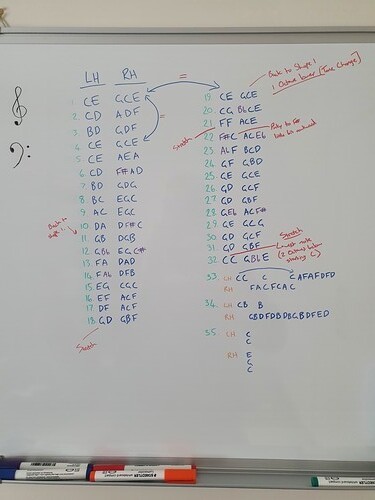
Now, I know what you’re thinking. He looks like a bit of a prick! Well, you’re absolutely right, by all accounts he was an A-Grade asshole, but that’s neither here nor there. All we care about, at this moment, is that he wrote 2 sets of preludes and accompanying fugues, collectively known as The Well-Tempered Clavier (Clavier, meaning keyboard). These pieces covered all of the major and minor keys of the chromatic scale and played a huge role in the popularisation of Well-Tempered Tuning (12 note - the type we use today) and the conversion from the old Meantone Tuning popular in J-Bach’s time. The song Rhodes teaches us is the first, and easiest but nevertheless beautiful, from the collections, Prelude in C Major. This is commonly played alongside the Fugue in C Major but, thankfully, we’re not required to excel to quite that level just yet! The song, in a nutshell, is 2 notes played with the left hand followed by 3 notes played twice with the right while, obviously, moving up and down the keyboard and altering fingering for 35 bars. The last 3 bars are an exception, they are slightly more difficult, but once you nail them, it’s euphoric… Orgasmic even.
I loved this. I loved playing a new instrument and have really taken to the Keyboard. Rhodes instruction was clear, helpful and encouraging and made me want to push for just one more bar every time I sat down to play. It’s going to be weird taking a step backwards, as I start working through a Beginner Adult Piano book that I own, but this gives one the encouraging knowledge that they can play some really great music at a very beginner level. As Schwarzenegger famously promised in 1984’s Smash hit ‘The Terminator’, I’ll be Bach for more of The Well-Tempered Clavier!
Está simpático este libro, y quizás si empuje a un par al piano, y eso le da un valor, para mi, pero es solo un manual bonito. Igual se trata de Rhodes, que si lo han leído les cae bien seguro, o por lo menos a mi, y entonces si James quiere hacer un libro que sea una lección de piano, pues yo lo apoyo. He dicho.
How to Play the Piano, by concert pianist James Rhodes, is the first offering in Quercus’s new ‘The Little Book of Life Skills’ series. I received the book six weeks ago and read it through almost immediately. I decided not to post my review until I had attempted to follow its instructions that I may report back on how effective they had been at teaching me to play Bach’s Prelude No. 1 in C Major within the time period proscribed. In the interests of full disclosure, I have never had a formal piano lesson but I did have some musical training on other instruments as a child.
The book opens with advice on how to master a piece of music. It is important to take things slowly and to practice regularly. To play the piano it is necessary to be able to read music, and to understand the correlation between the symbols on a musical score and a piano’s keys. Explaining this vital information takes up about half the book. It is then time to start to play.
A copy of the score is included and may be cut out or scanned. A few annotations have been added which are pointed out as progress is made.
The importance of correct fingering is explained. To navigate a keyboard smoothly this is a necessary skill to master. Timing is also important and to demonstrate this, and to give some idea of the sound being aimed for, the reader is directed to a series of short videos the author has posted at http://www.jamesrhodes.tv I found these helpful.
The next twenty pages take the reader through the score, two bars at a time, explaining the tricky sections and offering advice on how to move the piece along. Getting through this section took me about four weeks. I was diligent with my practice, although I may have averaged closer to half an hour, five days a week rather than the three quarters of an hour, six days a week suggested. As much as anything I found the muscles in my hands would start to ache after this length of time and wanted to maintain my enjoyment even if it was to the detriment of the musical skill I could aquire.
Having more or less mastered the notes, albeit at quite a slow pace, there is then a chapter on performance and instruction on how to use the piano pedals. I found this tricky. Remembering the pedal affected my concentration on the notes and I struggled to play without mistakes. I also wished to add the suggested interpretation which, again, led me to flounder on the bars where notes move between octaves and fingering positions must be changed. The author suggested that, having played through the piece so many times, the score would no longer be required. My memory does not work in this way and I continued to need the score in front of me in order to play.
There is a lot to take in and remember but the book is clear in its instruction and eager to remind the reader that they started out unable to play the piano. To be able to get through the piece, even if not to as high a standard as desired, is very pleasing.
The final chapter offers a pat on the back and suggests some other pieces that the reader may wish to tackle should they choose to continue their musical journey. Using the advice gleaned from this book I can see that this is possible. I now feel that I have learned to play this particular piece, which is satisfying. It has also been a lot of fun.
My copy of this book was provided gratis by the publisher, Quercus.
How to Play the Piano was a delightful read on so many levels. Rhode's commentary is witty, fun, and approachable, and his instructions are beautifully clear and concise. The first half of this book opens with general musical (and piano) know-how for absolute beginners, before breaking down the prelude bar by bar, in short easy steps. I do play the piano a little (I completed up to Grade 5 ABRSM), and I thought this guide was perfectly laid out. I love the idea of introducing someone to the instrument by teaching them a simple piece. It's a method where you get an instant result, which would be encouraging in a manner that would hopefully lead those people on to study the piano more fully. Accompanying the book are four short videos and a copy of the sheet music. My only tiny gripe was that, when the book notes where to find the videos, it gives only a main website address. It took me several minutes of searching through all the pages on the site before I found the videos and music, as it was not obvious where they would be. A note of the full direct link would make things much easier for readers.
I received this book as a free eBook ARC via NetGalley.
Pues el libro es una monada, como todo él ! Ahora estoy probando si en verdad funciona Estoy intentando tocar ese Preludio de Bach en cinco semanas Ya veré!!
'How to Play the Piano' (2016) - by acclaimed concert pianist James Rhodes.
I came to this book, not out of some inert desire to actually learn how to play the piano, moreover I'd heard a radio interview with Rhodes and was captivated by his story and personal journey, from troubled beginnings via a mental breakdown to his eventual achievement of becoming the renowned concert pianist he now undoubtedly is, it's fascinating and inspirational.
So, back to the book, which was something previously recommended to me, but I hadn't connected the recommendation with the person I'd listened to being interviewed and didn't realise that the author and the interviewee were one and the same person.
Rhode's book focusses solely on one piece of music, Bach's Prelude No. 1 in C major, which is, as he says and as I have discovered, a musical masterpiece. So deceptively simple and yet so immensely moving. Rhodes takes us through the basics concerning the piano and the way around a keyboard, before moving on to explain (with illustrations) how to play each bar in turn.
The principle behind 'How to Play the Piano' is of course to practice extensively alongside the relevant chapters of the book, which admittedly I haven't yet found the time to do. But, it does seem to me that this is a unique way in to learning a musical instrument and maybe one which would inspire people, children in particular, to take up a musical instrument - with the carrot and stick of being to play (albeit in the manner of a novice) a musical masterpiece such as this.
More power to James Rhodes and what a great little book.
This compact little book will teach anyone who has no musical knowledge whatsoever how to play a Bach prelude on the piano in 6 weeks. That is so long as you stick to the deal of practising for 45 minutes a day with one day off each week. I have some musical knowledge and I am trying to teach myself the piano. I read the book quickly skipping over the first bit and then started to learn the Prelude which I downloaded with the fingering from James Rhodes’ website. I am about three weeks in an I can say that I am getting the hang of the piece. I haven’t stuck to the schedule so I guess James is about right with his estimate of how long it will take to master it. I’ve already got my eye on the Moonlight Sonata for my next piece which I aim to master. James Rhodes is an inspirational teacher and evangelical advocate of the joy of piano playing. I can strongly recommend this book to anyone who wants to give the piano a go.
Este librito es exactamente lo que dice su portada. James Rhodes te enseña a tocar el Preludio en do mayor de Bach al piano en seis semanas. O sea que no es Instrumental. No es literatura ni cuenta una historia. Solo música.
No soy su público objetivo porque yo ya sé tocar el piano y he aprendido la pieza sin necesidad de sus lecciones, pero me encanta James Rhodes y escucharlo en directo fue maravilloso, así que me compré este librito por curiosidad (el precio me parece bastante caro, pero bueno, al menos he dado dinero a Blackie Books, una editorial genial, y a James). Lo recomiendo a los que estéis estresados por el trabajo o los estudios, a los que os guste la música pero nunca hayáis aprendido a tocar un instrumento por X o por Y. Se trata de un empujón divertido y enriquecedor para aprender a tocar una pieza sencilla pero nada desdeñable.
An amazing little book that taught me (someone who never played piano) to play a piece by Bach in about a month. The instructions are simple and precise and it includes sheet music and online videos. Not at all comprehensive, but a perfect starting point.
What a friendly way to get back into the piano after 15 years (at least) away! And I was never amazing to begin with- always self taught just in simple tunes, could never dream of playing classical music. This was a delight to work through.
How to Play the Piano by James Rhodes takes the task of learning to play the piano and both breaks it down and offers an achievable reward. The hope, of course, is that the reward will encourage the reader/student to continue learning and progressing.
First, the act of playing the piano is broken down into easy-to-digest chunks that have as their goal the ability to play a specific piece of music. The foundations here are the same ones needed for further study but some basic elements are mentioned but set aside because they aren't needed for this piece. I find this a wonderful pedagogical strategy. Limit overload while keeping focus. Rely on the reward, playing a beautiful piece of music, to get students to want to learn more.
Second, the use of a relatively simple piece as the goal makes this something that almost every student will be able to do if they have any interest at all in playing the piano. Being able to see, well, hear the result in a relatively short period of time likely will make many hesitant students decide the future rewards will be worth the future efforts. Rhodes never makes it sound like you are learning everything you need. He mentions what he is glossing over and that, should you choose to learn more, you'll learn that. As the piece builds so too does the student's confidence.
I would recommend this to anyone who has ever considered learning a musical instrument and in particular the piano. I would also suggest this as something a parent might want to get for a child who is on the fence about playing. This is something that can be used as a short term challenge with the idea that the child can decide after completing it whether they want to continue. Some will no doubt say no but those who say yes will be continuing based on their own decision and not that of the parents.
Reviewed from a copy made available by the publisher via NetGalley.
While I have played piano for decades, I was still curious to see what it'd be like to learn it from a book. So no, I am no approaching this it as someone new to the instrument, but it doesn't mean it wasn't worth reading at all. If nothing else, this is an incredibly well-done book that will show you what it IS like to be taught from a professional (and you actually are - just not in person!). The author writes in such an encouraging manner, with simple steps, and a few hard truths (sorry, but yes, sometimes you really are playing the same bar a billion times for a billion hours, give or take a million).
I believe anyone interested in trying to learn piano, but aren't sure they want to yet pay for lessons, should go with this cheaper option. It'll give you a very good sense of not just what it's like to play a piece you never imagined you could play, but a sense of how to play, and properly (please don't teach yourself via YouTube videos - so many make me cringe). And, if you really aren't convinced, it's actually quite a short read! Tons packed into a small book, though. I didn't expect to like this as much as I did, but I really, really did like this book. Highly recommend for you want to be pianist - this will get you one step closer!
I received a copy from the publisher via NetGalley in exchange for an honest review.
This is a good explanation on how to play the piano. If the reader takes it show and practices each lesson or idea as it is presented, they will have success in beginning to play the piano. It is a great resource for someone learning to play the piano by taking lesson. It is also great for someone who wants a little knowledge in reading music and playing a song on the piano.
I liked that this book takes a concept which can be confusing and breaks it down. For instance, page 18 shows line notes and space notes. It describes what these notes mean and an illustration of the same thing on the piano is below. I like that the author tells the reader to stop and explore this concept on the piano before going further. Learning by doing that is supplemented by an explanation is a terrific way to learn.
I received an ARC from NetGalley for an honest review.
It might be a question without answer (or a million answers!). But if your goals involve most or all of the following:
1) Getting to know the basics of piano playing ONLY.. 2) ..while discovering and exploring everything else yourself 3) Getting creative with your playing 4) Meditating, winding down by playing piano
Then, this book might be the answer.
Also, a shout-out to the way the book is written. It's an inspiring 20 min read, respecting and acknowledging the fast-paced life of the reader. Paradoxically, though, it's likely that the reader will slow down after this book; slow down in one of the best ways possible - by engaging with this wonderful activity of playing music.
I find James Rhodes inspirational, and this book is a very enjoyable and simple guide to playing not so much the piano as Bach's Prelude in C on the piano. It's a very (disappointingly) short but very practical book and I am confident that it will help me - but the most important thing, which a book can't help with, is the prescribed 45 minutes a day practice!
A short and condensed introductory book to start playing the piano. The author shares his experiences. Also, James is able to explain the techniques for the beginners in a simple and easy way despite his an experimented musician. Also, I liked the illustrations with the diagrams describing the fingers positions. This book is very useful and helpful.
Anyone who loves the piano and would like to learn how to play it, would find this book very helpful. The author's writing tone is witty, playful and friendly- just what you'd need to encourage you to keep playing. Thanks Netgalley for the eARC.
Links to the website videos didn't work. He says to go slow, 2 bars at a time, and then keeps talking about the next ones, with no indication where to actually find the bars I was supposed to be practicing before moving on. Finally found the sheet music at the end but that wasn't clear....maybe this works better as a physical book? The sheet music image was also super tiny, I had to take screen shots so I can expand enough to read it. There's also a sentence "And bankers." (To pay attention to) with no definition what bankers are in a musical context. I searched the internet, my piano playing partner looked it up...just confusing.
He says hand placement is super important, which is partly why I wanted to start with a book. But he doesn't really talk about how to identify hand placement for any new pieces. A little orientation to bass clef was helpful but generally all I learned from this was a suggestion of a good piece of music to start my learning.
James writes this book from the heart of a true musician. He communicates passion and understanding of music on every page. I feel so touched to have read this delightful little book. That I could be entreated to play this sublime and simple piece by JS Bach is surprising. It goes to show that playing it slowly and in small parts can. really reap some significant results. James provides extra details such as use of the pedal and different forms of expressing the piece to round off which I would otherwise have thought an impossible feat; to play a piece of music which transcends eras in under 6 weeks. Thank you James. An inspiring and simple read, which goes to the heart of what music is about. I too wish more music can be taught like this. Simple and profound stuff.
Dedicando menos tiempo de lo que el autor indica, pero tocando un poco casi todos los días, en 4 meses he terminado la pieza. Puedo tocar el preludio completo a una velocidad lenta. De cada 10 veces, 3 lo hago sin equivocarme. Pero bueno, nunca antes había tocado el piano. La obra es impresionante. Algo tan simple y tan maravilloso a la vez… Es una experiencia descubrir cómo, compás a compás, Bach va desarrollando pequeños cambios que pueden llenar tanto. Desde luego, no es lo mismo escucharlo que tocarlo. Cada nuevo compás incita a pensar: "Madre mía, creo que no era posible una solución mejor". El libro en sí es una cosa muy simple, pero la experiencia es algo digno de vivir.
4 stars because it is just so short! Also, if you're saying something will take six weeks, a one page calendar/grid would have been helpful. That said, it illustrates exactly how to go about learning a difficult piece on really any instrument (any piece) by breaking it down into very small segments and just focusing on those. Well worth the hour it takes to read the book and absorb the technique.
This book is amazing. I have only been playing piano for a couple of years but was intrigued by this concept. I have spoken to so many people who have said they used to play piano and wished they had not given it up. What a perfect way to launch back in. The book is so easy to follow from no knowledge to a point of being able to play a Bach piece....not bad.
If you already play or played the piano, don’t read this book. If you never played the piano before, use it carefully and with the help of the support videos. I would advise you to hire a teacher instead.
Well, I finally read the last page! But I can definitely say I've come away being able to play Bach's Prelude in C, even though I'm not following the exact fingering James so helpfully provides.
Though I didn't follow through with this as you're meant to - learning as you go, I did enjoy it, simply because I'm a fan of Rhodes, and his writing. So it's worthwhile.