With the defeat of Napoleon Bonaparte at the Battle of Waterloo in June 1815, the next two centuries for France would be tumultuous. Bestselling historian and political commentator Jonathan Fenby provides an expert and riveting journey through this period as he recounts and analyses the extraordinary sequence of events of this period from the end of the First Revolution through two others, a return of Empire, three catastrophic wars with Germany, periods of stability and hope interspersed with years of uncertainty and high tensions. As her cross-Channel neighbour Great Britain would equally suffer, France was to undergo the wrenching loss of colonies in the post-Second World War as the new modern world we know today took shape. Her attempts to become the leader of the European union is a constant struggle, as was her lack of support for America in the two Gulf Wars of the past twenty years. Alongside this came huge social changes and cultural landmarks but also fundamental questioning of what this nation, which considers itself exceptional, really stood - and stands - for. That saga and those questions permeate the France of today, now with an implacable enemy to face in the form of Islamic extremism which so bloodily announced itself this year in Paris. Fenby will detail every event, every struggle and every outcome across this expanse of 200 years. It will prove to be the definitive guide to understanding France.
Jonathan Fenby, CBE, has been the editor of The Observer and the South China Morning Post. He is currently China Director at the research service Trusted Sources.
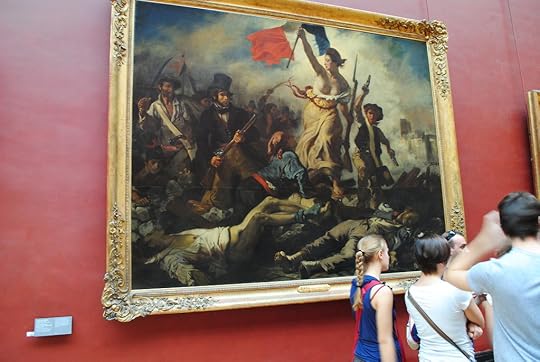
“Liberty Guiding the People” by Eugene Delacroix, 1830 In the Louvre (this symbolizes the July, 1830 uprising)
This is a history of France starting at around the early 1800’s with references to the revolution (1789) and the Napoleonic era. Throughout we are given the essence of a nation constantly striving and renewing itself – sometimes violently so. There is a never-ending struggle between left and right, clericalism and anti-clericalism. By anti-clericalism I mean “freedom from religion”, not “freedom of religion”. There was a constant battle to restrict religious instruction in schools, usurp church land up to the point of incarcerating and murdering those in a religion order (Catholics). This was accompanied by a freedom of the press which became more important over the years with the growth of literacy.
Page 244 (my book) Clemenceau, 1917
“The right to insult members of the government is inviolable.”
Paris was the driving force behind much of this. And those French can be such libertines; mistresses and affairs are open and common!
Conflict has become an ingrained way of thinking which is very evident in their political process. It also made France, more so in the 19th century, a beacon for progressive ideas where art, literature and free thought flourished. It became a beacon for all – Karl Marx, Frederic Chopin, Van Gogh… to name but a few.
I remember encountering a few years back a fellow from Africa (Cameroon) who lived in France for a few years and he remarked that any type of conversation would tend to end up as a philosophical inquiry!
Page 2
France’s enduring divisions – between left and right, Catholics and proponents of the secular state, centralisers and devolutionists – have deep roots in the mind sets of those who have seen 1789 and the ensuing events as the start of a new and glorious era and those who view it as having led to a distortion of the rule of reason.
Page 7
Common themes run through French history, the main one being that a nation which takes its’ revolutionary and republican legacy as constituting its core values has never, in fact, fully digested that heritage because it never wanted to shed its’ other, more conservative character… bringing the two into harmony is a problem hardly any easier at the start of the twenty-first century than it was at the end of the eighteenth.
The French see themselves as a unique people with a glorious history that prides itself on its’ “exceptionalism” – does that not remind us of another country – the U.S!
Besides the revolution of 1789-94 there were violent uprisings in 1830, 1848 and particularly 1870. These tossed aside leaders and governments which were seen as anti-progressive and incompetent. Mostly it was the bourgeoisie who benefitted from these revolutions. All this makes for turbulence and exciting times leaving an entitlement to change when the populace no longer was satisfied with their rulers.
This altered with the advent of the twentieth century and the First World War where France suffered 1.5 million dead, and millions of others wounded, disfigured, and suffering from what would now be PTSD. This had a great deal to do with the collapse in 1940. During the years of occupation the Vichy regime emphasized conservative values – family, religion and also xenophobia.
It is ironic that Petain was the leader of this right-wing Government during the occupation, but was himself not religious (and had a mistress) and de Gaulle, who was religious, made a secular government, gave women the vote, made peace with West Germany, and withdrew France from Algeria.
As per the author the French have now become disenchanted with politics and their leaders. Well they can be a cynical people!
There are many interesting topics covered in this book, but perhaps at times it is a little too negative – after all France is still functioning superbly with an immense and efficient transit system between cities and within cities, wonderful food (which the author acknowledges), and above all exemplified by its statues, walkable cities, museums and beautiful countryside.
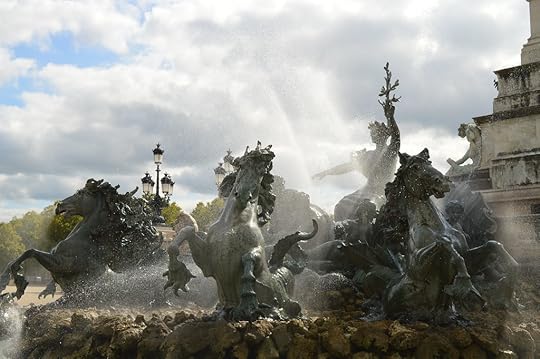
Bordeaux - Fontaine des Girondins, Place de Quinconces
Superbly written, concise, full of facts and details, and interesting pieces of information. France's history is truly complex but ever so fascinating and Jonathan Fenby makes it accessible and very, very readable. If history is your thing, make sure to read this one.
The History of Modern France – Definitive & Majestic
Jonathan Fenby former editor of The Observer and the South China Morning Post has written one of the best and most current histories on France. The History of Modern France – from revolution to the present day is the most definitive, majestic and lucid history of modern France that one can read today, written with an eye to the detail presented to the general reader as well as historian. From this book we not only are able to view the past but also understand why the French today are prisoners of their current belief systems, something we British need to understand instead of standing scornfully observing them.
There are many books on the history of France in the English language and this could easily disappear in to that canon but what Fenby does differently is that yes he uses the revolution as his starting point. From ‘Liberté, égalité, fraternité’ we see what Fenby calls the national narrative and gives France its ideological basis today. To us the French are always on strike but taking the view that the French have always had a tension in the republic between the rulers and the ruled, which gives often an angry and disenfranchised population.
In modern Europe we look at the politics of France and its Presidential election and the various swings between the left and right and how both secular views compete and win over every seven years. One thing that you do learn from this book is that one thing both the left and right on the political scale do believe historically is how to dominate every aspect of French life and centralise that and over the course that does not change other than the political leadership.
Fenby takes the view that France and its population is in the throes of a long civil war that started with the revolution and continues through to today, that this went on even through the occupation of the Second World War, European Union will be ongoing. Fenby’s account of the Nazi Occupation is one of the most fascinating that I have read in a long time and he sees it as a new chapter in the long civil war. The splits in the left and right, particular the fascists, is still an ongoing war today.
Fenby argues that throughout the book is that France today is still a prisoner today of its revolution and that is trapped under the weight of history. He produces some excellent observations on the use of Muslims to contain the power of the Catholic Church during the nineteenth century. One does not consider how much the French are in awe and prisoners of their own history until one is shown the evidence.
This is truly an excellent majestic history that should be on the shelves who want to learn more about France and understand her peoples. There is a great sweep of history that is dealt with honesty and an eye for detail and fact which makes this such a wonderful book to read and use. This is the most definitive and majestic histories of France that one can read today, truly excellent.
Observing the newly restored Bourbon King Louis XVIII’s reluctant choice of ministers, the devious Talleyrand leaning on the arm of brutal Fouché , Chateaubriand described “vice leaning on the arm of crime”. A Christmas Eve dinner during the Prussian siege of Paris in 1871 included, elephant consommé and bear ribs in pepper sauce from slaughtered zoo animals, along with the more mundane stuffed donkey’ s head and roast cat with rats. These entertaining asides spice up Jonathan Fenby’s broad sweep from the ill-fated attempt to restore the monarchy, after Napoleon’s final defeat in 1815, in the shape of the unimaginative, ageing brother of the guillotined Louis XV1, to the economic decline under the unpopular socialist President Hollande, aggravated by terrorist events like the attack on the satirical magazine Charlie Hebdo.
Throughout the book, I kept seeing parallels between past popular revolts and the present unrest: left-wing republicans trying to limit working hours, although the modern-day 35 hours a week was a ten hour day in the Paris of 1848; C19 Parisians uprooting trees to form barricades, and today’s CGT unionists burning tyres outside power stations in protest against legislation to make organisations more competitive, with the irony of a modern socialist government seeming to work on the side of employers. Of course, the paradox of the First Republic of 1848 was far keener, “a reminder of how eminently respectable republicans turned the troops on their own people motivated primarily by the desire for a decent livelihood.”
Jonathan Fenby is most readable when he focuses on particular people or events: the succession of four monarchs, including the well-intentioned “Citizen King” Louis-Philippe, whose approach to reform was too moderate to appease the republican genie let out of the bottle, particularly in 1848, the Year of Revolutions, which perhaps the author could have explained more. Napoleon’s step-nephew (I think, a few family trees would have been useful) managed to hold power for eighteen years as France’s last monarch, and presided over some much-needed economic progress and restoration of national standing, despite being dismissed by Bismarck as “a sphinx without riddles” and criticised for his amoral pragmatism. The humiliation of his loss of the Franco-Prussian War in 1870 is an aspect of the ongoing rivalry between the two countries either side of the Rhine: now, France suffers by comparison with Germany as regards growth rates and trade deficits.
Fenby paints a fascinating portrait of De Gaulle, who comes across as an egotistical dictator, alternating as is often the case between arrogant certainty and melancholy, profoundly ungrateful for the help received from Britain and America, presumably a constant reminder of his own impotence when France was occupied in WW2.
The price of covering so much is a text at times so condensed as to become indigestible and occasionally unclear, particularly in the period 1870-1939 which I found hard going. I accept that forty-two governments between two world wars, with a system resulting in short-lived coalitions, is hard to cover adequately. Fenby tries to aid clarity with subheadings, boxes to feature somewhat arbitrarily chosen individuals, and day-by-day accounts of some key periods of unrest. However, I could have done with a glossary of the large number of players involved, a timeline of key events, plus an explanation of the current French voting system, to avoid the need to refer elsewhere.
Fenby leaves us with a rather bleak picture of a depressed country which despite its sense of being special, has fallen behind as it prefers “to reject economic modernisation in favour of defence of tradition”. Although the Republic has been accepted since 1870 as the regime that divides the French the least, the warring factions remain: “the country invariably opts for right over left with occasional eruptions to prove that the revolutionary legacy is not dead”. I would have preferred more of this kind of an analysis, perhaps a two volume history with a break in 1945, to give more space to develop themes.
A fair overview of the history of France. Fenby breezed over more fascinating events in French history in order to provide a broad overview. Too much a stickler for economic statistics and less attention on the cultural/social trends. Good bibliography and notes.
The first was the layout of the book. From the prologue and introduction being almost 60 pages, makes me wonder why he didn't just make them chapters. The second issue is the timeline style for some parts of the book and not for others. The boxes within the chapters too with no breakoff point made the reading clunky and again, makes me wonder why he did that and not just include that information in the text. Very odd to start the book in 2015/2016 (the year this book was published).
Mr. Fenby wants to see France return to a stable and "democratic" France, in the likes of Charles de Gaul or Charles Napoleon in the mid-19th century. Not the biggest fan of Francois Mitterrand or the fourth republic in general and has a soft spot for Marshall Petain throughout the book. A very right-of-center review of France to be sure. Not to say that Francois Hollande was a good president, but there are ways for France to find its way without going to the old mold of the Age of Emperors.
This is a well written and admirably brief history of France from the revolution to the 2015 terror attacks. It's refreshing to read about the Franco-Prussian war and the two World Wars in the context of the development of the French state, rather than as events which were separate and free-standing. I liked the one-page pen portraits of the leading French political figures of the last 250 years, many of which were suitably irreverent! The idea of Jacques Chirac possessing a certificate in recognition of his banana split making skills was quite a surprise! If like me, you are a little shaky on your Second Empires and Fourth Republics, this masterful summary will sort you right out.
A detail heavy history that focuses on politics. If, like me, you know plenty about the culture, but don't really understand how Gaul was so important, this is the book for you. If you know about the politics, but not the culture, you'll find this book pretty much useless--a list of names doesn't really tell you anything about French philosophy, literature or art, and the cultural history more or less peters out in the '70s. If you think knowing about political history is pointless because bottom-up is the only way to really understand things, avoid it. That's not a criticism of the book.
One criticism of the book: Fenby doesn't spend much time explaining how international economic or political events shaped French political actions (aside from Gaul's kind of charming chest thumping). Perhaps they didn't, but it would have been nice to point that out.
And that was unavoidable, because Fenby, despite having written a popular history, also has--gasp!--an argument: that the history of modern France is the playing out of tensions dating back to the revolution. If you think that, you're hardly likely to care much about international affairs. But a charming read, provided you don't expect too much, or too much of the wrong thing.
Fast moving account -- I hope they do an update up through 2020. De Gaulle's relationships with various American Presidents are covered, but after that, USA - France relationships don't get much attention. Fun to read the blurbs on the back of my copy -- it sounded like everyone was praising the book, but it also sounded like they were talking about totally different books. In French history, the reader can see whatever the reader wants to see.
The authors one page capsule biographies of various important figures are extraordinary. I kept thinking "I wish I'd had that page five years ago -- before I tried to read other things."
Yet another book I've decided to reread that I didn't like the first time. There's a massive amount of history being cramed into a small space here, but it's good a starting point. Takes us up to 2015 with François Hollande as President of France. I did quite a bit of research on the side while reading this. Every page (maybe even paragraph) was super condensed, and was a little hard to wrap my head around without using the internet to get a grib on the barrage of names, events, and general information being thrown out at the reader. I did get a lot out of this on my second attempt at absorbing this book.
This book is disappointing because it shows no analysis of Modern France's history. The facts are correct but are not enough put in perspective to explain their consequences and how it shaped France as we know it today.
A very interesting book! It tells the story of modern French history in a very accessible way, and definitely does not hesitate to point out the many flaws thought that time. I heartily recommend this book!
In this brisk survey of French history since the Restoration, Jonathan Fenby takes the reader on an enjoyable journey through the efforts of France to reconcile the Revolution and its revolutionary heritage with the innate conservatism of the French, of both Left and Right. The book was first published in 2015, during the doleful and now forgotten Hollande years, and it is the predominant crisis of that time, the threat from radical Islamism and terrorist attacks, which frames the narrative, so not only does it predate the coming of Covid, it also has nothing to say about Emmanuel Macron and his ongoing sleight-of-hand tricks to assuage the electorate with his technocratic, petit Bonapartism. Fenby asks two main questions: one, is modern France governable?; and, two, concomitantly, if so, by what system and by whom is it best governed? To the first, his answer is a qualified yes, although he is pessimistic about the future, in his final chapter overtly comparing 2015 France to the situation on the eve of the great Revolution. And to the second, his answer is that France's best government is one that combines the nation's monarchical, republican, and Bonapartist traditions under a powerful and dominant personality, which he equates with the Fifth Republic in its first years during the first, successful term of Charles de Gaulle. After that time, he sees only relative decline, from the Évenements of 1968, tempered by a brief, bourgeois resurgence under Pompidou, through the corrupt and politicking years of d'Estaing, Mitterrand (about whom Fenby has little nice or positive to say), and Chirac, and onto the Bling years of the ineffectively effervescent Sarkozy and the tepid incompetence of M. Normal. It appears that the suit cut by the General in 1958 became too large even for him after 1965, and has dwarfed all his successors to varying extents. It will be interesting to see if Macron can better fit the tailoring, or if he too will become another failed over-promiser, and if France seeks another revolutionary turn, perhaps in the form of the anti-republican, nouvo-Pujardism of Marine Le Pen. By its nature, this book is teleological, seeking explanations for France's present woes in her past, which limits it as a work of history, while there is little proper analysis of either the Restoration and Orleanist monarchies or the Second Empire, since their failures are regarded as a failure of monarchical government in a country which is at heart a republican construct, although one that is predominantly conservative, interwoven with brief episodes of revolutionary ardour and quasi-romantic Leftism. To an extent, therefore, France today is a product of the great Revolution of 1789-94, but through a conservative interpretation of the revolutionary impulse that has simultaneously elevated the Revolutlon as both ideal and as warning, thereby combining two counter-interpretatons into one synthesised collective memory. The Revolution is indeed both the best and worst of times and the mark by which all subsequent events are measured, being valued, in so far as they reflect the French viewer's opinion, by the Revolution and its historical, even historicised, memory. Modern France, even more than Germany or the UK, despite its superficial modernism remains a prisoner of its past, and of the revolutionary construct imposed upon the events of 1789-94 and the ideologies thereby engendered, for good or ill.
I think the book starts at the perfect time in history to explain and add context to why the country is like it is today. It can be somewhat confusing when it talks about different parties (like the “Ultras” or “Gaullists”) but I’m glad those details aren’t made vague. It’s nice to get the gritty details because then you’re in France and see protest flags with FO written on them, it’s good to know “oh that’s Force Ouvrier and I read about it”. I also like how it started with 2015 and then jumped back to the Revolution, that was an interesting stylistic approach.
By the end of the book however I think the confusion starts to come more from the writing and not just the history itself or politics. It took me a bit more effort to keep names in my head and know “ok so that guy is the Prime Minister but this guy holds a different position…” etc. Also, the last chapter is very dark and kinda just roasts France for ten pages. I can’t really say how accurate it is because this is the only book of modern French history that I’ve read, but it seems very glum. Considering that an Englishman is the author, I’m a little suspect to say the least. He makes France sound like a backwater that’s nothing but rotting garbage pining after a golden era.
Pretty solid history, with lots of interesting stories and lots of fascinating detail about culture. Some of it slightly offends my materialist bent - he's very keen on ideas. I am a bit suspicious of this. But maybe it's more true in the case of France. Macron, for instance, does seem to be moved by the weight of french history. So, while I'm suspicious of some wide-ranging conclusions - rooting the war on terror in the complex legacy of the revolution, for instance, I really enjoyed it
This was neither here nor there. I enjoyed the pre-war chapters as I’m not very knowledgeable on the French Revolutions, however the book seemed to get less concise as it went on. WWII was crammed into two chapters, however I did appreciate the honesty re the collaboration of the Vichy government.
A couple of typos which always annoys me. Not a bad book. But didn’t blow my mind either.
Fenby’s central argument of the book is that, while proud of the achievements since the Revolution in 1789, the French have become prisoners of their historical heritage. By the standards of today, the notion of the Grande Nation as model for the world is not one which many people could still objectively defend in the 21st century, but it remains a potent reason to repel change or to simply come to terms with their country’s past – constituting what the author calls la morosité du jour. While some readers criticized Fenby for kicking off with a prologue on “A Republic at War” – taking a detour around France’s most recent terrorist attacks in 2015 (the year of its publication) – I find his approach very felicitous, since it reinforces his claim of a country at war with itself, not since only then, but from day one of the First Republic. Following the prologue, the reader is taken for a ride through French history with an excellent eye to historical detail, while also giving plenty of space to the cultural mood of the given time, diving also – although superficially – into literature, philosophy and art. From the ideals of the French revolution, the concept of freedom, the desire for social equality, the idea of solidarity and unity among citizens and the aspiration for a more representative form of government – to the Grande Terreur, characterized by mass executions of perceived enemies of the revolution, internal political purges and widespread fear and suspicion, Fenby masterfully narrates the conflicting beginning of the first of five French republics to come. Thereupon, French history heads to the Napoleonic Era (1799-1815) alongside the establishment of the First French Empire and military conquests across Europe, passing by the July Revolution of 1830 and the revolutions of the year 1848 – leading up to the point of the Franco-Prussian War of 1870/1. To me, this war in particular is somewhat of a recurring theme in French history: 100 year before the Franco-Prussian War, in the 1780s, France also had an unpopular ruler playing with reform but constrained by defenders of the status quo, an indebted economy falling behind that of a northern neighbour (Britain it was), a dissatisfied middle class and unhappy workers, all against the backdrop of radical challenge from those who wanted systemic change. Back then, in the 1780s it was Britain, 100 years later it was Prussia, which was on the verge of becoming Germany (today, a case could be made that it is still Germany, although in a much more pacifist setting and what’s at stake is the leadership of the European Union). Anyways – in 1871 France is heavily defeated under unpopular Napoleon III by Bismarck’s Prussia; to add insult to injury, the French ruler was also captured with a whole army during the battle of Sedan and Bismarck was to pronounce the unification of Germany in the Hall of Mirrors at the Palace of Versailles, on French soil. They also lost Alsace and Lorraine to their new unified neighbour. Fenby recognizes that the defeat of 1871 by the hand of the Germans was a crossroad in French history, defining their principal foe for the next 70 years to come, through two world wars. In fact, France never recovered from that defeat – the hype around characters like Georges Ernest Boulanger, also known as Général Revanche, underpins this view. What Fenby also masterfully illustrates is the Dreyfus Affair, a political scandal that rocked France in the late 19th and early 20th centuries, highlighting military corruption and the struggle between conservative and secular elements in French society. Nonetheless, what I find most striking about the whole Dreyfus Affair is the rambling anti-Semitism which was seemingly widely prevalent in French society at the time. In hindsight, what emerged from the Boulanger legacy was a new form of right-wing activity, with an undeniable anti-establishment, anti-capitalist and anti-Semitic touch, which one of its backers, Maurice Barrès, proposed to call – lo and behold – “national socialism”. Hence, in order to shed light on the cradle of political anti-Semitism, today’s historians would be well advised to maybe focus less on the wrong side of the Rhine. That being said, WWI obviously took a huge toll on France, being the first fully fledged industrialized war, which devastated French territories as well as its demographics. The period between the two world wars then characterized by instability, with 42 governments and a series of poor decision-taking, like cutting military expenditure by 1/3 between 1931 and 1935 just as Hitler was getting into his stride. In my opinion, the best part of the book starts with the account of the Nazi occupation in WWII, which is the story of the Vichy Regime under the “Lion of Verdun”, Marshal Petain. In general, the French like to see their history as if, apart from a bunch of Fascists and crooks around Petain sitting in Vichy, they resisted the Germans for four years with the true government around de Gaulle in British exile, while also fighting the occupiers through the Résistance. For decades the extent of collaboration was obfuscated and the deportation of tens of thousands of Jews forgotten; it took an American historian, Robert Paxton (“La France de Vichy: 1940-1944”) to show that the French had done the Nazis’ work (1/4 of French Jews deported, 400.000 disabled and mentally ill left to die and so forth). After de Gaulle’s takeover this chapter of French history was quickly forgotten. Coming to de Gaulle: hands down, the story-telling around de Gaulle’s Fifth Republic is what makes this book so great. What makes CDG so intriguing to me is his geopolitical stance, something which is unseen among European leaders not only nowadays, but since a long time. Under de Gaulle in 1966, France withdrew from the integrated military structure of NATO – a decision motivated by the desire to assert France's independence and pursue a more autonomous defense policy. Back then, it reshaped the dynamics of the Cold War and signaled France's commitment to maintaining its own strategic interests outside of the confines of NATO's command structure; given the current geopolitical tensions between the West and Russia/China/the Muslim world, maybe some European leaders should check out de Gaulle’s memoirs. Be that as it may, de Gaulle’s Fifth Republic continues to this day. To some extent, CDG was a revolutionary figure, but even he could not set a last template for a nation so immured in its history, spawned by the heritage of 1789. One of his greatest achievements is undoubtedly the presidential system he introduced that granted the French President significant powers, including the ability to appoint the Prime Minister, dissolve the National Assembly and rule by decree in certain circumstances. His heritage endured, but, without him, it was a lesser beast that would prove, over time, difficult to manipulate as old forces would reface. So, to reiterate, occasionally exceptional figures, such as Charles de Gaulle, can reconcile the different strands embedded in national life – but most of the time France is just at war with itself. For most of its modern history, there has been an underlying tension about the way France should go, sometimes spilling over into violence in the supposed home of enlightened reason, notably in the risings of the 19th century, Napoleon III's coup, the Paris Commune, the street violence of the 1930s, the fight between collaboration and resistance, the Communist Party's use of its labour muscle in the late 1940s, the excesses of Algérie française and the OAS, the student riots of 1968 – and, in a different way, the tensions around immigration of the recent decades. The presidents after de Gaulle (Pompidou, Giscard d’Estaing, Mitterrand, Chirac, Sarkozy, Hollande, Macron) all struggled with a deepening sense of dissatisfaction among the population. What’s left today is a nagging sense that the country is not living up to its history, but that is only partially true. As a matter of fact, the world changed tremendously, and France is not what it used to be anymore – since a very long time. Today, France consoles itself every five years with a never-ending divisive fight for the presidency, but as former President Giscard d'Estaing remarked in 2014, “if you’d tell the French the truth and propose a remedy, you are sure to be beaten” – people, he added, imagined they could continue to live as a century earlier, without taking into proper account the transformation that had occurred since then. Hence, today, the French President is just someone who somehow holds the idea of a great French nation together, even though the notion is visibly leaking everywhere. Once in the Élysée, as reality hits in – they see their popularity crumble, most strikingly in the case of Hollande. So, they coddle the population to protect them from the reality that the Trente Glorieuses were long gone, and that the world had become a harsher, more competitive place. So, to conclude – as Fenby points out, the French are still apt to see their country as the bearer of a special mission, bequeathed by their history. Nevertheless, as the Gallic cockerel is crowing proudly to the world, proclaiming the historic virtues of the revolution – the echo is just not the same as 250 years ago. But, not everything is lost, France is still the country of formidable food, long holidays, a short working week (35-hour week), good healthcare and big pensions.
I recently moved to France for work and wanted to find an outline of the modern history of the country. This book offers just that, presenting an overview of political developments since the 1789 revolution.
The main argument of the book is that the origins of modern France are to be found by tracing its development from the revolution, through the French Empire to the Bourbon Restoration. This tumultuous time was marked by the emergence of a particular understanding of France as the holder of a unique historical destiny as the adherent of truth and reason. It is this certainty that led to the factional divisions that emerged from the revolution and broadly speaking still structure French political life today. From then to now, constructive compromise on the basis of shared values is undermined by sharp disagreements on the very meaning of these values, often expressed through divisive rhetoric, occasionally erupting into violence.
France mixes the republican heritage on which its self-identity is ostensibly based, with a strong and persistent strain of conservatism which prevents the full assimilation of this heritage. This uneasy balance of forces has various consequences for the present. A deference to tradition leads the French to resist elements of economic modernisation and makes it particularly difficult to adapt to new cultural realities which the old terms can no longer adequately describe. On the other side, politicians with more radical ambitions are unable to moderate their rhetoric and take into account material realities and necessary concessions, leading to a political system marked by infighting and one-upmanship, tactical alliances but little productive compromise. The result is a deep cynicism among the population, who are increasingly turning towards populist alternatives.
Aspects of cultural development and technological change are touched upon alongside political wrangling, but with a more broad-brush approach, interspersed with colourful anecdotes. Fenby draws tentative links between the political and cultural aspects of French society, but they are presented as relatively autonomous to one another. While a book about France should of course focus on the achievements of the French in different fields, the lack of international context leads to a rather flat account that limits itself to merely listing accomplishments. Restricting the focus to the nation also mars Fenby's account of French political culture. The cynicism of the French for their political representatives is by no means unique to France, and persists in countries that have already pursued the forms of economic modernisation Fenby suggests France is particularly resistant to (the UK, for example). The wider international context of discontent would be worth mentioning. The book ends with Hollande's presidency, the nadir of popular confidence in politicians. It would be interesting to read how Fenby understands Emmanuel Macron's conspicuous attempt to chart a Third Way in a country so pointedly divided between Left and Right, and the inability of this form of politics to paper over the tensions Fenby identifies at the core of French society, despite hopes to the contrary.
Fenby’s scholarly book on France is probably best read by a devoted Francophile; the history is heavy going as so much of it is political, rather than cultural. Empires, governments and political parties have come and gone with nearly bewildering rapidity in France’s history, especially in the last 100 years. Keeping track of it all takes concentration.
Eras of particular interest include the French Revolution, the French government both before and after WWWI; the rise and fall, rise and fall of Charles De Gaulle. Also this: The country’s recent struggles to balance its historical reverence for equality and support for immigrants with the all-too-realistic tensions caused by an influx of Muslim immigrants, many of whom snub the idea of becoming French.
As Fenby notes, there is an unusual hesitation on the part of French leaders to ask for any particularly muscular political action. It is possibly due to the cultural fear of the public rising up violently. This is a country that once committed regicide, and that fact still resonates.
The author concludes that the current state of France is not a happy one. France is rapidly being outpaced by a changing world and “there is a signal lack of politicians ready and able to rally the country behind a new course.”
Americans who read this and think it can’t possibly pertain to their country– now or in the near future – need to think again.
Meget passende at få lidt styr på fransk historie nu, hvor terror foregår i Frankrig. Desværre er bogens første 50 sider ikke så lovende. Det anekdotiske fylder mere end jeg kan lide. Efter 100 sider erklærer jeg bogen for en nitte. Gider sgu da ikke høre om at aktørerne har en nasal stemme og gifter sig med en 16 årig og spiller billard, når det ikke i øvrigt er relevant for fortællingen. Det er kedeligt at læse og får mig til at tvivle på forfatterens dømmekraft.
One who is looking to wind the way through the story of five republics, two monarchies, a commune, a second empire, Vichy, and the Resistance will find this a compelling read. The text is solid and accessible. A worthy book for someone looking to improve an uncertain understanding of France after 1815.
After reading the outstanding ‘The English and Their History’ by Robert Tombs, I thought a similar survey approach to France might be interesting. Not sure if it’s fair to compare the two but this book is nowhere close to Tombs. (Author even quotes Tombs, p.172) Not enough insights. Mostly broad brushed facts which provide a reasonable starting point on French history from 1789 to today.
This is a well-written history of France, starting with the Revolution but really focusing on WWII and beyond. It's long, and I think it would have been more enjoyable if it kept up the pre-WWII pace throughout the book. The author has a definite point of view that he doesn't try to hide, and I think that's what makes it so readable. Overall one of the better country histories I've read.
This was an inexpensive book, that I bought because I wanted to learn about France. I don’t recommend it. There are plenty of better books out there about France. It was very dry, very general, no flow and had a writing style that seem to be one big long list of all the things that authors wanted to mention about France and its history.
I should admit off the top that my knowledge of French history was somewhat limited. Most of my knowledge of France's history after the French Revolution, and outside of the Second Empire, was understanding France as part of the broader narrative about Europe and the world. So, I know about the early Vietnam War or World War I and World War II, but I couldn't give you a specific answer to the situation within France itself.
If one is looking for a highly detailed history of France this is not the place to find it. Jonathan Fenby is attempting to describe 225 years of history in 484 pages. As a result, it is fair to say that this is a survey of French history.
However, Fenby's long view of French history starts to create certain patterns. I'm sure for those well versed in the history some of this is terribly cliche. The division between right and left. The inability to form stable governing coalitions. The entrenched position of certain groups making reform impossible. Deep rifts within French society. France's declining place among the leaders of the world.
Fenby bookends the monograph with the dramatic and horrifying incidents of terrorism that has plagued France in recent years. The book is relatively recent so reading those events framed within the context of wider history was a bit jarring - but not in a bad way. The author clearly communicates the trauma that the country has suffered over the last few years.
As the history from the Revolution onward is examined it feels clear that France has not been able to fundamentally address the legacy of the French Revolution. Moreover, that the divisions created before, during, and after continue to haunt the country. There remains a revolutionary spirit within the country. There remains a strain of reactionary thought and puritanical republicanism. France has not triumphed over crises, but weathered them. Fenby, for example, paints a rather dim picture of France in the Second World War and in the 1960s. Furthermore, the author's disdain for certain leaders, particularly Mitterand, is very clear.
The prognosis and conclusions Fenby draws is quite bleak for a country that views itself as a beacon for the Western World. Economic, social and political crises confronting the country seem to have no leadership apt to meet them. France's reflexive responses are not suited to the work ahead. I am very glad for the author's comprehensive overview for the country's history, though now I find myself concerned for its future.
TLDR: absolute slog to get through, more summary and lists than actual storytelling, some insightful anecdotes and fun trivia. High-key parachute journalist vibes.
Don't get me wrong, this book is excellent if you're looking for lots of insightful, quixotic anecdotes about some of Frances most famous faces. But other than the slew of minute details, which make for excellent pieces of trivia, the overall structure and style of the book is seriously lacking.
The section of the French Revolution, for example, does such a bad job of explaining its causes, events, and 'what really happened' that I had to consult several other sources, namely Britannica and Wikipedia, to get an idea of it. Here, and indeed throughout the whole book, the author name drops some obscure French politician then never mentions them again, or only writes their last name with no context, or brings back the 'character' a chapter later...it's very confusing.
The style itself is difficult to engage with. Often whole paragraphs are filled with what can only be described as lists without bullet points. "The economy stagnated. Barns were looted. Animals starved." Those aren't direct quotations but you can imagine what it would be like having to read multiple paragraphs like this. Additionally their sentences are filled with more clauses than you could ever imagine. It made me think at times that this book hadn't been edited at all, let alone a little.
Every so often, the author stops making their lists and comes to argue for their main point, being that the French revolution has created a social/political legacy, the issues of which still manifest today. But it's so seldom that the book reads like a dry summary speckled with some memorable or eye-catching piece of gossip or trivia.
To give credit where it's due, the discussion on the Dreyfus Affair and the role of collaborators during WW2 was really well done, and didn't suffer from any of the aforementioned setbacks. If only the rest of the book was written like that.
Fenby is by trade a journalist, and it shows in his interest in very particular stories and anecdotes about characters which otherwise would remain impassive, purely historical figures. The little stories he pops in about kings, generals, politicians, so on so forth, are genuinely fascinating. But this comes at the expense of a coherent narrative, an exposition of an overarching plot, and, let's face it, a good history book.