Alice is trying to thread a needle by the fire on a snowy afternoon, when she finds herself in an alphabetical land populated by Siamese-Twin Cats (joined at the tail), the Welsh Rabbit (with his toasted cheese), the Kangaroo, the spelling bees, the Italian Hairdresser who uses a small crocodile as a pair of scissors, Jack and Jill, and best of all- the Grampus. It’s fun trying to find all the letters in the right order: this is one of my favourites of the sequels/ rewrites. The pictures are perfect too: I’ll try and get organised and scan some in.
Gilbert Adair was a Scottish novelist, poet, film critic and journalist. Born in Edinburgh, he lived in Paris from 1968 through 1980. He is most famous for such novels as Love and Death on Long Island (1997) and The Dreamers (2003), both of which were made into films, although he is also noted as the translator of Georges Perec's postmodern novel A Void, in which the letter e is not used. Adair won the 1995 Scott Moncrieff Translation Prize for this work.
In 1998 and 1999 Adair was the chief film critic for The Independent on Sunday, where in 1999 he also wrote a year-long column called "The Guillotine." In addition to the films made from his own works, Adair worked on the screenplays for a number of Raúl Ruiz films. Although he rarely spoke of his sexual orientation in public, not wishing to be labelled, he acknowledge in an interview that there were many gay themes in his work. He died from a brain hemorrhage in 2011.
To attempt a sequel to Lewis Carroll’s “Alice in Wonderland” series raises reader expectations on at least two levels.
Firstly, the originals are so well-known and well-loved, not to mention extraordinarily well-written, that readers will approach the sequel with a degree of scepticism, and preciousness about the originals.
Secondly, such a project is likely only to attract an author whose chops are already pretty good, so their own reputation as a writer will be under more scrutiny than ever.
The Alice series is one of my favourite pieces of thinking and writing. It invites parody and pastiche. Gilbert Adair is also a writer I think highly of and one of the few I would have expected to be up to the task.
As in the original books, Alice arrives in an uncertain world and encounters the unfamiliar, as well as the linguistic building blocks of the familiar. And it's all written down for the benefit of other children. (The primary audience for this novel still seems to be children.)
For all the imagination on display, I came away with a sense of disappointment, of being let down.
Transitional Metaphors
Adair managed to create a transition between two worlds worthy of his model. However, his parallel world doesn’t have the same imaginative and visual appeal as that of Carroll’s, and this lets the story down in the middle after its strong start.
Carroll’s own transition mechanisms (down the rabbit hole, and through the looking glass) are so evocative that they have become metaphors in their own right.
Adair takes an existing Biblical metaphor (through the eye of a needle) and repurposes it to good effect.
Alice enters the parallel world by falling through the eye of a needle, while she is sewing (i.e., attempting to thread the needle).
Connected with Letters
Adair then turns the “eye” into an “I”, and no sooner have we arrived in the other world than we are exploring the letters of the alphabet. Alice says in the penultimate chapter:
”All the things which have happened to me today seem to have been connected with letters in some way.”
Alice’s fall to Earth is broken by a haystack, more correctly described as an A-stack.
Alice assumes that the needle has also come to Earth by passing through its own eye “like a serpent swallowing its tail.” She proceeds to look for the eye (or the “I”) of her needle, in the A-stack.
Hence, to paraphrase the Biblical expression, it is harder for a rich man to enter the kingdom of heaven than to find the I of a needle in an A-stack.
Drawing the Short Straw
Instead, in the A-stack, she finds a Country Mouse, which had “recently been sucking on a short straw, which the chattering of its teeth was now causing to swing up and down in a comical manner.”
Alice thinks of it as the last straw, whereas I wondered whether the mouse might have been artistic and might have “just drawn the short straw.” This is the style of infectious verbal humour used by both Lewis Carroll and Gilbert Adair.
Capital A’s
Alice then discovers that all of the hay is in the shape of Capital A’s and the mouse reveals that “it’s best to make A’s while the sun shines.”
There’s much ado about the “silent aitch” in “haystack” and other words like “had” and “hoped”.
Meanwhile Alice is surrounded by bees, whose job she thinks is to collect pollen from flowers. However, the mouse reveals that it is to collect letters to spell out words. “That’s why they’re called spelling bees.”
The mouse also points out that “there ain’t no ’i’ in ‘needle’.”
Characters of the Alphabet
Next, Alice meets two Siamese Twin Cats named Ping and Pang, who are, quite logically, joined at the tail.
They recite a poem called “The Sands of Dee”, thus completing the first four letters of the alphabet.
Soon it starts “raining kittens and puppies, but they’ll turn to cats and dogs soon enough.”
After some wordplay about camels, Alice spots an elephant that had been frightened by the mouse.
Together they go to Hide and Seek Park to hear the Election speeches. Here, they find a fast-talking Emu (“It’s got ‘Emu’ written all over it!” as is evidenced by the illustration), as well as a Grampus in academic gown, and a moustachioed Italian hairdresser who uses a crocodile for a pair of scissors.
The Emu stands for everything beginning with an “F” (e.g., freedom, facts, fair play, fairyland, faith, Father Christmas, the fat of the land, festivities, foreign affairs, forgiving and forgetting, fruit-cake and fun.
Adair’s poetry is a lot of fun throughout, including the Emu’s poem about F:
“Oh, f’s the only letter The world can count upon; For, without f’s, there’d be no if’s, And dreams would end anon.”
Anonymouse
Alice and the Emu then argue about who Anon is and whether it is the author of the poem. The Country Mouse claims credit, because it believes it stands for Anonymouse.
In the next scene, the Grampus is revealed to be very absent-minded. “I sometimes forget I am absent-minded, and remember everything!”
Alice asks, “Then I suppose the first thing you remember is your own absent-mindedness?”
The Grampus replies, “Exactly so, which means that I forget everything all over again! So I decided to write the story of my life, in advance, so that I could live it out afterwards. This way, I am sure to remember.”
There follows a discussion of Snakes and Ladders and Auto-Biographies and trains and shortcuts and tunnels and surprises and brigands on the platform.
Well Meant
“Well,” said the Grampus, smiling with condescension at Alice, “that went off quite satisfactorily, I think.”
“I only meant –“ Alice began to say.
“Don’t mean!” the Grampus roared at her. “Think, speak, mention, assert, deliberate, declare – even opine, if you will – but never, never mean! Why, the world would be in a fine stew if just anybody felt free to mean, where and when they pleased!”
“But dictionaries are full of meanings,” objected Alice.
“Full of meanings, perhaps, but empty of meaning,” said the Grampus. “And the reason for that is, that the best meanings ca’n’t ever be written down, that’s how precious they are.”
Broken Crown
Next, Alice meets Jack and Jill up the hill “well, it was a very little one indeed – not much more than a mound really.”
Alice doesn’t know what to make of Jack’s broken crown: “Perhaps he’s a young Prince in disguise in unfancy dress, I imagine you would call it, since Royalty are in real fancy dress every day of the week.”
Jack explains that it means “my bean, my noodle, my head.”
Illustrations in the style of John Tenniel by Jenny Thorne
Otters, Queens and Queues
Later, Alice meets a Hamster, as well as a singing Otter, “a composite Otter, the Platonic ideal of Otters, the very essence of Otterdom” who offers Alice an “Ottergraph”.
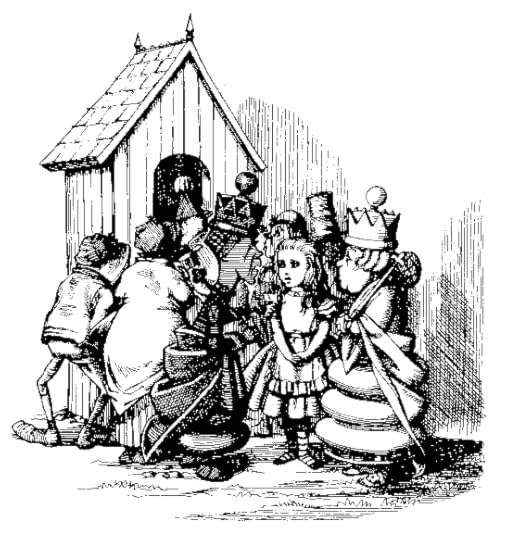
Then Alice encounters the Red Queen and the White Queen standing in a queue with all and sundry.
Alice joins the end of the queue and is told by the Red Queen that “a queue is always followed by you!”
And then, “Always remember, child. Dot your i’s and cross your t’s, mind your p’s and q’s, and the other letters’ll take care of themselves!”
Off to the King’s Head
Next, Alice is off to the King’s Head for lunch where she peruses the menu, not realising that the stains are meant as samples.
The waiter is a Frog, and Alice sits next to a Rattle-Snake who’s been waiting weeks for the delivery of his oysters.
Swan Songs and Capital Tea
Alice orders a swan pie, but changes her mind when the swan selected for her meal sings its swan song.
She orders a cup of tea, which proves to be capital Tea.
Noting the connection with letters that her day has had, Alice remarks, “It’s a pity my adventures aren’t all written down in a book, for then I could turn back the pages and make certain of it...still, it seems to me as if I’ve been travelling through the Alphabet...”
Adair Lacks Sufficient Flair
Little does she know her adventures have been written down - by Adair!
And that’s pretty much how it ends! I was left with a sense of deflation, like when you return to your favourite restaurant only to find that the owner, the chef and the head waiter have all moved on. The fit out is still the same, but everything else has changed.
Competence and imagination are still apparent, but not as much flair, and sadly, another five star restaurant has reverted to three.
This ‘third adventure’ is as witty and warm as Carroll’s own stories, perhaps even more so since the emphasis is largely on wordplay, puns and sheer delight in the magic of language. Adair doesn’t parody Carroll, merely imitate his creations in his own unique style, making the settings a tad more modern, but still firmly ensconced in the 19thC. Fresh from reading the two originals, I can safely say this holds up as brilliant and funny, paving the way for the author’s later translation of Perec’s lipogram A Void.
I am a tremendous fan of Lewis Carroll's works, and when I happened upon this book in a used book shop one day, I couldn't resist.
There is much here that is quite in line with Carroll's original stories. The style of writing is quite accurate, and Alice's character seems appropriate. Yet it misses somehow, and I'm not quite sure where or why. Perhaps there seems to be a lack of adventurousness in this Alice, or that she seems a little too bold, rather than curious.
I suspect that I will read this book again, but I am certainly happy to have it on my shelf along with a variety of other 'Alice' books.
(The illustrations by Jenny Thorne seem like authentic John Tenniel drawings!)
This charming book is true to the tone and feel of the original two books. The characterization of Alice rings true, the story in engaging, and the author adds a humor that is all his own, while always being careful not to lose that authentic Lewis Carroll atmosphere. The wordplay is delightful, something that Carroll would approve of himself, and the illustrations are perfect. I highly recommend this book -- for yourself and all your kids.
Okay. I know you're going to think I'm lying, but I'm not. I tell you that this is just as excellent as a real Alice book.
My copy, inscription (in my grandmother's hand): "To: C, (underlined), from Grandma and Grandpa Taylor. Dec. 27 1990. Now that your tonsils are out I know you will be much better and not get so many sore throats. Get better soon. We love you very much."
Alice Through the Needle's Eye is one of those books that is essentially a published fanfiction, being a retelling or sequel of a classic public domain story. A third Alice book written over a century after the originals sounds like a recipe for disappointment, but I'm glad I was intrigued enough by this idea to try it out because Alice Through the Needle's Eye truly is in the spirit of Carroll's immortal classic!
Adair's Alice feels just like she should. She has a rational yet imaginative mind, and retains her occasional heedlessness and boundless curiosity. The decision to include illustrations and to make them integral to the text was a great one. Adair seemed to remember that these were children's books, and doesn't spoil the magic by pandering to an older demographic by making it "adult". This has been done ad nauseum in modern Alice adaptations so I was relieved that Adair stayed true to the real Alice instead. The pictures pay tribute to the iconic Tenniel art very well, although there are a couple of poses that appear to be copied directly from originals.
As well-done as this sequel is, it doesn't quite reach the very high bar set by Carroll himself. The story beats of Alice's Adventures in Wonderland(and a few characters) are followed too closely: the Caucus Race/labyrinth races, White Rabbit/Welsh Rabbit, two metamorphosed caterpillars, a climactic courtroom/parliament fight that causes Alice to waken, etc. Through the Looking Glass departs a lot from the first book in terms of structure, so I would have liked more originality like that here. Some characters were also a bit too lucid by Wonderland standards.
Alice Through the Needle's Eye isn't perfect, but it is a surprisingly convincing sequel that recaptures the wordplay, whimsy, and weirdness of Wonderland. Gilbert Adair's love for the Alice books comes through so clearly, and I'm sure he had as much fun writing this as I did reading it!
Thanks to MJ who recommended Gilbert Adair. This is a sequel to Alice's Adventures and Through the Looking Glass, a feat I didn't think anyone could pull off, but Adair does surprisingly well. He's greatly assisted by superb illustrations by Jenny Thorne which could easily have been done by Tenniel. The book is a clever imitation (without wandering into the 'too cute for words' arena) of Carroll's books, both in detail and overall structure. And most enjoyable is the poem at the end wherein the author explains 'How This Book Came to be Written.'
Really cute and it seems to really fit into the Lewis Carrol series. However, while I enjoyed it while I read it (I was a teenager) I can't for the life of me remember it, unlike the other two original books.
Really cute and recommend if you are Alice. Also fun for nostalgia's sake. But it didnt stand the test of time for me.
This book is a relatively fun read if you enjoyed books like Lewis Carol's original Alice in Wonderland or Norton Juster's The Phantom Tollbooth. Be prepared for a lot of nonsensical adventure, much wordplay, and an absolutely enjoyable way to while away the hours.
Very much like the original Alice In Wonderland series. The play on words is interesting and catchy. Not a very long book, probably good for readers who need something short to catch their attention.
Adair seemed to be trying too hard to capture the Carrollian style. The characters are dull and unlovable, most of the puns are not at all clever, and a lot of concepts are recycled. Only a couple of witty puns to be found throughout the book.
No ma ei tea... Kui Carrolli Alice'i-lood saavad mult kõhklematult maksimumpunktid ("Peegel" võimalusel rohkemgi), siis see nõelasilmajutt jättis mind küll ükskõikseks. Selline punnitatud "järg". Kahju. :(
Well I think it fits very well. I think Mr Adair has done the best you could expect anyone to do, really! It's an impossible task to please everyone when you're tacking on a sequel to such a beloved series.
One of the problems I think other readers might have with this book is that it's less possessed of Carroll's trademark whimsy. "Wonderland" and "Through the Looking Glass" have a very particular tone which is probably impossible to capture unless you're Carroll himself. But Mr Adair does his very best and gets pretty close. Possibly the only character that would blend in entirely unnoticed (which, considering the nature of this "series", seems an odd requirement) with the Red Queen, the Caterpillar, the Cheshire Cat and the Mad Hatter's crew is Adair's Grampus, but the rest of them are quite good enough for me.
There's a lot less whimsy and a lot more cleverness. In some ways it more closely resembles Norton Juster's "The Phantom Tollbooth" than anything by Carroll but why would I object to that? I love that book just as much as I loved either of the "Alice"s.
I think what might have made this a definite miss for me is if Adair's Alice was clearly someone other than Carroll's Alice, but she isn't at all. She sounds and acts like the same person, perhaps a little older? But then she was a little older in "Through the Looking Glass" than she was in "Wonderland", so I still don't complain.
I enjoyed it very much and I can't see how I would find fault with this book other than by setting standards for it that no-one could meet. Not a perfect 5, but I will re-read it. I think you might frown at needing to read the first two to "get" it, but that's how it is with a series, isn't it?
I had first heard of this in an essay, which I think was about Oz. I didn't think of looking for it until recently, however. I'm not opposed to sequels by other hands, as I'm sure you can tell from my take on the post-Baum Oz books. I'm generally more concerned with whether the later author respects the original than whether they imitate the style, although one doesn't preclude the other. Adair does try to copy Lewis Carroll in many ways, both in structure and wording, bringing Alice into a strange land through unusual means, taking her through a series of adventures with constant wordplay and sudden changes of scenery, and having her wake up at the end. As per the title, she's transported through the eye of a needle, which she's trying to thread to make a jacket for her cat Dinah. There's a running alphabet theme that Alice discovers, starting with an A-stack and a swarm of bees, and ending with a Parliament meeting of all the letters. She sees a rain of cats and dogs, and encounters an Italian hairdresser who speaks in italics, and a Grampus who constantly reads from his own autobiography to find out what's going to happen next. Some of the events are specifically crafted after ones from Carroll: a Welsh Rabbit instead of a Mock Turtle; a race involving Running a Temperature, Jumping to Conclusions, and Skipping the Difficult Passages instead of a caucus-race; and the Parliament meeting that dissolves into chaos like the Knave of Hearts' trial or Alice's coronation party. There are more storybook characters with the Country Mouse and Jack and Jill. The Red and White Queens reappear to wait with Alice in a seemingly endless queue. And there are plenty of nonsense songs, although I don't know that any of them are parodies like most of Carroll's. In some ways, the wordplay seems even more frequent and to always build on itself more than in the originals. So maybe the issue is that Adair might have tried too hard, but that's not really a fair complaint. I did enjoy reading the book, and illustrator Jenny Thorne does a good imitation of Tenniel.
When I read something like this, I marvel at how exquisite Lewis Carroll's originals were. I suppose it's easier to transform Alice into another medium (opera, film, painting) rather than try to replicate the will-o-the-wisp genius of those first two books. Gilbert Adair does a fair job, but I end up being disappointed at times by how similar it is, and at other times by how dissimilar it is--you can't win for trying. Some of the conceptions didn't seem quite right, to me, and I think he's better with wordplay than with characterization: most of his puns worked, but none of the new introductions had anywhere near half the panache of even a minor original character.
So worth reading if you're curious, but I was never in a place where I felt "golly, I can't wait to return to this book because I'm enjoying it so much," that never happened.
(I feel much the same reading other Carroll works--Sylvie and Bruno aren't a match for the Alice books, not by a long shot).
(Note: 5 stars = amazing, wonderful, 4 = very good book, 3 = decent read, 2 = disappointing, 1 = awful, just awful. I'm fairly good at picking for myself so end up with a lot of 4s).
I wish spin-offs were like this more often, striving to capture the original author's style as if they wrote another book. It's more interesting than making everything "with a twist" which always just means adding romance or dumbing down the writing.
This is especially true with Alice in Wonderland, where the edgy Hot Topic aesthetic is more cool than the original books. This isn't always wrong, but it can be depressing when everything old fashioned or out of the ordinary is portrayed as "creepy" and this image egotistically obscures the original point. It all goes back to not being able to see anything for itself, only a mirror of some perceived impressive self image.
Anyway, this book captures the spirit of the originals, and the review saying Lewis Carroll was obviously much more clever is slightly stuck up. There was lots of clever wordplay and, I think it was as similar as you can get within reason. (I say this as someone who read the originals four times, if my opinion has any weight, although I'm sure you could nitpick it).
I'd like to try imitating a style in a similar way someday.
Overall, a diverting bedtime story. Where you might get mightily lost in the original duology and vibrant Disney film, this reads less like a worthy successor and more like a valiant side-quest. Ample punning propels our precocious protagonist into petty arguments with pompous anthropomorphized plot devices in the form of rude, irreverent mammals and one pesky spelling bee with a bothersome buzz. The author's penchant for drawling upon devious whimsy wearied me by and by, though the pages flowed by like a burbling river, making up with playful banter what they lacked in thrilling escapades. Intricate illustrations enlivened the self-aware narrative. Typological tricks tickled the metafictional sensory organ. This book is well-endowed with wit but wanting in adventure. You can tumble through a needle's eye, into the lumpy hairstyle of an angry haystack, but you will be hard-pressed to find more elegant claptrap in the dusty, barren annals of classical fan fictions that are remotely readable. I do wonder how much of the original's laurels rest on accumulated nostalgic sediment, or sentimental zeitgeist.
Ever wanted to go into yet another adventure with Alice? Now you can with this book! The author made an amazing job of copying the whimsical worlds of Carroll.
The story feels magical and nonsensical. You meet new interesting characters and get to revisit some old ones too. The illustrator Jenny Thorne did a tremendous job on imitating Tenniel's style so that the illustrations match the other books.
This was carefully studied, developed and crafted to follow Carroll's writing and style, and I believe they did an excellent job in doing so. You can tell they really tried on making a "third" installment, and I enjoyed it a lot.
Go through the needle's eye, follow the alphabet, and go along with Alice for another adventure once again!
This book suffers from the problem of all serious fan fiction: the need to stay within the bounds of the original canon. It is a literary form that requires competence but does not allow genius. To be an Alice writer is much more limiting than to be Lewis Carroll. Thus, there is nothing in Needle that wasn't in the original two books. The rudeness, strangeness and eccentricity are a source of constraint, not freedom.
This is a fun tribute to Lewis Carroll's Alice books. While trying to thread her needle, Alice falls through its eye and into a frustrating but magical world. There's lots of plays on words & the alphabet too. Wonderland-worthy characters introduced and a couple old friends show up. The illustrations look just like Tenniel's & the effort in that is impressive. Unfortunately the magical world doesn't feel as rich or as deep as the ones that Carroll built. I also felt like instead of having a purpose (like reaching the eighth square in Looking Glass) Alice just wanders around aimlessly. I enjoyed this book but it's missing something for me. Nice addition to my Alice collection nonetheless.
This book really lives up to Alice in Wonderland. The whimsicalness and nonsense and wordplay screamed Lewis Carroll. Even the illustrations were the exact style of the original books. I highly, highly recommend picking this up if you're a big Alice fan. You wont regret it!
Not bad . The outstanding thing about this dream/adventure is that Alice doesn't have to eat , drink or toke anything to increase the excitement of her journey . A clever penultimate ending .
I liked it more than Alice through the Looking-Glass. The idea of the letters of the alphabet having a war was cool. Some of the side characters were interesting I suppose.
This curious sequel to Lewis Carroll’s classics, Alice’s Adventures in Wonderland, and Through the Looking-Glass and What Alice Found There was written in the 1980s by Scottish novelist Gilbert Adair. He mimics Carroll’s whimsical style with mixed results.
You don’t ever forget that this isn’t written by Lewis Carroll, but the effort is clearly there. It also features illustrations by Jenny Thorne, who does a good job of copying the distinctive style of Sir John Tenniel. If I had gotten my hands on this book as a little girl, when I first read the original Alice books, I would probably have loved it.
It opens with Alice sitting by the fireplace with her cat, Dinah, attempting to thread a needle. She peers into the eye of the needle and sees a beautiful countryside, and the next thing she knows she’s falling into it. She lands in a haystack where a country mouse mistakes her for Haley’s Comet.
After that, Alice meets a “Siamese twin” cat - two cats connected at the tail - a whale professor (Grampus) who has written his own autobiography in advance and is obsessed with living what he wrote down, Jack and Jill as stick-figures, and more.
Oh, also, the world she finds herself in is Alphabet-themed. It's cute and perhaps a good pick for the young Alice-fan in your life.
This new adventure for Lewis Carroll's Alice finds her in another strange dream, this one influenced by the alphabet. It's got quite a few grins and laughs in it. I enjoyed it as a kid, and I enjoyed rereading it.