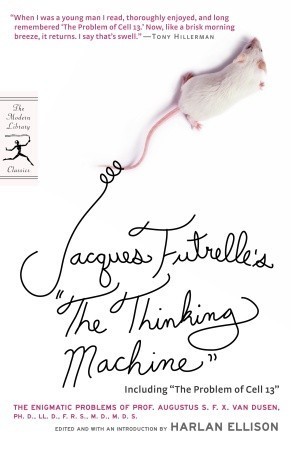
This irascible genius, this diminutive egghead scientist, known to the world as “The Thinking Machine,” is no less than the newly rediscovered literary link between Sherlock Holmes and Nero Professor Augustus S. F. X. Van Dusen, who—with only the power of ratiocination—unravels problems of outrageous criminous activity in dazzlingly impossible settings. He can escape from the inescapable death-row “Cell 13.” He can fathom why the young woman chopped off her own finger. He can solve the anomaly of the phone that could not speak. These twenty-three Edwardian-era adventures prove (as The Thinking Machine reiterates) that “two and two make four, not sometimes, but all the time.”
Jacques Heath Futrelle (1875-1912) was an American journalist and mystery writer. He is best known for writing short detective stories featuring the "Thinking Machine", Professor Augustus S. F. X. Van Dusen. He worked for the Atlanta Journal, where he began their sports section; the New York Herald; the Boston Post; and the Boston American. In 1905, his Thinking Machine character first appeared in a serialized version of The Problem of Cell 13. In 1895, he married fellow writer Lily May Peel, with whom he had two children. While returning from Europe aboard the RMS Titanic, Futrelle, a first-cabin passenger, refused to board a lifeboat insisting his wife board instead. He perished in the Atlantic. His works include: The Chase of the Golden Plate (1906), The Simple Case of Susan (1908), The Thinking Machine on the Case (1908), The Diamond Master (1909), Elusive Isabel (1909), The High Hand (1911), My Lady's Garter (1912), Blind Man's Bluff (1914).
Van Dusen (el personaje creado por Jacques Futrelle) es encerrado voluntariamente en una prisión de máxima seguridad por una apuesta. Él piensa que, cualquiera que sea capaz de usar el cerebro de forma adecuada, podrá salir de la cárcel. El personaje de Van Dusen es muy interesante. Se le llama "La máquina pensante". Es cierto que la resolución es un poco inverosímil, pero posible, al fina y al cabo.
-----------------------
Van Dusen (the character created by Jacques Futrelle) is voluntarily locked up in a maximum security prison for a bet. He thinks that, whoever is able to use his brain properly, will be able to get out of prison. Van Dusen's character is very interesting. He is called "The Thinking Machine". Admittedly, the resolution is a bit far-fetched, but possible after all.
I have started my reading for the New Year with a classic golden age mystery short story, featuring Augustus Van Dusen, who is known as The Thinking Machine. It was authored by Jacques Futrelle, who unfortunately went down on the Titanic, and whose plots were cleverly written and kept the reader guessing.
The Thinking Machine was a brilliant scholar who was a logician and whose proposition was that all things that start must go somewhere and brought his mental superiority to bear on a specific problem. There is no crime involved in this story but rather a bet with fellow professors that Van Dusen cannot escape from a cell in a secure prison. Of course, he accepts.
All possible precautions are taken to ensure that there is no logical way he can escape. But the reader knows that he will..................but how? That is the beauty of this story as we are given hints but don't know that they are hints. It is a true joy and is recommended.
That was quick and light, the mystery was good but I was a bit disappointed in the ned, I thought it would be something really awesome.
Two scientists had a bet, can one of them get out of a highly secured prison within a week, knowing that he would be treated the same way a sentenced to death guy is.
This is a little description: "...Chisholm Prison was a great, spreading structure of granite, four stories in all, which stood in the center of acres of open space. It was surrounded by a wall of solid masonry eighteen feet high, and so smoothly finished inside and out as to offer no foothold to a climber, no matter how expert. Atop of this fence, as a further precaution, was a five-foot fence of steel rods, each terminating in a keen point. This fence in itself marked an absolute deadline between freedom and imprisonment, for, even if a man escaped from his cell, it would seem impossible for him to pass the wall. The yard, which on all sides of the prison building was twenty-five feet wide, that being the distance from the building to the wall, was by day an exercise ground for those prisoners to whom was granted the boon of occasional semi-liberty. But that was not for those in Cell 13. At all times of the day there were armed guards in the yard, four of them, one patrolling each side of the prison building. By night the yard was almost as brilliantly lighted as by day. On each of the four sides was a great arc light which rose above the prison wall and gave to the guards a clear sight. The lights, too, brightly illuminated the spiked top of the wall. The wires which fed the arc lights ran up the side of the prison building on insulators and from the top story led out to the poles supporting the arc lights..."
A fun, though very uneven collection of The Thinking Machine stories. A character that almost, but didn't quite make it to top. The character's most famous story, The Problem of Cell 13 is a bona fide classic, but the other stories just don't quite have it.
Large compilation of short stories all featuring the Thinking Machine, Professor Van Dusen.
The good: Some creative locked room mysteries, some ingenious solutions, little historical gems that were just 'life as we knew it' when written, but strike the modern reader as so different. (like the 'automobile helmets' the young ladies wear when driving in that fast modern car!)
The bad: Wow, an escaped orangutan that kidnaps a baby? Really? Sometimes the solutions to these mysteries are chosen more for their effect than because they would really make any sense. Large plot holes now and then. And several stereotypes that were accepted then, but not any more!
The annoying: Apparently this is from several books or collections of his stories, because Van Dusen is introduced, including the whole story of how he got his name, his peculiar looks, etc, etc, several times in here, at least 10. That got old. I remember from the last time! But that couldn't be helped, really, without really editing the stories from the way they were written. But would it have been so hard to put the stories in chronological order? That was just sloppy. He refers to this case involving a cockatoo that related to his current mystery, but that story wasn't in the collection until much later. No reason they couldn't have fixed that.
In short, I got this one for the Kindle for 99 cents. I wouldn't have paid much more than that, but since these are out of print and I liked the ones I have read, I thought it would be worth a dollar to give it a try. I'm glad I did - it was fun. I like the old-fashioned feel to the stories, like their complete horror at discovering the three or four day old dead body of a murdered young woman. Now a cop, even a rookie, wouldn't even flinch. Times have changed. But sometimes the dated feel made the stories clunky. The writing was still fresh, though, if not brilliant, and the stories themselves were easy to read. I really liked the one where his wife wrote the first half and challenged him to come up with a solution. Fun stuff.
AROUND THE WORLD OF CRIME AND MYSTERY 1905: The fame of this short story is a puzzle in and of itself: What's the big deal?* Why has this story appeared in so many anthologies since 1907, even "The Best American Mystery Stories of the Century" edited by Tony Hillerman. CAST - 3 stars: OK, but "The Thinking Machine" is rather lightly characterized here. ATMOSPHERE - 2: A bit dry. CRIME-3: A man says he'll be able to break out of a prison in 7 days. He is thus imprisoned. A conventional crime, a prison break. INVESTIGATION-3: Our prisoner studies his environment carefully, the interior of his cell, the exterior through a small window. Mechanical, but the reader is pulled along in different directions. SOLUTION-3: Conveniently, the prison has recently updated its plumbing system but has left the old system intact. Why not at least block it up? Conveniently, wiring for the prison's electrical system is just a few feet outside of the prisoner's window. And, most conveniently, untrained rats do exactly what the prisoner hopes they will do. One might think about Micheal Jackson's "Ben". And...well, I could go on, but it would spoil the whole thing for you, if you should read it. Personally, I didn't believe any of it. That said, during a second reading I noticed, buried within the unbelievable explanation, a statement by our escapee: "There were two other ways out..." *THERE it is, the real mystery, the one that gets a reader thinking about a plausible escape. SUMMARY: 2.8 stars. What isn't told here is what's best.
For sheer pleasure of a mystery story in the manner of Conan Doyle it delivers gloriously. I am sure such pompous characters as the protagonist in this story are rare and a laughable stock in the literature of our times, but don't we miss their audacity? Don't we miss the self-importance with which they say "My name is Professor Augustus S. F. X. Van Dusen, Ph.D., LL.D., F.R.S., M.D., M.D.S."? Please take note that it's not for comic effect! The dude means it.
Because its a short story (and quite ingenious as far as impossible crime goes) it works best for a quick read. For good effect, follow it with a victorian ghost story or a one by Satyajit Ray or something by Carnacki, or anything set in that world of yore when detectives were sure and content. Take my word. There's no better way to pass a rainy afternoon!
again- another book i picked up through 'league of extraordinary gentlemen'- a sort of bare-bones short story so it was a quick read, but it was engaging. a science-against-humanity sort of thing and although it was a wee far-fetched, it was also a bit surprising and nicely unpredictable.
This collection of seven stories featuring Professor Augustus S.F.X. Van Dusen, "The Thinking Machine," was first published in 1907. The narratives previously appeared in the Boston American newspaper in late 1905. The stories present a bank robbery, a murder that may be suicide, a mysterious amnesiac, a haunted house, and a kidnapping. The book introduces Professor Van Dusen, a consulting detective in the Sherlock Holmes vein, but a unique character, not an homage or pastiche -- he's no Solar Pons. A remorseless logician, Van Dusen is a medical doctor, a lawyer, a scientist, and apparently a dentist as well. He's also managed to escape from prison. Not as well developed a character as Holmes, he serves mainly to facilitate resolving the riddle posed in each account, though with a charming crankiness. Character plays little role in these primarily puzzle stories, in which The Thinking Machine is often aided by reporter Hutchinson Hatch who does most of the legwork, but isn't his biographer. More Archie Goodwin than Dr. Watson. The stories begin promising much, but when solved it's something of a minor let down as when one discovers how a magic trick is done -- "Oh, is that all it is." Still good but somehow the reader is left expecting more. And sometimes, given the almost 120 years since these tales were written, the resolution is not all that mysterious -- we've seen it before. Enjoyable and entertaining, but not fully developed characters or stories. American Jacques Futrelle (of Huguenot extraction) wrote one novel and 47 short stories featuring The Thinking Machine. During his lifetime a second collection of short stories appeared, The Thinking Machine on the Case (1908). With any luck Library of Congress Crime Classics (LCCC) will see fit to issue that volume also. Unfortunately Futrelle died on the Titanic in 1912 after forcing his wife into a lifeboat. Also a writer, she published some of his work posthumously. The LCCC is apparently the American counterpart to the British Library Crime Classics series, both of which are generous in sharing their mystery collections from the olden days. In these stories are such anachronisms as specifying a "gasoline car" (most autos ran on steam then) or an "incandescent light" as opposed to gas, or an easy acceptance of phrenology. [3½★]
A scientist who actually solves impossible crimes using stone cold logic.
Everything that people complain about with Sherlock Holmes--the inconsistency, the lack of fair play--is absent here. The stories are solved using fair, if not obvious, logic. Details are consistent. And yet the reviews for this book are not as glowing, nor the character as beloved, as Holmes.
It's almost as though what people say they want in a Great Detective isn't what they actually want. [Whistles.]
I liked these stories, although they did get repetitive after a while. They are puzzles, not adventures, and don't particularly engage the emotions. A fun point is that these are the type of mysteries that you'd see with Scooby Doo. There's even one with a tricked-up ghost. But the characters here aren't nearly as fun.
Clever, well written, logical. Just not stories to love.
Read if you like Holmes stories. Either you'll appreciate Holmes more, or you'll appreciate the logic here better!
Much clearer, the second time around. This is really quite flawlessly constructed (though it is a bit dry). There is nothing extravagant in it. Many of the locked room mysteries I’ve read seem to have a certain extravagance somewhere or other. This is more apparent in the short stories than in the novels, where the sheer complexity of the plot overwhelms you.
2.5 stars. This collections starts out well, but goes downhill quickly. These are very long stories, and some of them are quite tedious. The last story is quite frankly ridiculous. "The Thinking Machine" himself was also kinda obnoxious, and there was no humor used to balance that out.
I'm glad I read this, but wouldn't read it again, or more of the same with this character.
قصة قصيرة خفيفة في 44 صفحة عن البروفيسور (فان دوسين) الملقب بآلة التفكير الذي يتحدي إثنين من زملاءه أن الإنسان يستطيع فعل أي شئ يريده من خلال العقل والمنطق فقط. فيُسجن البروفيسور طوعاً في زنزانة بسجن مُحكم ومشدد الرقابة، ويُراهن آلة التفكير زملاءه أن بإستطاعته الهروب من هذا السجن خلال أسبوع واحد فقط بدون أي أدوات إلا معجون أسنان و25 دولاراً وتلميع حذائه, فهل يستطيع؟ قصة كلاسيكية طريفة قد يظنها البعض ساذجة ولكنها بالتأكيد كانت عبقرية في عام 1905 -وقت كتابتها-.
كتب قصير و للطيف ممل بعد شئ ولكن قصير لغة ليس بالجيدة الاقتباس الدي اعجبني لا شيء مُستحيل.» هكذا أعلن آلة التفكير في تأكيد مماثل. كان دائمًا يتحدَّث في صرامة، وأضاف: «العقل سيد كل الأشياء. وحين يُقِر العلم إقرارًا تامًّا بهذه الحقيقة، سيتحقَّق تقدم عظيم.»
I remember reading this as a young boy (about 45 years ago) and being so fascinated by Professor Augustus S. F. X. Van Dusen (a.k.a. "The Thinking Machine") and his intellectual abilities. I've always wanted to revisit it and it was fun to do so!
Several 5 star stories, a few 4 star and the rest just 3 star. Those where the author takes the time to construct an exquisite puzzle make it worth the read overall.
it's a fun little book, makes you wonder how he could've done so much out of a five dollar bills, two ten dollar bills, cleaned shoes and something else that i forgot. really fast paced but it's not that big of a deal to be a five stars
First of all, this book is very weirdly titled. The spine and title page have Futrelle's name only as a possessive, not as the actual author - very confusing, since usually when a title gets a possessor like that, it's because the present book or movie or whatever is a derivative work by some other author. Not in this case.
I bought it without ever having heard of Futrelle, Professor Van Dusen, or "Cell 13," simply because there it was and it sounded like it would be fun. It absolutely was. The stories are of uneven quality, but the best ones are delightful and the worst, in their dusty forgottenness, still have a certain charm. (Mostly.) Futrelle is shamelessly jumping on the Sherlock Holmes bandwagon, but he plays up the comic joy of the absurd deductions even more than Doyle ever did. He also has what's absolutely mandatory for writing such stories: a nerdy enthusiasm for his own ridiculous gimmicks and twists. His Holmes, (the Thinking Machine) and his Watson, (Hutchinson Hatch, reporter!) are so self-apparently second-rate creations that they have nothing to apologize for. By the end I was rooting them on whole-heartedly.
The introduction by Harlan Ellison is so outlandishly, pointlessly, willfully obnoxious that it actually ends up being pretty easy to ignore. And ignore it you should.
An outstanding series of mystery-deduction stories. The hero is Professor S.F.X Van Deusen, aka "The Thinking Machine". I first read a book of some of those stories when I was young, and they made a pretty big impression on me. They're extremely clever and unique.
Futrelle himself was an interesting character, not least in the manner of his death: he was on the maiden voyage of the Titanic. With him, when he died, were several manuscripts for Thinking Machine stories - now lost forever, of course.
Jacques Futrelle's official site contains the full text of fifty Thinking Machine stories. I recommend starting with "The Problem of Cell 13". Yes, they're old, but they're really good.
Jacques Futrelle perished aboard the RMS Titanic. He refused to enter a lifeboat, insisting his wife board instead. The last she saw of him he was smoking a cigarette alongside John Jacob Astor IV. Most accounts of the disaster fail to mention him. Too bad. It makes for a far more interesting tale than that of Decaprio and Winslet. He left behind a bunch of interesting tales of detection and logic. My only beef with the book is I don't know who that is on the cover. It bears no resemblance to the title character.
Stories are dated, but the logic in them is fascinating. Could have been a lot more stories if the author hadn't gone down on the Titanic. Still worth reading, highly recommended.