Jump to ratings and reviews
Rate this book

Lyonesse #2

The Green Pearl

Rate this book
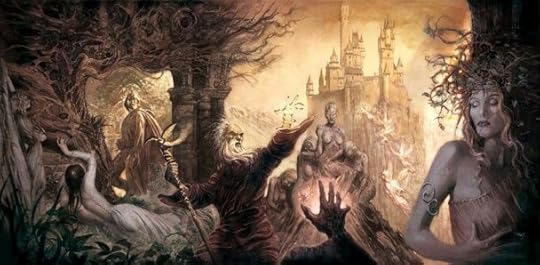
In the second volume of the Lyonesse trilogy, new threads are woven into the epic tapestry begun in Suldrun's Garden. While war rages across the Elder Isles, King Aillas's true love, Glyneth, is carried off to a parallel world by an amoral magician in the pay of the wicked King Casmir. Meanwhile, a sorceress's malice, condensed into a green pearl, passes from hand to hand bringing poignant misery to whomever it touches. Jack Vance conjures up a tale of war and politics, magic and derring-do, presented in the inimitable style that has made him one of fantasy's acknowledged grandmasters. - Matt Hughes

The Green Pearl is Book II of the Lyonesse series, and Volume 53 of the Spatterlight Press Signature Series. Released in the centenary of the author's birth, this handsome new collection is based upon the prestigious Vance Integral Edition. Select volumes enjoy up-to-date maps, and many are graced with freshly-written forewords contributed by a distinguished group of authors. Each book bears a facsimile of the author's signature and a previously-unpublished photograph, chosen from family archives for the period the book was written. These unique features will be appreciated by all, from seasoned Vance collector to new reader sampling the spectrum of this author's influential work for the first time.

- John Vance II

428 pages, Paperback

First published January 1, 1985

76 people are currently reading
1957 people want to read

About the author

Jack Vance

776 books1,583 followers
Aka John Holbrook Vance, Peter Held, John Holbrook, Ellery Queen, John van See, Alan Wade.

The author was born in 1916 and educated at the University of California, first as a mining engineer, then majoring in physics and finally in journalism. During the 1940s and 1950s, he contributed widely to science fiction and fantasy magazines. His first novel, The Dying Earth , was published in 1950 to great acclaim. He won both of science fiction's most coveted trophies, the Hugo and Nebula awards. He also won an Edgar Award for his mystery novel The Man in the Cage . He lived in Oakland, California in a house he designed.

Ratings & Reviews

What do you think?
Rate this book

Friends & Following

Create a free account to discover what your friends think of this book!

Community Reviews

5 stars
1,257 (41%)
4 stars
1,187 (38%)
3 stars
505 (16%)
2 stars
83 (2%)
1 star
20 (<1%)
Displaying 1 - 30 of 182 reviews
Profile Image for Tharindu Dissanayake.
309 reviews977 followers
July 25, 2022
"I'm a vagabond poet; I wander where the wind blows me."

"Twitten's Post is all the rage."

Review of Book 1: Suldrun's Garden

"Celts think only of drinking mead and stealing each other's cattle: this is the basis of their economy."
"Never steal or rob objects or value, especially if they are green!"

Jack Vance is a genius of many traits when it comes to writing fantasy: this series keeps getting better, growing in complexity as always, but with no lack of quality humor. I've linked my review of the first book above, so that praise wouldn't come as an exact duplicate, but that was exactly what this book delivered. Amazing world building, highly colorful and entertaining characters submerged in one of the most immersive plots of all time.

"When terriers bark, one may ignore them. When the old hound bays, then one leaps for his weapons."

While this second book (obviously) being a continuation of the Suldrun's garden, with all (still alive) characters making frequent appearances, it is not altogether impossible to view The Green Pearl as a standalone. You still get brief introductions to each and every character whether they appeared in first book or not, enabling both old and new readers alike to enjoy the book with little effort. However, the ending here is a lot more open-ended, giving that feeling of insufficient closure (at least until one gets her or his hands on the next book, which I promptly did).

"The staid stark stupid truth carries more conviction than the most entrancing falsehoods, even though the latter sometimes receive more currency."

Looking forward to a solid ending to the series in Madouc.

"MY FRIENDS ARE FAIR; MY GOODS ARE OFTEN REMARKABLE! No GUARENTIES; No RETURNS; No REFUNDS"
Profile Image for Krell75.
432 reviews84 followers
November 6, 2024
Mi perdo sognando,
tra reami d'incanto e torri d'alabastro.
Tra Maghi e cavalieri, tradimenti e fughe.
Nei mondi di Vance, dove sogno e incubo,
convivono e si uniscono.

E' indubbio che quando inizio un nuovo romanzo di Jack Vance so già cosa aspettarmi e difficilmente ne rimango deluso. Questo secondo romanzo della trilogia di Lyonesse si pone sugli stessi livelli di intrattenimento, divertimento e buona scrittura.

Più strutturato nella trama del precedente romanzo segue diversi capovolgimenti di fronte pur mantenendo ancora il principe Aillas del Troicinet come figura centrale su cui ruotano gran parte delle vicende narrate.
Non mancano personaggi secondari di spessore, le cui vicende corrono parallele al protagonista, risultando allo stesso modo avvincenti.
Avventura, viaggi, rapimenti, duelli, magie favolose, oggetti straordinari e creature magiche, non manca nulla dell'immaginario classico fantasy, ma sempre evidenziati dal marchio di fabbrica di Vance dove il bizzarro permea tutto.
Mi ricorda le atmosfere del romanzo "The Princess Bride" da cui è stato tratto il meraviglioso film "la Storia Fantastica" del 1987 ma qui decantate all'ennesima potenza.

Vance è solito utilizzare per i suoi personaggi esponenti dell'aristocrazia, mettendone bene in evidenza i lati peggiori: avarizia e opulenza, decadenza e brama di potere, vizi peccaminosi e inenarrabili.
Da segnalare i dialoghi sopraffini e arguti di questi nobili pomposi e viziati accompagnati dai loro modi impeccabili da gentiluomini di vecchia data. I sogni convivono con gli incubi, e sono sempre gli uomini a crearli.

Impossibile non consigliarlo, seppur nelle pagine finali tenda ad essere troppo prolisso di avvenimenti e sembra non voglia concludersi mai.

----------------------------
I get lost dreaming,
between enchanting realms and alabaster towers.
Between wizards and knights, betrayals and escapes.
In the worlds of Vance, where dream and nightmare,
they coexist and unite.

There is no doubt that when I start a new Jack Vance novel I already know what to expect and I am unlikely to be disappointed. This second novel in the Lyonesse trilogy is on the same levels of entertainment, fun and good writing.

More structured in the plot than the previous novel, it follows several reversals while still maintaining Prince Aillas of Troicinet as the central figure on which most of the narrated events revolve.
There is no shortage of important secondary characters, whose stories run parallel to the protagonist, proving equally compelling.
Adventure, travel, kidnappings, duels, fabulous magic, extraordinary objects and magical creatures, nothing is missing from the classic fantasy imagery, but always highlighted by Vance's trademark where the bizarre permeates everything.
It reminds me of the atmosphere of the novel "The Princess Bride" from which the wonderful 1987 film "La Storia Fantastica" was based but here extolled to the nth degree.

Vance usually uses exponents of the aristocracy for his characters, highlighting their worst sides: avarice and opulence, decadence and lust for power, sinful and unspeakable vices.
Of note are the refined and witty dialogues of these pompous and spoiled nobles accompanied by their impeccable manners as old-time gentlemen. Dreams coexist with nightmares, and it is always men who create them.

It's impossible not to recommend it, even though in the final pages it tends to be too verbose with events and never seems to want to end.
Profile Image for Lyn.
2,009 reviews17.6k followers
March 26, 2016
Damn it, Jack Vance!

Your 1983 Lyonesse novel Suldrun's Garden was a mix match of good, bad and ugly but good enough to leave me curious about the next book.

The 1985 sequel The Green Pearl was better – more of a linear narrative and more focused – but it was still not what it could have been. Cool fantasy, mixing legendary city names like Ys and Avalon and creating the Elder Isles just south of Cornwall and west of Gaul, with historic and mythical references, but just too … something! Or not enough something!

Damn it!

I thought the coolest element and one that did not get enough ink was the Ska, a racially pure breed from ancient Norway and then Ireland whose heritage is traced back to before the last ice age, thousands of years.

Good fantasy, excellent world building and yes, God help me, I will no doubt read the last of the trilogy, Madouc.

description
Profile Image for Jaro.
278 reviews31 followers
March 21, 2018
This is my favorite of the Lyonesse books, and probably my favorite thing in the world. Like Twitten's Almanac it is a work of great complexity and inner coherence. Like Melancthes precious and remarkable flowers it is an exquisite work of startling distinction that exudes a multitude of strange and fascinating odors, each purporting entire cascades of meaning, and meanings of meanings, and each bringing various and surprising dreams, some of which exceed the limits of imagination.

Profile Image for Bradley.
Author 9 books4,865 followers
February 9, 2017
And now that we've entered firmly into the mid-eighties Fantasy, I'm startled by just how much a giant like Vance was either influenced by or was the influencer of such notable works as many, many of the D&D compendiums. After all, hasn't he been around so much longer? Ah, but never mind that.

What we've got is not dwarves and elves in a fantastic other-realm, but a continuation of the Gaelic isles, the Elder Realm, the lost continent near Avalon, with christian priests still blackmailing, kingdoms still plotting, and parentages still not known to all the pertinent peoples.

The plots are delightful and adventuresome, when they're not political and crafty, and when they're not adventuresome, they're still magical (Ten Realms, so much so,) and full of confidence games, tricksters, and Fae. And even kings play these same games.

Most impressively, at least for me, is the clever and clear and pertinent retellings of old fairy tales, yet again, including the redoubtable Green Pearl that enhances greed and bad luck, various old tales of mistaken identities, and yeah, I'm looking at you, Murgen, and so many other interspersed tales that I cannot even begin to crow about, because they should all be savored and enjoyed.

This may take place hundreds of years before Arthur, but it is no less delightful or lacking in any way when it comes to the sheer weight of myth, great characters, and sheer enjoyment.

Anyone looking for some great fantasy?
Profile Image for J.G. Keely.
546 reviews12.7k followers
June 17, 2015
The first volume in Vance's Lyonesse trilogy felt like such a departure for the author--not that it didn't have his characteristic wit and oddness, but I really felt it was one of the first times that I was invited to feel for his characters. His usual fare is light and disconnected, skipping across the surface without taking time to reflect. His characters are often clowns, comically suffering for their own errors and bruised egos, motivated by base urges, like spite and greed, and lacking more personal depth--yet I found Suldrun's subtle sense of alienation and melancholy to be vastly more intriguing than all of Cugel's adventures in Dying Earth, no matter how wacky they became.

Which is why it was a disappointment that this second volume returns to more of the same from Vance: largely episodic picaresque scenes. And yet, unlike the more silly and freewheeling style of Dying Earth, here his silliness is at constant odds with his larger, more serious plot of war and politics and betrayal.

The explanations of politics and history fall particularly flat, trying to drum up some interest in the intrigue and battle which would be better served by personal connections from the characters through whom we experience the tale--as opposed to references to (thankfully brief) appendices and lengthy descriptions of architecture and food.

He gets caught up in these explanations and descriptions, in reminding us of where we are, what's going on, and what the characters' motivations are. These are central aspects of the story, so the fact that he feels that he has to keep restating them just highlights the fact that he's struggling with focus, structure, and pacing in a longer, more interconnected story.

These explanations extend to the characters--we're often being told why they do what they do, and it's not just that we're in their heads, but that Vance seems concerned with making them transparent to us. It’s not really an effective use of words to sit and tell us why the characters do everything. The reader should be able to figure that out from the behavior and details, from how they are presented. If it isn’t clear from how it’s presented, then you don’t really gain anything by sitting down and telling us.

It’s also a denial of the reader’s act of interpretation, that instead of looking at the character and trying to figure them out, to read them, we are instead told what ‘the truth’ of it is. This doesn’t mean we should never get into the characters’ heads, but what makes a character intriguing is to see their conflicts, and the gradual progression of those conflicts, which eventually lead to a point of climax, where we see that conflict come to some kind of fruition. Of course, these conflicts should also relate to the character’s outer life--the problems they have to face should reveal those internal conflicts, and force the characters to come to terms with them.

During one section, Aillas knows there is a spy in his midst, but doesn’t know who it is. So, he goes on to mention several times that he’s concerned that there’s a spy, and that he wonders who it might be. As readers, of course we’re curious, but it’s just redundant to have the character keep mentioning it in the same way without any kind of progression or fresh view on the subject.

Certainly, sometimes a writer has to remind their reader of a fact, to catch them up, and it's admittedly always a challenge to find a way to do this without being obtrusive or repetitive, and to find a balance between too much explanation and not enough--but that's what sets an author of skill apart.

In the first book, Vance managed to do a better job giving us Suldrun's and Aillas' internal conflicts without overstating them, and letting them develop naturally, over the course of the book--and besides Suldrun and Aillas, we also had the strange intertwinings of Faude Carfilhiot and Melancthe, these figures trying to discover their own identity, at once competent but unfulfilled, literal half-creatures searching for wholeness.

In The Green Pearl, there is a similar relationship between Melancthe and Shimrod, but we really only get one side of the story. We see Shimrod's pining after her, his attempts to romance her, his thoughts and desires, but not hers. She is meant to be a mystery, and we do get some explanations for why she behaves the way she does, but by and large, she serves mainly as a motivation and foil for Shimrod's romantic intentions, the source of his desires and frustrations--which is unfortunate, since she seems to be a much more interesting character, with more intriguing motivations.

That Vance faltered here may be because the emotional depth he's dealing with isn't as intense as the star-crossed romance in the first book--and also because a star-crossed romance is much easier to get your head around, rather than the existential struggle with identity that Melancthe and Shimrod go through as magical creatures.

Vance’s villains also tend to be more interesting than his heroes, not an uncommon trait in writers, because villains are, overall, given more free reign in terms of behavior and personality. This being said, they are still rather flat, often acting out of malice and spite instead of more complex internal motivations. It's more that they have more vigor, that they are more demonstrable in their personalities because they are given freer reign.

All in all, it shouldn't be surprising that Vance should struggle somewhat with this series. Here is an author who tends to prefer silly, amoral heroes motivated by greed and self-preservation now trying to produce characters of depth and pathos, who prefers episodic, humorous, unstructured stories but is now trying to relate a long-running, large scale political conflict, who tends to tell stories about character faltering and ultimately failing, now trying to depict a rise to power, who usually portrays sex as a lewd joke, but is now trying to capture deeper romantic feelings.

It's all outside of his comfort zone--which is why the true surprise is that he did so well with this experiment in the first book. Then again, the second volume in a trilogy is notorious for lagging and struggling along between the promise of the opening and the excitement of the climax. I'm still intrigued to see where this experiment ultimately ends up.
Profile Image for Algernon.
1,839 reviews1,163 followers
April 5, 2015

HERE ARE THE PREMISES
OF THE NOTABLE AND SINGULAR
ZUCK
DEALER IN OBJECTS UNIQUE UNDER THE FIRMAMENT
MY PRICES ARE FAIR!
MY GOODS ARE OFTEN REMARKABLE!
No guarantees! No returns! No refunds!

Welcome back to the Elder Isles, the fantastic realm of warring kingdoms and powerful wizards, beautiful maidens and fickle faery folks, where druids fight against Norse raiders and Arthurian Knights cross paths with early Christian pilgrims and with the last survivors of Atlantis. Get ready for adventure, for bloodshed and romance, for alternative universes that can be reached through magical portals and for grotesque creatures unseen anywhere else except from the pen of the master of ceremonies : Jack Vance, who really lets his imagination fly all over the map and for whom one universe, one planet is never enough.

As in the first volume of the Lyonesse epic, these flights of fancy can get overwhelming and just one step away from self-indulgence. The plot and the wanderings of the main actors are even more pointless and leisurely than in Suldrun’s Garden. By the end of the novel, Vance does a decent job of tying up the many loose ends, but it felt a bit rushed after all the build-up, and many questions and resolutions are left for the last part of the trilogy. Green Pearl is a fine example of the “the journey is more interesting than the destination” school of adventure.

Having made my complaints, you can probably understand why the plot is difficult to reduce to a few lines of synopsis, and still make sense. I must also be careful to avoid spoilers. The most important aspect I think readers need to be aware of is that the Lyonesse books are not standalones, they are just three episodes of one huge story that got too big to be published in one single novel ( not unlike Lord of the Rings). So, if you haven’t already done so, pick up Suldrun’s Garden and get busy getting familiar with the Elder Isles and with their ten competing kingdoms, with the Forest of Tantrevalles where each tree, each meadow and each creature you meet is brimming with magic and mystery and danger. Boiled down to its most simple building bricks: there’s an ambitious king in the town of Lyonesse (Casmir) who plots to reunite all ten kingdoms under his rule, and he is prepared to break every rule of decency and morality to achieve his goal. His opponent is the young King Aillas, who is as lawful and honorable as Casmir is dastardly. Casmir is allied with a couple of wizards (Tamurello and Vishbume) while Aillas has on his side the powerful archmage Murgen and his disciple Shimrod.

The ladies are as strong and interesting as the men: Melancthe – the Galateea created by the witch Desmei as a revenge against men, unbearably beautiful but completely devoid of emotions; Tatzel - the warrior princess of the Ska raiders, proud and merciless with both her enemiesand her tentative suitors; the gentle and melancholic Glyneth, the golden maiden who is relegated to the role of damzel in distress yet still manages to show initiative and courage.

My favorite episodes in the novel : the introduction with the fate of the Green Pearl as it passes from one hand to another bringing misfortune and despair to all who touch it; the romantic journey of Aillas and Tatzel, full of perils yet maintaining a humorous tone and elaborate turns of phrase; the vain attempts of Shimrod to find a flutter of emotion in Melancthe empty breast; the whole journey into the alternative realm of Tanjecterly, more weird and incredible than any other I have yet read from Vance, with its own romantic subplot between Gwyneth and Kul, her golem-like guardian. Last but not least, I have enjoyed returning to the faery fairs in the middle of the Tantrevalles forest, where anything could happen and where Zuck and his fellow merchants will sell more weird stuff than you can imagine.

There’s not much more to say about the plot: even when things were going nowhere I was still captivated by the language and the humorous twists of fate (similar often to the adventures of the likable rogues from the Dying Earth series). On the more serious side of the epic, there’s a lot of death and foreshadowing of doom to balance the lighter tone of many of the passages. There is also some food for thought on contemporary issues, if the reader is inclined to pursue them:

I hereby declare torture, in all its categories, to be a capital offense, punishable by death and confiscation of property. (Aillas uncompromising stance on the subject of torture)
----
His subjects espoused a variety of beliefs: Zoroastrianism, a whiff or two of Christianity, Pantheism, Druidical doctrine, a few fragments of classic Roman theology, somewhat more of the Gothic system, all on a substratum of ancient animism and Pelasgian Mysteries. Such a melange of religions suited King Casmir well. (despite being the evil overlord of the epic, Casmir gets some bonus points for arguing in favor of religious tolerance and diversity)

Conclusion: Highly recommended to readers more interested in adventure and beautiful prose than a tight plot. To be read together with the other Lyonesse books.
Profile Image for Phil.
2,433 reviews236 followers
August 26, 2021
The strange Lyonesse fantasy saga by Vance has a little more focus in this second installment but I am still pretty mixed on it. I am still not sure what Vance was striving for here. While not a total farce, at times it reminded me more of Monty Python than 'serious' high fantasy.

Vance developed two plot threads here. The first, as the title states, involves the green pearl. From the first volume in the series, we know the pearl emerged from the ashes of a burning magician and floated off to the sea. Here, a fisherman finds the pearl in a fish and it changes his life dramatically-- he becomes wildly successful (where he was a lazy bum before). The pearl continues to change hands and change people. The other tread involves a more 'traditional' fantasy trope and concerns the political and military struggles among the three great kings of the Elder Isles. The king of Lyonesse desires to rule the entire Elder Isles and we follow his various machinations. The king of Dahaut just wants to maintain his luxurious lifestyle and finally, we have the new king of Troicinet (our main protagonist) Aillas. Aillas came to the throne in the last volume and here, he seeks to drive the Ska from the Elder Isles and thwart the king of Lyonesse's plans.

The Ska were the most interesting group, but Vance does not develop them much. They hold themselves as 'true' humans and trace their lineage to the wars with neanderthals in what is now Nordic lands. The ur-goths kicked them out and they fled to the Elder Isles with a vow they would never be on the run again. The Ska see them selves at war with the world and especially with the humans that interbreed with the neanderthals (basically, all of humanity except themselves). We get Vance's sly culture building here on display, but I wish he had done more.

We also have a few magicians running around, and while they have vowed not to interfere with humanity (i.e., take sides in conflicts), some of them push the boundaries pretty far in that direction.

Lyoneese Two-- the green pearl is a fun read, but again, I think Vance never really figured out what exactly he wanted to do. If he was going to go the farce/parody route (something like Bored of the Rings: A Parody of J.R.R. Tolkien's Lord of the Rings) he does not quite get there. Nonetheless, the occasional absurd situations prohibit taking this too seriously. The magic is often comical as well. It feels like he had all the pieces of a great story, but somehow they never quite gelled. 3 stars.
Profile Image for Kat  Hooper.
1,590 reviews430 followers
April 28, 2009
ORIGINALLY POSTED AT Fantasy Literature.

The Green Pearl is another engrossing adventure in Jack Vance's whimsical world. This installment of Lyonesse mainly follows Aillas, now King of Troicinet, as he seeks revenge on the Ska, tests his infatuation with Tatzel, deals with a couple of traitors, and tries to thwart the ambitions of King Casmir of Lyonesse who, unbeknownst to Casmir, is Aillas's son's grandfather. We also spend quite a bit of time with Shimrod, Glyneth, Melancthe, and some new and excellent characters such as the duplicitous innkeeper Dildahl, the dogged but distractible Visbhume, and The Notable and Singular Zuck (Dealer in Objects Unique Under the Firmament).

There are two main reasons that I love Lyonesse. First, I admire Vance's florid imagination. His world and its creatures are unique and, while not as bizarre as Lewis Carroll's, there's plenty of weirdness. Second, I love Jack Vance's odd but irresistible style. There's no message, no lesson, no pretensions — it's just pure fast-paced entertainment. But best of all, Vance's deliberately peculiar and droll prose makes me laugh:

A crippled ex-soldier named Manting for ten years had served the county as executioner. He did his work efficiently and expunged Long Liam's life definitely enough, but in a style quite devoid of that extra element of surprise and poignancy, which distinguished the notable executioner from his staid colleague. ... [then Manting comes into possession of the Green Pearl which Long Liam had carried:] ... Thereafter, all who watched Manting declared that they had never seen the executioner's work done with more grace and attention to detail, so at times Manting and the condemned man seemed participants in a tragic drama which set every heart to throbbing; and at last, when the latch had been sprung, or the blow struck, or the torch tossed into the faggots, there was seldom a dry eye among the spectators.


And the dialog is truly humorous — so many authors try, but Vance gets it right. Just two short examples:

• The barber said politely: "Sire, I suggest that you hold your feet motionless while I am cutting your toenails."
• When the beautiful but empty-headed Melancthe tries to seduce Shimrod, he says: "My character is intensely strong, and my will is like iron; still, I see no reason to demonstrate their strength needlessly."

Again I shake my head in bewilderment that this charming trilogy can not be acquired by the usual book-obtaining methods. What a shame!
Read my other Jack Vance reviews.
Profile Image for Terry .
449 reviews2,196 followers
June 16, 2018
3. 5 stars

I think that one of the things that draws me to Vance’s Lyonesse series (apart from his wonderful sardonic wit and urbane dialogue) is the anachronism of it. It is a world ostensibly our own in the ‘dark ages’ and yet there is a wonderful melding of times and cultures that wreaks havok with any real sense of history, but manages to build a colourful world that is consistently diverting. Though any Arthurian element to these stories is thin at best (really little more than a few allusions and some shared names) the Lyonesse series in many ways is more like the older Arthurian stories than many of the newer interpretations of the cycle that try and reconstruct a ‘real’ history for a ‘real’ Celtic chieftain in post-Roman Britain. Like those older tales (I am thinking specifically of Malory and Cretien de Troyes here, though I imagine Eschenbach and many others would fit right in as well) the author throws historicity to the wind and creates a legendary world inhabited by giants, ogres, trolls and wizards no less than noble (and ignoble) knights and kings all pursuing their various quests in a world soaked with magic (in this case the rather idiosyncratic ‘Vancean’ magic that inspired Gary Gygax when he was co-creating D&D). It’s just such a refreshing, and yet strangely familiar, world that I love inhabiting it.

In this volume Aillas stands front and centre as something approaching a traditional fantasy hero. As I noted in my review of the previous volume this is one series where Vance seems to modify some of his more regular modus operandi: namely he has a much more consistent story arc (though one admittedly still often made up of a series of joined semi-picaresque tales), and also his heroes are much more heroic. Indeed ‘sympathetic’ is not usually a word I would associate with the common Vancean hero (interesting yes, resourceful always, quite often charismatic, but rarely what one might call fully sympathetic), but in the Lyonesse series there are a plethora of sympathetic characters from which to choose whether it be the noble and fair-minded Aillas who struggles, mostly successfully, with his desire for vengeance, the altruistic and resourceful magician Shimrod, or the charming Prince Dhrun and his almost angelic companion Glyneth. Fear not though, for Vance still populates his story with enough conflicted antagonists (and straight ahead villians) that there is more than enough scope for the more typical Vancean archness and mordant commentary on the human condition.

This volume sees the rise of the alluring and dangerous green pearl of the title as a result of the demise of Faude Carfilhiot in the previous volume. This magical artifact shares some similarities with Tolkien’s ring (at least insofar as it is a malignant object of desire to nearly all who come in contact with it with a decidedly negative effect) and leaves a wave of chaos in its wake as it moves from hand-to-hand across the elder Isles. Aillas also shoulders his role as King (now of South Ulfland in addition to Troicinet) and tackles the problem of the Ska head-on, while King Casmir of Lyonesse continues to plot in the background and attempts, though the malign services of his spy the minor magician Visbhume, to ferret out the secrets that Aillas as thus far managed to keep from him.
Profile Image for Jim Kuenzli.
490 reviews41 followers
May 21, 2023
This is the second book in Jack Vance’s Lyonesse fantasy series. Excellent read. Vances unique style makes me wish he would have written more fantasy than science fiction. It’s the same way I feel about Poul Anderson. Highly recommend.
Profile Image for Peter Tillman.
4,038 reviews476 followers
August 13, 2021
2021 reread:
My copy doesn't have the maps, so here are two nice maps of the Elder Isles online, to help keep track of the action: https://www.cartographersguild.com/at... -- a better copy of the map included with vol. 1 in the hb first ed, I think.
https://atlasoficeandfireblog.files.w... -- for the regional setting. No map of the the bizarre world of Tanjecterly, where King Casimir's unsavory agent Visbhume has kidnapped Princess Glyneth, and I'm not sure how helpful such a map would be. The Progressive Eels!

Anyway, another volume of delights, and another 5-star rating from me. TJ's detailed plot outline is a good memory-aid, but you likely shouldn't read it before your first reading of "The Green Pearl": https://www.goodreads.com/review/show...
Profile Image for Sumant.
271 reviews8 followers
January 16, 2023
The Green Pearl has to be one of the best fantasy books I’ve read in quite a long time, and although I was fantasy buff initially, but I got bored pretty quickly by reading about the same old wine in the new bottle.

Although Vance takes the same old troupe of hero travelling through land having his share of adventures and overcoming difficulties, but in this case the characters he meets and the land he navigates is such twisted thing that you just can’t put the book down till you have reached the end and read the last line. And then you think what the hell’s just happened, and are blown away by sheer imagination of it.

I will divide this book of being an adventure story of Aillas of troicient and then that of Glyneth travelling through a twisted realm of Twitten with a disgusting character of Visbhume and at the same time a highly loyal Kull, who is not even human.

Also Aillas of troicient is my most favourite character from the series, not only is he loyal, but at the same time he is crafty and a demon with sword(not my words). Also he has fallen heads on hills over the idea of Tatzel who is a Ska girl and has her own very distinct views about the world. When these two meet things quickly start becoming interesting.

The same thing happens when despicable Visbhume is recruited by Casamir to find the mystery about Suldrun’s child, and although being a crude personality, this guy has a personality which makes him crazy as well as brilliant as well as dangerous at the same time, but Glyneth is a match superior to him when outcrafting him at his own craft, even when she has all the odds against her.

This book takes this story to another level and I just love the characters and the landscapes which Vance makes me traverse through this book, because not only are they exhilarating but they are breathtaking, and I just want to read more.

Loved it.
This entire review has been hidden because of spoilers.
Profile Image for Pam Baddeley.
Author 2 books64 followers
November 23, 2019
This second volume in the series begins with a flashback which gives additional information on something already covered in book 1. It seems that the sorcerer Tamurello, who has been an opponent of the helpful sorcerer Shimrod and his patron, was behind the decision of the witch Desmei to split herself into three components: Melancthe, who seems stupefied by ennui (as Desmei was as a result of Tamurello's spell) and has already acted as his pawn against Shimrod, Carfilhot, who was known for his cruelties until he was finally defeated and executed in book 1, and a green vapour which had been breathed in by Carfilhot and was released at his death. That vapour, which is the essence of evil, went into the ocean and became a green pearl, so in this volume it is retrieved by a fisherman after being swallowed by a fish, and brings him and others to death and disaster.

However, the story soon leaves the tale of the pearl for some time and returns to King Aillas and his attempts to bring order to his new kingdom in South Ulfland which has been beset by the ruthless Ska invaders who had enslaved him in book 1. Also, his enemy, King Casmir who was responsible for his own daughter's misery and death, is still conspiring against Aillas and trying to discover who is the father of the girl whom he believes to be his daughter's, Suldrun's, child, but whom (as revealed in book 1) is a changeling swapped for her son Dhrun. That son, his growth accelerated by his year with the fairy folk, is now with Aillas, as is Glyneth, the friend who helped Dhrun on his search for his father. Casmir also wants to find out who Dhrun's mother was, and engages Visbhume, a minor sorcerer, a vile character who is a sexual predator of young girls, to find out. And Visbhume eventually targets Glyneth.

I was confused at the beginning where Casmir pays a state visit to Aillas - they have a temporary truce - because at the end of book 1 the villainous priest who betrayed Aillas and Suldrun actually told Casmir. He seemed incredulous, but at least I would have expected him to remember what the priest had said and wonder about it when he comes face to face with Aillas and thinks he looks familiar.

The part of the book where Visbhume kidnaps Glyneth and takes her to another world where he attempts to extort the secret from her, and to assault her, and is continually thwarted by a being sent into that world who combines the virtues of certain others plus the stalwart courage and love of Aillas, does become a bit long and drawn out. It is also a bit irritating that characters such as Glyneth remain naive and prone to falling for the ploys of those that they know are totally evil. It was more believable in book 1 when Glyneth was a child, but not when she is a grown woman and that character has already wrecked havoc.

Therefore, although this was an enjoyable read with plenty of incident, the flaws in the story mean that it balances out at a 3 star read for me.
Profile Image for Malum.
2,839 reviews168 followers
May 14, 2020
Another great entry into the Lyonesse series that avoids middle book syndrome by sticking to the formula that worked so well in volume 1: a slow (but interesting) build up to some crazy dark fantasy shenanigans.
Profile Image for Ostrava.
909 reviews22 followers
May 2, 2024
In my last review I commented that the Lyonesse books remind me of Gormenghast. That is still true, but it’s got less to do with its kind of storytelling, or its writing, and more so with the ways it manages to reward the reader. Unlike other books, both Lyonesse and Gormenghast, which have plots and themes and ideas, are more concerned with creating for the moment to moment “happenings”. These are books that collect images and sounds and smells from places that do not exist, and wrap them up for you as a beautiful gift.

And that makes me want to reread Perdido Street Station, even though it had a terrible plot. And it makes me want to give Jonathan Strange and Mr Norrel another chance, in spite of how dull the introduction seemed to me. Because certain fantasies take their time, and waiting doesn’t always pay off, but sometimes it does. And the Green Pearl is a beautiful tapestry of ideas that only demands some of your time, and steals it little by little, but is still very generous and kind and full of potential.

I really like this book...

...But there are some flaws here and there. I don’t care for the way any of the romances were handled. The politics, while entertaining, were also a bit pointlessly dragged on. The eponymous green pearl is shockingly absent for most of the story and it could have been a great addition for most of the tales. I don't know...make Casmir crave for it, make king Allias’ kingdom struggle from its influence. Something. Anything!

I could go on. This book is not a masterpiece, unlike Suldrun’s Garden. It has the bones of a masterpiece, but it doesn't really come together as one.
Profile Image for TJ.
277 reviews9 followers
May 28, 2024
Lyonesse: The Green Pearl was first published in 1985 as a hardcover novel. It is currently in print as a trade paperback or hardcover from Spatterlight Press and in a Kindle edition. My out of print hardcover copy has 408 pages of text. In the past few years I have read this twice and rated it a 5 both times. The Green Pearl is the second book in the Lyonesse trilogy, and I highly recommend it and all three books in the trilogy. Although I rated all three novels a 5, I found each one to be even more engaging than its predecessor. Each is a wonderfully written, very engaging, highly creative fantasy novel that totally enveloped me in a fascinating other world.
For the most recent review and other Vance reviews please see:
https://vancealotjackvanceinreview.bl...

The setting continues to be in the Elder Isles, a string of islands that run from near northern France extending up toward southern Ireland. The Elder Isles are currently divided into ten kingdoms that either cooperate or compete with other Elder Isles kingdoms for survival or control. The time depicted seems to be in the Middle Ages. The powerful and ambitious King Casmir, the current ruler of Lyonesse, wants to conquer or gain control of all other kingdoms in the Elder Isles so that he can be king of all the isles. King Audry II of Dahaut and King Granice of Troicinet have been his main opposition. After King Granice's death his son Aillas becomes king and continues the same policy of trying to keep Casmir in check.

The Green Pearl picks up where Suldrun's Garden left off. In the previous novel a green mist came out of Carfilhiot's body after he was executed and made its way to the sea where it manifested itself as a unique green pearl that was subsequently swallowed by a large flounder. In the Green Pearl a fisherman catches the flounder and discovers the pearl. A subplot follows the valuable pearl as it exchanges hands causing each owner to engage in excessive behavior before coming to a tragic end. Eventually the beautiful pearl comes to the attention of Tamurello, a powerful wizard, who covets it and goes to great efforts to obtain it, although he ends up with much more than he bargained for.

In another subplot the wizard Tamurello meets with a sorcerer named Vishuume to plot revenge against King Aillas and another wizard named Shimrod who tries to protect Aillas. Tamurello supports King Casmir even though all wizards are prohibited from becoming involved in politics. He also has a vendetta against Aillas because Aillas hanged Tamurello's lover. In addition Tamurello conspires to overthrow Murgen, the most powerful wizard on the Elder Isles who is closely allied with Shimrod. Their plan leads to the kidnapping of Princess Glyneth of Troicinet after she follows a magnificent butterfly into a cottage in the forest. Once she enters the cottage she is transported to another dimension where the bizarre world of Tanjecterly is encountered. Neither Aillas nor Shimrod can enter the world of Tanjecterly to rescue her or they will be lost forever. But Murgen has a plan and creates a hybrid creature from a strange humanoid called a syaspic feroce, combined with a dead pirate called Kul the Killer, and mixed with some blood from King Aillas. (Aillas blood is added to the mixture so the creature created will have his love for Glyneth and other higher level character qualities.) Murgen sends this creature they call Kul to Tanjecterly to rescue Glyneth. There we encounter the bizarre world of Tanjecterly with its very strange inhabitants including Zaxa, "a hybrid creature half-man and half-hespid batrache, with arms like baulks of timber", two legged wolves that hop like kangaroos and will suck blood from a person's chest "through the rasping orifices in the palms of its forepaws", Progressive Goblin Eels that carry spears and cook humans and other creatures in a boiling pot, and many other fantastical creatures and exotic settings.

King Aillas in the meantime becomes the king of South Ulfland after the old king dies. As their new king he tries to unite the barons of South Ulfland who have been fighting feuds with each other instead of defending themselves against the invading Ska who claim to be at war with everyone. (The Ska were originally expelled from Norway and then Ireland and are a fierce, highly disciplined, militarized people who want to conquer all of Elder Isles.) King Casmir is angry that Aillas is now king of South Ulfland as well as Troicinet so he tries to undermine Aillas rule by sending a talented spy to South Ulfland to spread false rumors detrimental to Aillas. He also sends a notorious Ska named Torqual who creates an outlaw gang that creates turmoil and instigates conflicts between the barons. The Ska army meanwhile increases its aggression toward South Ulfland so that Aillas is forced to respond in order to maintain respect as the king. During one of the battles with the Ska, Aillas becomes separated from his troops and then lost after riding to capture a Ska woman of nobility who was part of the household that once enslaved Aillas. Initially he intends to make her a slave the way her family did with him, but he learns that she is not the idealized person he had imagined and loses interest in her. Aillas is soon reunited with his troops, and his strategy for combating the Ska continues to be very effective and successful.

There are so many interesting adventures, encounters, subplots, characters and scenes that only a few can be briefly mentioned in a review. The novel is infused with a tremendous amount of creativity and imagination, and it was difficult to put down each time I read it. The Green Pearl is very well written, extremely engaging, highly interesting and one of the most enjoyable novels I've ever encountered. I look forward to reading it and the other two Lyonesse novels yet again a few years from now.
Profile Image for John.
Author 9 books34 followers
July 8, 2014
I read Suldrun's Garden (then titled Lyonesse), the first novel in Jack Vance's Lyonesse fantasy trilogy, in the mid-1980s. After three decades, I finally return to Lyonesse and its second novel, The Green Pearl.

When I read Suldrun's Garden, I was impressed by Vance's readable prose, his skill with incisive and witty dialog and his convincing worldbuilding, but the first half of the novel disappointed me. It amounted to a costume romance, the story of kings and queens and princesses in an alternate but mimetic world, politicking, having love affairs, going to war, betraying each other, and so forth. The setting could just as easily have been medieval Europe. Much of what passes for high fantasy is like this, but not the kind I like. I need fantasy in my fantasy: things unearthly, magical, inhuman, eerie and dangerous. The novel's second half, though, was vastly different, almost a different novel: suddenly the reader is plunged into a world of fairies, trolls, of magic, adventure, wonder, danger, horror. That half of Suldrun's Garden I loved to death, and thought it was one of the best things I'd read in years.

I regret to report that The Green Pearl has the same problem with unevenness, and that it's worse.

The novel begins with brief stories about the green pearl of the title, a magical item that first empowers and then destroys its possessor, as it passes from one luckless owner to the next. The stories are clever, fast-moving, and entertaining. Then, after about 30 pages, Vance parks the pearl in a forest glade, and forgets about it until near the novel's end. The novel's middle three-quarters or so concerns the political adventures of Aillas, a character from Suldrun's Garden, a newly minted king, who must struggle to consolidate his inherited lands and beat back assaults from neighboring kingdoms. The story is well-told, but almost entirely a drama of war and political intrigue, with few fantasy elements. It has another problem: Aillas has it too easy. He effortlessly surmounts all difficulties and never seems to be in any serious danger. Potentially interesting subplots develop, but Vance tends to step on the climax, or abandons the story and never finishes it in a satisfying manner. Finally, about seventy-five pages from the end, the reader is treated to a brief portal-fantasy-within-a-costume-romance in which a sympathetic character has entertaining, dangerous and wildly fantastical adventures in until the book's end.

Vance's use of point of view bears mention. Much of the novel is close to third-person objective, and the reader is left to puzzle out for themselves what the characters are thinking or feeling. Sometimes, though, Vance dips into the thoughts of one character or another, sometimes different characters in the same scene, although never 'head-hopping'. Vance always lets at least a page go by, and subtly moves the focus of the narrative from one character to another (even though both may be in the same room, having a conversation) before he allows the reader into the second character's thoughts. The narrator is never chatty and never wanders away from the scene of the action -- as a Susanna Clarke omniscient narrator might -- has almost no 'voice', and is essentially transparent to the reader. Vance carries this off skillfully, and I doubt the casual reader would ever notice the narrator or the POV. The novel is a tutorial in one way successfully to handle omniscient POV.

In summation, although this novel is easy to read and enjoy, and is skillfully written at level of line, paragraph, and scene, it is ultimately frustrating and disappointing. It feels like two quite different types of fantasy novel, cut up and interleaved together. The plot and subplots never develop convincingly. There is a lack of narrative tension.
Profile Image for Thom.
1,819 reviews74 followers
March 7, 2020
The cast of characters grows only a little, as this novel was clearly meant to be read in series with the first. Interesting adventures with both suspense and humor, along with creative magic. Also, another planet (dimension?) expands the world even more.

It has been 6 years since I read the first, and the people mentioned in the beginning were a bit confusing. The story wasn't - the tale of the cursed green pearl, causing trouble and mischief wherever it lands. That little pearl shows up throughout the story, trapped at the end - but what will book three bring?

As to that, I will dive straight into it. This is good for my goal of finishing series, and so far this one is worthy of a reread, maybe a decade hence. A company called The Design Mechanism announced a role playing game based on Lyonesse, probably tied in to their Mythic Britain and others using Runequest. That is also quite interesting - though it isn't available yet.

Back to this book (and series), so far it has been very good, and recommended. I look forward to reading more Jack Vance after I finish this series - whether Dying Earth or another is still undecided.
Profile Image for Ivan Stoner.
147 reviews21 followers
April 8, 2018
Lyonesse is the best fantasy ever written (and it's amazing that it's the only straight fantasy Vance ever wrote). The Green Pearl showcases all of the areas in which Vance excels. A genius for names. An ability to combine the unwordly and arch with the concretely real. A meticulous sense of place. It's really good.

More a matter of personal taste is the way Vance sets up his stories. The Green Pearl is complex and intricate without having exactly a standard or straightforward sense of narrative. You never know what little detail--sometimes even dropped in a footnote--will suddenly become critical. There are extended scenes that seem like Vance meditating on some thought that's not totally apparent (at least to me--these books need to be discussed by smart people), and not really connected to the "plot." The witch Melancthe wandering moonlit Atlantic beaches to sit on a bluff and be joined in song by vague and ephemeral monsters is one. They can be breathtaking. Some people don't like the story being set up this way. I love it.
Profile Image for Rodrigo Medina.
104 reviews8 followers
October 2, 2025
Debo aclara que soy fan incondicional de Vance. Una vez dicho, también debo señalar que esta trilogía no es lo que más me gusta del autor. Creo que no se luce a la hora de mezclar episodios totalmente feericos y de fantasía desbordada con escenas muy medievales. No me resultan creíbles sociedades tan mundanas generadas a la vuelta de la esquina de mundos disparatadamente mágicos y originales.
En otros trabajos (tanto de fantasía como de ciencia ficción) Vance brilla en la construcción de sociedades extrañas a la vez que sorprendentemente creibles.
Profile Image for Finrod.
285 reviews
January 22, 2014
Fantasy d'altissimo livello in questo secondo volume della serie di Lyonesse, e che non tradisce nessuna delle aspettative generate dal primo. Ritroviamo gli stessi personaggi, anche se questo volume è forse più centrato sulla figura di Aillas e della sua crescita umana e come sovrano, ma non troppo perché tra le tante sotto trame ce n'è anche una ambientata su di un pianeta lontano... e si arriva quasi alla fantascienza. Sicuramente a breve mi leggerò anche “Madouc”.
Profile Image for Bryan.
326 reviews7 followers
February 9, 2010
Sheer pleasure! Highest possible rating! Jack Vance is a master - his writing has a style of its own. He loves language, and no other author I've read matches his command of English. Humor and action, wit and wisdom, through worlds strange and fantastic. This is a truly enthralling tale, a masterwork to be treasured and reread again and again.
Profile Image for Dave.
157 reviews3 followers
March 29, 2007
Jack Vance has better command of of the English language and its possibilities than any other author I've ever known.

Of all his books, this series is my favorite:
1) Lyonesse
2) The Green Pearl
3) Madouc
Profile Image for cycads and ferns.
817 reviews95 followers
October 5, 2023
Aillas is made king of Ulfland, uniting both the north and the south.

"Aillas, come forward." Gax kissed Aillas forehead and Aillas saw that tears were streaming down the haggard cheeks. "Aillas, my son, and I wish that you were my son indeed, you have made me a happy man! In joy I tender you this crown and place it on your head. You are now Aillas, King of Ulfland, and let none in all the world dispute my decree!”


Glyneth is kidnapped and taken to an alternate world, Tanjecterly. She is rescued and reunited with King Aillas.

“She mentioned a low sorcerer by the name of Visbhume, formerly apprenticed to Hippolito.
Visbhume conferred with Tamurello, who sent him to King Casmir of Lyonesse. Thereafter, according to Melancthe, Visbhume went to Watershade and for reasons not entirely clear, kidnapped Glyneth and took her to the place Tanjecterly.”


Finally what is to become of the Magic Mirror, Persilian’s prophecy?

“Persilian the Magic Mirror once spoke out to me, though I had put no charge upon him. The utterance defies both fact and reason, and causes me a great puzzlement."
"And what was the utterance?"
"Persilian spoke like this:
Suldrun's son shall undertake
Before his life is gone
To sit his right and proper place
At Cairbra an Meadhan.
If so he sits and so he thrives
Then he shall make his own
The Table Round, to Casmir's woe, And Evandig the Throne.
Profile Image for Benedetta Troni.
118 reviews26 followers
April 18, 2024
Okay, prima di buttarmi sul terzo ho bisogno di un periodo di detox dalle fatine e dal folklore inglese perché negli ultimi mesi non ho letto altro.
Poi lo stile è pesantuccio.

18/04/2024
Okay recensione in differita.
La copertina dell'edizione italiana è molto bella ma non ci azzecca un tubo con gli eventi narrati nel romanzo, che pure sono molto interessanti.

Aillas, il giovane principe di cui si era innamorata Suldrun, è ormai un sovrano conosciuto e rispettato in tutti i regni delle Isole Elder. Nella sua figura sembra quasi di vedere quello che poi diventerà Re Artù. Il suo crescente prestigio sia come re che come capo militare tuttavia sembra destinarlo allo scontro con Re Casimir, principale antagonista della saga nonché padre di Suldrun. Per adesso tutto avviene ancora nell'ombra ma la loro battaglia si fa sempre più vicina, come il passaggio preannunciato di una cometa. Questa sensazione di fatalità è ciò che mi ha tenuta incollata alle pagine per tutta la durata del libro.

Rispetto al primo libro, qui Jask lascia un po' da parte lo sfondo magico delle Isole Elder per dedicarsi alla politica e al viaggio del nostro proto Re-Artù. Non arriveremo mai ai livelli di Martin, essendo questo un high fantasy quasi tutti gli intrighi sono abbastanza ovvi fin dall'inizio e forse è proprio questo che crea la sensazione di fatalità: tutto è già stato scritto e per quanto i personaggi si impegnino a eludere il proprio destino, ognuno di loro è chiamato a recitare la propria parte.

Sui personaggi, qui mi è piaciuta molto la parte in cui Aillas inizia ad addestrare le truppe dell'Ulfland Meridionale e cerca di farsi rispettare dai nobili locali: nei loro rapporti c'era un bel miscuglio di diffidenza e cameratismo. Mi è dispiaciuto invece che il figlio Dhrun, destinato a sua volta a qualcosa di grande, sia stato lasciato nelle retrovie e che anche il rapporto con Tatzel non abbia trovato la conclusione che mi aspettavo. Ma chissà, c'è sempre il terzo libro che comincerò a breve.
Sullo stile vale quello che ho detto per il primo libro, ma non immaginavo di apprezzare tanto questa saga. Vorrei davvero che venisse ristampata in un formato cartaceo un po' più di qualità.

E adesso resta solo un libro per concludere il ciclo della seconda isola fantastica della Britannia. Poi toccherà a una penna italiana.
Profile Image for Bertrand.
114 reviews7 followers
May 19, 2010
Follow-up of a very solid first opus, the Green Pearl continues the first steps of a top fantasy trilogy started with Suldrun's Garden. The Lyonesse cycle is basically a power struggle taking place in an imaginary archipelago located close to Brittany and England and mixing History with fairy tales, Arthurian legends with pure fantasy.
We see in the Green Pearl the quick rise of King Aillas from Troicinet who is opposing the domination of his neighbour the King Casmir from Lyonesse. The latter is actively investigating the origins of Aillas and his son Dhrun while being disturbed by an old prophecy foreseeing his grandson to rule the Elder Isles.
I'd say this is a very powerful sequel which is capitalizing on the strengths of the first book. The battle between the two kings is fascinating with the twisted plots and spying and betrayals attached to it. Aillas - a real vancian hero - relies on tricks and cleverness to triumph from his rival, hence expanding his empire. The Green Pearl is all about humour, fantasy, nimbleness and light-hearted situations/characters. The mix of fantasy with a historical background is clearly the highlight of this work.
Recommended.


Suite d’un premier tome haut en couleurs, la Perle verte poursuit efficacement les jalons d’une belle trilogie de fantasy débutée avec le Jardin de Suldrun. On le rappelle, Lyonesse c’est une guerre pour le pouvoir prenant place sur un archipel imaginaire situé au loin de la Bretagne et de l’Angleterre, mêlant Histoire, contes de fées, légendes arthuriennes et fantasy pure et dure.
On assiste dans la Perle verte à l’ascension fulgurante du roi Aillas de Troicinet qui poursuit sur sa lancée et s’oppose fermement à la domination de son voisin le roi Casmir de Lyonesse. En parallèle ce dernier enquête dans la plus grande discrétion sur les origines d’Aillas et de son fils Dhrun, alors que Casmir est toujours perturbé par une prophétie prédisant que son petit-fils monterait sur le trône d’Evandig et unifierait les Iles Anciennes.
Une suite très efficace donc, qui capitalise sur les points forts du premier volume. Le mano a mano que se livrent les deux Rois concurrents est passionnant et c’est une délicieuse suite de trahisons et coups fourrés que nous propose l’auteur. Aillas, héros vancien s’il en est, redouble d’astuce et de ruse pour doubler son opposant et étendre son empire. On retrouve avec grand plaisir les litres de tendresse, de légèreté, d’humour et d’émerveillement déversés par Jack Vance dans ce roman. Son talent de conteur est évident et la superposition du merveilleux sur un contexte historique est à mon sens la vraie réussite de l’œuvre. La sauce prend !
Profile Image for xiny.
94 reviews15 followers
February 21, 2017
La parte de la historia de la perla verde está fenomenal, me ha encantado. Y, en conjunto, he encontrado todo el libro mucho más enfocado y trascendente que "El jardín de Suldrun" (más como la primera parte de este libro, mejor dicho).
Displaying 1 - 30 of 182 reviews

Can't find what you're looking for?

Get help and learn more about the design.