

What do you think?

Rătăcirile lui Herman Melville
În romanul lui Jay Parini, aflat în curs de ecranizare, Herman Melville, personalitate vulcanică, saturniană, e deopotrivă figura paternă autoritară de care fiii săi nu reuşesc niciodată să se apropie, dar şi un partener de viaţă introvertit şi uneori agresiv, care sfârşeşte prin a transforma afecţiunea soţiei sale, Lizzie, şi fascinaţia resimţită de aceasta în tinereţe faţă de viaţa lui aventuroasă în compasiune amestecată cu teamă. Însă dincolo de nebuloasa unei existenţe cotidiene frământate şi înnegurate se conturează opera impresionantă a unuia dintre cei mai importanţi scriitori ai secolului al XIX-lea.
Narat pe mai multe planuri şi din multiple perspective, glisând între tărâmurile exotice de la tropice (precum insulele Marchize, unde Herman Melville trăieşte o vreme printre canibali) şi New York, care se confundă pentru autorul lui Moby Dick cu neliniştea şi angoasa existenţială, romanul dezvăluie treptat culisele întunecate ale vieţii şi operei unui autor ale cărui detalii biografice au rămas mai degrabă un mister pentru exegeţii săi.
Narat pe mai multe planuri şi din multiple perspective, glisând între tărâmurile exotice de la tropice (precum insulele Marchize, unde Herman Melville trăieşte o vreme printre canibali) şi New York, care se confundă pentru autorul lui Moby Dick cu neliniştea şi angoasa existenţială, romanul dezvăluie treptat culisele întunecate ale vieţii şi operei unui autor ale cărui detalii biografice au rămas mai degrabă un mister pentru exegeţii săi.
424 pages, Paperback
First published January 1, 2010
About the author
Jay Parini
187 books160 followersJay Parini (born 1948) is an American writer and academic. He is known for novels and poetry, biography and criticism.
Ratings & Reviews
Friends & Following
Create a free account to discover what your friends think of this book!
Community Reviews
Displaying 1 - 30 of 40 reviews

February 4, 2020
Chiar dacă nu e cu totul o biografie imaginară (personajele sînt reale), există (prea) multă invenție în acest volum.
Jay Parini își lasă închipuirea să zburde liber și își justifică opțiunea, afirmând că adevărul se află, mai degrabă, în scrierile de ficțiune decât în cronicile istorice. Mă îndoiesc de temeiul acestei declarații de principiu. Herman Melville (1819 - 1891) e un scriitor mult prea important ca să fantazăm despre viața lui și să-i atribuim opinii pe care nu le-a avut, trăiri pe care nu le-a încercat. Aș fi preferat, așadar, o biografie canonică, bazată strict pe documente (multe, puține, câte s-au păstrat). Faptul că la moartea prozatorului ziarele i-au stâlcit numele (l-au numit Henry Melville) e mai elocvent decât orice invenție biografică. Cel mai important prozator american din secolul al XIX-lea fusese complet uitat.
Un astfel de caz e rarissim. Nu mai știu altul. Să scrii una dintre cele mai tulburătoare capodopere din istoria literaturii și să mori în anonimat este unul din faptele care dovedesc că Dumnezeu nu există. Astăzi, până și cel mai neînsemnat dintre scriitori are parte de mai multă atenție. Geniul lui Melville a fost recunoscut abia la 30 de ani de la moarte. Acest fapt e incredibil, strigător la cer, imposibil de gândit de o minte rațională. Cum a fost posibil acest scandal? Abia o astfel de problemă ar fi meritat o anchetă.
Totuși, ca să fiu drept, Jay Parini anunță, în final, că Rătăcirile lui Herman Melville este „un roman și nu o biografie literară”. Și tot el decretează: „Într-o ficțiune, putem coborî în interiorul unui individ, într-o biografie rămânem la datele de suprafață”. Jay Parini a ales prima variantă. Romanul se compune din monologul soției lui Melville, Elizabeth Shaw = Lizzie (capitolele impare de la 1 la 17) și dintr-o relatare la persoana a III-a a vieții prozatorului (capitolele pare). Monologul lui Lizzie ignoră cronologia, e sinuos, pătimaș, așa cum e și firesc; relatarea la persoana a III-a pune ceva ordine în viața lui Melville.
Pe cât de speculativ e acest roman, tot pe atâta sunt și ipotezele lui Jay Parini. În opinia lui, Herman Melville a fost un „geniu întunecat” și e foarte posibil să fi suferit de o afecțiune maniaco-depresivă. Firește, acesta e un diagnostic postum, nu avem nici cel mai searbăd motiv să-l acceptăm. După un veac putem atribui orice diagnostic ne trece prin cap oricărui prozator. Că scriitorul a încercat o profundă depresie după eșecul de public și critică al romanului Moby-Dick e incontestabil. Nici mintea cea mai echilibrată n-ar fi rezistat acestei „înfrângeri”. Orice om ar fi fost cuprins de îndoială cu privire la valoarea propriei opere. Dar de la depresie la maladie este o cale lungă. Nici un biograf serios n-ar face acest salt în necunoscut.
Așadar, cartea lui Jay Parini se cuvine citită cu multă precauție. (9.05.23, marți)
Jay Parini își lasă închipuirea să zburde liber și își justifică opțiunea, afirmând că adevărul se află, mai degrabă, în scrierile de ficțiune decât în cronicile istorice. Mă îndoiesc de temeiul acestei declarații de principiu. Herman Melville (1819 - 1891) e un scriitor mult prea important ca să fantazăm despre viața lui și să-i atribuim opinii pe care nu le-a avut, trăiri pe care nu le-a încercat. Aș fi preferat, așadar, o biografie canonică, bazată strict pe documente (multe, puține, câte s-au păstrat). Faptul că la moartea prozatorului ziarele i-au stâlcit numele (l-au numit Henry Melville) e mai elocvent decât orice invenție biografică. Cel mai important prozator american din secolul al XIX-lea fusese complet uitat.
Un astfel de caz e rarissim. Nu mai știu altul. Să scrii una dintre cele mai tulburătoare capodopere din istoria literaturii și să mori în anonimat este unul din faptele care dovedesc că Dumnezeu nu există. Astăzi, până și cel mai neînsemnat dintre scriitori are parte de mai multă atenție. Geniul lui Melville a fost recunoscut abia la 30 de ani de la moarte. Acest fapt e incredibil, strigător la cer, imposibil de gândit de o minte rațională. Cum a fost posibil acest scandal? Abia o astfel de problemă ar fi meritat o anchetă.
Totuși, ca să fiu drept, Jay Parini anunță, în final, că Rătăcirile lui Herman Melville este „un roman și nu o biografie literară”. Și tot el decretează: „Într-o ficțiune, putem coborî în interiorul unui individ, într-o biografie rămânem la datele de suprafață”. Jay Parini a ales prima variantă. Romanul se compune din monologul soției lui Melville, Elizabeth Shaw = Lizzie (capitolele impare de la 1 la 17) și dintr-o relatare la persoana a III-a a vieții prozatorului (capitolele pare). Monologul lui Lizzie ignoră cronologia, e sinuos, pătimaș, așa cum e și firesc; relatarea la persoana a III-a pune ceva ordine în viața lui Melville.
Pe cât de speculativ e acest roman, tot pe atâta sunt și ipotezele lui Jay Parini. În opinia lui, Herman Melville a fost un „geniu întunecat” și e foarte posibil să fi suferit de o afecțiune maniaco-depresivă. Firește, acesta e un diagnostic postum, nu avem nici cel mai searbăd motiv să-l acceptăm. După un veac putem atribui orice diagnostic ne trece prin cap oricărui prozator. Că scriitorul a încercat o profundă depresie după eșecul de public și critică al romanului Moby-Dick e incontestabil. Nici mintea cea mai echilibrată n-ar fi rezistat acestei „înfrângeri”. Orice om ar fi fost cuprins de îndoială cu privire la valoarea propriei opere. Dar de la depresie la maladie este o cale lungă. Nici un biograf serios n-ar face acest salt în necunoscut.
Așadar, cartea lui Jay Parini se cuvine citită cu multă precauție. (9.05.23, marți)

August 10, 2014
The Passages of H.M. is a work of considerable imagination but not one for the reader to quickly settle into. The book involves the accumulation & piecing together of fragments of Herman Melville's life to create a functioning fictional model, rather than a traditional biography. The cast of characters from Melville's life are real enough but many of the actual intersections with the author are imagined in a way that I found quite effective.

This reconstruction of H.M. requires patience on the part of the reader but the compression of voices from Melville's long-suffering wife Lizzie, Nathaniel Hawthorne, fellow mariner & soul-mate John Troy, among others, gradually serves to create a kaleidoscopic survey of Melville's life & times, often with the manner of speech the author would have employed.
With Herman Melville lacking much formal education, his older brother Gansevoort tutored him, suggesting books that might stimulate the future author's mind, while going off to sea constituted Melville's "Harvard & Yale experience", as was the case with Joseph Conrad, providing material for later novels and broadening his worldview.
I enjoyed the imagining of specific incidents in the Marquesas Islands & elsewhere that led Herman Melville to fashion the character of Billy Budd and also provided the inspiration for Moby Dick and other novels. Melville's less-grandiose early sea tales set in Polynesia sold well but his magnum opus confounded & overwhelmed both critics & general readers alike, causing his esteemed mentor, Hawthorne to comment in a letter to Melville:
Hawthorne was in awe of Moby Dick & this adulation pleased Melville exceedingly but the lack of robust sales and a positive response by the critics seemed to haunt the author. His already tortured psyche could not endure the sense of rejection & failure, causing Melville to drift into menial work at a New York City customs house and days of increasing dread & almost total discontent. One son committed suicide and his wife was at peace only when Melville exited each morning en route to his lonely existence at the Manhattan customs house.
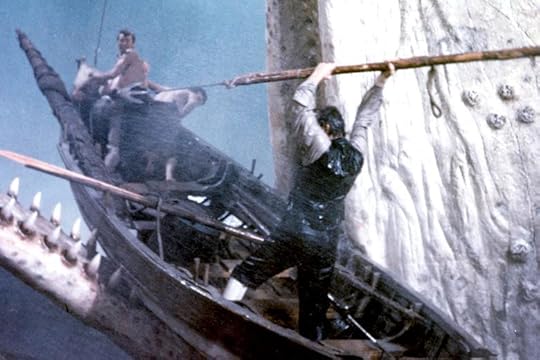
There may be complaints with Jay Parini's conception of Herman Melville's life but I found the story and the prose used to bring the fragments to life quite enriching. *The 1st image within my review is of the author; the 2nd a stylized image of Ahab doing battle with his nemesis.
This reconstruction of H.M. requires patience on the part of the reader but the compression of voices from Melville's long-suffering wife Lizzie, Nathaniel Hawthorne, fellow mariner & soul-mate John Troy, among others, gradually serves to create a kaleidoscopic survey of Melville's life & times, often with the manner of speech the author would have employed.
With Herman Melville lacking much formal education, his older brother Gansevoort tutored him, suggesting books that might stimulate the future author's mind, while going off to sea constituted Melville's "Harvard & Yale experience", as was the case with Joseph Conrad, providing material for later novels and broadening his worldview.
I enjoyed the imagining of specific incidents in the Marquesas Islands & elsewhere that led Herman Melville to fashion the character of Billy Budd and also provided the inspiration for Moby Dick and other novels. Melville's less-grandiose early sea tales set in Polynesia sold well but his magnum opus confounded & overwhelmed both critics & general readers alike, causing his esteemed mentor, Hawthorne to comment in a letter to Melville:
As you will certainly know, each character in this novel is you. You are Ahab--the monomania is yours, the will to fusion with the whiteness of the whale, in itself a sublime idea. Ahab fits poorly in the industry of whaling, of course. He wants only one whale, whereas his investors at home desire many whales, as numerous as possible, redacted, rendered into oil. Ahab is Don Quixote, a fantasist. May I call you this as well?
May I say that you fit poorly into the economic machinery of our day, which wants to grind or boil us, render us all? As an artist you require the sovereignty of Herman. The imperial quest leads only to destruction. You are Ishmael too: the ordinary seaman who ends his quest for knowledge at sea, quite literally as a lone man in a broken vessel, clinging to the remnants of his soul-brother Queequeg, whose coffin represents the fragmented self.
Hawthorne was in awe of Moby Dick & this adulation pleased Melville exceedingly but the lack of robust sales and a positive response by the critics seemed to haunt the author. His already tortured psyche could not endure the sense of rejection & failure, causing Melville to drift into menial work at a New York City customs house and days of increasing dread & almost total discontent. One son committed suicide and his wife was at peace only when Melville exited each morning en route to his lonely existence at the Manhattan customs house.
There may be complaints with Jay Parini's conception of Herman Melville's life but I found the story and the prose used to bring the fragments to life quite enriching. *The 1st image within my review is of the author; the 2nd a stylized image of Ahab doing battle with his nemesis.

February 27, 2022
After finishing Parini’s extraordinary historical novel Benjamin’s Crossing about the brilliant German-Jewish scholar Walter Benjamin, I ventured into Parini’s epic The Passages of H.M., another ambitious historical fiction chronicling the life of the complex Herman Melville. As a biographical novel, Parini employs his descriptive gifts and splendid prose to capture the era of the 19th century in impressive fashion. His mastery of ships and maritime settings is equally impressive as he charts Melville’s adventures and exploits around the world while the future writer collects unforgettable experiences and jots notes in his journal for his classic tales.
Parini balances Melville’s adventures between intimate chapters focusing on Melville’s wife Lizzie. Her first-person narrations bring immediacy and empathy to her longtime suffering in a marriage that has her weighing justifications for Melville’s temper and bouts of violence against her considerations to leave him. By delving into all aspects of Melville’s life and mind, Parini gives us glimpses into how difficult and repulsive he could be as a husband and father. If fictionalizing the life and probing the mind of Melville did not serve as challenges enough, Parini gives us scenes and chapters where the peerless Dickens and Hawthorne appear.
The Pasasages of H.M. recreates both an entertaining travelogue of Melville’s adventures and also a sympathetic and sometimes disturbing look at Melville’s unstable mental state. Overall, Parini offers a fair and complex examination of Melville’s oftentimes unlikeable character. Although not as riveting and flawless in construction as Benjamin’s Crossing, I admire Parini’s endeavor to undertake an intense study of Melville that makes him as human as possible with all his talents and faults.
Parini balances Melville’s adventures between intimate chapters focusing on Melville’s wife Lizzie. Her first-person narrations bring immediacy and empathy to her longtime suffering in a marriage that has her weighing justifications for Melville’s temper and bouts of violence against her considerations to leave him. By delving into all aspects of Melville’s life and mind, Parini gives us glimpses into how difficult and repulsive he could be as a husband and father. If fictionalizing the life and probing the mind of Melville did not serve as challenges enough, Parini gives us scenes and chapters where the peerless Dickens and Hawthorne appear.
The Pasasages of H.M. recreates both an entertaining travelogue of Melville’s adventures and also a sympathetic and sometimes disturbing look at Melville’s unstable mental state. Overall, Parini offers a fair and complex examination of Melville’s oftentimes unlikeable character. Although not as riveting and flawless in construction as Benjamin’s Crossing, I admire Parini’s endeavor to undertake an intense study of Melville that makes him as human as possible with all his talents and faults.
December 8, 2021
I thought this was a very clever insightful novel which helped me to come to terms with Melville - an author more praised than read - if we are honest - how many of us really read 'Moby Dick' at school? but it has made me reconsider this gap in my reading - if you want a really excellent and insightful and very well written review go to the one posted by 'Quo' back in 2014 (when I wrote this review it was the top review on the Goodreads page for the book - but that may change). But above everything it is well written book which opens up and explores so much about Melville as a person and writer. I thought it very beautiful. If my review doesn't convince then go to the one by 'Quo' I agree with everything he says, and he says it so much much better than I could.

March 26, 2012
You will enjoy this book if...
You believe that Moby-Dick is one of the great American novels.
You had an American Lit professor who made the book come alive for you. You are a writer who alternates between believing your own genius and falling into the depths that everyone is better than you.
You love a good adventure on the high seas.
You ever had an unrequited love that affected you deeply.
You had to put aside your Art to take a job in the real-world to pay real bills.
You wish you could sit at a table with Melville, Hawthorne or Whitman and debate Emerson.
You like a good tragedy.
You have worked in the publishing industry.
You will not enjoy this book if...
Moby-who? (if so, then go out and take an American Lit class, or see if there is a free podcast on iTunes)
Herman Mel-who? (he isn't the most likeable of people, so you really do have to have read Moby-Dick or other works to appreciate him)
You are looking for a light-hearted book or a romance
You believe that Moby-Dick is one of the great American novels.
You had an American Lit professor who made the book come alive for you. You are a writer who alternates between believing your own genius and falling into the depths that everyone is better than you.
You love a good adventure on the high seas.
You ever had an unrequited love that affected you deeply.
You had to put aside your Art to take a job in the real-world to pay real bills.
You wish you could sit at a table with Melville, Hawthorne or Whitman and debate Emerson.
You like a good tragedy.
You have worked in the publishing industry.
You will not enjoy this book if...
Moby-who? (if so, then go out and take an American Lit class, or see if there is a free podcast on iTunes)
Herman Mel-who? (he isn't the most likeable of people, so you really do have to have read Moby-Dick or other works to appreciate him)
You are looking for a light-hearted book or a romance

Read
July 26, 2021O carte pe care o citesti greu, pe care o intelegi greu si de care nu te poti efectiv bucura. Oricum nu am citit nicio carte de Melville, deci cumva lectura asta a fost o pura curiozitate. Nu ma mira ce am citit, scriitorii geniali sunt dereglati, insa cumva imi intregeste un tablou. As mai citi astfel de carti, chiar si atunci cand e vb despre autori pe care NU i-am citit.
March 10, 2011
Parini has written an arresting and intriguing fictional account of the life of Herman Melville. That he uses the novel format is perhaps surprising, yet the voyages and troubled relationships of Melville’s life provide suitable material for Parini’s writing. He uses the voice of Melville’s wife, Lizzie, and a third-person narrative, to alternate chapters. This also allows him to shift from different times in Melville’s life, giving the reader a textured approach to Melville and his eccentricities.
The novel opens with Lizzie’s account of the anger, drunkenness, and questionable sanity of Melville in the later years of their marriage. This leaves Melville’s character more open to a reader’s imagination when the next chapter begins with a young Melville looking for work on a whaler and embarking on his first sea voyage.
Lizzie’s narrative deftly portrays an alternative view of Melville than the one we get from the third-person narration. From her point of view we can see how Melville’s preoccupations and internal conflict become a detached husband and father and a difficult man to live with.
When the chapters move to that of the third-person narration, Parini’s accounts of Melville’s private life and his voyages are beautifully written, with lush descriptions and a skilful creation of Melville’s inner turmoil and infrequent peace. Most of the characters he comes across are also well-written, with few short cuts or stock depictions.
One major problem with Parini’s novel is the frequent anachronism present in the dialogue, vocabulary, and mindsets of the characters he is depicting. The characters, Lizzie in particular, could be lifted in parts from a novel set in contemporary America. Her view of her relationship with Herman, and her manner of conversing with him, are jarringly modern in places.
Another issue with Parini’s prose lies in his propensity to tell a lot of detail, rather than show it. This is particularly notable at the beginning of the novel, as he tries to portray Melville initially through Lizzie’s narrative. While this is perhaps an aspect of the genre of biography, in a fictional account I would have expected less exposition.
There is a similar lack of subtlety in the manner in which Parini highlights the relationship between Melville’s works and their real-life inspiration. The incidences and characters which Parini’s Melville encounters are sometimes little more than caricatures or vague reworkings of the fictional versions, designed to propel this Melville on his writing journey.
Parini’s account of the life of Herman Melville is an unapologetically fictional one. He acknowledges his almost total creation of Lizzie, Melville’s wife, and his chronological shifting of details to suit his own narrative. Parini, however, may take too much free rein with the subject of Melville’s homosexuality. He takes various homosocial aspects of Melville’s texts, and extrapolates from them a lifetime of supposed yearning for handsome young men. This facet of Melville’s character nearly takes over the entire text.
In short, this novel is not perfect, neither as an account of Melville’s life, nor as a novel in its own right. It is, however, an intriguing read and a good insight into Melville’s life for those with no prior knowledge on the subject.
The novel opens with Lizzie’s account of the anger, drunkenness, and questionable sanity of Melville in the later years of their marriage. This leaves Melville’s character more open to a reader’s imagination when the next chapter begins with a young Melville looking for work on a whaler and embarking on his first sea voyage.
Lizzie’s narrative deftly portrays an alternative view of Melville than the one we get from the third-person narration. From her point of view we can see how Melville’s preoccupations and internal conflict become a detached husband and father and a difficult man to live with.
When the chapters move to that of the third-person narration, Parini’s accounts of Melville’s private life and his voyages are beautifully written, with lush descriptions and a skilful creation of Melville’s inner turmoil and infrequent peace. Most of the characters he comes across are also well-written, with few short cuts or stock depictions.
One major problem with Parini’s novel is the frequent anachronism present in the dialogue, vocabulary, and mindsets of the characters he is depicting. The characters, Lizzie in particular, could be lifted in parts from a novel set in contemporary America. Her view of her relationship with Herman, and her manner of conversing with him, are jarringly modern in places.
Another issue with Parini’s prose lies in his propensity to tell a lot of detail, rather than show it. This is particularly notable at the beginning of the novel, as he tries to portray Melville initially through Lizzie’s narrative. While this is perhaps an aspect of the genre of biography, in a fictional account I would have expected less exposition.
There is a similar lack of subtlety in the manner in which Parini highlights the relationship between Melville’s works and their real-life inspiration. The incidences and characters which Parini’s Melville encounters are sometimes little more than caricatures or vague reworkings of the fictional versions, designed to propel this Melville on his writing journey.
Parini’s account of the life of Herman Melville is an unapologetically fictional one. He acknowledges his almost total creation of Lizzie, Melville’s wife, and his chronological shifting of details to suit his own narrative. Parini, however, may take too much free rein with the subject of Melville’s homosexuality. He takes various homosocial aspects of Melville’s texts, and extrapolates from them a lifetime of supposed yearning for handsome young men. This facet of Melville’s character nearly takes over the entire text.
In short, this novel is not perfect, neither as an account of Melville’s life, nor as a novel in its own right. It is, however, an intriguing read and a good insight into Melville’s life for those with no prior knowledge on the subject.

June 27, 2022
Reperele biografice ale vieții lui Melville sunt veridice și fac parte din marea istorie a literaturii americane. Ceea ce nu a rămas consemnat a fost imaginat cu mare artă. Lizz Shaw, soția lui Herman este exemplu elocvent în acest sens. Pe lângă povestea incitantă a lui HM cartea lui Parini mi-a deschis apetitul pentru Nathaniel Hawthorne așa că am pus mâna pe prima carte pe care-o aveam și o tot ocoleam (asta datorită filmului omonim cu Demi Moore), Litera stacojie. Capitolul introductiv, numit Vama m-a făcut să nu pot lăsa cartea din mână, dar despre asta ,mai mult, după ce termin cartea. Până atunci, dacă aveți posibilitatea citiți cartea lui Parini despre HM dar mai ales vă recomand extraordinarul lui roman Moby Dick, o carte pe care contemporanii lui nu s-au putut ridica la nivelul absolut magnific al scriiturii. Filmul clasic cu Gregory Peck în rolul lui Ahab, deși o producție bună din toate punctele de vedere, este doar o poveste hollywoodiană. Romanul este cu totul altceva.

Did Not Finish
November 22, 2010It was easier to read "Moby Dick," which is what made me interested in reading this book, and even that I could only do once. I just could not get into this book. Maybe I'll try it again some day, but for now I'm giving up on this drag.

February 26, 2011
I’ve never read any Herman Melville and the only two things I knew about him before reading Jay Parini’s novel were that he wrote Moby Dick and that musician Moby is related to him. I now know much more about him thanks to reading this book, but have to say that I don’t much like the Melville portrayed in its pages.
The book tells us about Melville’s life, starting with his youthful journeys to sea and sojourns in the Pacific, then moving on to his literary life and career as an author. This narrative is interspersed with chapters written by Melville’s wife Lizzie, giving her views on the great man and his writer contemporaries. Lizzie is a wonderful creation and in my view steals the book from Melville, who by contrast seems affected, pompous and much less easy to get along with than his wife.
I really enjoyed the first half of the book which covers both Melville’s early travels and some “flash forwards” of his later life, courtesy of Lizzie. However, when Melville starts his writing career and begins his relationship with fellow author Nathaniel Hawthorne the action becomes less physical and more cerebral, which I found duller than the beginning of the book. I also felt that Melville was fast wearing out his welcome and that the more I got to know him the less I liked him, and increasingly did not want to spend time with him. I came to resent Melville’s constant search for enlightenment and for the perfect male companion while his family was neglected and making sacrifices for him. For someone addressing the big questions about the purpose of life, he demonstrates very little self-enlightenment and never seems to learn from experience.
However I think this is deliberate on the part of the author in trying to show us someone who could not come to terms with the fact that he was ageing, had not had the literary glory he felt he deserved and was seeking the elusive something (or someone) that would make his life complete. There’s also perhaps the implication that he is damaged by the early death of his father and therefore spends his life trying to fill the hole left by this loss.
I wanted to get to know Lizzie better and to hear more about her daily life and her desires, but we don’t get enough of her. We see little of her reaction to family life and tragedies that take place, but this, I suppose, fits in with Melville’s world view that she is there to support him and outside that does not have her own existence.
As I knew only my two basic facts about Melville, I can’t comment on whether the novel is a realistic portrayal of the man, but it seems to be a realistic recreation of the era. I was “tripped up” a few times by what seemed to be anachronistic language – for example, talk of a sea captain having “leadership skills”, and Melville and Hawthorne going to the pub in Liverpool for a “plowman’s lunch” (a concept invented by marketing men in the 1960s) – but on the whole felt that the language and style appropriate to the subject matter of the novel.
All in all I enjoyed “The Passages of Herman Melville” and am glad I read it. It hasn’t instilled in me any great desire to read any of Melville’s work, but it introduced me to Lizzie Melville and for that, at least, I’m grateful.
The book tells us about Melville’s life, starting with his youthful journeys to sea and sojourns in the Pacific, then moving on to his literary life and career as an author. This narrative is interspersed with chapters written by Melville’s wife Lizzie, giving her views on the great man and his writer contemporaries. Lizzie is a wonderful creation and in my view steals the book from Melville, who by contrast seems affected, pompous and much less easy to get along with than his wife.
I really enjoyed the first half of the book which covers both Melville’s early travels and some “flash forwards” of his later life, courtesy of Lizzie. However, when Melville starts his writing career and begins his relationship with fellow author Nathaniel Hawthorne the action becomes less physical and more cerebral, which I found duller than the beginning of the book. I also felt that Melville was fast wearing out his welcome and that the more I got to know him the less I liked him, and increasingly did not want to spend time with him. I came to resent Melville’s constant search for enlightenment and for the perfect male companion while his family was neglected and making sacrifices for him. For someone addressing the big questions about the purpose of life, he demonstrates very little self-enlightenment and never seems to learn from experience.
However I think this is deliberate on the part of the author in trying to show us someone who could not come to terms with the fact that he was ageing, had not had the literary glory he felt he deserved and was seeking the elusive something (or someone) that would make his life complete. There’s also perhaps the implication that he is damaged by the early death of his father and therefore spends his life trying to fill the hole left by this loss.
I wanted to get to know Lizzie better and to hear more about her daily life and her desires, but we don’t get enough of her. We see little of her reaction to family life and tragedies that take place, but this, I suppose, fits in with Melville’s world view that she is there to support him and outside that does not have her own existence.
As I knew only my two basic facts about Melville, I can’t comment on whether the novel is a realistic portrayal of the man, but it seems to be a realistic recreation of the era. I was “tripped up” a few times by what seemed to be anachronistic language – for example, talk of a sea captain having “leadership skills”, and Melville and Hawthorne going to the pub in Liverpool for a “plowman’s lunch” (a concept invented by marketing men in the 1960s) – but on the whole felt that the language and style appropriate to the subject matter of the novel.
All in all I enjoyed “The Passages of Herman Melville” and am glad I read it. It hasn’t instilled in me any great desire to read any of Melville’s work, but it introduced me to Lizzie Melville and for that, at least, I’m grateful.

May 21, 2026
As a self-proclaimed Melville obsessive who wants to learn more about his life in Manhattan after he became a customs inspector, 1866-1885, while living in relative obscurity, I was heartened to learn there is a novel by Jay Parini that gives this period of Melville’s life, one that his first biographer, Raymond Weaver referred to as his “Quietus” period, imaginative reign. This last descriptor has been chosen carefully since the implicit caveat emptor is that Parini’s The Passages of H.M.: A Novel of Herman Melville is, largely, a work of fiction, albeit one that is steeped in scrutinization and utilization of historical documents and a close reading of Melville’s own fiction as well as relevant criticism.
Normally I would shy away from a fictionalized account of an author whom I revere. However, in the case of Melville, the definitive biography, Hershel Parker’s gargantuan encyclopedic two volume set (1996 & 2002), of the author who was almost completely ignored and reviled during his lifetime for his greatest works is too ponderous to seriously consider revisiting. The second volume, which clocks in at over 900 pages, before the “Notes” are considered, is particularly soporific since Parker is a biographer without any flights of fancy or natural ability to keep his narrative enticing to the reader who—truth be told—must long for Melville’s death over the final 600 or so excruciating pages of prosaic minutia; I speak from experience. Given any ambiguity, Parker opts for a straight recitation of fact based on historical documents, however mundane they may be, which leads the biographer on a quest more akin to a laundry list—pardon the cliché—than biography. Parker’s restraint is an obvious choice. Removing the personality of the biographer completely does an exemplary service to his or her subject, although it does not lead to a scintillating reading experience.
In his brief “Acknowledgment” afterward, Parini admits to relying heavily on Parker’s two tomes as well as Jay Leyda’s indispensable two volume chronological compilation of documents related to Herman Melville’s life, The Melville Log (1951). These in addition to a couple of other stronger works of Melville criticism and biography, particularly Andrew Delbanco’s phenomenal Melville: His World and His Work (2005), a book that I find utterly essential for anyone who wants to learn more about the once neglected genius of whom there is a sparsity of information after his life shifted into obscurity as he became an anonymous Manhattanite with a peripatetic day job. Thus, Parini consults the absolute best sources available before indulging his own flights of fancy, most of which do not involve a very long leap. The Passages of H.M.: A Novel of Herman Melville is an engaging work of fiction that, for many readers, may be preferable to an actual biography, especially since so many essential aspects of Melville’s life and work are broached with reverence and are based on fact.
As the saying goes, “Truth is often stranger than fiction,” so Parini’s fictionalized account may seem bizarre and far-fetched to some, but Melville’s life was so strange that it fueled his fiction and makes his life fascinating. He was born into a gentry family that was financially ruined. He went to sea as a young man, twice, the second time on a whaler that he deserted in the South Pacific where he cavorted with natives. . .lasciviously and salaciously, much to the chagrin of the US literary establishment. The veracity of many points in his first novel, Typee were disputed as too far-fetched, that is until the sailor whom Melville deserted with came forward after reading the sensational first novel to corroborate the “tale.” Later, Melville is inspired by his friendship with his neighbor in Western Massachusetts, Nathaniel Hawthorne, who had just published The Scarlet Letter, and turns a mundane adventure story about a whale staving a ship into the Great American Novel, one that contains many elements of Modernism, a movement that Moby-Dick, or the Whale predates by 70 years. The novel is too far ahead of its time and falls on largely deaf ears. Melville ripostes with a strange gothic tale with a protagonist that resembles himself who is Oedipally obsessed with his mother—decades before Freud—and who eventually marries his half-sister. . .before committing suicide as a failed novelist in despair over the plight of the author in a superficial society. Pierre, or the Ambiguities sealed Melville’s fate. His was written off by the literary establishment as mad. And although two of his later novellas and one posthumous short novel are now regarded as masterpieces of world literature, they were completely overlooked in his lifetime.
Melville biographers, as a result, have struggled to adequately describe the last half of Melville’s life. While it is obvious to jump to conclusions that he was pathologically disgruntled and had to face tragedy when his eldest son, Malcolm, dies of a suspicious self-inflicted gunshot wound in the family townhouse on 26th Street, there is no historical documentation of physical violence towards his family, though many biographers speculate that Melville was a huge personality, a frustrated failed novelist, one whom was emphatically not easy to be around, so much so that his father-in-law funded a trip to the Holy Land hoping that Melville would regain his grip on sanity and give his beleaguered wife a break. Since Parini chooses to have Melville’s wife, Lizzie, narrate every other chapter, the reader is treated to assumptions about Melville’s anger, assumptions that are not so far-fetched. And since artistic license is taken, I have no qualms about Parini fabulating an apropos scenario where Melville throws a book at his beleaguered wife, blackening her eye. Kudos to Parini for handling the whispers of spousal abuse, whether it be physical or psychological, with an apt metaphor for violence by a neglected author prone to neologism and obsessing over verses almost no one will read.
Parini’s other diversion into speculations that have a high degree of validity involve Melville’s penchant for homoerotism. Melville is very frank in his rhapsodic descriptions of beautiful enticing men throughout his maritime fiction as well as actions that are metaphors for homosexual behavior, e.g. the crews’ hands squishing through the sperm whale’s sperm. One must assume that Melville had bisexual tendencies which he either acted on or tried to act on at periods throughout his life. Queer theorists have harped on all these passages since the late 1950’s, so much so that the homoerotic elements of Melville’s fiction cannot be ignored by any serious Melville scholar. I have no quibble with Parini making up homosexual Melville crushes. When the shoe fits. . .
For me, the most satisfying chapters are narrated by Melville’s wife Lizzie, of whom little is known. The other chapters merely fictionalize a life that was already fictionalized by Melville himself. They are less enticing. However, they fit into a plan for elucidating for the novice reader less versed in the pertinent periods of the author’s life. Nevertheless, anyone interested in Melville’s sailing period in his mid-twenties must read Typee, Omoo, White Jacket, Redburn and Moby-Dick. The chapters encompassing these years in The Passages of H.M.: A Novel of Herman Melville will strike any Melville fan as highly redundant. Yet the chapters narrated by Lizzie, although they are fiction, leave me admiring Parini’s valiant effort in bringing the author, “H.M.” to life and allowing me to ponder Melville’s daily existence as an aging Manhattanite in a manner that is entirely probable despite the dearth of historical documentation. In Parini’s novel, the humdrum trumps the “truth is often stranger than fiction” cliché, which is why The Passages of H.M.: A Novel of Herman Melville is a worthy addition to the Melville bookshelves.
Normally I would shy away from a fictionalized account of an author whom I revere. However, in the case of Melville, the definitive biography, Hershel Parker’s gargantuan encyclopedic two volume set (1996 & 2002), of the author who was almost completely ignored and reviled during his lifetime for his greatest works is too ponderous to seriously consider revisiting. The second volume, which clocks in at over 900 pages, before the “Notes” are considered, is particularly soporific since Parker is a biographer without any flights of fancy or natural ability to keep his narrative enticing to the reader who—truth be told—must long for Melville’s death over the final 600 or so excruciating pages of prosaic minutia; I speak from experience. Given any ambiguity, Parker opts for a straight recitation of fact based on historical documents, however mundane they may be, which leads the biographer on a quest more akin to a laundry list—pardon the cliché—than biography. Parker’s restraint is an obvious choice. Removing the personality of the biographer completely does an exemplary service to his or her subject, although it does not lead to a scintillating reading experience.
In his brief “Acknowledgment” afterward, Parini admits to relying heavily on Parker’s two tomes as well as Jay Leyda’s indispensable two volume chronological compilation of documents related to Herman Melville’s life, The Melville Log (1951). These in addition to a couple of other stronger works of Melville criticism and biography, particularly Andrew Delbanco’s phenomenal Melville: His World and His Work (2005), a book that I find utterly essential for anyone who wants to learn more about the once neglected genius of whom there is a sparsity of information after his life shifted into obscurity as he became an anonymous Manhattanite with a peripatetic day job. Thus, Parini consults the absolute best sources available before indulging his own flights of fancy, most of which do not involve a very long leap. The Passages of H.M.: A Novel of Herman Melville is an engaging work of fiction that, for many readers, may be preferable to an actual biography, especially since so many essential aspects of Melville’s life and work are broached with reverence and are based on fact.
As the saying goes, “Truth is often stranger than fiction,” so Parini’s fictionalized account may seem bizarre and far-fetched to some, but Melville’s life was so strange that it fueled his fiction and makes his life fascinating. He was born into a gentry family that was financially ruined. He went to sea as a young man, twice, the second time on a whaler that he deserted in the South Pacific where he cavorted with natives. . .lasciviously and salaciously, much to the chagrin of the US literary establishment. The veracity of many points in his first novel, Typee were disputed as too far-fetched, that is until the sailor whom Melville deserted with came forward after reading the sensational first novel to corroborate the “tale.” Later, Melville is inspired by his friendship with his neighbor in Western Massachusetts, Nathaniel Hawthorne, who had just published The Scarlet Letter, and turns a mundane adventure story about a whale staving a ship into the Great American Novel, one that contains many elements of Modernism, a movement that Moby-Dick, or the Whale predates by 70 years. The novel is too far ahead of its time and falls on largely deaf ears. Melville ripostes with a strange gothic tale with a protagonist that resembles himself who is Oedipally obsessed with his mother—decades before Freud—and who eventually marries his half-sister. . .before committing suicide as a failed novelist in despair over the plight of the author in a superficial society. Pierre, or the Ambiguities sealed Melville’s fate. His was written off by the literary establishment as mad. And although two of his later novellas and one posthumous short novel are now regarded as masterpieces of world literature, they were completely overlooked in his lifetime.
Melville biographers, as a result, have struggled to adequately describe the last half of Melville’s life. While it is obvious to jump to conclusions that he was pathologically disgruntled and had to face tragedy when his eldest son, Malcolm, dies of a suspicious self-inflicted gunshot wound in the family townhouse on 26th Street, there is no historical documentation of physical violence towards his family, though many biographers speculate that Melville was a huge personality, a frustrated failed novelist, one whom was emphatically not easy to be around, so much so that his father-in-law funded a trip to the Holy Land hoping that Melville would regain his grip on sanity and give his beleaguered wife a break. Since Parini chooses to have Melville’s wife, Lizzie, narrate every other chapter, the reader is treated to assumptions about Melville’s anger, assumptions that are not so far-fetched. And since artistic license is taken, I have no qualms about Parini fabulating an apropos scenario where Melville throws a book at his beleaguered wife, blackening her eye. Kudos to Parini for handling the whispers of spousal abuse, whether it be physical or psychological, with an apt metaphor for violence by a neglected author prone to neologism and obsessing over verses almost no one will read.
Parini’s other diversion into speculations that have a high degree of validity involve Melville’s penchant for homoerotism. Melville is very frank in his rhapsodic descriptions of beautiful enticing men throughout his maritime fiction as well as actions that are metaphors for homosexual behavior, e.g. the crews’ hands squishing through the sperm whale’s sperm. One must assume that Melville had bisexual tendencies which he either acted on or tried to act on at periods throughout his life. Queer theorists have harped on all these passages since the late 1950’s, so much so that the homoerotic elements of Melville’s fiction cannot be ignored by any serious Melville scholar. I have no quibble with Parini making up homosexual Melville crushes. When the shoe fits. . .
For me, the most satisfying chapters are narrated by Melville’s wife Lizzie, of whom little is known. The other chapters merely fictionalize a life that was already fictionalized by Melville himself. They are less enticing. However, they fit into a plan for elucidating for the novice reader less versed in the pertinent periods of the author’s life. Nevertheless, anyone interested in Melville’s sailing period in his mid-twenties must read Typee, Omoo, White Jacket, Redburn and Moby-Dick. The chapters encompassing these years in The Passages of H.M.: A Novel of Herman Melville will strike any Melville fan as highly redundant. Yet the chapters narrated by Lizzie, although they are fiction, leave me admiring Parini’s valiant effort in bringing the author, “H.M.” to life and allowing me to ponder Melville’s daily existence as an aging Manhattanite in a manner that is entirely probable despite the dearth of historical documentation. In Parini’s novel, the humdrum trumps the “truth is often stranger than fiction” cliché, which is why The Passages of H.M.: A Novel of Herman Melville is a worthy addition to the Melville bookshelves.

January 26, 2019
While I am a fan of all things Herman Melville, I found this novel to be rather ponderous. Parini uses a great deal of good information and follows Melville's life nicely. Construction of Lizzie Melville seems weak. The language of the novel falls fairly flat - heavy with too many words.
There are charming moments - nice little moments with Hawthorne or Lizzie that allowed me to finish it.
There are charming moments - nice little moments with Hawthorne or Lizzie that allowed me to finish it.

December 13, 2013
The Irish hold up "Ulysses," the Russians cherish "War and Peace," and we point to "Moby-Dick" - those national monuments we revere but seldom visit. Face it: Herman Melville, the man who wrote the most famous opening line in American literature, is now largely unread. Call me crazy, but that's a damnable fate, the literary equivalent of being lost at sea.
Luckily, I had a high school English teacher who sailed us through the pages of "Moby-Dick" with the unwavering determination of Captain Ahab. But in college and graduate school - focused on American literature! - we only pursued a few of Melville's shorter works, dark marvels like "Bartleby, the Scrivener" and "Billy Budd."
Size matters, but length isn't the only challenge posed by "Moby-Dick." It's a vortex that sucks up chunks of classical history and literature, theology and geography, nautical science and 19th-century industry. Melville's style is thick and demanding, too, even by the standards of his friend Nathaniel Hawthorne. Yes, it's a rip-roaring seafaring adventure, but it sails through rough waters of philosophy, and there's no escaping the howling wind of Melville's anguished mind.
But I feel a little closer to the surprising warmth of that mind after reading Jay Parini's new biographical novel, "The Passages of H.M." There are certainly fuller treatments of the author's life, starting with Hershel Parker's definitive biography - 2,000 pages in two volumes, completed in 2005 - but that's another leviathan more praised than read. Although Parini's story tacks close to the outline of Melville's experience, much has been artfully omitted, and what remains benefits from the novelist's ability to shape the story of a lonely man, a volcanic husband and an obsessed writer.
Parini has written such faction before. A longtime English professor at Middlebury College and a prolific literary critic, he's produced traditional biographies of John Steinbeck, Robert Frost and William Faulkner, but 20 years ago he wrote a novel about Tolstoy, "The Last Station," which was the basis for the recent film starring Christopher Plummer and Helen Mirren. I'm tempted to feel there's something vaguely cowardly about the biographical novel as a form, as though it's merely a preemptive defense against writing a dull novel (Remember, it's a biography) or an inaccurate biography (Please, it's a novel). And yet these hybrid books, with their crafted themes and dramatic arcs that no messy real life could follow, have given me an intimate sense of such figures as Charles Dickens, Alfred Tennyson and Emily Dickinson.
That's certainly the case with "The Passages of H.M." In fact, Parini is more effective with the interior life of his hero than with the great author's famous adventures. He starts in 1839 when Melville is a restless 19-year-old, dreaming of serving on a whaler. We travel with him on his first voyage, a four-month round trip to Liverpool (total wage: $12), and then on to his next trip in 1841 to the South Seas in search of sperm whales. It was during that tumultuous voyage that Melville and a buddy deserted at Nuku Hiva. Melville went on to Tahiti and Hawaii and then returned home almost four years later with those tales of paradise, cannibals and sexual exploits that he published in "Typee" and "Omoo."
Parini is careful to highlight the biographical bases for Melville's stories, and the better you know his oeuvre, the more allusions you're likely to catch, as when a sick crewman refuses to work, "saying quite simply to his superiors, 'I prefer not to.' " And no one will miss young Melville's interest in the story of "Mocha Dick, a huge bull whale, white as a sail, who had smashed several ships in the course of an infamous life."
But despite the dramatic potential of this material, there's a disappointing amount of shorthand storytelling here. Perhaps it's prudery, or maybe Parini doesn't want to compete with the great novelist's own descriptions of his experiences among the Polynesians, but his recreations seem muted and pale at the very moments that they should be most libidinous and terrifying. When a flotilla of South Sea nymphs meets the ship of horny sailors in the bay, for instance, what happened next "defied easy description." Well sure, it's hard, but give it a try, Mr. Parini, because by the time we get to Polynesia, those nymphs will be long gone! Later, the author says that an old sailor named Toothless Tom "reveled in tales that made the blood curdle. . . . You could not invent such things." But a little more invention would help here.
Besides, Parini is thoroughly capable of such creativity, as other sections of the novel show to great effect. He confesses in a short afterward, for example, that he practically made up Melville's long-suffering wife from scratch. Lizzie narrates every other chapter, sometimes in sync with Parini's retelling of Melville's life and sometimes jumping ahead. She's a marvelous creation, a smoldering prisoner of bitterness and devotion, resentment and affection. Her traditional faith makes an awkward marriage with her husband's febrile search for God, swinging between an Old Testament Yahweh and Ralph Waldo Emerson's misty pantheism. Enduring Melville's moods and punches, she gives a sobering portrait of life with the depressed genius who started his career with his most popular books and then watched his reputation sink.
Parini is especially sensitive in his portrayal of the desperate loneliness that afflicted the writer throughout his life. On sea and land, Melville was prone to intense emotional devotion to men who were too reserved, too frightened or simply too uninterested to return his craving for intimacy. The lengthy section about Melville's sometimes embarrassing affection for Nathaniel Hawthorne makes the latter part of the novel particularly rewarding. And what's so impressive is that Parini manages to create Melville's homoerotic yearning and despair in the context of 19th-century attitudes about sexuality, a pre-Freudian age that had not neatly divided the world into gay and straight, but also had no words for the feelings of love between men that Walt Whitman was so bravely yawping about. Wounded by Hawthorne's impenetrable restraint, Melville gropes for some way to express his feelings in a language that offers only romance or deviancy: "We lack the appropriate terms," he says. "But I say what I feel. Love is the only word that will suffice."
The finer elements of this novel are sometimes submerged beneath its more ordinary sections, but "The Passages of H.M." remains a sensitive introduction to Melville's stormy life and imagination. Anyone setting off into the great writer's novels, or returning to them after years away, might enjoy this thoughtful re-imagining of the man who remains America's Milton.
http://www.washingtonpost.com/wp-dyn/...
Luckily, I had a high school English teacher who sailed us through the pages of "Moby-Dick" with the unwavering determination of Captain Ahab. But in college and graduate school - focused on American literature! - we only pursued a few of Melville's shorter works, dark marvels like "Bartleby, the Scrivener" and "Billy Budd."
Size matters, but length isn't the only challenge posed by "Moby-Dick." It's a vortex that sucks up chunks of classical history and literature, theology and geography, nautical science and 19th-century industry. Melville's style is thick and demanding, too, even by the standards of his friend Nathaniel Hawthorne. Yes, it's a rip-roaring seafaring adventure, but it sails through rough waters of philosophy, and there's no escaping the howling wind of Melville's anguished mind.
But I feel a little closer to the surprising warmth of that mind after reading Jay Parini's new biographical novel, "The Passages of H.M." There are certainly fuller treatments of the author's life, starting with Hershel Parker's definitive biography - 2,000 pages in two volumes, completed in 2005 - but that's another leviathan more praised than read. Although Parini's story tacks close to the outline of Melville's experience, much has been artfully omitted, and what remains benefits from the novelist's ability to shape the story of a lonely man, a volcanic husband and an obsessed writer.
Parini has written such faction before. A longtime English professor at Middlebury College and a prolific literary critic, he's produced traditional biographies of John Steinbeck, Robert Frost and William Faulkner, but 20 years ago he wrote a novel about Tolstoy, "The Last Station," which was the basis for the recent film starring Christopher Plummer and Helen Mirren. I'm tempted to feel there's something vaguely cowardly about the biographical novel as a form, as though it's merely a preemptive defense against writing a dull novel (Remember, it's a biography) or an inaccurate biography (Please, it's a novel). And yet these hybrid books, with their crafted themes and dramatic arcs that no messy real life could follow, have given me an intimate sense of such figures as Charles Dickens, Alfred Tennyson and Emily Dickinson.
That's certainly the case with "The Passages of H.M." In fact, Parini is more effective with the interior life of his hero than with the great author's famous adventures. He starts in 1839 when Melville is a restless 19-year-old, dreaming of serving on a whaler. We travel with him on his first voyage, a four-month round trip to Liverpool (total wage: $12), and then on to his next trip in 1841 to the South Seas in search of sperm whales. It was during that tumultuous voyage that Melville and a buddy deserted at Nuku Hiva. Melville went on to Tahiti and Hawaii and then returned home almost four years later with those tales of paradise, cannibals and sexual exploits that he published in "Typee" and "Omoo."
Parini is careful to highlight the biographical bases for Melville's stories, and the better you know his oeuvre, the more allusions you're likely to catch, as when a sick crewman refuses to work, "saying quite simply to his superiors, 'I prefer not to.' " And no one will miss young Melville's interest in the story of "Mocha Dick, a huge bull whale, white as a sail, who had smashed several ships in the course of an infamous life."
But despite the dramatic potential of this material, there's a disappointing amount of shorthand storytelling here. Perhaps it's prudery, or maybe Parini doesn't want to compete with the great novelist's own descriptions of his experiences among the Polynesians, but his recreations seem muted and pale at the very moments that they should be most libidinous and terrifying. When a flotilla of South Sea nymphs meets the ship of horny sailors in the bay, for instance, what happened next "defied easy description." Well sure, it's hard, but give it a try, Mr. Parini, because by the time we get to Polynesia, those nymphs will be long gone! Later, the author says that an old sailor named Toothless Tom "reveled in tales that made the blood curdle. . . . You could not invent such things." But a little more invention would help here.
Besides, Parini is thoroughly capable of such creativity, as other sections of the novel show to great effect. He confesses in a short afterward, for example, that he practically made up Melville's long-suffering wife from scratch. Lizzie narrates every other chapter, sometimes in sync with Parini's retelling of Melville's life and sometimes jumping ahead. She's a marvelous creation, a smoldering prisoner of bitterness and devotion, resentment and affection. Her traditional faith makes an awkward marriage with her husband's febrile search for God, swinging between an Old Testament Yahweh and Ralph Waldo Emerson's misty pantheism. Enduring Melville's moods and punches, she gives a sobering portrait of life with the depressed genius who started his career with his most popular books and then watched his reputation sink.
Parini is especially sensitive in his portrayal of the desperate loneliness that afflicted the writer throughout his life. On sea and land, Melville was prone to intense emotional devotion to men who were too reserved, too frightened or simply too uninterested to return his craving for intimacy. The lengthy section about Melville's sometimes embarrassing affection for Nathaniel Hawthorne makes the latter part of the novel particularly rewarding. And what's so impressive is that Parini manages to create Melville's homoerotic yearning and despair in the context of 19th-century attitudes about sexuality, a pre-Freudian age that had not neatly divided the world into gay and straight, but also had no words for the feelings of love between men that Walt Whitman was so bravely yawping about. Wounded by Hawthorne's impenetrable restraint, Melville gropes for some way to express his feelings in a language that offers only romance or deviancy: "We lack the appropriate terms," he says. "But I say what I feel. Love is the only word that will suffice."
The finer elements of this novel are sometimes submerged beneath its more ordinary sections, but "The Passages of H.M." remains a sensitive introduction to Melville's stormy life and imagination. Anyone setting off into the great writer's novels, or returning to them after years away, might enjoy this thoughtful re-imagining of the man who remains America's Milton.
http://www.washingtonpost.com/wp-dyn/...

April 14, 2025
Pretty engaging stuff if you’re a fan of Herman Melville, and curious about the man behind “Moby Dick”, “Bartleby the Scrivener” and one of my favorite novels, “The Confidence-Man”.
I was surprised by the overall homoeroticism that’s a leitmotif, though it’s a subtext in many of Melville’s works; though fond of his long-suffering wife Lizzie, and while he’s apparently not immune to some women’s charms, there’s a catalogue of young men for whom he pines, mostly in vain, throughout his life. This includes reclusive author Nathaniel Hawthorne, who plays an important role in Melville’s life and creative inspiration, but who rejects his unabashed expressions of affection. Financial disappointment, loss of readership, and the premature death of his two sons further plague him, but he perseveres.
I’ll be picking up some of Melville’s early work, starting with “Typee”, as this novel certainly tells a story of his wild young days in the south seas that tempts further investigation.
I was surprised by the overall homoeroticism that’s a leitmotif, though it’s a subtext in many of Melville’s works; though fond of his long-suffering wife Lizzie, and while he’s apparently not immune to some women’s charms, there’s a catalogue of young men for whom he pines, mostly in vain, throughout his life. This includes reclusive author Nathaniel Hawthorne, who plays an important role in Melville’s life and creative inspiration, but who rejects his unabashed expressions of affection. Financial disappointment, loss of readership, and the premature death of his two sons further plague him, but he perseveres.
I’ll be picking up some of Melville’s early work, starting with “Typee”, as this novel certainly tells a story of his wild young days in the south seas that tempts further investigation.

March 7, 2017
I'll have to assume you need to be a super fan of Melville to enjoy his life...he was certainly a character. The author took many liberties to form the persona of his wife Lizzie who put up with way too much, drunkenness, money problems, his not well received published works, his lack of employment and not the most comforting of fathers, let alone supportive husband. The book went from his adventurous times on the high seas and the perspective of Lizzie; started soon before they started courting and ended with his death.

June 13, 2017
2.5 STARS
- I generally love reading fictional "biographies" of writers and their inner lives, but this book was a drag to finish.
- Herman Melville is a literary master who looms large over the canon...For who has never heard of the famous Captain Ahab or MOBY DICK? (Few and far between, I would wager...)
- Though this book occasionally displays glimpses of tenderness, fascination and empathy into Melville's life, it was mostly a mostly tedious narrative about sea life and structured inoptimally, alternating between Lizzie Melville's voice, and Herman's.
- Though Parini "teases" at some potentially deep emotional themes, such as Melville's relationship with God, spirituality and nature, along with his mysterious friendship with Nathaniel Hawthorne, I found the emotional resonance missed the mark. It's almost as if these ideas grasp at straws, but never quite makes it there.
- Overall, this novel was a bit of chore to read, but it did not lessen my desire to learn more about Melville, the man, or his literary works.
- I generally love reading fictional "biographies" of writers and their inner lives, but this book was a drag to finish.
- Herman Melville is a literary master who looms large over the canon...For who has never heard of the famous Captain Ahab or MOBY DICK? (Few and far between, I would wager...)
- Though this book occasionally displays glimpses of tenderness, fascination and empathy into Melville's life, it was mostly a mostly tedious narrative about sea life and structured inoptimally, alternating between Lizzie Melville's voice, and Herman's.
- Though Parini "teases" at some potentially deep emotional themes, such as Melville's relationship with God, spirituality and nature, along with his mysterious friendship with Nathaniel Hawthorne, I found the emotional resonance missed the mark. It's almost as if these ideas grasp at straws, but never quite makes it there.
- Overall, this novel was a bit of chore to read, but it did not lessen my desire to learn more about Melville, the man, or his literary works.

August 10, 2016
I've enjoyed Parini's The Apprentice Lover, and had a very enjoyable read with H.M. I remember reading Moby Dick three decades ago (better to have read then to be reading), and some stories, like Benito Cereno in college, and I admit Melville doesn't really grab me. I much prefer Parini. I liked his concise accounts of H.M., and his search for paradise and a male companion. Melville was frustrated in this, and I see it less as bisexuality then the writer's need to share his art and aesthetic experiences. He became defined by loneliness, as many artists are. Rilke said art is loneliness. The book is a study of the organic life of a writer, how reality creates fiction, and with Melville, how the sea influenced him. I'm reminded of the movie The Master, where the ocean appears and reappears, guiding the life and longing of a man.
The book chronicles Melville's progression, from seeker to best selling author (Typee), then his trying for Great Author at you-know-who-Dick and failing, then after a reexamination of his life, comes to terms with his inner self, and finds the inspiration for Billy Budd, his last masterpiece.
I was reminded a lot of Gore Vidal in The City and the Pillar, with Melville seeking to recapture his early desire for John Troy. He tries to become a friend to Hawthorne, with very unhappy results. You can feel Hawthorne's discomfort. The book has a lot of good writing and descriptions, from Mt. Graylock to New York, and the use of Lizzie as an alternative historian of Melville and her trials being married to him are a treasure, and a good counterpoint to the life of an artist.
There are two problems I had. It is mentioned Nelson (of Trafalgar fame) died from a cannonball. He was shot by a sniper. Also, I'm surprised Parini didn't mention the Essex, a ship sunk by a great whale. (read Philbrick's In the Heart of the Sea) Melville did talk to one of the sailors who suffered in that catastrophe.
I also empathize with the trials of writing Moby Dick. As a writer (check me; I'm on Goodreads), I felt at home in the literary world, but there was much humanity and strong description here to make the book accessible to all. I had a great August reading H.M.
The book chronicles Melville's progression, from seeker to best selling author (Typee), then his trying for Great Author at you-know-who-Dick and failing, then after a reexamination of his life, comes to terms with his inner self, and finds the inspiration for Billy Budd, his last masterpiece.
I was reminded a lot of Gore Vidal in The City and the Pillar, with Melville seeking to recapture his early desire for John Troy. He tries to become a friend to Hawthorne, with very unhappy results. You can feel Hawthorne's discomfort. The book has a lot of good writing and descriptions, from Mt. Graylock to New York, and the use of Lizzie as an alternative historian of Melville and her trials being married to him are a treasure, and a good counterpoint to the life of an artist.
There are two problems I had. It is mentioned Nelson (of Trafalgar fame) died from a cannonball. He was shot by a sniper. Also, I'm surprised Parini didn't mention the Essex, a ship sunk by a great whale. (read Philbrick's In the Heart of the Sea) Melville did talk to one of the sailors who suffered in that catastrophe.
I also empathize with the trials of writing Moby Dick. As a writer (check me; I'm on Goodreads), I felt at home in the literary world, but there was much humanity and strong description here to make the book accessible to all. I had a great August reading H.M.

February 9, 2011
Herman Melville's tormented soul comes to life through the prose of his wife, Lizzie, about whom very little is known in real life but who comes across as "a marvelous creation, a smoldering prisoner of bitterness and devotion, resentment and affection" (Washington Post). Any fictionalized biography of an elusive writer such as Herman Melville is certain to generate some controversy. Some critics found Parini's version of Melville's inner musings to be too much guesswork, although this may amount to a criticism of the genre as a whole. Most reviewers agreed, however, that Parini remains faithful to what facts we know of Melville and that Melville's life told through his wife's eyes renders the writer human and accessible, if sometimes robbed of drama. While some readers may prefer to intuit Melville's mind from the writer's own inspired works of fiction, others will find The Passages of H.M. to be a fine, insightful work of historical biography. This is an excerpt from a review published in Bookmarks magazine.

June 27, 2013
An enjoyable, mostly sympathetic (fictional) narrative of Melville's life. This is no biography, nor does it attempt to be, but rather an attempt to blow life into a character most of us know only as a name on a book's cover (if even that). To Parini's credit, he brought us a Herman Melville who was not flat as paper he wrote on, but three-dimensional, with hopes, dreams, pain, happiness, and everything in between. While this wasn't exactly the Melville I've conjured in my own mind from reading a good deal of his writings, it was not totally unlike how I imagined him, either. None of us, given only an author's books to go by, would ever come away with the same impression of him/her, so that Parini's take on Melville differs from mine is unsurprising.
Also being a fan of Tolstoy's, I'll be sure to check out The Last Station: A Novel of Tolstoy's Last Year one of these days, too.
Also being a fan of Tolstoy's, I'll be sure to check out The Last Station: A Novel of Tolstoy's Last Year one of these days, too.

November 8, 2010
Although I have no interest in reading Melville's novels, I found myself very interested in reading this novel about his life. I was particularly interested in reading about the intense passion he felt towards other men throughout his life--homosocial male bonding, something apparently quite common among men, particularly literary men of the day, as well as among seafaring men--and his friendship with the perhaps enigmatic Nathaniel Hawthorne. HE would make an interesting topic for a novel. The description on the book's jacket led me to believe that the book would focus more on Melville's wife. I only learned at the end of the novel that little is known about her and the author had to use his imagination to develop that character. I think the novel could have worked without her entirely.
March 10, 2011
Parini captures with incredible clarity the Melville that any reader of our great novelist/poet would recognize. His linking HM with Odysseus is especially insightful, you can tell that Parini is both poet and novelist, just as Melville was. The sections on Melville's many 'passages' at sea, especially his trip to the Levant, were some of the best of the book. As a lifelong Melville reader, retired sailor and admirer of poetry, history and novels Professor Parini has captured all three in this one amazing volume. The perspectives of his wife Lizzie was an interesting viewpoint as well, she stayed with him during the many storms of his life, as turbulent as any he experienced rounding the Horn.

February 14, 2011
I was delighted to be given the opportunity of reviewing this book for Real Readers.
Having not read any of Herman Melville’s books I faced this book with some trepidation, however, I found it to be an interesting fictional biography, which allowed a glimpse into the imagined life of this great author. The weightiness of the novel is lightened by the inclusion of Melville’s wife, Lizzie’s account of their life, which I found more interesting, than the third person narrative from Melville. The text is rather cumbersome in places, but, overall I enjoyed reading about Melville’s life and am now encouraged to go on to try to read at least one of Melville’s books.
Having not read any of Herman Melville’s books I faced this book with some trepidation, however, I found it to be an interesting fictional biography, which allowed a glimpse into the imagined life of this great author. The weightiness of the novel is lightened by the inclusion of Melville’s wife, Lizzie’s account of their life, which I found more interesting, than the third person narrative from Melville. The text is rather cumbersome in places, but, overall I enjoyed reading about Melville’s life and am now encouraged to go on to try to read at least one of Melville’s books.

November 5, 2010
Parts of this fictional biography of Melville are excellent. I especially enjoyed his time with the Typees and his relationship with Hawthorne. Melville's character in the book is not a very pleasant one.
He is an absentee father and husband, a loser of grandchildren and he seems adrift in his own life.
Never much of a provider, the book alternates between his story and the story of his long suffering wife, Lizzy. The part that I found the least believable were the chapters that revealed him as bisexual and a wife abuser.
He is an absentee father and husband, a loser of grandchildren and he seems adrift in his own life.
Never much of a provider, the book alternates between his story and the story of his long suffering wife, Lizzy. The part that I found the least believable were the chapters that revealed him as bisexual and a wife abuser.

February 12, 2012
A surprising portrait of Herman Melville's life and the aspects of his character that gave his writing its scope. The book skips between a narration of Herman's activities at sea and his dealings with writing, his friends, etc. and sections described by his wife, Lizzie, who has a much darker view on Herman's vehement passion and isolation. Interesting to see how different the response to his writing was at the same time that Hawthorne, Dickens, and Whitman were all becoming respected literary figures.

April 20, 2013
This book took me quite a while to get into, but ultimately I really enjoyed this fictional account of Melville's life.
The narrative shifts between 3rd-person limited (Melville) to 1st-person (his wife, Lizzie). I didn't feel like I got much insight from the completely fictional perspective of Lizzie. Parini imagines her as generally frustrated with her husband, but I don't know that the 1st person voice was necessary. Parini 3rd person narrator offers plenty of measured insights about Melville's struggles as a human & a writer.
The narrative shifts between 3rd-person limited (Melville) to 1st-person (his wife, Lizzie). I didn't feel like I got much insight from the completely fictional perspective of Lizzie. Parini imagines her as generally frustrated with her husband, but I don't know that the 1st person voice was necessary. Parini 3rd person narrator offers plenty of measured insights about Melville's struggles as a human & a writer.

April 3, 2011
Enjoyable read about a difficult and most likely closeted gay Herman Melville. Granted, this is a fictionalized portrait of his life, but a nicely written and researched book. I read Moby Dick about 10 years ago and reading The Passages of HM made me want to go back and tackle that dense tome again.

December 5, 2013
This fictional account of the life of Herman Melville shifts between a straightforward chronology and the views of his wife Lizzie after twenty years of marriage. Lizzie is being slowly driven crazy and it is no wonder, since Melville seems to be such a miserable human. The wonder is why the author wanted to write about such an off-putting character.

January 26, 2015
After reading this book I certainly feel like I have a much better sense of Melville. However, the story sort of plodded along, and it made me think of how it must be to read Moby-Dick (which I have not done in over 30 years). I am actually considering rereading the latter, so perhaps that could be considered a partial positive recommendation.

March 2, 2011
Unfair to rate perhaps because I did not finish but I disliked this book a lot. Granted there is not much in the historical record to go on but I do not believe in Parini's characterization of Melville. I would recommend Delbanco's biography and The Night Inspector by Frederick Bush.

January 2, 2012
There are so many biographies of Herman Melville out, you might ask why we need a fictional one. I was asking that question as I once again read through the events that inspired "Typee." This book is worth it though for the less well known second half of Melville's life and is well written.
Displaying 1 - 30 of 40 reviews