

What do you think?

No Scrap Left Behind: 16 Quilt Projects That Celebrate Scraps of All Sizes
Rescue your fabric scraps―even the smallest pieces―with 16 satisfying quilts and projects. Sew modern quilts for everyday use that will help you return to the roots of quiltmaking, with projects designed to help you use up every last scrap. Learn sorting and storage tips to help you plan your next quilt, with projects categorized by type of scrap―squares, strings, triangles, or little snippets. You'll never look at scraps the same way again!
128 pages, Paperback
First published February 1, 2017
Ratings & Reviews
Friends & Following
Create a free account to discover what your friends think of this book!
Community Reviews
Displaying 1 - 30 of 45 reviews

April 14, 2017
This is my kind of quilt book - one that you can actually read and reflect on, not just a collection of patterns. And all the patterns are great too. I got this copy from the library, but I think it's one for me to buy and keep and get plenty of use from.

March 21, 2017
This book was the perfect next book to follow Sunday Morning Quilts. There were lots of wonderful modern ideas for using up your scrap stash.

July 27, 2017
I don’t know about you..
But as a sewist I find that I have far too many fabric scraps that I don’t know what to do with.
No Scrap Left Behind aims to tell you what to do with such things and with ideas from scrap management, color schemes as well as many projects, your scrap bundle will be no more.
The projects is this inspiring book use squares, triangles and either large or small from quilts to pin cushions, Amanda Jean Nyberg has some fabulous ideas for everyone.
Every level of sewist will benefit from this book and it would make a perfect gift for a newbie.
I love it.
But as a sewist I find that I have far too many fabric scraps that I don’t know what to do with.
No Scrap Left Behind aims to tell you what to do with such things and with ideas from scrap management, color schemes as well as many projects, your scrap bundle will be no more.
The projects is this inspiring book use squares, triangles and either large or small from quilts to pin cushions, Amanda Jean Nyberg has some fabulous ideas for everyone.
Every level of sewist will benefit from this book and it would make a perfect gift for a newbie.
I love it.

May 17, 2018
This is a really good book. Some of the projects are modern; some evoke a vintage feel. Everything was inspirational and there were about five projects I'd like to make, so I may have to pick this one up (I read a library copy). Amanda Jean has great tips on making pincushions, too! Of course! She even has a little tute on making greeting cards by sewing fabric to paper. There were a couple of HST quilts I loved, plus a couple of others I'd love to make, too. Some are things you might not need a pattern for, unless you want her measurements, but most people probably would need a pattern. The only thing that would have made the book better is if she had used pattern testers to show the quilts in more than one colorway--for even MORE inspiration.

August 16, 2017
Cute quilts. Lookingforward to getting scraps out.

May 14, 2021
Makes me wish I had more scraps!
December 30, 2023
(SEE UPDATE BELOW.)
I appreciated Nyberg’s personal story about how she came to realize why she felt more comfortable using fabric scraps than cutting into new, larger pieces of fabric. She said she noticed at some point that she felt slightly stressed, would kind of freeze up, when faced with cutting up a big piece of new fabric. I get it: Making that first cut is daunting! Where you cut determines how much you’ll have left over, so you want to maximize the number of possibilities. It’s sort of like fabric chess: Trying to think five steps ahead. ;) I totally understand, because I was raised the same way (also in the Upper Midwest): “make do” vs. buy new. (Sadly I have no quilting friends who live nearby to exchange scraps with. ;)
Her childhood of frugality clearly encouraged her creativity however. I love her ideas for adding leftover scraps to quilt backs, how she used them to break up the monotony of the traditional solid piece of fabric. E.g., Adding a narrow row of tiny scraps to separate two different blocks of contrasting color (CC) fabrics adds interest. So does placing a few CC blocks off-center to catch the eye. She included plenty of examples, which got me thinking about all the possibilities in my own fabric stash.
Side note: Another great thing she does is remove the guesswork and stress of having to figure out how to cut up a half yard (or quarter yard, etc.) of fabric required for a particular pattern. She includes an illustration showing you where to cut to maximize the number of pieces.
She repeats some of the same ideas she discussed in SUNDAY MORNING QUILTS, which bear repeating however, because—as she says—we all tend to gravitate toward our favorite colors, which means we all have color gaps in our stash of fabrics. (Hence, her tip to trade scraps with others.) Her second tip is to (remember to) vary color VALUE in your fabrics. I.e., a quilt of only medium-value fabrics looks a bit flat; It needs the ‘spice’ of a few light-value and dark-value fabrics to add interest. She also says that most of us tend to buy mostly medium value fabrics, meaning that we shouldn’t be surprised to find that we have few light or dark value fabrics. I found that very interesting.
.
My favorite patterns are: “Slope” and “Scrap Happy Rails.” I’m not wild about the rest, I think because they’re *too* scrappy; the scraps are too tiny. It’s sort of like this book is a sequel to her earlier book, which used bigger pieces… If this were a cookbook, it would be about how to make leftovers tasty and exciting. Or, to be fair, just basic dishes made fresh from whatever you have in the fridge and/or freezer. In contrast, I think her other book, SUNDAY MORNING QUILTS, has more unique patterns. But….
UPDATE: I reread the book (again!) and see that I was hasty in my conclusion. Some of these patterns may not be as flashy as those in her other book, but they are supremely useful for using up a bucketload of SCRAPS. “Hot & Cold” is made up of same-size squares, but evokes a sort of optical illusion by grouping yellow, orange & red squares together in 3 rectangular ‘islands’ amidst a ‘sea’ of blue, green & purple squares. “Mini Nines” use 1˝ × 1˝ squares of white and a contrasting solid color to make the traditional Nine-Patch quilt. “Scrap Happy Rails” (her takeoff on the traditional Rail Fence quilt design) combines small rectangles of yellow, various pink solids & prints and orange solids & prints into a rail ‘track’ that meanders so often it presents a maze of color against a crisp white background. It has a fun, modern look that a young girl would appreciate. (It goes without saying that substituting blues and greens for the pinks and oranges would appeal to young boys.)
Nyberg says she created “June” for family picnics. It features pieced strips in a diagonal grid on a vivid grass-green background.
She has divided her quilt “projects” into sections: those using squares, then strips of pieced-together rectangles and squares, then a section for triangles. My fave here is “Remainders” (60” x 75”) which utilizes 2” (along short-edge) triangles. A whopping 720 triangles of medium value and 720 triangles in a light value are called for, against a cream background. (Sharpen your scissors!) The muted colors against cream lends it a delicious vintage flavor. “Chain of Triangles” looks like just that: chains. Vertical, chain-like ‘stripes’ of various single-color triangles. E.g., one full-length ‘chain’ of yellow separated from the next long chain of green by a field of white, which is followed by a long stripey chain of aqua, then gray, etc. Each link’ in the chain is a tilted square of 4 triangles pieced together, all in the same color but are a mix of solids and prints. I’m not wild about this design, but it’s probably easier to construct.
Included in the strips section is “Donuts”. Yes, single-color circles made of strips.. (Ho-hum.) The next section is for “Projects using Snippets”—ie, smaller fabric scraps. “Ring Me” features multicolored rings against a solid white background. The ‘rings’ are actually just 4-sided squares minus the corner pieces. (Clever, but a bit monotonous. Still, it would be cute for a child.)
Nyberg follows with patterns for tiny objects: a 5”x5” pincushion, a pieced “Bright Birch Tree Pincushion”, and a 2” x 6” pincushion that machine. that she calls a “Skinny Pinnie” that fits inside the throat of her sewing machine. (There is a larger version of this as well.) Another pincushion (the 3” x 6” embroidered “Needle Sorter”) is to separate needles you use on paper from those for fabric only. Then there is an 8” x 8.5” pillow pincushion (button in center). I hadn’t even thought about filler material, but Nyberg did: “My favorite type of pincushion filling is crushed walnut shells. [Who knew!] Sold in major pet stores as lizard litter [!], they add a nice weight to a pincushion, and they are supposed to sharpen your pins as you stick them into the filling. (I’m not completely sure that they help, but they certainly don’t hurt.) If you have nut allergies, consider using ground emery or play sand instead of the crushed walnut shells. Pincushions up to 5˝ × 5˝ square are good candidates for crushed walnut-shell filling. For large pincushions (larger than 5˝ × 5˝ square), I prefer to use polyfill so that the pincushion doesn’t get too heavy. If you have wool roving on hand, that also makes a wonderful filling.”
She even offers a project idea for the tiniest of scraps: stitch them to rectangles of card-stock to make a Thank-You card. Brilliant! (Or you could just use to record the particulars of a favorite fabric.)
Don’t toss those dull rotary blades just yet, either: she recommends using them to cut paper when no longer sharp enough for fabric.
Other tips I highlighted for myself: “Use a thin (50wt) thread for piecing. Thicker thread will shrink your seam allowance.” And “Press—don’t iron.” I.e., place iron on top of the fabric gently — don’t use a heavy hand and push the iron across it because it might stretch the fabric by and distort the shape of the piece(s). And: “Use a digital camera to gauge your progress. Make sure that the colors and values are evenly distributed throughout the quilt. Take a digital photo of the final arrangement to refer to during assembly.”
Third time around, I better appreciated the value of Nyberg’s expertise and raised my rating to a full five stars. When she says “No Scrap Left Behind”, she means it!
(Note regarding format: I read this in ebook format, but it was in ePub ebook format, not PDF, which would have been much better because it would have shown page numbers. EPUB is never ideal for any book that contains fraction symbols, tables and/or graphs, because their sizes often go wonky, as do photo sizes, all of which throws off the original page layout which is preserved in PDF format. But it was bearable, and normally I rail against the lack of page numbers. At least I was able to find sections she references despite there being no page numbers.)
I appreciated Nyberg’s personal story about how she came to realize why she felt more comfortable using fabric scraps than cutting into new, larger pieces of fabric. She said she noticed at some point that she felt slightly stressed, would kind of freeze up, when faced with cutting up a big piece of new fabric. I get it: Making that first cut is daunting! Where you cut determines how much you’ll have left over, so you want to maximize the number of possibilities. It’s sort of like fabric chess: Trying to think five steps ahead. ;) I totally understand, because I was raised the same way (also in the Upper Midwest): “make do” vs. buy new. (Sadly I have no quilting friends who live nearby to exchange scraps with. ;)
Her childhood of frugality clearly encouraged her creativity however. I love her ideas for adding leftover scraps to quilt backs, how she used them to break up the monotony of the traditional solid piece of fabric. E.g., Adding a narrow row of tiny scraps to separate two different blocks of contrasting color (CC) fabrics adds interest. So does placing a few CC blocks off-center to catch the eye. She included plenty of examples, which got me thinking about all the possibilities in my own fabric stash.
Side note: Another great thing she does is remove the guesswork and stress of having to figure out how to cut up a half yard (or quarter yard, etc.) of fabric required for a particular pattern. She includes an illustration showing you where to cut to maximize the number of pieces.
She repeats some of the same ideas she discussed in SUNDAY MORNING QUILTS, which bear repeating however, because—as she says—we all tend to gravitate toward our favorite colors, which means we all have color gaps in our stash of fabrics. (Hence, her tip to trade scraps with others.) Her second tip is to (remember to) vary color VALUE in your fabrics. I.e., a quilt of only medium-value fabrics looks a bit flat; It needs the ‘spice’ of a few light-value and dark-value fabrics to add interest. She also says that most of us tend to buy mostly medium value fabrics, meaning that we shouldn’t be surprised to find that we have few light or dark value fabrics. I found that very interesting.
.
My favorite patterns are: “Slope” and “Scrap Happy Rails.” I’m not wild about the rest, I think because they’re *too* scrappy; the scraps are too tiny. It’s sort of like this book is a sequel to her earlier book, which used bigger pieces… If this were a cookbook, it would be about how to make leftovers tasty and exciting. Or, to be fair, just basic dishes made fresh from whatever you have in the fridge and/or freezer. In contrast, I think her other book, SUNDAY MORNING QUILTS, has more unique patterns. But….
UPDATE: I reread the book (again!) and see that I was hasty in my conclusion. Some of these patterns may not be as flashy as those in her other book, but they are supremely useful for using up a bucketload of SCRAPS. “Hot & Cold” is made up of same-size squares, but evokes a sort of optical illusion by grouping yellow, orange & red squares together in 3 rectangular ‘islands’ amidst a ‘sea’ of blue, green & purple squares. “Mini Nines” use 1˝ × 1˝ squares of white and a contrasting solid color to make the traditional Nine-Patch quilt. “Scrap Happy Rails” (her takeoff on the traditional Rail Fence quilt design) combines small rectangles of yellow, various pink solids & prints and orange solids & prints into a rail ‘track’ that meanders so often it presents a maze of color against a crisp white background. It has a fun, modern look that a young girl would appreciate. (It goes without saying that substituting blues and greens for the pinks and oranges would appeal to young boys.)
Nyberg says she created “June” for family picnics. It features pieced strips in a diagonal grid on a vivid grass-green background.
She has divided her quilt “projects” into sections: those using squares, then strips of pieced-together rectangles and squares, then a section for triangles. My fave here is “Remainders” (60” x 75”) which utilizes 2” (along short-edge) triangles. A whopping 720 triangles of medium value and 720 triangles in a light value are called for, against a cream background. (Sharpen your scissors!) The muted colors against cream lends it a delicious vintage flavor. “Chain of Triangles” looks like just that: chains. Vertical, chain-like ‘stripes’ of various single-color triangles. E.g., one full-length ‘chain’ of yellow separated from the next long chain of green by a field of white, which is followed by a long stripey chain of aqua, then gray, etc. Each link’ in the chain is a tilted square of 4 triangles pieced together, all in the same color but are a mix of solids and prints. I’m not wild about this design, but it’s probably easier to construct.
Included in the strips section is “Donuts”. Yes, single-color circles made of strips.. (Ho-hum.) The next section is for “Projects using Snippets”—ie, smaller fabric scraps. “Ring Me” features multicolored rings against a solid white background. The ‘rings’ are actually just 4-sided squares minus the corner pieces. (Clever, but a bit monotonous. Still, it would be cute for a child.)
Nyberg follows with patterns for tiny objects: a 5”x5” pincushion, a pieced “Bright Birch Tree Pincushion”, and a 2” x 6” pincushion that machine. that she calls a “Skinny Pinnie” that fits inside the throat of her sewing machine. (There is a larger version of this as well.) Another pincushion (the 3” x 6” embroidered “Needle Sorter”) is to separate needles you use on paper from those for fabric only. Then there is an 8” x 8.5” pillow pincushion (button in center). I hadn’t even thought about filler material, but Nyberg did: “My favorite type of pincushion filling is crushed walnut shells. [Who knew!] Sold in major pet stores as lizard litter [!], they add a nice weight to a pincushion, and they are supposed to sharpen your pins as you stick them into the filling. (I’m not completely sure that they help, but they certainly don’t hurt.) If you have nut allergies, consider using ground emery or play sand instead of the crushed walnut shells. Pincushions up to 5˝ × 5˝ square are good candidates for crushed walnut-shell filling. For large pincushions (larger than 5˝ × 5˝ square), I prefer to use polyfill so that the pincushion doesn’t get too heavy. If you have wool roving on hand, that also makes a wonderful filling.”
She even offers a project idea for the tiniest of scraps: stitch them to rectangles of card-stock to make a Thank-You card. Brilliant! (Or you could just use to record the particulars of a favorite fabric.)
Don’t toss those dull rotary blades just yet, either: she recommends using them to cut paper when no longer sharp enough for fabric.
Other tips I highlighted for myself: “Use a thin (50wt) thread for piecing. Thicker thread will shrink your seam allowance.” And “Press—don’t iron.” I.e., place iron on top of the fabric gently — don’t use a heavy hand and push the iron across it because it might stretch the fabric by and distort the shape of the piece(s). And: “Use a digital camera to gauge your progress. Make sure that the colors and values are evenly distributed throughout the quilt. Take a digital photo of the final arrangement to refer to during assembly.”
Third time around, I better appreciated the value of Nyberg’s expertise and raised my rating to a full five stars. When she says “No Scrap Left Behind”, she means it!
(Note regarding format: I read this in ebook format, but it was in ePub ebook format, not PDF, which would have been much better because it would have shown page numbers. EPUB is never ideal for any book that contains fraction symbols, tables and/or graphs, because their sizes often go wonky, as do photo sizes, all of which throws off the original page layout which is preserved in PDF format. But it was bearable, and normally I rail against the lack of page numbers. At least I was able to find sections she references despite there being no page numbers.)

Read
February 25, 2020Jean Amanda Nyberg begins this book by telling her own quilting story. She learned to make quilts, and gained lots of skills, but she never felt comfortable cutting into new fabric, and she never felt like she had discovered her individual style. It finally hit her that, having grown up frugal on a dairy farm, she “would rather rescue scraps of fabric than cut into new stuff.”
She then describes how she is able to make that happen, how she sorts and stores her scraps: by size, by color, by shape, by print vs solid. She has a basket of triangles, and a basket of strings.
Then she describes how she plans a quilt: coming up with a color scheme, making some trial blocks, changing the plan if she doesn’t like how it works up. As part of her use every last piece” ethic, she likes to use her discarded trial blocks as pillows or pincushions, or as part of a pieced back on her finished quilt.
Then come the quilt patterns, divided into patterns made of squares, patterns made of triangles, patterns made of strips, and patterns made of snippers, which are really little bits. All of the quilts are beautiful. Many are made of such small pieces that I imagine there won’t be many imitators.
I think the string quilts are some of my favorites, and the tiny-ness of the pieces is a bit deceiving. Because once the strips are sewn up into a larger piece, then you cut squares or triangles from that piece, and it’s construction as usual, no more difficult than a “normal” quilt.
Of course I like to look at quilt books to get ideas, but I also just like to admire the gorgeous photos, and there are plenty of those here.
She then describes how she is able to make that happen, how she sorts and stores her scraps: by size, by color, by shape, by print vs solid. She has a basket of triangles, and a basket of strings.
Then she describes how she plans a quilt: coming up with a color scheme, making some trial blocks, changing the plan if she doesn’t like how it works up. As part of her use every last piece” ethic, she likes to use her discarded trial blocks as pillows or pincushions, or as part of a pieced back on her finished quilt.
Then come the quilt patterns, divided into patterns made of squares, patterns made of triangles, patterns made of strips, and patterns made of snippers, which are really little bits. All of the quilts are beautiful. Many are made of such small pieces that I imagine there won’t be many imitators.
I think the string quilts are some of my favorites, and the tiny-ness of the pieces is a bit deceiving. Because once the strips are sewn up into a larger piece, then you cut squares or triangles from that piece, and it’s construction as usual, no more difficult than a “normal” quilt.
Of course I like to look at quilt books to get ideas, but I also just like to admire the gorgeous photos, and there are plenty of those here.
July 7, 2017
I haven't made anything from this yet, but I hope to in the near future. The projects are divided up between squares, rectangles, and triangles and all the quilt projects were really cute AND modern. Nyberg also provides her method of sorting scraps, which I'm not sure I will follow 100%, but is a good suggestion. As someone who loves to piece backs to also look interesting, I love that she shows examples of her pieced backs too.
There are a few small projects in the back, which I will probably skip but overall this would be a really solid book to add to any quilty crafty bookcase.
There are a few small projects in the back, which I will probably skip but overall this would be a really solid book to add to any quilty crafty bookcase.
September 17, 2017
I love scrappy quilts and often make quilts from leftover fabric, but I don't like clutter and have always thrown away the smaller scraps from my projects. This book has me thinking about scraps in a new light, and I will perhaps be saving some of the smaller scraps, though maybe not, we'll see. The quilts in the book are gorgeous, the tips are really helpful, and the tone of the book is encouraging and uplifting.
June 28, 2017
Great inspirational book to use up those scraps! What I appreciated the most was her section on Sorting and Storing scraps. It motivated me so much that I currently have my scraps in ROYGBIV rainbow heaps on my sewing room floor. Need to move on that project :)
Highly recommended for quilters.
Highly recommended for quilters.
September 4, 2017
Quilting projects equals leftover "scraps" that keep growing and growing with other "scraps" and this book helps you have fun with all your leftovers. Each page provides ideas and inspires every quilter.

October 12, 2017
In a typical craft book, I might like 1 or 2 projects out of 20+. In this one, I liked 5 out of 16, so it's a winner for me! I appreciate Nyberg's frugality and love for scraps. The projects here all have a modern-vintage feel - scrappy, but still updated.

June 16, 2019
since I hate throwing things out I love ideas to use/reuse items that normally get thrown away. it is so hard to throw out scraps. now if only had time to reinvent some of these ideas into a quilt of my own.
July 11, 2020
Really fun and inspiring
I read this in one sitting. I enjoyed reading about her design process and the trial and error that went into each design. Such creative use of scraps, resulting in quilts that feel both modern and vintage.
I read this in one sitting. I enjoyed reading about her design process and the trial and error that went into each design. Such creative use of scraps, resulting in quilts that feel both modern and vintage.

February 28, 2022
Beautiful and contemporary color combinations elevate designs that are not too difficult. The piecing is very good, the machine quilting does not distract and the photography is excellent. Lots of tips and hints. I will look for Nyberg's other works.
March 6, 2023
A nice premise and fairly well presented/written but honestly, the absolute ugliest quilts I have ever seen. It’s hard to know if the patterns would work out with one’s own scraps because the pictures were all so hideous.

April 23, 2023
Because most of the quilts were mostly solids it's hard to tell what others would look like using the patterns. I do like the ideas especially with triangles. Many of the patterns are easy but look complicated.
August 31, 2025
Resourceful Quilter's Delight
Give the current economic conditions, I want to get the best use of all the very expensive quilting fabrics I purchased. I continue to turn to this book to get my scraps into beautiful quilts. Lovely and inspirational.
Give the current economic conditions, I want to get the best use of all the very expensive quilting fabrics I purchased. I continue to turn to this book to get my scraps into beautiful quilts. Lovely and inspirational.

May 10, 2017
Wonderful book, especially for beginners, but even as a long time quilter, I thoroughly enjoyed it.
May 25, 2017
Great ideas for scraps!
I thought I had enough books about using scraps already, but this book gave me a lot of new ideas I plan to use.
I thought I had enough books about using scraps already, but this book gave me a lot of new ideas I plan to use.

July 22, 2017
Nice tips for prepping, storing and working with different kinds of scraps. These are not quick or beginner projects but should inspire quilters of all levels to save and use their little bits.

October 20, 2017
Excellent book that really gives practical ways to sort, store and use all those little bits that float around your sewing room.
March 28, 2018
I have a list of quilts I want to make from this book.
June 12, 2018
Most, if not all, of these patterns and ideas are available for free on the author’s blog. Waste of money.

June 19, 2018
Absolutely loved this book and am already cutting up fabrics to make the Subtle quilt!
October 6, 2018
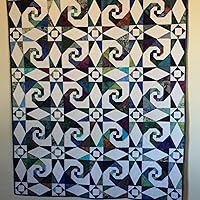
Meh...I always love looking at new quilt books, truly, but this one just didn’t do it for me.
January 20, 2019
Great book with clear instructions and beautiful scrap projects!

March 1, 2019
Great section on storing and sorting scraps.
Love the Slopes quilt on page 62.
Love the Slopes quilt on page 62.

December 16, 2019
Another good (and inspiring) collection of patterns for scrappy quilts, plus advice on how to organize your fabric scraps.
Displaying 1 - 30 of 45 reviews