

What do you think?

Inspector Maigret #7
Un crime en Hollande
Quand Maigret arriva a Delfzijl, une après-midi de mai, il n'avait sur l'affaire qui l'appelait dans cette petite ville plantée a l'extrême nord de la Hollande que des notions élémentaires.
Un certain Jean Duclos, professeur a l'université de Nancy, faisait une tournée de conférences dans les pays du Nord. A Delfzijl, il était l'hôte d'un professeur a l'Ecole navale, M. Popinga. Or, M. Popinga était assassiné et, si l'on n'accusait pas formellement le professeur français, on le priait néanmoins de ne pas quitter la ville et de se tenir a la disposition des autorités néerlandaises.
C'était tout, ou a peu près. Jean Duclos avait alerté l'université de Nancy, qui avait obtenu qu'un membre de la Police Judiciaire fut envoyé en mission à Delfzijl.
La tâche incombait à Maigret. Tâche plus officieuse qu'officielle et qu'il avait rendue moins officielle encore en omettant d'avertir ses collegues hollandais de son arrivée.
Par les soins de Jean Duclos, il avait reçu un rapport assez confus, suivi d'une liste des noms de ceux qui étaient mêlés de près ou de loin a cette histoire.
Ce fut cette liste qu'il consulta un peu avant d'arriver en gare de Delfzijl.
Un certain Jean Duclos, professeur a l'université de Nancy, faisait une tournée de conférences dans les pays du Nord. A Delfzijl, il était l'hôte d'un professeur a l'Ecole navale, M. Popinga. Or, M. Popinga était assassiné et, si l'on n'accusait pas formellement le professeur français, on le priait néanmoins de ne pas quitter la ville et de se tenir a la disposition des autorités néerlandaises.
C'était tout, ou a peu près. Jean Duclos avait alerté l'université de Nancy, qui avait obtenu qu'un membre de la Police Judiciaire fut envoyé en mission à Delfzijl.
La tâche incombait à Maigret. Tâche plus officieuse qu'officielle et qu'il avait rendue moins officielle encore en omettant d'avertir ses collegues hollandais de son arrivée.
Par les soins de Jean Duclos, il avait reçu un rapport assez confus, suivi d'une liste des noms de ceux qui étaient mêlés de près ou de loin a cette histoire.
Ce fut cette liste qu'il consulta un peu avant d'arriver en gare de Delfzijl.
190 pages, Pocket Book
First published January 1, 1931
About the author
Georges Simenon
2,688 books2,456 followersGeorges Joseph Christian Simenon (1903 – 1989) was a Belgian writer. A prolific author who published nearly 500 novels and numerous short works, Simenon is best known as the creator of the fictional detective Jules Maigret.
Although he never resided in Belgium after 1922, he remained a Belgian citizen throughout his life.
Simenon was one of the most prolific writers of the twentieth century, capable of writing 60 to 80 pages per day. His oeuvre includes nearly 200 novels, over 150 novellas, several autobiographical works, numerous articles, and scores of pulp novels written under more than two dozen pseudonyms. Altogether, about 550 million copies of his works have been printed.
He is best known, however, for his 75 novels and 28 short stories featuring Commissaire Maigret. The first novel in the series, Pietr-le-Letton, appeared in 1931; the last one, Maigret et M. Charles, was published in 1972. The Maigret novels were translated into all major languages and several of them were turned into films and radio plays. Two television series (1960-63 and 1992-93) have been made in Great Britain.
During his "American" period, Simenon reached the height of his creative powers, and several novels of those years were inspired by the context in which they were written (Trois chambres à Manhattan (1946), Maigret à New York (1947), Maigret se fâche (1947)).
Simenon also wrote a large number of "psychological novels", such as La neige était sale (1948) or Le fils (1957), as well as several autobiographical works, in particular Je me souviens (1945), Pedigree (1948), Mémoires intimes (1981).
In 1966, Simenon was given the MWA's highest honor, the Grand Master Award.
In 2005 he was nominated for the title of De Grootste Belg (The Greatest Belgian). In the Flemish version he ended 77th place. In the Walloon version he ended 10th place.
Although he never resided in Belgium after 1922, he remained a Belgian citizen throughout his life.
Simenon was one of the most prolific writers of the twentieth century, capable of writing 60 to 80 pages per day. His oeuvre includes nearly 200 novels, over 150 novellas, several autobiographical works, numerous articles, and scores of pulp novels written under more than two dozen pseudonyms. Altogether, about 550 million copies of his works have been printed.
He is best known, however, for his 75 novels and 28 short stories featuring Commissaire Maigret. The first novel in the series, Pietr-le-Letton, appeared in 1931; the last one, Maigret et M. Charles, was published in 1972. The Maigret novels were translated into all major languages and several of them were turned into films and radio plays. Two television series (1960-63 and 1992-93) have been made in Great Britain.
During his "American" period, Simenon reached the height of his creative powers, and several novels of those years were inspired by the context in which they were written (Trois chambres à Manhattan (1946), Maigret à New York (1947), Maigret se fâche (1947)).
Simenon also wrote a large number of "psychological novels", such as La neige était sale (1948) or Le fils (1957), as well as several autobiographical works, in particular Je me souviens (1945), Pedigree (1948), Mémoires intimes (1981).
In 1966, Simenon was given the MWA's highest honor, the Grand Master Award.
In 2005 he was nominated for the title of De Grootste Belg (The Greatest Belgian). In the Flemish version he ended 77th place. In the Walloon version he ended 10th place.
Ratings & Reviews
Friends & Following
Create a free account to discover what your friends think of this book!
Community Reviews
Displaying 1 - 30 of 303 reviews

August 5, 2019
Another wonderful atmospheric Maigret novel.
So, I was a tad late in reading this, as it was meant to be July's Maigret, but nevertheless it was a fantastic read. Simenon must have been an amazing observer of human nature as his characters show the good things about humans but also the bad, the evil, the hate and the jealousness.
This story is based in a little village in north eastern Holland near the border with Germany, on the river Ems and the gateway to the North Sea. Maigret, unable to speak any Dutch has been called in by the Frenchman found with the murder weapon in his hand to prove his innocence.
Maigret attempts to initially piece together the sequence of events then tries to interview the main characters in the story with varying degrees of success depending on their knowledge of the French language.
He recreates the night of the murder involving all the major players from the French Professor (there to give a lecture) to the young farmers daughter who lived along the canal who flirted with the murdered man. This recreation creates unbelievable pressure on all the major players but Maigret presses ahead.
Simenon's prose is so wonderfully descriptive and his characters are likewise so well written, but he makes Maigret with his intelligence, his determination and his flaws the most interesting and believable character of all.
It's heartening to know that I have over 5 years of Maigret novels to read.
So, I was a tad late in reading this, as it was meant to be July's Maigret, but nevertheless it was a fantastic read. Simenon must have been an amazing observer of human nature as his characters show the good things about humans but also the bad, the evil, the hate and the jealousness.
This story is based in a little village in north eastern Holland near the border with Germany, on the river Ems and the gateway to the North Sea. Maigret, unable to speak any Dutch has been called in by the Frenchman found with the murder weapon in his hand to prove his innocence.
Maigret attempts to initially piece together the sequence of events then tries to interview the main characters in the story with varying degrees of success depending on their knowledge of the French language.
He recreates the night of the murder involving all the major players from the French Professor (there to give a lecture) to the young farmers daughter who lived along the canal who flirted with the murdered man. This recreation creates unbelievable pressure on all the major players but Maigret presses ahead.
Simenon's prose is so wonderfully descriptive and his characters are likewise so well written, but he makes Maigret with his intelligence, his determination and his flaws the most interesting and believable character of all.
It's heartening to know that I have over 5 years of Maigret novels to read.

Read
December 22, 2018This could have been called the mystery of the three bosoms , as the crime and it's resolution are triangulated from three women's breasts, the characterisation of two of the women in particular by reference to their breasts reminded me of Issicratea's review of The Brethren, and this disappointed me, because I expected better from Simenon, perhaps this is simply not just of me, further reading will reveal .
Simenon sets this story in Holland, Maigret speaks only French, since his policing technique mostly consists of overhearing people or talking with them and then allowing the matter at hand to condense, this might be a sign of Simenon getting a bit bored and tying one authorial hand behind his back, luckily Maigret has an ability to understand that character is revealed through physical form - hence the additional importance of the afore mentioned breasts.
A crime has been committed in Holland, a country so peaceful that their only recourse is to summon a non-Dutch speaking policeman to solve the case, in truth the Dutch have police but the accused is a Frenchman and the dignity of France requires etc, etc...Maiget meeting this Frenchman quickly deduces that he is by birth Swiss, and a Protestant, as I said the bulky Maigret can read a person like a book, and is possessed of the well known ability of Papists to identify a Protestant at twelve paces . This naturalised Frenchman was in small town Holland lecturing on the psychology of crime - to an audience of indeterminate size
On the plus side the French criminologist lays out his sociological conception of crime: in certain close knit communities, like this one where the crime has occurred, propriety and appearances are so important that the community would prefer for the crime to be blamed on someone who has escaped and can not be caught or a convenient foreigner rather than for the dirty laundry of people's real lives behind the neat facade to be revealed. And Simenon evokes this small town atmosphere and the sense of not so concealed passions and frustrations very nicely. Again some superfluous exclamation marks. The linguistical handicap is quite a nice metaphor in a way as Maigret even in French is trying to get at what people are not telling him , what they don't want to reveal, here even if there was a shared language, the key witness would have preferred not to speak, let there be no scandal!
Simenon sets this story in Holland, Maigret speaks only French, since his policing technique mostly consists of overhearing people or talking with them and then allowing the matter at hand to condense, this might be a sign of Simenon getting a bit bored and tying one authorial hand behind his back, luckily Maigret has an ability to understand that character is revealed through physical form - hence the additional importance of the afore mentioned breasts.
A crime has been committed in Holland, a country so peaceful that their only recourse is to summon a non-Dutch speaking policeman to solve the case, in truth the Dutch have police but the accused is a Frenchman and the dignity of France requires etc, etc...Maiget meeting this Frenchman quickly deduces that he is by birth Swiss, and a Protestant, as I said the bulky Maigret can read a person like a book, and is possessed of the well known ability of Papists to identify a Protestant at twelve paces . This naturalised Frenchman was in small town Holland lecturing on the psychology of crime - to an audience of indeterminate size
On the plus side the French criminologist lays out his sociological conception of crime: in certain close knit communities, like this one where the crime has occurred, propriety and appearances are so important that the community would prefer for the crime to be blamed on someone who has escaped and can not be caught or a convenient foreigner rather than for the dirty laundry of people's real lives behind the neat facade to be revealed. And Simenon evokes this small town atmosphere and the sense of not so concealed passions and frustrations very nicely. Again some superfluous exclamation marks. The linguistical handicap is quite a nice metaphor in a way as Maigret even in French is trying to get at what people are not telling him , what they don't want to reveal, here even if there was a shared language, the key witness would have preferred not to speak, let there be no scandal!

November 12, 2021
For once, Maigret will encounter other customs in a country whose language he does not know, which will slow his investigation.
However, he will succeed in unraveling a family secret with his French methods, which will unsettle the Dutch. It was interesting. I liked it, but nothing more.
However, he will succeed in unraveling a family secret with his French methods, which will unsettle the Dutch. It was interesting. I liked it, but nothing more.

April 24, 2020
After having recently read the Simenon biography by Assouline, I indicated that I wanted to do a little research project to see whether the formula expressed by Simenon for writing Maigret detectives proved to be easily noticeable when reading one. His formula was: the detectives should never exceed 220 pages, the book should be readable in one sitting of 2 to 3 hours, simple language should be applied with only a sparse use of adjectives, the story should be fast and the conclusion clearly explained. Well, as I have not read a Maigret since my teens, it was quite revealing to read that the plot of ‘Een Misdaad in Holland’ (‘Un crime en Hollande’) was exactly fitting the formula: 190 pages, read it in one afternoon, noticed only strictly necessary adjectives, thus simple bare language and a traditional sort of Agatha Christie ending. So there it is. Strictly according to formula. He must have written it as usual in a week! I must say that it made me curious why some people in Delfzijl, Northern Holland, where the action took place, were even contemplating to sue Simenon for slander, as I really could not pinpoint whom could have been feeling insulted by the content of this detective story but, then again, the book was written in the early 1930s. So my conclusion is that it was fun, but I don’t think I will try another Maigret soon.

Read
April 15, 2023
Inspector Maigret takes on a murder case in the small northern Dutch city of Delfzijl.
What will any seasoned reader of Simenon's roman durs encounter when reading an Inspector Maigret novel? A shorter work with a tighter focus: instead of a detailed examination of the main character's psyche, the man or woman (usually a man) having been pushed to the edge, we follow Maigret tracking down clues and probing into the minds and hearts of everyone associated with the circumstances of a crime. I mention this since A Crime in Holland is my very first Maigret.
The facts of the case: Jules Duclos, a French professor visiting this quiet Dutch coastal town to deliver a lecture, attends a social gathering following his talk at the home where he's staying. Shortly after the guests leave, he hears a gunshot, rushes to the bathroom, looks out the window and sees the man of the house, Conrad Popinga, a Naval College professor, dead on the ground outside, shot in the chest. He makes the mistake of immediately picking up the revolver. Maigret is sent to investigate.
Simenon uses so few words to convey atmosphere. This on Delfzijl: "Just a little town: ten to fifteen streets at most, paved with handsome red bricks, laid down as regularly as tiles on a kitchen floor. Low-rise houses, also built of brick, and copiously decorated with woodwork, in bright cheerful colours. It looked like a toy town. All the more so since around this toy town ran a dyke, encircling it completely.”
Likewise, Simenon's quickest of character sketches, as per these observations made by Maigret when first meeting a few women and men -
Daughter of a farmer whose a friend of the Popinga family – “Beetje Liewens was wearing black rubber boots, which gave her the look of a stable-girl. Her green silk dress was almost entirely covered up by a white overall. A rose face, too rose y perhaps. A healthy, happy smile, but one lacking any subtlety. Large china-blue eyes. Red-gold hair.
Professor Duclos - “He hadn't expected him to look so young. Duclos was about thirty-five to thirty-eight. But there was something slightly unusual about him that struck Maigret....Duclos belonged to a category of men that the inspector knew well. Men of science. Study for study's sake. Ideas for ideas. A certain austerity of manner and lifestyle, combined with a taste for international contacts.”
Dutch inspector sent from Groningen who speaks French “slowly and rather pedantically” - “A tall blonde, clean-cut young man, of remarkably affable manner, he underlined every sentence with a little nod, which seemed to indicate: 'You get my meaning? We are agreed on this?'”
Mademoiselle Any, sister-in-law of Conrad Popinga, staying at the Popinga house - “Irregular features. If not for the large mouth and uneven teeth, she wouldn't have been worse-looking than average. Flat-chested. Large feet. But above all, the forbidding self-confidence of the suffragette.”
Maigret doesn't speak Dutch, which gives the tale an element of charm, since the French inspector doesn't need to know the language to read all the people he meets and questions as if they are an open book, especially when they treat him as an intrusive outsider who just might upset their social niceties and equilibrium. The way gruff Maigret goes about solving the case, step by step, gives these nice, proper people exactly what they deserve.
I don't see A Crime in Holland listed as one of Simenon's top Maigret novels but for fans of the author, I can't imagine anybody being disappointed.

Maigret statue in Delfzijl

Current day photo of Delfzijl, not that much different than what Maigret saw back in 1931, publication date of the novel

Georges Simenon, 1903-1989

May 14, 2019
Superb! This may well be the best of the 8 Maigret novels I've read so far. Wondrously plotted. Loved it.

May 1, 2019
The holder of the smoking gun claims he was not the murderer.
Then who?
Inspector Maigret investigates.
Two lovers - a young naval cadet and farm girl with a fierce father.
The conservative view point
Beetje is the only female round here who goes swimming every day, and not wearing a decent bathing-dress with a skirt, like all the other ladies, but in a skin-tight costume. Bright red, what’s more!
A safe little town‘Just take a look,’ Duclos said in an undertone, pointing to the scene all around them, the picture-book town, with everything in its place, like ornaments on the mantelpiece of a tidy housewife, the harbour too small for serious trouble, the placid inhabitants standing there in their yellow clogs.
Then he went on:
‘Everyone here earns his living. Everyone’s more or less content. And above all, everyone keeps his instincts under control, because that’s the rule here, and a necessity if people want to live in society. Pijpekamp will confirm that burglaries are extremely rare. It’s true that someone who steals a loaf of bread can expect a jail sentence of at least a few weeks. But where do you see any disorder? There are no prowlers. No beggars. This is a place of clean living and organization.’
The Dutch canals, the tidy farmyards, the ebb and flow of life by the harbor - all conspired to hide scandal and murder!
Enjoy!
Then who?
Inspector Maigret investigates.
Two lovers - a young naval cadet and farm girl with a fierce father.
The conservative view point
Beetje is the only female round here who goes swimming every day, and not wearing a decent bathing-dress with a skirt, like all the other ladies, but in a skin-tight costume. Bright red, what’s more!
A safe little town‘Just take a look,’ Duclos said in an undertone, pointing to the scene all around them, the picture-book town, with everything in its place, like ornaments on the mantelpiece of a tidy housewife, the harbour too small for serious trouble, the placid inhabitants standing there in their yellow clogs.
Then he went on:
‘Everyone here earns his living. Everyone’s more or less content. And above all, everyone keeps his instincts under control, because that’s the rule here, and a necessity if people want to live in society. Pijpekamp will confirm that burglaries are extremely rare. It’s true that someone who steals a loaf of bread can expect a jail sentence of at least a few weeks. But where do you see any disorder? There are no prowlers. No beggars. This is a place of clean living and organization.’
The Dutch canals, the tidy farmyards, the ebb and flow of life by the harbor - all conspired to hide scandal and murder!
Enjoy!

May 7, 2012
A Crime in Holland-Reread in (I believe) a different translation. The previous title was Maigret in Holland. The original French title was Un Crime en Hollande. The difference in English translation titles is important, because the novel concerns Maigret's investigation of a murder in a small town in Holland, where the authorities and the people of the town would like the murder to be forgotten and life to go on as it was. Maigret, of course, has another agenda.
As in most of the Inspector Maigret novels, the identity of the murderer is relatively unimportant. What is important is the psychology of the characters and their interactions, both among themselves and, most importantly, with Maigret, and that's whet you'll find here. If you're looking for a whodunit, look elsewhere.
As in most of the Inspector Maigret novels, the identity of the murderer is relatively unimportant. What is important is the psychology of the characters and their interactions, both among themselves and, most importantly, with Maigret, and that's whet you'll find here. If you're looking for a whodunit, look elsewhere.

July 31, 2024
It's not the best Maigret I have read, but I still enjoyed Simenon's writing and characterisation.
A Crime in Holland is an easy-reading crime novel with a Christie-esq gathering and unveiling at the end.
A Crime in Holland is an easy-reading crime novel with a Christie-esq gathering and unveiling at the end.

November 18, 2021
I love this series, so that's (so far, at least...) only the second Maigret novel I've quoted less than four stars.
Not a bad story, but I didn't like the atmosphere, the characters, and even Maigret isn't in his best mood.
The other 3 star novel is The Yellow Dog...
Not a bad story, but I didn't like the atmosphere, the characters, and even Maigret isn't in his best mood.
The other 3 star novel is The Yellow Dog...

December 21, 2014
A Crime in Holland (also published as Maigret in Holland) begins with a picture-postcard view of Delfzijl, numbering just a few thousand in 1931, when Georges Simenon’s slim novel was first published. But it isn’t long before Detective Chief Inspector Jules Maigret uncovers the savage emotions barely contained beneath the pretty surfaces. So, when Naval College professor Conrad Popinga is shot on his very doorstep and a French citizen is suspected, Maigret heads from Paris to the Netherlands’ northeast border with Germany, and the surly chief inspector proceeds to offend the über-polite, –repressed and — –repressive — bourgeoisie of Delfzijl.
Whether a longtime fan or a first-time reader looking for a new series, A Crime in Holland provides an offbeat police procedural that can’t please the thinking reader.
Whether a longtime fan or a first-time reader looking for a new series, A Crime in Holland provides an offbeat police procedural that can’t please the thinking reader.

February 22, 2026
Not my favorite Maigret mystery, but one where Maigret depends on his powers of observation & insight into human behavior to ferret out the murderer. He has been called to a small town in the Netherlands (Holland) to help with an investigation that involves in a guest lecturer who was a French citizen.

November 5, 2010
Not a book to make your acquaintance with the writing of Georges Simenon and his wonderful creation - Chief Inspector Maigret. This is the 8th in the series and perhaps the weakest to date.
It is a confusing plot set in Holland; the French police are requested to go to support a French national who is being asked to remain in the locality following an unresolved murder, Maigret is sent and soon carrying out his own investigation.
The sad aspect of this case is that the Dutch police and local community are not keen to reveal the truth; that almost reflects the value of this story; "who did it? - who cares?"
Happily Maigret is not amused even though he doesn't understand Dutch. His character is further revealed in this account, in that he cannot accept that a premeditated criminal could 'get away with murder'. Here the book is quite clever and could be a treatise on that very subject. It even has an amazing reconstruction of the crime, (beyond any denouement with Poirot) and it is worth reading this novel for both these reasons.
However, I fear if this was the first book you picked up you might not be impressed enough to read another one. That would be your loss and I'm ready and willing to read number nine and beyond.
It is a confusing plot set in Holland; the French police are requested to go to support a French national who is being asked to remain in the locality following an unresolved murder, Maigret is sent and soon carrying out his own investigation.
The sad aspect of this case is that the Dutch police and local community are not keen to reveal the truth; that almost reflects the value of this story; "who did it? - who cares?"
Happily Maigret is not amused even though he doesn't understand Dutch. His character is further revealed in this account, in that he cannot accept that a premeditated criminal could 'get away with murder'. Here the book is quite clever and could be a treatise on that very subject. It even has an amazing reconstruction of the crime, (beyond any denouement with Poirot) and it is worth reading this novel for both these reasons.
However, I fear if this was the first book you picked up you might not be impressed enough to read another one. That would be your loss and I'm ready and willing to read number nine and beyond.

October 22, 2025
Detective Chief Inspector Maigret is sent to investigate a murder in the Dutch town of Delfzijl, as the accused is a French citizen. Maigret is surprised by the town which is "a hundred times more Nordic in character than he had imagined." The streets are paved with red bricks, and the houses are "copiously decorated with woodwork, in bright cheerful colors." He likens it to a 'toy town.'
Maigret goes directly to the family home where he is made a cup of tea. "Steam rose from the teacups." Quickly, we realize that there is turbulence under the appearance of domestic bliss.
There is some friction between the Dutch and French in terms of the language barrier and some cultural norms. When Maigret talks with the daughter her father complains via a translator "that in Holland the police do not make arrangements to meet unmarried girls after dark out in the countryside."
Another reference to cultural differences comes in the comment, "I'm beginning to think the foreigners are right. A Frenchman is above all someone who cannot resist irony."
Interestingly, the topic of irony pops up again in the following passage:
Dutch Inspector "Pijpekamp was close to tears. Maigret's grave yet hardly perceptible irony had unsettled him so much that he bumped into the doorframe of the café's telephone booth."
Maigret orchestrates a re-enactment of the murder and solves the crime. This was an interesting and enjoyable read.
Note: it took me a minute to realize the term 'wireless' used in the story refers to a radio, and not our current use of the word, as in wireless internet.
Maigret goes directly to the family home where he is made a cup of tea. "Steam rose from the teacups." Quickly, we realize that there is turbulence under the appearance of domestic bliss.
There is some friction between the Dutch and French in terms of the language barrier and some cultural norms. When Maigret talks with the daughter her father complains via a translator "that in Holland the police do not make arrangements to meet unmarried girls after dark out in the countryside."
Another reference to cultural differences comes in the comment, "I'm beginning to think the foreigners are right. A Frenchman is above all someone who cannot resist irony."
Interestingly, the topic of irony pops up again in the following passage:
Dutch Inspector "Pijpekamp was close to tears. Maigret's grave yet hardly perceptible irony had unsettled him so much that he bumped into the doorframe of the café's telephone booth."
Maigret orchestrates a re-enactment of the murder and solves the crime. This was an interesting and enjoyable read.
Note: it took me a minute to realize the term 'wireless' used in the story refers to a radio, and not our current use of the word, as in wireless internet.

August 18, 2023
Nisan Yayınlarının Simenon Serisinin 11 numaralı kitabı Hollanda’da Bir Cinayet.
Çok farklı, şaşırtıcı bir Maigret profili. Maigret’nin bu tarzını sevmedim. Ama hikaye güzel, akıcı anlatım.
Beğendim.
Çok farklı, şaşırtıcı bir Maigret profili. Maigret’nin bu tarzını sevmedim. Ama hikaye güzel, akıcı anlatım.
Beğendim.

February 11, 2022
Maigret Goes Dutch
Review of the Penguin Classics paperback (May 2014) of a new translation* by Siân Reynolds of the French language original Un crime en Hollande (1931)
A Crime in Holland was a fish-out-of-water story for Maigret who is called in an unofficial capacity when a French professor is arrested for suspicion of committing murder in the town of Delfzjil, Holland. Maigret is faced with a situation where most of the suspects don't speak French but he still solves the crime by deduction and the gradual elimination of suspects.
The conclusion did use one of the standard golden age of crime tropes where Maigret assembles all of the suspects together on the scene and recreates the crime. That was the only orthodox part of the case in which Maigret is his usual cranky self with many of the locals and the official Dutch police who become quite frustrated with the foreign interference.
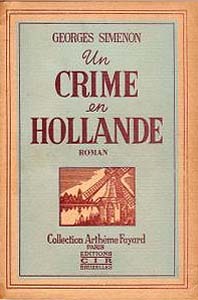
The cover of the original French language edition of "A Crime in Holland" as published by Fayard, France 1931. Image sourced from Association Jacques Riviere Alain Fournier: Maigret.
I've now read more than a dozen of the early Maigret novellas in the past several weeks and they continue to impress with how different they are not only from each other, but also from other "Golden Age of Crime" novels of that interwar era. What is even more impressive is that the first dozen were all published in 1931 as if he wrote one every month. Perhaps it is not that surprising from an author who wrote over 500 books in his lifetime, but it still an eyeopener.
In the continuing confusion for completists, this is Maigret #7 in the recent Penguin Classics series of new translations (2013-2019) of the Inspector Maigret novels and short stories, but it is Maigret #8 in the previous standard Maigret Series Listopia as listed on Goodreads.
Trivia and Links
* Some earlier English translations have given the title as Maigret in Holland.

There is a statue of Maigret in the town of Delfzijl, Netherlands to commemorate Maigret's appearance in A Crime in Holland. Image sourced from French Wikipedia.
See further information on the statue at https://www.trussel.com/maig/statue.htm
There is extensive background and a detailed plot description (spoilers obviously) about A Crime in Holland at Maigret of the Month.
A Crime in Holland has been adapted in 3 different television versions, in English (once) and French (twice). Information and links about the various adaptations are available at French Wikipedia.
There is an article about the Penguin Classics re-translations of the Inspector Maigret novels at Maigret, the Enduring Appeal of the Parisian Sleuth by Paddy Kehoe, RTE, August 17, 2019.
Review of the Penguin Classics paperback (May 2014) of a new translation* by Siân Reynolds of the French language original Un crime en Hollande (1931)
"Do you see? Someone wanted to provide too much evidence. To cause too much confusion. [_], or someone like him from outside, might have left half those clues, but not everything.
Therefore, there was premeditation. Therefore, a desire to escape punishment.
So we simply have to proceed by elimination."
[...]
"And that's all ... What time is the next train for France?"
Nobody said a word. They were all struck dumb with amazement, anguish, fear or horror.
- Maigret sums up the case and identifies the culprit (with some text redacted to avoid spoilers) in A Crime in Holland
A Crime in Holland was a fish-out-of-water story for Maigret who is called in an unofficial capacity when a French professor is arrested for suspicion of committing murder in the town of Delfzjil, Holland. Maigret is faced with a situation where most of the suspects don't speak French but he still solves the crime by deduction and the gradual elimination of suspects.
The conclusion did use one of the standard golden age of crime tropes where Maigret assembles all of the suspects together on the scene and recreates the crime. That was the only orthodox part of the case in which Maigret is his usual cranky self with many of the locals and the official Dutch police who become quite frustrated with the foreign interference.
The cover of the original French language edition of "A Crime in Holland" as published by Fayard, France 1931. Image sourced from Association Jacques Riviere Alain Fournier: Maigret.
I've now read more than a dozen of the early Maigret novellas in the past several weeks and they continue to impress with how different they are not only from each other, but also from other "Golden Age of Crime" novels of that interwar era. What is even more impressive is that the first dozen were all published in 1931 as if he wrote one every month. Perhaps it is not that surprising from an author who wrote over 500 books in his lifetime, but it still an eyeopener.
In the continuing confusion for completists, this is Maigret #7 in the recent Penguin Classics series of new translations (2013-2019) of the Inspector Maigret novels and short stories, but it is Maigret #8 in the previous standard Maigret Series Listopia as listed on Goodreads.
Trivia and Links
* Some earlier English translations have given the title as Maigret in Holland.
There is a statue of Maigret in the town of Delfzijl, Netherlands to commemorate Maigret's appearance in A Crime in Holland. Image sourced from French Wikipedia.
See further information on the statue at https://www.trussel.com/maig/statue.htm
There is extensive background and a detailed plot description (spoilers obviously) about A Crime in Holland at Maigret of the Month.
A Crime in Holland has been adapted in 3 different television versions, in English (once) and French (twice). Information and links about the various adaptations are available at French Wikipedia.
There is an article about the Penguin Classics re-translations of the Inspector Maigret novels at Maigret, the Enduring Appeal of the Parisian Sleuth by Paddy Kehoe, RTE, August 17, 2019.

April 10, 2012
I'm reading this because my library has only one non-Maigret title ('The Nightclub,' which I read and loved) and about 20 Maigrets. I recently finished Simenon's 'The Man Who Watched Trains Go By' and curiously, the protagonist of that novel and the murdered man in this one share a surname: Popinga. Other than that, there is little similarity. J'aime les romains durs... It's his 'hard novels' I love. The Maigrets I find rather comic. But they'll do in a pinch.
>>>>>>>>>
This is what's called a police procedural. It was mildly interesting, with none of the psychological depth or astute painting of society that his romains durs have. Small-town life in Holland is portrayed to be sure, in all of its claustrophobia, blandness and conformity, but it lacked the depth (and bite) I've come to expect from Simenon. In fact, it was almost annoying as it was again and again stated more than shown.
This is only the second Maigret I've read and I don't know that I'll read many more.
>>>>>>>>>
This is what's called a police procedural. It was mildly interesting, with none of the psychological depth or astute painting of society that his romains durs have. Small-town life in Holland is portrayed to be sure, in all of its claustrophobia, blandness and conformity, but it lacked the depth (and bite) I've come to expect from Simenon. In fact, it was almost annoying as it was again and again stated more than shown.
This is only the second Maigret I've read and I don't know that I'll read many more.

April 19, 2025
In a small town in Holland, a man was shot outside his own home. The man was a professor at the Naval Institute. The shooting was in the late evening after a guest lecturer from France had given a presentation on the responsibility of criminals. Ok, that sounded really preposterous to me, but I noted this was written in 1931 and there were certainly people then (and now) propounding theories on all sorts of subjects that seem more than a bit outlandish. Anyway, the guest lecturer was found to have a gun in his hand immediately after the murder. While Duclos wasn't charged, he was politely and firmly asked not to leave the area. He prevailed on the police in his home country to send someone to help. Enter Maigret.
I have read a fair amount of this series. I like the man Maigret. In the series and in this installment, we know everything Maigret knows as far as facts. When in France, Maigret has his staff out gathering information, but in Holland, he was alone. Anyway, throughout, what we don't know is what Maigret thinks about these facts. We can depend on his coming to a logical conclusion and I happily turn the pages, watching him put things together. I sometimes know the answer a paragraph or two - never more - before he announces that conclusion. I didn't here.
And now that I've said all the platitudes about the series, I must admit I missed Paris. I missed Maigret directing those who were his eyes and ears following people and doing undercover work. I don't think I can be a completist of the series - there are 75 installments! I might have skipped this one and not missed much, but I would always have wondered. Anyway, this is still worth 3-stars, although it probably comes in in the bottom half of that group.
I have read a fair amount of this series. I like the man Maigret. In the series and in this installment, we know everything Maigret knows as far as facts. When in France, Maigret has his staff out gathering information, but in Holland, he was alone. Anyway, throughout, what we don't know is what Maigret thinks about these facts. We can depend on his coming to a logical conclusion and I happily turn the pages, watching him put things together. I sometimes know the answer a paragraph or two - never more - before he announces that conclusion. I didn't here.
And now that I've said all the platitudes about the series, I must admit I missed Paris. I missed Maigret directing those who were his eyes and ears following people and doing undercover work. I don't think I can be a completist of the series - there are 75 installments! I might have skipped this one and not missed much, but I would always have wondered. Anyway, this is still worth 3-stars, although it probably comes in in the bottom half of that group.

August 29, 2026
This is another one of those stories where a figure in authority has asked the Police Judiciaire in Paris whether they can 'borrow' Maigret to investigate, in his own style, a murder. A man is shot dead by a single bullet from a revolver which is left by the bathroom window of the man's house. This gun is picked up by a French professor who's on a lecture tour of northern Europe. The professor is called Leclos and is very critical of Maigret and his indelicate methods of dealing with people with whom he doesn't share a common language.
The murder took place in the coastal town of Delfzijl on the Ems Delta in eastern Netherlands, right by the German border. This is an actual town near Groningen and not fictitious.
Maigret spends time walking around the town, getting the feel of the place and its small-town respectability, and becoming familiar with the locals and especially the people who might have committed the murder. He is helped or, more accurately, hindered by a local Groningen detective who thinks he's found a solution to the murder and invites Maigret to a celebratory lunch.
Of course, Maigret can't accept the solution provided and does his own version of the classic Hercule Poirot scene where all the suspects are gathered to hear his verdict. The truth is that any of them could have done the murder but Maigret pieces together the timescales so that only one person could have done it.
The murder took place in the coastal town of Delfzijl on the Ems Delta in eastern Netherlands, right by the German border. This is an actual town near Groningen and not fictitious.
Maigret spends time walking around the town, getting the feel of the place and its small-town respectability, and becoming familiar with the locals and especially the people who might have committed the murder. He is helped or, more accurately, hindered by a local Groningen detective who thinks he's found a solution to the murder and invites Maigret to a celebratory lunch.
Of course, Maigret can't accept the solution provided and does his own version of the classic Hercule Poirot scene where all the suspects are gathered to hear his verdict. The truth is that any of them could have done the murder but Maigret pieces together the timescales so that only one person could have done it.

September 10, 2023
Lo spiegone olandese
Deludente episodio della saga, questa trasferta olandese di Maigret, inviato (non si sa bene perchè e su che basi, ma tant'è) a coadiuvare un'inchiesta per omicidio che coinvolge un cittadino francese.
C'è ben poco di originale, il microcosmo di un paesetto olandese lindo e ordinato, che ovviamente nasconde passioni e tensioni furibonde, un delitto apparentemente inspiegabile, un set di personaggi un po' stereotipati cui Simenon dedica le sue peculiari attenzioni (piuttosto misogine, a dirla tutta: le donne del romanzo ne escono malino).
Il tutto finisce con uno spiegone stile Caso Saint Fiacre, che però viene completato da una ricostruzione in situ del delitto.
Trascurabile, nonostante qui e là ci siano, come sempre, notazioni e dettagli di livello.
Deludente episodio della saga, questa trasferta olandese di Maigret, inviato (non si sa bene perchè e su che basi, ma tant'è) a coadiuvare un'inchiesta per omicidio che coinvolge un cittadino francese.
C'è ben poco di originale, il microcosmo di un paesetto olandese lindo e ordinato, che ovviamente nasconde passioni e tensioni furibonde, un delitto apparentemente inspiegabile, un set di personaggi un po' stereotipati cui Simenon dedica le sue peculiari attenzioni (piuttosto misogine, a dirla tutta: le donne del romanzo ne escono malino).
Il tutto finisce con uno spiegone stile Caso Saint Fiacre, che però viene completato da una ricostruzione in situ del delitto.
Trascurabile, nonostante qui e là ci siano, come sempre, notazioni e dettagli di livello.

September 26, 2021
«Mi sono intromesso in una faccenda che non mi riguardava!» disse parlando in fretta. «Visto che si sospettava di un francese, mi hanno mandato qui per chiarire le cose...».
Così, ancora una volta Maigret si trova coinvolto in una indagine al di fuori della propria giurisdizione, addirittura a Delfzijl in Olanda, con una difficoltà in più: quella della lingua.
Nulla da dire sull’ambientazione, cosa in cui Simenon eccelle sempre.
Meno entusiasta dei personaggi (delineati magnificamente), a tratti veramente antipatici, così ciechi di fronte alla realtà, chiusi nel loro perbenismo e nelle loro superbe abitazioni, luoghi che giocano un ruolo di primo piano nella vicenda.
Pur con mille difficoltà, Maigret risolve il caso, con grande angoscia di tutte le persone coinvolte.
Fatto sta che alle cinque del mattino il commissario se ne andò tutto solo a prendere il treno alla piccola stazione di Delfzijl. Nessuno l’aveva accompagnato. Nessuno l’aveva ringraziato.
Che tristezza... Ho avvertito un po’ di amaro in bocca, soprattutto dopo le ultime pagine.
Che gente!
✍️ G.S./Maigret
# LdM- Mini sfida Oceania - task 8
Così, ancora una volta Maigret si trova coinvolto in una indagine al di fuori della propria giurisdizione, addirittura a Delfzijl in Olanda, con una difficoltà in più: quella della lingua.
Nulla da dire sull’ambientazione, cosa in cui Simenon eccelle sempre.
Meno entusiasta dei personaggi (delineati magnificamente), a tratti veramente antipatici, così ciechi di fronte alla realtà, chiusi nel loro perbenismo e nelle loro superbe abitazioni, luoghi che giocano un ruolo di primo piano nella vicenda.
Pur con mille difficoltà, Maigret risolve il caso, con grande angoscia di tutte le persone coinvolte.
Fatto sta che alle cinque del mattino il commissario se ne andò tutto solo a prendere il treno alla piccola stazione di Delfzijl. Nessuno l’aveva accompagnato. Nessuno l’aveva ringraziato.
Che tristezza... Ho avvertito un po’ di amaro in bocca, soprattutto dopo le ultime pagine.
Che gente!
✍️ G.S./Maigret
# LdM- Mini sfida Oceania - task 8

October 3, 2024
En esta ocasión el inspector francés Maigret es enviado a un pueblo de nombre impronunciable en Países Bajos, ha habido un asesinato y un ciudadano francés es retenido como persona de interés en el caso.
Aparenta ser un pueblo inocente con gente común, pero conforme pasan los días, Maigret percibe el rechazo a su presencia, y lo aliviados que se sienten muchas personas por no poder ser interrogadas por el, debido a la barrera del lenguaje.
Un libro donde Maigret tiene que utilizar otras herramientas como la observación y la intuición para recrear los hechos y llegar a una solución que nadie parece querer, ni siquiera el profesor francés inmiscuido.
Poco a poco se van develando los prejuicios y dogmas que rigen a la gente que vive ahí, el asesinato ocurrió en el círculo principal de ciudadanos que por así decirlo rigen la moral, para así mantener el equilibrio donde reposa la convivencia de todos, y en caso de que este puñado de gentes estuviera involucrado el populacho podría darse cuenta que no están en tan buenas manos, todos estos elementos no parecen importar a Maigret, el busca un objetivo y tarde o temprano lo conseguirá, no importando las consecuencias.
Al final del libro, un Maigret solitario abordando el tren rumbo a Paris, es la prueba evidente de que triunfó la verdad pero nadie en la localidad quedó satisfecho.
Simenon siempre logra añadir una pizca de crítica y realidad a sus libros policiacos, esto hace que se vuelvan un poco más reflexivos e inciten al análisis.
Un relato corto que entrega una historia llena de secretos y apariencias.
Aparenta ser un pueblo inocente con gente común, pero conforme pasan los días, Maigret percibe el rechazo a su presencia, y lo aliviados que se sienten muchas personas por no poder ser interrogadas por el, debido a la barrera del lenguaje.
Un libro donde Maigret tiene que utilizar otras herramientas como la observación y la intuición para recrear los hechos y llegar a una solución que nadie parece querer, ni siquiera el profesor francés inmiscuido.
Poco a poco se van develando los prejuicios y dogmas que rigen a la gente que vive ahí, el asesinato ocurrió en el círculo principal de ciudadanos que por así decirlo rigen la moral, para así mantener el equilibrio donde reposa la convivencia de todos, y en caso de que este puñado de gentes estuviera involucrado el populacho podría darse cuenta que no están en tan buenas manos, todos estos elementos no parecen importar a Maigret, el busca un objetivo y tarde o temprano lo conseguirá, no importando las consecuencias.
Al final del libro, un Maigret solitario abordando el tren rumbo a Paris, es la prueba evidente de que triunfó la verdad pero nadie en la localidad quedó satisfecho.
Simenon siempre logra añadir una pizca de crítica y realidad a sus libros policiacos, esto hace que se vuelvan un poco más reflexivos e inciten al análisis.
Un relato corto que entrega una historia llena de secretos y apariencias.

March 3, 2019
Another Maigret novel that reads more like a sketch than a finished book, although strangely for such a slim, no-thrills plot the pacing of this one feels almost languid. Maigret turns up, immediately gets the measure of his provincial Dutch hosts, toys with them for a bit whilst fussing about with his pipe and then casually arrives at a denouement that could have been lifted from a Cluedo envelope. As usual, Simenon evokes place and atmosphere very well but the characterisation is virtually non-existent, relying for the most part on physical description (particularly the size and pertness of the main female protagonist’s tits).

February 16, 2020
This was a really good read. Maigret finds himself dealing with Dutch people (the horror!) with the mystery of a dead husband.
The characters are well drawn. Miagret is a pleasure to read and this book looks closely at the pressures of a small community.
The characters are well drawn. Miagret is a pleasure to read and this book looks closely at the pressures of a small community.

June 18, 2026
I especially love the Maigret novels that not only take you back in time, but also to places other than in and around Paris. Here, Maigret is sent to a small town in Holland because a fellow Frenchman has become the main suspect in a murder. When Maigret finally meets the man (who is a professional speaker on the psychology of crime), he is a self-hating Frenchmen and considers himself more worldly and looks down on Maigret. Needless to say, he's a bit of a strawman for Maigret to good naturedly dismantle later on.
The murder victim is a teacher at the Naval College, a post of some distinction, but lives a little outside the lines of the "acceptable" community standards. Think of the movie Hot Fuzz and you have a pretty clear picture, except more canals and everyone is speaking Dutch. Maigret acquaints himself with the people surrounding the murdered man and is soon doing his usual Maigret detective work, which is simply looking around and letting people talk, pretending to be simple.
Once Maigret has his hypothesis straight (which only half-jokingly revolves around a young lady's ample breasts, harped on enough to even make me crack a wry smile), he recreates the crime and justice is done.
An adventurous outing for my favorite detective of all time with lots of characters with possible motives to keep you guessing, with the usual no-nonsense basic understanding of humanity at its core behind the crime.
The murder victim is a teacher at the Naval College, a post of some distinction, but lives a little outside the lines of the "acceptable" community standards. Think of the movie Hot Fuzz and you have a pretty clear picture, except more canals and everyone is speaking Dutch. Maigret acquaints himself with the people surrounding the murdered man and is soon doing his usual Maigret detective work, which is simply looking around and letting people talk, pretending to be simple.
Once Maigret has his hypothesis straight (which only half-jokingly revolves around a young lady's ample breasts, harped on enough to even make me crack a wry smile), he recreates the crime and justice is done.
An adventurous outing for my favorite detective of all time with lots of characters with possible motives to keep you guessing, with the usual no-nonsense basic understanding of humanity at its core behind the crime.

March 26, 2026
“Solo chi crede nella realtà può riuscire a disegnarla con mezzi così strepitosamente succinti”. (Carlo Fruttero)
Mai come in questa storia vediamo Maigret arrivare nella cittadina olandese, intraprendere l’indagine, concluderla, e poi finalmente andarsene, restando sempre di cattivo umore.
Forse perché la piccola città di provincia dove si consuma il delitto cerca di mantenere la sua facciata perbene e puritana, mentre in realtà oscure passioni serpeggiano, indomabili, al suo interno.
È il fuoco nascosto che Maigret scoperchierà sotto le braci a distruggere definitivamente quella patina di finta bontà.
Questo accadrà indagando sulla morte di Conrad Popinga, un uomo amabile e di buon carattere che mal sopporta la rigida morale comune, e della quale è accusato un professore francese, criminologo, in transferta in quella cittadina.
Ed ecco perché Maigret, pur malvolentieri, si trova là. A tutti farebbe comodo, infatti, attribuire allo straniero di turno un crimine che, altrimenti , potrebbe disgregare quella già fragile comunità paesana.
Ma la realtà si rivelerà ben diversa da come le comuni illusioni vorrebbero dipingerla e a Maigret è dato l’ingrato compito di dimostrarlo. (Ed ecco giustificato il suo umor plumbeo).
Poco avvincente dal punto di vista del plot giallo, l’avventura numero 8 di Maigret è invece molto interessante dal punto di vista dell’analisi sociologica. È con racconti come questo che Simenon si allinea al grande romanzo realista francese, dimostrando ancora una volta di esserne il legittimo erede.
3.5
Mai come in questa storia vediamo Maigret arrivare nella cittadina olandese, intraprendere l’indagine, concluderla, e poi finalmente andarsene, restando sempre di cattivo umore.
Forse perché la piccola città di provincia dove si consuma il delitto cerca di mantenere la sua facciata perbene e puritana, mentre in realtà oscure passioni serpeggiano, indomabili, al suo interno.
È il fuoco nascosto che Maigret scoperchierà sotto le braci a distruggere definitivamente quella patina di finta bontà.
Questo accadrà indagando sulla morte di Conrad Popinga, un uomo amabile e di buon carattere che mal sopporta la rigida morale comune, e della quale è accusato un professore francese, criminologo, in transferta in quella cittadina.
Ed ecco perché Maigret, pur malvolentieri, si trova là. A tutti farebbe comodo, infatti, attribuire allo straniero di turno un crimine che, altrimenti , potrebbe disgregare quella già fragile comunità paesana.
Ma la realtà si rivelerà ben diversa da come le comuni illusioni vorrebbero dipingerla e a Maigret è dato l’ingrato compito di dimostrarlo. (Ed ecco giustificato il suo umor plumbeo).
Poco avvincente dal punto di vista del plot giallo, l’avventura numero 8 di Maigret è invece molto interessante dal punto di vista dell’analisi sociologica. È con racconti come questo che Simenon si allinea al grande romanzo realista francese, dimostrando ancora una volta di esserne il legittimo erede.
3.5

June 6, 2020
M. Simenon takes us back to the canals and tow paths in Book #8 - after all it takes place in Holland (1931). In January 2020 it officially became The Netherlands, no more Holland!
This book had more of an Agatha Christie flair to it - lots of suspects with a countdown to the murderer. Bit of a twist.
I will say that I thought the translation was pretty poor. Seemed like it was missing something. There have certainly been many different translators for this series of 75 books.
This book had more of an Agatha Christie flair to it - lots of suspects with a countdown to the murderer. Bit of a twist.
I will say that I thought the translation was pretty poor. Seemed like it was missing something. There have certainly been many different translators for this series of 75 books.

May 18, 2018
A tale that features the beam from a lighthouse, a young woman who eventually marries a lightbulb salesman and Jules Maigret, a police inspector who is expected to throw light on crimes, is -- paradoxically -- full of shadows and dark corners. Knowing a little about the Chief Inspector's reputation we can expect him to deliver the goods in his steady methodical way, but the investigation will be hampered, first by his not being able to speak Dutch, and secondly by a small cast of characters who as expected have their own secrets to hide from him and from the close community they all live in.
Maigret travels to the northern end of Holland to assist a French criminology lecturer, Professor Jean Duclos, who has been caught up with the murder of a teacher in the Dutch port of Delfzijl. Duclos was found in possession of the revolver that killed Conrad Popinga, but there soon emerges a houseful of suspects and bystanders who could have had a motive for murder. And one common denominator among these motives turns out to be unrequited love.
Thankfully the local police inspector, Pijpekamp, speaks French, as do a handful of others who are involved, and while his modus operandi -- slow, silent and never jumping to conclusions -- irritates some, Maigret goes about collecting his evidence systematically (almost like a French juge d'instruction or examing magistrate). Then, as if in a classic British cosy, he stages a reconstruction of the crime with participating witnesses, allowing him to reach his conclusions, before finally leaving the matter in the hands of the Dutch inspector.
Despite his cold, taciturn exterior Maigret is not merely forensic in his approach: he is interested in human psychology and, in particular, individual motivation. This, along with him being an outsider, enables him to see what others do not. Simenon is like a reporter standing behind the inspector, observing his actions and his decisions but not daring to interpret them until the case is resolved.
This is apparently a key novel in the Maigret canon. We're told that in the late 1920s Simenon began to travel by boat around the French canals, moving on to Belgium (he was born in the Belgian town of Liège) and the Netherlands. Supposedly it was in Delfzijl, in September 1929, that he came up with the character of Jules Maigret, this epiphany eventually resulting in the corpus of seventy-odd novels featuring the Chief Inspector. Un Crime en Hollande was in the first batch of Maigret titles published two years later, in 1931.
Delfzijl is now a major town with a population of around 25,000, but in this novel set around ninety years ago it comes across as a sleepy provincial enclave. Sparsely peopled in this novel, the very nondescript nature of the port allows Maigret the leisure to stroll around, witness goings-on, make enquiries and eventually solve the crime before returning to his Paris haunts. His observational powers of searchlight propensities make him realise early on that it is the travelling beam of the local vuurtoren or lighthouse that is key to alighting on the likely supect, but not in the most obvious of processes.
Short enough to be a novella, Maigret in Holland for us moderns exudes an old-fashioned charm as it depicts a world long gone, one in which the pace of life was much less hectic than now. It's also very easy to imagine Simenon himself, laid up in a coastal town while his boat is being overhauled, taking the opportunity to quietly and unostentatiously make mental notes on what he sees and hears, saving those memories for the policier that's gestating in his imagination.
https://wp.me/s2oNj1-delfzijl
Maigret travels to the northern end of Holland to assist a French criminology lecturer, Professor Jean Duclos, who has been caught up with the murder of a teacher in the Dutch port of Delfzijl. Duclos was found in possession of the revolver that killed Conrad Popinga, but there soon emerges a houseful of suspects and bystanders who could have had a motive for murder. And one common denominator among these motives turns out to be unrequited love.
Thankfully the local police inspector, Pijpekamp, speaks French, as do a handful of others who are involved, and while his modus operandi -- slow, silent and never jumping to conclusions -- irritates some, Maigret goes about collecting his evidence systematically (almost like a French juge d'instruction or examing magistrate). Then, as if in a classic British cosy, he stages a reconstruction of the crime with participating witnesses, allowing him to reach his conclusions, before finally leaving the matter in the hands of the Dutch inspector.
Despite his cold, taciturn exterior Maigret is not merely forensic in his approach: he is interested in human psychology and, in particular, individual motivation. This, along with him being an outsider, enables him to see what others do not. Simenon is like a reporter standing behind the inspector, observing his actions and his decisions but not daring to interpret them until the case is resolved.
This is apparently a key novel in the Maigret canon. We're told that in the late 1920s Simenon began to travel by boat around the French canals, moving on to Belgium (he was born in the Belgian town of Liège) and the Netherlands. Supposedly it was in Delfzijl, in September 1929, that he came up with the character of Jules Maigret, this epiphany eventually resulting in the corpus of seventy-odd novels featuring the Chief Inspector. Un Crime en Hollande was in the first batch of Maigret titles published two years later, in 1931.
Delfzijl is now a major town with a population of around 25,000, but in this novel set around ninety years ago it comes across as a sleepy provincial enclave. Sparsely peopled in this novel, the very nondescript nature of the port allows Maigret the leisure to stroll around, witness goings-on, make enquiries and eventually solve the crime before returning to his Paris haunts. His observational powers of searchlight propensities make him realise early on that it is the travelling beam of the local vuurtoren or lighthouse that is key to alighting on the likely supect, but not in the most obvious of processes.
Short enough to be a novella, Maigret in Holland for us moderns exudes an old-fashioned charm as it depicts a world long gone, one in which the pace of life was much less hectic than now. It's also very easy to imagine Simenon himself, laid up in a coastal town while his boat is being overhauled, taking the opportunity to quietly and unostentatiously make mental notes on what he sees and hears, saving those memories for the policier that's gestating in his imagination.
https://wp.me/s2oNj1-delfzijl

July 15, 2012
Simenon's novels are an acquired taste. I first read one many years ago and wondered how he achieved such success--now I get it. It's a bit like eating something unusual for the first time (think Wasabi encrusted peanuts)-- you may not be sure it is to your taste, but you keep nibbling.
Simenon is a master of the environments he writes about. After a few short chapters you are part of its culture, feeling the atmosphere of the streets and cafes, and understanding the cadence of life there. It is intoxicating for me and I particularly love the Maigret books that are set in Paris. It is a charming way to visit Paris for a few hours, savouring the food and the drinks that Maigret often over-indulges in.
BUT, this book was set in Holland. And for the exact reasons that the French settings are so much fun for me, this one was restrictive and stifling. The author does such a thorough job of describing the village and its inhabitants that I was screaming to escape after 15 pages. Although this was far from my favorite Maigret story, it enhanced my appreciation for the author if he can accomplish so much in one spare volume.
Simenon is a master of the environments he writes about. After a few short chapters you are part of its culture, feeling the atmosphere of the streets and cafes, and understanding the cadence of life there. It is intoxicating for me and I particularly love the Maigret books that are set in Paris. It is a charming way to visit Paris for a few hours, savouring the food and the drinks that Maigret often over-indulges in.
BUT, this book was set in Holland. And for the exact reasons that the French settings are so much fun for me, this one was restrictive and stifling. The author does such a thorough job of describing the village and its inhabitants that I was screaming to escape after 15 pages. Although this was far from my favorite Maigret story, it enhanced my appreciation for the author if he can accomplish so much in one spare volume.

May 29, 2015
Inspector Maigret has gone to Holland to look into the case of a French citizen involved in a murder. He doesn't speak Dutch and not everybody in the town of Delfzijl speaks French. Nevertheless he finds that even in a prim and proper Dutch town, things are not always what they seem. Several people could be plausibly suspected. Maigret gathers the clues to eliminate the suspects, leaving the guilty person, in another intriguing episode.
Displaying 1 - 30 of 303 reviews