

What do you think?
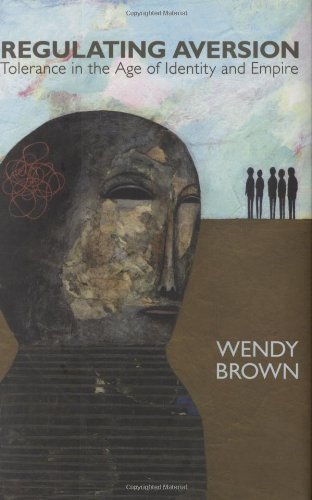
Regulating Aversion: Tolerance in the Age of Identity and Empire
Tolerance is generally regarded as an unqualified achievement of the modern West. Emerging in early modern Europe to defuse violent religious conflict and reduce persecution, tolerance today is hailed as a key to decreasing conflict across a wide range of other dividing lines-- cultural, racial, ethnic, and sexual. But, as political theorist Wendy Brown argues in Regulating Aversion , tolerance also has dark and troubling undercurrents.
Dislike, disapproval, and regulation lurk at the heart of tolerance. To tolerate is not to affirm but to conditionally allow what is unwanted or deviant. And, although presented as an alternative to violence, tolerance can play a part in justifying violence--dramatically so in the war in Iraq and the War on Terror. Wielded, especially since 9/11, as a way of distinguishing a civilized West from a barbaric Islam, tolerance is paradoxically underwriting Western imperialism.
Brown's analysis of the history and contemporary life of tolerance reveals it in a startlingly unfamiliar guise. Heavy with norms and consolidating the dominance of the powerful, tolerance sustains the abjection of the tolerated and equates the intolerant with the barbaric. Examining the operation of tolerance in contexts as different as the War on Terror, campaigns for gay rights, and the Los Angeles Museum of Tolerance, Brown traces the operation of tolerance in contemporary struggles over identity, citizenship, and civilization.
Dislike, disapproval, and regulation lurk at the heart of tolerance. To tolerate is not to affirm but to conditionally allow what is unwanted or deviant. And, although presented as an alternative to violence, tolerance can play a part in justifying violence--dramatically so in the war in Iraq and the War on Terror. Wielded, especially since 9/11, as a way of distinguishing a civilized West from a barbaric Islam, tolerance is paradoxically underwriting Western imperialism.
Brown's analysis of the history and contemporary life of tolerance reveals it in a startlingly unfamiliar guise. Heavy with norms and consolidating the dominance of the powerful, tolerance sustains the abjection of the tolerated and equates the intolerant with the barbaric. Examining the operation of tolerance in contexts as different as the War on Terror, campaigns for gay rights, and the Los Angeles Museum of Tolerance, Brown traces the operation of tolerance in contemporary struggles over identity, citizenship, and civilization.
288 pages, Hardcover
First published July 31, 2006
About the author
Wendy Brown
59 books362 followersWendy L. Brown is an American political theorist. She is Class of 1963 First Professor of Political Science and a core faculty member in The Program for Critical Theory at the University of California, Berkeley.
Ratings & Reviews
Friends & Following
Create a free account to discover what your friends think of this book!
Community Reviews
Displaying 1 - 25 of 25 reviews

January 5, 2015
Regulating Aversion is an intelligent and insightful but ultimately frustrating critique of tolerance discourse in western liberalism. Brown lays bare the hypocrisies of tolerance, as well as its troubling ties to empire and violence. Her chapter about the Museum of Tolerance is an excellent piece of criticism and the book as a whole skillfully undermines western liberalism's pretensions to universality and justice. But Brown mostly smashes idols and reveals inconsistencies, which brings her dangerously close to complete cultural relativism, at least in theory if not in personal practice or belief. Sometimes her comparisons between the plight of women in North America and elsewhere seem insincere, though I don't dismiss them completely. In any case, if so much of western liberalism and liberal culture is just as arbitrarily cultural and conceivably "barbaric" as the Others that it chooses to tolerate or condemn, are we left with no grounds to critique or restrict cultural practices that we (and Brown) find to be abhorrent? Brown exposes hypocrisy and violence skillfully, but she leaves little to stand on. Moreover, her condemnation of certain positions and practices as wrong or unjust frequently assumes that her reader shares her views. She should have done more to show why her view of a particular injustice should be shared.
It is interesting to read this book in 2014/2015, given that it appeared in 2006, at the nadir of the Bush years. Its original context gives Brown a rather easy and unsophisticated target to attack quote throughout: George W. Bush. I'm still not sure how I feel about this. On the one hand, it seems too easy to go after him and his regime, and the frequency with which she uses his public statements as an object of criticism makes the book feel too much of its strident time. Of course Bush's articulation of liberalism is hypocritical! On the other hand, she is critiquing the public articulations that historically justified multiple wars and which still animate our moment (I write this review the day after the Charlie Hebdo shooters were finally killed; the discourse now is that their acts were barbaric acts against the free expression of liberalism and civilization), even if their most explicit and simplistic mouthpiece is no longer around.
It is interesting to read this book in 2014/2015, given that it appeared in 2006, at the nadir of the Bush years. Its original context gives Brown a rather easy and unsophisticated target to attack quote throughout: George W. Bush. I'm still not sure how I feel about this. On the one hand, it seems too easy to go after him and his regime, and the frequency with which she uses his public statements as an object of criticism makes the book feel too much of its strident time. Of course Bush's articulation of liberalism is hypocritical! On the other hand, she is critiquing the public articulations that historically justified multiple wars and which still animate our moment (I write this review the day after the Charlie Hebdo shooters were finally killed; the discourse now is that their acts were barbaric acts against the free expression of liberalism and civilization), even if their most explicit and simplistic mouthpiece is no longer around.

June 3, 2021
A masterpiece of scholarship parsing the notion of tolerance.
"That is, the tolerated subject is not just disliked but disliked because it is different, and different by virtue of its practices and beliefs. On the one hand, this logic essentializes race, ethnicity, and sexuality as cultural, as “practices and beliefs.” Exactly as Foucault’s theory of the modern subject would suggest, racialized being or “sexual preference” is treated as intrinsic and as generating certain beliefs and practices that are “different,” and therefore as producing an inherent and permanent condition for which tolerance becomes the solution. Nowhere is race or sexual preference recognized as produced by the essentializing of difference that the discourse of tolerance itself reiterates; that is, nowhere is tolerance recognized as reproducing racialization or sexual identity. On the other hand, the invocation of tolerance inflects these “practices and beliefs” with a religious quality and reaffirms the conceit that the tolerating body—whether the state or an unmarked identity—is neutral or secular. All otherness is deposited in that which is tolerated, thereby reinscribing the marginalization of the already marginal by reifying and opposing their difference to the normal, the secular, or the neutral" (p.45).
"That is, the tolerated subject is not just disliked but disliked because it is different, and different by virtue of its practices and beliefs. On the one hand, this logic essentializes race, ethnicity, and sexuality as cultural, as “practices and beliefs.” Exactly as Foucault’s theory of the modern subject would suggest, racialized being or “sexual preference” is treated as intrinsic and as generating certain beliefs and practices that are “different,” and therefore as producing an inherent and permanent condition for which tolerance becomes the solution. Nowhere is race or sexual preference recognized as produced by the essentializing of difference that the discourse of tolerance itself reiterates; that is, nowhere is tolerance recognized as reproducing racialization or sexual identity. On the other hand, the invocation of tolerance inflects these “practices and beliefs” with a religious quality and reaffirms the conceit that the tolerating body—whether the state or an unmarked identity—is neutral or secular. All otherness is deposited in that which is tolerated, thereby reinscribing the marginalization of the already marginal by reifying and opposing their difference to the normal, the secular, or the neutral" (p.45).

October 22, 2016
Way too many people we encounter throw-off the tolerance word never fully comprehending what it is they mean by tolerance, but when someone dares look-up the word in a good dictionary, that someone will find that the actual meanings of tolerance are nowhere near commonly misused synonyms like acceptance or equality. What this means is that Wendy Brown's "Regulating Aversion: Tolerance in the Age of Identity and Empire" is one of those books you are lucky to find even if it constitutes difficult reading for some. Brown, one of the finest ethical philosophers to study the impact of neoliberalism on the common traditions of the liberal democratic tradition, here discusses how states and other implements of "governmentality", a Foucaultean term for instruments of governing that bypass state regulation, legality and the political sphere altogether, culture, society, literature, art, mass media, economics, business, and more all providing a great amount of how civilization orders and controls its citizens and subjects, and how while we often naively understand that equality is one of the primary values we use to measure our relations to both the state, to the many orders within the state's legal and political purviews, mainly because equality cannot embrace all civilization. Hence Brown's study will be important to those who want to better understand women in civilization, or more complexly, the "other" within civilization, mainly because tolerance properly defined means to tolerate or to bear qualities or factors that tend to be otherwise intolerable, difficult to bear.
This is a wow of a book. Brown shows the difference between how "women's liberation" is a striving for equality, but the predicament of the Jews, both in 19th and 20th Century Europe, and in the United States, is often a striving for tolerance, a sort of separate but tolerated state of affairs that may or may not given time lead certain transnational or previously unequal populations towards equality In simpler words, tolerance is an add-on when equality isn't enough.
Moreover, as Brown also shows, states and power elites, typically a majority or an empowered minority, often utilize tolerance as an imperialistic tool that actually makes sometimes hard lines in the sand between us and them or civilized and barbarian, and hence ideals such as multiculturalism become both problematic to liberal democratic nation-states and to Western civilization itself--and a matter of sometimes extreme injustice, especially when equality is not even on the table, not as a possibility or as a promise. Tolerance is a double-edged sword, and typically, those on top of the power gradient reap the advantages when they interpret themselves and their ways and means of life as "civilized" and all else as "not civilized", or barbaric or even a threat to all humankind. Local or non-local, those problems only amplify injustice, at least when justice is actually valued, though often it is not in neoliberal ideology when "soft" economic power overwhelms or renders insignificant the demos or polity in favor of other ends neither liberal nor democratic at all.
This book is going to remain relevant for years to come as certain criticisms of Foucault and beyond continue to bear their weight against more conservative or traditional understandings of what constitutes power with the liberal democratic tradition.
This is a wow of a book. Brown shows the difference between how "women's liberation" is a striving for equality, but the predicament of the Jews, both in 19th and 20th Century Europe, and in the United States, is often a striving for tolerance, a sort of separate but tolerated state of affairs that may or may not given time lead certain transnational or previously unequal populations towards equality In simpler words, tolerance is an add-on when equality isn't enough.
Moreover, as Brown also shows, states and power elites, typically a majority or an empowered minority, often utilize tolerance as an imperialistic tool that actually makes sometimes hard lines in the sand between us and them or civilized and barbarian, and hence ideals such as multiculturalism become both problematic to liberal democratic nation-states and to Western civilization itself--and a matter of sometimes extreme injustice, especially when equality is not even on the table, not as a possibility or as a promise. Tolerance is a double-edged sword, and typically, those on top of the power gradient reap the advantages when they interpret themselves and their ways and means of life as "civilized" and all else as "not civilized", or barbaric or even a threat to all humankind. Local or non-local, those problems only amplify injustice, at least when justice is actually valued, though often it is not in neoliberal ideology when "soft" economic power overwhelms or renders insignificant the demos or polity in favor of other ends neither liberal nor democratic at all.
This book is going to remain relevant for years to come as certain criticisms of Foucault and beyond continue to bear their weight against more conservative or traditional understandings of what constitutes power with the liberal democratic tradition.

April 13, 2017
A must-read. "Today, we hear from every corner, differences matter. If not intrinsic and permanent - which is what much popular and scientific discourse holds - they are at least considered highly intractable. And tolerance is required because they are intractable. Indeed, as the homosexuality-is-curable advocates make clear, differences eligible for transformation do not require tolerance. Tolerance arises at the dusk of Enlightenment Man not to relieve us of the problem of difference but to inscribe its power and permanence." (Wendy Brown, Regulating Aversion)

August 31, 2016
This book would serve as a good starting point for discussion in a class on multiculturalism, foreign policy or race relations. Sadly, I read it on my lonesome, quickly, and without the consideration such discussion would afford. So doing, I was reminded of reading H. Marcuse back in high school. This was easier, but then I'm more educated now. A more contemporary association was with M. Foucault.
What I didn't see much of, but would have liked to have seen much more of would be a listing of the taboos/restrictions we comfortable white folks bear in the West and in the U.S.A. in particular. Perhaps they might be culled from the writings of non-westerners. Brown does mention some, but only in a paragraph and only towards the end of her text. That would be mind-opening for me.
What I didn't see much of, but would have liked to have seen much more of would be a listing of the taboos/restrictions we comfortable white folks bear in the West and in the U.S.A. in particular. Perhaps they might be culled from the writings of non-westerners. Brown does mention some, but only in a paragraph and only towards the end of her text. That would be mind-opening for me.

June 25, 2019
It should be reiterated widely that tolerance is not in itself a value, but rather a tactic of managing difference. Tolerance have been the watchword of liberalism ever since its conception during the religious strife in 17th century Europe. At first, the word only pertains to the managing of contradicting beliefs in a given society. As time goes on however, the meaning of the concept was extended to include the management of perceived difference in gender, in race, and in sexuality.
Liberal tolerance managed difference in its subject by several mechanisms, all of which depended on the Cartesian view of the soul-body split:
1. The pure human soul is rational, and humanistic. Liberalism is the height of rationality, so profane things such as religion and culture is, at least subconsciously, regarded as defect in the supreme rationality of the human soul. For liberals, illiberalism is a mark of defect in humanity.
2. A tolerant person has a superior position in the matrix of power-relation to those who are the subject of toleration. American Christians can be said to 'tolerate' the Muslims, but American Muslims can't be said to be 'tolerant' towards their Christian brethren. Same goes for Indonesian muslims and non-Muslims, and for any majority to minority in general.
3. Neutralization of difference by relegating it to the private. You can go to church or mosque or temple, and you can fuck men or women or anything-in-between, but you can never make your difference be visible in public, lest your inhuman defect become political. And God knows how everyone hate to politicize identities nowadays. By everyone, I mean liberals--whose notion of identity is severely twisted.
Brown threw lots of unkind remarks at tolerance. However, she maintained that tolerance is still a very useful and is a virtuous trait to have. She just wrote this book to make us wiser to how the discourse of tolerance works in maintaining and shuffling the structure of power.
Well, I can say that I'm wiser than I had been before I read this book. And also a tad more pessimistic, I should add.
Liberal tolerance managed difference in its subject by several mechanisms, all of which depended on the Cartesian view of the soul-body split:
1. The pure human soul is rational, and humanistic. Liberalism is the height of rationality, so profane things such as religion and culture is, at least subconsciously, regarded as defect in the supreme rationality of the human soul. For liberals, illiberalism is a mark of defect in humanity.
2. A tolerant person has a superior position in the matrix of power-relation to those who are the subject of toleration. American Christians can be said to 'tolerate' the Muslims, but American Muslims can't be said to be 'tolerant' towards their Christian brethren. Same goes for Indonesian muslims and non-Muslims, and for any majority to minority in general.
3. Neutralization of difference by relegating it to the private. You can go to church or mosque or temple, and you can fuck men or women or anything-in-between, but you can never make your difference be visible in public, lest your inhuman defect become political. And God knows how everyone hate to politicize identities nowadays. By everyone, I mean liberals--whose notion of identity is severely twisted.
Brown threw lots of unkind remarks at tolerance. However, she maintained that tolerance is still a very useful and is a virtuous trait to have. She just wrote this book to make us wiser to how the discourse of tolerance works in maintaining and shuffling the structure of power.
Well, I can say that I'm wiser than I had been before I read this book. And also a tad more pessimistic, I should add.
February 11, 2018
Highly interesting and, unfortunately, highly relevant, this is a book I'm taking with me for the seminar I'm writing on Secularity. The breadth of the material covered is amazing, what is even more noteworthy is the density of the writing. Every word counts, and that's not an easy fit, to say the least. The time did take its tall, as the references to George Bush Jr. do seem a bit dated, and yet it is quite easily one of the more important books I've read this year.
July 23, 2022
Thought provoking
Wendy Brown is addressing thoughtful liberals who may not fully understand the many disturbing assumptions which underlie the promotion of tolerance. A change in emphasis away from toleration and toward equality and justice has to a considerable extent taken place within progressive discourse during the past decade, but Brown's book will deepen readers' understanding of why this change was needed and why it should be deepened.
Wendy Brown is addressing thoughtful liberals who may not fully understand the many disturbing assumptions which underlie the promotion of tolerance. A change in emphasis away from toleration and toward equality and justice has to a considerable extent taken place within progressive discourse during the past decade, but Brown's book will deepen readers' understanding of why this change was needed and why it should be deepened.
August 5, 2018
"Tolerance is invoked in liberal democratic societies when a hegemonic norm can not colonize or incorporate its Other with ease, when that norm maintains or regroups its strength through a new technique of marginalization and regulation rather than through incorporation and direct relations of subordination."

March 18, 2020
An interesting read; I would have liked to see more supporting evidence, but it definitely provides food for thought.

February 16, 2022
some good arguments (especially about “tolerance” as an emblem of “Western” civilization) but way too dense for my little brain
April 26, 2023
Really thought provoking and insightful. Highly academic. Would love to see a version of this book written for more general public consumption.

August 13, 2025
a great companion text to Mamdani's Neither Settler Nor Native; such brilliant and rigorous scholars both!

May 25, 2015
Regulating Aversion is an outstanding critique of the concept of tolerance and its use as a supplement for understanding to further justify oppression. 'We' tolerate the Other as a form of domination and control; Jews in Europe were the subject of toleration before 1945 (Chapter 03), as Muslims are today (Chapter 06). Brown's books serve as magnificent critiques of liberalism, modernity and the West's self-righteousness.
Wendy Brown is an excellent writer, my notes for this book were nearly as long as the book itself, as every paragraph seemed vital and worthy of reflection. The book is often painful to read as it hits close to home, a seemingly benign concept exposed as yet another discourse of control and oppression.
Wendy Brown is an excellent writer, my notes for this book were nearly as long as the book itself, as every paragraph seemed vital and worthy of reflection. The book is often painful to read as it hits close to home, a seemingly benign concept exposed as yet another discourse of control and oppression.

January 6, 2012
This book is a thorough and nuanced account of the operation of tolerance discourse as articulated by Western liberalism. Brown is attentive to detail, clear in her reasoning, probing in her questioning, and careful in her conclusions. For these reasons, it is an excellent book. However, this book is not theoretically groundbreaking. It is a fine application of Foucault and other theorists, and often thought-provoking with regard to the particulars of this topic, but it is only occasionally surprising and it does not really attempt to posit big revolutionary ideas.

April 27, 2010
This is a critique of tolerance as the height of civility or civilization. Tolerance is basically dealing with a situation you would prefer not to-- Like --I'd kill you if I could, but I have to tolerate your existence, or have mine disrupted. This is not an elevated feeling of love and respect for fellow human beings and their cultures, beliefs, and differences. Tolerance is reigning in suspicious to murderous feelings, not embracing difference.

April 20, 2008
Wow. Wendy Brown provides a critique of the depoliticizing of "toleration" in the West. Now i want to hear more about constructive efforts to apply toleration minus the cultural baggage of Enlightenment rhetoric and practice.

June 23, 2011
I find Brown very wishy-washy when it comes to the issue of identity politics. And nowhere near at the intellectual level of her partner Judith Butler, but she did have a lot of good things to say here.

January 6, 2016
I am such a Wendy Brown fangirl. Her account of how and why the contemporary deployment of the concept of "tolerance" is a discursive trick made my brain bigger. Also contains an epic takedown of Susan Orkin.

May 8, 2007
some great observations on the western/liberal rhetoric of tolerance. highly relevant and erudite
August 27, 2007
i like the read stringy brains
February 21, 2009
As usual, a very good critical account of the liberal state from Brown. Also a very good reminder to those who emulate liberal societies for a multiculturalist talk.

February 27, 2010
Very informative and very important.
My highest recommendation to anyone who is interested in post-structuralist analysis of discourse.
My highest recommendation to anyone who is interested in post-structuralist analysis of discourse.
April 18, 2013
The writing is kind of ponderous, but what she has to say is not only I believe valid but important. A lot of valuable insights and food for thought.

to-keep-reference
March 16, 2016Usado en Sobre la Violencia Pág.170
Displaying 1 - 25 of 25 reviews