The Yoga Vasistha has been a favourite book of spiritual seekers in India these several centuries. Its special appeal lies in its thoroughly rational approach, and in its presentation of Vedanta as a philosophy to bridge the gulf between the secular and the sacred, action and contemplation, in human life, through a comprehensive and lofty spirituality. This monumental scripture is the greatest help to the spiritual awakening and the direct experience of the Truth. This is certain. If this is what you want, you are welcome to the Yoga Vasistha. An oft-recurring expression in this scripture is kakataliya'-a crow alights on the coconut palm tree and at that very moment a ripe coconut falls. The two unrelated events thus seem to be related in time and space, though there is no causal relationship. Such is life. Such is 'creation'. But the mind caught up in its own trap of logic questions why, invents a 'why' and a 'wherefore' to satisfy itself, conveniently ignoring the inconvenient questions that still haunt an intelligent mind. Vasistha demands direct observation of the mind, its motion, its notions, its reasoning, the assumed cause and the projected result, and even the observer, the observed and the observation-and the realisation of their indivisible unity as the infinite consciousness.
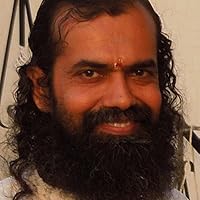
Swami Venkatesananda (Parthsarathy as he was known then) was born in Tanjore on December 29th, 1921, to a South Indian Brahmin family. He learned Sanskrit at an early age from his uncle and grandfather, and used to love to take part in religious observances. He was not only scholarly but full of fun (a trait which endeared him in later life when, as a Swami, he travelled in the West, illustrating the everyday concepts we live by with his humorous stories.)
At the age of fourteen he discovered a book by Swami Sivananda in a bookshop. He was so impressed that he wrote to Swami Sivananda asking if he could join him in his ashram. Swami Sivananda told him to finish his education and then come to Rishikesh.
On leaving school, he studied shorthand and typing, coming first in the examination. After working for the Madras Corporation, he obtained the position of Private Secretary to the Minister of War in Calcutta; most suitably, as a member of the diplomatic core. In this capacity one day he was asked to escort some V.I.P.s to Haridwar and Rishikesh. He visited Sivananda Ashram and was told that Swami Sivananda was resting and he wouldn't be able to meet him. Shortly after, Sivananda unexpectedly came out. He looked at Parthasarathy and said, "So. You have come," and asked him to stay at the ashram.
So after fulfilling his work commitments for a year, he returned to Rishikes to stay. Sivananda put him to work in various departments of the ashram's kitchen, temple, office, and typing, the press etc. After that he became the private secretary to Swami Sivananda, typing his books, answering letters and generally helping in his day to day activities. Later he travelled the world to spread the message of his master, Swami Sivananda.
This was my third reading of it. Each time reveals more depth and wisdom. These stories all have a common theme: “dream within a dream” or “room full of mirrors” to illustrate the nature of consciousness and it’s powerful ability to become identified with the objects it experiences.
I highly recommend this book to students of yoga and philosophy. It is designed to be be psychoactive and awaken the Rishi or inner knower. It does this well.
This is a book by famed Swami Venkatesananda of the Sivananda Ashram. The Swamiji had travelled the world and brought in those insights into his profound commentaries of the spiritual classics and shaastras. This exposition on Yog Vasistha is one such. Each page expands on a new verse. It explains the backdrop and the spiritual contexts, meanings and implications. There is a date put on each page number suggesting that the idea is to read a page a day. In my view, putting dates was not needed. Likewise there are Roman numeraled page numbers along with the Arabic numbers is all confusing. But this is only a minor blip that the reader can easily ignore. The innate spiritual ability in the Swamiji, his genius is explaining verses while making them most interesting are very well in display in this book. The book is about a phase in Sri Ramachandra's life when he wanted to give it all up and renunciate, seeing no point of this endless cycle of samsara. Being an incarnate himself, this is no suprise and all of us have faced this feeling at some point in our lives. Yog Vasistha's message through this enjoyable book filled with stories is that is not the way to approach life. Life is to be lived as a service to everyone around. And as an offering to God. Staying unattached with such an attitude one definitely lives a life of peace and fulfillment and achieves its purpose, that is Moksha!
A dialogue between a mythological anthropomorphic god (Ram) and his guru (Vashishth) where the guru explains the nature of reality to his disciple Ram. The book explores the most basic tenet of spirituality: ontology (the philosophical study of being). This philosophy is very similar to metaphysical idealism which asserts that consciousness is primary and the matter is secondary. It also delves into how a human can realize these realities merely by stilling their mind. This is very similar to the 10 principal Upanishads, the Brahma Sutras, and the Gita which form the very basis of Hindu religion and mythology. An excellent piece of mystic philosophy.