

What do you think?

A History of London
Stephen Inwood has written a compelling and comprehensive history of this incredibly unique and complicated city, from the fires and plundering of latterday Londinium to the frenetic art, music and politics of London's last 30 years. This is the updated paperback edition. "Inwood's book has it all, so much so that, coming to the end, the reader wants to start over again." - "Sunday Times". "An utterly winning work, erudite yet entertaining...This is a wonderful book." - "Financial Times". "Inwood proves himself a heroic reader, absorbing and filtering all that is to be known about a city for which he has a genuine and abiding affection." - "Daily Telegraph". "As sprawling and richly textured as London itself." - "Independent".
Paperback
First published January 1, 1998
About the author
Stephen Inwood
5 books5 followersDr Stephen Inwood was educated at Dulwich College and at Balliol and St Antony's College, Oxford. For twenty-six years he was a college and university history lecturer, but he became a professional writer in 1999.
Ratings & Reviews
Friends & Following
Create a free account to discover what your friends think of this book!
Community Reviews
Displaying 1 - 14 of 14 reviews

February 21, 2021
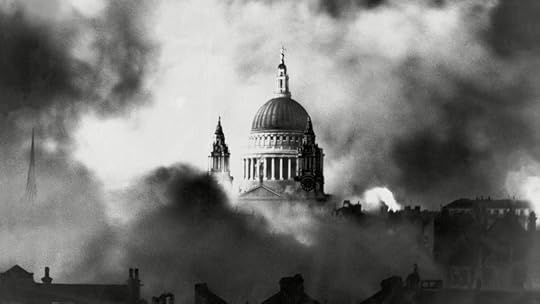
St Paul's Cathedral during a raid in 1940, London Blitz. Photo by Herbert Mason
------
1000 oversized pages that seem to each somehow get longer as the book progresses. I read half in Dec 2019 when I was able to visit London. Picked it up again Dec 2020 and finally finished last weekend. It‘s incredibly detailed and thorough. Fascinating throughout, although the interesting bits get more sparse as it goes forward and spends more time on regional government, housing, rails and roads.
I visited London in December 2019, having read to roughly the mid 1700's and I walked through The City, looking for all these locations I had read about, and, if you know London, you can imagine I was little bewildered. Of course, it's not till much later in the book Inwood explained how much was destroyed during and, especially, after WWII.
When I came back to the book this past December, Inwood began covering the expansion of London and all these famous suburbs, some of which I had managed to stumble through. I found this maybe my favorite part of the book. Of course, London kept expanding and expanding (and location names seemed to multiply exponentially).
-------
A note about London in the 1930's
"It was, as it had been for two centuries, Europe's largest and richest consumer market"
on expansion
"By 1939 the area occupied by the London conurbation was more than twice as great as that occupied in 1914, and about six times that of 1880. Most of the London we know today only became part of the conurbation in the interwar years, and well over half the rest is late Victorian or Edwardian. Much of he newly developed land was fertile agricultural land of the highest quality..."
-------
7. A History of London by Stephen Inwood
foreword: Roy Porter
published: 1998
format: 1040-page paperback brick (plus bibliography and index)
acquired: December 2019
read: Dec 11-31, 2019, and Dec 25, 2020 – Feb 14, 2021
time reading: 54 hr 24 min, 3 min/page
rating: 4½
locations: 🙂

April 6, 2013
Over the past two weeks, whenever I haven't been packing, working, or cleaning, I've been marathon reading Inwood's History of London. Don't let the book's size daunt you: Inwood keeps everything zipping along at a good clip and doesn't get bogged down in minutiae -- if anything I would have preferred more detail in some sections. Overall, though, I found this extremely coherent and readable, and a good foundational overview of London's development.
Battling the overwhelming urge now to read Connie Willi's Blackout and All Clear. The only thing keeping me from doing so is that I think they're both currently packed in a box somewhere!
Battling the overwhelming urge now to read Connie Willi's Blackout and All Clear. The only thing keeping me from doing so is that I think they're both currently packed in a box somewhere!

May 21, 2019
For a comprehensive history of London this book is a must read.

March 2, 2020
This is simply a spectacular book about London. Inwood is brilliant historian who recreates the history of this great city in vivid and astonishing detail.

November 27, 2014
Now this is an interesting addition to reading categories: book as offensive weapon. Honestly, I'm not joking - I weighed my edition (and I have the paperback!) and it came in at over 3 lbs (or 1.4kg for the metrically minded) - so chucking this at an assailant, a critic or a Brummie would certainly cause severe bruising, probably concussion and, hitting the right spot, possibly even death. Even reading it was a workout for the wrists: mine are now like the steel hawsers that they used to use on the London Docks, before containerisation killed them (a death upon which Inwood performs an exhaustive, not to say exhausting, inquest).
Yes, this is is history written big, in a big, big book, of a big, big, big city. It's were I was born, making me a Londoner in a way that few of the other people I meet here are (almost everyone seems to have come here from somewhere else) so it's interesting to find out that London has always drawn people in, although for most of the city's history they were from other parts of Britain. And if not for these historical infusions, London would have withered away, for the city consumed its citizens, killing far more than it gave birth to, so if it was not for the hopeful and the desperate running or fleeing to the city, it would have died to. Although the great Victorian sanitary engineers - Joseph Bazalgette and Co did more for the city than anyone else in its history - stemmed and then reversed the tide of death, yet it still seems a city that consumes itself, eyes directed inwards, darkly. London is a dark city, London is a light city; more stories end here than begin, shuffling without notice into forgetfulness as the city, in its ceaseless churn, buries itself and starts again. No museum piece - no Venice of aspic beauty - it's ugly and destructive but, undeniably, also alive.
In the battle of big London books, A History of London is longer, heavier and bigger than Peter Ackroyd's biography of the city and Inwood is certainly the better, more careful historian, but Ackroyd is the better writer. Read Inwood for depth and breadth, read Ackroyd for fizz and zap.
Yes, this is is history written big, in a big, big book, of a big, big, big city. It's were I was born, making me a Londoner in a way that few of the other people I meet here are (almost everyone seems to have come here from somewhere else) so it's interesting to find out that London has always drawn people in, although for most of the city's history they were from other parts of Britain. And if not for these historical infusions, London would have withered away, for the city consumed its citizens, killing far more than it gave birth to, so if it was not for the hopeful and the desperate running or fleeing to the city, it would have died to. Although the great Victorian sanitary engineers - Joseph Bazalgette and Co did more for the city than anyone else in its history - stemmed and then reversed the tide of death, yet it still seems a city that consumes itself, eyes directed inwards, darkly. London is a dark city, London is a light city; more stories end here than begin, shuffling without notice into forgetfulness as the city, in its ceaseless churn, buries itself and starts again. No museum piece - no Venice of aspic beauty - it's ugly and destructive but, undeniably, also alive.
In the battle of big London books, A History of London is longer, heavier and bigger than Peter Ackroyd's biography of the city and Inwood is certainly the better, more careful historian, but Ackroyd is the better writer. Read Inwood for depth and breadth, read Ackroyd for fizz and zap.

February 21, 2019
Well, one thing you can say about a book about the history of a single city (even a large and ancient one) that's almost 1,000 pages long is that it's going to be thorough. And it certainly is; there's a huge amount of information in here, covering all aspects of the city's long history. The longest section of the book covers Victorian London, but there's almost as much on the 20th century and the Georgian period, and a substantial amount on the earlier periods - although our knowledge of anything much prior to around 1066 is somewhat limited, filled in more by archaeologists than by contemporary written sources.
The book naturally includes the major historical events in London's existence - the Great Fire, the Blitz, and the various changes in the structure of civic government down the years. There's also a significant focus on industry and trade, from the medieval guilds to Victorian factories and the city's modern role as a financial hub. But this is also a social history, discussing the lives of both poor and rich, and information on, for example, the changes in popular entertainment over the centuries.
I found this a fascinating and mostly readable book, although one suspects that a decent prior familiarity with the city will help a reader appreciate it.
The book naturally includes the major historical events in London's existence - the Great Fire, the Blitz, and the various changes in the structure of civic government down the years. There's also a significant focus on industry and trade, from the medieval guilds to Victorian factories and the city's modern role as a financial hub. But this is also a social history, discussing the lives of both poor and rich, and information on, for example, the changes in popular entertainment over the centuries.
I found this a fascinating and mostly readable book, although one suspects that a decent prior familiarity with the city will help a reader appreciate it.

October 1, 2021
I didn't read every chapter and every word but it's obvious that the author did a great deal of research for this book. I just read the time frames of interest to me (16th and 17th centuries), although the book covers the history of London from Roman times up to the mid 20th century.
If you want to read the entire book, go ahead but be prepared for a long read. If you dip and choose as I did, I think you'll find some great information of your favorite time period.
If you want to read the entire book, go ahead but be prepared for a long read. If you dip and choose as I did, I think you'll find some great information of your favorite time period.

February 23, 2015
If you dont know your history dont read this book it wont fill you in.
If you do know your history dont read this book you'll be bored to tears!
If you simply like brushing up on knowledge and like big books then by all means go ahead but dont expect it to be interesting
If you do know your history dont read this book you'll be bored to tears!
If you simply like brushing up on knowledge and like big books then by all means go ahead but dont expect it to be interesting

April 18, 2016
A challenging read. Lots of info, and well documented, but often quite plodding.
August 9, 2022
A History of London is a very thoroughly researched history of the city of London. Inwood a native, gives a detailed account of London from it’s inception through the 1990s. The story begins with Romans, Normans, Italians, Germans and French settlers along the Thames River. Later immigrants will come from Ireland, Africa, Asia, and the Americas. Inwood sees this diversity as the key to success of London through the centuries which allowed it to maintain its economic, cultural, and demographic vigor. London became a center for manufacturing which sustained it through the mid-1900s but had to transition to service economy based jobs after World War II. By this time it was also a leading world trade and banking city. Later it became a cultural for plays, books, newspapers, and music. City planning politics and housing seemed to be constant struggles as the city population grew faster than structures and transportation.
Transportation changes turned out to be the key to the expansion of London. London persevered despite fires, plagues and diseases, invasions and modern bombings. This is partly due to political stability and social harmony but one great paradox was the gulf between the wealthy and the destitute. London certainly was the identity of Great Britain where the city influenced the nation more than the reverse. Natives of London will appreciate this book but those who have either briefly visited or never been there, this book will be extremely tedious as it is 937 pages long with maps that are difficult to read. An exhaustive read.
Transportation changes turned out to be the key to the expansion of London. London persevered despite fires, plagues and diseases, invasions and modern bombings. This is partly due to political stability and social harmony but one great paradox was the gulf between the wealthy and the destitute. London certainly was the identity of Great Britain where the city influenced the nation more than the reverse. Natives of London will appreciate this book but those who have either briefly visited or never been there, this book will be extremely tedious as it is 937 pages long with maps that are difficult to read. An exhaustive read.

October 14, 2022
A generally pessimistic, regretful and quite depressing history of London.
50% interesting
20% statistics
20% dull information about the minute specifics of how London has been governed over the centuries
10% desperately trying to prove that London is bigger and better, cleverer and more important than anywhere else in Britain, especially the industrial North.
If you want to UNDERSTAND London, Peter Aykroyd's 'London: The Biography' is unparalleled. Try that first.
50% interesting
20% statistics
20% dull information about the minute specifics of how London has been governed over the centuries
10% desperately trying to prove that London is bigger and better, cleverer and more important than anywhere else in Britain, especially the industrial North.
If you want to UNDERSTAND London, Peter Aykroyd's 'London: The Biography' is unparalleled. Try that first.

April 25, 2023
Encyclopedic, well-written, but ultimately about as enjoyable as reading an encyclopedia. DNF.

December 22, 2024
Magisterial account of a city and its history.

Read
July 23, 2011Now this is a comprehensive history of London, more than 900 pages plus almost 100 more of endnotes and bibliography. It's also very readable. Inwood asserts in the preface that "London, I found, is not a city that can easily be enjoyed in ignorance," and he is determined to promote enjoyment by dispelling ignorance. As Roy Porter's introduction points out, Inwood's approach emphasizes people as much as geography, politics, architecture, and so on, always making clear how those topics have affected the lives of Londoners rich or poor. For example, each time he discusses London theatre, he is concerned about the composition of the audience: looking at the ongoing debate about Shakespeare's audience, he concludes that playgoers then must have been a more mixed lot than at the licensed theatres after the Restoration, and he seems pleased to report that even though the quality of drama declined in Victorian England, the plays and entertainments attracted wide audiences. Sections of black and white plates add to the text but could be more usefully referenced in it. Rewarding either as reference or for sustained reading.
Displaying 1 - 14 of 14 reviews