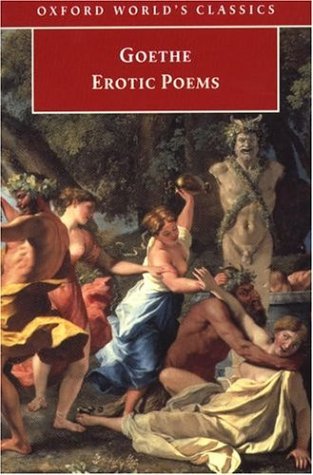
This books collects all of the Roman Elegies, forty-one of the 100-ish Venetian epigrams, and all of the Diary with parallel German text. It is translated by David Luke, who also deals with the notes, and has a useful introduction from Hans Rudolph Vaget. The translation was originally published in 1988, although my copy is a 2008 reissue.
There is so crossover with the Penguin Classic 'Selected Poetry', which was also translated and introduced by David Luke. So it is possible that the text is the same. Unfortunately I took my 'Selected Poetry' back to the library. The 'Selected Poetry' doesn't contain as much of either the Roman Elegies or the Venetian epigrams though. It does contain the whole Diary.
The poems balance an awareness of classical poetry - especially Tibullus, Ovid, and Propertius - and myth with an 18th century modernity of subject. Love is the main subject here and that includes lust. If that's not too unpoetic a term.
Not everything here was published during his lifetime. Either through his own caution or his later translators hesitancy. Some of that is because of, let us call it, 'vulgarity' and some because of its pagan anti-Christian position. After all in one of these poems he rhymes 'Christe' with 'Iste', which is the word he has chosen for penis. I mean that isn't going to go down well in the 18th century. And also there's something like this:
I'm not surprised that our Lord Jesus Christ liked consorting with sinners
And with whores; after all, that's just what I fancy too.
Or the suggestion that a young female acrobat might be so flexible that...well...let Goethe tell it
She'll end up with her delicate tongue in her delicate p***y,
Learning to play with herself: what will her lovers do then?
And look at me editing it myself. In 2024.
The Epigrams are usually a little spicier than the Elegies, but even there the 24 poems are topped and tailed with Priapus and talk about prostitution and the dangers of syphilis, which disadvantage the modern lover versus the ancient who didn't have that to fear.
The Diary is a longer poem that talks about a married man returning from a business trip who is held up by a broken carriage wheel. He must wait in an inn where he makes plans with a maid in the inn for a late night assignation, but his body lets him down and so he watches her sleep whilst he talks about how this hasn't happened before, about how the penis has ideas of its own and when things start to actually stir he, thinking on his wife and their love, can't bring himself to act upon his original intentions.
All of this shouldn't hold back from how good the poetry actually is, especially in the Elegies and The Diary.