What do you think?
Rate this book


Born at the very heart of Greece - between Athens and Apollo's shrine at Delphi - in the mid-40s of the first century AD, Plutarch combined an intense love of his locality and family with a cosmopolitan outlook that embraced the whole Roman Empire. His enclyclopaedic writings form a treasure trove of ancient wisdom, yet his strong religious feelings and deeply humanist temper give them all a compelling and individual voice. Whether he is offering abstract speculation or practical ethics, fresh and arresting reflections on anger and flattery, military versus intellectual glory or the reasoning powers of animals, Plutarch's personality and charm constantly shine through. Above all, concludes Kidd, his essays remain magnificently readable, works that "can still entertain, instruct, stimulate and educate us and also introduce us to one of the most attractive characters in classical literature".
Paperback
First published April 6, 1993
My overall opinion of this collection of essays is positive and I enjoyed many aspects of it. Plutarch's style is one that utilises many anecdotes, quotes, analogies to make his points clear. It's arguing in a way that draws parallels and uses imagery to illustrate his points and to make the reader think, "Ah yes, what Plutarch is saying must be true". It's a very readable style and Plutarch is very good at fashioning many wonderful paragraphs and sentences.
I rated it 3* because I found some essays uninteresting like On God's Slowness to Punish and I even skipped On Socrates' Personal Deity. Furthermore, I found some sentences were just too long (many lines long). Most of the essays are serious and make clear arguments however the dialogue between Odysseus and a Pig in On the Use of Reason by 'Irrational Animals' is a fun piece and somewhat different to the others. The Pig Gryllus preferred being an animal, free from "illusions of money" and the obsessions of humans.
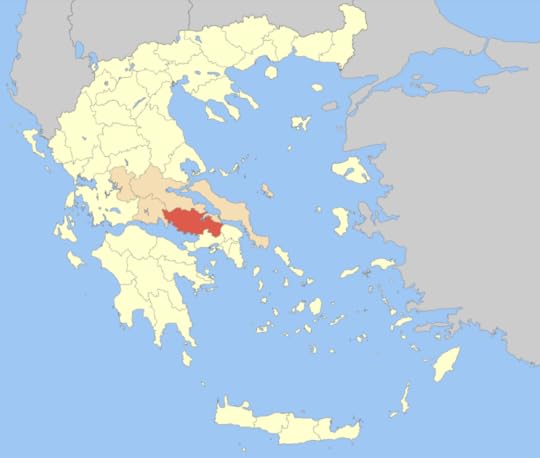
Plutarch never really came up with his own ideas. Instead he uses his mastery of rhetoric and expansive knowledge to pull ideas from all schools of thought together (the Stoics, the Epicureans and more). Expect references to many different historical figures but most importantly and abundantly of all: Plato. Each essay has an introduction which is very helpful and explains the context to which Plutarch was writing. Plutarch was a Boeotian (region in central Greece) and had powerful friends in Rome and rivals in Athens which sets the backdrop for many essays. He was also priest of Apollo in Delphi which explains his interest in theological matters too. On reflection, I am very glad to have read this book. There are a few standout essays which are so wise and so wonderfully written.
Down below, I'm going to highlight some meaningful and significant points which interested me or which I found personally quite helpful. I am exluding the essays I didn't enjoy so much such as On the Fame of Athens , On God's Slowness to Punish and On Socrates' Personal Deity and the not-so-serious On the Use of Reason by 'Irrational Animals' . My notes (see below) aren't exhaustive and are mostly for myself so I can come back and read this review for a quick summary.
'The flatterer is a charmeleon with no consistency in character. I have no need of a friend who changes place when I do and nods in agreement when I do; my shadow is better than that. I need a friend who helps me by telling the truth and having discrimination.'
'The most unsuitable behaviour of all is to repay rebuke with rebuke and candour with candour, because it makes tempers rapidly flare and provokes argumentativeness...It is preferable, therefore to let a friend get away with it, when he seems to be telling you off, because if at a later date he goes wrong himself and needs telling off...he is more likely to submit and be open to correction, and see it as a repayment not from angry recrimination but charitable goodwill ' pg 108
'The point is that it is more likely to have an effect on someone's character to say "you didn't know" rather than "you acted disgracefully"' Pg 110
'we ought to find either a proper friend or a fervent enemy so that one way or another - either by being reuked or by being treated - he might steer clear of badness.' pg 137
'Reasonableness and civility during discussions, neither embarking on conversations competitively nor ending them in anger, neither crowing if an argument is won nor sulking if it is lost - all this is the behaviour of someone is progressing nicely' pg 133
'Beginners in philosphy tend to look for ways of speaking which will enhance their reputation' pg 130
'the more a person denies a defect, the more he immerses and imprisons himself in the vice. It is obvious that anyone who is poor, but pretends to be rich, increases his poverty by his masquerade' pg 138
'So it is from mental pain and suffering that anger arises, thanks above all to weakness; and whoever said that anger is, as it were, the mind's sinews was wrong: it is straining and spraining of a mind being unduly dislocated in the course of its defensive impulses.' Pg 185
'There are people who think that freedom from distress resides in one way of life in particular - for instance, in farming or kingship'
'[Exchanging one way of life for another] does not eradicate from the mind the factors which make it distressed or disturbed' pg 214
'Plato compared life to a game of dice in which it is not just important to throw something appropriate, but also to make good use of it however the throw turns out.'
'But it is our job to accomodate ourselves to whatever fortune deals us and to allocate everything to a place where, as each situation arises, if it is congruent, we can maximise its benefit, and if it is unwelcome, we can minimize its harm.' pg 216
'why, my friend, do you obsessively contemplate your own weakness...but fail to apply your mind to the good things you have'. pg 220
'We do not expect a vine to produce figs or an olive to produce grapes, yet if we don’t have the advantages of both plutocrats and scholars, military commanders and philosophers…all at once, we bully ourselves and despise ourselves.' pg 228
'The point is that fortune can make us fall ill can deprive us of our wealth can ruin our relationship with the people or the king but they cannot make someone who is good, brave and high minded into a bad, cowardly mean-spirited, petty and spiteful person and it cannot deprive us of the permanent presence of an attitude towards life.' pg 234
'Our daughter was the sweetest thing in the world to hug and watch and listen to, and by the same token she must remain and live on in our thoughts, and bring not just more, but a great deal more pleasure than distress pg 366
'Mental suffering ought to be helped by physical fitness. Mental distress abates and subsides in physical calm' pg 369
'We will seem to regret that our child was ever born if we find more to complain about now than in the situation before her birth'. pg 370
'The good was brief, but should not therefore be regarded as a long-term bad influence; and we not should be ungrateful for what we have received just because our further hopes [of her growing up] were dashed by fortune'. pg 371
'And that is the condition we should avoid - the syndrome of whingeing if the book of our life has a single smudge while every other page is perfectly clean'.
END
...described the terrible behavior of some of the students in his class: 'some of them arriving late; some constantly signaling and passing messages about more exciting matters; some standing and posing like statues with arms crossed, or picking their noses; others sitting in general confusion, or forcibly holding down the more enthusiastic; some alleviating their boredom by counting newcomers, staring blankly out the window or gossiping with a neighbor; some applauding inanely; or finally stamping out, drawing others in their trail.'
...Carneades used to say that the sons of wealthy men and of kings learn nothing but horsemanship, and that the reason they learn nothing else properly and well is that while their teacher flatters them with compliments during their lessons and their wrestling opponent submits to them, their horse neither knows nor cares who is an ordinary citizen or who is a political leader, who is rich or who is poor, and simply bucks off all incompetent riders.
“And if one also keeps reiterating Plato’s saying, ‘Am I not like that too?’, he will turn his thinking inward instead of outward, and will interrupt his complaining with caution, and will consequently not employ a great deal of righteous indignation towards others when he sees that he himself requires a lot of forbearance.”
Being easy to please, on the other hand, is either a help or an embellishment or a delight, and its gentleness overcomes anger and discontent of all kinds. Consider Euclides, for instance: when his brother ended an argument by saying, 'I'll get my own back on you, if it's the last thing I do', Euclides replied, 'I'll win you over, if it's the last thing I do', and immediately made him alter course and change his mind.
There are two possible results of this: either his nature completely obliterates and avoids the hereditary blemish of iniquity, or it deceptively conceals its wickedness for a long time in a sheath, as it were. And we are the objects of the deception: we eventually recognize his iniquity only when we have been, so to speak, physically struck or hurt by any of his crimes. Or rather, we usually assume that it is the committing of a crime that makes a person a criminal, and the act of rape that makes a person immoral, and running away that makes a person a coward - which is equivalent to thinking that scorpions grow a sting only when they strike and that vipers gain their poison only when they bite. This is stupid. The beginning of badness and the eruption of badness are not simultaneous, but any bad person carries his iniquity with him from the start: once a thief obtains the opportunity and the ability, he puts his thieving into practice, and the same goes for a tyrant and his lawlessness.
Kindness requires a recipient just as much as it requires a donor: where its excellence is concerned, it is incomplete without both of them. Anyone who refuses to accept kindness, when it is offered cleanly like a well-thrown ball, lets it fall to the ground incomplete and negates its excellence.