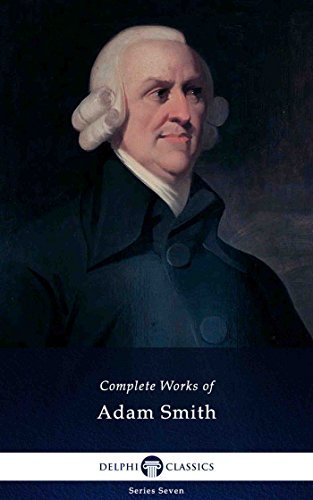
The moral philosopher and pioneer of political economy, Adam Smith was a key figure of the Scottish Enlightenment. His famous treatise ‘The Wealth of Nations’ is the first modern work of economics, earning him recognition as the father of modern economics. This comprehensive eBook presents Smith’s complete works, with numerous illustrations, rare texts appearing in digital print for the first time, informative introductions and the usual Delphi bonus material. (Version 1)
* Beautifully illustrated with images relating to Smith’s life and works * Concise introductions to the works * All the published books, with individual contents tables * Includes rare texts appearing for the first time in digital publishing, including lectures by Smith * Images of how the books were first published, giving your eReader a taste of the original texts * Excellent formatting of the texts * Features two biographies, including Dugald Stewart’s first memoir on the great man * Scholarly ordering of texts into chronological order and literary genres
Please note: the recently rediscovered LECTURES ON RHETORIC AND BELLES LETTRES cannot appear in this collection due to its copyright status.
Please visit www.delphiclassics.com to browse through our range of exciting titles
CONTENTS:
The Books THE THEORY OF MORAL SENTIMENTS THE ORIGINS OF LANGUAGES AN INQUIRY INTO THE NATURE AND CAUSES OF THE WEALTH OF NATIONS ESSAYS ON PHILOSOPHICAL SUBJECTS
The Lectures LECTURES ON JUSTICE, POLICE, REVENUE AND ARMS REPORTED BY A STUDENT IN 1763
The Biographies ACCOUNT OF THE LIFE AND WRITINGS OF ADAM SMITH by Dugald Stewart LIFE OF ADAM SMITH by John Rae
Please visit www.delphiclassics.com to browse through our range of exciting titles or to purchase this eBook as a Parts Edition of individual
Adam Smith FRSA FRS FRSE was a Scottish philosopher and economist who was a pioneer in thinking on political economy and a key figure during the Scottish Enlightenment. He wrote two classic works, The Theory of Moral Sentiments (1759) and An Inquiry into the Nature and Causes of the Wealth of Nations (1776). The latter, often abbreviated as The Wealth of Nations, is considered his magnum opus and the first modern work that treats economics as a comprehensive system and as an academic discipline.
Authorities recorded his baptism on 16 June 1723 at Kirkcaldy.
Rarely in history can you point to a single year as truly transformative for life in the world. 1776, 250 years ago, is one of them.
Yes, we like to think of it as transformative because of the American Revolution and the Declaration of Independence; those were very important events that would profoundly affect much of what would take place afterward.
But during that same year, Edward Gibbon began publishing his Decline and Fall of the Roman Empire….and Adam Smith would publish On the Wealth of Nations.
What the American Revolution would do to philosophy and politics, Smith and Wealth of Nations would do to economics. Within Smith’s own lifetime, British politicians began crafting policy based on the principles he established in his work. The movement away from mercantilism and the establishment of bedrock principles of modern economic thought and practice ultimately derive from Smith and On the Wealth of Nations.
But if you were to ask him, Smith would have rather been known for his Theory of Moral Sentiments. Arguably one should not read or uphold On the Wealth of Nations without regard to the Theory of Moral Sentiments, but alas.
Adam Smith’s writings, therefore, are understandably classics, and ought to be read and considered. Yet, as with all such late eighteenth century works, we do better to appreciate them for the lines of thought and practice they started, and to carry on the conversation and the practices, and to not treat them as sacred Scripture having been written down by prophets whose fountains of inspiration have been closed off to us today.
I would imagine Smith himself would be horrified to see how his works have been elevated to such a dogmatic level. He was making observations based on what he saw. Very little of it comes with anything that we would resemble as “proof,” and was mostly posited based on shared experience and understanding. The enduring legitimacy of many of his observations testifies to his perceptiveness and why it was so important for him to write his treatises. But none of them should be considered the final word on anything, and we do ourselves a disservice to pretend otherwise.
The Delphi Classics complete works are a great way of accessing Smith (and many other authors). As is consistent with the series, the main works are presented first, and at the end are a series of biographies. The material is all well formatted for reading on the Kindle.
Regarding the works in greater specificity:
Smith's Theory of Moral Sentiments: An exposition relying on common sense moral realism to explore why people maintain the moral frameworks and structures they do. Smith seems to rely heavily on the premise that sympathy/empathy is a primary driver for the kind of ways people behave.
That's a very short summary of a much longer and expansive presentation. Much of the time I was not quite really sure what I was reading. There's not much appeal to any other kind of authority other than what an 18th century Scotsman who traveled around the United Kingdom and France and heard some stories about America would accept based on his experience. In this respect the difference between the past and present proves quite vast; one comes to realize quickly how much of what we today accept and believe about people and their behaviors should have some kind of basis in psychiatry, sociology, and results from experiments and studies in those domains. Granted, neither existed in the middle of the 18th century, and so that's not exactly Smith's fault.
Thus, as a relic of a former age and part of the heritage upon which later belief systems were built, this volume has value. Just accepting his conclusions based on his premises would, however, prove woefully insufficient today.
Smith's dissertations on language show the same kinds of tendencies. Interesting; rooted in his personal explorations and frameworks of understanding; relevant in the 18th century; but today?
An Inquiry into the Nature and Causes of the Wealth of Nations: this may not be the work Smith wanted to be known for, but it remains his most famous, and most significant, work.
Smith goes into exacting detail in exploring all things economics, inquiring into everything from labor and capital to considering the long-term changes in tax policy and cost of wheat in England and Scotland.
He makes the case for free trade, a turn away from a mercantilist economic framework, and encouraged the basic principles of capitalism which have endured to this day, very much because Smith's work became popular and was the catalyst for changing British economic policy. His concept of mutual self-interest as an effective driver but also check on capitalism sounds good in the abstract, and was an improvement over existing economic theory.
But as with the Theory of Moral Sentiments, so with the Inquiry into the Wealth of Nations: Smith's using his reason and experience well, and it worked well at the time, but why should this be the Economics Bible? Would that be what Smith himself would even want? As a testament to the profound economic changes of the late 18th century, and a major driver of what has made our modern world what it is, the book is a priceless witness. But hopefully we've learned a few things in our experiences with capitalism, and the discipline can move forward.
The rest of the complete works features Smith's preserved discourses on language and other aspects of culture, and a good chunk represents what is purported to be the extensive notes one of his students took from his lectures at the University of Glasgow. In these we see a lot of the same kind of work and presentation which would present themselves again in On the Wealth of Nations, and perhaps a little of what might have been Smith's planned work on law and governance.
Smith biography by Stewart: a good general introductory biography, providing helpful detail into the life of Adam Smith and motivations and purpose of his writings. It was composed by someone who knew him well and not terribly long after his death.
Smith biography by Rae: "thorough" would be an understatement. Written a little over a century after Smith's death, Rae included pretty much every detail known about Smith's life and travels, and every piece of correspondence of Smith and written to Smith which was preserved (or at least it felt like it), and all kinds of impressions of Smith by others as it details his life in extreme detail. So much detail, in fact, you end up learning a lot more about late 18th century Scotland (and London, and France) than you seem to do about Smith. A case of so much detail that it is hard to get a handle on what would be considered more important versus less important.