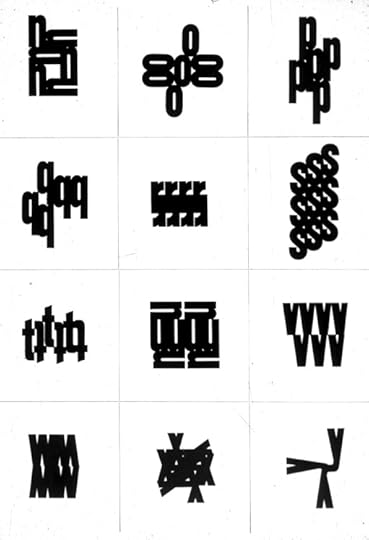
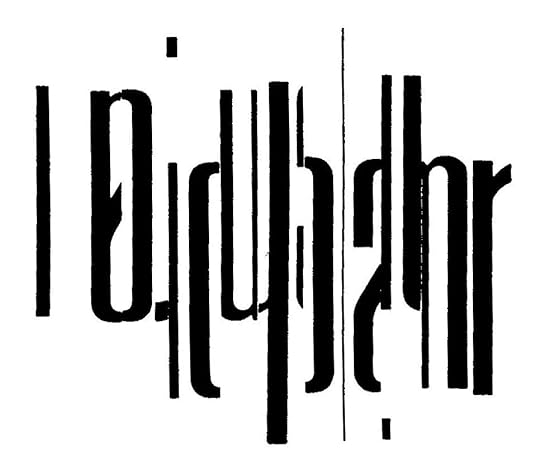
This collection presents one of the most interesting and lively developments on the international poetry scene in recent years. Concrete Poetry has been growing in many countries, from Brazil to Japan, and especially in England and Europe. Its ancestry goes back to pre-historic picture writing and the anagrams of early Christian monks; it has affinities with the oriental ideogram, and, in our century, with Apollinaire’s Calligrammes, the work of Klee and Schwitters, and the experiments in "visual form" of Cummings, Dylan Thomas, and the Dadaists and Surrealists. Once Again is not so much an anthology, though it includes the work of 54 poets from 10 countries, as a group presentation, designed to be read as a consecutive "visual happening." It has been assembled by Jean-François Bory, an editor of the Paris magazine Approches and the author of Plein Signe , Height Texts + 1 and other "Concrete" books. Bory has provided an introduction which traces the history of the movement and analyzes its aesthetic. He also comments on individual poems.
I have 3 main Concrete Poetry compilations in my personal library that I've read + various other bks w/ related material that have slightly different foci. I love them all. Sometimes, though, I think I might love this one the most - even though it's the smallest (I'm a size queen when it comes to bks). The other comps have mainly pieces designed for the PAGE. This Bory edited collection has photographs of pieces that are more sculptural & that adds a whole other dimension (nyuk, nyuk).
I'm usually interested in EXPANDED concepts that expand the notion of what something is so much that it goes beyond what previously might've been its basic definition. EXPANDED TECHNIQUE in musical instrument playing, EXPANDED CINEMA (Stan Vanderbeek's marvelous projection experiments come to mind), EXPANDED LANGUAGE PRESENTATION: this bk documents it well.
A transparent box w/ 3 transparent geometrical shapes inside, consonants on the outside of the box, vowels on the interior objects. One's perspective changes what words one sees (if any). Language becomes focused on one's position in relation to it. This perspective/position becomes a part of language, the reader has an expanded notion of how the mind works in relation to language. Then perspective/position can be thought of as part of language w/o even having letters or words necessarily visible anymore. The expansion has taken us outside a narrower definition of language in wch letters or words are 'needed'. Or something like that.
Bicycle wheels arranged as a sculpture, a central pole w/ letters/words on it, the sculpture burns, perhaps some of the letters/words are transformed, the process of fire is tied concretely into the words, these concrete connections are what Concrete Poetry is all about - intensifying the meanings of the words by connecting them to their physical substance. Adamitic language regained, magikal language regained or gained for the 1st time. Making the relationships between signs & what they signify no longer arbitrary.
This anthology contains poems by Ferdinand Kriwet, Hansjörg Mayer, Valerian Valerianovich Neretchnikov, Mary Ellen Solt, Maurizio Nannucci, and Adriano Spatola, among others...
knocked this book out in about an hour because I was just so entranced. Man, this is awesome.
I am a huge proponent of visual poetry and this collection is BREATHTAKING! so inspiring! I bookmarked so many pages while reading this because I just wanted to sit and stare at the work forever. even the pieces in languages I can't read. all of it. go r ge ou s
the introduction is a little superfluous at times and kind of made my head hurt in a few moments, which is the only reason this book doesn't get a perfect score in my book. I know it's kinda academic, but sometimes, I'm not the biggest fan of writers over-explaining their work, or work of others. but the collection still stands on its own. love!