Shirley Jackson was an influential American author. A popular writer in her time, her work has received increasing attention from literary critics in recent years. She has influenced such writers as Stephen King, Nigel Kneale, and Richard Matheson.
She is best known for her dystopian short story, "The Lottery" (1948), which suggests there is a deeply unsettling underside to bucolic, smalltown America. In her critical biography of Shirley Jackson, Lenemaja Friedman notes that when Shirley Jackson's story "The Lottery" was published in the June 28, 1948, issue of The New Yorker, it received a response that "no New Yorker story had ever received." Hundreds of letters poured in that were characterized by, as Jackson put it, "bewilderment, speculation and old-fashioned abuse."
Jackson's husband, the literary critic Stanley Edgar Hyman, wrote in his preface to a posthumous anthology of her work that "she consistently refused to be interviewed, to explain or promote her work in any fashion, or to take public stands and be the pundit of the Sunday supplements. She believed that her books would speak for her clearly enough over the years." Hyman insisted the darker aspects of Jackson's works were not, as some critics claimed, the product of "personal, even neurotic, fantasies", but that Jackson intended, as "a sensitive and faithful anatomy of our times, fitting symbols for our distressing world of the concentration camp and the Bomb", to mirror humanity's Cold War-era fears. Jackson may even have taken pleasure in the subversive impact of her work, as revealed by Hyman's statement that she "was always proud that the Union of South Africa banned The Lottery', and she felt that they at least understood the story".
In 1965, Jackson died of heart failure in her sleep, at her home in North Bennington Vermont, at the age of 48.
Mrs. Wilson is a despicable racist witch!! When Johnny Wilson comes home with Boyd, his black friend, Mrs. Wilson starts her racism show:
"You shouldn't let Johnny make you carry all that wood" "There's plenty of food here for you to have all you want" "Boyd wants to grow up and be a big strong man so he can work hard"
Even if Boyd had explained that his father made a good living, that they could afford anything they wanted, that his mother didn't have to work and only took care of them, that his parents had only two children, the witch Mrs. Wilson still didn't want to hear about it and got really upset when Boyd refused to take used clothers home with him, calling him rude.
Shirley Jackson nails subtle racism, while illustrating that it is a taught and not an innate trait. Beautifully done in a minimum of words and very effective.
Just because you think you are being kind and thoughtful doesn't mean you aren't being a total racist. A well meaning mother meets her son's new black friend and forms conclusions immediately. She assumes he comes from a poor family, without enough food, and too many kids. When the boy politely corrects her misconceptions she doesn't want to hear it. I hope that she self-reflected after the story ends and can grow from her mistakes. The way Shirley Jackson can turn such a simple story into such a deep and meaningful message is a truly beautiful talent.
Interesting short piece on how one doesn't need to lace their words with viciousness and hatred to show a racial bias . The "well-meaning" racist pretends to be compassionate and considerate, ignoring the voice of the person she claims to care about, all because they want to feel in a way superior , that they are good.
Another strange short story finished, I'm starting to believe all short stories are strange. This one has a lady who is trying to be nice - I guess - in her own strange way, reminding me of half the people in my family while doing it. We have Mrs. Wilson, one of our three main characters I was about to say, but thinking more about it we only have three characters in the story. First is our Mrs. Wilson, then her son Johnny and his friend Boyd. When Boyd comes home with Johnny Mrs. Wilson had never met Boyd before and is surprised to see that he is African American. Boyd comes in the house with an arm load of split wood, while Johnny isn't carrying anything at all. This causes trouble with Mrs. Wilson telling Johnny he shouldn't have done that to which Johnny replies that Boyd is carrying the wood because they got it at Boyd's house. I thought it was strange what they were planning on using the wood for, according to Johnny it is "Dead Japanese," Johnny said mildly. "We stand them in the ground and run over them with tanks." I guess cowboys and Indians shooting each other aren't enough anymore.
After this it is time for lunch which Mrs. Wilson says she knows Boyd must eat well telling Johnny when he says Boyd doesn't like tomatoes that Boyd will eat anything. She somehow knows that about a boy she just met, and not only that, she seems to have quite a lot of wrong information about Boyd and his family. She hesitates now then asks Boyd if his father....works. She seems amazed when Boyd reveals that not only does his father work in a factory, but he's a foreman. She asks him about all his brothers and sisters and once again is amazed to find out there is only Boyd and one sister, Jean, and she is going to become a teacher.
Mrs. Wilson insists that Boyd needs to eat as much as he wants to, even when he is full she can't believe he really is. She then offers Boyd some of Johnny’s old clothes, and she also wants to give Boyd’s mother and sister some of her old dresses. His mother can "make them over into lots of things" for him. I wonder what his mother would have thought if he came home carrying all Mrs. Wilson's old clothing. Boyd is confused and says that he has plenty of clothes and that his family can afford to buy anything they need. This just angers her, she believes Boyd to be ungrateful and proceeds to clear the table while he is still eating. I want a part two of this story so I can see what happens when Boyd comes home with all the old clothing. Maybe she could throw a bag or two of food in while she's at it, after all, they must be starving. Happy reading.
Mrs. Wilson diligently prepares a meal for his beloved sonny. But when little Johnny finally shows up, he arrives with a mysterious new friend, Boyd.
I can certainly appreciate the value of this idea but can't say I enjoyed this at all, or that I could recommend it. I suppose it's ok if you don't mind the veiled racism.
----------------------------------------------- PERSONAL NOTE: [1943] [4p] [Fiction] [Not Recommendable] -----------------------------------------------
La señora Wilson diligentemente prepara una comida para su amado hijito. Pero cuando el pequeño Johnny finalmente aparece, llega con un nuevo y misterioso amigo, Boyd.
Ciertamente puedo apreciar el valor de esta idea, pero no puedo decir que la haya disfrutado en absoluto, ni que pueda recomendarla. Supongo que está bien si no te importa el racismo encubierto.
----------------------------------------------- NOTA PERSONAL: [1943] [4p] [Ficción] [No Recomendable] -----------------------------------------------
Goodness, how many can relate to going to a friend's house and having their parents ask awkward questions or make inappropriate racial comments?
This short from Shirley Jackson is only about two and a half pages long, but it brings to the forefront the topic of racial prejudice.
The story centers on Mrs. Wilson, her son Johnny, and Johnny's new black friend Boyd. Johnny brings in Boyd as a guest for lunch. As the tale progresses, Mrs. Wilson betrays her bias in her questioning about Boyd and his family, seemingly unable to believe that Boyd's family could possibly be well off and only have two kids.
the fact that this was written in the 1940s!! it's a rlly good reminder of how we can't allow bigotry to pass as ignorance, and that casual racism has always had its critics. same vibes as get out w the portrayal of insidious everyday racism. looking forward to reading more jackson for sure - the irony here was executed so well and she did a great job at portraying the sympathetic white saviour complex.
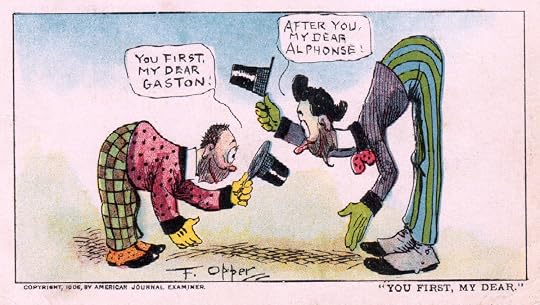
Decades after reading it "After you, my dear Alphonse" STILL tickles me like Tim Sawyer, 'ceptin shorter. Reading reviews, I never realized it was SOOO SOOO RACIST!!!! Get BLM on it immediately, or instead of a commonality of childhood vs. parents; WE can teach children that being racist will allow a death sentence, at least according to reviewers here. Heaven Forbid I didn't read the sequel when Shirley Jackson has him go to Boyd's mother's house where he was FORCED eat chitterlings and watermelon, and she has to instruct the white boy on the evils of slavery a century after the Civil Wat. (I am of SLAVIC Ancestry, Great-Great (x23) grandson of an African Moor Slave that wasn't fed, housed or clothed, just beaten and abused; before BEING allowed to die in the Moors' fields like every seaman captured by North Africa. No wonder it is called SLAVery until Thomas Jefferson, President of our fledgling country, stopped paying tribute to the Barbary coast, kicked butt and stopped the the Moors' abuse of ALL United States vessels' crews (black, white, and asian). CHOOSE what you WANT to read, and you can surely find it in whatever you read.
As always, Jackson manages to say so much in such a short space. In this short story, the Mum clearly hides her unconscious biases, (perhaps) unintentionally racism and general superiority behind a host of well intentioned comments.
I can hear these words and phrases muttered up and down any country, even today, with people querying what the problem is. Young Boyd, thankfully, seems to allow most of it to go over his head, batting back what he needs to, then being branded as rude/ungrateful.
A really interesting look at our own prejudices. Super quick read!
Want to be a racist? Act like this. Lots of people find it none too hard. Mrs. Wilson thinks she's being kind, but she's reinforcing her own sense of superiority with every sentence, and gets downright hostile - in a housewifely way - when her preconceptions are contradicted.
Mrs. Wilson is part of "chained to the stove" generation. Her world is her kitchen and her house. Probably newspaper and wireless programs are interpreted to her by her husband. She was never taught to think but to live on a sort of Pavlov's reflex: Sunday-church, marriage-children and of course black-poor. She will be aware that African Americans are getting educated and started to get better paid jobs and starting to be economically emancipated. In spite of that reflex kicks in and when it is proven wrong it is not replaced by rational thinking but by anger. Things should be better 80y in the future. Chained to the stove is very rare (in the Western world!!) but it is replaced by - chained to the smart phone! Thinking is again outsourced to activists, influencers, social media, mainstream media, government (do you still remember pandemic) etc. Pavlov's reflex is still the king just today goes like this black-racism. Eminent Professor of English came to one inch of accusing Shakespeare of racism as two female characters in his play darkened their faces (to decrease risk of sexual assault). It is funny how reviewers are behaving on the same principles as Mrs. Wilson and Pavlov is silently laughing in his grave.
Having only the proposition that black people are poor is not Mrs. Wilson's downfall. Her downfall is when she doesn't want to accept that some of the families that belong to black community are not poor and they even can be as equal as her family. It's wonderful the way Jackson highlights white people's desire to look down on blacks. it seems that in Mrs. Wilson's world white people are superior to black people and by showing mercy and kindness they highlight their good aspects so that they can have the right for this superiority. Just as Kings remind their people of their power may be by helping them in different ways. As a matter of fact this is no kindness. This is the very definition of megalomania.
This entire review has been hidden because of spoilers.
Poignant and subtle. Shirley Jackson spotlights class/racism in this short story in a way that was both somewhat unexpected, yet very realistic. I found it incredibly relevant even today (because people like the mother do very much still exist today! Unfortunately.) I will forever applaud Shirley Jackson's range in story telling....
She has a way with writing. I don’t know if I’m gonna do any more reviews for her stories just because there’s so many in this one but so far I have enjoyed all of them and if there’s one that I did not enjoy, I will do a review them talking about why I did not enjoy it.
acımak, benim için ayıp bir duygu çocuğun annesi de kucumseyip açlığdı için yardım etmek istiyor ama assagiliyor çocuğu, kafasında oturtmus siyahi anne hizmetci baba fabrika iscisi diye çocuk orta sınıf zenci çıkınca şaşırdı kendine yediremedi, çocuklar siyah beyaz fark etmeden oyuna devam ettiler
This entire review has been hidden because of spoilers.
Might be my favourite Shirley Jackson short story, the way she can fit so much about a character in such few words is incredible, the subtle racism thought to be kindness is so well portrayed and I’m impressed with how much message Shirley can fit into such a tiny story
The fact that this was written in ~1943 and still resonates in 2026 is amazing
I love the assumptions made, the clear critique on how some participate in liberalism still continue to be racist and how the children are almost more grounded than the mother. Incredible read