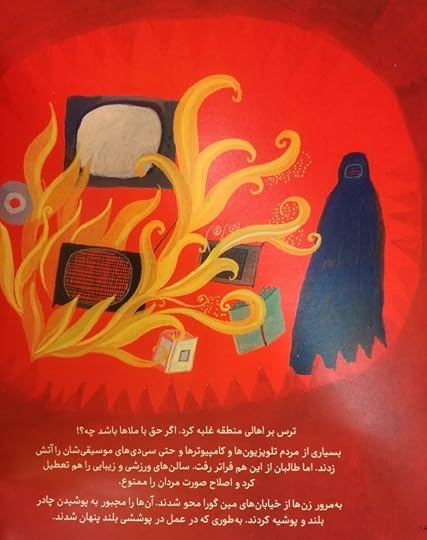
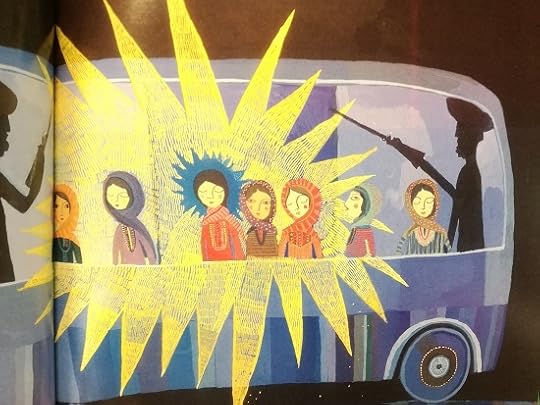
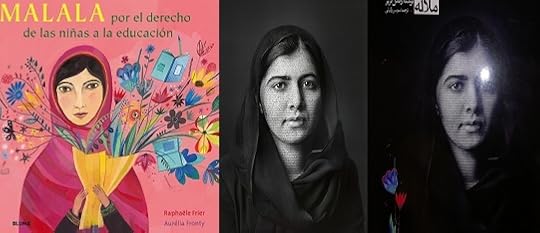
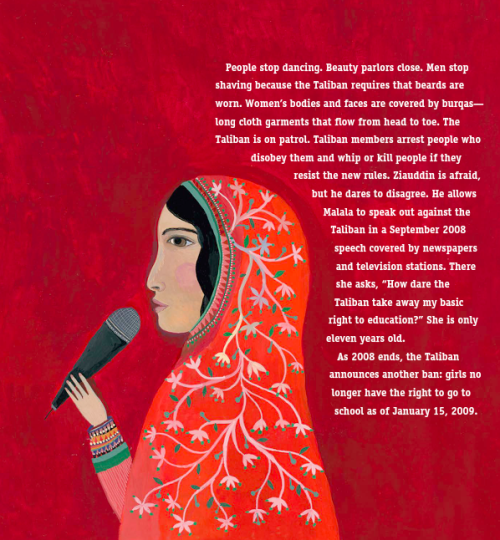
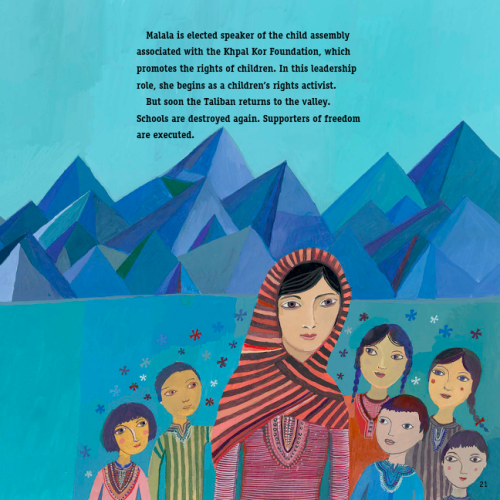
Translated from French to English and published in China, the 2017 Batchelder award winning book, “Malala: Activist for Girls’ Education” is an empowering picture biography book about a young Pakistan woman named Malala who stood up for the rights for girl’s education. When the Taliban people took over the city of Mingora in Pakistan, they forced people to stop listening to music and movies. Men were required to wear beards. Women covered their faces and bodies with burqas. This book does a wonderful job exploring mature themes that students in fifth grade and up can discuss: activism, racism, and violence. With the support from her father, Malala becomes a voice for all women in promoting education for all girls in her village. In fact, “Malala doesn’t get discouraged” even after being shot in the head by a member of the Taliban group (Frier, 2017, p. 27). Therefore, this book encourages children to stand up for what they believe in and shows us readers to use our voice for change.
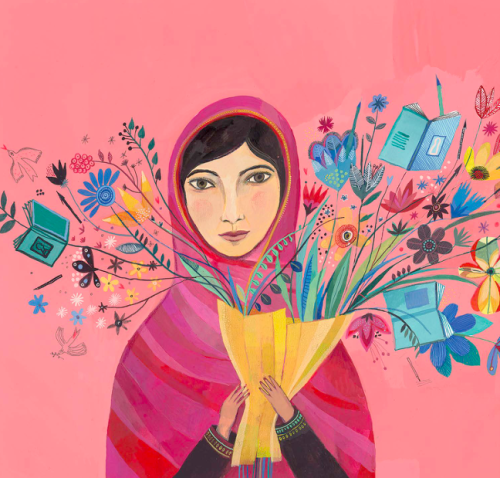
I appreciate the cultural authenticity and the cultural accuracy that the author integrates throughout the novel, giving readers who are unknowledgeable about some of the customs in Pakistan information about them. For example, the author defines what a burqas is to help readers who are not part of this culture understand what it is (Frier, 2017, p. 17). The author also shows Malala wearing one so we can visualize this cultural piece. The illustrations accurately show burqas. I also appreciate the author integrating cultural terms, such as the Qur’an and cardamom tea to again illustrate this cultural group appropriately. The book tells readers towards the end of the book the cultural practices they practice, “many people believe that women should stay at home to watch the younger children… Girls are often required to marry at a very young age. Many families believe that only boys should have jobs” (Frier, 2017, p. 29). I appreciate the author including this in the book as a way to further support Malala’s argument for change. Lastly, I appreciate the many features at the end of the book, such as the timeline, map of where Pakistan is located in the Middle East, and additional information about Malala's country. What stuck out to me the most were the real photographs of Malala spreading awareness to other countries because this accurately represents who she is.
The end of the book gives readers background information about other noble people who stood up for their rights, such as Mahatma Gandhi, Nelson Mandela, Martin Luther King Jr., Gul Makai, and Malalai. I would have students compare and contrast Malala to another noble figure as a way for students to make connections with how others stood up for freedom. Teachers may want to give supplemental resources for students to further explore this topic.
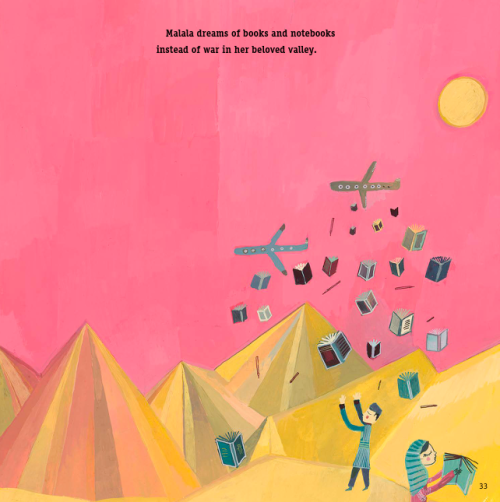
I found this book on the Batchelder award winning list and it was recommended to me by my local librarian. This book can be accessed as a digital copy on Youtube, but I thought the audio was fuzzy and can be distracting for readers. However, I do appreciate the close ups of the illustrations.