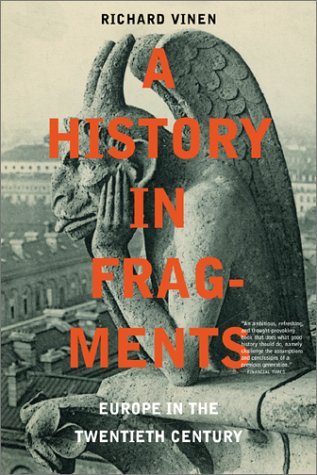
The problem with the history of twentieth-century Europe is that we all think we know it. The great stories of the century—the two world wars, the rise and fall of Nazism and Communism—seem self-evident in their importance. But behind the politics and the ideologies lies another the history of forces that shaped the lives of individual Europeans…and the lives of men and women around the world. (Americans need only think of the way that the history of Europe has shaped the flow of immigrants to the U.S. and thereby altered our nation's history.)Richard Vinen contends that there is no single history that encompasses the experience of the century, but rather a multiplicity of different, interlocking histories—stories not only of politics and military movements, but also of culture, religion, sex, and demographics, related here with an unmatched eye for the telling detail and spiced with memorable anecdotes. As the Sunday Telegraph put "Vinen moves effortlessly from social and economic issues to politics, from ideology to military history. . . . The writing is lively, the enthusiasm infectious, and the gift for bold, epigrammatic summary genuinely impressive." A canvas encompassing both the broad and the particular, this is a major work of history—and history writing at its best.
Richard Vinen is a Professor in Modern European History at King's College, London. Prior to joining the department in 1991, he was a Fellow at Trinity College, Cambridge and also lectured at Queen Mary (Westfield) College.
Richard Vinen is the author of the widely praised "A History in Fragments: Europe in the Twentieth Century". He writes regularly for The Independent, The Times Literary Supplement, the Boston Globe and the Nation.
Super kniha o období! Koncept ako autor pristupuje k udalostiam, ako ich vyberá a vysvetľuje bol a je pre mňa fascinujúci a neuveriteľne obohacujúci - stále o nej premýšľam a neviem sa nabažiť myšlienkami, ktoré kniha zasial a teraz vo mne rašia ako burina.
Spočiatku som pristupoval ku knihe s dešpektom - priznávam, keď vidím knihy, ktoré sa snažia syntetizovať nejaké obdobie, zaváňa to zjednodušovaním, radikálnou selekciou udalostí a plytkosťou pre "amatérov". Ako som na toto došiel? Ani neviem, lebo doteraz veci, ktoré som čítal v tomto formáte (rôzne dejiny Slovenska) boli vždy slušné - teda je to len moja osobná blbá zášť a komplex- zaujatosť. Ale naprávam si toto ponímanie! Musím, lebo som bol truľo.
Vinen sa pozrel na EU 20. storočia hlavne z pohľadu politického a sociálneho - a toto ma zaujalo najviac. Riešil napríklad ako ovplyvnil vstup žien do politického života, ako technológie pomohli modelovať chovanie štátov a ako ideológie (nie len komunistická) odôvodňovali vývoj rôznych oblastí EU. Neviem slovom a vetami poriadne uchopiť toto dielo, no určite stojí za nejedno čítanie, teda nie len raz! A toto platí aj pre mňa.
Nepokladám sa za totálneho amatéra v poznaní dejín Európy, ale Vinen mi ukázal, že som červ a že nepoznám rôzne pohľady na dejiny - za to ohromná vďaka; len ma naštartoval a podnietil záujem na tento aspekt dejín pozerať viac, študovať s bázňou a novým/iným plameňom v duši a srdci a snažiť sa o prístup čo najviac objektívny - teda si uvedomujúc to, čo ma modeluje a smeruje "k"(...). Skutočne svet nie je o čiernej a bielej, nie je to o jednoduchých odpovediach na otázky a že to nie je o tom, kto z koho! Čiže vety typu: "môžu za to Sovieti/Rusi alebo Američania" je tuposť v základe! Svet a dejiny sú komplexnejšie a bohatšie, aby to bolo tak primitívne ľahké.
Veľmi ma teší poznanie, že je toho ešte tak veľa, čo neviem :)
Absolutely fantastic read, though oriented towards scholars/history students. Offers history from a new angle and its intricate details leaves your imagination wandering in the past. The chapter on Genocide nearly had me in tears - history is better than fiction because it is all the more real. Vinen is truly gold.
A very interesting discussion on the key events and movements in 20th Century Europe. A surprising amount of observations struck me as very pertinent at our current point in time, despite being written before Brexit, the rise of Social Media, or even the September 11th attacks on the USA (not a European event but one that nevertheless was significant for Europe in how it shaped the view of terroism and how countries participated in the aftermath)
I really, really like this book. I am using it for a fiction project and find it to be an excellent survey of the times in history that I need to know more about. Though it's too broad to offer me all the information I need, I think it is an excellent resource in terms of finding the authors and work that I do need--work that I would not have been able to find otherwise.
I also really enjoy Vinen's tone and style--he's much more conversational than the average historian, and I like the way that he looks at the lives of certain figures--Keynes, Virginia Woolf, Robert Capa, Henri Cartier-Bresson--as being very emblematic of larger themes of the time. This makes imagining the lives of the people who lived during the times in question much easier for me as a novelist.
I will come back to this book when I am researching other time periods for sure!
The chapter that summarizes varies reactions/the legacy of the Great War, while due to its shortness, obviously makes some generalizations, nonetheless does a good overview of some differences between nations--primarily France and England, as well as classes/society.