Jump to ratings and reviews
Rate this book

أقوى من الموت

Rate this book
كان الجميع يتوقع أن تتزوج إيزابيلا تشارتريس، تلك الفتاة الأرستقراطية المحمية، من ابن عمها روبرت سانت لو عند عودته من الحرب. فقد عرفته منذ طفولتها؛ كان وسيماً، قوياً، ومغرماً بها بعمق. واتفق الجميع على أن هذا الزواج سيكون الأنسب، فهم الثنائي المثالي.

لكن الغريب أن يظهر في حياتها جون غابرييل، بطل الحرب وأحد المرشحين في انتخابات ما بعد الحرب في كورنوال. لم يتوقع أحد أن تقع إيزابيلا في حبه. كان جون نقيض روبرت تماماً: رجلاً ذا طموح لا يرحم، وشهوات طاغية، يرغب في إيزابيلا لكنه يحتقر كل ما تمثله.

منذ اللحظة التي التقيا فيها، أدركت إيزابيلا أن جون لن يتردد في تدميرها… ومع ذلك لم تستطع مقاومته. بالنسبة لإيزابيلا، كان ثمن الحب التخلي عن أحلامها في البيت والسعادة إلى الأبد. أما بالنسبة لجون، فسيعني ذلك ضياع مستقبله المهني وكل طموحاته.

168 pages, Paperback

First published November 8, 1948

Loading...
Loading...

About the author

Mary Westmacott

27 books735 followers
Pseudonym used by Agatha Christie to write her dramatic novels about relationships.

Associated Names:
Мэри Вестмакотт (Russian)
Мері Вестмакотт (Ukrainian)

Ratings & Reviews

What do you think?
Rate this book

Friends & Following

Create a free account to discover what your friends think of this book!

Community Reviews

5 stars
834 (23%)
4 stars
1,103 (31%)
3 stars
1,058 (30%)
2 stars
415 (11%)
1 star
114 (3%)
Displaying 1 - 30 of 391 reviews
Profile Image for Woman Reading  (is off exploring).
477 reviews393 followers
August 14, 2022
4 ☆
a bad film is exactly what history really is
After publishing her first mystery novel in 1920, Agatha Christie wanted the freedom to experiment with her writing. Under the pseudonym Mary Westmacott, Christie wrote six novels from 1930 to 1956.
"To love anyone," I said, "is always to lay upon that person an almost intolerable burden."

The Goodreads description managed to disclose too much information and still completely missed the author's point. Although The Rose and the Yew Tree explored the concept of love and its actions, it is not a typical romance. Readers will be disappointed if they hold this expectation.
"God save us from the cranks! It's really remarkable the amount of suffering a really high-minded idealistic crank can inflict on a decent law-abiding country."

Published in 1947, The Rose and the Yew Tree was a psychological story of redemption set amidst the 1945 election for a Parliamentary seat. Even as a bit of fairy tale essence gleamed, a rapier wit pierced through the human foibles of Cornish village life.

The prologue introduced the narrator, Hugh Norreys, who was physically disabled. The main body of the story consisted of Hugh's memories of the summer of 1945 during his convalescence with his family. Southern England was relatively isolated from the still raging battles of WWII. Although his emotional equilibrium hadn't recovered its earlier footing, Hugh was a solid chap of good manners and conventional values, including a chivalric (occasionally patronizing) attitude towards women. His morés prevented him from recognizing all of the events which transpired during that eventful summer.
The last thing you want in an election is a lot of people who think things out and really use their heads.

Political change was in the air, and the Labour Party was in its ascendancy. The Norreys household, however, supported Winston Churchill and thus the Conservatives. The locals hoped that new blood as represented by John Gabriel, recipient of the Victoria Cross, would replace the septuagenerian incumbent and fend off the Labour challenge.
"We used to have gentlemen in politics. Precious few of them. I wish this chap was a gentleman, but he isn't, and there it is. If you can't have a gentleman, I suppose a hero is the next best thing."

Hugh wasn't impressed by John but recognized his charisma while simultaneously dismissing his appeal to women. John's antecedents didn't hail from the landed gentry, and he felt it bitterly. As any Christie fan knows, she had always been fascinated by the psychology underlying behaviors. In The Rose and the Yew Tree, she explored the interior journey of a person who had at least one bad fairy at his christening.

The people who seemed to have had only the good fairies attend their christening were the inhabitants of St. Loo Castle, which dominated the county's skyline. As expected, the Castle's residents supported the Conservative Party and thus interacted with John, someone normally outside their milieu.
[Lady St. Loo and entourage] were, you see, exactly right to have come out of St. Loo Castle. They were pure fairy story. The Three Witches and the Enchanted Maiden.
The "Maiden" was 19 year-old Isabella who soon became on comfortable terms with Hugh. Yes, there were some unusual metaphors popping up in what seemed primarily a story about politics. Christie exposed the rigidity of the socioeconomic divide in British society, in particular how it had cut off human potential. To lighten the tone, Christie's political commentary was cynically astute and wickedly funny. Utilizing this kind of narrator also thankfully minimized what could have easily been melodrama.

By this point, Christie had been publishing mystery novels for nearly 30 years. While disguising herself with a pseudonym, she couldn't resist some of her mystery writing tactics -- primarily, misdirection and red herrings from the narrator and one lethal crime. Her mysteries were quite clever, logically plotted out and occasionally sterile. But with The Rose and the Yew Tree, Christie gave free rein to in-depth character analysis and showcased a keen wit.

I read this because buddies had suggested it. See https://www.goodreads.com/topic/show/...
I was very pleasantly surprised by this. For Christie fans, it's worth exploring other facets of this prolific writer.
Profile Image for Anne.
4,986 reviews71.8k followers
February 22, 2026
Love, scandal, politics, & redemption.

description

Agatha Christie takes a look at British society through the eyes of Hugh Norreys, a man who has inadvertently become everyone's confidante after a car accident left him unable to walk.
He moves in with his brother and sister-in-law, and eventually falls into this courtly love with the beautiful and well-bred daughter of their neighbor, Isabella.

description

John Gabriel is a lower-class politician running for the conservative party, and he and Isabella find themselves unable to overcome their attraction to each other, though each one despises the thought of shaking off convention and marrying outside of their class.
Christie takes a look at what love looked like in post WWII England, and what roles that sort of caste system played in a person's happiness at that time.
It's well-told and probably my favorite of these Westmacott "romances" so far.

description

Recommended.
Profile Image for Vikas Singh.
Author 4 books339 followers
January 27, 2019
This is the most complex novel Christie wrote under the pseudonym Mary Westmacott. In many ways it is a love story but the two principal characters have so complex personality that at times you are left wondering their drives and motivations. As a Christie’s fan of her mystery novels, I found this novel brilliant because it brings out the brilliance and creativity of the author. Must read to understand the other side of this great author.
Profile Image for Roman Clodia.
3,033 reviews5,089 followers
August 7, 2022
The moment of the rose and the moment of the yew-tree | Are of equal duration.
~ T.S. Eliot, Four Quartets

What an unexpected surprise from Agatha Christie, writing as Mary Westmacott! I would strongly advise avoiding or ignoring the blurb which puts the emphasis in all the wrong places (this is not a romance) and, simultaneously, is full of spoilers - all very misleading and the book is far better than it sounds.

As always, Christie may not be a great stylist but her writing is deft and fluent, and she communicates with economy, making complex characterisations and ideas lucid and accessible. There's more than a touch of Daphne du Maurier about this book which is neither securely 'genre' nor 'literary' - it's an interesting, even compulsively readable story which is also packed with literary allusions: T.S. Eliot for the title and the concept of relativity of time, life and death, the circularity of ends and beginnings, all of which she weaves neatly though not simply into the text. Also fairy tales and, unexpectedly, Iago from Othello as the partial key to one of the main characters.

For much of the book, the main concern is the run-up to the 1945 General Election, a moment of acute social change and a landslide triumph for Labour. Christie's snippy political comments are often a delight ('The last thing you want in an election is a lot of people who think things out and really use their heads') and haven't lost their bite 75 years later. And the electioneering plot strand is also a throwback to the novels of Anthony Trollope and George Eliot's Middlemarch which are also concerned with political enfranchisement, social class and political power.

It's only in the last third or so of the book that the focus switches to the personal plot, a psychodrama that hovers on the edge of melodrama. The limited emotional intelligence of the narrator dials down the sensationalist potential and keeps the whole thing grounded. Overall, the whole thing is nicely done and is an entertaining read.
Profile Image for Alan (The Lone Librarian) Teder.
2,953 reviews319 followers
March 18, 2026
Love is a Rose
A review of the William Morrow eBook (May 20, 2025) of the William Heinemann Ltd. hardcover (November 8, 1948).
The weather remained fine. I spent much of my time pushed out on to the sunny terrace. There were rose beds along it and a very old yew tree at one end of it. From there I could look across to the sea and the battlements of St Loo Castle, and I could see Isabella walking across the fields.
I had been hesitant about trying the Mary Westmacott novels (the non-crime books written under Agatha Christie's pseudonym) as I had feared a letdown. However, The Rose and the Yew Tree did not disappoint at all. There was plenty of drama and suspense and mystery, even if there was no murder and sleuth involved. I jumped in at one of the later modest-length books, since they are all standalones. The first Westmacott Giant's Bread (1930) was too intimidating at 528 pages (but could be an LBC candidate down the road 😉).

The novel is told from the point of view of Hugh Norreys, a World War II veteran who was invalided due to a car accident rather than a war wound. Releasing his fiancee from marriage obligations, Norreys moves in with his brother and sister-in-law and wallows in depression and misery until he becomes distracted with a neighbour Isabella Charteris, and with the political machinations of war hero John Gabriel. Norreys' invalid status makes him a stationary confessional for any visitors to the household.

Gabriel is running as a Conservative for the local MP seat in the 1945 General Elections in which Labour is expected to win over Churchill's Tories. Gabriel still expects to win as the local Labour candidate is weak. Norreys listens to all of Gabriel's cynical plans for the future where he hopes to capitalize on his war hero status. Gabriel even encourages Norreys to pretend his invalid status is from the war rather than a seemingly less-romantic car accident. Both men become captivated by Isabella with a shocking result which leaves Norreys embittered for years afterwards.

Even though there was no crime and murder involved here, there was still mystery aplenty as you read on to learn what did Gabriel do that so angered Norreys and what was the fate of Isabella. You learn at the front end that Norreys is going to the deathbed of Gabriel in order to finally learn the truth which is not revealed until the end of the book.


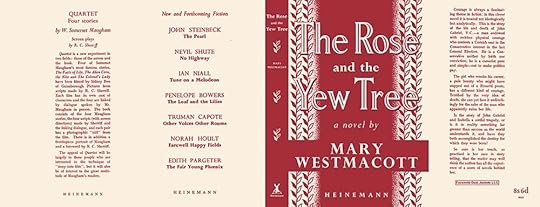
The full back and front covers and flaps from the 1948 Heinemann edition.

I should have known that Christie would not let me down even when writing under a pseudonym. You are still in the hands of a master writer of character and plot. The publisher Heinemann even slyly tried to hint that the author was a long-time veteran without revealing her true identity. Their 1948 book flap synopsis ends with: "So sure is her touch, so practiced in her ease in story telling, that the reader may well think the author has all the experience of a score of novels behind her."

This novel counts against my Complete Agatha Christie binge goal, so I have 19 novels (including the 5 remaining Westmacotts), 5 short story collections, 11.5* theatrical plays (+ several harder to find 1-act radio plays) and 1 autobiography left to go. If my count is wrong I'll adjust it as I get nearer to the end of my target.

Footnote
* I am counting Towards Zero stage play version #1 (1945) and Towards Zero stage play version #2 (1956) each as 1/2 of a play.

Soundtrack
My lede header was inspired by the Neil Young song Love is a Rose (1974) best known from its cover version by Linda Ronstadt from the album Prisoner in Disguise (1975) which you can listen to on YouTube here or on Spotify here.
Neil Young's version was on his unreleased Homegrown (1974) album which was finally released in 2020. You can listen to Neil Young's original on YouTube here or on Spotify here.

Trivia and Links
The Rose and the Yew Tree was the 4th of 6 non-crime novels published by Agatha Christie under the pseudonym of Mary Westmacott. Her regular publisher Collins was not happy with the Westmacotts, although they did publish the first 3 of them. After their rejection of The Rose and the Yew Tree, Christie took the novel to the publisher William Heinemann Ltd. who accepted it and published the final 3 Westmacotts. The identity of Agatha Christie as the actual author had been kept a secret up until 1949 when it was released in a gossip column in the Sunday Times. A cynic might suspect 🤔 that the truth was leaked by the publisher in order to increase sales.
Read the further background on the Mary Westmacott novels at the official Agatha Christie website here.

Addendum
This is a reckoning of my remaining Agatha Christie TBR novels. The novels read are stroked through and those yet to be read are counted on the right hand side of the listing.
1. The Mysterious Affair at Styles
2. The Secret Adversary
3. The Murder on the Links
4. The Man in the Brown Suit
5. The Secret of Chimneys
6. The Murder of Roger Ackroyd
7. The Big Four
8. The Mystery of the Blue Train
9. The Seven Dials Mystery
10. The Murder at the Vicarage
11. The Sittaford Mystery
12. Peril at End House
13. Lord Edgware Dies
14. Murder on the Orient Express

15. Why Didn't They Ask Evans? 1
16. Three Act Tragedy
17. Death in the Clouds
18. The A.B.C. Murders
19. Murder in Mesopotamia
20. Cards on the Table
21. Dumb Witness
22. Death on the Nile
23. Appointment with Death
24. Hercule Poirot's Christmas

25. Murder Is Easy 2
26. And Then There Were None 3
27. Sad Cypress
28. One, Two, Buckle My Shoe
29. Evil Under the Sun
30. N or M?
31. The Body in the Library
32. Five Little Pigs
33. The Moving Finger
34. Towards Zero

35. Death Comes as the End 4
36. Sparkling Cyanide 5
37. The Hollow
38. Taken at the Flood
39. Crooked House
40. A Murder Is Announced

41. They Came to Baghdad 6
42. Mrs McGinty's Dead
43. They Do It with Mirrors
44. After the Funeral
45. A Pocket Full of Rye

46. Destination Unknown 7
47. Hickory Dickory Dock
48. Dead Man's Folly
49. 4.50 from Paddington

50. Ordeal by Innocence 8
51. Cat Among the Pigeons
52. The Pale Horse 9
53. The Mirror Crack'd from Side to Side
54. The Clocks
55. A Caribbean Mystery
56. At Bertram's Hotel
57. Third Girl

58. Endless Night 10
59. By the Pricking of My Thumbs 11
60. Hallowe'en Party
61. Passenger to Frankfurt 12
62. Nemesis
63. Elephants Can Remember

64. Postern of Fate 13
65. Curtain 14
66. Sleeping Murder

As Mary Westmacott
66. Giant's Bread 15
67. Unfinished Portrait 16
68. Absent in the Spring 17
69. The Rose and the Yew Tree
70. A Daughter's a Daughter 18
71. The Burden 19
Profile Image for Alexis Hall.
Author 62 books15.7k followers
Read
July 15, 2019
How fucking fascinating.

So, Mary Westmatcott is the pen-name Agatha Christie used when she wanted to get away from writing mysterious and write ... romances? Well, romances in the broad sense of "stories about people have emotional reactions to things and each other, some of which may be love" rather genre romance sense of "happy ever after."

Fair warning, there isn't a whole lot of happy ever after here.

But it's still really damn good.

It opens with the narrator, who seems to have some kind of physical disability, being called to the deathbed of a man he professes to hate. But why would be invited to the deathbed of such a person? What is the relationship between these two men. Is there a woman?! Oh the mystery.

The main action of the book takes place at a between-the-wars election in a small Cornish town. The narrator, as this point (and, btw, he's splendidly unreliable and occasionally obtuse throughout) is largely paralysed following a motor accident, and profoundly not okay about it (trigger warnings for of-the-time attitudes to disability, although some of that is the narrator being in a terribly bad place). This enables him to bear witness to the events of the election, and particularly the actions of the Tory candidate, a ruthless, lower class social climber called John Gabriel. There's love and sex, and politics and violence, class struggle, and, oh my gosh, all the best things. There's some really amazing character stuff, all of it spun through the eyes of a cynical, not all that observant narrator riddled with self-loathing. The sort-of-heroine, Isabella, is fascinatingly oblique, fragile in some ways, odd in others, and unexpectedly resilient in others. The whole novel pulls towards a gothic flavour, though Isabella herself resists it.

A book to read again, I think. To read through the gaps in itself and piece carefully together. And a TS Eliot reference is just the fucked up modernist cherry on top. *chef's kiss*

Also, a shoutout to Teresa, the narrator's utter fabulous sister. I'm not sure I've encountered a character quite like her fiction before: she's hilarious, perceptive, ruthlessly honest and utterly unashamed of who she is. Heroine of my life.

I pounced on that and told her she was illogical. She had just said that to fall in love with John Gabriel would be enjoyable.
‘Not to me,’ said Teresa. ‘Because I resent—and have always resented—feeling emotion.’
‘Yes,’ I said thoughtfully. ‘I believe that’s true. But why? I can’t understand that.’
‘And I can’t explain.’
‘Try,’ I urged.
‘Dear Hugh, how you like to probe! I suppose because I have no instinct for living. To feel that my will and my brain can be entirely swamped and overridden by emotion is insufferable to me. I can control my actions and to a large extent my thoughts—not to be able to control my emotions is galling to my pride—it humiliates me.’


Profile Image for Nisha-Anne.
Author 2 books27 followers
May 27, 2011
Lord, the skill and unnerving perception of Christie.

I love the choice she makes in a setting, how she unashamedly places a story in the midst of a small village with no pretence to exoticism or grandeur and then proceeds to ruthlessly delineate and unpack and thoroughly dissect the characters with a psychological insight that sometimes leaves me breathless and overwhelmed, struggling to contain so much intricacy of characterisation in my head.

And her clever use of symbolism, how unusual that central phrase of the novel is to me removed from her by the distance of space and time. So much so that I start the novel knowing it, intrigued, and then get so caught up in the plot and its emotions that I gradually forget the phrase as it recedes. And then she'll use the symbolism and I'll remember that I've forgotten the phrase but I know the symbol is significant and so I notice it as it crops up again and again. She never overwhelms the reader with heavyhanded imagery and symbolism, something I admire so much about her. And yet it's there, enough so I can love her for including it, enough so I can love her for adding that extra layer of literary excellence. And she reminds me of the phrase again at the end so I can go 'woah' with a sudden moment of sheer marvel. Marvel at her and how she bore out the central concept, twisted it and explored it and embellished it and then delivered liek woah.

I did find the Othello parallel handled a little unsubtly but then I liked very much that it focused solely on the character of Iago, affording an utterly fascinating insight into the character of Gabriel. And well, I always love when books are discussed within books. And now that I think about it, the irony of it was quite lovely too ... the fact that our Iago character was himself a victim of a husband's suspicion and jealousy when in fact he did nothing reprehensible at all to the wife in question. *lol* Oh Christie.

And her way with the unreliable narrator, how it's never with the knowing wink or the moody selfconsciousness of contemporary fiction. Hers is truly the unreliable narrator that startles you when the reveal comes, however small it may be, unsettling you enough to realise you've trusted this character's narration completely and blindly all the way until now and maybe they hadn't told you the whole story because they hadn't seen it themselves. So very very tantalising.

Most of all, I love the strong elegance of Christie's prose. How the sentences could be sharp and choppy but aren't. How they could be long and torturous and convoluted but they aren't. She is at once modern and classical, at once scientific and poetic, at once warm and distant.

How I adore her. *sigh*
Profile Image for Antoinette.
1,152 reviews283 followers
August 25, 2026
3.5 STARS.

Agatha Christie wrote 6 books under the pseudonym, Mary Westmacott. She wanted to try her hand at something other than her mysteries. Some might call this book a romance. I will call it an exploration of 2 disparate persons coming together in what appears to be an inexplicable attraction.

Our narrator, Hugh Norreys, has had some extraordinary bad luck and he has been left badly crippled. From his position on a couch, he has time to watch the goings on in the home he is sharing with his brother and sister in law. Everyone seems to use Hugh as their sounding board- after all, he can’t just get up and leave- and because of this, he is very aware of all that seems to be going on.

Our two would be lovers are John Gabriel, an up and rising politician, who originated from poor beginnings and Isabella Charteris, the granddaughter of Lady St Loo, who lives in a castle and is certainly on a higher footing than John Gabriel.

The setting is claustrophobic as we are stuck with Hugh and his perceptions. There is an election going on and as John Gabriel is running, there are lots of political ramblings- too many in my opinion.

Ultimately, I think this book is about the choices an individual makes and how sometimes love is not so clear cut.

If I had not known that this book was written by Agatha Christie, I would never have suspected. It is a very well written book but with a different tone from her mysteries.

Published: 1947
Profile Image for Katya.
564 reviews2 followers
Read
October 21, 2026
Todos começamos como figura central da nossa própria história. Mais tarde, interrogamo-nos, duvidamos, ficamos confundidos. Assim foi comigo.

Durante quase vinte anos, Agatha Christie conseguiu ocultar a autoria de seis romances sob o pseudónimo Mary Westmacott. Muito por força da sua fama, nos seis volumes que escreveu fora do género policial (e eu incluiria aqui ainda os seus dois volumes autobiográficos), a sua qualidade como romancista nunca foi devidamente apreciada. Diz-se, aliás, que foi precisamente para provar que era mais do que apenas uma escritora de policiais que Agatha Christie se lançou nesta aventura.
E eu digo que nem aqui Agatha se descolou do talento para a intriga — e isto pretende ser um elogio.

Pensar (no sentido especulativo da palavra) é na verdade um processo altamente artificial que ensinamos a nós mesmos com algum labor. Preocupamo-nos com o que fizemos ontem e discutimos o que faremos hoje e o que acontecerá amanhã. Mas ontem, hoje e amanhã existem de modo completamente independente da nossa especulação. Aconteceram e acontecerão, façamos nós o que fizermos em relação a eles.

Num texto que abre com uma epígrafe de T. S. Eliot, em que se lê que o momento da rosa e o momento do teixo são de igual duração, é mais ou menos este o mote: o tempo — passado, presente e futuro — segue irredutível, façamos nós o que fizermos em relação a ele. Apesar de quaisquer tentativas para agir sobre o curso dos acontecimentos, eis o tempo a recordar-nos os limites dessa intervenção. É isso que Hugh Norreys deverá perceber ao longo de uma jornada em que passa de jovem galante e independente a homem inválido.
Mas — sendo Mary Westmacott, Agatha Christie—, a coisa não pode ser de caras. E que melhor condutor pode haver para a vida introspectiva do que a intriga política? Afinal, não é apanágio dos políticos falar ao coração?

A última coisa que se quer numas eleições é pessoas que pensem bem e usem a cabeça.

O cenário, uma pacata e bucólica vila da Cornualha, à beira-mar plantada — uma espécie de ilha mítica na qual uma Miss Marple não desdenharia habitar — com um castelo a fingir, de gengibre, três velhos corvos crocitantes, e uma jovem como um palito, tão convencida que nem é capaz de nos dirigir palavra, [...] o tipo de rapariga que sentiu a ervilha debaixo dos colchões todos. Portanto, uma terra habitada pelas mulheres, os velhos, os inválidos e os artistas que escaparam ao recrutamento em tempos de guerra. É neste clima, em que se mimica um mundo feminino em miniatura, uma espécie de universo político como extensão das relações pessoais, que o capitão Hugh se instala e — qual Jeff, por detrás da sua Janela Indiscreta —, observa os habitantes desta pequena comunidade: um ou outro refugiado, alguns rendeiros, crianças de boa cepa e as suas mães, e as habitantes do Castelo — uma trindade de velhas coroada por uma jovem aristocrata que aguarda o regresso do noivo vindo da frente de guerra. Gentes que se observam à distância, que se interpretam, que escondem intenções e que tentam antecipar as ações alheias — gentes que, involuntariamente, materializam o problema do controlo, da dependência e da passagem do tempo.

Por conseguinte, vira-me mergulhado num mundo puramente político. E o mundo político, pelo menos em locais como St. Loo, é essencialmente feminino. É um mundo de cálculo de efeitos, de persuasão, de mil pequenas subtilezas, a par daquela imensa labuta desinteressante que constitui, lá está, a quota feminina da existência. É um mundo em miniatura, o universo exterior de derramamento de sangue e violência tem o seu lugar apenas como um cenário teatral o pode ter. Contra o pano de fundo de uma guerra mundial ainda em curso, entregávamo-nos a uma refrega tacanha e intensamente pessoal. O mesmo se passava no resto do país, disfarçado sob clichés nobres: Democracia, Liberdade, Segurança, Império, Nacionalização, Lealdade, Admirável Mundo Novo estas eram as palavras de ordem, os estandartes.
Mas as eleições de verdade eram influenciadas, como eu começava a suspeitar que seriam sempre, por aquelas insistências pessoais que são muito maiores, muito mais urgentes, do que as Palavras e os Nomes — os Estandartes — sob os quais a luta é travada.


A vida aqui é pacata. Hugh não consegue deixar a sua cadeira de inválido, mas tem um irmão com tato e uma cunhada com garra a olhar por si. E tem o seu poiso privilegiado de onde vai observando... Nesse clima de pasmaceira, nada faz prever a reviravolta do momento das eleições: é então que John Gabriel chega à Cornualha (e duvido que um nome como Gabriel, associado ao arcanjo da Anunciação, não tenha sido intencional). É Gabriel, como forasteiro, quem torna visíveis as fragilidades da ordem social, e quem, com isso, abre a porta a um tema caro a Agatha Christie — a classe.
É sabido que a cultura inglesa é fortemente classista, fundamento que apenas vem a ser abalado em meados da década de 60 do século XX. Todavia, há um caminho que se trilha até ao abalo cultural desta época: se nos cingirmos à literatura, podemos falar de Dickens ou Gaskell, no século XIX; e, em princípios de século XX, de Orwell ou Woolf. Mas há um nome muitas vezes esquecido na bruma de uma literatura menor (e Agatha sabia-o melhor do que ninguém). Agatha Christie aborda questões de classe em quase todas as suas obras, da sua autobiografia aos mistérios de Poirot. Talvez não seja sistemática ou impiedosamente crítica das distinções de classe (sobretudo, quando a não afetam), mas existe uma forte consciência de um sistema que já não serve à estrutura social e que, no entanto, é frequentemente mobilizado em narrativas daninhas. E, em A Rosa e o Teixo, é precisamente aí que entra John Gabriel, candidato Tory apenas porque sim, como testemunha e prova de que desafiar a hierarquia social não equivale necessariamente a combatê-la de forma emancipadora.

Fui para casa e disse ao meu pai: «Papá, quando for grande quero ser um lorde. Quero ser Lord John Gabriel.» «Isso é exatamente o que nunca vais ser», respondeu-me ele. «Tem de se nascer já lorde. Podem nomear-te Par do Reino se enriqueceres o bastante, mas não é a mesma coisa». E, de facto, não é a mesma coisa. Há uma coisa... uma coisa que eu nunca poderei ter... Oh, não me refiro a títulos. Refiro-me a ter-se nascido seguro de si, a saber o que se vai fazer ou dizer, a ser indelicado apenas quando se quer ser indelicado, e não ser malcriado só porque não nos sentimos bem e estamos constrangidos e queremos mostrar que somos tão bons como todos os outros. Não termos de andar por aí ansiosos, a interrogar-nos o tempo todo sobre o que as pessoas estarão a pensar de nós, e preocupar-nos apenas o que nós pensamos delas. Saber que se formos bizarros ou desleixados ou excêntricos isso não importará nada, porque somos quem somos...

E não digam que Agatha Christie não sabe o que faz. A tensão entre protagonistas não podia ser mais produtiva: Hugh observa; Gabriel age. Um encontra-se condicionado pelas circunstâncias; o outro procura transformar as circunstâncias em instrumentos da sua vontade.
Este é, por definição, o anti-herói que irá abalar as convicções da população, esgotar a boa vontade do capitão, virar os planos dos políticos de pernas para o ar e mexer com a vida de várias pessoas, recorrendo a esquemas interesseiros e pouco éticos. Numa terra sedimentada nas tradições, há um equilíbrio social precário que apenas alguém como Gabriel pode ter interesse em quebrar: ele é o motor da revolta contra o sistema de classes britânico — um homenzinho grosseiro e mesquinho... um homenzinho ganancioso que visa a destruição simbólica do poder.
Mas qual será o seu motivo? Querer aceder a uma posição social, querer destruir quem a ocupa ou querer transformar o sistema que produz essas diferenças? Será possível distingui-los?
Não seria a primeira vez que Agatha Christie recorria a um anarquista (um comunista ou um nazi) para apimentar as suas narrativas. Seria este radicalismo político um deslize freudiano?
Analisar John Gabriel seria matéria para uma longa dissertação — uma que eu leria —, mas onde é que isso deixa Norreys e a questão do tempo?
Sendo Agatha Mary Christie quem é, há, irresistivelmente, uma tendência para banalizar as questões maiores. Mesmo quando constrói uma trama em redor da intriga política, há uma fraqueza romântica na sua pena: Agatha não resiste à tentação trágica. Além disso, a autora não abandona a intriga quando abandona o policial; transfere-a para as relações humanas e para o campo político. Enquanto as questões políticas e de classe coexistem intimamente com as referências de época (guerra, racionamento, papéis de género...), a tragédia é uma constante disruptora que interrompe ou desvia a exploração das questões políticas. Perante ela, as relações de poder perdem parte das suas consequências e as contradições sociais acabam absorvidas por uma lógica de sofrimento individual que está na origem da sua visão da natureza humana. Nem John Gabriel escapa ao julgamento moral:

— Quanto ao John Gabriel... — comecei.
Teresa disse na sua voz profunda:
— Deixa-o nas mãos de Deus, Hugh.
— Isso é uma coisa estranha de se dizer, Teresa.
— Não, acho que é a coisa certa de se dizer. Sempre foi o que pensei. — E acrescentou: — Um dia, talvez percebas o que quero dizer.


Em A Rosa e o Teixo , a narrativa segue mais ou menos este rumo: o tempo é impiedoso para o coração, mas há uma coisa ainda mais inclemente. E não deixa de ser curioso perceber como é um liberal feito conservador quem o prova. Porque, de certa forma, é essa a mensagem que Gabriel traz: a natureza humana é contraditória e pode ser tão impiedosa com os outros como consigo própria. E qualquer destas implicações tem consequências políticas:

Só há duas coisas que galvanizam politicamente as pessoas. Uma é pôr-lhes alguma coisa nos bolsos. A outra é o tipo de ideia que parece mesmo ir fazer tudo correr bem, uma ideia extremamente fácil de perceber, nobre mas vaga, que nos permite vermo-nos a uma luz interior lisonjeira. Um homem gosta de se sentir um animal nobre, além de bem pago. Não se quer que a ideia seja demasiado prática... só qualquer coisa compassiva e que não seja dirigida a ninguém que tenha de se conhecer pessoalmente. Já reparaste como jorram donativos para as vítimas dos terramotos na Turquia ou na Arménia ou noutro sítio qualquer? Mas ninguém queria receber na sua própria casa uma criança deslocada, pois não? A natureza humana é assim.
Profile Image for Marwa.
274 reviews442 followers
October 10, 2024
بعد اللقاء الثالث مع روايات أجاثا كريستي الرومانسية التي نشرتها تحت اسم "ماري ويستماكوت" المستعار، يمكن القول أن هذه الروايات أكثر تعقيداً وعمقاً، بل وتشويقاً من رواياتها البوليسية.

تدور هذه الرواية على خلفية انتخابات عام ١٩٤٥ البريطانية، على لسان شاب قعيد على إثر حادثة مؤلمة. تبدو أجواء الرواية مغرقة في الرمادية، فمن ناحية يرثي الراوي لحاله على مدار الرواية، ومن ناحية يصعُب تخيل دوافع بطلة الرواية وبطلها، وغرابتهما. لذلك على الرغم من افتتاني بروايتي ويستماكوت Absent in the spring و A daughter is a daughter، إلا أن هذه الرواية كانت مختلفة. بالتأكيد ظهرت مهارة أجاثا في رسم شخصيات بالغة التعقيد إلا أنه ذلك النوع من التعقيد الذي لم أقابله في حياتي! فعبثاً حاولت أن أفهم دوافع البطلة إيزابيلا الرقيقة المتعلمة وراء ما فعلت فلم أستطع، أما جون جابرييل الوصولي فلم أستوعب أيضاً كيف أقدم على قلب الأمور رأساً على عقب بعد أن حقق حلمه. في روايتيها اللتين أشرت إليهما، كانت الشخصيات عادية بمزاياها وعيوبها وضعفها، شخصيات ستجد فيها نفسك وأشخاصاً قابلتهم في حياتك، أما بطلا هذه الرواية فكانا متطرفين في دوافعهما وردود أفعالهما. ترى هل لهذا السبب نتفاعل ونستمتع أكثر بالروايات التي تُخبرنا بما نعرفه مسبقاً وتصفه بدقة؟ أي تلك التي تذكرنا بصراعاتنا وإخفاقاتنا وضعفنا بدلا من أن تقص علينا صراعات لم نخضها؟

أما نهاية الرواية نفسها فجعلتني أفكر في وجود جريمة ما، ربما بسبب بعض التلميحات التي نثرتها أجاثا في فصولها الأخيرة. لذا كانت من الروايات التي تمنيت لو حظيت بقراءة مشتركة لها لأناقش هذه الفرضية، ولمحاولة فهم ما استعصى علي من حكاية إيزابيللا وجابرييل اللعين هذا.

عموما بعيداً عن الشخصيات والنهاية، فإن القراءة لأجاثا في مضمار الدراما النفسية متعة خالصة، فقدرتها على رسم الشخصيات وحواراتها العميقة الواقعية تبتلعك تماما في أجواء الرواية. لذا، وعلى الرغم من عدم "شرائي" لدوافع بعض الشخصيات كما يقولون، إلا أنني بعد الانتهاء من الرواية جلست في صمت وتأمل تماماً كالمرتين السابقتين. إن الحكمة التي تتمتع بها أجاثا والتي تدفعني للتمهل أثناء القراءة، والتأمل بعد الانتهاء منها، لجديرة بتجديد الإعجاب في كل مرة أزور رواياتها.
Profile Image for Lucy Powrie.
Author 4 books5,458 followers
Read
December 28, 2023
"'What is the real truth of a human creature who can appear so differently to different people?'
Robert, who seldom joined in our conversations, moved restlessly and said rather unexpectedly:
'But isn't that just the point? People do appear differently to different people. So do things. Trees, for instance, or the sea. Two painters would give you an entirely different idea of St Loo harbour.'
'You mean one painter would paint it naturalistically and another symbolically?'
Robert shook his head rather wearily. He hated talking about painting. He never could find the words to express what he meant.
'No,' he said. 'They'd actually see it differently. Probably—I don't know—you pick out of everything the things in it which are significant to you.'"

*

I can't decide if I love or hate this book. On one hand, it features Christie's fascinating insight into the human character, given more space and attention in this novel in comparison to her murder mysteries. But this is also what makes it so difficult to like: with an unreliable narrator, characters who it's impossible to like, and a plot that - much like life - never seems to know where it's going, it's often a frustrating read.

But maybe that's the point. Maybe what makes us human is precisely the fact that we're frustrating and nonsensical, unseeing and unlikeable. Either way, I'd still read this all over again, even in spite of the thin-on-the-ground plot and the fact it is most definitely not a romance, as many reviews have said. (Definitely do not use this as a romance guide, unless Romeo & Juliet is also your thing.)
Profile Image for Nigeyb.
1,604 reviews452 followers
August 3, 2022
I heard about The Rose and the Yew Tree (1947) on a recent episode of the BBC's A Good Read. More info here.

Despite the book's description this is not a romance. The Rose and the Yew Tree is written by Agatha Christie. It's one of six novels she wrote under the Mary Westmacott pseudonym. Despite the lack of crime it does have plenty of suspense and intrigue.

John Gabriel, an opportunistic working class war hero stands for Parliament in the post WW2 election as a potential Conservative MP. Hugh Norreys, a disabled character bears witness to the events of the election. Boiling beneath the surface are love, passion, politics, class divisions, shifting social boundaries, and violence. It's a mere 200 pages and, I realise in hindsight, it's best read fast, something I didn't do.

Hugh Norreys is an unreliable narrator, not very observant and blinded by his own feelings and emotions. The central story is the relationship between John Gabriel and Hugh Norries, so quite why the blurb plays up the romance element is unclear and indeed downright misleading. This is an effective and cleverly structured psychodrama which packs a lot of incident into its modest length.

There are many other characters who are all interesting and well drawn. It's easy to understand why this was one of Agatha Christie's favourites of her own books, a view shared by her daughter. A concise and unusual read with plenty to ponder.

4/5


Profile Image for Matthies.
14 reviews1 follower
July 9, 2020
This story was very complicated and even a bit mind baffling. I might be biased when it comes to judging Agatha's work, but I really think this one is quite special.
I have to admit that it was a bit dragging at some points because of the huge amount of political talk (one of the topics the story covers), but I can mostly just praise it for the stunning characters Agatha created and the deeper, darker themes the story tells about. The class struggles (and the hate / love that it results in) - the depressed, crippled and selfish narrator - and the quite dramatic love story -> it all works extremely well in this depressing, but very well written story.
Profile Image for Πάνος Τουρλής.
2,805 reviews174 followers
April 1, 2019
Η Agatha Christie, εκτός από τα πασίγνωστα και σημαντικά αστυνομικά μυθιστορήματά της, έγραψε και έξι κοινωνικά με το ψευδώνυμο Mary Westmacott, κυρίως την περίοδο 1930-1956. Πρόκειται για σωστά μελετημένα ψυχογραφήματα και ταυτόχρονα για «γλυκόπικρες ιστορίες αγάπης» που ξεκουράζανε τη συγγραφέα από την ένταση και τις απαιτήσεις ενός αστυνομικού μυθιστορήματος. Δείχνουν με ιδιαίτερο τρόπο μια διαφορετική πλευρά της αγαπημένης συγγραφέως και πόσο σωστά και κατάλληλα ήξερε να παρατηρεί, να μελετά και να σχεδιάζει τις αντιδράσεις της ανθρώπινη φύσης.

Στο βιβλίο «Η στιγμή του ρόδου» έχουμε ένα ερωτικό τρίγωνο ανάμεσα στον ανάπηρο Χιου Νόρεϊς, τον καιροσκόπο και υποψήφιο των Εργατικών Τζον Γκάμπριελ και την ξεπεσμένη αριστοκράτισσα Ιζαμπέλα Σεντ Λου, με φόντο την Κορνουάλη. Το μυθιστόρημα κυκλοφόρησε το 1947, λίγα χρόνια μετά τον Β΄ Παγκόσμιο πόλεμο κι αυτό φαίνεται μέσα στο κείμενο: «Στα χρόνια που ακολούθησαν τον πόλεμο του 1939-45, η Ευρώπη και η Ανατολή είχαν διέλθει μια ζοφερή περίοδο. Ο φόβος κορυφωνόταν ολοένα κι ο φόβος είχε θρέψει μια νέα σοδειά από αγριότητες και θηριωδίες. Ο πολιτισμός είχε αρχίσει να ραγίζει» (σελ. 14). Ο πρωτότυπος τίτλος του είναι «The rose and the yew tree» («Το ρόδο και ο ίταμος»), είναι εμπνευσμένος από τον στίχο του T. S. Eliot «Η στιγμή του ρόδου κι η στιγμή του ίταμου έχουν την ίδια διάρκεια» και αναφέρεται στο αρωματικό και τρυφερό τριαντάφυλλο (Ιζαμπέλα) και στον τοξικό και πικρό ίταμο (Γκάμπριελ): Το μυθιστόρημα κυκλοφόρησε πρώτη φορά το 1988 από τις εκδόσεις «Λυχνάρι» με τον τίτλο «Η Ιζαμπέλα που φοβόταν τον θάνατο» και τώρα επανεκδίδεται με τη γνωστή φροντίδα και επιμέλεια των εκδόσεων Διόπτρα.

Ο Τζον Γκάμπριελ είναι ένας «πολεμιστής παρασημοφορεμένος με τον Σταυρό της Βικτωρίας, καιροσκόπος, φιλήδονος και χαρισματικός», δεινός ομιλητής και με ένα βαθύ μίσος για την αριστοκρατική τάξη: «Μισώ αυτές τις αλαζονικές γυναίκες της ανώτερης τάξης… Ζούνε, σε ολάκερη τη χώρα, σε σπίτια υπό κατάρρευση, με εισοδήματα που έχουν συρρικνωθεί σε μηδαμινό βαθμό. Πολλές από δαύτες δεν έχουν να φάνε… Αλλά έχουν κάτι που δεν μπορώ ν’ αποκτήσω -και που ποτέ δε θ’ αποκτήσω-, ένα τρισκατάρατο αίσθημα ανωτερότητας» (σελ. 66). Τα πυρά του τα στρέφει ακόμη και στον έμπιστό του Νόρεϊς: «Δεν είναι επειδή είσαι ένας τόσο θαυμάσια συμπονετικός ακροατής και τα σχετικά. Είναι επειδή δεν είσαι χρήσιμος για οτιδήποτε άλλο» (σελ. 115). Πρόκειται για μια αντιπαθητική φιγούρα που δε διστάζει να τσαλακώσει τη δημόσια εικόνα του, ριψοκινδυνεύοντας να χάσει ακόμη και τις εκλογές.

Ο παράλυτος από τροχαίο ατύχημα Χιου Νόρεϊς μετακόμισε στο Σεντ Λου της Κορνουάλης, στο σπίτι που κληρονόμησε η γυναίκα του ζωγράφου αδελφού του, Τερέζα. Εκεί μπαίνει στη ζωή του η Ιζαμπέλα, εγγονή της λαίδης Σεντ Λου, χήρας και κληρονόμου του κάστρου και της γύρω περιοχής. Κινούμενος σε αναπηρικό αμαξίδιο και μην έχοντας να κάνει κάτι, γίνεται πολύ εύκολα κάτι σαν εξομολογητής των συνομιλητών του ή μπορεί, μιας και κανείς δεν του δίνει πολλή σημασία, να παρατηρεί και να καταγράφει αντιδράσεις, συμπεριφορές και συνομιλίες ευκολότερα. Παρ’ όλη τη θέση του, δε χάνει το χιούμορ του, που είναι καλοδεχούμενο μέσα σε τόση ψεύτικη ανωτερότητα γύρω του: «Καμιά φορά, μόνο και μόνο για να διασκεδάσω, της ανέφερα το ένα όνομα μετά το άλλο και περίμενα να ξινίσει η αρχική γλυκύτητα των σχολίων της» (σελ. 116).

Η Ιζαμπέλα είναι μια προσωπικότητα που δε σκιαγραφείται τόσο πολύ ούτε τόσο εύκολα ενώ μια απρόβλεπτη κίνηση προς το τέλος του μυθιστορήματος της δίνει μια πινελιά αγιότητας. Εκπροσωπεί την καταρρέουσα αστική τάξη που πέφτοντας παρασύρει έναν ολόκληρο κόσμο γύρω της, κάτι που η Agatha Christie δε σταματά να τονίζει καθ’ όλη τη διάρκεια του μυθιστορήματος.

Γύρω από αυτούς τους τρεις ανθρώπους θα στηθεί ένα αξιόλογο δίχτυ, με αναπάντεχους ελιγμούς και απρόσμενες εξελίξεις. Δεν μπορώ να μην αναγνωρίσω πως πρόκειται για ένα σχετικά στατικό μυθιστόρημα, που θυσιάζει τη δράση για τα μελετημένα, τεκμηριωμένα πραγματολογικά στοιχεία, μέσα από τα οποία αναδύεται η βρετανική μεταπολεμική κοινωνία. Άλλωστε, ο παροπλισμένος Νόρεϊς, ο Εργατικός Γκάμπριελ και η αριστοκράτισσα Σεντ Λου είναι τα καλύτερα δείγματα των τάξεων που θέλει να αναλύσει και να αναφέρει η συγγραφέας. Μόνο η συναρπαστική ματιά ενός κόσμου που αλλάζει και στέκει μουδιασμένος και ίσως ανήμπορος μπροστά στις σαρωτικές αλλαγές μιας νέας εποχής, καθώς και η Κορνουάλη (πάντα η Κορνουάλη) και φυσικά το βάρος του ονόματος της Agatha Christie είναι αυτά που με βοήθησαν να τελειώσω το μυθιστόρημα, χωρίς αυτό να σημαίνει πως δε βγήκα κερδισμένος από το βιβλίο.

Η γραφή είναι παλαιομοδίτικη, με συντακτικό και λεξιλόγιο που πλέον δεν υφίστανται στην εποχή μας, οπότε έχουμε και την αντίστοιχη αξιόλογη μετάφραση, που ζωντανεύει ακριβώς την ατμόσφαιρα της εποχής και το στυλ της αγγλικής αριστοκρατίας (ο Αύγουστος Κορτώ πρέπει να κοπίασε πολύ αναζητώντας το κατάλληλο λεξιλόγιο και τη σωστή δομή), χωρίς να υποσκελίζει ή να προσβάλλει το πρωτότυπο κείμενο. Υπάρχουν πάντως πολλές παρομοιώσεις και μεταφορές που δίνουν ζωντάνια και γλαφυρότητα στο κείμενο: «Διότι η Κάθριν Γιουγκουμπιάν διαθέτει την επιμονή μιας βαριοπούλας και τη μονοτονία ενός φλόγιστρου ασετιλίνης, σε συνδυασμό με την εξουθενωτική επίδραση του νερού που στάζει σε πέτρα!» (σελ. 8), «Η αχνή, γλυκιά σαν μήλο φωνή σώπασε…» (σελ. 56), «Ο Κάρσλεϊκ είναι άριστα χωμένος στη δουλειά του, όπως ο σκόρος στο μάλλινο» (σελ. 54).

Η διεισδυτική και διερευνητική ματιά της συγγραφέως δε μένει μόνο στην ανθρώπινη ψυχολογία αλλά παρατηρεί και σχολιάζει με ευρηματικό τρόπο και απτά παραδείγματα και τις κοινωνικές, οικονομικές και πολιτιστικές αλλαγές της Αγγλίας κυρίως αλλά και του κόσμου. Με αφορμή την παραδοσιακή, ήρεμη και καθόλου συναρπαστική ζωή στην αγγλική επαρχία όπως αυτή αναπαρίσταται στο Σεντ Λου δίνεται η ευκαιρία να καταγραφούν ένα σωρό παρατηρήσεις για τον ελεύθερο χρόνο των κατοίκων (αγαπημένο χόμπι το ουίστ, ένα παιχνίδι με χαρτιά), τους μεταξύ τους δεσμούς, τις συνήθειές τους, τον διαχωρισμό τους σε Συντηρητικούς και Εργατικούς, Τόρις και κόκνεϊ κλπ. Η πολιτική αντιπαράθεση εν όψει των εκλογών, που καταλαμβάνει το μεγαλύτερο βάρος στην υπόθεση, εξουδετερώνεται και ισοπεδώνεται σε δύο φράσεις: «-Σε ενδιέφεραν ποτέ τα πολιτικά, Τερέζα; -Ανέκαθεν μου φαίνονταν περιττά. Αρκούμαι στο να ψηφίσω τον υποψήφιο που θεωρώ πιθανότερο να κάνει τη λιγότερη ζημιά» (σελ. 38). Φυσικά δε λείπουν και οι αιχμές: «Η γυναικεία ψήφος, είπε, ήταν ανέκαθεν ακανθώδης» (σελ. 53). Από την άλλη, σα βόμβα έσκασε μπροστά μου η ασημαντότητα μιας παρατήρησης για έναν κατά τα άλλα σημαντικό υποψήφιο: «Τι κρίμα που έχει τόσο λαϊκά πόδια» (σελ. 57). Η πεμπτουσία του σνομπισμού και η κενότητα μιας παρατήρησης σε μια άκαιρη πρόταση που θα μπορούσε πραγματικά να εκφέρει ένας Άγγλος ψηφοφόρος! Τέλος, η πρόταση στη σελίδα 109 αποδυναμώνει την αξία της εξουσίας από τη μια και τονίζει τον φόβο που ακόμη είχε ο κόσμος για τον νεκρό πια και λαοπλάνο Φύρερ: «Ποιος θαρρείς πως είμαι, ο Χίτλερ; Δε θέλω εξουσία, δεν έχω καμία φιλοδοξία να επιβάλλομαι στους συνανθρώπους μου ή στον κόσμο εν γένει. Για όνομα του Θεού, άνθρωπέ μου, για ποιο λόγο θαρρείς πως έμπλεξα σ’ αυτήν την κομπίνα; Η εξουσία είναι μια μπούρδα!» Για άλλη μια φορά η Agatha Christie αποδυναμώνει το βάρος σημαντικών θεσμών με απλές, καθημερινές εκφράσεις! Και κλείνω με το πιο διαχρονικό, καίριο, πάντα επίκαιρο σχόλιο: «Τι είναι η πολιτική στο κάτω κάτω αν όχι γειτονικά κιόσκια στο πανηγύρι του κόσμου, που το καθένα τους προσφέρει το δικό του μαντζούνι που γιατρεύει όλα τα δεινά;» (σελ. 181).

Η συγγραφέας, αν και ήταν γύρω στα εξήντα όταν το έγραφε, πάρα πολλές φορές τονίζει το παρωχημένο των μεγάλων σε ηλικία ανθρώπων και πόσο μεγάλο εμπόδιο είναι για την πρόοδο μιας κοινότητας ή ενός ευρύτερου συνόλου. «Ο πρόεδρος [του Συντηρητικού πολιτικού κόμματος της περιοχής και κυριάρχου στις επερχόμενες εκλογές] άρχισε να μιλά με μια τρεμουλιαστή, μελίρρυτη φωνή. Ο κόσμος για τον οποίο μουρμούριζε, συλλογίστηκα, δεν υπήρχε πλέον» (σελ. 56). Ο κόσμος καταρρέει γύρω μας και πρέπει όχι μόνο να το συνειδητοποιήσουμε αλλά και να αντιληφθούμε τις νέες ανάγκες και επιταγές ώστε να δημιουργήσουμε έναν καλύτερο αυριανό κόσμο, αυτό υποστηρίζεται σθεναρά καθ’ όλη την έκταση του κειμένου.

Δεν είναι όμως μόνο οι σημαντικές πολιτικές αλλαγές της βρετανικής κοινωνίας αλλά και η επαναστατική αύρα μιας νέας τάξης πραγμάτων, για την οποία καθιερωμένες, πάγιες αξίες και ολόκληρα status quo κατακρημνίζονται: «-Δε θα παντρευτώ εκτός της τάξης μου. Ω, ναι, ξέρω ποια είναι η τάξη μου. Δεν είμαι τζέντλεμαν. -Σημαίνει τίποτα η λέξη αυτή στις μέρες μας; ρώτησα με αμφιβολία. -Η λέξη όχι. Αλλά αυτό που νοηματοδοτεί εξακολουθεί να υφίσταται» (σελ. 111). Και φυσικά υπάρχει το αγαπημένο μου απόσπασμα στη σελίδα 148 που δεν αφήνει τίποτα όρθιο: «Δεν έχουν δεύτερο βρακί. Ζούνε σ’ ένα κατεστραμμένο, ετοιμόρροπο κάστρο και παριστάνουν ότι είναι οι σπουδαιότερες όλων. Κάθεται εκεί και ξύνεται χωρίς να κάνει τίποτα, ελπίζοντας ότι θα την παντρευτεί ο μονάκριβος κληρονόμος… Αυτές οι κοπέλες με αηδιάζουν, Νόρεϊς. Κακομαθημένα πεκινουά, αυτό είναι. Κι η λαίδη Σεντ Λου αυτό ακριβώς θέλει να είναι. Τι διάολο ωφελεί να είσαι η λαίδη Σεντ Λου τη σήμερον ημέρα; Όλα αυτά τα πράγματα έχουν παρέλθει οριστικά. Κωμικά, μόνο αυτό είναι στις μέρες μας, σαν καλαμπούρι σε βαριετέ…».

Το μυθιστόρημα το προτείνω σε όποιον αρέσει να διαβάζει ρομαντικές ιστορίες του παλιού καιρού, με ψυχογραφίες, αργή δράση και μπόλικη ατμόσφαιρα Αγγλίας, σε όποιον θέλει να δει ένα άλλο συγγραφικό ταλέντο της Αγκάθα Κρίστι και σε όποιον έχει την υπομονή και τη θέληση να ξεψαχνίσει ένα κείμενο-ντοκουμέντο για τις μέρες της Αγκάθα Κρίστι και πώς κατάφερε να εντάξει όσα ήξερε, μάθαινε και διέβλεπε σε ένα μυθιστόρημα γεμάτο ρεαλιστικούς χαρακτήρες, αληθοφανή και ψυχολογικά επεξηγημένα συμπλέγματα ανθρώπινων σχέσεων, και επικαιρότητα.
Profile Image for JackieB.
425 reviews
January 13, 2011
I had to abandon this because it was so grim. I think the narrator was suffering from clinical depression. There was a kind of emotional "greyness" in all of the events and people he described. He didn't seem to like anybody and frequently complained about how useless he was and how meaningless his life was. I got about half way through and couldn't take anymore.
Profile Image for Yevheniia Shepel.
228 reviews8 followers
February 27, 2024
Дуже цікаво було подивитись на творчість Агати Крісті в її таємному амплуа.
Розумію чому вона писала під псевдорнімом. Я вже знаючи, що це Агата читала книгу в її звичній детективній манері, важко було абстрагуватись від Пуаро 🕵️
🌸Мені дуже подобалось як гарно і неоднозначно прописані персонажі, їх ставлення до людей і речей, опис їх думок і почуттів. І загалом персонажі не штучні, такі справжді звичайні люди.
Сподобались описи на одну і ту саму особу від різних персонажів. Це дає можливість побачити з різних сторін героїв.

Знижую тільки. за те, що в деяких главах сильно стрибали думки і місця подій, трошки недоречно, як на мене. Це заважало мені тримати цілісність картинки в голові 🙌
Profile Image for Susan.
3,138 reviews566 followers
August 2, 2022
Having never read any of Agatha Christie's books, written under her pseudonym of Mary Westmacott, I was interested to give this a try when it was suggested as a buddy read on one of my Goodreads groups.

First published in 1948, and was the fourth of the six novels she wrote under this name. Christie's daughter suggested that these books were her most autobiographical and this was apparently a favourite of her and her mother. In many ways it reminded me of 'Endless Night,' published later, in 1957, but also a story that revolves around class.

The narrator of this story is Hugh Norrey, crippled in a road accident and living in the Cornish town of St Loo with his artist brother and sister in law. He meets Isabella Charteris, who lives in the castle and who is expected to marry her cousin, Rupert St Loo. From the outside, this seems a very comfortable, post-war world. However, an election is looming and the country is about to vote against Churchill. The Conservative candidate is John Gabriel, who is brash and of a lower social class.

Much of this story revolves around Hugh Norrey and John Gabriel. From his position as an invalid, Hugh witnesses Gabriel and instinctively both dislikes and is fascinated by him. He feels confused about Gabriel's attraction to the opposite sex and he is wary of Gabriel's ability to take chances. When he witnesses a child drowning, Gabriel leaps into the water, although he can't swim and later declares, 'If you can't have a gentleman, a hero is the next best thing!' This then is about class, a country re-creating itself after conflict, of falling for the wrong person and unrequited love. I am pleased I have finally read one of Christie's Westmacott novels.
Profile Image for Amorfna.
204 reviews81 followers
February 15, 2020
Iznenađujuće čitljiva.
Iskreno da mi ovo nije doneto greškom ( vidi Agata na trafici!) ne verujem da bih uzela ikada da čitam išta od Agatinog ' romansa' žanra. Iako u osnovi žanrovska, ovo je daleko od onoga čega sam se plašila.

Jedna sasvim depresivna romansa i studija likova.

3.5 *
Profile Image for Leslie.
416 reviews
September 26, 2013
British politics, unhappy women, and dreaming of marrying your cousin. Yep, sounds like a great read. I have now read 3 of the 6 novels Agatha Christie wrote under the pseudonym Mary Westmacott. But unlike her mystery stories, I'm pretty sure I will never have a desire to re-read any of these. These are marketed as romance, but I find them too filled with depressing people with unredeeming qualities. Even the narrator here, Hugh Norreys, leaves something to be desired.
Profile Image for Louise Culmer.
1,282 reviews53 followers
July 23, 2022
The story begins when the narrator, Hugh Norreys, is called to the bedside of a dying man called John Gabriel, whom he hasn’t seen for ten years and whom he hates with a passion. We then go back in time ten years to the summer of 1945. Hugh, badly injured in a road accident, is staying with his brother Robert and sister in law Theresa in St Loo, in Cornwall, where everyone is in a ferment over the coming general election. John Gabriel has been chosen as the Conservative candidate. A short ugly man of lowly origins (his father was a plumber) John Gabriel has a massive chip on his shoulder about the local gentry, and especially about Isabella, the beautiful and enigmatic niece of the old ladies who live in the crumbling castle, and who hopes to marry her glamorous cousin, Lord St Loo, when he returns from the war. Through Hugh’s eyes we see the various local people who are involved in the election, and all the tensions that come about through the behaviour of John Gabriel, who is a strange mixture of cynicism and chivalry and selfishness and courage and cruelty and cunning. The venom he directs at Isabella at times takes a disturbing turn (one very nasty incident caused me to put the book down for a while and wonder if I would pick it up again, though I did). And nobody ever really knows what Isabella is thinking. There are some very good characters (I particularly like Robert and Theresa) and the story is certainly gripping, though ultimately rather too melodramatic for my taste. But never dull.
Profile Image for Gina House.
Author 3 books155 followers
January 26, 2026
I'm torn about this book. I can't say that I loved it, but I also didn't dislike it. It's just so different from anything I've ever read by Agatha Christie. It's not just a traditional Agatha Christie novel with the mystery taken out. The writing is still brilliant, but the tone is almost bitter and slightly depressing.

Strangely, I felt compelled to read it and really wanted to know how the story would end BUT, at the same time, not looking forward to the story and not feeling any positive connection to any of the characters.

Reading The Rose and the Yew Tree reminded me of long-ago parable between opposing forces. Not between good and evil exactly, but more higher morals vs. old-fashioned everyday suffering. Not sure if that makes any sense.

I don't know if I would read this novel by Mary Westmacott/Agatha Christie again, but I am glad that I did. So far, all of the novels she wrote under this pseudonym that I've read have only been 3 stars. But, maybe I will find a gem in the ones I haven't read yet.

This is the July book choice for #readChristie2026, but I felt impatient to try it. If you've read it, I'd love to hear you thoughts on it!
Profile Image for Steve R.
1,055 reviews72 followers
December 2, 2020
This 1948 novel, written by Christie under the name of Mary Westmacott, was overwhelmingly rich in vibrant characterizations and insight into the political system in England. Set in the few months of 1945 after the defeat of Germany but before the defeat of Japan, war weariness affects all the personalities involved in an election in the town of St. Loo in Cornwall. This town currently has less than 6,000 people, but it is not the first story Christie chose to set there.

The characterizations are vivid, entrancing and impressive. The stillness and almost fairy-like innocence of Isabella, the crass opportunism and self-promotion of Gabriel, the pragmatic hard-headedness of Teresa, the slow but steady recovery of spirit by Hugh, the asperity of Mrs. Carstairs, the brutalized timidity of Milly Burns: these seemed to be quite real people. Such characterizations are very different from the often two-dimensional figures featured in her crime novels. The reader feels they have re-entered the real world in reading one of the Westmacott books.

But Christie’s political insights are truly profound. I had to write down a few of them:

- ‘What are politics after all but adjacent booths at the world’s fair, each offering their own cheapjack specific to cure all ills? And the gullible public swallows the chatter.’
- ‘Heaven help any country that has men in power with ideas! A man with an idea will grind down the common people, and starve children and break women, without even noticing what’s happening to them. He won’t even care.’ (Seems to apply quite well to the ideas of national socialism in Germany and communism in the USSR)
- ‘The last thing you want in an election is a lot of people who think things out and really use their heads.’ (Spoken by a candidate for office)
- (from the Conservative candidate) What is the Tory Party anyway? Taken by and large it’s the most muddle-headed crowd of gentlemanly inefficients combined with unbusinesslike business men.’
- (on the Labour Party) ‘young men with intellects and degrees and lots of money are Labour, mainly, I suppose, because they don’t know the first thing about really working with their hands and haven’t an idea about what a working man really wants.’
- (on the Liberal party) ‘Nobody ever does like Liberal ideas, really, by which I mean that nobody ever likes the middle course. It’s too damned tame.’

Such pithy, cynical comments cannot be dismissed as jaded since they are brilliantly insightful.

The major crux of the plot involves two characters who could not be more opposite to one another: one a ‘common little boy’ obsessed with getting the better of the world around himself by manipulating all those with whom he comes in contact, the other an ethereal fairy-like princess who is so divorced from the world that she can sit for hours, hands folded in her lap, back straight, enjoying the sunshine. Such venal crassness contrasted so strongly with such unworldly repose means neither of these characters seem quite real. We ‘normal’ people find ourselves somewhere between the two extremes as we are respectively either less in or more in the world. The manner in which these two extremes meet and develop a a relationship

Very, very well written. Highly recommended.
Profile Image for Dane Cobain.
Author 22 books319 followers
July 14, 2013
The Rose and the Yew Tree is one of Christie’s pseudonymous novels, originally published under the pen name of Mary Westmacott. The novels which Christie wrote as Westmacott are usually referred to as romance novels, and while there’s a healthy dose of romance involved here, it’s more of a human interest novel than anything else.

Loosely speaking, the story follows the ruthless John Gabriel in his attempt to make it as a politician in a sleepy village, a man who would happily represent any political party so long as he could gain power. It’s an interesting look back at a time that is no more, and to the types of character that you no longer get to meet – it’s also surprisingly exciting, despite the subject matter.

I’ll be honest, I wasn’t expecting great things – as usual, Agatha Christie surprised me. If you only read her because you’re in to crime novels then this isn’t for you, but if you’re a fan in general of literature from her era then you’re going to love this – it puts her on a par with Hemingway, Graham Greene and other great writers of her generation.
Profile Image for Ferne (Enthusiastic Reader).
1,550 reviews55 followers
August 4, 2018
According to Agatha Christie's daughter, Rosalind Hicks, "The Rose and the Yew Tree" was a favorite of Agatha Christie and also of her daughter. A beautiful woman, Isabella Charteris, has always envisioned that she will marry the man of her childhood dreams - her cousin - and Rupert, the handsome man is to marry the beautiful young girl - his cousin - that he met in childhood and always envisioned marrying when he returns "home" from the war. The story is the tell of all the circumstances leading up to the reveal if the handsome man returns "home" and the life the woman has come to live. Their story is told by Hugh Norreys, a neighbor, a man who has his own story to tell. There are many unexpected twists and turns and as always the reader becomes entranced by the writing.

Don't miss reading more about the novels by Christie's daughter, Rosalind Hicks...
https://www.agathachristie.com/about-...

I am looking forward to reading the next romance titled, "A Daughter's a Daughter."
Profile Image for Kathy.
215 reviews5 followers
October 13, 2009
I loved Agatha Christie and her odd little Belgian and her prim Miss Marple, so I expected that I would love her Mary Westmacott stories. Unfortunately I didn't... they were good stories, but I didn't feel the usual sense of accomplishment or enjoyment upon finishing it.
The Rose and the Yew Tree sounded intriguing; instead I was left feeling down and depressed. NOT how I want to feel at the end of a story.

I can't say that even trying years later that there was any change... although the stories were well written and dragged me along, I didn't like them any better. Dark, depressing, sad, unhappy... all very apt words to describe the Rose and the Yew Tree and the other MW stories I managed to find.

Yeah, and the star? That's my feelings about the book and nothing about how well-written it was. I know a lot of people who would absolutely LOVE any of Mary Westmacott stories... I'm just not one of them.
Profile Image for Julie.
899 reviews22 followers
September 6, 2019
Written by Agatha Christie under a pseudonym, this story is narrated by Hugh Norreys who knows all the participants in this unusual tale. When Hugh is summoned by John Gabriel now known by as Father Clement, Hugh is shocked by the revelation. John Gabriel was a scoundrel and social climber who was a hero in the war and was running for election when Hugh first met him. However, when John meets the lovely Isabella, whose family Hugh is staying with, everything changes for John. I really enjoyed this book, the characters, the story line and the surprise ending.
Profile Image for Pratiksha Das.
18 reviews1 follower
December 20, 2013
This is my first Mary Westmacott novel and I picked it up thinking it'd be a mystery novel with either the odball M.Poirot or the adorable Miss Marple (both of whom I love). Instead, it turned out to be a romance. But did it disappoint me? Not in the least.
I throughly enjoyed perceiving the world through the eyes of Hugh Norreys, who, after being rendered invalid, has all the time in the world to observe people. Though it gets quite depressing, I will read it again.
Profile Image for Alisha.
1,300 reviews178 followers
November 10, 2024
Agatha Christie’s pseudonym, Mary Westmacott, is definitely worth a read, but prepare yourself for some psychological darkness, broken people, and fewer resolutions than you might expect. Sometimes I struggle to be on board with what she does under this pseudonym, but it’s completely and compulsively page-turning. Her writing as Mary Westmacott is even more addicting than as Agatha Christie.
Profile Image for Ioana.
1,451 reviews
September 22, 2023
Pentru #provocareaAgathaChristie din luna aceasta am ales o nouă carte scrisă de Regina Crimei sub pseudonimul de Mary Westmacott ✍️

"The Rose and the Yew Tree" explorează conceptul de iubire, mai exact al efectelor iubirii 💔 Povestea este relatată din perspectiva lui Hugh Norreys, ce în vara anului 1945 se află în convalescență la familia sa din sudul Angliei 🏡 Imobilizat pe canapea din cauza unui accident nefericit ce îi curmă șansa la iubire, acesta devine prieten cu un candidat la alegerile parlamentare 🤗 Printre politici și bârfe, romanul se focalizează pe promițătorul candidat și pe relația neașteptată a acestuia cu o tânără din localitate 🧡

Am lecturat cartea în format audio, iar vocea naratorului a adus un mare plus de expresivitate 🎧 Nu e favorita mea din cele scrise sub numele de Mary Westmacott, dar este o poveste ce oglindește realitatea și o mică parte din imprevizibilul și tumultul interior cu care fiecare dintre noi ne confruntăm la un moment dat ✨

"You can't feel pity for a person unless there's self pity there. A person has to feel sorry for themselves before you can feel sorry for them."
Displaying 1 - 30 of 391 reviews