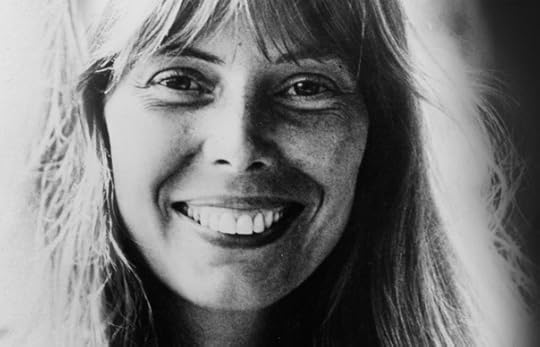
Joni Mitchell may be the most influential female recording artist and composer of the late twentieth century. In Reckless Daughter, the music critic David Yaffe tells the remarkable, heart-wrenching story of how the blond girl with the guitar became a superstar of folk music in the 1960s, a key figure in the Laurel Canyon music scene of the 1970s, and the songwriter who spoke resonantly to, and for, audiences across the country.
A Canadian prairie girl, a free-spirited artist, Mitchell never wanted to be a pop star. She was nothing more than “a painter derailed by circumstances," she would explain. And yet, she went on to become a talented self-taught musician and a brilliant bandleader, releasing album after album, each distinctly experimental, challenging, and revealing. Her lyrics captivated listeners with their perceptive language and naked emotion, born out of Mitchell's life, loves, complaints, and prophecies. As an artist whose work deftly balances narrative and musical complexity, she has been admired by such legendary lyricists as Bob Dylan and Leonard Cohen and beloved by such groundbreaking jazz musicians as Jaco Pastorius, Wayne Shorter, and Herbie Hancock. Her hits—from “Big Yellow Taxi" to “Both Sides, Now" to “A Case of You"—endure as timeless favorites, and her influence on the generations of singer-songwriters who would follow her, from her devoted fan Prince to Björk, is undeniable.
In this intimate biography, drawing on dozens of unprecedented in-person interviews with Mitchell, her childhood friends, and a cast of famous characters, Yaffe reveals the backstory behind the famous songs—from Mitchell's youth in Canada, her bout with polio at age nine, and her early marriage and the child she gave up for adoption, through the love affairs that inspired masterpieces, and up to the present—and shows us why Mitchell has so enthralled her listeners, her lovers, and her friends. Reckless Daughter is the story of an artist and an era that have left an indelible mark on American music.
David Yaffe is assistant professor of English at Syracuse University and the author of Fascinating Rhythm: Reading Jazz in American Writing. He is a music critic for the Nation and has written articles for the Cambridge Companion to Bob Dylan, the New York Times, Bookforum, New York Magazine, Slate, The New Republic, The Village Voice, and other publications.
Biographies are quite dangerous books, they can turn on you just like that, take a whole lump out of you before you can say wait, I didn’t want to know that. Don’t tell me. Please. No.
I like biographies of people I don’t care too much about, like the Marquis de Sade, or Kathy Acker or H P Lovecraft or Marlon Brando. I get nervous when they’re about people who I love or think I love like Nina Simone or John Fahey or Joni Mitchell. But I want the information; I’m so greedy.
Joni was everything they said she was – a terribly twee impossibly fragile folkie; a wannabe jazz bore; a high and mighty queen of the nasty putdown; and a fruitcake who thinks she has shamanic powers. Also a little bit of a genius; perhaps more than a little bit, perhaps a lot of a genius. Well you know, you gotta take the weft with the woof and the coke with the zen. It’s all part of life’s rich porridge.
Some biographies are in love with their subjects, and the authors are trying to perform some hideous reverse-engineered Single White Female move, creepy to the max (Norman Sherry on Graham Greene). Some start in worship and end up hating their subjects with a deep and deadly hatred (Roger Lewis on Anthony Burgess).
This one…. well, you might think David Yaffe is Joni Fan No 1 – I think he even thinks he is Joni Fan No 1 - but I dunno. The stuff he quotes from his hours and hours of interviews is quite often not conducive to the concept of Joni Mitchell as a pleasant or even a reasonably balanced individual. You might think David Yaffe is smiling with his face and stabbing with his keyboard, or perhaps just innocently stepping aside and letting Joni stab away at herself.
If you don’t cringe at many of the pages of this hapless biography, you’re cringe-making days are over I think. Here’s Joni on some of her gentleman acquaintances:
Chuck Mitchell was my first exploiter, a complete asshole.. the guy was a talentless nobody who hooked on to a tremendously talented girl
Jackson Browne was a leering narcissist… just a nasty bit of business
Larry Klein (husband of 12 years) : puffed-up dwarf
Leonard Cohen was the high priest of envy.
David Crosby : he was paranoid and grumpy. He was paranoid about his hair. He was unattractive in every way and overlording.
(David Yaffe tries his best to be evenhanded here – he interviews Crosby, Klein and even Chuck Mitchell to get their comments on her comments.)
Now here is Joni on how uncannily talented Joni is :
I can usually interpret my own dreams easily, because I am in touch with my own symbolism.
My own parents are color-blind and I’m color acute.
I’m a fine artist working in a commercial arena, so that’s my cross to bear.
I had a column in the school paper called “Fads and Fashions”. I started fads and I stopped them. I knew the mechanics of hip.
And sometimes you may be cringing or could be guffawing at observations made by Professor Yaffe himself :
By the 1980s, Joni felt deeply, Nietzsche’s prophecy had become fate. If Nietzsche was disgusted by Wagner, what would he have made of Hall and Oates or Phil Collins?
(Sure, but don’t stop there. What would Nietzsche have made of the Spice Girls?)
So these are the very dubious aspects on display here (and let’s not forget Joni blacking up on the cover of her album Don Juan’s Reckless daughter).
Oh, plus, I might add, we get more than several tiresome pages of vaporising jazzbo muso-talk. When this professor is interviewing with his musical gods he leaves his bullshit detector at home. It all goes down on paper uncritically. Oh boy.
But, and this is the big but, he has the goods. David Yaffe tells the whole long story of Joni from polio in Saskatoon to the brain aneurysm in Bel Air with the 19 studio albums in between all given full treatment, even the disrespected no-selling synthy 80s ones (Wild Things Run Fast, Dog Eat Dog, Chalk Mark in a Rainstorm) - to the point where I thought I had myself cruelly ignored these three and have now ordered them.
He fills in the strange encounter with the dying Charles Mingus, one of the most detailed sections , and all completely unknown to me. Fascinating stuff.
Perhaps the part he most glaringly evades or tactfully skates round is the 1997 re-union with Joni’s daughter Kilauren Gibb, who she’d given up for adoption in 1965. It was clearly not the most cloudless of relationships and we don’t get any interviews with Ms Gibb to balance Joni’s wounded account. And why should we – even in this immodest age some things are quite rightly still private.
So I think this book has a few major problems but Joni fans surely need it badly.
Just to be crystal clear if it should be in doubt : Joni Mitchell has written two of the greatest ever albums (A Song to a Seagull and Blue) and on top of that two further fistfuls of the greatest songs of the 20th century; plus, she had one of the most beautiful ever voices, in spite of a 4 packs a day habit, which only caught up to her in the 1990s, and then just made her sound beautifully damaged as opposed to just beautiful. So given all that, you might say she can be as cranky, rude and ungracious as she feels like, who cares.
I could drink a case of you And I’d still be on my feet I would still be on my feet
I was just walking near Lake Michigan and saw a young woman wearing a Woodstock T-Shirt, I had just listened to this biography's focus on that period, and I stopped to tell her. "Oh!" she said, "Who's Joni Mitchell?" I smiled, seeing my mistake that the t shirt might have actually meant something to her. "Oh," I said "She's just a genius I've always been in love with."
I love Joni Mitchell, always have. Of course, like most people, I prefer her earlier work: Clouds, Ladies of the Canyon, Blue, For the Roses, Court and Spark, Hejira, and like less her jazzier/synth work: stuff like Mingus and Dog Eat Dog, though I have favorites on even the less liked albums. I learned that the author had extraordinary access to Joni and talked at length with several of her long time friends/collaborators in the process, so I listened to the audio version, and liked it pretty well. Yaffe is not a great writer, but he neither romanticizes her nor castigates her for her late crusty-period decades, as she is increasingly less the flower child and more the grumpy and blunt Grand Dame of Pop Music. He takes us from Joni as folkie, as pop singer, as jazz improviser, always changing, asking so much of her fans to keep up with her.
Yaffe’s idea, following Joni’s own idea, is that giving up a child at 22 to adoption--and her many broken relationships, of course--shaped much of the wistful melancholy of the early music. A survivor of polio as a teen whose symptoms came back in her old age, a lover of Leonard Cohen, David Crosby, Graham Nash, James Taylor and others, and a painter (though Yaffe spends no time on that aspect of her life except to say as others have, that she is both “painterly” in her music and often cinematic), Joni is a complex person, not easy to categorize.
“I’m so hard to handle—I’m selfish, and I’m sad—I’ve gone and lost the best baby, that I ever had. I wish that I had a river, that I could skate away on”—Joni Mitchell
Of course I also love the music of most the men she loved, so it is fun to hear anecdotes linking the songs to particular incidents, but Joni was and is still a strong woman who could drink a whole case of some of the men she was with and still be on her feet:
What is she best known for? Blue is at the very top of a recent list of the best 150 albums by women’s artists ever. Court and Spark was her big popular hit. Unable to make it to Woodstock, she wrote its sort of melancholy anthem for it:
“We’ve got to get back to the garden.” Later in life, she would be an environmentalist, be rich enough to have her own gardeners, and angry and despondent about the possibilities of our ever getting back to that garden. Joni is increasingly angry and bitter about the music industry, about war, racism, environmental devastation, though she is not as convincing in writing about social causes as love and relationships. She does reunite with her adopted daughter, so that was a good thing.
As I said, it's not great writing from Yaffe, but as a fan I was pretty completely absorbed throughout, and I knew some of this stuff from previous bios. I would say 3/3.5, rounded up for Joni, and all the listening to the music I did throughout as I read.
Here’s an attempt for a top radio hit, “You Turn Me on, I’m a Radio” live 1974, Miles of Isles:
Yaffe not surprisingly uses the ideas of her “both sides now,” and “circle game” as guiding themes, though these are not my favorite songs from her. Still, here’s “Both Sides Now,” from Clouds, 1969, with the purity and innocence of the 22 year old who wrote it:
Cactus Tree Song for Sharon A Case of You River Urge For Going Woodstock The Last Night I Saw Richard For the Roses Conversation Little Green
Honorable Mentions:
In France They Kiss on Main Street Help Me Chinese Café Amelia Morgan Morgantown Chelsea Morning Carey Free Man in Paris Cherokee Louise Night Ride Home The Magdalene Laundries I Think I Understand Song for a Seagull California Chinese Café Big Yellow Taxi See You Sometime God Must Be a Boogieman Court and Spark Furry Sings the Blues
Joni Mitchell is a very important artist to me, as she is for many people. I've never really been able, however, to articulate why she means so much to me. I think that's a universal experience though. Her music speaks to people in ways they can't explain. And in this new biography, what's so compelling about not only Joni's story but Yaffe's telling of it is that he's able to, every once in a while, put into words how Mitchell's music makes you feel.
This is a special book because you can tell the author truly loves his subject. If you're a fan of Joni as well, you'll be able to feel that love on the page and resonate with it, and that makes for a really special reading experience.
I'm also a huge nerd who loves knowing random facts and behind the scene type stuff about artists, their work, their history, etc. and this book is chock-full of it. It's a book I didn't want to end! And it made my appreciation for Mitchell and her oeuvre even greater, as if that was even possible. She's brilliant! And complicated! And undeniably a genius. And Yaffe makes that clear while showing the very human sides of the artist as well. It's a well-rounded book that accomplishes a hard task of summarizing one of the most influential singer/songwriters of the last century, possibly ever. And he does it excellently.
---
Disclaimer: I requested a copy of this from the publisher and they kindly sent it to me. However, I was not obligated to write a review for this book. As always, all thoughts and opinions are my own.
This book really celebrates the unique talent of Joni Mitchell, someone who conjures the true hippie spirit of the 60’s & 70’s, a singer that is quintessentially and synonymously the voice of the folk hippie scene.
A simple prairie girl from Canada emerges when she picks up the guitar and discovers her raw untapped talent. She’s the real deal. A true talent with soul in her heart and voice. She’s strong but also fragile. She’s not always portrayed perfectly. There are vulnerabilities which you can hear in the lyrics in her music, the loss of giving her child away as a young unwed girl giving her plenty of fodder to harness her emotions into lyrical genius. There’s her trail of failed relationships with men, often musicians many she had working relationships with, members of her band and other prominent musicians of the time, David Crosby, Leonard Cohen, Jackson Browne to name a few. She had a habit of keeping past lovers in her life many years after the failure of the relationship even those that were painful breakups. It was interesting to find out that Joni was not part of Woodstock, a sore point as she was appearing on the Dick Cavett show instead. Her manager thinking that would be more advantageous, how wrong that would prove to be. I loved reading about the background stories of the albums and the inspiration that created them, and also discovering her own musical inspirations. It was hard reading how this former glory girl of her time fails to make musical connections with newer audiences the 80’s being an epic fail for Joni, prompting a long absence from music, Joni becoming disgruntled with the whole music industry. The book rounds out with the decline of her health, a survivor of Polio as a child she had ongoing health issues, in later stages her health made touring difficult and she secluded herself to conserve energy and then becoming more of a recluse, eventually she suffered a brain aneurysm rendering her an invalid but amongst that there are glimmers of the old Joni there. A true pioneer woman of her generation paving many to follow in her footsteps.
4 🎼🎼🎼🎼 “Joni Mitchell is more than a 1970s icon or pop star. She is our eternal singer-songwriter of sorrows, traveling through our highs and lows . . . a master of the art song tradition.”
“Men fell in love with her and women felt like she was singing their secrets out loud.”
For this fan her songs were as constant as the northern star. I yearned to put on some silver and be
a lady of the canyon a woman whose man sung about Our House out dancing and wreck my stockings in a jukebox dive loved so naughty it made me weak in the knees a woman who could drink a case of that holy wine and still be on my feet
Yah, I also wanted to know about the men who inspired the lyrics—Leonard Cohen, David Crosby, Graham Nash, James Taylor, Jackson Brown, Beethoven—the mysterious Carey. But it was her lifesongs I wanted to know most about and this delivered. Like her, I missed going to Woodstock but she took me there. She was my earliest feminist archetype. I wore out almost every album because I saw myself in those lines from time to time. Many of the people responsible for the art I love have a flip side that’s often not so lovely. Joni has one, as do I, as does this book, which I can accept because it’s not about them but what they give and Joni gave me some of the best soundtracks of my youth while she was so busy being free. For her album Blue alone I would be eternally grateful but there was so much more. No doubt some fans might read this and wish they had let her music speak for itself—or not.
“Would you still love me if you knew what I was really like?
Depression can be the sand that makes the pearl. Most of my best work came out of it. If you get rid of the demons and the disturbing things, then the Angels fly off, too. There is the possibility, in that mire, of an epiphany.”
In the 1990s 2 fans told her “Before Prozac there was you.”
I’m glad I read this because the music has expanded. Her higher octaves have been filling my listening space and for that I am thankful. The seasons do indeed go round and round and yes, Joni, I still love you.
This a remarkable biography of the iconic Joni Mitchell. Reckless Daughter provides not only the background of the famous singer/songwriter but also delves into her brilliant musicality. A must read for rabid fans.
Since it looks like she won't be writing the autobiography I've been waiting for, this will probably be the closest we'll get. Maybe a tad too deferential, but with so many details I've never read before about her fascinating life and the genesis of the songs that I can hardly complain. If you're going to read a Joni book, read this one.
Then be sure to play the records one by one. Over and over and over and over.
This was a very in depth and super researched book about Roberta Joan "Joni" Mitchell, documenting her life going back to the beginnings on the windswept plains of Saskatoon, Saskatchewan, Canada. Considered by ROLLING STONE magazine to be one of the best singer-songwriters of our time, she's also a painter who has put some of her works on her album covers. There were romances with many musicians, Leonard Cohen, David Crosby, Graham Nash, and James Taylor to name a few during the earlier years. She was around during the times when many artists were getting started in NY and then out in LA in the 60's and 70's and knew and met many of those who became popular artists, when times were changing in music and in the world.
"They paved paradise And put up a parking lot"
"I've looked at life from both sides now From win and lose and still somehow It's life's illusions I recall I really don't know life at all."
"We are stardust, we are golden, We are billion year old carbon, And we got to get ourselves back to the garden."
The book talks about all of her albums, the songs on them, the writing of the songs...and does spend time on technical details and terms about writing, playing and recording, things that unless you're more involved in the making of it, you may not be familiar with. Some of that made my eyes glaze over and I could have done without. The book closely follows the progression of her musical evolution through the albums and the years as her tastes and styles changed as she meets different people along the way, and tries different styles of writing and playing and just trying to enjoy life and love.
An ARC was provided by NetGalley and the publisher for an unbiased review.
I've been a Joni Mitchell fan since, well, forever. So is the author, and he's done a nice job talking to his subject, her various lovers and friends, and other significant people in her life. He writes well, and I'm learning tons of cool, interesting stuff about one of my favorite musicians.
I paired the book with re-listening to all of her albums, more or less in order as Yaffe describes them. Which adds a lot to both the book and the music, so I recommend this approach to you, too.
I wish he'd done a better job with his photo section. Definitely not up to the text! Oh, well -- a bit of Google Image searching will substitute.
Joni Mitchell is/was a musical genius, and a very flawed person. Sadly, the latter part of her life is pretty much "be careful what you wish for." She did bounce back, personally, but I don't find her late-period music very interesting. Still, ± required reading if you're a fan. And I might pick it up again some year, to reread parts of it.
The short jacket note on the author shows David Jaffe to be an academic with an award for fiction. It may be the fiction background that results in prose that needs an editor. From the book I’d have guessed he was a music critic. His wide range of knowledge of music in a 30-40 year period inclusive of pop, folk and jazz makes this a slog at times.
An example of the choppy writing is the p. 65 intro of David Geffen with the anecdote about his working in the William Morris mail room and intercepting the letter that could have gotten him fired. Then on p. 70 “David Crosby … drove her (Joni) and her friend Geffen around town”. When you read back to find how Joni and Geffen met (i.e. how Geffen went from working in the mail room to having access to Mitchell and Crosby) you see it isn’t there.
The book is arranged by the chronology of Joni’s recordings. Jaffe discusses tuning and chords, the influences of those who worked on the albums, the lyrics, mood and the reasons behind Joni's personnel choices and how the albums fit the context of her life. You learn who the Canyon ladies actually are, that Dylan is the object of “Talk to me”, and James Taylor, “acid, booze and grass…” etc. The material on the making of the Mingus relationship/album stands out.
With the emphasis on music the contract/financial side is weak. While there are some signings the terms are hazy. The closest you get to money is in mid-career, when Joni says she has never received a royalty check. You don’t have enough information to know if this is true/amazing, and if so, why. Most music related bios cover the contracts and how the musicians scurry to fulfill album requirements or wait out their duration, there is none of that here.
Joni’s romantic partners are all in the music industry. Some are married... some with children. Some are written into music (hers and other's) and interviews. Regarding Jackson Browne, Yaffe notes the inconvenient truths about Daryl Hannah and his wife’s suicide that Joni wrote into her songs. Jaffe reports her negative one liners about other ex’s but she still hires many of them to work on her albums. Graham Nash, named the love of her life, may define the reason these artist to artist relationships didn’t work out. In writing “Our House”, and ode to Joni’s sense of style (homemaking skills?), he tricks her into cutting flowers so that he can use the piano.
Joni essentially ended her writing career in 2007, and the book essentially ends there too. There is out of sequence information on finding her daughter which seems to be tacked on. (After childhood, there is almost nothing on Joni’s parents.) The book rambles to a close.
In between a weak beginning and ending you get a lot of information on this singer-songwriter's life and career. The book is most meaningful when you know the songs and the people profiled. I’d like to give it 4 stars for the amount of information; but there are a lot of gaps and holes. Joni Mitchell is a difficult subject, perhaps this can be a starting point for the next intrepid biographer.
I wasn't sure what to expect from Reckless Daughter. There are an awful lot of terrible showbiz biographies around, so as someone who has loved Joni Mitchell's music for nigh on half a century now I approached this with some trepidation – but it turns out to be very good. Yaffe's style is readable and pretty straightforward and although it's a little over-written in places for my taste I never found that intruding too badly and I found the whole thing an enjoyable and fascinating read.
David Yaffe knows his stuff and covers the whole of Joni Mitchell's life in interesting but not excessive detail. He has known Joni personally for a long time and has spoken to her extensively for this book. He has also spoken to a very wide variety of others who know her from childhood friends to musical collaborators and the friends of older age; what seems like a genuine picture emerges of a stunningly talented musician who, partly as a result of formative experience is tough, thoroughly individual, headstrong and self-reliant. As a woman, this has brought her a good deal of criticism over the years, but thank heavens she is who she is because it has enabled her to create and record a body of work which is among the finest of all musical creations of the last half century, in my view. Yaffe doesn't skate over her less personable sides; he obviously likes and admires her very much but this is never a hagiography and it seems to me to be a pretty balanced portrait which thinks seriously about how Joni's life experience may shaped her and her music, but– praise be! – doesn’t go in for excessive speculative psychologising.
Part of the genius in Joni Mitchell's lyrics is that they are so often plainly intensely personal, but they speak to me of things in my own experience, often very indirectly but with great poignancy. Learning more about the experiences which gave rise to many of these songs is fascinating to me, and only intensifies their significance. Many, many years after I first heard and loved Little Green, I remember her revealing that it was about being forced by circumstance to give up her beloved baby for adoption. Even after those decades, it gave it an added poignancy which I have felt ever since. I'm not sure that there are revelations here which had quite the same impact on me, but it has certainly enriched my understanding and enjoyment of a lot of Joni's music.
The word "genius" is very over-used about artists of all kinds, but I think it may be justly applied to Joni Mitchell who is one of the very greatest of all songwriters and performers. I think this is a biography which is worthy of its subject and I can recommend this to any Joni Mitchell fan - which, let's face it, ought to be everybody.
As someone who scrawled Joni's (first-name basis, of course) lyrics across my college notebooks and in my journals, I consider myself a pretty ardent fan. My husband can't stand the shrieking voice or the mopey lyrics but even he, as I read this book and played certain songs alongside it, had to concede that she was a force to be reckoned with. So with this new bio and its beautiful cover photo, I set out to fall in love with her again, or at least with her story. But I didn't. David Yaffe's portrait of Joni starts out with a fantastic preface, in which he sets a mood of confession, friendship and poetic understanding between himself and his subject. But we never feel that way. Joni's story is mostly told through her music and many chapter titles come from her albums. I get that--it's a great way to follow an artist. But somewhere along the way Yaffe's prose turns workmanlike. He gets deep in the weeds when discussing her later work, starting with Hejira. He delves deeply into Joni's jazz-influenced albums, without really letting us hear them. Instead he throws around jazz and studio jargon that went right over my head. He gets extremely excited talking about all of the studio musicians who collaborated with Joni over the years, but then Joni herself gets kind of lost in the shuffle. There were some great realizations for me, however. I had no idea Prince was such a Joni fan or that Chaka Khan was her good friend. And her smoking and drug habit were both way more serious than I thought. Finally, she was kind of a bitch. I don't mind that. I think any artist has a right to be as cranky and misanthropic as they like, but I would have loved to have heard more about how this crankiness fueled her work. I wanted to hear her talk about her poetry and her writing method. And I wanted to know WHY she leaned why she morphed into a jazz artist more than I wanted to know what kind of synthesizers and pedals she used to do it. This may be a book more for musicians and music scholars than for those of us who know every word and cadence of many, many songs. But I shouldn't be surprised that I was disappointed by this book. I've never read a biography of a writer in which the author can bring words to life. That's the writer's job. The biographer's job is to provide information and revelation... In this case it just wasn't the information or revelations I wanted.
I've heard and heard about Joni Mitchell all my life, but I never really knew her beyond her hits and her early public persona as a golden California flower child of the late 60s. Hell, it was years upon years before I discovered that she's from Canada!
Yaffe's bio does of nice job of outlining her life by following the linear path of her output. Each album, especially the early work, gets a detailed description and analysis. What was happening in Mitchell's life at the time infuses the music with meaning.
I can't say that I came away from this book liking Mitchell any more than I did. Perhaps less, actually. She came off as gruff, difficult, and selfish at times. Traits I don't warm to. Of course, the music industry and how it warped her through its greed and manipulation needs to take a good deal of the blame for this. Regardless of whatever I think of her personality, she has an admirable grit, determination, and drive. For a "flower child" she took no guff from nobody!
I listened to most of her albums while reading Reckless Daughter, a title taken from one of Mitchell's albums. Like I said, I didn't know her output beyond the hits, so this was a great education in the range and depth of her music. I highly recommend it!
For a quick taste of what I mean, take a listen to these two versions of the same song: Both Sides Now from 1968 Both Sides Now from 2000
A recurring motif in Reckless Daughter is the attempt to find a suitable comparison for Joni Mitchell. The author, the subejct, and contemporaries of hers take their best shot; Miles Davis, Rembrandt, Beethoven, Schubert, Van Gogh, and Picasso are all mentioned. Joni, who always considered herself as much a painter as a musician, would appreciate the cross-medium comparisons, and as someone who grew up loving Rachmaninoff and Debussy and took pride in her compositions, she wouldn’t mind being mentioned alongside classical giants either. And indeed, the mere realm in which people grasp for comparisons is impressive and perhaps even the least bit useful when considering Mitchell’s place in the all-time artistic firmament. But mostly, they, like all comparisons, do a double disservice, to Mitchell and the other party.
Having crudely delimited the rarefied artistic territory Mitchell inhabits, Yaffe does little to build on her status as a musical genius. He struggles to find a tone—he’s sometimes loving, sometimes clinical, and mostly just bored-seeming—and as a result, the Joni Mitchell rendered by the book never feels like a person; his effort comes slightly closer to portraying a career, but even in that regard, the book falls significantly short of offering up a multidimensional narrative, instead often feeling like a folder of newspaper clippings. Yaffe is happy to ineffectually co-opt Mitchell’s lyrics and turns of phrase in a transparent effort to atone for his own lack of imagination and prose style, but by coldly taking her words and none of their feeling, he misses her biggest lesson and fails to insert any of himself and any personality he might have into his book.
This lack of life on the part of the author seems linked to the lack of life breathed into a subject who has never before been accused of seeming lifeless. I’m not sure Yaffe could necessarily have salvaged this effort, but he might have been able to if he adopted a more personal approach to the material, almost structuring it as a backdoor-memoir by discussing the way his life has been affected by her work; from his occasional efforts at a more academic tone analyzing her music, I’m fairly certain he wouldn’t have had the technical chops to take the only other reasonable tack, that of a more rigorously clinical analysis of her corpus. By focusing on Mitchell’s effect on him, he would be able to sidestep the problem of approaching a genius as merely a person, or of approaching a person as merely a genius; also, straight analysis, even by someone with the skill to pull it off, would risk coming off as comically, woefully insufficient.
There are too rare moments where Yaffe essentially does this; he doesn’t quite make it personal, but he gets at how music and lyrics work together to produce a certain effect, and it’s great, often providing real insight to a certain degree of the immense power of Mitchell’s music. But more often, his offerings are trite, if not downright specious. There are also successful instances of contextualizing Mitchell’s songwriting without trying to explain it outright, draw parallels, or make explicit connections, but much more often Yaffe falls into the trap—all the more frustrating since he specifically mentions this fallacy early on, which raised my hopes that he would, you know, avoid it—of treating her songs as strictly biographical, in so doing unintentionally (hopefully) and wrongly undercutting her imaginative and artistic contributions.
Yaffe undercuts his subject in other ways as well, including unsourced speculation at various points, even when it flies in the face of on-record statements, as if he wants to include certain famous (and certainly famously disproven) myths in the book to ensure that they were part of the historical record. It doesn’t seem ill-intentioned, quite, just careless. It’s perhaps another hint of his authorial timidity; he’s willing to occasionally allow flatly contradictory interviews, but does little digging to help contextualize for his reader which of two or more sides might most likely be true. This lack of forcefulness or pushback (or one might more cruelly, but fairly, say “journalistic rigor”) often makes the book read more like an oral history, or an “as told to” memoir.
The endnotes suggest that Yaffe relied on interviews far more than any archival material in writing Reckless Daughter, and besides being lazy, this approach also causes real distortion in the narrative at points. Yaffe gives enormous space to less eventful periods of Mitchell’s career simply because the relevant interview subjects of the time period were more voluble. I’ll note in passing that further bloat occurs because of Yaffe’s willingness to include page-long quotes in which little of consequence is said; as indifferently written as Reckless Daughter mostly is, the straight transcripts from the interviews are even less considered, and far less valuable than would have been actual discourse on the less well known portions of her career.
Fortunately, Joni Mitchell herself was interviewed at length, and her voice in direct quotes is probably the single best aspect of the book; just getting to hear her casual phrasing, wordings, and tossed-off lines is a treat. There are occasionally anecdotes offered by Yaffe that are worthy and new even to the well-versed Joniphile: a lengthy elaboration on her famous quote about feeling like the cellophane on a packet of cigarettes; the source of the first two lines of “Don’t Interrupt the Sorrow;” the cause for the string section being out of tune in the middle of “Paprika Plains;” the reason Joni had to accompany Neil Young’s The Last Waltz rendition of “Helpless” from off-stage; and an examination of the degree to which Mitchell and Charles Mingus hardly knew, or even knew of, each other before collaborating. But the worthwhile anecdotes, the great Joni quotes, feel like breadcrumbs not dropped as a trail but merely fallen to the earth more or less at random after being tossed indiscriminately upwards.
There’s a disconnectedness to the material that can make it feel as though it’s on the verge of devolving into merely a collection of trivia. More times than I cared to count, Yaffe seemed to forget that he had already mentioned facts or events, not only repeating the substance of what he’d already said but with virtually the same wording; similarly, he repeatedly failed to make obvious connections forward or backward. The structure, to the extent that it exists, is the most rudimentary imaginable; Yaffe intends to proceed straightforward chronologically, yet still manages to make a muddled jumble of events, overlapping timelines without apparent intent. This carelessness is pervasive. There are missing words, misused punctuation marks, awkward phrasings, factual errors, sloppy misattribution of dialogue; the endnotes are skimpy, the index is incomplete and indifferent. Even at its smoothest, Yaffe’s prose is clipped, quippy, and glib in a way that feels jumpy and dashed-off, ill-suited to such a meticulous subject.
Taken in combination with his apparent lack of rigor in researching Mitchell—biography is a genre in which I would always be happy to see some of the work in the writing—none of this is surprising after a while; while Reckless Daughter lacks anything in the way of an authorial point-of-view, it at least has an obvious reason for existing: Yaffe pretty clearly wanted to be the first in the market with a major, substantial Joni Mitchell biography. The lack of competition in the marketplace is all too apparent in the lack of effort and polish—“substantial” would be much too generous for this book, and “major” is flat out of the question—but now that an attempt has been made, however insufficient, I’m eager to see the next efforts.
An excellent job of research. Yaffe seems to have spoken with all the major figures from each musical period in Joni's career. He also certainly knows his music history and music theory, being able to discuss the harmonic and rhythmic elements in Joni's always-expanding palette of song types.
The trajectory of Joni Mitchell's career went from sensitive and articulate folk songwriter through a more rock-accompanied period that led her into jazz. Much the way Steely Dan accrued accomplished jazz musicians in their studio output, such that those of us who only heard them on the radio discovered years later to our amazement that we were familiar with much of the jazz idiom, Joni too found herself adding jazz artists to her sound, starting with her drummer, Russ Kunkle's suggestion that she really should work with a jazz drummer, through the L.A. Express years, and eventually with jazz legends Wayne Shorter, Herbie Hancock, Jaco Pastorius and Don Alias, many of whom had worked with Miles Davis back in the day.
While she lost some of her fans during this transition, others stuck with her. I was an early fan right from the release of her first album in the mid-60s, SONG TO A SEAGULL. My ears were glued to the speakers right through HISSING OF SUMMER LAWNS and HEJIRA, but she briefly lost me during SHADOWS AND LIGHT and MINGUS, when she was truly offering jazz. I felt that some of the heart and intimacy and elegance was left behind at that point (plus, I was never a jazz devotee).
I found out from reading this book that the writing of these albums coincided with her heavy use of cocaine; this would explain some of the compulsive cramming of lyrics into rhythms without the mitigating and transformational effect of her beautiful melodies from early songs.
However, I have also come to understand that an artist needs to follow the path that compels them, and this Joni certainly did.
Being aware of Joni's illness following her collapse from a brain aneurism in 2015, I was starting to worry that the author was presenting her life story as if she were already gone. However, (spoiler alert) he ends the book with a graceful and rather hopeful account of her last appearances, coming back from that illness.
Joni Mitchell is an artist who was always a genius; driven to reveal truth and beauty and fearlessly demanding from other musicians what she needed for her vision of her music. If you look at early videos of her performances, she was a young, breathtakingly beautiful young woman with a startlingly lovely voice. As the years went by and she wrestled with her life and her career, her determination and even aggression overtook some of that innocent beauty, but her songs themselves continued to be shining realities. As the author keeps quoting from her lyrics, "Nothing lasts for long," but nothing can take those songs away.
This is an excellent book, worthy of its subject.
One caveat--I kept asking myself, as Yaffe interpreted her feelings and intentions embedded in her songs, whether the fact that he was a man colored in any way his view of her. He quotes many, many male fellow-musicians, but only one or two women. The ONLY woman who speaks well of Joni seems to have been the R&B singer, Chaka Khan, who defended Joni's alter ego, "ART NOUVEAU" (Joni's black face creation which she would use to impersonate a Black man and even put this image on the album cover of SHADOWS AND LIGHT.) Chaka seems to have appreciated Joni's spunk.
Joan Baez condescending explains why a prison audience of Black women booed Joni off the stage, saying that Joni did not know how to speak to Black women. Baez was no stranger to aggressive ambition herself, so it is not surprising the two did not hit it off.
Judy Collins relates how hurt and insulted she felt that Joni was not properly grateful for Judy launching her career by having a smash hit with her cover of "Both Sides Now."
But nowhere are there any fellow-musicians who are women speaking about working with Joni...because she never seems to have collaborated with any. This just underlines how Joni's work and ambition involved making it in a man's world and this was way before Sarah McLaughin's LILLITH FAIR tours; it was a jungle out there, if it is not still one now.
So that was one bit of queasiness I felt.
The other was the way the author kept weaving lines from Joni's lyrics into his descriptions of her life. I suppose it was hard to resist. And it was sort of a dog whistle, because only fans who really knew her lyrics would even notice; others would just think he was trying to be poetic.
Having said all that, all in all, it's an excellent biography.
Even before she’d recorded her first album, 24-year-old Joni Mitchell had already endured a lonely childhood on the Canadian prairies with dutiful yet unsupportive parents, a life-threatening bout of childhood polio, an unwanted pregnancy and having to give her daughter up for adoption, and a disastrous yet brief first marriage. Plenty of emotional baggage there, but that seemed to provide the perfect fuel for her creative fire. Indeed, many of her best seeringly autobiographical songs are set in the wake of personal disasters, usually revolving around her turbulent love life. It was only in the 1980s when, for a while, she was happily married to her bassist, Larry Klein, that the creative well seemed to run dry. However, the 80s are often dubbed “The Decade That Music Forgot” and many of Joni’s fellow singer-songwriters, including Bob Dylan, Leonard Cohen, Neil Young produced little of worth during that period. Also, Joni was far more musically diverse and eclectic than the aforementioned counterparts. Whereas they usually stuck to tried and tested blues and country formats, her influences extended into jazz and even ballet. During the 70s and 80s, on her albums and live tours she was accompanied by the cream of jazz-rock players, including Wayne Shorter, Larry Carlton, Robben Ford and Pat Metheny She frequently thought of herself as a painter first and songwriter second but, whereas, her music was usually ahead of the curve, she eschewed then current artistic forms like abstract expressionism in favour of older masters such as Van Gogh, Rousseau, early Picasso, Klimt and Magritte. Although this isn’t quite the lovefest of Sylvie Simmons’ autobiography of Leonard Cohen, there’s no doubt the author is frequently enamoured by his subject. However, that doesn’t stop him describing some of her less flattering attributes and moments. Overall – eight years in the making – this is a biography befitting the greatest female singer-songwriter of her generation.
I have plenty of mixed feelings about this book. On the one hand, I loved all the stories around Joni, about musicians around her, who she worked with, the process of each album. That part was great. On the other hand, the author chooses to tell things that I find invasive, not just of her own privacy, but of everyone she crossed paths with. I guess I would have loved to read a memoir by her, not this guy telling you what she is like. There is a very thin line in biographies, the personality of the biographer is important, and this author seems to like gossip just a bit too much. Still, there is love for her work here, so that makes it worth it.
Ms. Mitchell gets the book she deserves; detailed, balanced, and while full of respect and admiration inclusive of actions, events and statements that do not paint the lady of the canyon in a flattering light. The author's deep understanding of music allows a depth not normally found in biographies of this sort. Expect feeling a need to work your way carefully through Mitchell's catalogue while reading, and once you've finished this.
I have really enjoyed reading something other than a thriller for a change. This book, while no great shakes as a biography, was very interesting in terms of its content – i. e., the fascinating details of Joni Mitchell’s life and career. She is one of my heroes. What a remarkable lady!
"Wild Things Run Fast, released in October 1982, is never anyone's favorite Joni Mitchell album..."
Writing like that is why musician biographies are always lacking. Every reader has their own experience of the artist.
Wild Things Run Fast is my favorite Joni Mitchell album. It is the album I heard first and through which I discovered her others. (Elaboration on just why it's my favorite album will have to wait for my own biography...hehe)
In the same chapter, it was odd to hear the tour that accompanied that same album described as "idyllic", and extensive quotes from Larry Klein, tour musical director and husband, explained how, during the tour, "life doesn't get any better than this."
The show I saw on that tour, 20 July 1983, was the worse concert I ever attended. An openair concert, Joni complained after a few songs that too many people were wandering around and left the stage for 30 minutes, so we could "settle down". She came back, played a few more songs and complained, "I guess I'm just pooped." and left for good. I felt ripped-off. Life, for me, got so much better than that.
Reading about the tour now, I can conjecture that perhaps she was drained by some of the polio-related fatigue she was experiencing at that time. At the time, for me, I experienced disappointment.
It becomes transparent, while David Yaffe is describing how beautiful Joni is and how beautiful Leonard Cohen, David Crosby, Graham Nash, et.al. find her, that David Yaffe himself has fallen in love and in the thrall of her beauty. I found this oppressive. It is not an opinion I agree with, (though, in the gatefold insert from Miles Of Aisles album which I cut from the copy I borrowed from my local library and saved, Joni looks particularly radiant). Joni is, and deserves acknowledgement primarily as, a musical genius.
Yaffe, justly, does elaborate on Mitchell's inate phenomenal musical ability. It can be that her natural beauty is underscored in the writing to accentuate the struggle and the enduring independence Mitchell maintained in the male-dominated, female-exploiting music/entertainment industry.
It was enlightening and inspiring to read about Mitchell's creative path through what can be a industry built on rote procedures for hits and blockbusters throughout her career.
There is much of Joni's personality that could have been explored deeper. Does she really have an "inner black man" that allows her to masquerade as the zip coon character with impunity? Who decides? What's behind that animosity she holds for Jackson Browne?
Reading this book will have you playing songs already heard a million times listening now for something new. You will be scrolling through your favorite digital jukebox for songs of hers that have so far eluded your ears.
I've long been a fan of Joni Mitchell's music, so I was eager to read this. It's written in a bit of an unconventional manner, as if the author was eager to show his audience the depth of his musical knowledge and how cool and hip he is. As an example, he keeps talking about everyone's "chops" - Joni's jazz chops, someone else's drumming chops, a producer's engineering chops. I was waiting for the appearance of lamb chops and pork chops, but perhaps the author, or his subject, is a vegetarian.
The book covers Mitchell's musical career quite well. The albums are carefully analyzed, sometimes track by track. You also get a strong sense of Mitchell's restless creative nature, and her unique musical genius. The rest of her life is covered not as well. The author seems preoccupied with the number of lovers she had, how famous they were, and the number of cigarettes she smoked. A pivotal event in Mitchell's life was her reconnection with the daughter she had given up for adoption when she was very young. The loss of her daughter was a huge event for Mitchell, and she wrote several songs over the years reflecting on it. But the reunion is not covered in any depth, except for a few brief references to the difficulty of the relationship, and Mitchell's stronger attachment to her grandchild.
Mitchell doesn't really come across in the book as a very nice person. She holds grudges, and has a lot of bitterness toward the music industry and some of the people in the industry. There are hints of her tremendous determination in the discussion of her early career and in her recovery from a brain aneurysm. But I was left hoping for more depth, more of a deep digging into the life of this tremendously talented and insightful individual. Instead, I was often left with the sense that the author was condescending toward his subject. So the book was ok, mostly because it was about Joni Mitchell, but I'm hoping to read a more in-depth study at some point.
Joni Mitchell's first album was released in March, 1968. I was an off and on student at the University of Michigan in Ann Arbor, dropping out and then enrolling again. I was also singing in various spots around campus, covering songs recorded by Judy Collins, Joan Baez, and Bob Dylan, already playing Judy Collins' version of "Both Sides Now." So of course, I bought the album the minute it came out and listened to it daily. Eventually a couple friends of mine helped me figure out her open tunings and how to finger the chords.
I finally saw her perform live in the very coffeehouse where I met my first husband and where we would get married in April, 1969. She played "Little Green." Nervous and tongue-tied, I went down to the dressing room and asked her if "Little Green" would be on her upcoming album.
I cannot describe how much all of this influenced my life. Reading this account of her life, which has its problems but is the best biography about Joni so far, was such a personal experience for me that I find it hard to fully express all that it meant to me. I finished it a few weeks ago and am still processing all the memories and feelings stirred up.
If I ever get to that part of my own memoir, having read this year by year, album by album account will help immensely. Thank you David Yaffe.
So I will only say that if you were a woman of heart and mind from the late 60s onward and at any point fell in love with Joni, you will want to read this book. Especially if you lived a life of conflict between your dreams for yourself and the demands made on you as a woman, you will find much to ponder. It is all here.
I think music journalism is just not my thing. I love Joni Mitchell’s music and I did enjoy the first half of this book. The writing was engaging and interesting. Each chapter told the story of one of her albums, essentially, in chronological order from her first album on. It was interesting to hear about the (supposed or assumed) stories that inspired the individual songs, what was going on in Joni’s life at the time that each album was written, and the professional/business aspects of her career advancement – major milestones in her career, collaborations and obstacles. Her childhood was also very interesting.
However, I did lose interest right around the time that I had to return my copy to the library. I was challenging myself to speed through the chapters to get closer to the end, but I didn’t actually care all that much. I just love her music and wanted to enjoy the music – I was less interested in being voyeuristic about her life or her art, as much as I was interested and thought that the knowledge would improve my appreciation for her songs, that turned out to not be the case.
Granted, Joni Mitchell is an innovator who has lived the life of an artist, creating some enduring music, and this book is well written, but after a while Joni wears you down. She lacks warmth or generosity of spirit, unlike Springsteen or Robbie Robertson in their recent books, which made it difficult to finish.
Odlična knjiga! Yaffe je prikazao oba lica Joni Mitchell. I ono talentovano, lepo i pametno lice umetnice, ali i ono ne toliko privlačno lice iz privatnog života koje je javnosti manje poznato. Knjiga je još jedan kontraargument za poistovećivanje umetnice i njenog dela. Navođenje skoro svih njenih ljubavnika uz često ekspliciranje njihovih odnosa bi bilo neukusno da nema opravdanje u činjenici da su njene emotivne veze "gorivo" za njenu umetnost pa je ulaženje u njenu intimu neophodno za razumevanje iste. Od svih knjiga o Joni koje sam imao u rukama, ova je najtemeljnija pa je "must" za sve prave fanove.
I am a child of the 70's and reading this book was like checking up on one of those distant friends you have a picture of in your yearbook. We were never close, Joni and I, but I surely wish her well. I never even had one of her albums, cassettes or CDs.
The story of her child given up pulled at my heartstrings. So glad they've gotten together. When you give up things thinking it's the necessary thing, and life unfolds and then life exotica fades away. . .one wonders. This is not judgment. How many times have I wanted to go back to that junction in time and have a serious chat with the girl I was. . . .
I got the feeling Joni might have too. . . or not, for it so often feels like all is exactly as it was always meant to be. I do catch myself humming Both Sides Now. . .that's new. I blame it on this read.
Although my oldest sister was a big fan of Joni Mitchell and played her records all the time while we were growing up, it wasn’t until Mitchell’s Wild Things Run Fast LP of 1982 that I became a genuine fan and immediately began amassing her old stuff. During the rest of the eighties and throughout the nineties Mitchell would release a new record every few years and I would always be all over it, right away. Though I genuinely enjoyed all of those records, even 1985’s oft-maligned Dog Eat Dog, none were revelatory in the way that Mitchell’s groundbreaking experimental LPs of the mid-to-late 70’s were: The Hissing of Summer Lawns, Hejira, Don Juan’s Reckless Daughter, and even the misunderstood-in-its-time Mingus (which has held up quite well and sounds really fresh today). And these records came *after* her acknowledged early-70’s classics Ladies of the Canyon, For The Roses, Blue, & Court and Spark! I liked and still like Joni’s “weird” & arty music best of all. She was just absolutely flyin’ high throughout the decade as a truly important, and, as it turned out much later, tremendously influential artist.
David Yaffe’s book is a good, absorbing read for Mitchell fans. He’s clearly a huge fan (well duh) and writes very well about the technical as well as aesthetic aspects of crafting music. And he paints a convincing, well-rounded portrait of Mitchell as an enormously complicated, mercurial, brilliant, but often unpleasant person (i.e. she can be quite cranky, narcissistic and petty). He reveals a lot of startling information about her personal life over the years, but his work is generally strongest when he's examining the inner workings of Mitchell's creative process. I was absorbed throughout. While I have mixed feelings about her as a person, Mitchell is one of my genuine musical heroes. She is Her Own Thing, standing apart. It's no surprise, but reading Reckless Daughter spurred a week-long Joni music binge, which I enjoyed even more than the book (as above, was startled at how much I got into Mingus, which I'd previously admired more than I enjoyed). Four out of five stars, and get completely well soon, Joni.
My starting assumption that most rock criticism is written by English majors who focus entirely on the lyrics at the expense of the music was pleasantly belied by Yaffe's giving considerable attention to Mitchell's innovative use of open tunings and her unique harmonic and melodic style.
Not that the lyrics get short shrift - he nicely balances what can be known of her literary and poetic background with her tenuous relationship to actual "folk" music, and adds a lot of well-researched (based on dozens of interviews) biographical analysis of the sources of her lyrics, none of which feels forced because she was exactly that autobiographical.
Once her recording career has gotten underway, there is a pretty strict one chapter per record model that manages to fit in all the ancillary detail you could want. As we approached "Mingus" (where I got off the train), I began to worry if the latter part of the book would sustain my attention. Perhaps aware that this might be a problem, Yaffe seems to accelerate and compress a bit (plus she only really released 6 records in the following 20 years).
Both since he seems to be a gracious person and since this is to some extent "authorized", Yaffe is very even-handed in presenting whatever you might want to know about Mitchell being a rather difficult person. Well beyond her standing up for herself as a woman in the music industry (refusing to work with record company appointed producers), she seems to have fallen out with, and subsequently maligned, pretty much everyone she's ever worked with (the fact that she never kept her romantic and musical life at all separate probably doesn't help).
The 80s were not kind to many of her generation (which she raged against unabashedly) and the stories of celebrity package tours and collaborations with everyone from U2, Peter Gabriel and Don Henley to Thomas Dolby are not happy. However, Yaffe's analysis (and fandom) is compelling enough that I might take a listen to some of the later records.