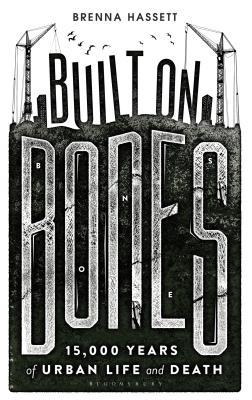
A droll, easily readable book about some of the most interesting science of our day. A pleasure!
Most anthropologists are a little bit crazy. Sadly, the majority tend to be crazy in predictable ways, such as the pursuit of Marxist politics and marrying people from the Third World. Examples would be Robert Trivers (OK, an evolutionary psychiatrist) and Obama's mother.
Brenna Hassett is wholly unpredictable in her craziness. She writes in a flippant, offhand way that doesn't detract whatsoever from the seriousness of her topic. She can write about the distinguished Gordon Childe being both a lifelong Marxist and an outstanding anthropologist. She doesn't get them confused. She captures the libertine atmosphere of large congregations of young anthropologists, hormones fully engaged, camped out on Neolithic sites in the middle of nowhere not too far from Cappadocia, Turkey. Or on a goat-ridden Greek island.
The chapter titles below give some idea of her capriciousness. And I'll bet this is the only book review you'll ever read in which the author's footnotes are cited. The footnotes are hilarious – I found myself clicking to go from footnotes back to text instead of the normal path of text to footnotes – in the rare instance you might be interested.
She is so off-the-wall that you don't even ask yourself if she's politically correct or not. The question is not relevant. She is simply a delight to read, and you have the feeling that she is telling you exactly what is on her mind, without a by your leave from anybody. I would bet that she gives the American Anthropological Association fits. It couldn't happen to a better bunch of folks.
It's about time I got around to telling you what the book is about. Here goes.
Bioanthropology is the science of figuring out how people lived from examining human remains. The most durable of our remains are our teeth and bones. They play the primary role in this drama. However, every now and again a little bit of our soft tissue gets left behind. It may be intentionally mummified. A corpse may be preserved in the glaciers in the Alps or the Andes, or the frozen steppes of Siberia. A corpse may fall into a peat bog, buried where the air cannot get to it in order to decay it.
As the field has evolved over the past three decades or so, bioanthropologists have gotten increasingly clever at teasing out secrets from bones. As DNA analysis has progressed on all fronts, the bio anthropologists have gotten extremely clever at digging archaic DNA out of bones going back hundreds of thousands of years. From this they have made several startling conclusions. Not only are we descended in part from the Neanderthals, which was long suspected, but also from a group named the Denisovians of which we have very little fossil record. They were a surprise.
A large part of the book deals with the two major revolutions named by the aforementioned Childe, the Neolithic Revolution that led to agriculture and the urban revolution a few millennia later that led to cities. Agriculture led to increased population densities. It had a few downsides – shorter lives, worse health, tooth decay and so on – but evolution doesn't concern itself with quality of life nearly so much as quantity. The bioanthropologists are fascinated by it all.
These scientists trace the development of our foods from the minute bits stuck in our grinding stones and embedded in the plaque on our teeth. They look at the animal bones to examine their dates and extents of domestication. They even look at the grooves we have worn in our teeth to decide what might have done that. They examine human bones to see if the flesh on them had simply decayed or had become somebody's dinner.
Hassett has several long and fascinating chapters on disease. We picked up a lot of disease from the animals we domesticated. The cities we built are wonderful breeding grounds for disease. An epidemic is rather like a nuclear bomb. It has to have a critical mass of potential victims in order to get started, but once it does – boom! She takes a detailed look at plagues, both ordinary and The Plague. The black one. She goes into typhoid and smallpox. She has a long and fascinating chapter on syphilis. I had not known it is actually four diseases. There is the notorious sexually-transmitted one, but also the relatively benign form called pinta, and the non-sexually-transmitted forms bejel and yaws. None of them sound like something you would want to sign up for.
The book is fascinating purely as research. Hassett tells you what she has found. There is no moralizing, no particular storyline. She simply has a droll way of recounting what is going on today in this field of science. I hope that she is able to inspire a new generation to follow in her footsteps. A five-star effort.
Here is one page of footnotes. Doesn't it make you curious about the text it comes from?
1 Some enterprising folk maintained two residences on site; one now-established scholar for instance kept a tent expressly for (ahem) facilitating sociability. I always preferred tents for the exact opposite reason, but the downside to having your own canvas bubble was the fact that they get to about 45 degrees by 7.00 a.m., and you might occasionally wake up to find your guy-wires crossed with a tent erected for purely (cough) social purposes.
2 To be fair to our smaller-brained ancestors, it was very cold.
3 And beyond; the first seeds in space were sent on a 1942 V-2 rocket trip, and current crops aboard the International Space Station include romaine lettuce.
4 Though not too far aside. Maybe 4° C (8° F) or a few H-bombs aside.
5 Much like my skills in analogy.
6 For instance: early, using the Bering Strait.
7 This is surprisingly true in physical anthropology. No one expects the Denisovans.
8 Thailand, Japan.
9 And cannibalism: see Chapter 8.
10 In which someone paid for him to go canoeing, kayaking, mountain biking, lumbering, boating, salmon fishing, carving, weaving and god knows what else all across the coastline of Western Canada; that’s what is known to UK archaeologists as ‘jammy’.
11 Or at least, in theory, it shouldn’t. Though anyone who’s ever been in my car off-roading to site might disagree.
12 In the immortal words of excavator Anies Hassan, broadcast over the site radio: It’s soooo hot.
13 Problem.
14 Without which I would never have been able to achieve the desired hair height for the French Revolution theme night.
15 Highlights include: nuns, vicars, gods, goddesses, the conservation team as Ninja Turtles, and a fabulous seventeenth-century full-skirted gown constructed entirely from a patio umbrella and Efes bottle caps.
16 Which did finally explain what had happened to my second-best digging shirt.
17 Traditional dancing is a much-underestimated hazard of archaeological fieldwork.
18 On Twitter, which is why the tweeting of conferences is wonderful. Thanks Jens!
19 On balance, Morris dancing probably did not feature.
20 I am still peeved about the crossed guy-wires thing. Ten years later.
And here is the table of contents. Not very telling, but very inviting.
Contents Introduction: Nothing (but Flowers)
Chapter 1: Papa Was a Rolling Stone
Chapter 2: Feed Me (Seymour)
Chapter 3: What’s New Pussycat?
Chapter 4: Revolution
Chapter 5: Power of Equality
Chapter 6: Oops Upside Your Head
Chapter 7: Under My Thumb
Chapter 8: War! What Is It Good For?
Chapter 9: Under Pressure
Chapter 10: Bring Out Your Dead
Chapter 11: Tainted Love
Chapter 12: Take This Job and Shove It
Chapter 13: Panic ...
Conclusion: Karma Police Acknowledgements: Some of My Friends Index